Schweizer SGS 1-23

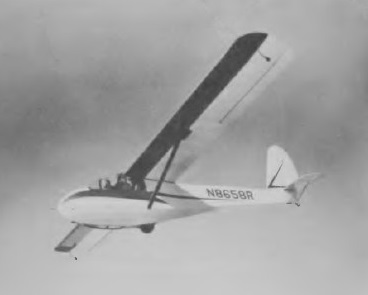
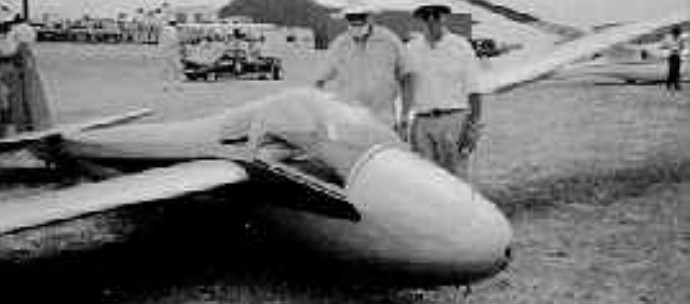
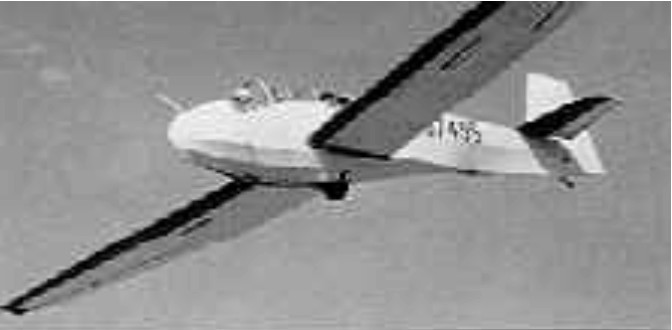
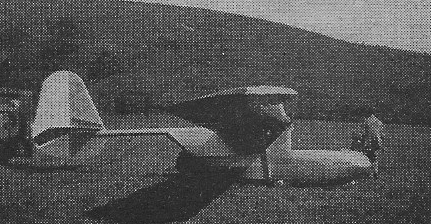
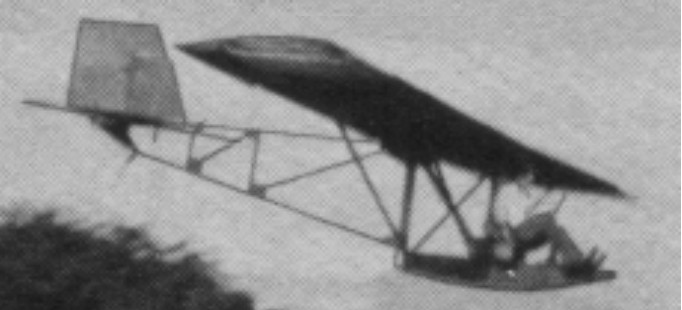
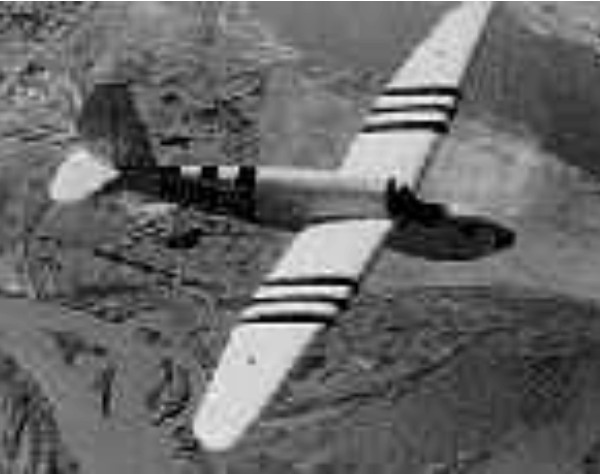
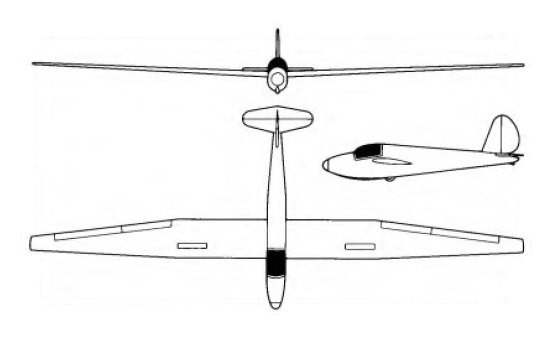
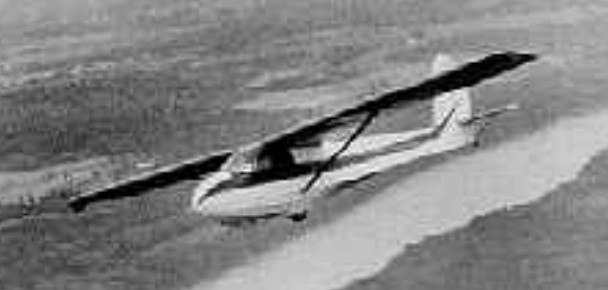
Designed by Ernest Schweizer, the SGS 1-23 all-metal high performance single-seater was first flown at the 1948 US National Soaring Contest at Elmira, NY, and was based on the 1-21.

The 1-23 has mid-set single-spar cantilever wings and is of truly all-metal construction with flush riveting, there being no fabric covering at all; 75ST alloy was used in the spar ends and fuselage centre-section, and the remainder of the structure was of 24ST Alclad. In its initial form the 1 -23 had a wing span of 43ft 10in, and an aspect ratio of 12.88, and there were two sets of spoilers in the wing upper surfaces. The outside spoilers were double ones and could be locked in four positions, fully open as dive brakes or intermediately for the landing approach; the inner spoilers were single for glide control on the approach, and were coupled to the monowheel brake. There was a rubber-mounted skid forward of the non-retractable unsprung monowheel, and a small tail wheel.

The 1-23B & C were built for the 1952 World Championships held at Madrid Cuatro Vientos, Spain flown by Paul MacCready and Paul Schweizer. They both had the wing spars spliced and stretched to 15.24 m / 50 ft, and the C had thicker wing skins, a heavier spar and weighed 41 kg./ 90 lb more.

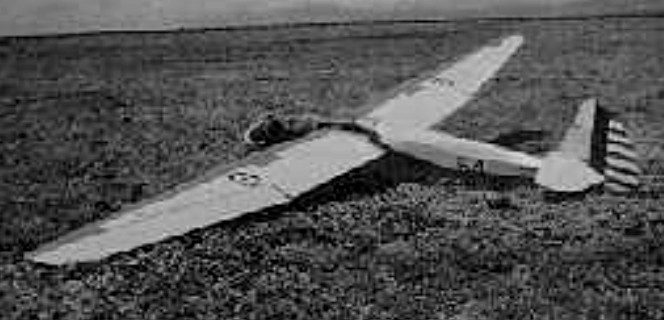
The SGS 1-23D production version of the B (Air Transport Certified), like the 1-23B and 1-23C featured a wing increased in span to 50ft 0in, with an aspect ratio of 15.58, for improved performance, and production of this version started in July 1953; the wing tips were now square-cut instead of pointed as on the 1-23, and the fin and rudder were slightly larger.

One flown by Paul MacCready won the 1953 Nationals, and another was flown 733 km / 455.5 miles by Joe Lincoln to earn the Barringer Trophy for 1960. An example belongs to the National Soaring Museum.

The single 1-23E was built for Paul MacCready to fly in the 1954 World Championships where it finished 4th. It has balanced airbrakes and originally no wheel, using the skid for takeoff and landing. The 1-23E had a wing span of 16.1 m / 52ft 9.5 in and a thicker wing skin. Paul Bikle won two world altitude records with the 1-23E (14.102 m / 46.267 ft absolute 12.894 m / 42.303 ft gain).

The one 1-23F built was an E which featured butt joints in the structure instead of lap joints. A larger fin and rudder with squared-off top distinguished the 1-23G (Air Transport Certified). The 1-23G was a 1954 production model with the longer wing of the E and F, standard spoilers and a larger vertical tail of slightly different shape.

One 1-23G was developed into the experimental 1-29, which was basically a 1-23G fitted with a new constant-chord laminar flow wing, the first Schweizer design to be so fitted; this was used to flight test new design features as well as for competition flying.

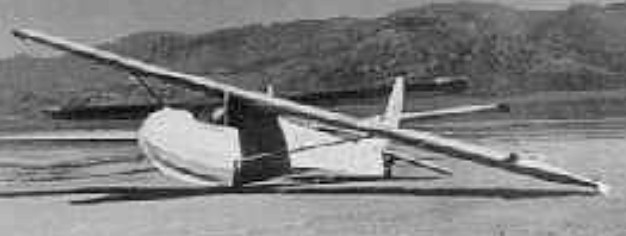
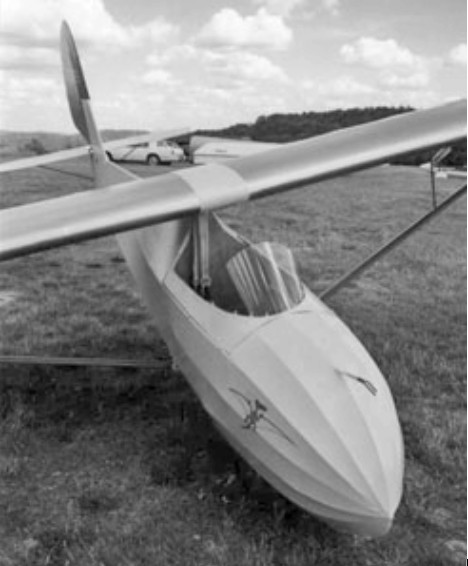
Final production versions, also with the larger vertical tail surfaces, were the 1-23H and 1-23H-15, the H, of which 8 were built, having a span of 52ft 8in and limiting speed DFS-type air brakes which replaced the double spoilers of earlier versions, as well as detachable wing tips enabling it to be converted to a Standard Class 15m span, in which form it was known as the 1-23H-15. The pilot sits over the leading edge under a blown one-piece sideways-opening Perspex canopy, and there is room behind him for a radio, barograph and oxygen equipment. The 1-23H and H-15 has a squared-off top to the fin and rudder. The more numerous H-15 version has a wingspan reduced to 15.0 m / 49.2 ft qualifying it for the FAI-OSTIC Standard Class. It was also produced with removable tips increasing the span to 16.1 m / 52.8 ft. 39 of this model were built.
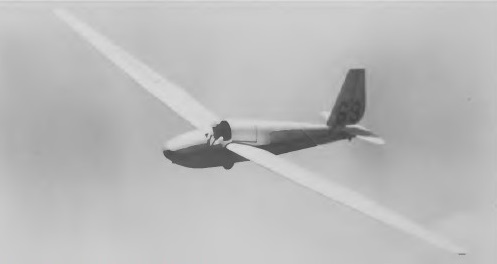
On 30 December 1950, a 1-23 flown by William Ivans set a new World height record of 42,100ft above sea level at Bishop, California, gaining 30,100ft from his aero-tow release height, and on 25 February 1961 a 1-23E flown by Paul Bikle set the world height record of 46,266ft.

A total of 69 SGS l-23s of all versions have been produced.

One, which also belongs to the National Soaring Museum, was substantially modified by Sterling Starr by the fitting of a new NACA 65 (3)-618 section 16.5 m / 54 ft wing.

Wing span: 15 m / 49.2 ft
Wing area: 14.81 sq.m / 159.4 sq.ft
Aspect ratio: 15.12
Airfoil: NACA 43012A
Empty Weight: 213 kg / 470 lb
Payload: 127 kg / 280 lb
Gross Weight: 340 kg / 750 lb
Wing Load: 22.96 kg/sq.m / 4.7 lb/sq.ft
L/DMax: 29 80 kph / 43 kt / 50 mph
MinSink: 0.67 m/s / 2.2 fps / 1.30 kt
Seats: 1
No. Built: 74

SGS 1-23D
Wing span: 15.24 m / 50.0 ft
Length: 6.25 m / 20 ft 4 in
Height 1.52 m / 5 ft 0 in
Wing area 14.9 sq.m / 160 sq ft
Wing section: NACA 43012A/23009
Aspect ratio: 15.6
Empty weight: 190 kg / 420 lb
Max weight 340 kg / 750 lb
Water ballast: None
Max wing loading: 22.8 kg/sq.m / 4.6 lb/sq ft
Max speed: 114 kt / 212 km/h
Stalling speed: 28 kt / 52 km/h
Min sinking speed at 30 kt / 55 km/h: 0.61 m/sec / 1.86 ft/sec
Best glide ratio at 41.5 kt / 77 km/h: 30

SGS 1-23H
Span: 52 ft 8 in
Length: 20 ft 10 in
Wing area: 164.9 sq ft
Aspect ratio: 16.9
Empty weight: 480 lb
Max weight: 750 lb
Max speed: 140 mph
Min sinking speed: 2.05 ft/sec at 37 mph
Best glide ratio: 30.8:1 at 50 mph

SGS 1-23H-15
Span: 49 ft2.5 in
Length: 20 ft 10 in
Wing area: 159.4 sq ft
Aspect ratio: 15.12
Empty weight: 474 lb
Max weight: 750 lb
Max speed: 140 mph
Min sinking speed: 2.15 ft/sec at 38 mph
Best glide ratio: 29.2:1 at 50 mph
Schweizer SGU 2-22

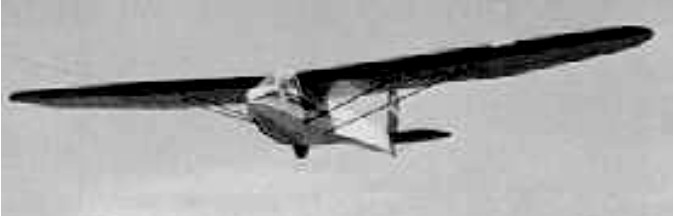
Designed by Ernest Schweizer, the two-seater 2-22 first flew in 1947 and entered service the following year and became (until superseded by the 2-23) the most used two- place trainer in America. It was derived from the SGU 1-7 and developed through A, B, C, D and E models.

Of all-metal construction with metal and fabric covering, the 2-22 has strut-braced constant chord aluminium alloy hjgh-set wings, with a metal D-tube leading edge ahead of the main spar and fabric covering aft of it; there are no flaps or spoilers. The fuselage is a welded chrome-molybdenum steel tube structure with fabric covering, and there is a non-retractable and unsprung Goodyear mono-wheel with brake immediately aft of a nose skid mounted on rubber blocks; there is also a rubber-mounted tailskid. The fin and rudder are of aluminium with fabric covering, while the strut-braced tailplane and elevators are steel tube frameworks with fabric covering. The two pilots are seated in tandem with dual controls under a transparent, sideways-opening canopy, and in its initial form the 2-22 had tandem open cockpits with provision for an enclosed canopy.

The original 2-22 had a 204 kg / 450 lb empty weight and 377 kg / 830 lb gross with no rear side windows and no doors.

The SGU 2-22A (3 built) which appeared in 1957 featured several changes in the cockpit section, a redesign for the U.S. Air Force Academy with lengthened nose, full canopy and 409 kg / 900 lb gross weight.

The B is the original modified for 409 kg / 900 lb gross weight.

The C incorporated the A and B changes plus smaller ailerons; 103 built, including 28 kits (described as the 2-22CK). The D is the original model with small ailerons. The E was the last production model, with larger spoilers, roomier cockpit, new canopy with wing root changes to provide for a skylight.

Schweizer 2-22E

No. Built: 258, including kits sold for amateur construction.

The 2-33 was designed to succeed the 2-22 as something a little plusher and better performing, thereby making it easier to attract new students into soaring.

2-22E
Wing span: 13.11 m / 43 ft 0 in
Wing area: 19.51 sq.m / 210 sq.ft
Aspect ratio: 8.81
Airfoil: NACA 4301 2A
Length: 25 ft 8.5 in
Height: 9 ft 0 in
Empty Weight: 213 kg / 470 lb
Payload: 195 kg / 430 lb
Gross Weight: 408 kg / 900 lb
Wing Load: 20.91 kg/sq.m / 4.8 lb/sq.ft
Max speed: 89 mph (in smooth air)
L/DMax: 17 76 kph / 41 kt / 47 mph
MinSink: 1.07 m/s / 3.5 fps / 2.07 kt
Min sinking speed (solo): 2.8ft/sec
Seats: 2

Schweizer SGS 1-21

Designed by Ernest Schweizer and built in 1947, the 1-21 won the Nationals that year flown by Dick Comey, whose 483 km / 300 miles flight was a National distance record at the time.

Stan Smith flew a 1-21 in the 1952 World Championships at Madrid Cuatro Vientos in Spain. The ship features triple spoilers (2 on top, 1 on bottom) and water ballast tank in the wing.

The structure was all metal, with some fabric on the tail and trailing edge of wing.

There was no market at the 1947 price so a simpler model, the 1-23, was produced instead.

Wing span: 15.54 m / 51 ft
Wing area: 15.33 sq.m / 165 sq.ft
Aspect ratio: 15.75
Airfoil: NACA 23012
Empty Weight: 213 kg / 470 lb
Payload: 113 kg / 250 lb
Gross Weight: 326 kg / 720 lb
Wing Load: 21.26 kg/sq.m / 4.26 lb/sq.ft
Water Ballast: 121 kg / 266 lb
L/DMax: 27 80 kph / 43 kt / 50 mph
MinSink: 0.76 m/s / 2.5 fps / 1.48 kt
Seats: 1
No. Built: 2

Schweizer SGU 1-20

Designed by Ernest Schweizer, the 1-20 long wing version of the 1-19 first flew in 1946.

The structure was wood/ fabric, 2-spar, 2-strut-braced wings; metal/ fabric tail; steel-tube/ fabric fuselage.

Plans were offered for the new wings and canopy, and several 1-19’s in the U.S. were modified.

The prototype was flown 222 km/ 138 miles by Paul A. Schweizer in 1947.

Wing span: 13.11 m / 43 ft
Wing area: 16.91 sq.m / 182 sq.ft
Aspect ratio: 10.15
Airfoil: NACA 4301 2A
Empty Weight: 181 kg / 400 lb
Payload: 104 kg / 230 lb
Gross Weight: 285 kg / 630 lb
Wing Load: 16.85 kg/sq.m / 3.5 lb/sq.ft
L/DMax: 18 68 kph / 36 kt / 42 mph
MinSink: 0.92 m/s / 3.0 fps / 1.78 kt
Seats: 1

Schweizer SGU 1-19

The 1-19, designed by Ernest Schweizer and produced as a low cost utility ship intended for the post war market, first flew in 1944.

The 1-19A was the kit version. Despite being small and light, rigging is complicated with many pins, and through it was produced with an open cockpit, many owners have added canopies. The structure is wood/ fabric, 2-spar, constant chord, 2-strut-braced wings; metal/ fabric tail; steel-tube/ fabric fuselage.

Wing span: 10.97 m / 36 ft
Wing area: 15.79 sq.m / 170 sq.ft
Aspect ratio: 7.9
Airfoil: NACA 4301 2A
Empty Weight: 145 kg / 320 lb
Payload: 104 kg / 230 lb
Gross Weight: 249 kg / 550 lb
Wing Load: 15.76 kg/sq.m / 3.25 lb/sq.ft
L/DMax: 16 68 kph / 36 kt / 42 mph
MinSink: 1.07 m/s / 3.5 fps / 2.07 kt
Seats: 1
No. Built: 50

Schweizer SGS 2-12

When aluminum became unavailable during World War II, Ernest and Paul Schweizer reworked the all-metal TG 2-8 (USAAC TG-2/ USN LNS-1) into a wooden sailplane. Besides being fabricated from wood, the wings were lowered from the 2-8’s shoulder position to a mid/ low mounting to improve rear seat visibility. The wing was thickened to allow cantilever construction and greater strenght for high speed aerotowing. Also upper and lower surface spoilers were used and the design simplified to ease of construction.

Harland Ross set an altitude record at 11,003 m / 36,100 feet in 1950, and Betsy Woodward held the feminine version of the same record.

One belongs to the National Soaring Museum. The Vintage Sailplane Association has the military manuals, color scheme drawing and paint chips.

Wing span: 16.6 m / 54 ft
Wing area: 22.02 sq.m / 237 sq.ft
Aspect ratio: 12.3
Airfoil: NACA 4416
Empty Weight: 390 kg / 860 lb
Payload: 154 kg / 340 lb
Gross Weight: 544 kg / 1200 lb
Wing Load: 24.7 kg/sq.m / 5.05 lb/sq.ft
L/DMax: 24 84 kph / 45 kt / 52 mph
MinSink: 0.92 m/s / 3.0 fps / 1.78 kt
Seats: 2
No. Built: 114

Schweizer SGS 2-8 / TG-2 / LNS-1

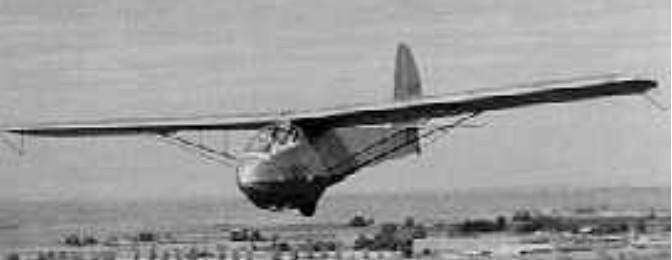
Ernest and Paul Schweizers 2-8 two-place was the first large scale production Schweizer design and the first dozen were built for private owners and clubs.

An all metal glider has a strut braced wing with upper surface spoilers for glidepath control.

A batch was built for the U.S. Army Air Corps for the intial instructor training class at Elmira and subsequently more were ordered as the TG-2. Production was limited by the availability of aluminum. The U.S. Navy and Marines ordered 2-8’s which were designated LNS- 1. Pre World War II civilian gliders were impressed into the USAAC as the TG-2A. After the war. TG-2’s were sought after as they were light, rugged and all metal, despite a low 116 kph/ 63 kt/ 72 mph redline.

Even so, Bob Stanley and Ernie Schweizer made a goal flight from Elmira Washington, D.C. (373 km / 232 miles) and Dick Johnson set a 499 km./ 310 mile multi-place distance record, both in 2-8’s.

The ship is unusual in that it is mainly fastened with PK self-tapping sheet metal screws and there are very few rivets. The empty weight of 204 kg / 450 lb is the original published figure. 2-8’s which remain active have empty weights in the 236-263 kg / 520- 580 lb range. The sturcture is metal/ fabric, 1-spar, 1-strut-braced wings; metal/ fabric tail; steel-tube/ fabric fuselage.

An example of a LNS-1 belongs to the National Museum of Naval Aviation at Pensavola, FL.

The Vintage Sailplane Association has copies of the military manuals, drawings of the color schemes and paint chips available.

Wing span: 15.84 m / 52 ft
Wing area: 19.88 sq.m / 214 sq.ft
Aspect ratio: 12.6
Airfoil: NACA 4412
Empty Weight: 204 kg / 450 lb
Payload: 186 kg / 410 lb
Gross Weight: 390 kg / 860 lb
Wing Load: 19.62 kg/sq.m / 4.02 lb/sq.ft
MinSink: 0.84 m/s / 2.75 fps / 1.63 kt
L/DMax: 23 68 kph / 36 kt / 42 mph
Seats: 2
No. Built: 57

Schweizer SGU 1-7

Designed by Ernest and Paul Schweizer, the 1-7, which first flew in 1937, was the first Schweizer design of which more than one ship was produced. The sturctue is metal/ fabric, 1-spar, constant chord, 1-strut-braced wings; metal/ fabric tail, steel-tube/ fabric fuselage.

1938 SGU-1

Wing span: 10.97 m / 36 ft
Wing area: 12.4 sq.m / 133.5 sq.ft
Aspect ratio: 9.6
Airfoil: NACA 2415
MinSink: 1.07 m/s / 3.5 fps / 2.07 kt
L/DMax: 17 72 kph / 39 kt / 45 mph
Empty Weight: 110 kg / 243 lb
Payload: 82 kg / 180 lb
Gross Weight: 192 kg / 423 lb
Wing Load: 15.89 kg/sq.m / 3.2 lb/sq.ft
Seats: 1

1938 SGU-1
Wing span: 38 ft
Length: 20 ft
Wing area: 170 sq.ft
Aspect ratio: 8.5
Empty Weight: 293 lb
Gross Weight: 473 lb
MinSink: 3 fps
L/DMax: 17

Schweizer SGP 1-1 / SGU 1-1

In 1928 J.C. Penney III, son of founder of the J. C. Penney department store chain, provided financial backing for a glider pilot training school run by the American Motorless Aviation Corporation. In order to gain publicity AMAC sponsored some soaring flights at Corn Hill, Truro, Massachusetts, Highland Light, Massachusetts and South Wellfleet, Massachusetts on Cape Cod. AMAC’s chief pilot, Peter Hesselbach made the first flight on 28 July 1928 in the Darmstadt I glider. This flight was of 57 minutes duration and bettered Orville Wright’s record duration flight by a factor of five. Hesselbach flew again on 31 July 1928 from Corn Hill, Massachusetts and flew for more than four hours, soaring in the winds that flowed up over the dunes. This flight was given front-page coverage in the New York Times.

The New York Times story greatly impressed the members of the Mercury Model Airplane Club including Atlee Hauck, Ernie Whidden, Robert Yellow and brothers Paul, Ernest and Bill Schweizer. As a result, they decided to convert the model club to a gliding club and build a primary glider. The club charged a US$5 membership fee. This rather substantial amount caused only those serious about glider flying to remain to build the aircraft, led by the Schweizer brothers.

Ernst Schweizer designed the then-unnamed primary glider, drawing inspiration from photographs of German designs then in use. The teenagers estimated that the glider would cost US$100 to complete and saved their busfare money by walking to and from school. They were not permitted to own bicycles or to hitchhike, as their father considered those methods of transportation too dangerous. They hid the glider construction project from him, even though it was built in the Schweizer’s barn.

The glider was built with a wooden structure and steel fittings. The wings and tail surfaces were covered in fabric. Typical of the primary gliders of its day, the fuselage was open and featured an open seat with stick and rudder three-axis controls. The aircraft was designed to be bungee launched with an elastic shock cord and had a single skid for landing gear.

Ernest Schweizer recognized the need to ensure that the glider was designed properly and so, even though he was still in high school, he conducted a stress analysis of the design.

The Schweizer brothers were concerned that their father might not let them fly the glider when it was completed and so they built it in secret. Their father worked in New York City during the week and would only enter his barn on weekends. The glider was constructed during weekdays and dismantled and hidden on the weekends. At the point in construction when the aircraft parts had become too large to hide, the brothers decided to assemble the aircraft as far as they could and show their father. He saw that they had done too much work to be stopped at that point and did not object to the completion of the glider.

The glider first flew on 19 June 1930, when Ernest Schweizer was 18 years old, Paul was 17 and Bill was 12. The final cost of the aircraft was US$135.

The club members taught themselves to fly using the glider launched by shock cord. They enlisted the aid of local children to pull the shock cord, but after the novelty appeal wore off, they had difficulties finding sufficient people for bungee launching. They switched to auto-tow using a Ford Model A to pull the shock cord. This method allowed higher flights.

The SGP 1-1 was flown extensively during the summer of 1930, although the total flying time for the year was less than one hour.

The SGP 1-1 has also been referred to as the SGU 1-1.

The success of the 1-1 led the Schweizer brothers to continue on to design the Schweizer SGU 1-2 and to form the Schweizer Metal Aircraft Company. The 1-1 became the first in a line of 38 glider designs that the Schweizers created and the first of over 5700 aircraft built by them.

A replica of the original 1-1 was constructed by a group of Schweizer Aircraft volunteers under the direction of Ernst Schweizer. The glider was completed, registered as N50SZ and flown in 1989 to celebrate 50 years of Schweizer sailplanes. The aircraft was flown by each of the Schweizer brothers and was donated to the National Soaring Museum where it remains on display.

Wingspan: 32 ft 0 in (9.8 m)
Aspect ratio: 8
Airfoil: Clark Y
Length: 15 ft 0 in (4.6 m)
Crew: One