Sharapov-Verzilov Buyán

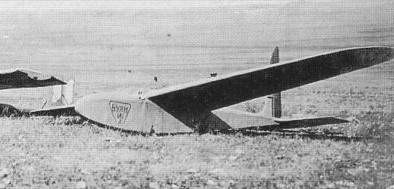
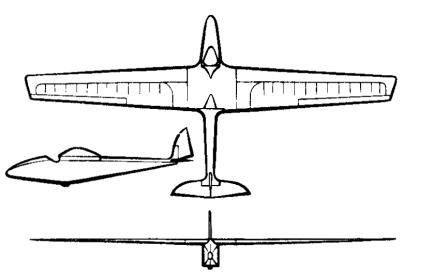
The Sharapov-Verzilov ”Buyán” (Russian: Шарапов-Верзилов “Буян”) was designed as a single-seater racing glider. The “Buyán” was a cantilever-wing monoplane. This wing, with a trapezoidal shape in the plane and slanted straight ends, was located high in the fuselage.

The fuselage had a fusiform shape with straight gunwales. At the top and inside it had a curved shape. At the front was the open cockpit.

The shape of the tail surfaces was reminiscent of the fins of a dolphin. The landing gear featured a wheel partially inserted into the centerline of the fuselage.

Built in 1928 in Simferopol by AN Sharapov and VN Verzilo, it was a participant in the 5th round of national gliding competitions after first flying in the fall of 1928.

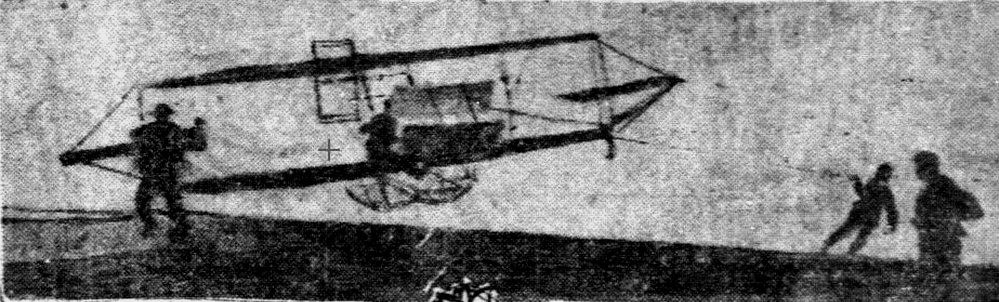
Shaffer 1909 glider

Cleve T. Shaffer was founder of the California Aero Mfg & Supply Co, San Francisco, USA. The glider was built by Cleve T. Shaffer and his sister Geneve, she even flew this glider. The building site was at San Bruno hills near San Francisco in 1909. Cleve was an aviation enthusiast and co-founder of Pacific Aero Club.

Segelflugzeuge

A management consulting firm for the plastics industry, Gliders, and glider trailers.

EWMS Technology GmbH
P.o. box 315
CH-1716 Plaffeien

EWMS techno-Management GmbH was founded in for industry and development work on the plastic and metal industry. The company is divided into:
Plastics technology
Metal-working
Management consulting
Aircraft construction

Aircraft production:

Segelflugzeuge have taken over the entire glider spare parts inventory of Pilatus aircraft Ltd. and safeguard the supply of spare parts by modern warehousing and technical advice on repairs. They accept new builds, total revisions, and maintenance work on gliders, as well as special projects.

Searsby Special

Designed and built by H.A. Searsby of Nottingham, UK, the Special was a single-seat, wooden, primary glider. It featured wing-warping, and one of the A-frame members was placed in front of the pilot.

Only one was built, which had its first flight on 7 September 1930 at Wirksworth, Derbyshire, UK.

Scott Viking 2

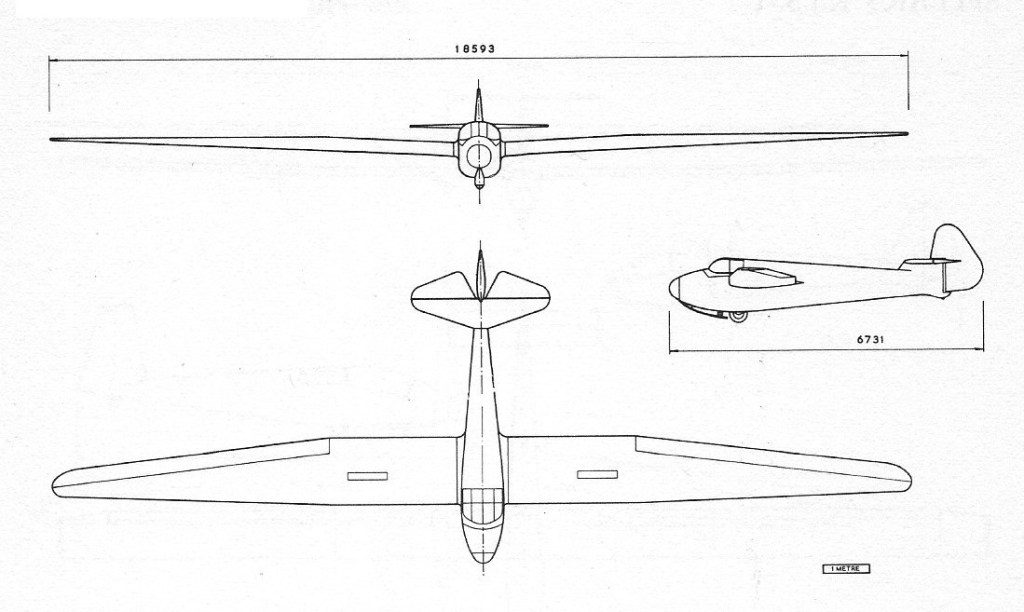
The Scott Viking 2 is a two-seat side-by-side sailplane of conventional wooden construction. The cantilever gull wing was fitted with spoilers and variable droop ailerons. The undercarriage consisted of a main skid, main wheel of fixed centre, and tail bumper.

The first flight was at Dunstable on 27 August 1939.

Wing span: 18.60 m / 51 ft 0 in
Length: 6.73 m / 22 ft 1 in
Wing area: 21.83 sq.m / 235 sq.ft
Aspect ratio: 16.4
Empty weight: 231.34 kg / 510 lb
AUW: 412.77 kg / 910 lb
Wing loading: 18.55 kg/sq.m / 3.80 lb/sq.ft
Max L/D: 24
Min sink: 0.63 m/sec at 56 kph / 2.3 ft/sec at 35 mph

Scott Viking 1

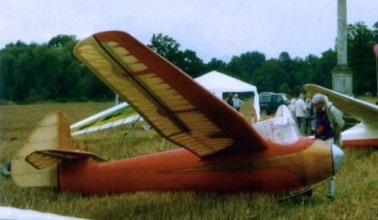
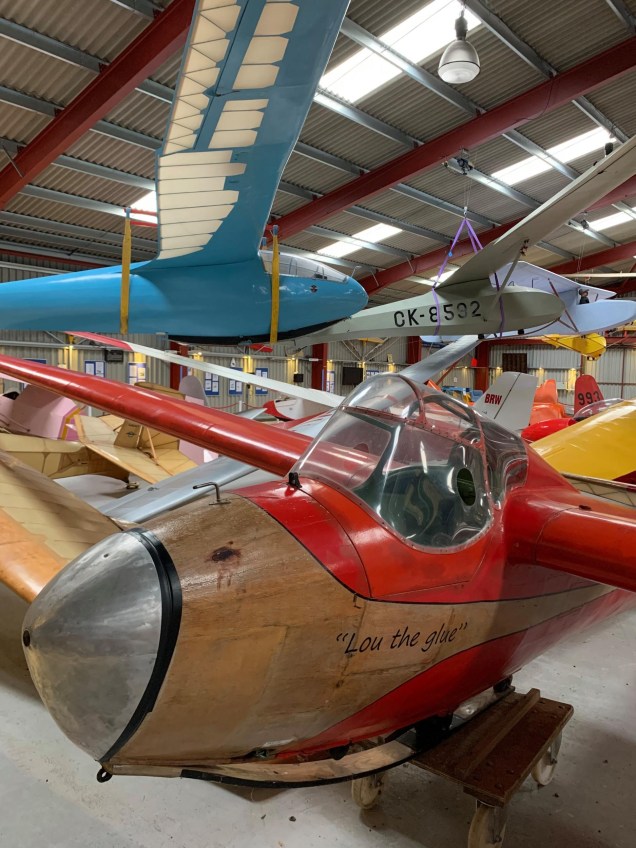
Viking 1, BGA 416, at the Firle Beacon memorial event in 1972

The Scott Light Aircraft Ltd of Dunstable, UK, built four Viking 1 during 1938/39. The first flew at Dunstable on 6 November 1938. Of wood construction, they feature a cantilever wing, fitted with spoilers and variable droop ailerons. They were priced at £265 ex-works. The outbreak of WW2 in Sept 1939 ceased production.

The third built, c/n 114 Registration marks BGA 416, G-ALRD, AHU, survived. History Bought new by W.E. Filmer of the Southdown GC in 1939, flew in the 1939 Camphill Nationals.

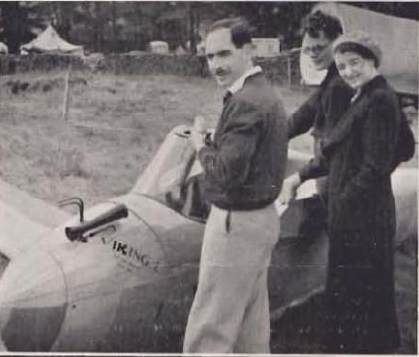
W.E. Filmer at the 1939 Camphill Nationals with Mr & Mrs S Cox

Believed to have been stored during WW2 and thus was never in RAF/ATC ownership. Passed to the ownership of R.D. Dickson in 1948.

Bought by the Coventry GC in 1951 and then to Lou Glover in 1962 who owned it for 40 years before selling it to Mike Beach in 2001. Sold to Willem den Baars in May 2004 and acquired by the GHC in August 2015.

Notable flights: The logbook starts in 1948. We know it went to 15,000 ft in wave at Sutton Bank, otherwise no details. Was at the 1972 Firle Beacon meeting which commemorated the famous 1922 Itford Hill event. Also at the Sept 1999 Percy Pilcher memorial meeting close to Husbands Bosworth.

Sept 1999 Percy Pilcher memorial meeting

Major restorations in 1948 and 1960 and the last, including recovering, in 1992 done by Lou Glover. The last C of A expired 19th Sept 2012. The Viking flew at Lasham for the first time on Sunday 15th May 2016 flown by Gary Pullen.

Owned by the Gliding Heritage Centre, Lasham, following funds being raised for its purchase by a substantial number of Vintage Gliding Club members.

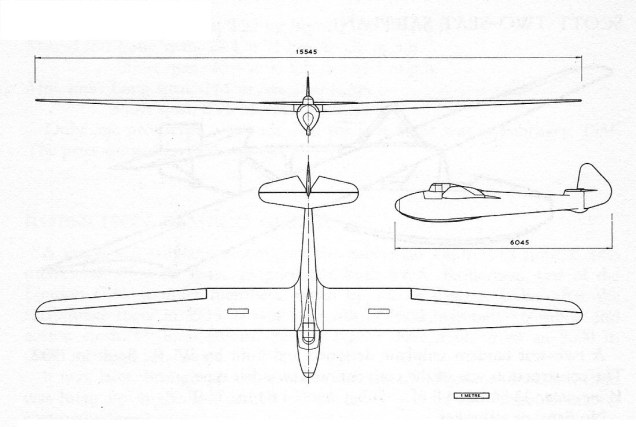
Scott Viking 1 BGA 416

Wing span: 15.54 m / 51 ft 0 in
Length: 6.05 m / 19 ft 10 in
Wing area: 15.89 sq.m / 171 sq.ft
Aspect ratio: 15.4
Empty weight: 167.83 kg / 370 lb
AUW: 245 kg / 540 lb
Wing loading: 15.38 kg/sq.m / 3.15 lb/sq.ft
Max L/D: 20
Min sink: 0.76 m/sec at 53 kph / 2.5 f/sec at 33 mph
Undercarriage: main and tail skid

Scott Light Aircraft Ltd

Albion St
Dunstable
Bedfordshire
UK

W.R. Scott built his first glider at the age of 13 after seeing a film about gliding at the local cinema in his home town of Thetford. This was a hang-type glider of about 30 feet wingspan, and was built out of materials costing 3/- saved out his weekly money. The glider was covered with thick brown paper proofed with terobene paint drier thinned with petrol.

On its first flight the glider was found to be unstable and it crashed after covering a distance of twenty to thirty feet at a height of four feet.

Several more gliders were built, with progressive results, and the last was shown to the Duke of Grafton who offered Scott facilities on his estate at Euston Hall Park near Thetford. Scott then designed and built a tandem two-seat glider which took eighteen months to complete whilst he was serving an apprenticeship in a local garage. The glider flew quite well, being towed by the Duke in one of his racing cars, until it was crashed by an RAF test pilot in Euston Hall Park in November 1933.

Scott built a similar version, using the wings salvaged from the crashed machine, and this was sold to the Duke of Grafton and made several flights on the owner’s estate near Newmarket.

The next glider Scott designed was one similar to the Abbott-Baynes Scud sailplanes. Scott completed the fuselage and some of the wing details, but he sold the incomplete machine to a club at North Walsham, Norfolk.

Scott went to work with Zander & Weyl at their newly established works at Dunstable. Whilst working there he began to build in his spare time three Hutter 17 gliders, two to sell and one for himself. Due to the financial insecurity of the Dart company Zander suggested to Scott that they should set up their own company to build these gliders, and in August 1937 they formed Zander & Scott. Initial production centered around the Hutter 17, for which they held the sole building rights for England, although several primary gliders were also built.

In 1938 Scott designed a high-performance single-seat sailplane. This was named Viking and first flew in November. By then Zander and Scott had run their capital to a very low level but Lord St. Davids offered assistance. He was therefore appointed Chairman of a Board of Directors and the company was renamed Scott Light Aircraft Ltd in December 1938. Several Vikings were then put into production and a two-seat version was designed and built in 1939. This flew for the first time one week before the war started and was therefore the only one of its type to be built.

After the outbreak of the war gliding ceased and Scott Light Aircraft Ltd only ever managed to produce parts and precision tooling.