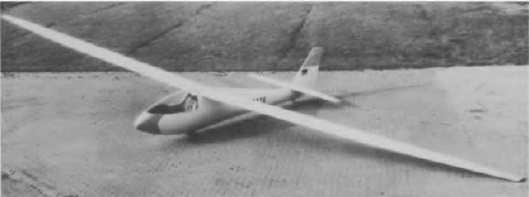
Siebert Sie 3

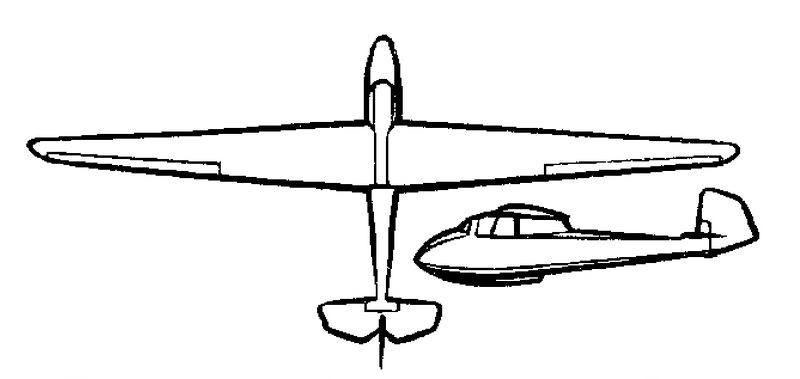
This wooden Standard Class single-seater was designed by Paul Siebert and first flew in prototype form in 1971; by January 1975 a total of 27 had been built by the Paul Siebert Sportund Segelflugzeugbau and sold to Belgium, Holland, Denmark and Portugal as well as to customers in Germany. Permission was being sought from the Luftfahrtbundesamt, the Federal German civil aviation authority, to offer the Sie 3 in a form suitable for amateur construction. Of conventional wooden construction, the Sie 3 is a cantilever high wing monoplane with a constant chord centre section and tapered outer panels; Schempp-Hirth aluminium air brakes are featured. The fin and rudder are swept back and the low-set tailplane is an all-moving surface. Landing gear consists of a monowheel with brake and a tailskid, and the pilot sits under a one-piece flush-fitting cockpit canopy.

Span: 49 ft 2.5 in
Length: 22 ft 0 in
Height: 3 ft 11 in
Wing area: 127.44 sqft
Empty weight: 467 lb
Max weight: 750 lb
Max speed: 124 mph (in smooth air)
Min sinking speed: 2.23 ft/sec at 48.5 mph
Best glide ratio: 34.3:1 at 56 mph

Short SB.1 / SB.4 Sherpa

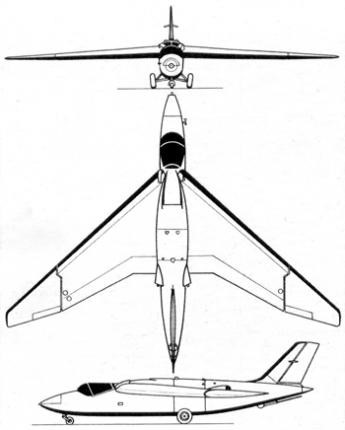
The Short SB-1 experimental glider was constructed mainly of wood, and was used for research into the aero-isoclinic wing concept.

Short SB.4 Sherpa Article

The particularity of this flying wing, designed by David Keith-Lucas, the arrow leading edge reaching 42 deg 22 min isoclinic developed from the theory of Major Hll, which had also been tested on a series of flying wings (Pterodactyl), built before the war by Westland. This demanded a flexible rather than stiff wing structure with the tips hinged to serve collectively as elevators and differentially as ailerons.

Following a serious incident occurred during a towed takeoff flight, it was found that this method was too dangerous. As Blackburn had acquired the license to manufacture small French Turbomeca engines, it was decided to redesign the system with two Blackburn-built Turbomeca Palas of 330-1b (150-kg) thrust, as the SB.4 Sherpa. The engines are placed side by side on the back of the fuselage in a compartment isolated from the rest of the cell by firewalls. The air inlet is located on the back.

The ejection of the burnt gases is done by two independent nozzles. It is slightly divergent. Compared with SB-1, the airfoil has been enhanced so as to allow a significant increase in the weight, primarily due to the increased presence of engines, their components and the fuel.

The SB.4 Sherpa first flew on 4 October 1953 from the airfield near Sydenham, piloted by Tom Brooke -Smith, chief pilot of Short.

Only one was produced.

The aircraft was recovered and partially restored (the wings are missing) by the Medway Aircraft Preservation Society Rochester, Maidstone Road.

It is now in possession of the Ulster Aviation Society. This association had recovered two Palas engines (Nos. 53 and 54), and considering a static display, based on the former Long Kesh in Northern Ireland.

Gallery

Short SB.4 Sherpa
Engines: 2 x Blackburn Turbomecca Palas
Length: 9.70 m (31 ft 10 in.)
Wingspan: 11.58 m (38 ft)
Height: 2.77 m (9 ft 1.12 in.)
Wing area: 21.40 m² (230 ft ²)
Empty weight: 1400 kg (3,000 lb.)
Max speed: 275 km / h (150knts)
Cruise speed: 188 km / h (102 knts)
Service ceiling: 1500 m (5,000 ft.)
Endurance: 45-50 min

Sheremetiev / Koltunov / Sirken / Pietsuj PAI-2 / Pavel Golovin

The “Pavel Golovin” glider, also known as PAI-2, was designed and built by a group of enthusiasts consisting of BN Sheremetiev, Yu. I. Koltunov, BL Sirken and AI Pietsuj. The main objective in the construction of this glider was the study of the flight methodology for a training glider with a view to using it for the calculation of record-keeping flights.

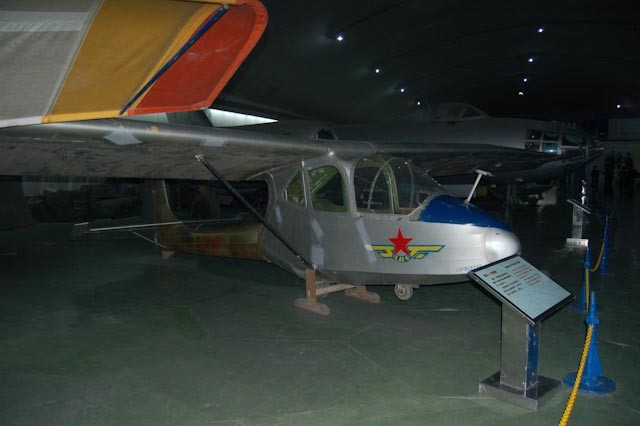
The Sheremetiev / Koltunov / Sirken / Pietsuj “Pavel Golovin” glider (Russian: Шереметев, Колтунов, Сиркен, Пьецух – Павел Головин) was designed as a cantilever monoplane with high wing in parasol. The wing construction was characterized by a single spar.

The fuselage was constructed of wood and featured a hexagonal cross section.

In order to provide the pilot with the highest level of comfort, a large cockpit was designed, equipped with all the necessary instruments: altimeter, speedometer, barometer, thermometer, compass, reversal indicator. The cabin was closed using an angled cover, which opened to the side and could be released from the inside in case of emergencies.

The tests carried out in July 1937 with the pilot II Shelest at the controls, showed good stability in the air and response to the controls, as well as excellent manoeuvrability. At speeds of 80 – 160 km / h it was possible to make high school piloting figures.

The negative aspects were the long take-off run and the large wing loading. The landing, on the other hand, was quite short.

Sharapov-Verzilov Piervieniets

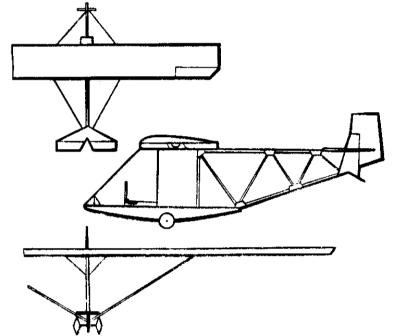
The Sharapov-Verzilov “Piervieniets” (First) (Russian: Шарапов-Верзилов “Первенец”) was designed as a single-seater training glider.

Conceptually the “Piervienets” was designed as a high wing glider braced by four uprights. The wing had a rectangular shape in the plane with ailerons in the outer area.

The fuselage was in the form of a low-sided “bathtub” to which a flat, uncoated wooden structure was attached, ending in the conventional tail.

The landing gear consisted of two wheels located on the sides and a tail skid.

The pilot sat in a fully exposed seat. The cabin space was so wide that flights were carried out with a passenger behind the pilot.

Built in Simferopol in 1927 by AN Sharapov and VN Verzilov and flying that fall, the “Piervieniets” glider was entered in the IV edition of the national glider competitions. During competitions it was the most popular glider, flying 274 training flights.

Piervieniets
Wingspan: 12 m
Wing area: 18 m²
Aspect ratio: 8
Length: 6.5 m
Empty weight: 125 kg
Wing loading: 11 kg / m²
Aileron surface: 2.6 m²
Accommodation: 1