The initial layout of the Buxton Hjordis 2 were commenced by Mungo Buxton but it was built as the Slingsby T.9 King Kite. Many of the King Kite drawings were entitled Hjodris 2 (King Kite).
Slingsby had had a bad experience with the Type 9 King Kite entering incipient spins at low airspeed which was ascribed to the use of a NACA 4312 aerofoil section at the wing-tips, so he designed the Gull with a modified RAF 34 profile at the tips. The cause of the wing drop problem on the King Kite was later found to be inaccurate manufacture, but the Gull retained the modified RAF 34 section.
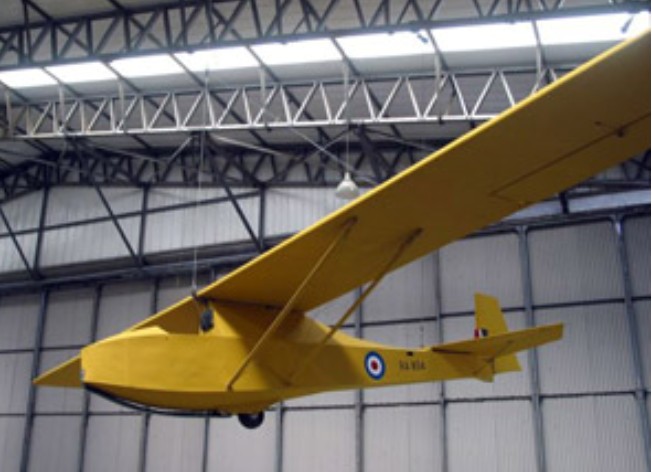
The T8 Tutor single-seater introduced in 1937 was an improved version of the Kirby Kadet with a new two-spar wing of increased span (43ft 3.75in) and tapered outer wing panels married to the same wooden fuselage and wooden tail unit with braced tailplane as the Kadet’s. At the same time a differential mechanism was introduced into the aileron control circuit. This wing was capable of being fitted to the Cadet TX Mk 1, most of which, by the early 1950s, had been converted to Tutor standard as the T8 Cadet TX Mk 2 by the fitting of this wing.
The Tutor prototype first flew in July 1937 and seven examples had been built by the outbreak of war; it re-entered production after the Cadet to meet the demands for an ATC trainer, and 62 more were built in the war as the Cadet TX Mk 2.
Total Tutor production was 106, and the price had risen from £99 10s (£99.50) in 1939 to £360 ex-works in 1948. A two-seater version for teaching the initial stages of flying, and suitable for the circuits and bumps of training, was the T31 Tandem Tutor.
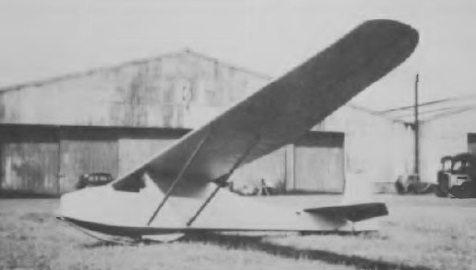
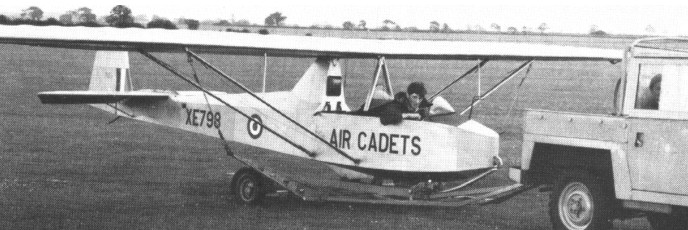
This single-seat intermediate trainer was originally designed by John S. Sproule in 1935 as a soarable version of the Slingsby T3 or Nacelled Primary glider, and was at first known as the T7 Kirby Kadet.
It first flew in prototype form at Sutton Bank on 11 January 1936.
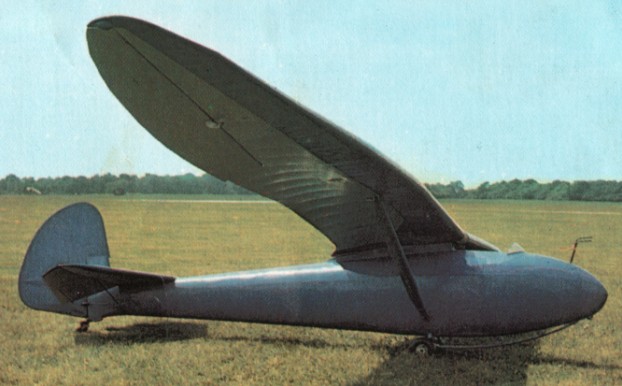
It was of conventional wood and fabric construction, with a high-set, braced, two-spar constant chord wing that was, in fact, interchangeable with that of the later T8 Tutor; no flaps or air brakes were fitted, and the ailerons were fabric-covered. The plywood-skinned wing was mounted on a built-up centre portion of the fuselage, in front of which the pilot sat in an open cockpit. Early examples had a rubber shock absorbed skid for takeoff and landing, but later versions had a modified nose, a less tall rudder and a fixed main wheel and a tailskid. The Cadet’s Gottingen 426 wing section gave it gentle stalling characteristics and good lift at low speeds and this, allied to a simple design making for ease of repair as well as manufacture, made it an excellent trainer.
Only 22 Kadets had been built when the war put a stop to production, the price of a new one being £93 in 1939, which had risen to £325 by 1948, but the type was put back into production with an Air Ministry order for 200 for use by the ATC, the first aircraft from this order, later to be known as Cadet TX Mk 1s, being built in 1943; the ATC variant differed slightly from the prewar civil Kadet in having reduced rudder height and a monowheel in the fuselage as well as the nose skid. The ATC’s predecessor, the Air Defence Cadet Corps, had given its cadets some instruction at British gliding clubs before the war, but this stopped when war broke out, and it was not until 1942 that the first ATC gliding school was opened at Kirbymoorside, Yorkshire, where the Slingsby works were located, and an instructors’ course was started.
By December 1945 the ATC had 84 gliding schools with over 600 Service and civilian instructors, and about 4,500 cadets had received some gliding instruction, as well as instruction in winch-launching, and an equal number had reached the top proficiency stage of their training. The Royal Air Force air cadet training program eventually acquired 376, known as the Kirby Cadet T.X. Mk. 1.
During World War II, Total production by Slingsby and subcontractors (including Ottley Motors Ltd., a batch of 30) amounted to around 430, with some kits being supplied in addition. Plans were made available for license building.
Altogether 226 Cadets were built during the war by Slingsby and three other subcontractors, of which Martin Hearn Ltd of Hooton Park, Cheshire, was the most important; this firm also built 27 of the postwar production for gliding clubs, which brought the total built since 1936 to 431.
By the early 1950s most Cadet TX Mk 1s had been converted to Tutor standard (the RAF Kirby T8 Cadet TX Mk 2) by fitting the Tutor’s longer span (13.24 m / 43.4 ft) tapered wings. This in turn evolved into the T.31 Tandem Tutor (RAF Kirby Cadet T.X. Mk. 3) two-place trainer. Spare T. 7 Kirby Cadet TX Mk 1 wings were used to produce the Slingsby T38 Grasshopper TX Mk 1 post war, which was a version of the SG 38 primary glider with a simplified open-framework fuselage, modified tail unit and the surplus Cadet wings; production began in 1952 and 115 Grasshoppers were built.
Variation: Cadet Aeronautics Cadet UT-1
Cadet TX Mkl Wing span: 11.73 m / 38 ft 6 in Wing area: 15.8 sq.m / 170 sq.ft Length: 20 ft 10.5 in Empty Weight: 134 kg / 295 lb Payload: 218 lb / 99 kg Gross Weight: 513 lb / 233 kg Wing Load: 3.02 lb/sq.ft / 14.75 kg/sq.m Aspect ratio: 8.67 L/DMax: 14 @ 48 kph / 26 kt / 30 mph Best glide ratio: 16:1 Airfoil: Go 426 MinSink: 1.07 m/s / 3.5 fps / 2.07 kt at 32 mph No. of Seats: 1
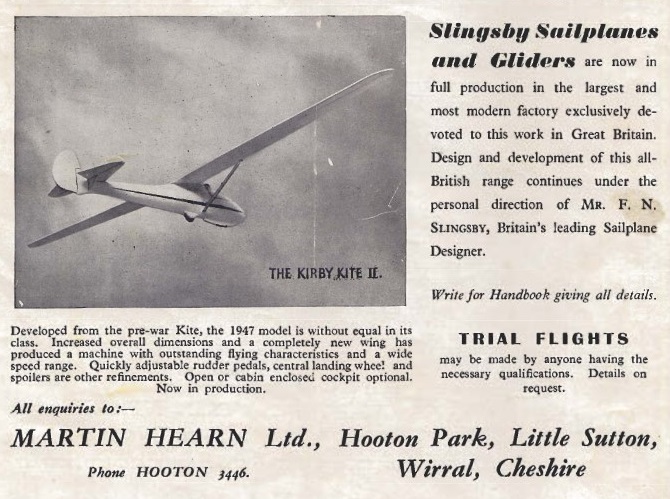
The Kirby Kite was a development of the Schneider Grunau Baby 2 with a gull wing and a streamlined fuselage first flown in 1935. Slingsby had already built a number of Grunau Babies under license and in the construction of the Kite used some of the same components and metal fittings. During World War II most were impressed into military service in 1940, and several kites were used to work out and establish safe towing procedures and instructing techniques for British Military glider pilots. After trials with standard kites, one was fitted with wooden control rods instead of cables to investigate the ability of radar to detect all-wooden aircraft. Only 25 were built.
Slingsby Sailplanes Ltd Slingsby Aircraft Company Ltd
Having served in the Royal Flying Corps in the First World War Frederick N. Slingsby helped to found the Scarborough Gliding Club in 1930 and, from repairing the first Primary the club owned, in his furniture works, soon became a designer and builder of gliders. His first glider, the Falcon I, was a version of the Schleicher Falke, built from plans bought from the German Aero Club.
Mr. C.E. Hardwick requested Slingsby build another Falke for himself and this was the beginning of the Slingsby glider works. He also began to manufacture primary gliders and the first advertisement appeared in “Sailplane and gliders” in November 1933 offering primary gliders for £45 complete.
For several months the empty tramsheds of Scarborough Corporation were used but, in September 1934, a move was made to part of an engineering factory in Kirkbymoorside. The move was at the invitation of Major J.E.D. Shaw, a local landowner, who owned several aircraft and had a small aerodrome on his estate at Welburn Hall. His objective was to bring employment to the region and he offered Slingsby complete financial backing. The engineering firm then operated as Slingsby, Russell & Brown Ltd.
During a slack period, light aircraft were also considered and the construction of two different types began in 1938 but both types were abandoned.
Slingsby post WW2
In 1938, at Kirbymoorside, Yorkshire, Slingsby Sailplanes Ltd built Kirby Kitten single-seat monoplane, designed by F. N. Slingsby.
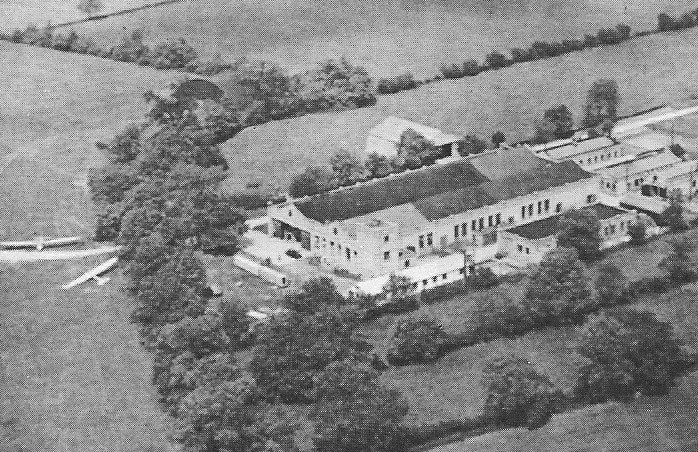
Demand called for larger premises and a new factory was built at the side of Major Shaw’s airfield at Welburn just outside Kirkbymoorside was built. In July 1939, when the new factory was ready for occupation, a separate company, Slingsby Sailplanes Ltd, was formed with Major J.E.D. Shaw as Chairman and F.N. Slingsby as Managing Director and Chief Designer. It was planned to officially declare the new factory open on Monday September 4th but the outbreak of the war on the previous day put a stop to all private flying in the UK.
Chiefly famous for gliders, Motor Tutor of 1948 was Slingsby Tutor glider with engine and landing gear.
On 21 April 1955 Major Shaw died. His share in Slingsby Sailplanes had to be sold to settle death duties on his estate. To avoid a take-over bid the shares were acquired by a trust formed by the leading members of the British gliding movement. The company was then owned by the Shaw-Slingsby Trust, and Phillip Wills was appointed Chairman.
In 1962 Slingsby was affect by heart trouble and in 1964, aged seventy, decided to retire. P.R. Street joined the company as Managing Director.
In 1965 J.W. Bradley was appointed Chairman of the Board, with W.N. Slater as Managing Director. In 1967 the company was split into Slingsby Aircraft Ltd and Slingsby Joinery Ltd, with a holding parent company Slingsby Aircraft Holdings Ltd.
The whole of the main aircraft factory area was burnt to the ground on 18 November 1967. No Slingsby drawings were lost in the fire but all records and drawings of Operation Sigma Ltd were destroyed.
After the fire many employees were made redundant. The total number before the fire was 120. Further redundancies were declared in February 1969 but on 11 July it was announced Slingsby Aircraft Holdings Ltd was in the hands of a Receiver.
On 3 November 1969 Vicker Ltd acquired the entire assets of the company for a reported figure of £179,150. A new company using the old title of Slingsby Sailplanes Ltd was established.
The fibreglass work which was by then a speciality was continued, but aimed more at the military and marine environment, such as bathyspheres and small submarines.
Slingsby Aviation Ltd. is member of ML Holdings Plc group and offers professional pilot training and subcontract component building, in addition to sales of the T67 Firefly side-by-side two-seat civil/military piston-engined trainer and private aerobatic-capable lightplane (first flown May 1981, as license-built Fournier RF6B).
Jim Tucker came along later and bought the company, being a major shareholder of Slingsby Aviation which continued to produce for military GRP contracts and underwater craft, as well as hovercraft and gondolas for airships.
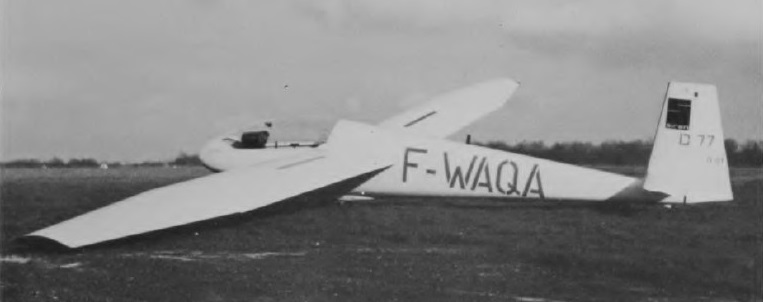
Design of the D 77 Iris single-seat training sailplane was started in 1973 by Siren SA. Of glassfibre/plastic foam sandwich construction, the Iris was also available in kit form for homebuilders, and has cantilever mid-set wings of Bertin E55-166 aerofoil section and glassfibre/polyester/PMC sandwich construction, with glassfibre ailerons and metal Schempp-Hirth air brakes in the upper surfaces. The fuselage is a glassfibre/polyester monocoque built in two halves and reinforced at the wing attachment points. As originally designed, the Iris had a cantilever T-tail but this was changed to one with a low-set fixed incidence tailplane and a spring tab in each elevator; the tail is of similar construction to the wings. There is a non-retractable unsprung monowheel with a Siren hydraulic brake, and a tailskid. The pilot sits in an adjustable semi-reclining seat under a one-piece flush-fitting cockpit canopy which opens sideways to starbaord.
The prototype first flew on 26 February 1977 and made its public debut at that year’s Paris Salon Aeronautique; after the manufacturer’s tests were completed, tests by the CEV (Centre d’Essais en Vol) followed early in 1978, after which certification got under way.
Production of the Iris and of the E 75 Silene became the responsibility of Societe Issorie-Aviation, which was formed late in 1977 by the President of Siren SA following the bankruptcy of Wassmer-Aviation; approximately 50 D 77s had been ordered by February 1979 when production was due to begin.
Issoire D 77 Iris Span: 13.5 m / 44 ft 3.5 in Length: 6.37 m / 20 ft 10.75 in Height: 0.9 m / 3 ft 11.25 in Wing area: 11.4 sq.m / 122.7 sq.ft Wing section: Berlin E-55-166 Aspect ratio: 16.0 Empty weight: 220 kg / 485 lb Max weight: 330 kg / 727 lb Water ballast: None Max wing loading: 27.2 kg/sq.m / 5.57 lb/sq ft Max speed: 145 mph / 126 kt / 234 km/h (in smooth air) Max aero-tow speed: 105 mph Stalling speed: 32.5 kt / 60 km/h Min sinking speed: 2.23 ft/sec / 0.68 m/sec at 50 mph / 39.5 kt / 73 km/h Best glide ratio: 33:1 at 48.5 kt / 90 km/h
Designed by Siren SA, this side-by-side two-seater training sailplane of 18m span was originally known as the CERVA CE 75 Silene, the letters CERVA standing for Consortium Europeen de Realisation et de Ventes d’Avions, which was owned jointly by Siren SA and Wassmer-Aviation SA.
Construction is entirely of glassfibre/polyester/PMC sandwich, and the cantilever mid-set wings, of Bertin E55-166 aerofoil section, have 2° forward sweep at the quarter-chord line. The two-section ailerons have spring tabs and there are Schempp-Hirth air brakes above and below the wings. The fuselage is a semi-monocoque, and the two pilots’ semi-reclining seats are slightly staggered, the starboard seat being a little to the rear, so as to keep fuselage width to a minimum; oxygen systems can be installed if desired. The rear section of the two piece canopy is hinged to open to starboard, and is jettisonable. There is a low-set fixed-incidence tailplane with a spring tab in each elevator.
Design of the Silene, which was the first French two-seater of glassfibre construction, began on 1 January 1972 and construction of the prototype by CERVA began on 1 February 1973; this first flew at Argenton on 2 July 1974. The Silene was intended to be suitable for all stages of training from ab initio to cross-country flights, and Siren SA was responsible for marketing it; by early 1978 40 Silenes had been ordered and six of them flown. But following the bankruptcy of Wassmer-Aviation, which built the wings and was the co-partner in CERVA, the President of Siren formed Societe Issorie-Aviation late in 1977, taking its title from Wassmer’s Aerodrome d’lssoire works, to continue production of the Silene, now known as the Siren E 75, and the D 77 Iris. The first six Silenes had a retractable rubber-sprung monowheel but a non-retractable monowheel can if the customer desires also be fitted as optional, and a Siren hydraulic brake is optional; there is also a tailskid.
French certification of the type was granted on 3 February 1978 and planned output for 1978 was two per month, with Siren SA building the fuselages.
The E 78 Silene is a new variant featuring improved and roomier accommodation for the pilots, an enlarged cockpit canopy, lowered seats and a slight increase in available cockpit width; the E 78B is the same as the E 78 but with a fixed monowheel. This was followed by the 1 79 variant which has flaps and provision for water ballast, and was under development in 1979. The modified wings incorporate carbon-fibre componets, and the flaps, air brakes and monowheel are hydraulically actuated.
E 75 Silene Span: 59 ft 0.5 in Length: 26 ft 1 in Height: 4 ft 11 in Wing area: 193.8 sqft Aspect ratio: 18.0 Empty weight: 805 lb Max weight: 1,246 lb Max speed: 124 mph (in smooth air) Max aero-tow speed: 105 mph Min sinking speed: 2.20 ft/sec at 56 mph Best glide ratio: 38:1 at 59 mph
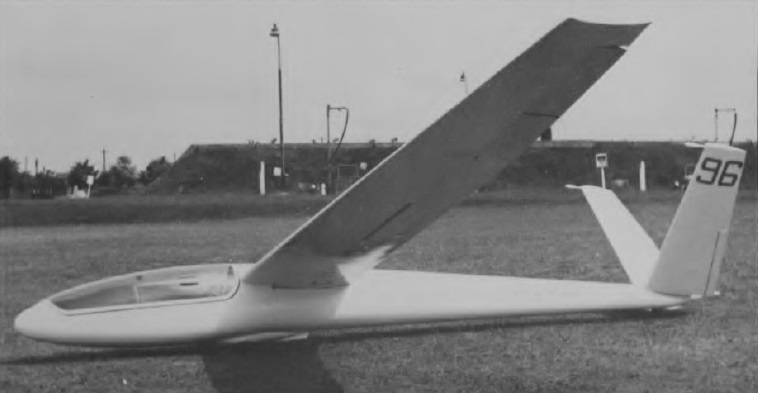
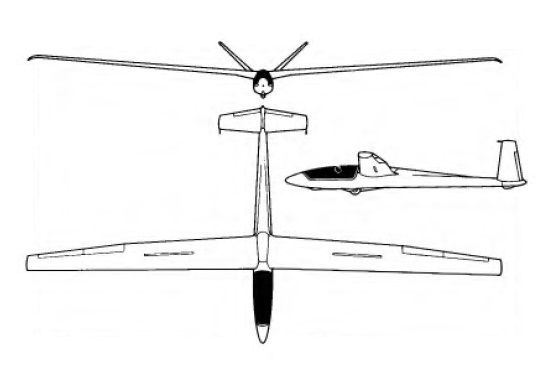
This high performance Standard Class single-seater was designed by Dr J. Cayla and features a V-tail and makes use of moulded plywood/Klegecel sandwich in its structure. The cantilever single-spar shoulder wings are foam-filled all-wood structures with only eight ribs, of sandwich construction, and are covered by a plywood/Klegecel sandwich skin 8mm thick; the down-turned wing tips are of reinforced plastics and the unslotted ailerons are all-metal. The air brakes in the upper and lower wing surfaces are interconnected with the hydraulic monowheel brake, and up to 110lb of ballast in the form of eight lead bars can be mounted in the wing roots so that the wing-loading can be varied; unlike the more conventional water ballast, this kind cannot be jettisoned. The fuselage is a moulded plywood/Klegecel sandwich structure made in two portions, with integral longerons and nose and tail cones made of laminated plastics. The V-tail consists of two identical all-moving surfaces, with an included angle of 90°, each with a trim tab; the leading edges are of wooden sandwich construction and the remainder is fabric-covered. There is a non-retractable monowheel with a hydraulic brake, and a castoring leaf-spring tailskid. The pilot sits in a semi-reclining seat under a long flush-fitting canopy hinged to starboard, and optional ‘extras’ that may be installed include a barograph, VHP radio, an oxygen system, artificial horizon, a Jaeger altimeter and a flight calculator.
The first of two Edelweiss prototypes made its maiden flight on 25 September 1962, and both prototypes took part in the 1963 World Championships at Junin in Argentina, finishing 2nd, flown by Jacki Lacheny of France, and 17th in the Standard Class contest.
The prototype differed from production aircraft, produced by Issoire, part of the goupe Siren, in having a slight forward wing sweep, longer span ailerons and air brakes and a longer fuselage nose. The first of an initial production batch of 15 was completed in January 1965, and one of these, piloted by Francois Henry, won the Standard Class section of the 1965 World Championships held at South Cerney, while another Edelweiss was placed 7th; two others of the type also finished 8th and 10th in the Open Class. The Edelweiss is no longer in production, but 50 had been delivered by 1 March 1968.
Siren C 30S Edelweiss
The Edelweiss IV was an Open Class version with a wing span increased to 17.5m (57ft 4.25in) and the length increased to 25ft 7in. The first of two prototypes of the Mk IV flew on 9 May 1968 but it did not go into production, and differed in some respects in structure from the earlier Edelweiss. The wings were built in two panels, with sandwich skins and pinch-webbed spars with spruce booms, and the fuselage was of completely moulded sandwich construction with built-in spruce longerons, and laminated plastic nose and tail cones. The monowheel was now retractable, and the wheel brake was also connected to operate with the air brakes.
C30S Edelweiss Span: 15 m / 49 ft 2.5 in Length: 7.5 m / 24 ft 7.25 in Wing area: 12.08 sq.m / 133.9 sqft Wing section: NACA 64 series Aspect ratio: 18.0 Empty Weight: 256 kg / 565 lb Gross Weight: 412 kg / 910 lb Payload: 156 kg / 345 lb Wing Load: 34.19kg/sq.m / 5.5lb/sq.ft Water Ballast: 0 Max speed: 140 mph / 121 kt / 220 km/h (in smooth air) Max aero-tow speed: 112 mph / 86 kt / 160 km/h Stalling speed: 35 kt (65 km/h) Min sinking speed: 2.1 ft/sec / 0.65 m/sec at 79 kph / 43kt / 50 mph Best glide ratio: 36:1 at 59 mph / 51 kt / 95 km/h L/DMax: 38 90 kph / 49 kt / 56 mph Seats: 1 No. Built: 65
C34 Edelweiss IV Length: 28.871 ft / 8.8 m Wingspan: 57.415 ft / 17.5 m Max take off weight: 1058.4 lb / 480.0 kg Landing speed: 21 kts / 38 km/h Cruising speed: 54 kts / 100 km/h Glide ratio: 45.5 Crew: 1
The Silent Family Silent Glider M is a German ultralight trike motor glider, designed by Helmut Grossklaus and produced by Silent Family of Westerrade. The aircraft is supplied as a complete ready-to-fly-aircraft.
Mieczysław Siegel, a village schoolteacher from Skrzynice near Lublin, had some experience with designing and building fairly amateur gliders when he decided to build an aircraft and in 1927 he built a small MS-5. A year later Siegel built an improved MS-6 airplane but failed to acquire an engine, which made the designer decide to stick to gliders.



 All Aero