Slingsby T-38 Grasshopper

Slingsby Type 38 Grasshopper

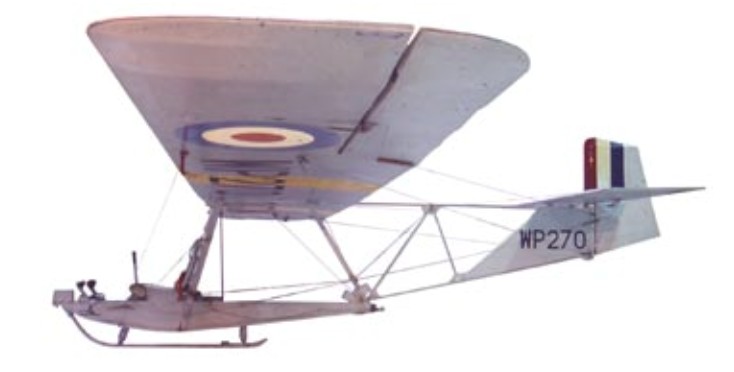
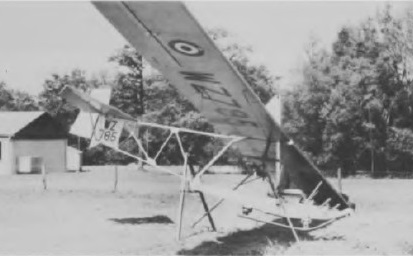
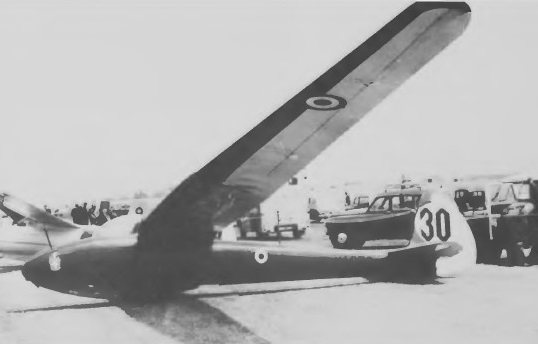
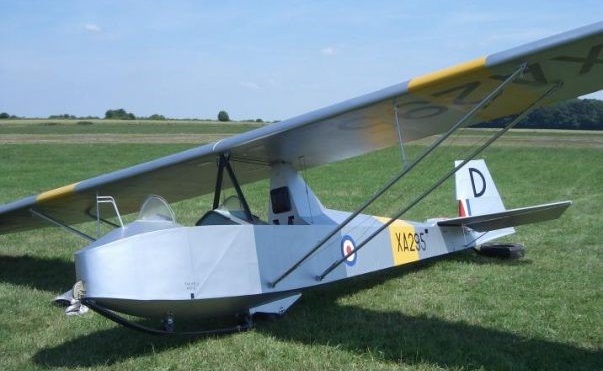
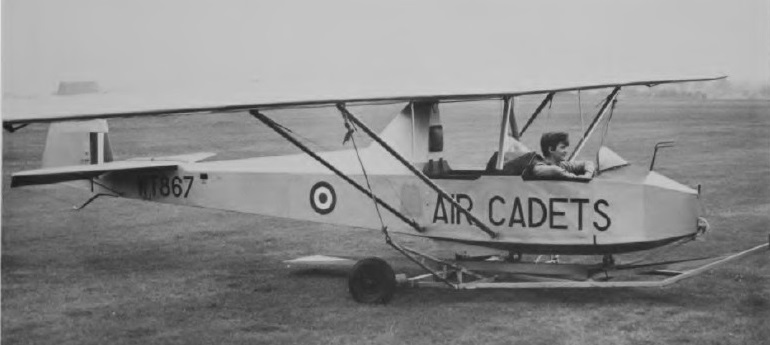
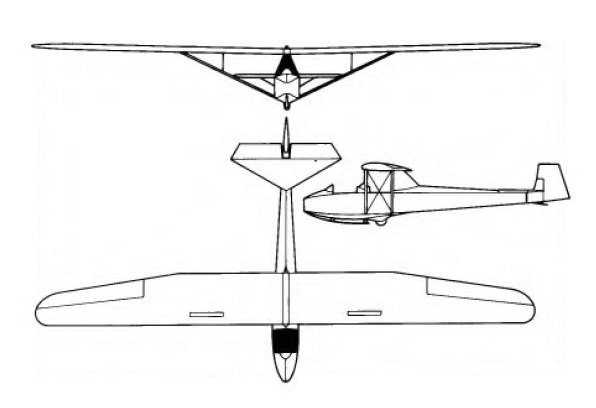
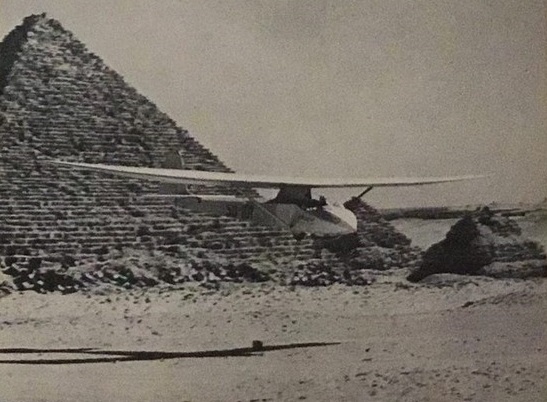
The Grasshopper is a primary single-seater glider intended to give basic training through short ‘hops’ on airfields or school playing fields. The open framework fuselage with a seat for the pilot was a simplified version of that of the Schulgleiter SG 38. It used the wings of the Slingsby Cadet Mk I and was designed to be easily dismantled for storage. The wing being wire-braced and without flaps or air brakes. A post war surplus of the T. 7 Kirby Cadet T.X. Mk. 1’s resulted in Slingsby building the primary T. 38 Grasshopper T.X. Mk. 1 with surplus T. 7 wings and tailplanes married to a new primary open fuselage. Most Cadet TX Mk Is were converted to Tutor standard as the T8 Cadet TX Mk 2 by fitting them with the Tutor’s longer span wings, and the spare wings of the TX Mk 1s were used to produce the Grasshopper TX Mk1.

It was launched by a V shaped elastic rope pulled by teams of cadets and could also be mounted on a pivoting tripod stand to enable the effects of the controls to be demonstrated.

The Grasshopper and the virtually identical EoN Eton were used by ATC Squadrons and RAF Sections of the Combined Cadet Force from 1952 to the late 1980s and many cadets made their first, somewhat brief, solo flights in these gliders.

Production began in 1952 and altogether 115 Grasshoppers were built.

Span: 39 ft 0 in
Length: 21 ft 1.5 in
Wing area: 174 sq ft
Aspect ratio: 8.73
Empty weight: 293 lb
Max weight: 550 lb
Max speed: 80 mph

Slingsby T37 Skylark 1

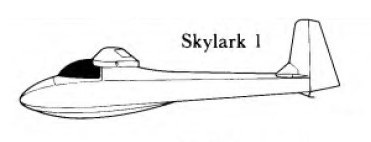
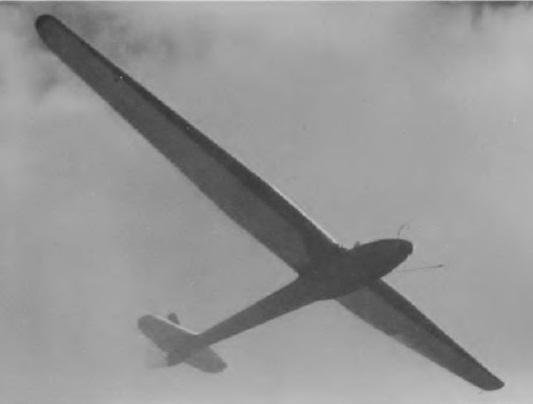
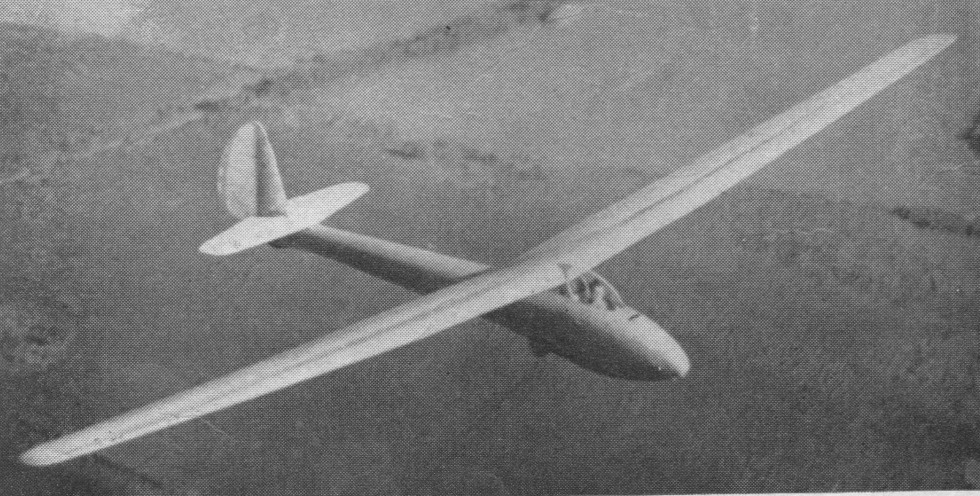
The T37 Skylark 1, first of the series, was built for a lark, according to Mr F. N. Slingsby-hence its name – and was an experimental single-seater with a three-piece laminar flow wing of 45ft span, intended to test various lateral stability devices to determine the best type of lateral control surface for use with a laminar flow aerofoil; the wing was of NACA 63-/64-series section and had very effective air brakes but no flaps. The fuselage was based on that of the T30 Prefect, with a one-piece canopy, the length being 20ft 11.5 in, and there was a main skid only plus a tailskid, no monowheel being fitted.

The first of two prototypes made its maiden flight in March 1953, and only the two Mk 1s were built partly as this version had, for that time, a very high stalling speed. But it had proved sufficiently promising to be developed into the T37B (later T41) Skylark 2.

Both of the single-seat Skylark 1 built were still flying in 1977.

Slingsby T.34 Sky

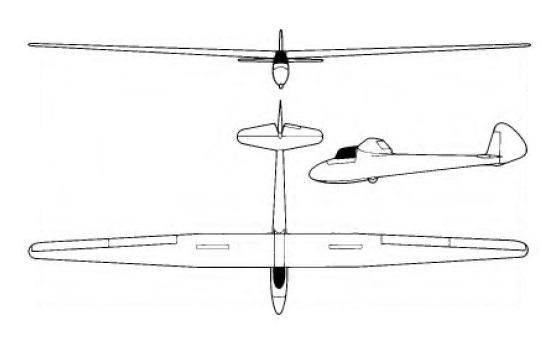
The Sky first flew in prototype form in September 1950 and was designed for the 1951 British National Championships, in which it came first and second, at the request of the newly-formed Royal Air Force Gliding and Soaring Association, who wanted a contest sailplane with a better performance than that of the well-known DFS Weihe. The Sky was basically an 18m span version of the 15m Slingsby Gull 4 with a longer fuselage and was at first known as the Gull 5 or the ‘Slingsby 18 metre’, but the name Sky was suggested by John Furlong as it was made up of the initial letters of Slingsby, Kirbymoorside where the firm’s works were, and Yorkshire.

The Gull 4 was intended to be Slingsby’s postwar 15m design, but did not go into production as the rival EoN Olympia was cheaper. The Sky, which resembled it, was of conventional wood and fabric construction; the production aircraft were designated T34A Sky 1 to distinguish them from the improved T34B Sky 2 intended for the 1954 World Championships but not, in the end, built. This version had NACA 64-/63 series wing sections instead of the Mk 1’s Gottingen 547 and NACA 2R 12 aerofoils, and revised squarecut wing tips and tail units. The high single-spar cantilever wings have a leading edge torsion box and a light secondary spar to carry the two-piece ailerons; the wing is fabric covered aft of the main spar and DFS-type air brakes are fitted in the upper surfaces, but there are no flaps. The fuselage is a ply-covered stressed skin wooden structure, and the landing gear is a single fixed monowheel behind an ash skid under the forward fuselage; there is a tail bumper and a jettisonable two-wheel dolly can be used in place of the monowheel. The tailplane is cantilever and the rudder and elevators are fabric-covered. The pilot sits under a one-piece moulded Perspex canopy and has adjustable rudder pedals; oxygen, radio and barographs can be installed for contest flying.

Although only 16 examples were built, the Sky high performance single-seater has a secure place in gliding history as being the first British-designed type to win the World Championships, which it did in 1952 flown by Philip Wills when this event was held at Cuatro Vientos, near Madrid; eight T34 Skys took part, also being flown by the Dutch and Argentine teams, and all but one of them were placed in the first 14, including the 3rd place taken by Robert Forbes. Philip Wills flew his Sky into second place in the 1954 World Championships at Camphill, Bedfordshire, and in the 1956 event this place was taken by Luis Vicente Juez of Spain in another Sky.

T.34 Sky
Span: 18.0 m / 59 ft 0.5 in
Length: 7.65 m / 25 ft 1.25 in
Wing area: 17.37 sq.m / 187 sq.ft
Aspect ratio: 18.7
Wing section: Gottingen 547/NACA 2R 12
Empty weight: 252 kg / 556 lb
Max weight: 363 kg / 800 lb
Water ballast: None
Max wing loading: 20.9 kg/sq.m / 4.28 lb/sq.ft
Max speed: 113 mph / 98 kt / 182 km/h
Stalling speed: 29 kt / 54 km/h
Max rough air speed: 72.5 kt / 134 km/h
Min sinking speed: 0.66 m/sec / 2.17 ft/sec at 39 mph / 33.5 kt / 62 km/h
Best glide ratio: 27.5:1 at 43 mph / 37 kt / 69 km/h

Slingsby T-31 Tandem Tutor

T-31B Tandem Tutor Trainer

The T. 8 Kirby Tutor (RAF Kirby Cadet T.X. Mk. 2) with a 13.24 m/ 43.4 ft. tapered wing evolved into the T.31 Tandem Tutor (RAF Kirby Cadet T.X. Mk. 3) two-place trainer.

The Tandem Tutor can be flown either dual or solo, and differs from the single-seat Tutor chiefly in having the forward fuselage lengthened to accommodate the second cockpit. An extra V-strut over the rear cockpit windscreen supports the wing leading edge, and wing spoilers are usually fitted in the upper surfaces, although some Tandem Tutors do not have them, and flaps are not fitted. The forward fuselage is plywood-skinned and the rear fuselage is fabric-covered; the pilots have full dual controls. Landing gear is basically the same as the Cadet’s with a monowheel, a skid under the forward fuselage and a tailskid.

The Tandem Tutor was designed by F. N. Slingsby, first flew in prototype form in September 1950. A two-place development of the single-place T.8 Tutor using the same wings with additional bracing. Early production T.31’s had no aids for approach control, but spoilers were added to later models, and retrofitted to most examples.

This was selected as a standard ATC trainer, being known as the Cadet TX Mk 3 by the RAF, and altogether 131 were built for the ATC and 69 for gliding clubs and other civil customers; 14 more were built from Slingsby-supplied kits and a number of Tandem Tutors were also built from Government surplus spares. The Royal Air Force used T.31B’s (known as the Kirby Cadet T.X. Mk. 3) in its air cadet organization from 1950 to the mid 1980’s. One ‘Mark 3’ made over 120,000 flights totaling 6,000 hours in this period.

Variations:
Martin & Wilkinson Cadet III

T.31 Tandem Tutor
Wing span: 13.2 m / 43 ft 3.75 in
Wing area: 15.8 sq.m / 170 sq.ft
Airfoil: Gottingen 426
Aspect ratio: 11.1
Length: 7.1 m / 23 ft 3.75 in
Empty Weight: 176 kg / 388 lb
Payload: 442lb/ 200kg
Gross Weight: 830 lb /376 kg
Wing Load: 4.88 lb/sq.ft/ 23.8 kg/sq.m
Water ballast: None
Max speed: 81 mph / 70 kt / 130 km/h
Stalling speed: 33 kt / 61 km/h
L/DMax: 18 @ 73 kph / 39 kt / 45 mph
MinSink: 1.05 m/s / 3.48 fps / 2.06 kt at 42 mph / 36 kt / 67 km/h
No. of Seats: 2
No. Built: 200
Structure: wood/fabric

Slingsby T 30 Prefect

Slingsby T30A Prefect

This single-seat intermediate trainer is basically an updated and improved version of the Grunau Baby, of which Slingsby had built a small number under licence before the war as the T5 Baby.

Of conventional wood and fabric construction, it has a braced wing with air brakes but no flaps, and a nose skid under the forward fuselage just ahead of the non-retractable monowheel; there is also a tailskid, and the tailplane is braced. The pilot sits in an open cockpit and has a small windscreen.

The Prefect, which first flew in prototype form in June 1948, is semi-aerobatic and suitable for cloud flying and cross-country flights.

Altogether 30 Prefects were built for clubs and other civil users, and 16 for the ATC as the T30A Prefect TX Mk 1 (WE979 to WE993 and WG783).

Prefect WG783 was initially delivered with camera mounting fittings and flaps fixed in the down position for the second stage of carrier wake trails, which involved flying a glider from the deck of an aircraft carrier to investigate characteristics of the wake over the flight deck.

Span: 45 ft 0 in
Length: 21 ft 3.5 in
Height: 4 ft 2 in
Wing area: 154 sqft
Aspect ratio: 13.2
Empty weight: 390 lb
Max weight: 587 lb
Max speed: 100 mph
Min sinking speed: 2.75 ft/sec
Best glide ratio: 21:1

Slingsby T.22 Petrel 2

A proposed postwar development of the T.13 Petrel was the T.22 Petrel 2, which had a revised cockpit with a step, wing spoilers, a monowheel and a tailplane with elevators, but this version was not built. A Petrel was fitted with a small engine on top of the fuselage in 1947 by Wing-Commander K. H. Wallis but this version of the Petrel was never flown.

Slingsby T.21 Sedbergh

Designed by F. N. Slingsby, this side-by-side two-seater was designed to meet the ATC’s requirements for a simple dual control sailplane of medium performance and low price. The prototype, designated T21P, first flew in 1944 and had a wing span of 50ft 0in using the same wing section as the Grunau Baby, and with a removable nose upper deck section to give students the same exposure to the airflow as experienced in primary gliders. Structure: All wood frame, wing D-box and forward fuselage plywood covered, remainder fabric.

The first production version was the T21A for clubs and other civil customers, with the span increased to 54ft 0in, which first flew in April 1947.

The T21B (originally designated T28) was the version of the T21A, with fixed nose, ordered for the ATC and known as the Sedbergh TX Mk 1 in Service use, being named after the famous Yorkshire public school; this first flew in December 1947.

Altogether 121 civil T21As were built and 73 T21B Sedberghs for the ATC, plus 19 more T21Bs built under sub-contract by Martin Hearn Ltd, who had also built Cadets for Slingsby. Three more T21s were built outside – by the Midland Gliding Club, by Leighton Park School and by Mr J. Hulme, making a total, including upper surfaces.

Slingsby T21B Sedbergh

The forward portion of the fuselage back to the two main wing attachment frames is a wooden stressed skin structure, and the centre and rear portions are of fabric-covered girder construction. The tailplane is braced and the rudder and elevators fabric-covered. Landing gear consists of a large non-retractable monowheel with a nose skid in front of it, and a sprung tailskid. The two pilots sit side-by-side in an open cockpit with dual controls, and with two small windscreens ahead of them; the spoiler lever, cable quick-release and trimming controls are positioned on a console between the two pilots.

The Royal Air Force operated 92 T.21B’s (known as the Sedbergh T.X. Mk. 1) in its air cadet training program until the 1980’s. Approach control is accomplished only by upper surface spoilers. Most examples had open cockpits; a few were modified to incorporate a canopy (T. 21 C).

Gallery

Sedbergh T.21 B
Wing span: 16.5 m / 54 ft 0 in
Wing area: 24.2 sq.m /260.5 sq.ft
Aspect ratio: 11.2
Airfoil: Gottingen 535
Length: 8.16 m / 26 ft 8 in
Empty Weight: 272 kg /600 lb
Payload: 204 kg / 450 lb
Gross Weight: 476 kg / 1050 lb
Water ballast: None
Wing Load: 19.6 kg/sq.m / 4.01 lb/sq.ft
Max speed: 105 mph / 92 kt / 170 km/h
Stalling speed: 28 kt / 52 km/h
L/DMax: 21 @ 69 kph / 37 kt / 43 mph
Min sinking speed: 0.85 m/sec / 2.79 ft/sec at 38.5 mph / 33.5 kt / 62 km/h
No. of Seats: 2
No. Built: 218

Slingsby T.13 Petrel

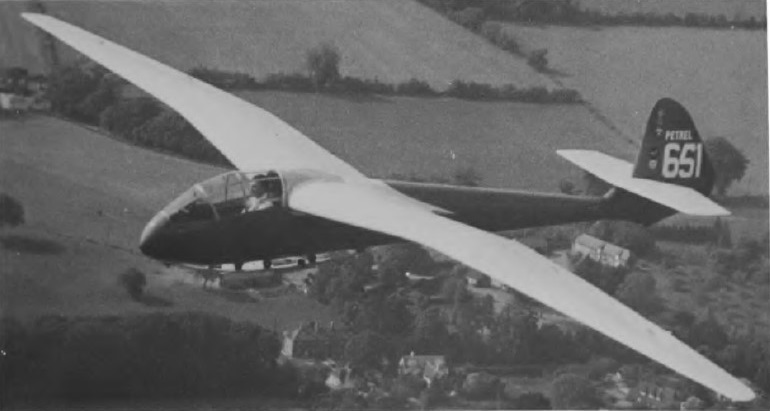
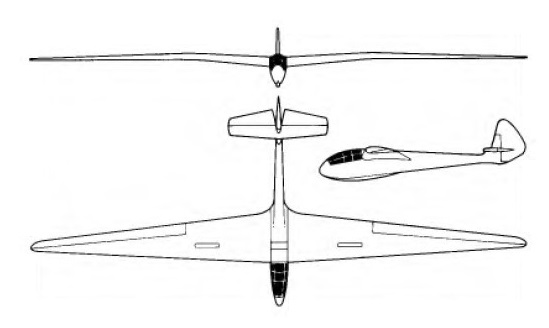
This high performance single-seater was one of the first prewar British attempts to produce a sailplane to rival such well-known German types as the Condor, Rhonadler and Minimoa in terms of performance and aerodynamic refinement. It was, in fact, based on the Rhonadler, with a gull wing of very similar plan form and long span ailerons, with a low wing loading suitable for the rather weak British thermals; no air brakes or flaps were fitted.

Of conventional spruce and birch plywood construction, the Petrel had an all-moving tailplane very similar in outline to the Rhonadler’s in its initial form, but later production aircraft had a larger, broader chord tailplane and elevators with a step in the rear fuselage underneath the tailplane.

The cockpit canopy was of a type later to become commonplace on many sailplanes, flush-fitting and completely faired into the fuselage line without a step, while the landing gear consisted of a long wooden skid under the fuselage, without a monowheel, and a tail bumper.

The Petrel first flew in prototype form in December 1938 and production aircraft, known as the Petrel 1, were offered to customers for a mere £266 in 1939, but only six were built before the war put a stop to further production. Two of these G-ALNP and GALPP, survived the war, the latter later being sold to Eire as IGA101.

T.I3 Petrel
Wing span: 17.3 m (56 ft 9 in)
Length: 7.25 m (23 ft 9.5 in)
Wing area: 16.72 sq.m (180 sq ft)
Wing section: Gottingen 535
Aspect ratio: 17.9
Empty weight: 199 kg (440 lb)
Max weight: 289 kg (637 lb)
Water ballast: None
Max wing loading: 17.3 kg/sq.m (3.54 lb/sq ft)
Max speed: 92 kt / 170 km/h / 105 mph
Stalling speed: 25.5 kt (47 km/h)
Min sinking speed: 0.64 m/sec / 2.1 ft/sec at 31 kt / 58 km/h / 50 mph
Best glide ratio: 27 at 36 kt / 67 km/h / 42 mph

Slingsby T.12 Kirby Gull 1 / Blue Gull / T.14 Gull II / T.15 Gull III

In the late 1930s the gliding movement in the UK did not receive the support from the government that was forthcoming in other European states. Fred Slingsby , John S. Sproule and Mungo Buxton designed the Type 12 Gull to be relatively inexpensive and easy to fly in the hands of the inexperienced pilots in the UK. Slingsby had had a bad experience with the Type 9 King Kite entering incipient spins at low airspeed which was ascribed to the use of a NACA 4312 aerofoil section at the wing-tips, so he designed the Gull with a modified RAF 34 profile at the tips. The cause of the wing drop problem on the King Kite was later found to be inaccurate manufacture, but the Gull retained the modified RAF 34 section.

Construction of the Gull aircraft was of semi-monocoque wood and plywood throughout, with a mixture of plywood and fabric skinning and covering. The wings were skinned with plywood forward of the main spar to form torsion boxes which increased their rigidity. They had a distinctive gull wing form, as the inner 2 metres carried marked dihedral out to the attachment points of the lift struts to the wing spars. Beyond, the wings lacked dihedral. The rectangular planform of the inner wings included the gulled portion and 2 metres beyond, with spoilers in the upper surface outboard of the gull joint in some later aircraft. Ailerons filled the trailing edge of the tapered outer wings.

The cockpit was enclosed with a faired multi-panel canopy which was removed for entry and egress. Ten Gulls were built, nine by Slingsby at Kirbymoorside and one by Herman Kursawe in the United States, from plans supplied by Slingsby.

The Gull 1 first flew in 1938, spoilers were fitted to all Gulls after the first production example, and in 1939, a Gull flown by Geoffrey Stephenson was the first sailplane ever to cross the English Channel in true soaring flight.

A Gull 1, originally the prototype and sold to Australia before World War II and later registered VH-GHL is on display at the Aviation Museum of Western Australia, Bull Creek near Perth, Australia.

The design was developed in 1939 to include what Slingsby called the cantilever Gull, designated as the T15. More commonly known as the Gull III, it had a slightly higher performance, and was fitted with spoilers on the upper surfaces of the wing. Built in 1939, it was not until January 1940 that the type first flew, and was such a success that Slingsby intended to put the type into production once the War was over.

With the tight post-war economy within Britain, gliders of simplified production quickly became a factor in being able to produce cost-effective sailplanes. This led to the Gull 4, which had a more conventional, less complicated straight wing.

The only Gull III to be built survived the war, and it went on to have a long and distinguished career, and was owned at one point by Prince Bira of Siam, who was at the time the World Motor Racing Champion. Bira had bought the Gull III in 1944 and flew it in the company of his dog on many epic flights, including one to 12000 ft.

The Gull III was later bought by a syndicate at the Oxford Gliding Club operating out of Weston on the Green. After a long rebuild, it was finally flown again in 1973. Its C of A expired again in July 1974 because its wing had been damaged by damp (casein glue failure) during the previous winter, when it had been left out in its closed trailer at St. Mary’s Farm, Clifton, near Deddington, Oxon. Restored in the 1980s by Mike Beach, it was initially loaned to Brooklands Museum as a non-flying exhibit but was later bought by the Museum in 1998.

There is one other Gull III in existence. Often referred to as the Gull 3 ½, this Gull is a faithful replica that was made from drawings that had come from Slingsby’s during the 1970s, with the drawings being developed for the project by a worker at Slingsby’s. The project was the brain-child of the late Mike Garnett, and completed by members of the Bowland Forest Gliding Club. It flew from Bowland Forest until 2011 when it was purchased by the current owner and moved to Lincolnshire. This Gull is currently the only airworthy example of either the Gull 1 or Gull III left in Britain. The only other airworthy Gull 1 went to the United States in 2010.

Variants

Slingsby T.12 Gull I / Blue Gull
Initial prototype and nine production gliders with strutted gull wings.

Slingsby T.14 Gull II
Enlarged Gull with two seats side by side, only one built.

Slingsby T.15 Gull III

Specifications:

Gull 1
Wing span: 15.33m / 50 ft 2 in
Wing area: 14.86sq.m / 160sq.ft
Airfoil: root: NACA 4416, tip:RAF34 (modified)
Length: 21 ft 8 in (6.61 m)
Empty Weight: 172kg / 384lb
Payload: 240lb /111kg
Gross Weight: 624lb / 283kg
Wing Load: 3.91lb/sq.ft / 19.1kg/sq.m
Aspect ratio: 15.8
Airfoil: NACA 4416
No of seats: 1
L/DMax: 24 @ 77 kph / 41 kt / 48 mph
MinSink: 142 ft/min / 0.72 m/s at 37 mph / 59.5 km/h / 32.2 kt
Never exceed speed: 80 mph / 70 kt / 129 km/h
Aerotow speed: 60 mph / 96.6 km/h / 52.1 kn
Winch launch speed: 50 mph / 80.5 km/h / 43.4 kn
G limits: +4.9
Number built: 10
Structure: strut-braced wood/ fabric wings, wood/ fabric tail, wood fuselage.