The SSW, or Sezione Sperimentale Volo Vela, was formed by the Aeroclub Volovelistio Milanese to maintain and repair the club’s gliders and also to build new designs. It concentrated at first on reconditioning Zogling and Allievo Cantu primary training gliders, and its first new product was the CVV 7 Pinocchio single-seat sailplane designed by Eng Edgardo Ciani. This was followed by the Spillo EC 37-53 high performance single-seater.
Glider
SSVV / Sezione Sperimentale Volo Vela
The SSW, or Sezione Sperimentale Volo Vela, was formed by the Aeroclub Volovelistio Milanese to maintain and repair the club’s gliders and also to build new designs. It concentrated at first on reconditioning Zogling and Allievo Cantu primary training gliders, and its first new product was the CVV 7 Pinocchio single-seat sailplane. This was followed by the Spillo EC 37-53 high performance single-seater, a small series of the Urendo EC 38-56 two-seater and the prototype EC 40 Eventuale two seat trainer, all designed by Eng Edgardo Ciani, and the small Gheppio R1 single-seater designed by Eng Gianfranco Rotondi. Eng Ciani next designed the Uribel single-seater Standard class sailplane.
Sportline Aviacija / Lak / Lithuanian Aviation Constructions / Experimentalnii Zavod Sportivnoi Aviatsii / Experimental Sports Aviation Factory
The Lithuanian Aviation Plant (now JSC “Sportinė Aviacija ir Ko”) Company was founded in 1969 and designed and manufactured highest quality gliders. In the course of its history the Company designed, tested and produced 20 different types and modifications of gliders and motor-gliders.
The first composite high performance glider BK.-7 “Lietuva” took-off in 1972. Since then, many other aviation projects were developed and manufactured best known of which are the 1978 Open class glider LAK-12; 15-18m class glider LAK-17a, Standard class gliders Genesis 2 and LAK-19; self- sustaining gliders LAK-17AT and LAK-19T; primary training glider LAK-16, open class ships LAK-20T and LAK-20M. The most popular member of the glider family is the Open Class glider LAK-12. Within 25 years, 253 units have been built and operated in 20 different countries. The LAK-12 was designed according to technical requirements and standards of the former Soviet Union, so called Norms of Flight Safety. In some cases, these Norms were stricter than the current European standards (CS-22).
Since 1996, Sportline Aviacija have worked on the American design standard class glider Genesis. Being the developer of the engineering part of the design, we completed the strength tests and calculations in accordance with JAR-22 standards. All works on obtaining type certificate in accordance with JAR-22 have been carried out and 26 units have been manufactured.
More than a thousand L-13 “BLANIK” gliders from all over the former Soviet Union and Bulgaria were overhauled in the plant.
Over the past 15 years after the company became private, LAK-17 type glider was developed and modified, and about 200 units of 15m and 18m class gliders were manufactured and delivered to the customers all over the world.
In 1999, the LAK factory was completely privatized, and a joint-stock company, Sportinë Aviacija, AB, was formed.
2002 launched a new open class glider, LAK-20 (two-seater version), and at the same time a turbo moto version of this glider as well. Few prototypes of the open class two-seater gliders LAK-20 and LAK-20M have been assembled, but the further development of the project has been frozen.
New modification of LAK-17 is the LAK-17B, which further evolved into a the most revolutionary and progressive product- the LAK-17B-FES (Front Electric Sustainer). The LAK-17B FES has been certified by EASA.
A Certificate issued by the Lithuanian Civil Aviation Authority, which grants the right to perform production of sailplanes, self-launching sailplanes as well as related products and parts.
LAK gliders are worldwide type certified, not only in Lithuania, but have type certificates for gliders in EASA, CAR, and other countries.
Apart from building gliders, the factory has capacities to develop a large variety of aviation or non-aviation composite structures and constructions. The testing facility can be employed for comprehensive analysis of projects and has its own strength test laboratory.
Sportflugzeugbau Goppingen
The production of Schempp-Hirth gliders began in the municipal building yard in Göppingen where Martin Schempp founded the Sportflugzeugbau Göppingen (Sport Aircraft Göppingen) company in 1935. In 1938 the company moved to Kirchheim/Teck and employed more than 300 people during the war time.
The first serial gliders were the aerobatic single seat trainer GÖ-1 ‘WOLF’ from Wolf Hirth and the renown GÖ-3 ‘Minimoa’ as well as the two seat GÖ-4 from Wolfgang Hütter.
Sportavia SFS 31 Milan / Scheibe SFS 31 Milan
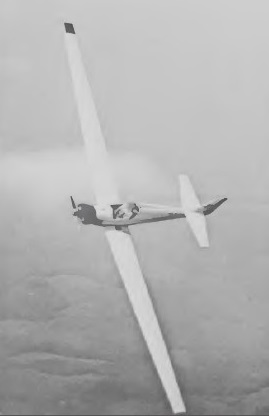
Designed by Rene Fournier and Egon Scheibe, Sportavia built the SFS 31 Milan, a single seat development of the Fournier RF4D with a sailplane wing of the Scheibe SF-27M motorglider and a feathering prop. The Milan’s designation is formed by adding together the manufacturers’ initial letters and the numbers in the designations of these two aircraft.
Like all of Rene Fournier’s designs, it had a big bubble canopy. It has spoilers for approach control and outrigger wheels and a steerable tailwheel to aid in taxiing. The cantilever wings are low-set instead of in the shoulder position of the SF-27M and Zugvogel V, with 4° dihedral from the roots, and are wooden structures with a pine box spar and plywood ribs covered with birch plywood and fabric; Schempp-Hirth glassfibre/metal air brakes are fitted in the upper surfaces. The SF-27M’s wings were made stronger than those of the unpowered SF-27 Zugvogel V, and it is powered by a 26hp Hirth Solo vertically-opposed four-cylinder engine. The Milan’s powerplant is a 39hp Rectimo (converted Volkswagen) 4 AR 1200 ‘flat four’ engine in a conventional tractor installation, driving a Hoffman two-blade fixed-pitch or fully-feathering wooden propeller, of 4ft 4in of 4ft 5.5in diameter respectively. The single fuel tank in the fuselage has a capacity of 7.7 Imp gallons. The landing gear is similar to the RF4D’s, but with spring-assisted retraction of the main wheel.
The Milan prototype, D-KORO, made its first flight on 31 August 1969. The SFS 31 was produced jointly by Sportavia and Scheibe.
Milan SFS-31
Engine: 29kW / 39 bhp Rectimo 4AR 1200
Wing span: 15 m / 49 ft 2.5 in
Wing area: 12 sq.m / 129 sq.ft
Aspect ratio: 18.6
Airfoil: Wortmann
Length: 19 ft 10.25 in
Height: 5 ft 1.75 in
Empty Weight: 310 kg / 682 lb
Payload: 130 kg / 286 lb
Gross Weight: 440 kg / 968 lb
Wing Load: 36.67 kg/sq.m / 7.5 lb/sq.ft
Max cruising speed: 112 mph at sea level
L/DMax: 29 95 kph / 51 kt / 59 mph
MinSink: 0.82 m/s / 2.7 fps / 1.60
Take-off run: 690ft
Range with max fuel: 415 miles
Structure: wood
Seats: 1
No. Built: 24
Sportavia / Sportavia-Putzer GmbH
Alfons Pützer and Comte Antoine d’Assche, director of the French company Alpavia SA, formed a new company in 1966, Sportavia-Pützer, to produce the Fournier series of light aircraft.
Formed to take over from Alpavia SA manufacture of Avion-Planeur series designed by Rene Fournier, by spring 1969 had delivered 150 RF4D single-seaters. Two-seat RF5 flew 1968, followed by RF6 and RS180 Sportsman four-seat lightplane.
Sportavia Pützer went bankrupt in 1977 not long after the first prototype RF-9 had made its maiden flight.
Became entirely owned by Rhein-Flugzeugbau GmbH 1977 and lost name 1981.
Spencer Compact 110
Bill Spencer designed and built a low cost glider aimed at the “lazy day soaring” crowd. It was interesting enough to be reviewed twice in Kitplanes, a magazine
The fuselage weighs only 29 pounds total. It is built of pop-riveted aluminum tubes and a plywood seat.
The Compact 110 is designed for foot launching from a gentle slope into a steady wind. Essentially, the pilot stands in the cockpit, picks it up, and runs down the slope into the wind until the seat picks the pilot up.
Spalenger S-18 III
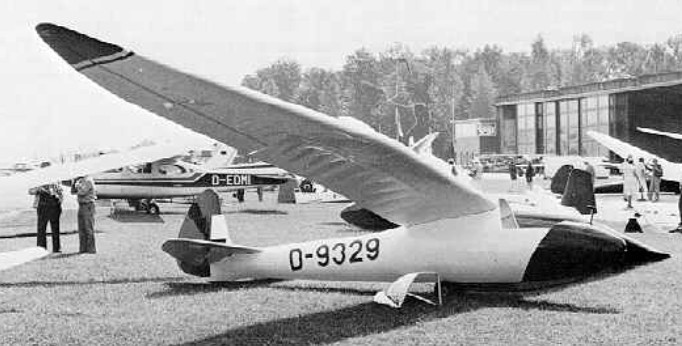
Designed by Jakob Spalinger. No. Built: 55
Spalinger S-18 III
Wing span: 14.3 m
Wing area: 14.16 sq.m
Aspect ratio: 14.44
Airfoil: go 535
Empty Weight: 158 kg
Gross Weight: 243 kg
Wing Load: 16.8 kg/sq.m
L/DMax: 24 71 kph
MinSink: 0.68 m/s 57 kph
Seats: 1
Southern Sailpanes
Thruxton Airfield
Andover
Hampshire
UK
Southern Sailplanes proprietor Ralph Jones was the agents in Britain for Schempp-Hirth KG.
Southern Sailplanes were converting a 17.6m span Cirrus to have a wing of 24m, with a centre-section of 5m span having spars constructed with carbon-fibre reinforced plastic. The estimated competition date was 1971.
Southdown Skysailing Club Skysailer / Brown Primary
Also known as the Brown Primary, the Southdown Skysailing Club Skysailer was a single-seat primary glider designed by L. Brown and built by Southdown Skysailing Club in the UK in 1931.
 All Aero