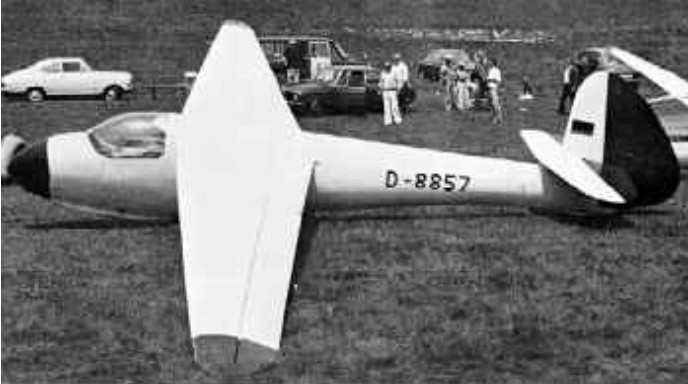
This single-seater sailplane was designed and built to Standard Class specifications by Otto Zauner of Vineland, New Jersey, who had previously built from kits and/or plans a Schweizer SGS 1-26, a Briegleb BG 12, a Bryan HP-14 and a Thorpe T-18 ultra-light. The OZ-5’s fuselage and tail unit are of Mr Zauner’s own design but the wings of a Bryan HP-15 are fitted in the shoulder position. The forward fuselage and cockpit tapers to a slim boom carrying the tail, the former being of glassfibre construction to about one-third back along the tail boom; the rest of the boom and the cantilever T-tail are all-metal, the fin and rudder being swept back. There is a retractable monowheel and the pilot sits under a one-piece flush-fitting cockpit canopy. The wings are the same structurally as the HP-15 and of high aspect ratio; they are two-spar all-metal structures with metal skinning and plastic leading edges, and only three ribs in each wing, the spaces between the ribs being filled with plastic foam. Metal fixed hinge flaps are fitted, the ailerons drooping in conjunction with them. Flight testing of the OZ-5 began in 1975.
Span: 49 ft 2.5 in Length: 22 ft 0 in Height: 4 ft 0 in Max pilot weight: 234 lb Max weight: 669.5 lb Max speed: Approx 18 0mph (in smooth air) Max aero-tow speed: 120 mph
A number of significantly modified HP Aircraft RS-15s have been built including Otto Zauner’s One Yankee with his own design of fuselage and tailplane.
As with many homebuilts, a number of builders have made design changes to their HP Aircraft HP-14. In some cases these have been substantial. Otto Zauner constructed an 18 m. model (called the Zauner OZ- 4) which has been modified substantially to have tip extensions with winglets to give a span of 19.2 m. / 63 ft, and a gross weight of 386 kg./ 850 lb.
AB Yumashiev built the Yu-1 glider in Kiev in 1925. Designed as a training glider, it was developed with a view to participating in the competitions that year in Crimea.
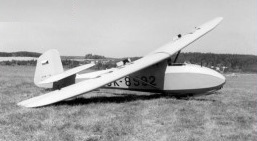
The Yumashiev Yu-1 (Russian: Юмашев Ю-1) was conceived as a single-seat training glider. It was conceived as a high-wing cantilever monoplane. The wing, with the Pr-426 profile, had a double spar structure and a trapezoidal shape in the plane.
The fuselage was built with a plywood frame structure and had an aerodynamic wing profile shape (curved at the top and flat at the bottom). The front 2/3s were covered in sheets of plywood. The tail section was covered with fabric.
The Yu-1’s offset rudders featured a rounded shape.
The landing gear featured a conventional wheeled structure, but for record flights they could be concealed within the fuselage. For training flights they were kept exposed.
First flying in September 1925, the Yu-1 glider was entered in the III National Sailing Competitions held in Koktebel in 1925. On September 30, Yumashiev managed to stay in the air in this glider for 1 hour and 30 minutes, which was a national record.
A day later, on October 1, Yumashiev at the controls of the Yu-1 would achieve for the first time in the USSR, a long-distance flight taking advantage of thermal currents. This flight recorded 4800 meters and was considered a national record, because in the competitions the longest flight value would be 24.4 km, reached by the German Nering on his “Consul” glider. For this flight Yumashiev would receive the award for second place in the competition.
Yumashiev Yu-1 Wingspan: 12.20 m Wing area: 17.20 m² Length: 5.70 m Empty weight: 83 kg Wing loading: 9.5 kg / m² Rudder surface area: 2.00 m² Ailerons surface: 3.00 m² Wing elongation ratio: 8.7 Accommodation: 1
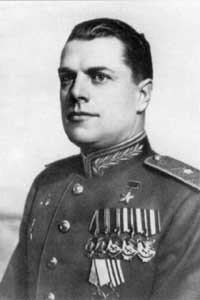
Major General of Aviation Andrei Borisovich Yumashiev.
Andrei Borísovich Yumashiev (Russian: Андрей Борисович Юмашев) Andrei Yumashiev was born in Saint Petersburg on March 31, 1902. He finished art school. He joined the Red Army in 1918. In October 1920 and February 1921 he participated in combat actions on the southern front as a soldier in an artillery division. In 1921 he finished artillery courses in Sevastopol.
In 1923 he finished training at the Yegórievsk Aviation Theoretical-military School and in 1924 the Borisoglebsk Higher Flight School and the Serpukhov Higher School of Air Combat, Shooting and Bombing. He later served in the VVS. Between 1926 and 1927 he worked as an instructor pilot at the Serpukhov school.
Between 1927 and 1937 he worked on the NII VVS as a test pilot. He made the first flight and tests of the Bartini Stal-6 (1933). He ran the state tests of the models of A. N Túpolev I-4 (1927), R-3 (1928), TB-1bis (1929 – 1930), R-7 (1930), R-6 (1931), TB -3 (1933), the Polikarpov I-3 fighter (1928 -1929) and the Bartini Stal-7 transport (1936 – 1937).
At the Third National Flying Competitions in Koebel, held in 1925, one of the best Soviet gliders was the Yu-1 designed and built by Yumashiev. This glider demonstrated staying in the air for an hour and a half and reaching 375 meters in height. These results were national records.
He set six world records (including two as co-pilot): in 1936 two flight weight records in the Tupolev TB-3TB-3 and in 1937 two flight distance records aboard the Túpolev ANT-25 as a crew member of MM Gromov.
Between 1937 and 1941 he worked as a test pilot for the TsAGI. During this period, it made the first flight and tests of the BOK-7 (1939). It participated in the crew tests in preparation for the projected long-range voyage on the BOK-15 (1940).
He participated in the Winter War with Finland. Between January and March 1940 he was appointed substitute for the commander of the 85 bombing regiment, carrying out more than 10 combat sorties. As of March 1941 he went on to serve as a substitute for the head of the LII (MM Gromov), attending the flight section. He participated in the flights of the Yakovlev UT-2 with an air cushion and the Gribosvki G-28 “Krechet”.
He fought in the Great Patriotic War. Between July and August 1941, he led the second independent fighter squadron subordinate to the Moscow Air Defense (PVO). In January and February 1942 he commanded the 237th Fighter Aviation Regiment on the Kalinin Front. Between March and August 1942 he was appointed substitute for the commander of the 3rd Air Army and between August 1942 and February 1943, substitute for the commander of the 1st Air Army. Between March and June 1943 he commanded the 6th Fighter Aviation Corps and between July 1943 and December 1944 he led the PVO of the Western and Southern fronts.
Between 1945 and 1946 he was appointed head of the Directorate of Hunting Aviation of the Main Directorate of Combative Preparation of the VVS. From 1946 it went to the reserve.
Lived in Moscow. In his spare time he devoted himself to painting, forming part of the Union of Painters of the USSR. He died on May 20, 1988. His remains rest in the Bagankovsky Cemetery in Moscow.
Awards and distinctions: Hero of the Soviet Union (1-09- 1937) Two Order of Lenin Five Order of the Red Banner Order of the Patriotic War 1st rank Order of the Red Star Medals He received the De la Vaux medal awarded by the FAI (1937).
The Swales SD3-15 was developed from the Birmingham Guild BG 135 Gipsy, the 13.5m span version of the BG 100/12 designed by J. C.Gibson, K. Emslie and L. P. Moore of Sailplane Design Ltd. Manufacturing rights of the BG 135 were acquired by Yorkshire Sailplanes Ltd, who built a batch of seven as the YS 55 Consort. The BG 135 was itself developed from the earlier and very similar Birmingham Guild Gipsy 12/15 project which, like the BG 100/12, was intended to be a low cost lightweight Standard/Sports Class sailplane in which either a medium-performance 12m wing or a high performance 15m one could be fitted to a common fuselage and tail unit. This was to be achieved by special attention to structural efficiency resulting from efficient wing skin stabilisation, with rigid foam cores, and low cost was achieved by eliminating taper as well as twin-skin sandwich or ribbed forms of construction. The prototype BG 100/12, with a 12m (39ft 4in) span wing, first flew on 7 April 1970 and was a cantilever shoulder-wing monoplane of all-metal construction with a V-tail and a large hinged moulded cockpit canopy; a 13.5m span wing was later fitted.
Structurally, the SD3-15 is very similar to the BG 135 and BG 100/12.
Slingsby sold jigs and production rights of their T.53 upon Slingsby’s 1969 receivership to Yorkshire Sailplane which produced an improved version with both nose and centre of gravity tow hooks known as the YS 53 Sovereign.
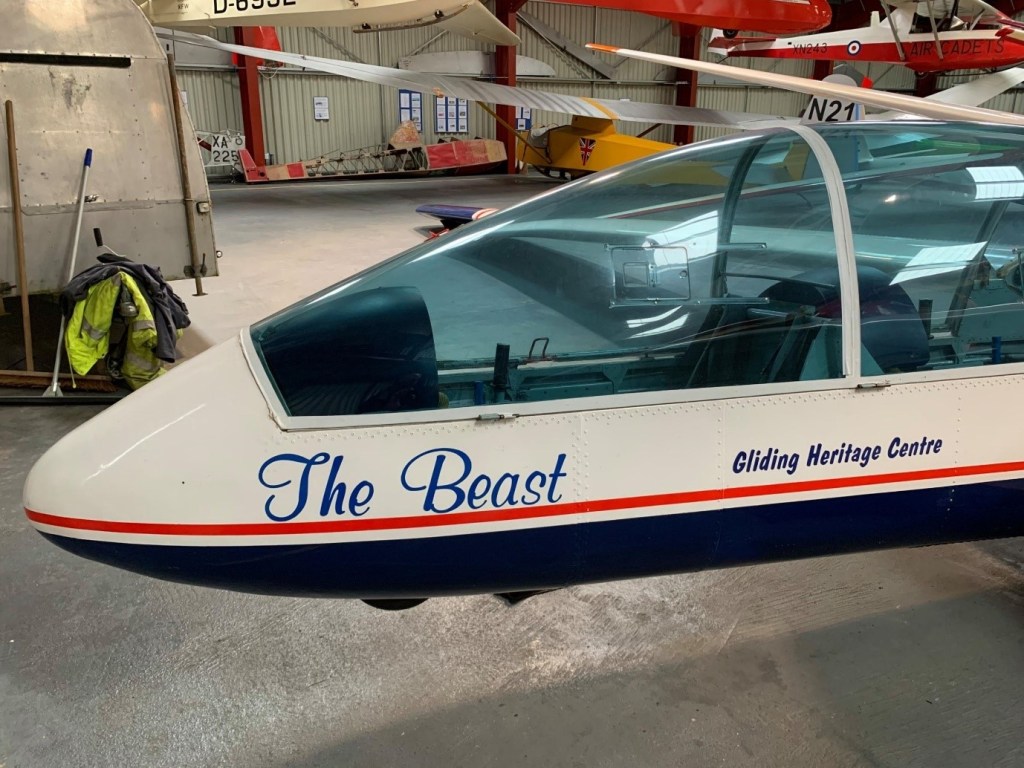
Yorkshire Sailplanes only turned out three of these all-metal two-seaters, conceived as a T31 replacement for the Air Training Corps only to be rejected due to unpleasant spinning characteristics.


 All Aero