St. Louis Aircraft Corp

1929: St Louis Aircraft Co
8000 N Broadway
St Louis
MO
USA

The St. Louis Aircraft Corporation was incorporated as a subsidiary of the St. Louis Car Co. during the First World War, in response to the Army’s urgent need for large quantities of aircraft to support the training of military aviators needed to meet American commitments to the Allies. But St. Louis Car (a highly successful manufacturer of railway cars and streetcars) had already been actively exposed to the new world of aviation. In late 1915, Tom Benoist, St. Louis’ earliest aeronautical entrepreneur, had arranged to construct his large Type 15 twin engine, six-seat flying boat in the St. Louis Car shops, lacking sufficient room in his own facilities. Sensing an opportunity to sell flying boats to Allied combatants in the War, Benoist contracted with St. Louis Car in October, 1915 for the production of large numbers (lots of 1000) of similar flying boats. However, Benoist’s sales efforts in Europe were eclipsed by those of Glenn Curtiss, and consequently no flying boat production occurred at St. Louis Car.

Later, when the U.S. did enter the War, Edwin B Messner of the St. Louis Car joined with AJ Seigels’ Huttig Sash and Door Co. (also of St. Louis) to form the St. Louis Aircraft Corporation, which went on to manufacture 450 JN-4D Jenny trainers (a Curtiss design) for the U.S. Army. The company became one of six across the country to produce the Curtiss JN 4D Jenny with first deliveries in 1918. The first order was for 200 planes, the company delivered 30 aircraft per month, and 57 JN 4D October 1918.

Although St. Louis Aircraft continued to exist (as a wholly-owned subsidiary of St. Louis Car) after World War I, its hopes of producing aircraft for private use were stymied by the glut of surplus military aircraft that became available. The company remained dormant until the so-called “Lindbergh Boom” in aviation developed in the wake of Lindbergh’s heroic solo flight from New York to Paris in May, 1927. An ingredient of this surge in aviation activity was the advent of powerful, reliable, air-cooled radial powerplants to replace the bulkier W.W. I-vintage water-cooled OX-5 and Liberty engines. St. Louis Aircraft seized the opportunity afforded by the “Lindbergh Boom” in 1928 to produce a line of light, enclosed-cabin, two-seat, single radial-engine monoplanes christened Cardinals. At 1929 Detroit Aircraft Show exhibited the Cardinal high-wing monoplane, the company’s first airplane. Cardinal Senior which followed had more power.

Unfortunately, the Cardinal’s timing was not ideal: having been beaten into production by such highly successful similar private aircraft as the Monocoupe, Curtiss Robin, and others, the Cardinal did not sell well, becoming an early victim of the Depression-era aeronautical slump. The last of 21 Cardinals was delivered in 1931.

The company had ordered 100 100 hp Kinner radial engines to power the KT monoplane light, but production ceased in 1931 at the height of the depression.

Having survived for several years on development and production contracts for military aircraft parts and equipment, St. Louis Aircraft didn’t produce another airplane until it brought out a biplane primary trainer in 1935, hoping to win an Army production contract. Initially unsuccessful, St. Louis Aircraft continued to develop the airplane and demonstrate it (including a crash at Wright Field in 1936) for the Army, which eventually acquired a trial batch of 14 trainers in 1939. The Army identified these trainers as PT-15. The hoped-for big production orders were not forthcoming, however, being won instead by the now-famous Boeing/Stearman PT-13/PT-17/N2S Army/Navy primary trainer.

While continuing to manufacture crew cars for motorized Army observation balloons (many of which operated at nearby Scott Field), St. Louis Aircraft renewed its efforts to get into the trainer-production business, especially with the World-War-I -fueled major buildup in military pilot-training programs. With its own funds, St. Louis Aircraft developed and flew in 1940 the PT-LM-4, a low-wing, all-metal primary trainer with a Ranger in-line engine. Although tested by NACA, the Army, and in Canada, the PT-LM-4 was not put into production. Instead, the Army gave St. Louis Aircraft production contracts for the similar Fairchild designed PT-19 trainer. During 1942-44, St. Louis Aircraft built and delivered 350 of these primary trainers, in two versions: the PT-19A (44), with a Ranger in-line engine, and PT-23/PT-23A (306), with a Continental radial. These trainers were all test-flown at St. Louis Aircraft’s own flying field, adjacent to the St. Louis Car factory on North Broadway in St. Louis. (This field was operated as a private airfield, Ross Airport, for a time after W.W. II.)

St. Louis PT-LM-4 trainer at Lambert Field, ca. 1940

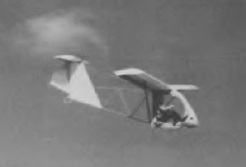
Having already placed large-scale aircraft production contracts with the major airframe builders, the Army sought to employ secondary sources when it decided in 1941 to develop a significant glider assault capability. Not being burdened at the time with aircraft production contracts, St. Louis Aircraft was invited to participate in the Army’s glider program, obtaining contracts to develop eight-place and fifteen-place troop-carrying gliders. The eight-place XCG-5 demonstrated serious aerodynamic flaws during its first test flights (at Lambert Field) in 1942. The redesign necessary to correct the aerodynamic, as well as significant structural, problems doomed the XCG-5. The larger, heavier XCG-6 was never built.

St. Louis Aircraft once again went dormant following the end of World War II. It disappeared forever when the parent company, St. Louis Car, closed its doors for the last time in 1973. The historical record, the St. Louis Car and St. Louis Aircraft corporate archives were given to Washington University, where they now reside.
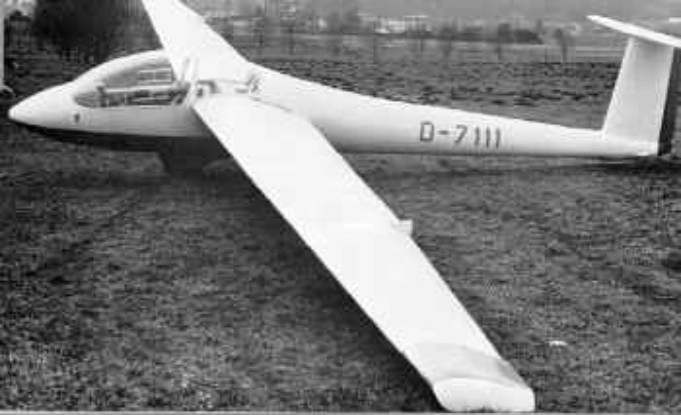
Start + Flug H-121 Globetrotter / Schulmeister

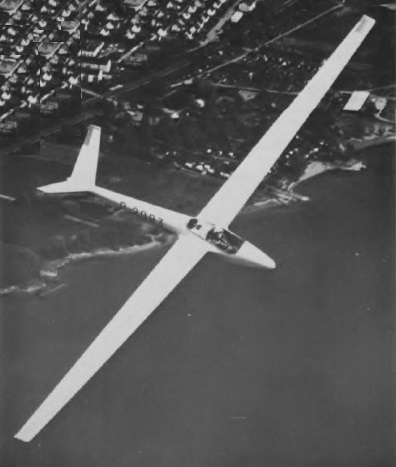
Designed by Walter Stender and Ursula Hanle and originally known as the Schulmeister, this side-by-side two-seater training sailplane first flew in prototype form on 28 July 1977, and production began in March 1978. The Globetrotter is a cantilever mid-wing monoplane of 17m span with a T-tail, and mainly of glassfibre reinforced plastic construction. The wings have an Eppler E 603 aerofoil section and are swept forward 2° 30′; air brakes are fitted in the upper surfaces, and there is provision for water ballast. Landing gear consists of a non-retractable monowheel and tailwheel, and the two pilots sit under a one-piece canopy that slides forward to open over the tip of the nose.

Only one was built.

Wing span: 17 m
Wing area: 15.8 sq.m
Aspect ratio: 18.29
Airfoil: Eppler 603
Empty Weight: 400 kg
Gross Weight: 600 kg
Wing Load: 38 kg/sq.m
L/DMax: 36 100 kph
Min Sink: 0.65 m/s 80 kph
Seats: 2

Span: 55 ft 9.25 in
Length: 25 ft 1.5 in
Height: 3ft 5.25 in
Wing area: 170.1 sqft
Aspect ratio: 18.3
Empty weight: 639 lb
Max weight: 1,102 lb
Max speed: 155 mph
Min sinking speed: 2.13 ft/sec at 50 mph
Best glide ratio: 36:1 at 62 mph

Start + Flug H-111 Hippie

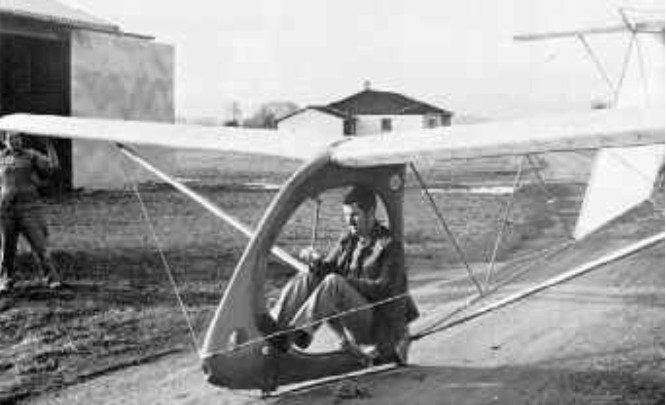
Designed by Ursula Hanle, this simple ultra-light single-seat glider weighs only 106lb without the pilot and is designed to achieve take-off by a variety of methods: by foot-launch, auto-tow, winch launching or any other suitable form of assisted launch.

It has strut-braced dihedral wings of constant chord with small endplate-type fairings and Wortmann aerofoil sections. The basic structure is of glassfibre with carbon-fibre reinforcement; the wings are plastic-covered and the tail surfaces fabric-covered, the tail being carried on an open girder-type framework, and the braced tailplane being mounted on the large fin. The landing gear is formed by the glassfibre seat fairing which has a small keel surface underneath it, and there is a metal hoop at the base of the rudder to form a tailskid. The pilot sits behind a windscreen extending from the leading edge to the front of the seat fairing.

For a foot-launch the product of the hill’s angle in degrees and the wind speed in metres per second should be a figure of 80 or above. After foot-launching, the pilot draws up his legs into the hoop-like glassfibre seat fairing at the front of the aircraft, which also serves as the landing skid.

The Hippie flew for the first time on 15 August 1974 and examples were flying in five countries outside Germany.

The airframe can be dismantled and packed into a carrying case measuring 5m (16ft 4.75in) by 1.10m (3ft 7.25in) by 0.60m (1ft 11.75in).

A new version of the Hippie was available, with wings of honeycomb construction, a longer tail structure of aluminium tubing, an enlarged rudder, quick-connect fittings and an enlarged seating area for the pilot.

35 were built.

Wing span: 10 m / 32 ft 9.75 in
Wing area: 9 sq.m / 96. 9sq ft
Length: 18 ft 8.5 in
Height: 4 ft 7 in
Empty Weight: 48 kg / 110 lb
Gross Weight: 133 kg / 298 lb
Wing Load: 14.8 kg/sq.m
Max speed: 37 mph
Aspect ratio: 11.11
Airfoil: FX S 02
L/DMax: 12 at 45 kph
Min Sink: 1.3 m/s 40 kph

Start & Flug H-101 Salto / Super Salto

The H 101 Salto is an aerobatic version of the Standard Libelle developed by Frau Ursula Hanle, widow of Ing Eugen Hanle, the former Director of Glasflugel; the Salto (this word is German for loop) is produced by Start + Flug GmbH formed by Frau Hanle.

The design of this single-seat 13 metre sailplane draws extensively on that of their glassfibre sailplane, the H-30, designed by Hutter, and of the Standard Libelle. The Salto is manufactured so that several components are interchangeable with those of the Libelle.

The Salto differs from the Standard Libelle largely in having a V-tail with an included angle of 99°. The Salte also owes something to the V-tailed Hiitter H-30 GFK. Four flush-fitting air brakes repositioned on the wing trailing edges replace the more conventionally-sited air brakes of the Standard Libelle; the Salto’s air brakes are hinged at their mid-points so that half the surface projects above the wing and half below. The fuselage has a fixed, faired wheel, and a tailskid, and the one-piece canopy is hinged to open sideways.

The Salto employs a Standard Libelle wing shortened at the root to produce a span of 13.6 m (44 ft 7.5 in), and fitted with trailing edge dive brakes and a tail parachute for approach control. Tip extensions have been designated extending the wingpspan up to a much as 15.8 m/ 51.8 ft. G limitations are +7 and -5.

The Salto prototype first flew in March 1970 and 60 had been delivered by the spring of 1977; German type certification was granted on 28 April 1972 and the Salto has also been certificated by the FAA as well as Germany in the Normal and Aerobatic catergories.

Later production was by Dokter Fiberglas.

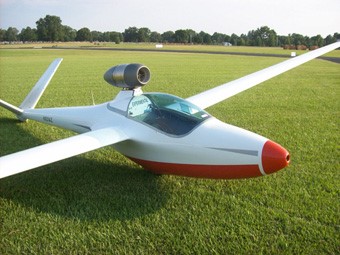
Bob Carlton’s Super Salto has been retrofitted with a 225 lb thrust jet from PBS in the Czech Republic. Powered by this new Jet engine, the highly modified Super Salto jet sailplane self-launches and performs both a classic sailplane aerial ballet and screamin’ low-level jet aerobatics.

The first flight of the Super Salto Jet Sailplane took place on October 8, 2008.

Start + Flug Salto
Wing span: 13.6 m (44 ft 7.5 in)
Length: 5.95 m (19 ft 6.25 in)
Height: 0.88 m (2 ft 10.75 in)
Wing area: 8.58 sq.m (92.4 sq ft)
Wing section: Wortmann FX-66-17-Al 1-182
Aspect ratio: 21.6
Empty weight: 180 kg (397 lb)
Max weight: 310 kg (683 lb)
Water ballast: None
Max wing loading: 36.13 kg/sq.m (7.4 lb/sq ft)
Max speed: 135 kt (250 km/h)
Stalling speed: 35 kt (65 km/h)
Min sinking speed: 0.6 m/sec (2 ft/sec) at 40.5 kt (75 km/h)
Max rough air speed: 135 kt (250 km/h)
Best glide ratio: 35 at 48.5 kt (90 km/h)

H101 Salto Normal
Wing span: 13.6m /44.6ft
Wing area: 8.58sq.m / 92.4sq.ft
Empty Weight: 182kg / 401lb
Payload: 98kg / 216lb
Gross Weight: 280kg / 617lb
Wing Load: 32.6kg/sq.m / 6.68lb/sq.ft
Aspect ratio: 20.6
Airfoil: Wortmann
L/DMax: 34 94 kph / 51 kt / 58 mph
Min Sink: 0.70 m/s / 2.3 fps / 1.36 kt
Seats: 1

H 101 Salto Aerobatic
Wing span: 13.6m / 44.6ft
Wing area: 8.58sq.m / 92.4sq.ft
Empty Weight: 182kg / 401lb
Payload: 98kg / 216lb
Gross Weight: 280kg / 617lb
Wing Load: 32.6kg/sq.m / 6.68lb/sq.ft
L/DMax: 34 94 kph / 51 kt / 58 mph
MinSink: 0.70 m/s / 2.3 fps / 1.36 kt
Aspect ratio: 20.6
Airfoil: Wortmann
Seats: 1

Stanton Sunbird

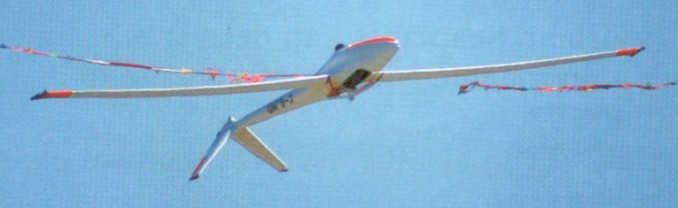
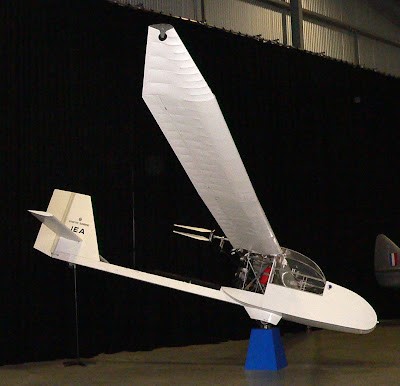
In early 1983, Charlie Stanton commenced a three-year project that would see him design and build the Stanton Sunbird powered glider.

The 28 hp Rotax 277 engine enables a take-off and climb to a height sufficient for the engine to be stopped, the propellor automatically folded and the aircraft to fly as a conventional glider. The engine can be re-started in flight if needed.

The single seat Stanton Sunbird motorglider ZK-JEA utilised various mechanical parts from Charlie’s earlier American Eaglet ZK-GOE.

It has a wingspan of 42 feet (12.8 metres) and was powered by a 27 HP Rotax 277 engine with a feathering propellor that could be restarted in flight if necessary. It was self-launching and flew successfully for over 10 years.

ZK-JEA (c/n 001) was registered as a Class 1 microlight to Charlie Stanton on 1 November 1994, and its first flight was on 26 February 1995 and over the next ten years Charlie made many flights including a maximum height of 13,000 ft and on another occasion a flight of 3 hr 30 min.

The registration was cancelled on 11 April 1997 as withdrawn.

Its final flight was on 16 April 2005.

On Sunday 4 December 2005, during the Ashburton Aviation Museum’s Christmas party, the Stanton Sunbird was donated to the museum by Charlie and his wife, Phyllis, where it is now on display.

Engine: 28 hp Rotax 277
Wingspan: 42 ft / 12.8 m
Wing area: 100 sq.ft / 9.2 sq.m
Wing loading: 5.3 lb/sq.ft / 26 kg/sq.m
Airfoil: Epple 748 High Lift
Empty weight: 313 lb / 142 kg
Payload: 214 lb / 97 kg
Max weight: 527 lb / 239 kg
Vne: 81 mph / 132 kph
Cruise: 45 mph / 90 kph
Stall w/flaps: 32 mph / 52 kph
Load factor: +- 4.4g
Service ceiling: 15,000 ft

SSVV Uribel

Uribel C

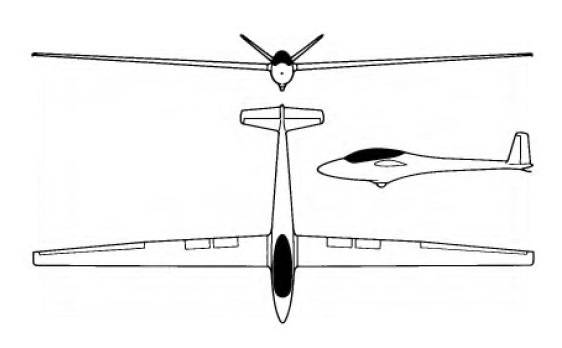
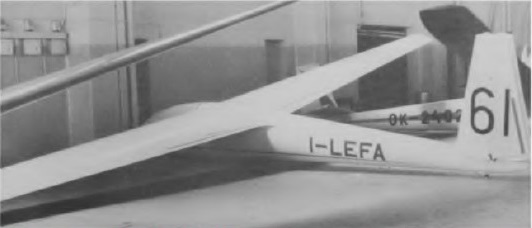
The SSW, or Sezione Sperimentale Volo Vela, was formed by the Aeroclub Volovelistio Milanese to maintain and repair the club’s gliders and also to build new designs. Eng Edgardo Ciani designed the Uribel single-seater Standard class sailplane, and after five examples of the Uribel and Uribel B had been built a small series of the improved Uribel C was started, this version having a completely redesigned wing and a fuselage of reduced cross section, but otherwise being similar to the B.

Like its contemporary, the Standard Austria, the Uribel C is a cantilever shoulder wing monoplane of all-wooden construction with a ‘butterfly’ V-tail. The C’s plywood-covered wings are of Eppler 257 aerofoil section and of 17% thickness/chord ratio; air brakes are fitted and there are no flaps. The fuselage is a wooden monocoque structure, with the cockpit canopy faired completely into the top profile of the nose section. There is a fixed monowheel and a small tailskid.

Uribel C
Span: 49 ft 2.5 in
Length: 19 ft 6 in
Wing area: 148.5 sq ft
Aspect ratio: 16.2
Empty weight: 463 lb
Max weight: 683 lb
Min sinking speed: 2.17 ft/sec at 43 mph
Best glide ratio: 31:1 at 48 mph

SSVV Gheppio R1

The SSW, or Sezione Sperimentale Volo Vela, was formed by the Aeroclub Volovelistio Milanese to maintain and repair the club’s gliders and also to build new designs. It concentrated at first on reconditioning Zogling and Allievo Cantu primary training gliders. It built the small Gheppio R1 single-seater designed by Eng Gianfranco Rotondi.

SSVV EC 40 Eventuale

The SSW, or Sezione Sperimentale Volo Vela, was formed by the Aeroclub Volovelistio Milanese to maintain and repair the club’s gliders and also to build new designs. It concentrated at first on reconditioning Zogling and Allievo Cantu primary training gliders. It built the prototype EC 40 Eventuale two seat trainer, designed by Eng Edgardo Ciani.

SSVV Urendo EC 38-56

The SSW, or Sezione Sperimentale Volo Vela, was formed by the Aeroclub Volovelistio Milanese to maintain and repair the club’s gliders and also to build new designs. It built a small series of the Urendo EC 38-56 two-seater designed by Eng Edgardo Ciani.

SSVV Spillo EC 37-53

The SSW, or Sezione Sperimentale Volo Vela, was formed by the Aeroclub Volovelistio Milanese to maintain and repair the club’s gliders and also to build new designs. It concentrated at first on reconditioning Zogling and Allievo Cantu primary training gliders, and its first new product was the CVV 7 Pinocchio single-seat sailplane. This was followed by the Spillo EC 37-53 high performance single-seater, designed by Eng Edgardo Ciani.