The Sutton Airedale was built by Mr Sutton in 1920/1 and first flown at Weeton, UK, on 15 February 1931.
Glider
Sunderland MOBA 2
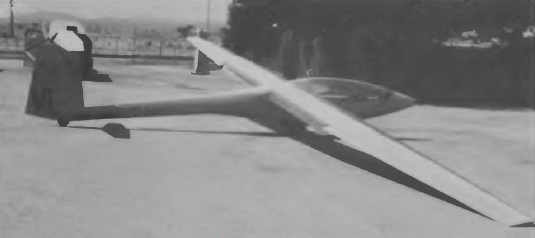
In 1972 the MOBA-2A, designed by an aircraft engineer, Gary Sutherland, was one of the two winners of an Australian Gliding Federation competition to design a 13 m (42 ft 8 in) sailplane which could be built in a small workshop with limited tools.
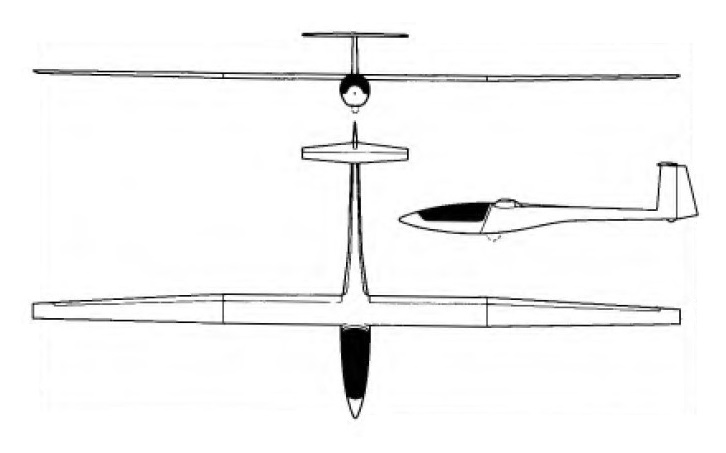
Designed and built by Mr Gary Sunderland of Heatherton, Victoria, an engineer with the Australian Department of Civil Aviation, the MOBA 2C is a Standard Class single-seater developed from the MOBA 2A, one of two 13m span sailplanes that competed with each other in 1972 in a design competition organised by the Australian Gliding Federation. MOBA is an acronym for My Own Bloody Aircraft, and the MOBA 2B was a 15m span version of the 2A; the 2C is an improved version of both the earlier models with a 15m span and the fin and rudder height increased to 4ft.
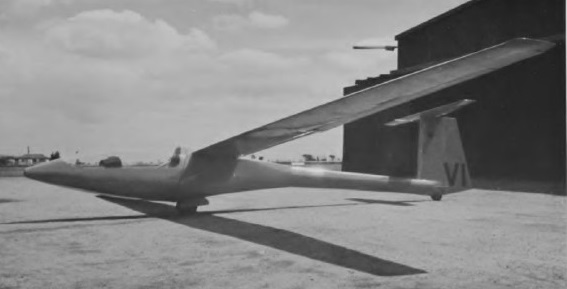
The prototype 2C made its first flight on 12 December 1979 and is a cantilever high wing monoplane of mixed construction with a T-tail; series production was not intended. The single-spar wings are built in three pieces and have plywood ribs with PVC foam infilling, and a skin of pop-riveted aluminium alloy sheet covered with glassfibre. The plain aluminium alloy flaps on the trailing edge also serve as air brakes, and the wooden ailerons are plywood-covered. The nose and centre fuselage are box structures of sheet aluminium alloy with a non-structural glassfibre skin, while the tail boom is of flush-riveted aluminium alloy sheet. The fin and rudder are also of flush-riveted aluminium, while the tailplane and elevator are of wood and plywood. Landing gear consists of a retractable monowheel and a fixed tailskid, while the pilot sits under a forward-sliding canopy.
MOBA-2A
Wingspan: 42 ft 8 in / 13 m
MOBA-2C
Span: 49 ft 2.5 in / 15.0 m
Length: 22 ft 3in / 6.78 m
Height: 4 ft 4 in / 1.32 m
Wing area: 97.7 sq ft / 9.08 sq.m
Wing section: Wortmann FX-67-K-150
Aspect ratio: 24.74
Empty weight: 499 lb / 226 kg
Max weight: 730 lb / 331 kg
Max wing loading: 36.5 kg/sq.m / 7.48 lb/sq ft
Max speed: 121 mph / 105 kt / 194.5 km/h (in smooth air)
Max aero-tow speed: 101 mph / 88 kt / 163 km/h
Stalling speed: 42 kt / 78 km/h
Min sinking speed: 2.0 ft/sec / 0.61 m/sec at 52 mph / 45 kt / 83 km/h
Best glide ratio: 37:1 at 57.5 mph / 50 kt / 93 km h
Sullivan Aircraft Manufacturing Co
1929:
(William P) Sullivan Aircraft Mfg Co,
630 E Gilbert St,
Wichita KS.
USA
In 1930 built a low-wing cabin monoplane which was developed as the K-3.
Sullivan also built about a dozen SG-1 gliders in 1930 for use at Braley School of Aviation.
Sukhanov Diskoplan-2

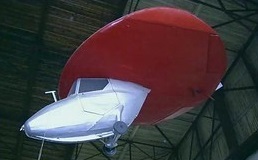
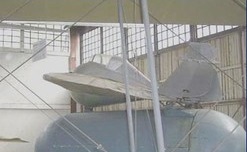
A 1960 version of the Discoplan 2 aircraft’s structure appears to have been based on a wooden or steel truss covered with lacquered canvas — standard lightplane and glider construction. Apparently the disc-shaped vertical “fin” was designed to revolve on a horizontal axis like a bicycle wheel — possibly to provide some sort of gyroscopic stabilization to the aircraft’s control system via a system of cables and struts.
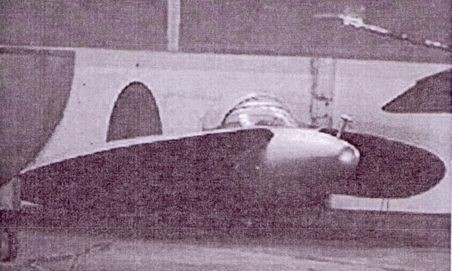
The construction was carried out by Lavochkin. The circular wing has neither ribs or longerons. The light alloy edging around the perimeter of the “wheel” serves only to give a streamlined form to the tip. It is controlled by ailerons and rudder.

Reported in March 1963, the circular wing Discoplan II was successfully tested on an airfield near Moscow in the previous Autumn.
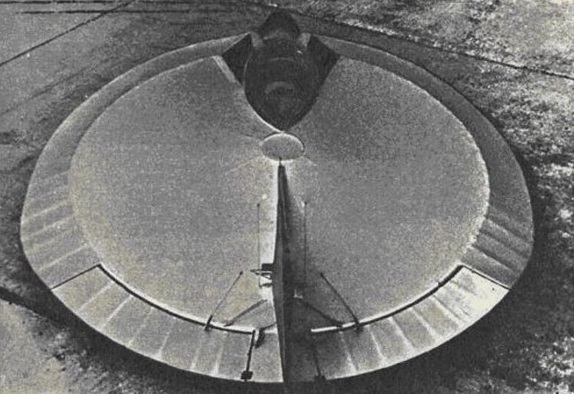
The Discoplan-II was piloted by Vladimir Ivanov, a glider expert.
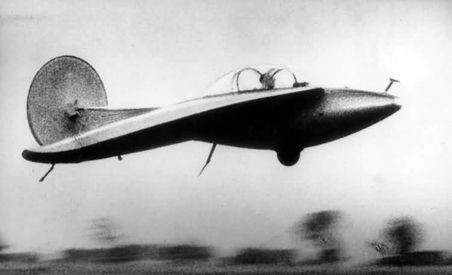
One of the main features of the machine discovered during tests was the aerodynamic effect of the ‘air cushion’. Owing to the proximity of the wing to the ground, and thanks to its circular form, the influence of the cushion on the landing and take-off characteristics proved most beneficial. At a height of 1.5-2m / 59-79 in Discoplan-II automatically stabilised both in the lateral and transverse directions and could fly without the pilot touching the controls. In gliding down to land the pilot also felt how the Discoplan was “padded” by the air cushion. Thus, the landing was also of an automatic.
Wingspan: 5 m / 16 ft 5 in
Wing area: 20 sq.m
Empty weight: 240 kg
Gross weight: 240 kg / 529 lb
Wing loading: 12 kg/m2
Seats: 1

Sukhanov Diskoplan-I
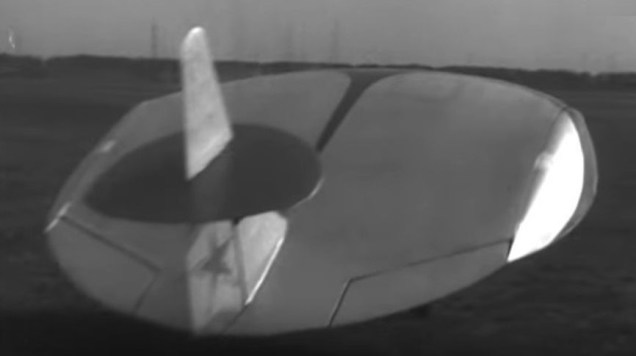
.During 1949-50 Master of Technology M.V.Sukhanov built an experimental single seat glider having a wing and control surfaces circular in planform, which he called Discoplan-I. The wing diameter was 3.5 m / 11 ft 6 in, and the gross weight was 230 kg / 507 lb.

The flight trials of the Diskoplan-I were carried out under the direction of the designer by a team of young engineers from the Voluntary Society for Assisting Army, Air Force and Navy, and covered aerobatics. It proved absolutely spin-proof.

It was flying in 1957.

Sud-Ouest M.1
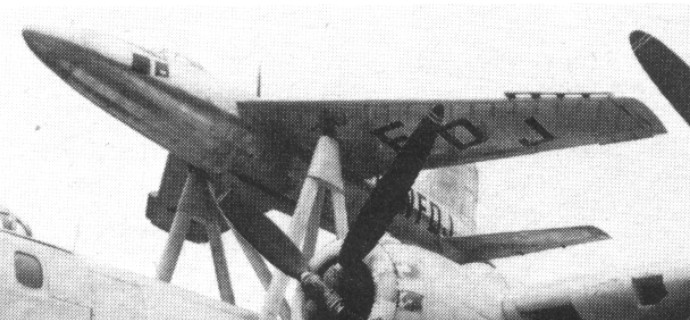
The half-scale model predecessors of the SO 4000 were the SO M.1 glider (F-WFDJ) and the powered SO M.2 (F-WFDK), these featuring a laminar flow wing swept 31 deg at the mainspar, mounted in the high-mid position and combining small ailerons interconnected with spoilers and leading-edge slats. The undercarriage consisted of a retractable central skid with wingtip stabilising skids in the case of the M.1, while that of the M.2 comprised a nosewheel, three main-wheels in train and wingtip outrigger wheels.
After trials attached to a rig mounted above the Heinkel He 274, the M.1 was tested in free flight for the first time on 26 September 1949 after being launched from an SE 161 Languedoc.
Sud-Ouest / Ouest Aviation
France
Formed 1935 at Bordeaux-Merignac by the Potez group when it took over the Societe Aerienne Bordelaise. Was intended as a decentralized production source for Potez and Bloch aircraft. A prime responsibility was development and production of Bloch types, especially single-seat fighters derived from MB.150 of 1936. Redesign facilitated production and improved performance, resulting in MB.151 and 152. By June 1940 production totaled about 600, involving five plants. MB.175 twin-engined bomber was in production and was revived after Second World War as torpedo aircraft. Several other prototypes built, including four-engined bomber.
In France, the Socialist Government of the so called Popular Front brought all the companies building military aircraft, aero engines and ar¬mament under its control in 1936. The im¬mediate result was the socialized oblivion of such established companies as Marcel Bloch, Bleriot, Nieuport, Potex, Dewoitine, Hanriot and Farman within half a dozen nationalized groups or Societies Nationales, named ac¬cording to their geographical location (Nord, Ouest, Centre, Midi and so on).
Incorporated in SNCASO 1936, incorporating the factories of Marcel Bloch, Bleriot and Liore et Olivier, subsequently merging with SNCASO and changing name to Ouest Aviation in 1956.
In 1942 completed forerunner of Bretagne twin-engined transport, though not flown until 1945; then used commercially and experimentally. Numerous and varied post-Second World War types included distinctly unusual forms of rotary-wing aircraft. Aeriel (1948) and Djinn (1953) with tip jets, and Farfadet convertiplane (1953).
Aerocentre went into liquidation during 1949, its plants and work being shared by SNCAN (Nord), SNCASO (Sud-Ouest) and engine form SNECMA.
Original designs included S.O.94R twin-engined trainer; S.O.95 Corse, and S.O.30 Bretagne military transports; S.O.4050 Vautour twin-jet bomber; and the S.O.9000 Trident. The S.O.1221 Djinn two-seat helicopter was produced, and Vertol H-21 helicopters were manufactured under license for the French Army. Ouest became part of Aerospatiale.
After World War II, although four of the nationalized groups continued operating un¬der state control, private companies were al¬lowed to resume the design and manufacture of both civil and military aircraft. Some of the pioneering names of French aviation, such as Breguet and Morane Saulnier, returned to prominence, and by 1950 a new one had been added Avions Marcel Dassault.
Loire-Nieuport joined SNCASO in 1942.
SNCASO and SNCASE joined to form Sud-Aviation in 1958.
Stupar, Maximillian
Maximillian Stupar was born on Sept. 23, 1885 in Metlika, Slovenia, where he learned the delights of flying kites. Even after his parents uprooted Max from the empire of the Hapsburgs to South Chicago, that joy never left him. He followd the exploits of Octave Chanute, another transplanted European (from France) who had found a home in Chicago and had developed an interest in kites.
Max was inspired by Chanute’s building on the landmark glider experiments of Otto Lilienthal, a German, to write Progress in Flying Machies (1894). This book was the bible of aeronautics. Max’s book, some glider experiments he attempted in the dunes of Indiana, Miller Beach, during 1896, and in Dune park during 1897, provided the design for the Wright brothers’ first airplane.
But while Chanute and the Wright brothers were becoming aeronautical icons, Max managed to elude celebrity. In 1902, as the Wright brothers also experimented with gliders, Max began his own experiments. Instead of taking off from the dunes of Kitty Hawk, Max leaped from the tops of houses, barns, low hills, and slopes of South Chicago.
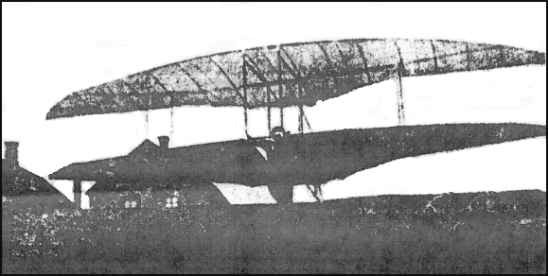
His gliders sometimes reached the awe-inspiring altitude of 300 feet. Some neighbors demanded the kid be given a saliva test. Then, like Octave Chanute, Max moved his experiments to the sands of Dune park, which led in 1908, to his construction of his first airplane. The plane cracked up before Max could test it properly.
Undeterred, Max patterned a plane after the one Louis Bleriot had used to fly the English Channel. He made a test flight to Milwaukee, lifting the hydroplane from the waters of Sandy Beach at 95th and the Big Lake the following year. That plane also had a short life, ignominiously plowing into Chicago’s first airfield, Cicero Field at 22nd and Cicero.
In 1910, he opened the Stupar Aero Works in South Chicago, then sold it in 1912 to the Chicago Aero Works for a one-third ownership, and a position as chief engineer. Between 1912 and 1916, Chicago Aero built 30 airplanes and introduced the Stupar Tractor Biplane, the first biplane to use an enclosed fuselage and tractor propellor.
With a glowing resume that proclaimed Max an aviation pioneer, he left South Chicago, in 1916, to join the Standard Airport Corporation in New Jersey.
With America’s entry into World War I Max returned to Chicago as a member of the inspection service for the new U.S. Air Service, and then went to Buffalo, and finally Washington, D.C., as assistant chief of wood inspection for airplane construction.
Throughout the war, and until 1922, airplanes were made almost exclusively of wood, the so-called “stick and wire” construction. Max knew more about that than just about anybody, having worked closely with several South Chicago lumber firms. He also authored a book entitled “Wood Technology,” as he drifted farther away from the cockpit.
After the war, Max became an engineer with the G. Elias and Brothers Lumber Co., which was just getting into aircraft design. In 1927 joined Curtiss Airplane. He stayed with Curtiss until 1939, as chief of the estimations department, in which post he originated the definitive advanced system of airplane cost estimating.
When war started again in Europe during 1939, not only did Max help develop the modern method of assembly-line airplane construction, he became liason between the government and the aircraft industry, flying all over the country in the process.
On Nov. 27, 1941, near the Dayton field named of the Wright Brothers, Max fell to the earth for the last time.
Strojnik S-2
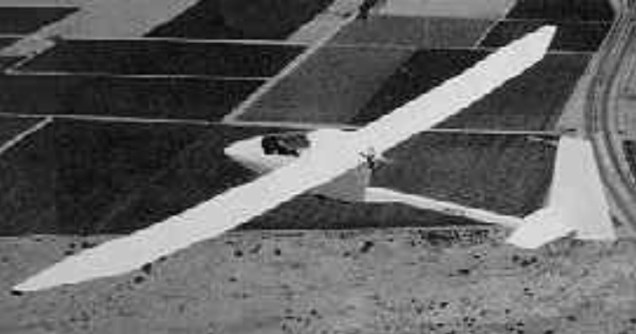
Designed by Alex Strojnik, the S-2 uses carbon fiber and aluminum wing spars with fiberglass skins. The fuselage pod is wood skinned with fiberglass, the boom is aluminum and the tail group is carbon-reinforced and skinned with fiberglass. The fixed gear consist of two small wheels in tandem. The Kohler engine drives a foldable propeller. Glidepath control is by flaps.
Designed by Alex Strojnik, the S-2a is a pod and boom pusher with folding propeller. The span is 15 meters and the best L/D is about 34:1. Alex made many excellent soaring flights with his motorglider, including diamond goal distance. A number of these have been built. Plans are no longer available for sale.
S-2
Wing span: 15 m / 49.2 ft
Wing area: 11.8 sq.m / 127 sq.ft
Aspect ratio: 19
Airfoil: Modified Wortmann
Empty Weight: 280 kg / 617 lb
Payload: 165 kg / 363 lb
Gross Weight: 445 kg / 980 lb
Wing Load: 37.11 kg/sq.m / 7.7 lb/sq.ft
L/DMax: 34 88 kph / 48 kt / 55 mph
MinSink: 0.67 m/s / 2.2 fps / 1.30 kt
Seats: 1
Structure: aluminum, wood and fiberglass
Streifeneder / Hansen Falcon
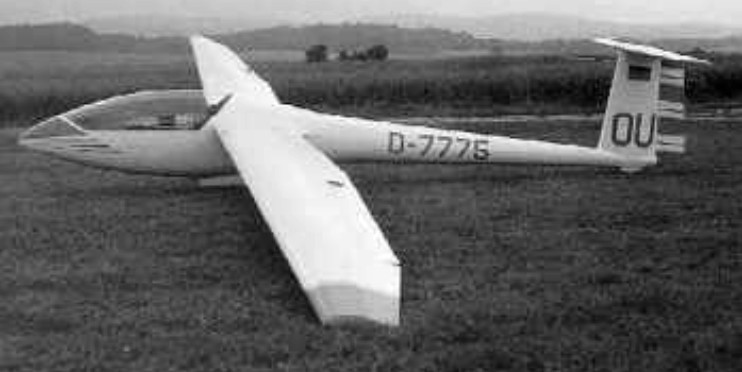
Wing span: 15 m
Wing area: 10.66 sq.m
Aspect ratio: 21.11
Airfoil: HQ-21/17.5
Empty Weight: 240 kg
Gross Weight: 450 kg
Wing Load: 42 kg/sq.m
L/DMax: 41 kph
MinSink: 0.58 m/s kph
Seats: 1
Structure: GFK
No. Built: 1
 All Aero