Shen Yang, near Mukden
Quantity production of Polish designed ABC, Bocian, Jaskolka and Mucha sailplanes began at Shen Yang in 1955-56. At about the same time, a design team was formed under the leadership of Dipl./Ing. J.Niespal of the Polish SZD (experimental glider establishment).
The first product of this team, which included Dipl.Ing Tchen-Kuei-Wen and Li-Ti-Tiun, was the Lie-Fang No.1.
Glider
Taylorcraft Glider
Piper was new to the airplane business but not to business principles, so he asked Taylor to design an inexpensive, easy to fly trainer that the average person could afford to rent. Most of the training planes of the time were older, relatively heavy biplanes requiring correspondingly powerful engines. The cost of learning to fly was therefore quite high. Piper figured that an airplane cheap to buy and operate might cut that cost in half, enabling more people to fly, which would require operators to buy more planes from him.
Taylor first built a glider that looked like a small Breezy. Those who later called the Cubs powered gliders were not far from wrong, because the E 2 Cub evolved from towing that glider behind a car up and down the Bradford runway.
Taylor, Molt
Born in 1912 in Portland, Oregon, Moulton B. (Molt) Taylor developed the Aerocar, the flying automobile that is easily converted back to a car with trailerable wing and tail components. Taylor started out in 1948 with $50,000 capital put up by businessmen in his home town of Longview, Washington. But his innovative ideas have found their way into many other unusual aircraft including the US Navy XLRQ-1 Amphibious Assault Glider, the Coot Amphibious aircraft, the IMP (also known as the Ascent 1 Tribute) and the Mini-IMP and Micro-IMP.
He wrote regularly for Sport Aviation, and other aviation magazines on everything from engine selection to static testing of aircraft parts.
1961: Aerocar International, Longview.
c.1970: Aerocar Inc.
Moulton B “Molt” Taylor, Chehalis and Longview WA. USA
1980: MB. (Molt) Taylor, P.O. Box 1171, Longview, WA 98632, USA.
Mini-IMP Aircraft Co, Saginaw TX. USA
2001: Aerocar International.
Molt was officially inducted into the EAA Hall of Fame by Paul Poberezny on November 10th, 1995. Only 6 days later, on November 16th, he left this world and us behind.
Aerocar International is a new firm formed by Roy Hyde (Hyde Investment Co) of Ft Worth TX with Molt Taylor as vice president-engineering and Herman Zimmer, vice president-marketing. Taylor, who first flew his Aerocar in 1950 and has logged more than 1,000 flight hours and 100,000 road miles on the vehicle, was a naval aviator and project engineer at the Naval Aircraft Factory where he was in charge of pilotless aircraft and missile development prior to setting up Aerocar Inc in Longview.
Taylor 1909 Glider / Aerial League 1909 Glider

In 1909 Mr. George Taylor, secretary of the Aerial League, took a biplane,18ft long, with 4ft planes, and box-kite tail balance, to Narrabeen, NSW, Australian-built glider. The trials at gliding were held, Mr. Taylor himself acting as demonstrator. The scene of the flights was at Narrabeen Heads, in the presence of about one hundred visitors, the wide stretch of sand rendering any possible fall a matter of some safety. At the beginning of the experiments the wind came from the south-east at 10 miles an hour. The machine was carried to a sand knoll, and brought face on to the wind. Messrs. Schultz, Le Clerc, and Gibbons, of Narrabeen, required all their strength to hold it down. For the preliminary flights the corners were held by guide ropes 15ft in length to prevent the machine from getting out of control before the experimentor was properly tuned to automatic balancing.
At the commencement of the latest flights the wind came from the north-east at a pace of only three knots, hardly sufficient to give the necessary lift to the machine. A few attempts were made, but they wore too short and too close to the ground. The wind, however, increased in volume, and at 6 o’clock a 15-knot breeze was coming from the north-east. As the machine was wheeled face on, it shot up with Mr. Taylor to a height of 25ft, and soared the full length of the course. The demonstrator, by means of the-elevating plane, brought the machine rather sharply to the ground at the water’s edge. Tho second flight was even more successful, the machine during its course actually poising for about 10 seconds, owing to its being tilted at an angle that for a short time allowed the wind to counterbalance the soaring tendency.
At the signal to let go the machine was well lifted by the wind, and by careful manipulation on the part of Mr. Taylor it shot towards the ocean 98 yards away in a series of curves from 3ft to 15ft above the ground, dragging its guides, who, however, pulled it to the ground at the water’s edge. Twenty-nine successful flights were made by Mr. Taylor and Mr. Hallstrom, an enthusiastic member of the Aerial League. As the afternoon wore on the flights improved on account of the wind freshening to 15 miles an hour, and coming directly from the east so much so that the last flight of the day was notable.
At “let go” the wind immediately lifted the machine to the full length of the guide ropes, and dragged the operators so fast to the ocean that two let go; the machine now soared to-wards the ocean, and at the water’s edge the remaining guide ropes were loosened, the machine making a leap upwards. Mr. Taylor by careful manoeuvring, kept the machine well under control, and dived it in the sea some little distance from the heads. The machine will be fitted with steering gear and other improvements for further flights. Mr. Taylor’s monoplane is now having its powerful engine fitted to it at Gibson and Son’s motor works at Balmain, and he hopes to have it in the air during Christmas week. If the flights are as successful as anticipated the machine will be placed at the disposal of the military authorities during the Kitchener camp and review.
Tatlin Letatlin

The ornithopter designed by Vladimir Tatlin from 1929 to 1932 and Tatlin built three versions of his machine. The word Letatlin is formed from the verb letat (fly), associated with the name of its creator, Tatlin. In the Stalin years, Tatlin, one of the major artists of the constructivist movement of the Soviet revolutionary years, designed his ornithopter inspired from birds.
Tatlin had carried out a trial flight that hadn’t worked out.
The ornithopter designed by Tatlin from 1929 to 1932 had disappeared. It had been more or less abandoned for twenty years in a warehouse belonging to the Molino Russian Federation Central Air force museum, next to Star City, the Youri-Gagarin cosmonaut training center fifty kilometers away from Moscow. It was the KSEVT, team, the space culture center in Slovenia, that by chance came across the machine in a precarious state during a protocol visit to the Monino museum in 2014. In February 2014, they were taken to the historical part of the Monino museum where one can see pioneers’ flying machines, since the Russians went into aeronautics very early. Miha Turšič, director of KSEVT until 2016, member of the collective Postgravityart, spotted the Letatlin in the corridors of the Monino museum in April 2014.
While the group was in discussion, Miha Turšič went ahead, getting a bit lost in the aisles of the museum, and suddenly I found myself face to face with a machine that looked like a plane but wasn’t one. He knew of the Letatlin and there it was right in front of him. We immediately asked if they knew what they had there, one of the most iconic works of 20th century art. They told us: “Yes, it’s an old Russian artist who built sort of flying machines rather like Leonardo de Vinci.” They had no idea of the importance of the piece. They considered it as best as an experimental flying machine that had never flown. Tatlin was mentioned, but with no context.
It was Letatlin n°3 that was found. It would have reached Monino in 1996 after being damaged on the way back from a presentation in an exhibition in Athens and was left there, abandoned in the context of complicated years following the collapse of the USSR.

The Molino Air force museum had just retrieved it a year earlier from the museum storeroom where it lay in bits in a corner, deteriorated, really damaged, and they had reassembled it to hang it in their museum.

It was obvious that a renovation was necessary for the Letatlin. The Monino museum and the Tretiakov gallery finally found an agreement for its renovation. Turšič went to Moscow at the end of December 2017 to meet the curator of the museum and saw it displayed in the 20th century art collection.
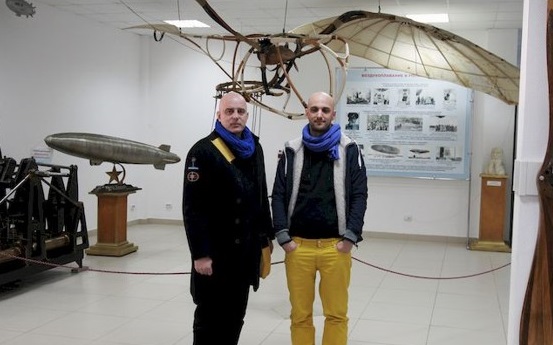
The Letatlin finally found the perfect place for its presentation to the public.
Tainan F-5 / TN-1
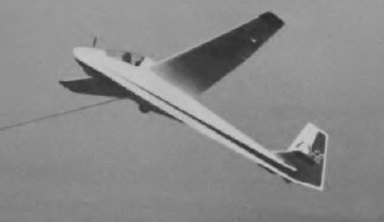
Also known by the manufucturers’ designation F5, the TN-1 single-seater was designed by Yukio Tanaka and construction of the prototype began in August 1974; this made its first flight in December 1976. The Japan Civil Airworthiness Board was conducting certification trials in the spring of 1978 and it was hoped to begin production in the summer of that year.
Of conventional wood and fabric construction very similar to the Mita III, the TN-1 had cantilever single-spar high wings of spruce and plywood, with fabric covering and a forward sweep of 2″ 4′ at the quarter-chord line; the wooden ailerons are ply-covered and there are Schempp-Hirth air brakes. The steel tube fuselage framework has fabric covering over wooden stringers, and the nose is of glassfibre. The wooden tail unit has fabric covered elevators and rudder, and there is a trim tab in the starboard elevator. There is a non-retractable unsprung monowheel mounted at the cg with a band brake, plus a tailskid.
Span: 50 ft 10.5 in
Length: 25 ft 0.75 in
Height: 7 ft 2.75 in
Wing area: 172.0 sqft
Aspect ratio: 15.03
Empty weight: 595 lb
Max weight: 837 1b
Max speed: 81 mph (in smooth air)
Max aero-tow speed: 81 mph
Min sinking speed: 2.59 ft/sec
Best glide ratio: 26:1 at 49 mph
Tainan Mita III / LADCO / Light Aircraft Development Co Mita III
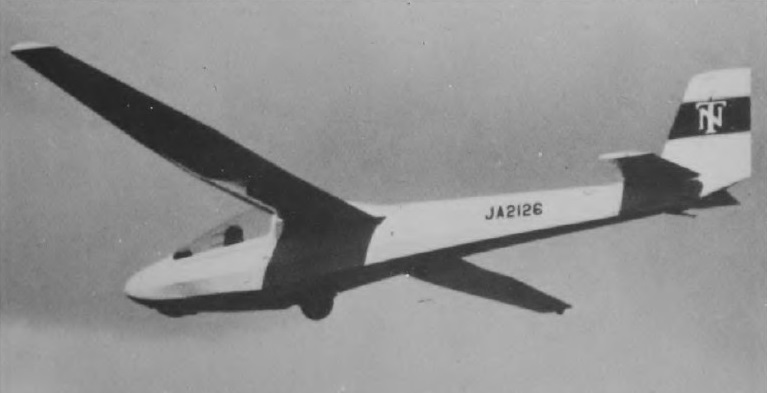
Japanese sailplanes of indigenous design often represent, as does the Mita III tandem two-seater training and sporting glider, an essentially conventional design philosophy. The Mita was built by LADCO – the Light Aircraft Development Co of Tokyo, whose designer was Mr Asahi Miyahara, and its production has been continued under licence by the Tainan Industry Co Ltd (Tainan Kogyo KK) after the latter took over the manufacture of sailplanes from LADCO; by 1 January 1979 a total of 37 Mita IIIs had been built.
Of conventional wood and fabric construction, the Mita has cantilever shoulder wings of constant chord centre section with tapered outer panels, of all-wood single box spar construction with plywood covering. The ailerons are fabric-covered and there are Schempp-Hirth air brakes in the wing upper surfaces. The fuselage is a steel tube framework with wooden stringers and fabric covering; the nose and forward section are of glassfibre, and there is an aero-tow release in the nose as well as a winch release at the cg. The wooden tail unit has a fabric covered rudder and elevators, and the landing gear consists of a rubber-sprung non-retractable monowheel with brake, plus a tailskid. The pilots sit under a flush-fitting two-piece blown canopy that hinges sideways to starboard for entry and exit.
Mita 3
Span: 16.0 m / 52 ft 5 in
Length: 7.96 m / 26 ft 1.5 in
Height: 1.28 m / 4 ft 2.5 in
Wing area: 15.87 sq.m / 170.82 sq.ft
Aspect ratio: 16.13
Wing section: NACA 633/618
Empty weight: 300 kg / 661 lb
Max weight: 450 kg / 992 lb
Water ballast: None
Max wing loading: 28.4 kg/sq.m / 5.81 lb/sq.ft
Max speed: 118 mph / 103 kt / 190 km/h (in smooth air)
Max aero-tow speed: 81 mph
Stalling speed: 33.5 kt / 62 km/h
Min sinking speed: 0.72 m/sec / 2.36 ft/sec at 47 mph / 40.5 kt / 75 km/h
Best glide ratio: 30:1 at 51 mph / 44 kt / 82 km/h
SZD IS-2 Mucha
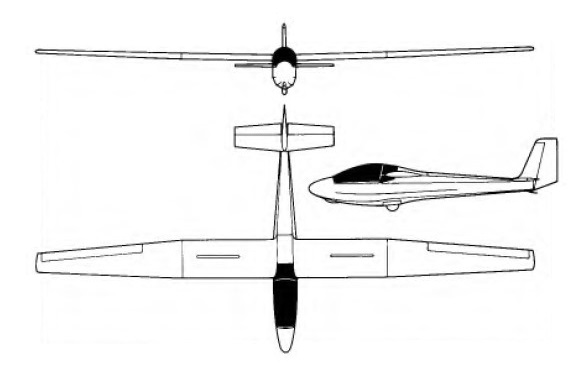
The SZD-22 Mucha Standard Standard Class single-seater had its origins in the IS-2 Mucha (or Fly) intermediate single-seater of 1948, which was produced in several versions and used in some numbers by the Polish gliding clubs; the Mucha-ter set up several national records for altitude and distance, and the type achieved several Diamond C flights. The IS-2 Mucha had a single-spar high wing with an aspect ratio of 15, and was fitted with dive brakes and spoilers; the fuselage was of elliptical cross-section. The Mucha-ter was developed into the SZD-12 Mucha 100 of 1953, this single-seater being used for training. It was of all-wood construction, the cantilever high wings having a single main spar and an oblique auxiliary spar, with a plywood-covered leading edge torsion box; air brakes were fitted and the ailerons were aerodynamically and mass balanced. The oval-section fuselage was plywood-covered and the pilot sat under a onepiece Plexiglas canopy. Landing gear consisted of a monowheel and short front and rear skids sprung with rudder pads.
Swift S.1

The GFRP Swift, which first flew in 1991, was designed as a sailplane for contest aerobatics (about 10 g). It has optional wingtip extensions which increase the span to 15.0 m / 49.2 ft. The main wheel is retractable. Approach control is by top surface Schempp-Hirth type airbrakes. Moving tail surfaces are fabric covered.
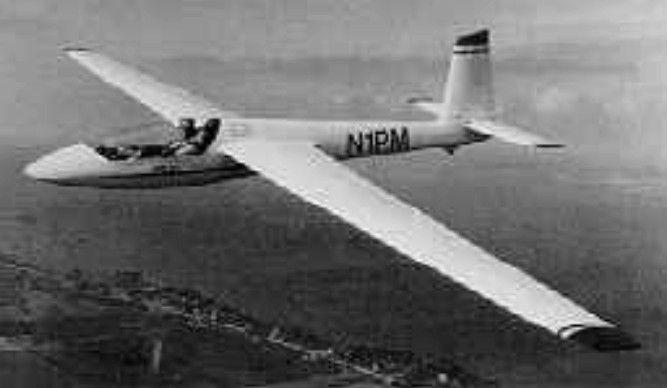
S-1
L/DMax: 28 127 kph / 68 kt / 78 mph
MinSink: 0.97 m/s / 3.18 fps / 1.88 kt
Wing span: 12.7m / 41.6ft
Wing area: 11.69sq.m / 125.8sq.ft
Empty Weight: 300kg / 660lb
Payload: 110kg / 242lb
Gross Weight: 410kg / 902lb
Wing Load: 35.07kg/sq.m / 7.17lb/sq.ft
Aspect ratio: 14.3
Airfoil: NACA 64/ 1-412
Seats: 1
S.1A
Swales SD3-15
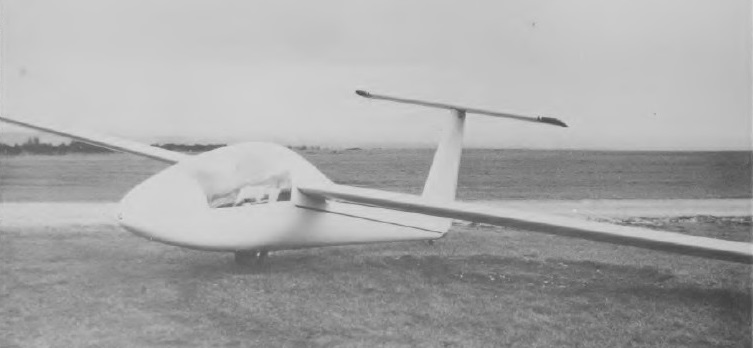
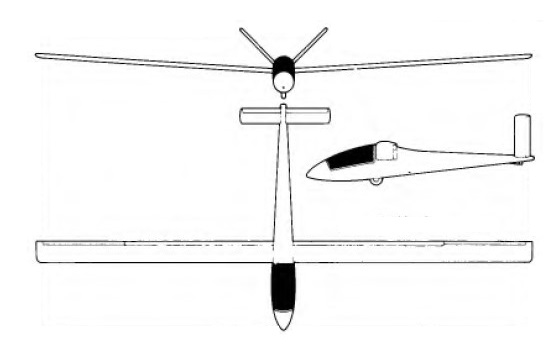
This single-seater 15m span sailplane is designed especially for use by clubs and small syndicates, with the emphasis on low running costs and capital outlay together with safe flying qualities. Available in two forms, as the SD3-15T with a T-tail and the SD3-15V with a V-tail, the Swales was developed from the Birmingham Guild BG 135 Gipsy, the 13.5m span version of the BG 100/12 designed by J. C.Gibson, K. Emslie and L. P. Moore of Sailplane Design Ltd. Manufacturing rights of the BG 135 were acquired by Yorkshire Sailplanes Ltd, who built a batch of seven as the YS 55 Consort. The BG 135 was itself developed from the earlier and very similar Birmingham Guild Gipsy 12/15 project which, like the BG 100/12, was intended to be a low cost lightweight Standard/Sports Class sailplane in which either a medium-performance 12m wing or a high performance 15m one could be fitted to a common fuselage and tail unit. This was to be achieved by special attention to structural efficiency resulting from efficient wing skin stabilisation, with rigid foam cores, and low cost was achieved by eliminating taper as well as twin-skin sandwich or ribbed forms of construction. The prototype BG 100/12, with a 12m (39ft 4in) span wing, first flew on 7 April 1970 and, like the later SD3-15V, was a cantilever shoulder-wing monoplane of all-metal construction with a V-tail and a large hinged moulded cockpit canopy; a 13.5m span wing was later fitted.
Construction of the prototype SD3-15 began in September 1974 and it first flew in March 1975, being designated SD3-13V. The first prototype SD3-15V first flew in July 1975 and the first SD3-15T made its maiden flight in December 1976, the suffix letter denoting the tail configuration; six SD3-15s had been built by mid-1979; production was then only to order and was restricted to the T-tailed SD3-15T.
Structurally, the SD3-15 is very similar to the BG 135 and BG 100/12 from which it was developed; the constant chord wings have metal and polystyrene ribs and glassfibre reinforced plastic (GRP) wing tips, and the trailing edge flaps also act as air bakes. The plain metal ailerons have foam ribs. The metal skinned semi-monocoque fuselage has a GRP nose cone and is built up on four longerons. The landing gear consists of a non-retractable monowheel with an internally-expanding brake, and a tailskid. Both versions have a metal tail unit with 50% foam ribs; the SD3-15T has a full-span elevator with spring trim while the SD3-15V has all-moving tail surfaces with anti-balance tabs. The cockpit canopy opens sideways to starboard.
SD3-15T
Span: 15.0 m / 49 ft 2.5 in
Length: 6.1 m / 20 ft 0 in
Height: 1.30m / 4 ft 3 in
Wing area: 9.57 sq.m / 102.0 sq.ft
Aspect ratio: 23.7
Wing section: Wortmann FX-61-168
Empty weight: 222 kg / 490 lb
Max weight: 330 kg / 728 lb
Water ballast: None
Max wing loading: 34.48 kg/sq.m / 7.06 lb/sq ft
Max speed: 125 mph / 109 kt / 201 km/h (in smooth air)
Max aero-tow speed: 90 mph
Stalling speed: 35 kt / 65 km/h
Max rough air speed: 86 kt / 159 km/h
Min sinking speed: 0.73 m/sec / 2.4 ft/sec at 48.5 mph / 42 kt / 78 km/h
Best glide ratio: 36:1 at 55 mph / 48 kt / 89 km/h
 All Aero