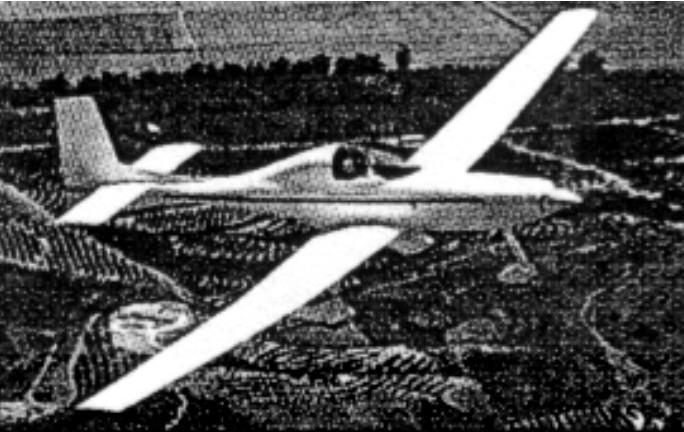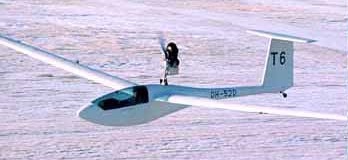
Tervamaki JT-6

Finnish company Eiri Avion started to build the PIK-20 B sailplane, an all-fiberglass/epoxy high-performance glider designed by a group of engineers (Tammi, Hiedanpää, Korhonen).

In 1975 an agreement was signed between Tervamaki and Eiri Avion to develop a retractable engine installation for the PIK-20B glider. The designation for the prototype was JT-6. It is a one-of-a-kind experimental machine used as a test bed for the production model which later emerged as PIK-20E (E for the engine).
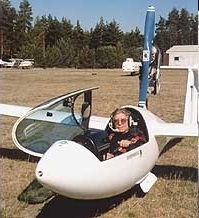
The modifications necessary to convert a PIK-20B glider into a JT-6 motorglider were as follows:
Engine installation including a retraction mechanism with automatically opening and closing doors, fuel tank, a 16-Ah battery plus engine gauges and controls.
The engine and propeller necessitated enlargement of the fuselage aft of wing and, therefore, a new fuselage center-section mold was made. The fuselage was bonded together from three sections.
The engine compartment opening required a strong beam around it to carry the loads.
All of the above modifications added some 70 kg of mass and moved the CG 100 mm (4 in) backwards. To compensate for this CG shift, the wings were swept 2 degrees backwards, necessitating new wing spars and new wing root fittings.
The wing spars were strengthened due to the increased fuselage mass.
The main landing gear was moved 100 mm (4 in) backwards and a steerable tail wheel was added, as was retractable outrigger wheels into the wings.
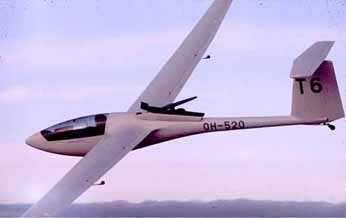
Tervamaki first flew the JT-6 in August 1976, registered OH-520X. There were numerous difficulties in the beginning, and the first flight was a near disaster. The first engine, a Canadian Kohler, was of too low power (33 hp). In addition, the Kohler factory ceased working in 1977 but, a good, new choice was found in the Rotax 502. It was the first Rotax 502 installation in an aircraft. With the Rotax 502 the plane had a climb rate of 3.5 m/s.
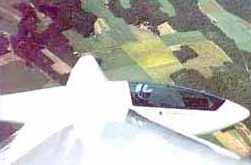
Since the machine was an experimental prototype, a lot of things changed during the test flights and thereafter during the 20+ years of flying. The most serious ones are a couple of engine seizing due to too lean mixture.

An article about JT-6 appeared in Homebuilt Aircraft, August 1980. Self-Launch!, a book by Peter A. Williams from 1998 thoroughly describes motorglider history including the JT-6 in detail.

The JT-6 logged 1621 hrs in 23 years of flying of which less than 5 percent was by power, the rest was soaring.

The JT-6 was handed over in an airworthy condition to the Finnish Aviation Museum in May 2007.
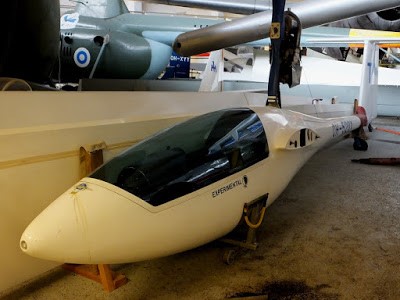
OH-520X / T6

Tekniske Silhouette

A 9 ft wing extension converts to a motor-glider. Available from Lunds Tekniske.

Engine: Rotax 447, 40 hp
Height: 6.66 ft
Length: 19.25 ft
Wing span: 32 ft
Wing area: 76 sq.ft
Fuel cap: 12 USG
Weight empty: 576 lbs
Gross: 825 lbs
Speed max: 125 mph
Cruise: 120 mph
Range: 460 sm
Stall: 50 mph
ROC: 800 fpm
Take-off dist: 800 ft
Landing dist: 800 ft
Service ceiling: 10,000 ft
Seats: 1
Landing gear: nose wheel

Teichfuss Nibio

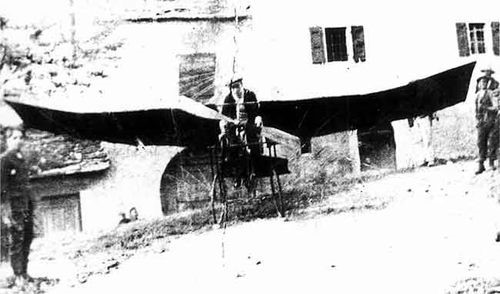
The Teichfuss Nibio (the German-speaking Teichfuss’s spelling of the Italian Nibbio or English: Kite) was an Italian single seat glider, designed by Luigi Teichfuss.

The original Nibio, the Nibio I was designed as a primary glider and was built in the Royal Aircraft factory at Pavullo nel Frignano Airport during 1929. Apart from its span of 12.5 m (41 ft 0 in), empty weight of 145 kg (320 lb) and all-up weight of 220 kg (485 lb) very little information on it exists. Some launches were made by aerotow, behind an Aviatik from Taliedo. The Nibio II, sometimes known as the Nibio II Freccia Nera (English: Black Arrow) followed the next year with a new wing. Its greater span, increased by 900 mm (35 in), provided an increase in aspect ratio. Despite its longer wing the Nibio II was 20 kg (44 lb) lighter.

The Nibio II was a high-wing monoplane with its wing braced by a single faired strut on each side, joining the lower fuselage to the outer end of the central panel at about one third span. This central panel was rectangular in plan and was without dihedral. The outer panels were straight tapered to blunt tips, the wing becoming thinner and thus acquiring dihedral though retaining a horizontal upper surface. Ailerons occupied the whole trailing edges of these outer panels; there were no inboard flaps or air brakes.

Its wood framed, plywood skinned fuselage was hexagonal in cross section, tapering markedly on its underside towards the tail. The wing was mounted on a pedestal which sloped away aft into the upper fuselage. The pilot’s cockpit, open behind a small windscreen, was immediately ahead of the pedestal and below the wing leading edge. The tail surfaces were straight tapered and straight tipped, with the tailplane mounted on the fuselage. The rudder extended down to the keel, operating within a small cut-out between the elevators and protected from the ground by a small underfin which served as a tail bumper. There was a short landing skid running from near the nose to just aft of the wing strut.

Only one of each version was ever built.

Nibio I
Wingspan: 12.5 m (41 ft 0 in)
Empty weight: 145 kg (320 lb)
All-up weight: 220 kg (485 lb)

Nibio II Freccia Nera
Wingspan: 13.40 m (44 ft 0 in)
Wing area: 12.60 m2 (135.6 sq ft)
Aspect ratio: 14.2
Airfoil: Göttingen 535 and NACA M6
Length: 6.20 m (20 ft 4 in)
Height: 1.3 m (4 ft 3 in)
Empty weight: 125 kg (276 lb)
Gross weight: 210 kg (463 lb)
Wing loading: 16.7 kg/m2 (3.4 lb/sq ft)
Maximum glide ratio: estimated 19:1
Rate of sink: 0.8 m/s (160 ft/min) minimum
Capacity: One

Teichfuss Balilla

The Teichfuss Balilla was an Italian single seat primary glider, designed by Luigi Teichfuss.

In 1939 Luigi Teichfuss designed an improved version of the Nibio I, the Balilla. It was a simple, low cost, robust, high wing, strut braced monoplane with an unswept, constant chord, elliptically tipped wing. Mounted with dihedral, this was supported over the fuselage on a narrow pedestal and braced on each side by a parallel pair of faired lift struts from the lower fuselage to the wings at about half span.

Its fuselage was wood framed, flat sided and plywood skinned. Its cockpit, open but with a small windscreen, was immediately ahead of the wing leading edge; there were no instruments. The Balilla’s tail surfaces were all straight edged: the tailplane, single strut braced from below, had a sharply swept leading edge and carried elevators with angled tips and a cut-out for rudder movement. The vertical tail was tapered with a squared tip; the rudder reached to the keel, where it was protected by a wire loop tail bumper. Elevators and the rudder lacked aerodynamic balances. A conventional skid, running from the nose to below the wing trailing edge formed the undercarriage.

The Ballila first flew in 1939. Ten were built, serving all the gliding schools of the R.U.N.A. It could be winch launched and was straightforward to fly, training novice pilots to their B-certificate.

Wingspan: 12.50 m (41 ft 0 in)
Wing area: 16.6 m2 (179 sq ft)
Aspect ratio: 9.4
Airfoil: Göttingen 535
Length: 6.38 m (20 ft 11 in)
Height: 1.48 m (4 ft 10 in)
Empty weight: 126 kg (278 lb)
Gross weight: 211 kg (465 lb)
Maximum glide ratio: estimated 17:1
Rate of sink: 0.85 m/s (167 ft/min) minimum
Wing loading: 11.6 kg/m2 (2.4 lb/sq ft)
Seats: One

Technoflug Piccolo

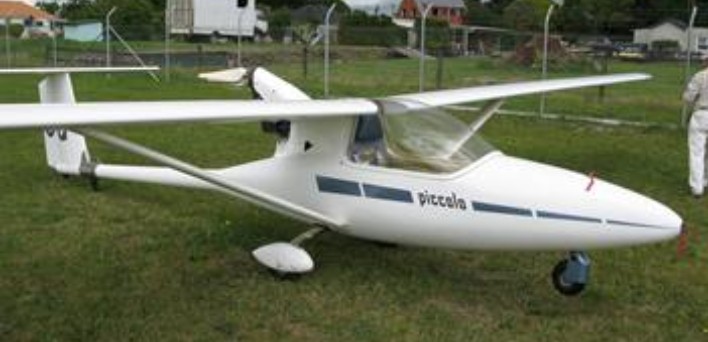
A powered glider design, the West German Technoflug Piccolo is a single seat high wing glider powered by a pusher 25hp KFM 107 engine.

Certification is under Luftfahrt-Bundesamt LBA 845.

Engine: Solo 2350 B, 22 hp
Wing span: 13.30 m
Wing area: 10.60 sq.m
MAUW: 297 kg
Empty weight: 180 kg
Fuel capacity: 30 lt
Max speed: 150 kph
Cruise speed: 130 kph
Minimum speed: 54 kph
Certification: VZ & JAR 22
Seats: 1
Fuel consumption: 6 lt/hr
Price (1998): 55 000 DM

Tchan-Tia-Kou Lie-Fang No.1

When during the 1950s the Chinese People’s Republic decided to revive the country’s sporting gliding movement it was to Poland that they turned for help, and with the aid of instructors, technicians and designers from the Polish SZD organisation a central Gliding School was organized at An-Yan and large gliding establishments were set up at Tchan-Tia-Kou. It was here that a Chinese glider design office was formed towards the end of 1956 under the direction of Dipl Ing Niespal of the Polish SZD, and a Glider Manufacturing Centre was organized for the licence production of Polish types such as the ABC, Salamandra, the SZD-8 Jasolka, the SZD-12 Mucha 100 and the SZD-9 Bocian, examples of which had already been purchased from Poland; production of these types began during 1955-56.

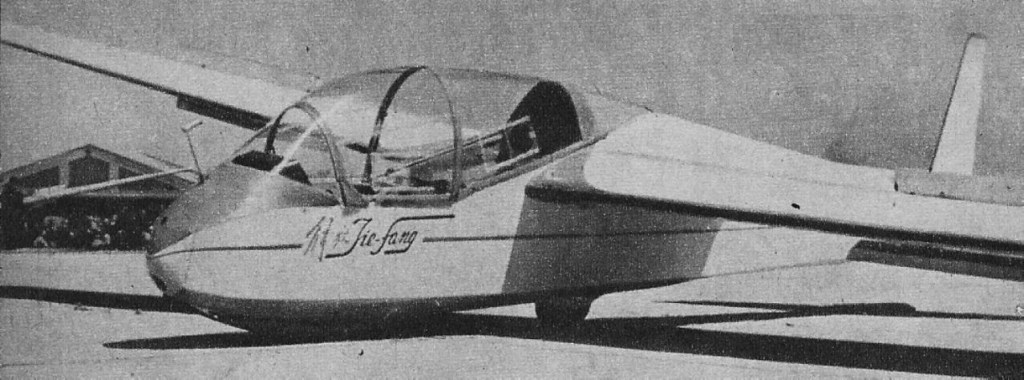
It was at Tchan-Tia-Kou that the first Chinese glider of original design, the Lie-Fang (or Liberation) two seater intermediate trainer, was created. The design of the Lie-Fang, one of the first gliders to originate in China, was led by the Polish J. Niespal. He was assisted by two Chinese engineers, Tchen-Kuei-Wen and Li-Ti-Tuin.

Niespal used the 1953 SZD-12 Mucha 100 as a starting point. There were many differences between the Mucha and the Lie-Fang, partly because the latter was a two-seat aircraft and therefore longer, with a much modified nose and more strongly forward-swept wings; the Lie-Fang’s fuselage was a simpler, flat sided structure compared with the Mucha’s oval section monocoque and the empennage was more angular.

The Lie-Fang 1 (English: Liberation 1), some sources Jeifang 1, is wood framed, with some use of the local “poton” wood and with a mixture of plywood and fabric covering. It has a high mid mounted single spar wing with a plywood covered torsion box leading edge, Behind the spar the wing is fabric covered. In plan it is straight tapered with unswept leading edges, resulting in forward sweep of 2° at one quarter chord. There is 4° of dihedral and 2° of washout. Its ailerons are slotted and fabric covered and spoilers, mounted behind the spar at about one third span, open above and below the wing.

The wooden slotted ailerons are also fabric covered and there are spoilers on both top and bottom wing surfaces. The fuselage is a plywood monocoque with a light alloy nose-cap, and the cantilever tail unit is of wood with fabric covering.

The fuselage is a flat sided monocoque which tapers gently to the rear, with the straight tapered tailplane mounted on top of it and forward of the fin. The rear surfaces are fabric covered. The straight edged rudder extends to the keel and moves in a cut-out between the elevators, one of which has a trim tab. The cockpit, mostly ahead of the wing leading edge, seats pupil and instructor in tandem with a single set of instruments that they can both see. The fixed, two part forward canopy reaches almost to the nose; a rear transparent section opens sideways for access to both seats. The Lie-Fang lands on a fixed monowheel undercarriage under the wing, fitted with brakes and aided by a short, rubber sprung nose skid and a tail bumper.

The landing gear consists of a non-retractable monowheel with brake, and a rubber-mounted skid under the forward fuselage. The two pilots are seated in tandem under a large sideways-opening Perspex canopy.

The prototype made its first flight on 10 May 1958. It was cleared for cloud flying and classed as semi-aerobatic. It went into production at the Tchan-Tia-Kou manufacturing centre, Shenyang, and was intended that pupils should graduate from the Lie-Fang to the single-seat SZD Mucha, which it resembles in appearance, for their first solo flights and the Lie-Fang went into small-scale production for the Chinese gliding centres.

Wingspan: 15.00 m (49 ft 3 in)
Length: 8.00 m (26 ft 3 in)
Wing area: 18.5 m2 (199 sq ft)
Aspect ratio: 12.4
Airfoil: Göttingen 549 over most of the span, NACA 4412 at tip
Height: 1.35 m (4 ft 5 in)
Empty weight equipped: 242 kg (534 lb)
Max takeoff weight: 420 kg (926 lb)
Stall speed: 55 km/h (34 mph, 30 kn)
Never exceed speed: 165 km/h (103 mph, 89 kn)
Rough air speed max: 138 km/h (85.7 mph; 74.5 kn)
Aerotow speed: 140 km/h (87.0 mph; 75.6 kn)
Winch launch speed: 100 km/h (62.1 mph; 54.0 kn)
Terminal velocity: with full airbrakes 165 km/h (103 mph; 89 kn)
g limits: +4.5
Max l/d: 22 at 53 mph / 86 km/h / 46.4 kn
Min sinking speed: 0.8 m/s / 160 ft/min / 2.62 ft/sec at 38.5 mph / 62 km/h / 33.5 kn
Min sink: 2.6 ft/sec at 38.5 mph
Crew: Two