Tijonrarov / Vaxmistrov AVF-22 Zmiei Gorinich

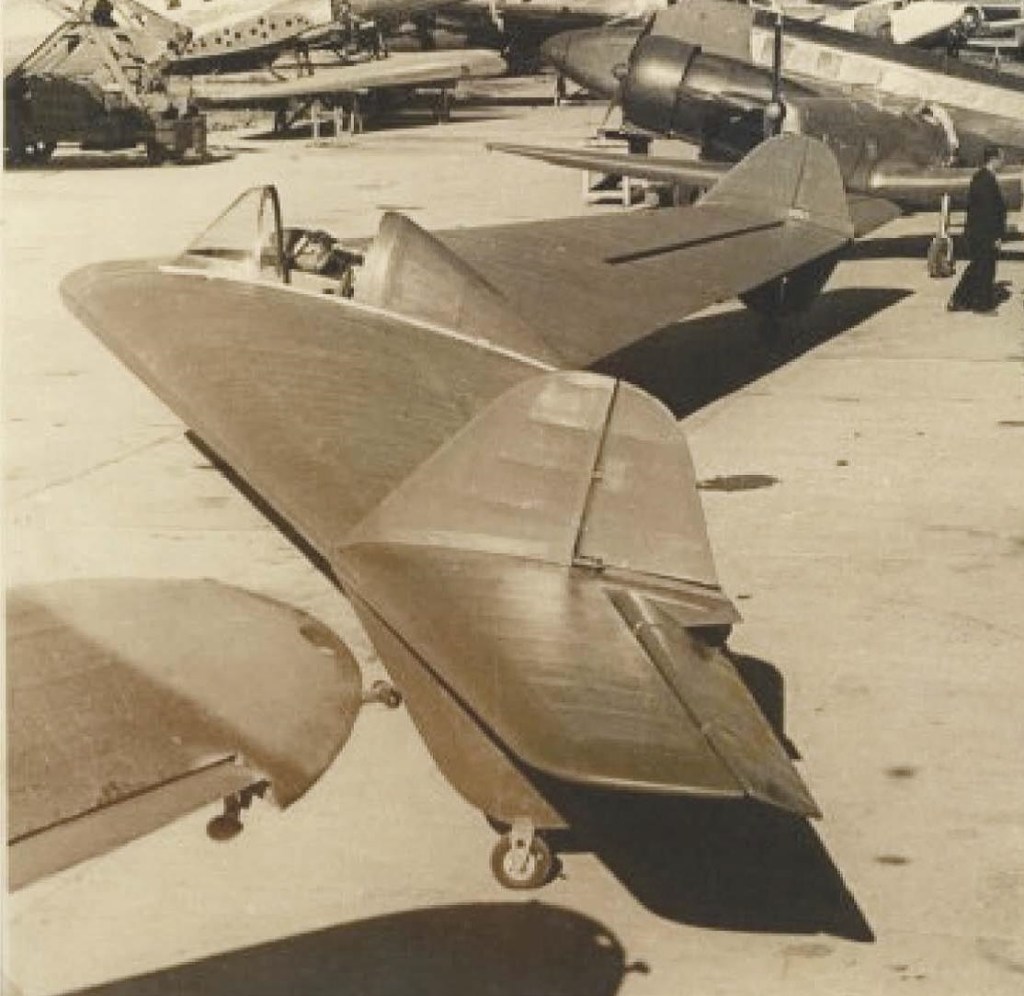
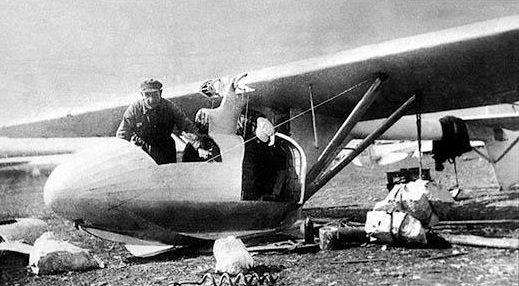
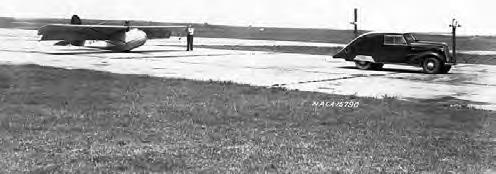
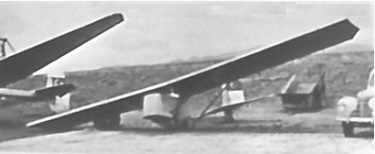
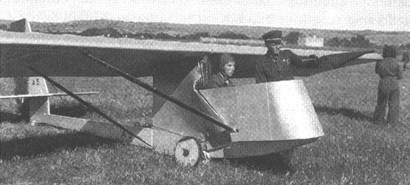
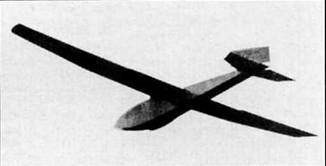
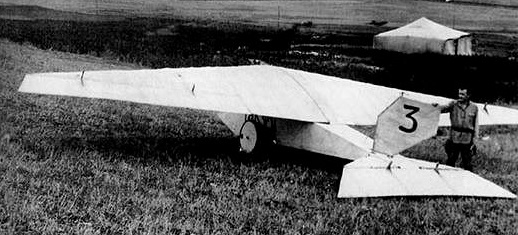
Shortly before graduating, in 1925 at the Zhukovski Military-Aeronautical Engineering Academy, Tijonrarov, together with the first-year student VS Vaxmistrov, designed and built the AVF-22 glider and that Tijonrarov nicknamed “Zmiei Gorinich” (Russian: Тихонравов / Вахмистров АВФ-22 “Змей Горыныч”).

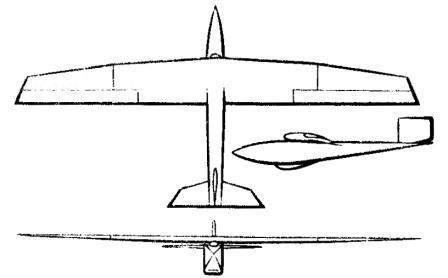
The AVF-22 “Zmiei Gorinich” glider was designed as a monoplane with a high trapezoidal cantilever wing of conventional design. The structure was built in wood with a textile covering. The large wings featured large ailerons on the trailing edge of the wing. The tail unit was a monoplane type with an integral rudder.

The fuselage was constructed of plywood with a rectangular cross section. In its side view, the fuselage was shaped like a wing aerodynamic profile. The tail unit was a monoplane type with a rectangular-shaped integral rudder and trapezoidal-shaped horizontal planes.

The landing gear consisted of a pair of skis in the lower region of the fuselage.

After graduating from the Academy, Tijonrarov was sent to serve in the “Lenin” Squad. Vaxmistrov and his glider were entered in the glider competitions held during August 1925 in Renske, Germany.

Specialists and the German press were greatly interested in the “Fire Dragon” (translation given to the name of the glider in Germany). On August 29, pilot Vladimir V. Sergueyev achieved a flight in the AVF-22 of 4400 meters. A day later the pilot LA Jungmeister managed to reach the height of 265 meters, which was a record for the time. On that very second day of racing, VV Sergueyev managed to fly the “Zmiei Gorinich” a distance of 11 km.

The glider “Zmiei Gorinich” participated in the III National Sailing Competitions held in Koktebel between September 27 and October 11, 1925. During its first flight in this contest the glider lost speed and fell, hitting the ground. The pilot received a major trauma to the neck. The glider could not be rebuilt.

AVF-22 “Zmiei Gorinich”
Wingspan: 14.35 m
Wing area: 19 m²
Length: 6.96 m
Height: 1.8 m
Empty weight: 130 kg
Wing loading: 11 kg / m²
Elevator area: 2.23 m²
Rudder surface area: 1.3 m²
Ailerons area: 1.0 m²
Wing elongation: 10.8
Accommodation: 1
Tijonrarov AVF-1 Arap

Tijonravov AVF-1 “Arap” at the First National Competitions of 1923.

In March 1923 the Society of Friends of the Air Fleet (ODVF) was created (in Russian: Общество друзей Воздушного флота (ОДВФ)) with the aim of supporting the construction of airplanes and aeronautical engines, familiarizing the population with aeronautics and with the study of airplanes, engines, gliders, parachutes, as well as the development of gliding. To this end and under the direction of KK Artseulov, the Center for Motorless Aviation was created within the ODVF.

Tijonrarov became interested in the construction process and began to combine his studies at the Academy with the projection of a glider that he called “Arap”. This was the first glider created within the Air Fleet Academy (AVF), for which it was officially designated AVF-1 (Russian: АВФ-1 “Арап”).

The AVF-1 “Arap” was developed by a group of academy students. The assembly was carried out at the “Aviarabotnik” factory in Moscow.

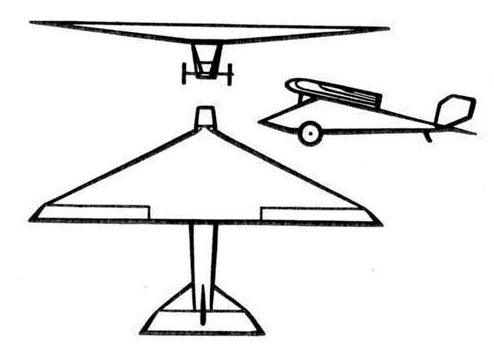
The AVF-1 “Arap” glider was designed as a monoplane with a triangular cantilever wing. The structure was built in wood with a textile covering. The wing profile was achieved by taking the shape of a Junkers monoplane with modifications to the shape and its structure had wooden stringers converging at a point on the wing root, joined with perpendicular ribs. Roll control was ensured by large ailerons on the trailing edge.

The fuselage, with a trapezoidal section, was made up of two flat surfaces joined by pieces of wood. Towards the tail section the fuselage closed towards a horizontal rib to which the tail was attached.

The tail unit was of the monoplane type. The large area horizontal stabilizer was located at the rear of the fuselage with a single large area elevator. The empennage functioned entirely as a rudder.

The landing gear was of the conventional type, fixed, with a tail skid. The two large wheels were located on either side under the cab, with a large light between them.

The cockpit for the pilot was located in the forward portion of the fuselage, under the wing.

The first flight was made on October 12, 1923. The AVF-1 was ready in time to participate in the First National Sailing Competitions, promoted by the ODVF and held between November 1 and 18, 1923 in the Uzun-Sirt mountains, Crimea.

Ten gliders appeared in this contest. The technical commission, chaired by Professor VP Vietchinkin authorized the flight of only 9, among which stood out the AVF-1 Arap of MK Tijonrarov, the AVF-2 Strizh of VS Pyshnov, the AVF-3 “Mastyazhart-1” of SV Ilyushin; the Maori of SN Lyushin and tailless glider BICH-1 of BI Cheranovski.

After tests that comprised flight for more than 15 seconds, the AVF-1 was one of the four gliders that were authorized to perform flights. In November or December 1923, piloted by VF Denisov, this flight lasted only 1 minute 5 seconds in which the glider reached 385 meters with a maximum height of 70 meters. On the second flight the “Arap” made a turn and destroyed the wing.

AVF-1 Arap
Wingspan: 10.1 m
Wing area: 15 m²
Aspect ratio: 6.8
Length: 6.2 m
Height: 1.9 m
Empty weight: 70 kg
Wing loading: 9.5 kg / m²
Stabilizer surface 0.65 m²
Elevator surface 2.5 m²
Rudder surface area: 0.65 m²
Spoiler area: 2.4 m²
Accommodation: 1

Tijonrarov, Mikhail Klavdievich

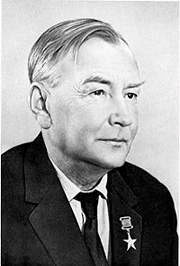
Mikhail Klavdievich Tijonrarov (Russian: Михаил Клавдиевич Тихонравов) was born on July 29, 1900 in the city of Vladimir.

In June 1919 he voluntarily joined the Red Army, serving as a political agitator in the military commissariat of the Vladimir governorship. In 1920 he began his studies at the Institute of Engineers of the Red Air Fleet (Институт инженеров Красного Воздушного Флота) which from 1923 would become the Military Aeronautical Engineering Academy Professor N. Ye. Zhukovski (VVIA) (Военно-воздушная инженерная академия имени Н. Е. Жуковского), graduating in 1925.

After finishing his studies, Tijonrarov served in the 1st “Lenin” light bomber squad. From 1926 he worked in various aeronautical companies, including the bureaus of DP Grigorovich and Nikolai. N. Polikarpov. From 1930 he became head of the KB engine group at Factory No.39 Menzhinski.

In those years, and as a complement to his professional activity, he built around 10 gliders in conjunction with VS Vaxmistrov and AA Dubrovin, among which the AVF-1 “Arap” of 1923, AVF-22 “Zmiei Gorinich” of 1925, “Zhar-Ptitsa” in 1927, “Gamayún” in 1928, “Skif” in 1928, “Konsomolskaya Pravda” or “Zhar Ptitsa-2” in 1929, “Skif-2” in 1931. Many of these specimens competed successfully in the National Sailing Competitions held in Koktebel, Crimea.

Sergei Koroliov proposed to Tijonrarov to devote himself to the development of ballistic missiles propelled by liquid fuel. From 1932 Tijonrarov was appointed brigade chief in the Group for the Study of Reactive Movements (GIRD), which was responsible for the development of the first Soviet two-stage reactive engine.

Starting in 1938, Mikhail Tijonrarov dedicated himself to the research of liquid reactive engines, the development of rockets for the study of the upper layers of the atmosphere, but at the end of the 1930s, work related to the development of ballistic missiles with reactive engines they were canceled and Tijonrarov set about developing the rockets for the “Katiuskas”.

Between 1940 and 1943 Tijonrarov led a construction group, under the leadership of AG Kostikov, which was in charge of the development of the intercept fighter “302” with combined power plant. In this stage of the war he developed an intense work in the development of reactive rockets for the VVS.

Starting in 1946, Tijonrarov was appointed substitute for the head of the reactive rockets group at Institute No. 4 of the USSR Academy of Gun Sciences. Between 1946 and 1956 Mijail Tijonrarov created within the institute a group for the development of a project known as BR-190 consisting of a piloted aircraft that took off vertically with the help of an R-1 rocket, reaching a height of 200 km.

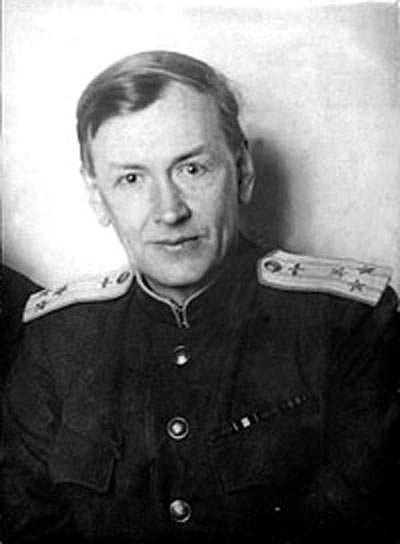
Mikhail Tijonrarov in the late 1940s.

The next works of Tijonrarov’s group were devoted to the study of missile trajectory calculations.

In March 1950 at the NII-4 Tijonrarov gave a lecture entitled ” Rocket packages and prospects for their development.” In his speech he developed the above ideas and for the first time he spoke publicly about the possibility of using these rockets to locate artificial satellites in orbit, and even take people into space. The group’s work was directed to the development of a “package” made up of three R-3 rockets, designed to carry a 3-ton military payload over a distance of 3000 km.

Under the leadership of Tijonrarov, the world’s first manned cosmic ship was successfully developed and launched for which he was awarded on June 17, 1961 with the title Hero of Socialist Labor , along with the Order of Lenin and the Hammer and Sickle medal.

From 1961 Tijonrarov was promoted to head of department and substitute for the main builder of OKB-1, which from 1966 became the Central Construction Bureau for Experimental Machinery Construction (TsKBEM). In the next few years the group under the direction of Tijonrarov worked on the project to develop a manned spacecraft to fly to Mars, several artificial satellites with different objectives. From 1970 he became scientific director of TsKBEM.

Miajil Tijonrarov died on 4 of March of 1974 in Moscow at the age of 73 years.

THK THK-13

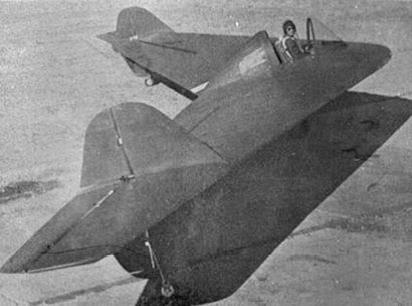
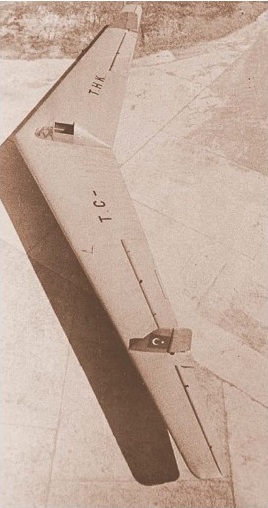
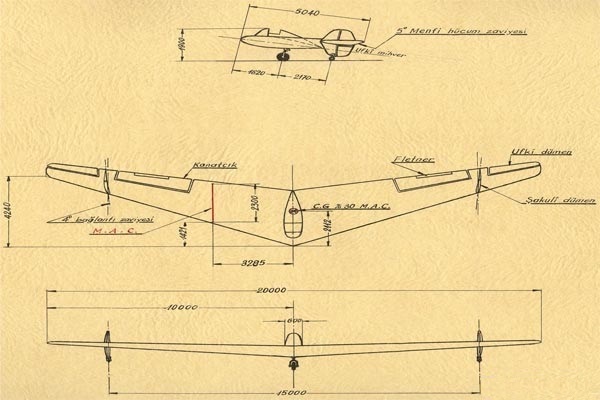
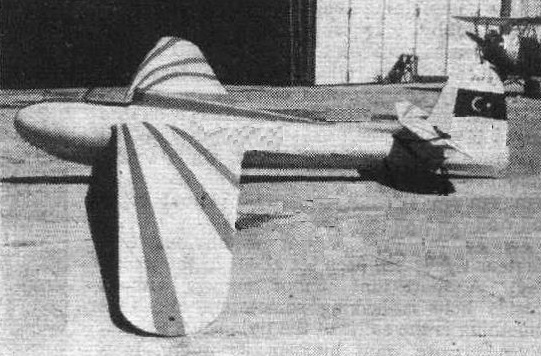
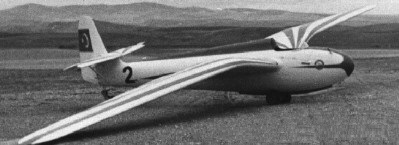
The 1948 THK-13 single-seat tailless wood and fabric glider was for aerodynamic research. It was planned to produce a Gipsy-powered version when the glider had successfully completed stability trials.

The undercarriage consists of a single main wheel under the nacelle, and small castering stabilizing wheels attached to the vertical fins.

In 1948, designed by Senior Engineer Yavuz Kansu and Y.Muh, the test flight pilots were Kadri Kavukçu and Pilot Cemal Uygun.

Exhibited at the 1949 Aerospace Exhibition in Paris.

The project was not developed after an accident.

Gallery

Wing span: 65 ft 7 in
Height: 6ft 6 in
Wing area: 431 sq ft.
Loaded weight: 1,014 lb

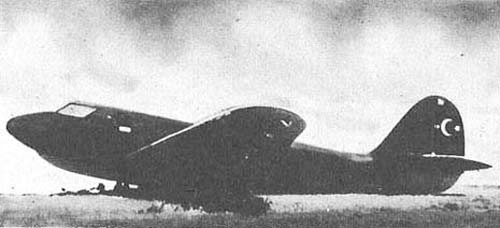
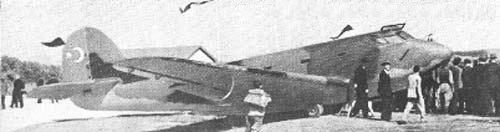
THK THK-1

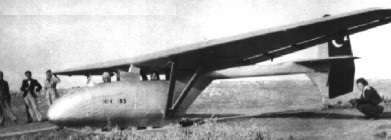
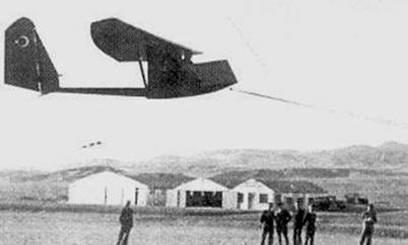
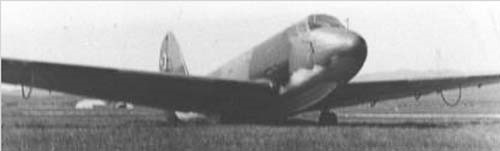
The Turk Hava Kurumu TNK-1 transport glider, built in 1943 was intended for military.

A 12-seat troop transport glider of wooden construction, the need for mass production was considered redundant and TNK-1 remained only a prototype.

THK-1
Wingspan: 26.00 m
Length: 12.50 m
Height: 4.60 m
Wing area: 56.00 sq.m
Weight empty equipped: 1100 kg
Maximum take-off weight: 2260 kg