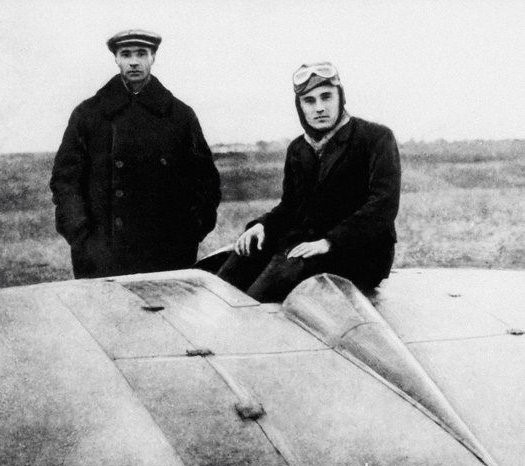
B. I. Cheranovsky was born on either 1 or 13 July 1896 in Pavlovychi, Volhynian Governorate, Russia. By profession he was painter and sculptor, but in 1920 became interested in aviation. From 1924 to 1927 he studied at the Air Force Academy. From 1922 on he engaged in the design and construction of airframes and aircraft of the flying wing configuration. Notable for creating aircraft with a characteristic tailless parabolic wing. — the BICh-1 and BICh-2 gliders from 1924, and the powered BICh-3 later. For his services to the aviation industry, Cheranovsky was awarded the Order of the Red Star. He died in Moscow, Soviet Union, on 17 December 1960.
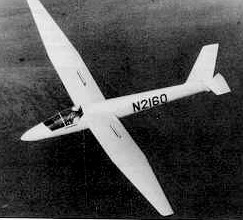
Designed by Robert Chase, the C100-S made its first flight in 1968. It uses a 3-piece wing with an airfoil 15% thick and no aerodynamic twist. Wood and Styrofoam are used in the construction of the wing (as well as the tail), but the entire surface and the stress- bearing material is fiberglass. The fuselage is of all-metal stress-skin construction, with a skid and fixed wheel.
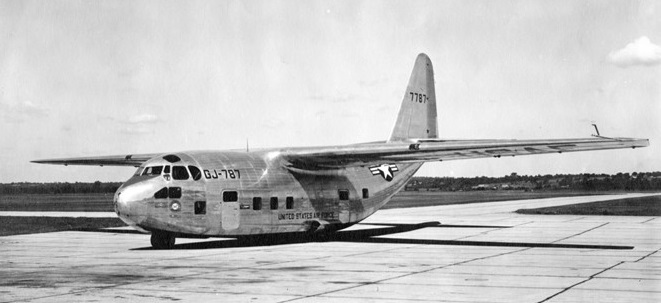
Chase Aircraft Corp was established in New York in 1943 by Michael Stroukoff to develop experimental assault/cargo gliders. Produced XCG-14, XCG-14A and CG-18A. Moved to Trenton, New Jersey, late 1946, developing a powered version, 30-troop YC- 122 Avitruc, first flown November 18,1948. Twelve built for USAF trials ,but no further production. Followed by larger C-123 Avitruc, first flown 14 October 1949, derived from XG-20 cargo glider; this project later taken over by Fairchild as C-123B and renamed Provider. An XC-123A prototype (four General Electric turbojets) flew on April 21,1951: first flight of a U.S. transport powered by jet engines. Chase became wholly owned subsidiary of Willys Motors Inc. of Toledo, Ohio, in 1953, itself owned by Kaiser- Fraser. In June 1953 a USAF contract for 300 C- 123Bs was canceled, a smaller contract going to Fairchild that autumn.
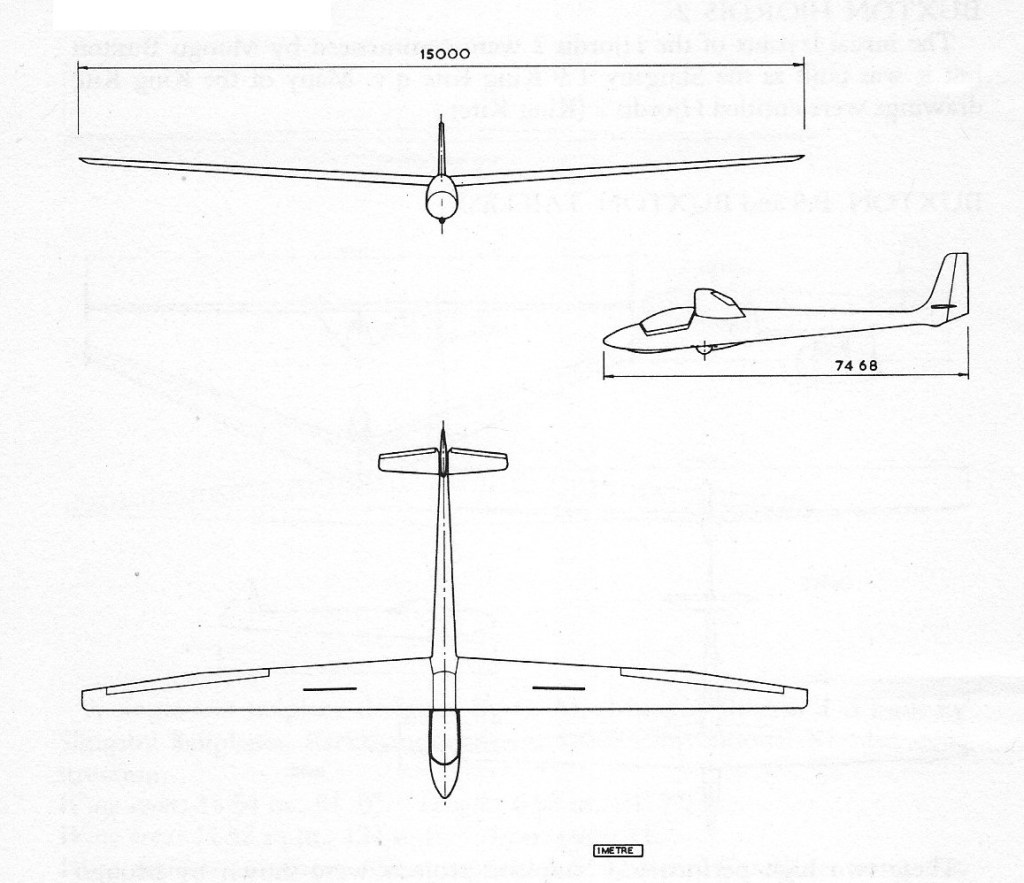
The Chard Osprey standard class glider was designed and built of conventional wooden construction by Keith Chard at Lasham, UK, using a Slingsby T.51 Dart 15 fuselage and tail, c/n 1457. The wings were designed and built by Chard. No flaps or airbrakes were fitted.
The wing sections were Chard KC-24 at root, Chard KC-29 at mid-point, and KC-30 at tip.
It was first flown on 15 May 1966.
Wingspan: 15.0 m / 49 ft 2.5 in Length: 7.47 m / 25 ft 5 in Wing area: 12.35 sq.m / 133 sq.ft Aspect ratio: 18.3 Empty weight: 249.02 kg / 549 lb AUW: 358.34 kg / 790 lb Wing loading: 29.04 kg/sq.m / 5.95 lb/sq.ft Max L/D: 34 Min sink: 0.64 m/sec at 85 kph / 2.1 ft/sec at 53 mph
As early as 1894, inspired by the work of the German glider experimenter Otto Lilienthal, Chanute began to design gliders capable of carrying human beings into the air. Anxious to provide employment for younger engineers and flying machine enthusiasts, he began contracting for the construction of several gliders.
The first thing done, after some models, was to build a kite, in order to test the stability of the proposed gliding machine. This was called the “ladder kite,” from its resemblance to a step-ladder in one of its postures, for it was so constructed as to allow grouping its surfaces in various ways. This kite proved exceedingly stable, flying in gusty winds. Then the construction of a similar machine was begun. which was capable of carrying a man, but first Mr. Herring rebuilt a machine, previously tested by him in New York, somewhat similar to that of Lilienthal, so that the known should be tested before passing to the unknown.
Chanute selected the sand dunes along the southern shore of Lake Michigan as the perfect place to test his creations. The area was close to Chicago. The little train station at Miller, Indiana served as an entry point into Dune country. The area offered a number of other important advantages, including steady winds, dunes from which a glider could be launched in any direction, an abundance of sand for soft landings, and, Chanute hoped, relative isolation.
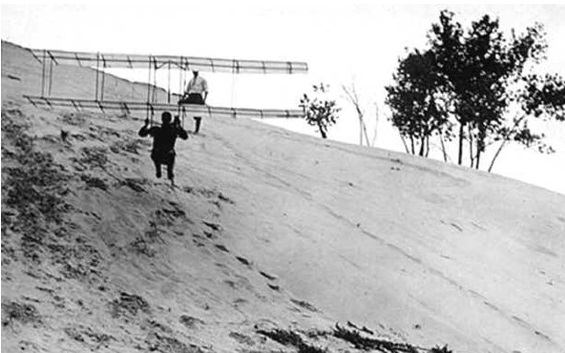
Chanute and his four assistants pitched their tents on a spot within the present city limits of Gary, Indiana, on June 22, 1896. Augustus Herring, the most experienced member of the group, had brought a glider based on the standard Lilienthal monoplane design. William Avery, a Chicago carpenter, had constructed a multi-wing glider designed by Chanute, while William Butusov would attempt to launch his own glider, the Albatross, down a wooden ramp. Dr. James Ricketts, a Chicago physician with “a slack practice and a taste for aeronautics,” would cook for the group and provide emergency medical service as required. Chanute’s dogs, Rags and Tatters, rounded out the party.
Herring and Avery did most of the flying. The Lilienthal glider proved to be a disappointment. After abandoning this Lilienthal form of machine, the experimenters in the sand dunes next tested the machine built after the fashion of the ladder kite which had proven so steady in the air.
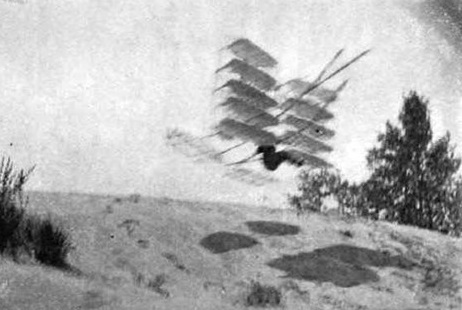
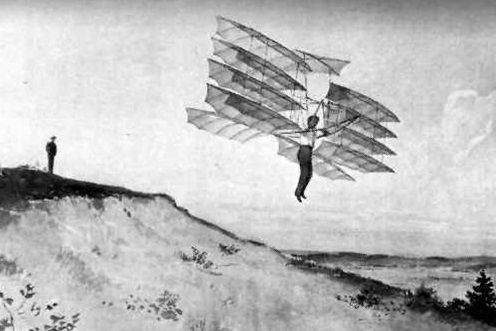
It consisted of six pairs of wings, superimposed and trussed together, pivoted at their roots upon a central frame, the lower chord of which was spread open to receive the man at the center. Here he was expected only to move for the purpose of steering, the stability to be maintained by the movements of the wings above him, which swung on their pivots back and forth, restrained by rubber springs, when the wind struck one side more than the other, or changed the center of pressure fore and aft. It will be seen that this is just the reverse of the first method tested, in which the man moved and the wings remained fixed. This wing movement took place as expected, but it was very soon found that there was an essential difference between the support from the wind derived from the same arrangement when flown as a kite, at an angle of incidence of 30 to 40 degrees, and when flown as a gliding machine, at an angle with the wind of three or four degrees, which is the most favorable for reducing the total resistance to a minimum. It was found that at very acute angles the moving air was deflected downward by the front wings, so that the support under all the following wings was greatly diminished, and that the apparatus was inefficient when its surface was considered. This had been expected, from prior experiments, and the frame had been designed so that the grouping of the wings could be readily changed. Then began an interesting and instructive evolution. The grouping of the wings was gradually changed, through six permutations, each being guided by gliding flights and by releasing bits of featherdown in front of the machine, and watching the paths of the air currents which swept past the wings. The result of this evolution was to change greatly the outward appearance of the apparatus while retaining the same general principle.
Chanute’s glider, featuring multiple sets of wings that could be arranged in various configurations, was more interesting, covering distances of from 50-116 feet through the air. The group returned to Chicago on July 4. They would spend the next month repairing their various craft and building a new glider featuring three wings set one on top of the other, all linked together with a truss of the sort that Chanute had employed in constructing railroad bridges. Herring was apparently responsible for the cruciform tail.
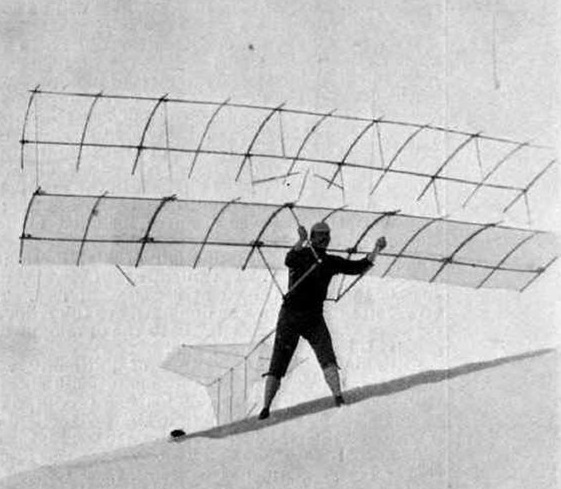
Sixth Form Multiple-Wing Machine
The improved arrangement as seen from one side in flight. It will be noticed that no less than five of the six pairs of wings have been superimposed at the front, and trussed together. That the operator is within and under them, and that a single pair of wings remains at the rear to serve as a tail. This tail was flexible and vibrated up all down in flight when the angle of incidence varied in consequence of the back and forth movements of the pivoted front wings.
About two hundred glides were made, in winds of 13 to 22 miles an hour, on a descending course of about 1 in 4 (14o), the longest flight being 82 feet from a height of about 20 feet. There was, however, undue friction in the wing pivots, thus retarding their automatic action, so that the operator had to move two or three inches, as against some 15 or 18 inches on the previous machine, and there being some further defects in the spacing of the wings, both vertically and horizontally, it was determined to rebuild the machine with the practical information thus obtained.
Camp was accordingly broken up early in July, with the conviction that more had been learned during this two weeks of experiment with full-sized machines than had previously been acquired during about seven years of theoretical study and experiments with models. The equipment was returned to Chicago, where three machines were constructed, and the five men returned to the Dunes on August 21, 1896, establishing a new camp some five miles down the beach from their original site.
Seventh Form Multiple-Wing Machine
The multiple-wing machine as reconstructed consisted of the same wings and of a new frame, and instead of ordinary pivots, there were ball bearings at the ends of vertical wooden posts to which the roots of the wings were attached, the latter being all trussed together, with vertical posts and diagonal wire ties, this being probably the first application which has been made of the Pratt truss to flying machine design. The frame was all made of spruce, the surfaces were of Japanese silk varnished with pyroxelene; the complete machine weighed 33 1/2 pounds, the supporting surface at the front was 143 1/2 square feet, including a concave aerocurve over the top, added when the front wings were cut down to four pairs, and the rear wings or tail measured 29 1/2 square feet in area. With this arrangement a great many glides were made, with the result of more than doubling the lengths previously attained, of reducing the angle of flight to 1 in 5, and of diminishing the required movements of the operator to one or two inches in preserving the equilibrium.
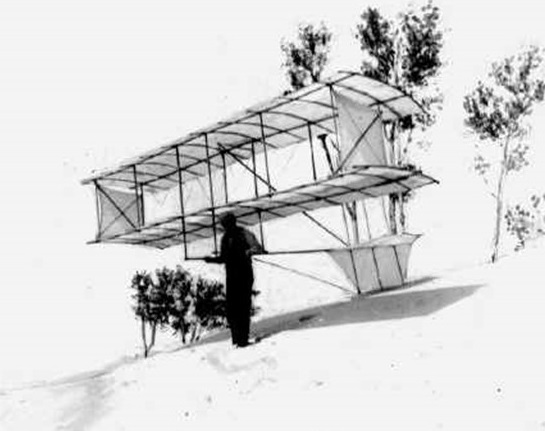
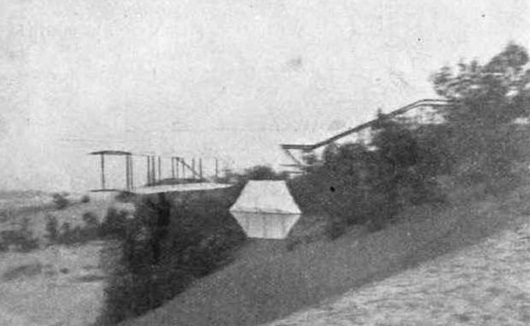
The Seventh Form Multiple-Wing Chanute-Avery Multiple-wing Gliding Machine “Katydid” was built by Chicago carpenter William Avery to the specifications of Octave Chanute based on the principles of the Pratt truss.
The photographed above is with Chanute during its extensive testing by Avery from the dunes on the shores of Lake Michigan at Miller Beach, Indiana, near Chicago in September of 1896; the Katydid was so named because of its insect-like appearance and made some two hundred glides that summer.
It might have been preferable to omit the aerocurve over the top, and to have placed all the supporting surface in the pivoted wings at the front. This aerocurve was added to save the expense of rebuilding the old wings, and this saving proved to be a mistake. The wings were so far racked and distorted by their prior service that they did not support alike and did not balance the weight properly, and thus the results obtained with that machine were inferior.
After some disappointing test flights, Chanute ordered the bottom wing removed from the new glider, producing a biplane design.
With that modification complete, Herring and Avery were soon making repeated flights of over 200 feet in length, occasionally traveling as far as 350 feet through the air. By the time the group broke camp for good on September 25, 1896, they had completed several hundred flights with the biplane. For the moment, the little craft was the most successful heavier-than-air flying machine in the world.
Two-Surfaced Machine with Side Keels
The next full-sized machine which was built consisted of a single intersection Pratt truss carrying the surfaces, to which was applied a regulating mechanism designed by Mr. Herring. This truss will safely support 300 or 400 pounds applied to the arm bars at the center. In calculating its proportions a basis has to be adopted which is the reverse of that which obtains in the calculation of bridges, for the support, or air pressure, has to be considered as uniformly distributed, and the load has to be figured out as concentrated at the center. It may be mentioned in this connection that one practical difficulty found has been in devising some method of adjustable connection between the vertical posts and the diagonal ties. The latter are from two to five hundredths of an inch in diameter, and it is not practicable either to cut a screw upon them for a nut, nor to apply a sleeve nut or a turn buckle. Perhaps some engineer will suggest a better device than the loop heretofore used, which is made by twisting the wire back upon itself, and which is not adjustable.
The regulating mechanism took care of the equilibrium fore and aft and diminished the effect of the side wind gusts which were then easily overcome by slight side movements of the operator. Towards the last amateurs were permitted to try it under instructions. They made fair glides in safety. One or two cruises by newspaper reporters, and another by a novice, who was picked up by the wind and raised some forty feet into the air, but who landed almost in his tracks as gently as if he had only fallen from the height of a chair.
With this apparatus several hundred glides were made, varying in length from 150 to 360 feet, at angles of descent of 7 1/2 to 10 degrees, at a height of ten to twenty feet above the ground, but it was not uncommon for the machine to sail forty or fifty feet above the ground, and during the six weeks occupied with the experiments, not the slightest accident occurred either to the operators or to the machines. The whole apparatus spread 134 square feet of supporting surface, weighed 23 pounds, and thoroughly supported the weight of a man at speeds of about 23 miles an hour.
The 1896 biplane tested on the Indiana Dunes proved to be a key step on the road to the invention of the airplane. Herring continued to experiment with the design on his own over the next five years. Chanute’s publication of the plans and specifications for the glider helped to spark a renewed interest in flight both in America and Europe. In May 1900, Octave Chanute received a letter from Wilbur Wright. “Afflicted with the belief that flight is possible to man,” the Wrights had designed a glider of their own. “In appearance, Wilbur noted, “it is very similar to the ‘double-decker machine with which the experiments of yourself and Mr. Herring were conducted in 1896-97.”
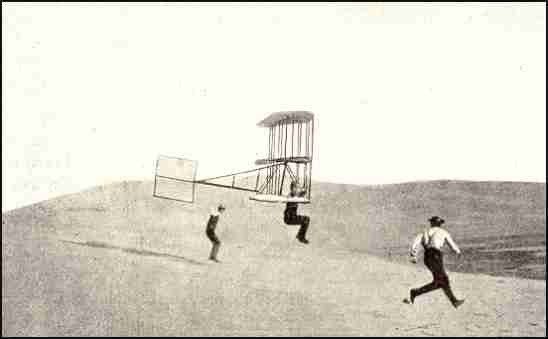
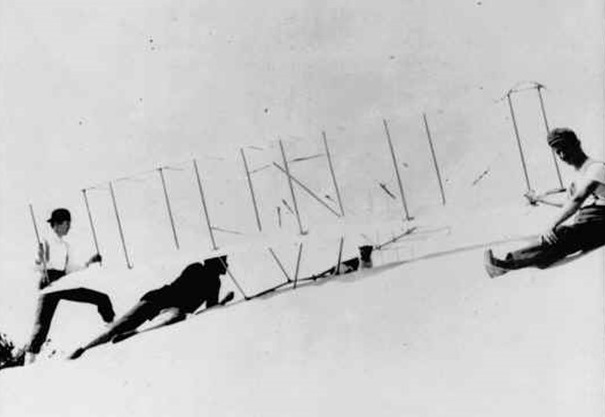
The operator (Mr. Herring in this instance) is seen creeping under the machine in order to rise with it, when lifted up by the two assistants, and to place himself within the arm bars
Chanute biplane First flight: 1896 Wing span: 4.9 m / 16 ft Length: 1.2 m / 4ft Weight: 14 kg / 31 lb
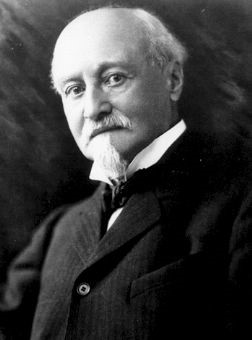
Octave Chanute was born in Paris February 18, 1832, the son of Joseph Chanute, assistant professor at the Collège de France, and came to the United States as a child in 1838 when his father became Vice-President at Jefferson College in Louisiana.
He became a respected civil engineer and scientist who lent his talents to furthering human transportation. He spent most of his adult life as an engineer in the railroad industry. Chanute designed and oversaw the construction of several important railroads, as well as the first railroad bridge over the Missouri River and the Union stockyards in Kansas City and Chicago. He had a wide variety of interests and specialties, being an authority in iron bridges, truss construction techniques, and wood preservation.
Chanute first became interested in aviation watching a balloon take off in Peoria, IL, in 1856. When he retired from his career in 1883, he furthered the new science of aviation. Applying his practical application background, Chanute collected all available data from formation researcher around the world and combined it with the knowledge gathered as a civilian engineer in the past. He published his findings in a series of articles in The Railroad and Engineering Journal from 1891 to 1893, which were and so re-published in the “Progress in Flying Machines in New York” in 1894, which summarized and thoroughly analyzed the technical accomplishments of the world’s aviation pioneers up to that time. The book became a classic and a guidebook for the efforts of many would-be aviators around the world, including the Wright brothers.
At the World’s Columbian Exposition in Chicago in 1893, Chanute arranged in with Albert Zahm an International Conference on Aerial Navigation.
In December, 1895, Mr. Chanute secured the services of Mr. Augustus M. Herring, a civil and mechanical engineer, who had for some years been making experiments in Aviation, this being the recent name given to attempts to imitate the birds, and William Avery. The first thing done, after some models, was to build a kite, in order to test the stability of the proposed gliding machine. This was called the “ladder kite,” from its resemblance to a step-ladder in one of its postures, for it was so constructed as to allow grouping its surfaces in various ways. This kite proved exceedingly stable, flying in gusty winds. Then the construction of a similar machine was begun. which was capable of carrying a man, but first Mr. Herring rebuilt a machine, previously tested by him in New York, somewhat similar to that of Lilienthal, so that the known should be tested before passing to the unknown. With these two machines Mr. Chanute and Mr. Herring, and two assistants (Mr. Avery and Mr. Butusov), went in June, 1896, to the desert sand dunes at the south end of Lake Michigan, north of Miller Station, about thirty miles from Chicago. The Lilienthal-like machine was the first tested. These convinced Chanute that the best way was to stack several wings one above the other, as proposed by the British technologies Francis Wenham in 1866 and realised in formation by Lilienthal in the 1890s.
Chanute was in contact with the Wright half brothers from the start in 1900, when Wilbur communicated to him after perusal of ‘Progress in Flying Machines’. Chanute offered encouragement and visited Kitty Hawk, North Carolina, in 1901, 1902, and 1903.
Chanute freely shared his work, although he did not encourage to patents on inventions. His approach led to friction with the Wright brothers, who refused to share them plans around aircraft engine and control. Chanute did not rely that the Wright moving machine patent, on wing warping, could be enforced and said so publicly, including a newspaper interview in which he said, “I admire the Wrights. I regret friendly forrad and so for the marvels and so have achieved; but you can easy gauge how I regret concerning their attitude at present by the remark I made to Wilbur Wright recently. I told him I was sorry to see and so were suing other experimenters and abstaining from entering the contests and competitions in which other men are brilliantly successful laurels. I told him that in my opinion and so are wasting valuable time over lawsuits which and so ought to concentrate in their work. Personally, I do not regard as that the courts will hold that the principle inherent the deformation tips can be patented.”
Chanute was also instrumental in the revival of flight research in Europe in the early twentieth century. His lectures in Paris following the successful flight of the Wright Flyer in the United States served to rekindle the waning interest in flight among many European engineers.
The Wright brothers acknowledged Chanute’s key role as a mentor, saying that his research and continual inspiration paved the way for their success. The friendship was still impaired when Chanute died, but Wilbur Wright took the opportunity to attend Chanute ’s memorial facility at the family’s home. Wright wrote a eulogy which was read at the Aero Club meeting in January 1911.
When the Aero Club of Illinois was created on February 10, 1910, Chanute function as its first business executive unloosen his death in November 1910. Just months before his death he published a final treatise, “Recent Progress in Aviation”.
Chanute died on November 23, 1910, in Chicago, Illinois. He is buried in the James Family plot at Springdale Cemetery in Peoria, Illinois, with his wife, Annie Riddell James (June 3, 1834 – April 3, 1902), and daughter, Alice Chanute Boyd December 24, 1859 – October 7, 1920.
The burg of Chanute, Kansas is named after Chanute, as is the past Chanute Air Force Base distance Rantoul, Illinois, which was authorised in 1993. The base incorporate the Octave Chanute Aerospace Museum.
Designed by Ken Champion, the Self-Lauching Freedom Falcon, which first flew in 1982, uses a Wankel type rotary engine with variable pitch propeller. Approach control is with spoilers.




 All Aero