Encouraged by the results of his first successful model, Cheranovski set out to design a sport glider. The new BICh-4(Russian: Черановский БИЧ-4)
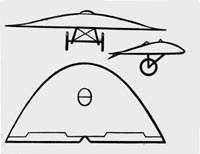
The 1925 BICh-4 repeated the layout of the previous BICh-2, except for the removal of the empennage, which in the previous model had been very ineffective.
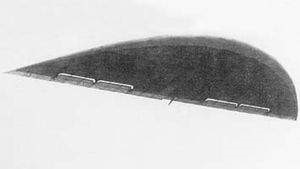
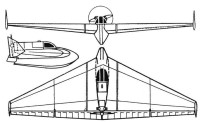
The BICh-4 glider was designed as a single-seater flying wing built entirely of wood, with a textile coating. The thick wing featured parabolic in-plane shape and a thin trailing edge with control surfaces along the entire span, on which the elevons were located, capable of acting as ailerons and elevator rudders.
The wing construction maintained the same characteristics of the BICh-2 with a structure of 10 x 8 mm pine slats crossed and joined by glue and nails. To facilitate movement, the wing structure was divided into three sections. Final assembly and fabric coating were done at the flight site.
The pilot was located in an open cockpit inserted within the front region of the wing,
The landing gear featured a single wheel located in a fairing in the lower center of the wing. Small curved skids were located at the wing ends and a conventional tail skid at the lower rear.
The BICh-4 was completed in 1925 and was sent to the III National Competitions held in Koktebel in that year together with the “Trapetsia” and KIM-2 models, also built by Cheranovski. At the pageant it was flown successfully, piloted by P. Berzhbitski.
BICh-4 Wingspan: 11.40 m Empty weight: 50 kg Wing loading: 6.8 kg / m² Glide ratio: 16 Accommodation: 1
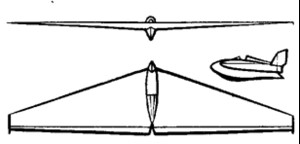
In parallel with the development of the BICh-22 or Che-22 glider, the OKB MAI began the development of a new model of two-seater glider in a flying wing configuration, which was known as BICh-23, or Che-23 (In Russian Черановский БИЧ-23 or Че-23). In contrast to the Che-22, the new Che-23 was characterized by its somewhat smaller dimensions and an increased sagging of the wing.
The Che-23 glider was conceived as a prototype for a large supersonic fighter development.
The Che-23 was built in the MAI workshops and successfully flown in 1948 by test pilot I. A. Petrov.
Che-23 (BICh-23) Wingspan: 6.7 m Wing area: 15 m² Length: 5.96 m Glide ratio: 12.3 Accommodation: 2
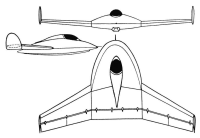
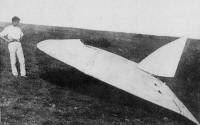
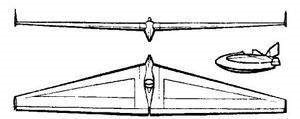
BI Cheranovski developed between 1947 and 1948 a set of novel designs, among which a new glider stands out that returned to the old “Parabola” scheme, but this time introducing the leading edge with variable angle of incidence. This glider was developed in the bureau of experimental constructions of the Moscow Aviation Institute, where Cheranovski worked at that time, and it became known as BICh-22 (Russian Черановский БИЧ-22) or Che-22 from the new Soviet designation system.
The BICh-22 was conceived as a single-seater experimental glider and featured a flying wing configuration. A scale model was built and studied in the wind tunnel of the Moscow Aviation Institute. The results of these tests showed good stability and validated the new shape.
The wing had a leading edge with variation in the angle of incidence and was made up of a short, parabolic centroplane to which the tapered trapezoidal wing consoles were attached. Vertical empennages were located on the wingtips (although in one of the project’s configurations these empennages were eliminated). The trailing edge of the consoles and the center plane featured control surfaces along the entire span. The ailerons were located on the consoles, while the elevator rudders were attached to the centroplane.
The wing profile was designed by the builder himself. The closed cockpit for the pilot was located in the central area of the centroplane, covered frontally by an oval and transparent cover that ended in an aerodynamic drop-shaped fairing.
The entire glider was made of wood with plywood and calico coating and its weight reached only 60 kg.
In 1948 the Che-22 prototype was built in the MAI workshops which was successfully tested and certified.
On 17 July 1949 during an air show at Tushino the flyover, among the aircraft was the Che-22, piloted by IA Petrov.
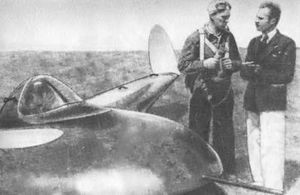
Cheranovski and Pilot Petrov
After some flight tests, the Central Committee of the DOSAV (Society for Cooperation with Aviation), placed an order with the OKB of Cheranovski to build a small series of 10 Che-22 gliders. At the end of 1949 in the DOSAV workshops in the Moscow suburb of Chornoye an accident occurred during a flight of the Che-22, killing the test pilot IA Petrov. Development work on the glider series was cancelled.
The prototype provided the theoretical basis for the development of more advanced models powered by ramjets and turbo jets.
Che-22 (BICh-22) Wingspan: 7.50 m Wing area: 14.03 m² Length: 5.04 m Height: 0.93 m Empty weight: 60 kg Glide ratio: 18-1 Accommodation: 1
The Cheranovski models BICh -4 and BICh-13 kept the parabolic wing scheme of the BICh-2, but in both the rudder was eliminated, which had proved very ineffective during flight tests. The main difference of the new BICh-13 model (Russian: Черановский БИЧ-13) was that, unlike the BICh-4 where roll control was achieved through the use of ailerons, now this control was achieved through the differential operation of the rudders located on the outer wings.
The BICh-13 glider was conceived as a single-seater flying wing built entirely of wood, with a textile covering. The thick wing featured a parabolic in-plane shape and a thin trailing edge with control surfaces along the entire span, on which the elevons were located.
As in the BICh-4 the rudder disappeared, but in this model small control surfaces with parabolic leading edge were introduced, located at the wing tips. These surfaces operated as ailerons and as aerodynamic brakes and their operation was linked to the cockpit pedals.
The wing construction kept the same characteristics as the previous models, with a structure of 10 x 8 mm pine slats crossed and joined by glue and nails. To facilitate movement, the wing structure was divided into three sections. Final assembly and fabric coating were done at the flight site.
The pilot was located in an open cockpit in the front.
The landing gear featured a single wheel located in a fairing in the lower center of the wing. Small curved skids were located at the wing ends and a conventional tail skid at the lower rear.
Firt flying in 1932, as a result of the tests, developed during the IX National Sailing Competitions by pilots N. Baruzdin and Zh. Puantis, the BICh-13 glider received a positive rating. During the flight, turns were executed at different heights and it was not possible to find any effect that would differentiate the “Parabola” from the more conventional gliders.
BICh-13 Wingspan: 14.30 m Wing area: 20.00 m² Length: 3.15 m Height: 1.20 m Empty weight: 96 kg Accommodation: 1
The Cheranovski BICh-2 (Russian: Черановский БИЧ-2) was the second glider of the “Parabola” family designed by BI Cheranovski. Generally similar to the previous BICh-1, it featured a larger wing area and an empennage directly behind the cockpit.
A slightly larger version, the new glider was built in the workshops of the Air Fleet Academy where it was given the sequential number AVF-15 and its designer would call it BICh-2.
The BICh-2 glider was designed as a single-seater flying wing built entirely of wood, with a textile covering. Like Cheranovski’s first design, the BICh-2 featured a thick wing (400mm at its thickest) with a parabolic leading edge and a thin trailing edge with control surfaces along the entire span, made up of elevons. As a fundamental difference with the first model, we can highlight the increase in the wing area by more than 1.5 times and the introduction of a vertical tail with rudder, just behind the cockpit and on the longitudinal axis of the aircraft. The wing was built using Pr-385 and Pr 436 profiles on a 10 x 8 mm pine slat structure. These slats formed a crossed lattice, fixed by glue and nails.
To facilitate movement, the wing structure was divided into three sections. Final assembly and fabric coating were done at the flight site.
The rudder was retained more out of a problem of tradition than necessity, as the ailerons provided all the necessary steering control.
The pilot was located in a cockpit in the frontal region of the model, practically hidden within the thick wing profile. In the lower center line of the glider, a single wheel was fixed on a fairing pile, which guaranteed the necessary angle of attack to allow takeoff. Small curved skids were located at the wing ends and a conventional tail skid at the lower rear.
Only one was built, which participated in the Second National Sailing Competitions held in Koktebel in 1924 and it demonstrated good handling and stability. During the competitions and piloted by BN Kudrin, it made 27 flights, of which the most successful took place on September 20 with a maximum duration of 1 minute and 20 seconds.
The glider in the tests demonstrated ease in handling. On launching from the low heights of the lift, the Kara-Oba easily detached from the ground, glided downward at low speed and settled smoothly. Despite this, the pilots had doubts about the behavior of the BICh-2 in more complex maneuvers and its structural resistance, which is why it was never launched from the heights of the Uzun-Cyrt mountain. In this event the “Parabola would receive the award for the originality of its construction.
BICh-2 Wingspan: 10.00 m Wing area: 20 m² Length: 3.75 m Height: 1.28 m Rudder surface area: 0.8 m² Aileron surface: 5 m² Empty weight: 50 kg Wing loading: 6 kg / m² Accommodation: 1
In 1931 – 1932 B. I. Cheranovski developed two other gliders based on the trapezoidal wing design of the BICh-8. The Cheranovski BICh-12 (Russian: Черановский БИЧ-12) experimental glider was similar to the BICh-11, but with greater wingspan, built in 1932 to test the influence of wing lengthening on the performance of flying wings. Unlike the prototype, these gliders had differentiated ailerons and elevator rudders.
The main objective of the construction of the BICh-12 was to test the influence of wing lengthening on the performance of a glider without tail.
The BICh-12 was conceived as a single-seater experimental glider built entirely of wood. The cantilever and high-set wing had a trapezoidal shape and a three-spar structure. This wing was conceived in three sections: a central one forming an integral part of the fuselage and the long wing consoles with rudders at the ends. The union of the consoles to the centroplane was made by means of some steel pieces.
The straight trailing edge featured control surfaces along the entire span, located on a bar on the soffit of the wing, just below the trailing edge. In the external part the ailerons were located and something more inside the elevator. In the inner part were the adjustable stabilizers on the ground.
The fuselage was covered with plywood. The landing gear was composed of two independent wheels and a tail skid.
The pilot was located in a closed cockpit forward, located on the longitudinal axis.
The Cheranovski BICh-12 participated in the IX National Sailing Competitions held in Koktebel.
BICh-12 Wingspan: 14.20 m Length: 3.2 m Height: 1.65 m Wing area: 20.10 m² Empty weight: 100 kg Accommodation: 1
The first flying wing project with wingspan of 1.5 was presented by BI Cheranovski to the TsAGI in 1921, being categorically rejected. Many professionals of this institution objected against the informality of the concept. Despite this, the tests in the wind tunnel of some scale models demonstrated the feasibility of the flying wing.
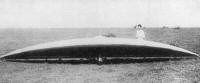
After the results obtained, Cheranovski decided to begin, with the help of his brother and other members of the “Paryashi Popiot” group, the construction of an experimental glider with this design. The works were carried out in the workshops of the Air Fleet Academy, where the glider received the consecutive AVF-12, although its designer named it BICh-1 (after its initials) and it was popularly known as “Parabola” (Russian: Черановский БИЧ-1 “Парабола”).
The BICh-1 glider was made entirely of wood, with a textile covering. This model featured a thick cantilever wing with a parabola-shaped leading edge and a thin trailing edge with ailerons and elevons across the entire span of the trailing edge. These moving surfaces performed both the functions of ailerons and elevator.
The pilot was located in a cockpit in the frontal region of the model, practically hidden within the thick 0.45 meter wing profile. Access was from below, through an opening in the wing intrados. The landing gear featured two large spoke wheels linked by a common axle.
Only one was built, which participated without great success in the First National Sailing Competitions held in Koktebel that same year. In some literature it has claims that during the competitions it would make a single flight before being destroyed and that the pilot VF Denisov managed to escape unharmed. Other sources suggest that the glider simply failed to take off, due to a poorly designed angle of attack. In any case, the BICh-1 was not a successful model, but it would create the basis for the development of later models that would present excellent flight characteristics.
Cheranovski BICh-1 Wingspan: 5.70 m Wing area: 12:00 m² Wing aspect ratio: 7.4 Length: 2.85 m Height: 1.20 m Empty weight: 30 kg Wing loading: 8.5 kg / m² Accommodation: 1
The Cheranovski BICh “KIM-2” (Russian: Черановский АВФ-12 “КИМ”) experimental glider was designed by Boris Ivanovich Cheranovski as a single-seater training glider. The cantilever wing had a parabolic shape in the plane, but unlike the AVF-12, installed high on the wide fuselage. The trailing edge maintained control surfaces throughout the span.
This glider featured large tail stabilizers with pronounced sagging and large area elevators.
The fuselage had a fusiform shape and smoothly ended at the rudder, without a differentiated empennage. The underside was reinforced to allow the glider to land on its belly.
The pilot was located in an open cockpit in the bow of the glider.
Built in 1924 by a group of enthusiasts from the Communist Youth Institute (KIM) located in the Jamovnich region, near Moscow, under the direction of Cheranovski. In general, it was a development of the AVF-12 “KIM”.
The BICh “KIM-2” glider was entered in the III National Sailing Competitions held in Koktebel. On 30 September 1925 it crashed on landing, losing the tail. The pilot was unhurt.
The Cheranovski AVF-12 “KIM” (Russian: Черановский АВФ-12 “КИМ”) experimental glider was designed as a single-seat training glider under the direction of Cheranovski. The cantilever wing had a parabolic shape in the plane and medium implantation. The trailing edge featured control surfaces throughout the span.
This glider featured large tail stabilizers with marked sagging and large area elevator rudders.
The fuselage had a fusiform shape and smoothly ended at the rudder, without a differentiated empennage. The underside was reinforced to allow the glider to land on its belly.
The pilot was located in an open cockpit in the bow of the glider.
The AVF-12 was built by a group of enthusiasts belonging to the circle of interest of the Central Club of the Communist Youth Institute (KIM) located in the Jamovnich region, in Moscow, under the direction of BI Cheranovski. The construction was developed in the workshops of the Air Fleet Academy (AVF) in 1924.
The AVF-12 was entered in the II National Sailing Competitions held in Koktebel. After a successful 11-second flight the glider lowered its wing and fell to the ground in an inverted position. The pilot was not injured. The glider was destroyed.
Wingspan: 12.00 m Wing area: 19.5 m² Length: 5.8 m Height: 1.10 m Stabilizers surface: 1.4 m² Elevator area: 0.8 m² Rudder surface area: 0.7 m² Spoiler area: 4.5 m² Empty weight: 72 kg Wing loading: 7.4 kg / m²
The BICh-11 appeared in 1932 as a continuation of the trapezoidal wing design started with the BICh-8 glider. Its construction was developed in the TsAGI workshops. The Cheranovski BICh-11 (RP-1) (Russian: Черановский БИЧ-11 (РП-1)), conceived in 1931, became the world’s first experimental aircraft in a flying wing configuration designed to use a reactive power plant. Problems with the development of the reactor made it necessary to equip the BICh-11 with a low-power engine in pusher configuration.
In practice, the BICh-11 had been conceived to test in flight the OR-2 liquid propellant rocket engine developed by FA Tsander, which weighed only 18 kg and was capable of developing a thrust of 0.62 kN. The funds for the modification of the model and the installation of the reactive power plant were approved by OSOVIAJIM on February 25, 1932. The installation of this engine was just behind the cabin. The fuel and oxidizing agent tanks were designed in fairings located on the wings, on both sides of the central fuselage.
The BICh-11 was conceived as a single-seater experimental glider, built entirely of wood. The cantilever and high-set wing had a trapezoidal shape and a three-spar structure. This wing was conceived in three sections: a central one forming an integral part of the fuselage and the long wing consoles with the rudders at the ends. The union of the consoles to the centroplane was made by means of some steel pieces. In the centroplane, they conceived some fairings that contained the chemical components necessary to make the OR-2 liquid reactive engine functional.
The entire leading edge was covered with a 1mm thick plywood sheet. The straight trailing edge featured control surfaces along the entire span, located on a bar on the soffit of the wing, just below the trailing edge. In the external part the ailerons were located, also used as elevator rudders. On the inside were the adjustable stabilizers on the ground and a little further inside the elevator. Adjustable stabilizers on the ground were located on the inside.
The fuselage was covered with plywood. The landing gear was composed of two independent wheels and a tail skid.
The pilot was located in a closed cockpit at the nose.
In mid-February 1932 the BICh-11 was transported to the GIRD and on February 22 it was flown in the form of a glider by Sergei Koroliov. Also in glider form, the BICh-11, piloted by Koroliov, flew in the IX National Sailing Competitions held in 1933.
The first tests work jet engine OR-2 began the 18 of March of 1933, but only 10 days after FA Tsander died and with him the work of building the rocket plane – 1 (RP-1), assigned name to the project.
Given the lack of a power plant, the BICh-11 was modified to use a 27 hp ABC Scorpion piston engine driving a propeller, with which the tests were continued. In this configuration the BICh-11 flew satisfactorily, becoming one of the first airplanes in a flying wing configuration with a trapezoidal ground plan to do so.
In the version with a piston engine, some modifications were made to the wing plan and its control surfaces. The ABC Scorpion power plant was located at the end of the fuselage fairing as an extension of the cabin and powered a two-bladed wooden propeller.
BICh-11 Engine: 27 hp ABC Scorpion Wingspan: 12.10 m Wing area: 20.00 m² Length: 3.25 m Empty weight: 200 kg Accommodation: 1
Cheranovski BICh-11 glider
Cheranovski RP-1 with wing fairings for liquid reactive engine fuel








 All Aero