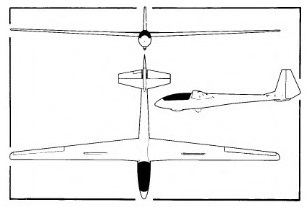
Civil Aviation Department of India TS-2 Ashvini / TS-3 Ashvini / TS-4 Ashvini II

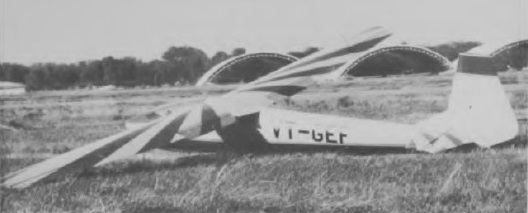
Ashvini is the first nakshatra, a lunar based division of the ecliptic in Hindu astrology. The glider named after it was the first Indian two seater, developed for the Indian Civil Aviation Gliding Centres and the National Cadet Corps. Designed by S.Ramamritham, the first prototype, the TS-2 Ashvini, was first flown on 3 September 1958 by F.H. Irani and later in its development by the very experienced glider pilot Hanna Reitsch. It was displayed to Prime Minister Nehru at Delhi Airport in February 1959.

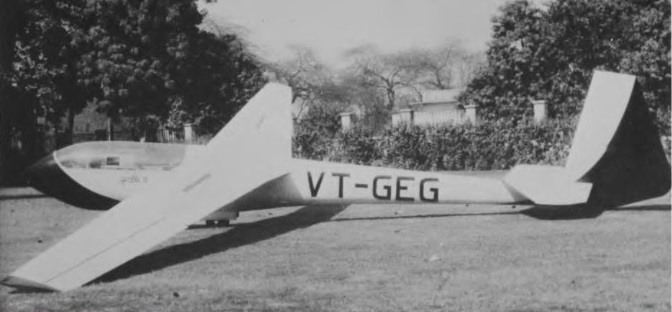
The reports of both pilots led to improvements incorporated in the next three pre-production prototypes, termed TS-3 Ashvini, along with some alterations made to ease later production. The first TS-3 flew in July 1959. The series production aircraft, first flown in prototype form in December 1960, was named the TS-4 Ashvini II. Alterations included revised forward fuselage contours and changes to control runs in the cockpit which allowed seats and sills to be lowered, easing access. The lift to drag ratio was increased by lowering the wing relative to the fuselage, improving the aerodynamics of the junction. Eleven production TS-4s were built.

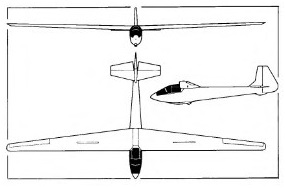
The Asvini had an all-wood structure, covered with a mixture of plywood and fabric, using Indian grown spruce and cedar. Its three part wing had two spars and 4° of forward sweep at the quarter chord line. The centre section had a span of 6.10 m (20 ft 0 in) and the outer panels were detachable. In plan the wing was straight tapered (taper ratio 0.41), with forward sweep on both leading and trailing edges. It was ply covered forward of the rear spar around the leading edge, forming a torsion box, and fabric covered over the remaining 30% of chord. Its high cantilever wing was mounted with 1° dihedral on top of the spar. It had plain fabric covered ailerons and short DFS-type air-brake pairs placed behind the forward spar at about one quarter span. There were no flaps.

The Ashvini’s fuselage was a ply covered wooden-semi-monocoque including an integral, ply covered fin with a straight, swept leading edge. Its balanced rudder, full and rounded, extended down to the keel. The horizontal tail was straight edged and double tapered, with square tips. It was mostly fabric covered apart from the leading edge and root and was placed on top of the fuselage, far enough forward that the inner edges of the separate elevators were in line with the rudder hinge. The rear control surfaces were fabric covered.

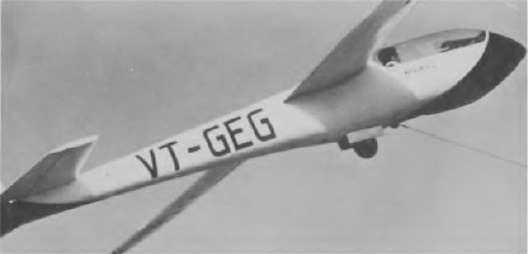
Pupil and instructor, provided with dual controls, sat in tandem ahead of the wing leading edge, the latter at the rear over the centre of gravity. They had separate perspex canopies; the forward canopy was side hinged and the instructor’s opened rearwards. The main landing gear was a single, non-retractable wheel without brakes. Ahead of the wheel and under the cockpits was a rubber sprung, steel shod skid and at the rear there was a short, tennis ball sprung tail skid.

Variants:
TS-2 Ashvini
First prototype, first flown September 1958.

TS-3 Ashvini
Pre-production prototypes with modifications to ease production and as a result of prototype flight testing. First flown July 1959; three built.

TS-4 Ashvini II
Production version with further improvements: forward fuselage and cockpit revised for easier access and wings lowered to improve wing-fuselage junction aerodynamics. First prototype flew December 1960 followed by eleven production models built by Aeronautical Services Ltd; production ended 1963.

Specifications:

TS-4 Ashvini II
Length: 8.66 m (28 ft 5 in)
Wingspan: 17.68 m (58 ft 0 in)
Height: 2.36 m (7 ft 9 in)
Wing area: 19.51 m2 (210.0 sq ft)
Aspect ratio: 16
Airfoil: NACA 4418 at root, NACA 4412 at tip
Empty weight: 318 kg (701 lb) equipped
Max takeoff weight: 500 kg (1,102 lb)
Wing loading: 25.6 kg/m2 (5.24 lb/sqft)
Maximum speed: 216 km/h (134 mph; 117 kn) placard, smooth air; rough air 120 km/h (75 mph; 65 kn)
Stall speed: 48 km/h (30 mph; 26 kn)
Never exceed speed: 222 km/h (138 mph; 120 kn) in dive
Maximum glide ratio: best, 23 at 77 km/h (48 mph; 42 kn)
Rate of sink: 0.82 m/s (161 ft/min / 2.7 ft/sec) minimum, at 58 km/h (36 mph; 31 kn)
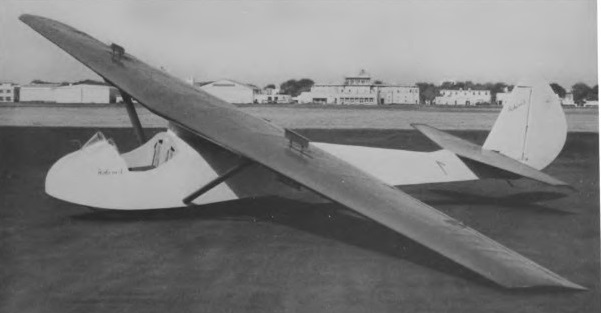
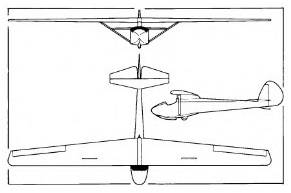
Civil Aviation Department of India RG-1 Rohini / Aeronautical Services Ltd RG-1 Rohini / Veegal Engines and Engineering Co RG-1 Rohini / Hindustan Aeronautics RG-1 Rohini

In the early 1960s S Ramamritham designed a two-seat training sailplane, the RG-1 Rohini, the first (built by Aeronautical Services Ltd RG-1) of four prototypes flying on 10 May 1961. The four prototypes were built between 1961 and 1964 at theTechnical Centre of Civil Aviation. The Rohini is the second two-seat glider to be designed and built in India.

To minimise production costs the Rohini uses a number of components identical to those on the Ashivini II including the tail surfaces, wing ribs and air brakes. The Ashivini is a tandem two-seater while the Rohini has its seating arranged side-by-side. Of all-wood construction, the Rohini has a braced high wing which is a two-spar structure, plywood-covered to the rear spar and with a fabric-covered trailing edge; the fabric-covered wooden ailerons have plycovered leading edges, and there are air brakes above and below the wing on each side. The fuselage is built as a one-piece structure with integral fin, the forward portion to the wing rear spar attachment and the rear portion aft of the tailplane front attachment bulkhead being plywood-covered wooden semi-monocoques, whereas the remaining centre and rear portions have a fabric-covered wooden girder structure. The cantilever wooden tail has a plywood-covered fin and fabric-covered rudder, tailplane and elevators except for the leading edges and that part of the tailplane between the two root ribs, which are ply-covered. There is a trim tab in the starboard elevator. The landing gear consists of a non-retractable unsprung Dunlop monowheel and tyre, with no brake, and a rubbersprung nose skid under the forward fuselage with a replaceable steel shoe; there is a spring steel tail skid. The two pilots sit side-by-side in an open cockpit with small windshields.

Since the Centre does not undertake quantity production of its gliders, but supplies complete sets of drawings of its designs to any firms interested in manufacturing them, the Rohini went into production elsewhere. A total of 17 Rohinis were built by Veegal Engines and Engineering of Calcutta, with Hindustan Aeronautics Limited building a further 86 RG-1s by 1971 at its Kanpur Division. At least 107 were built in total.

RG-1 Rohini 1
Wing span: 16.56 m (54 ft 4 in)
Length: 8.17 m (26 ft 9.5 in)
Height: 2.33 m (7 ft 7.25in)
Wing area: 20.76 m2 (223.5 sq ft)
Wing section: NACA 4418/4412
Aspect ratio: 13.2
Airfoil: NACA 4418 at root, NACA 4412 (modified) at tip
Empty weight: 274 kg (604 Ib)
Max weight: 494 kg (1,089 Ib)
Water ballast: None
Max wing loading: 23.76 kg/m2 (4.86 lb/sq ft)
Never exceed speed: 184 km/h (114 mph; 99 kn)
Stalling speed: 26 kt / 30 mph / 48 km/h
Aerotow speed: 112 km/h (69.6 mph; 60.5 kn)
Winch launch speed: 96 km/h (59.7 mph; 51.8 kn)
g limits: +5 -2.5
Min sinking speed: at 33 kt (61 km/h) 0.85 m (2.8 ft)/sec
Max rough air speed: 65 kt (120 km/h)
Best glide ratio: at 41.5 kt (77 km/h) 22
Maximum glide ratio: 21:1 at 77 km/h (47.8 mph; 41.6 kn)
Rate of sink: 0.85 m/s (167 ft/min) at 61 km/h (37.9 mph; 32.9 kn)
Crew: 2

Civil Aviation Department of India KS-I Kartik / KS-II Kartik

Several Civil Aviation Department aircraft were named after lunar related periods; Kartik (Sanskrit: कार्तिकः) is the eighth month of the Indian national calendar. The glider named after it was one of at least five designed by S. Ramamrithram at the Civil Aviation Department.

Produced at the Technical Centre of India’s Civil Aviation Department, the Kartik high performance single seater that first flew in prototype form, designated KS-I, on 18 March 1963. It performed successful stalling and spinning trials that same day and was followed by a second prototype.

It was a single seat, high performance machine, fairly conventional apart from the wing planform of the first variant, the KS-I Kartik. Rather than the usual taper, its 15 m (49 ft 3 in) span, high, cantilever wing had inner and outer rectangular panels of different chord, 200 mm (7.9 in) narrower outboard. This approximated taper and was simpler to build with fewer different sized ribs. The mid-wing joins were blended with short tapered sections of the trailing edge; the leading edges were straight. Overall there was 1° of forward sweep. The wing structure was wooden, consisting of a single main spar with plywood skinning forward from it around the leading edge to form a torsion resisting box, a secondary rear strut and diagonal drag struts at the wing roots. Fabric covering was used aft of the main spar. The wing was mounted with 1.50° of dihedral. It was fitted with ply covered, wood framed ailerons and had wooden air brakes which opened above and below at mid-chord.

The Kartik’s fuselage was a ply skinned, wooden framed semi-monocoque with an aluminium nose cap. The cockpit was ahead of the wing leading edge with a removable perspex canopy. Oxygen was an option. Aft, the fuselage tapered gently to the tail surfaces which were straight tapered and square tipped. Its tailplane, mounted at the top of the fuselage, was positioned forward of the fin so the rudder, which reached down to the keel, only required a small cut-out for operation. The fin and the tailplane leading edge were ply covered, the remainder fabric. The starboard elevator carried a trim tab.

Ramamrithram provided the Kartik with similar landing gear to that of his earlier Bharani: a fixed Palmer/Dunlop unsprung monowheel without a brake, a rubber sprung, steel shod forward skid and a tail skid with tennis balls as a spring. The pilot sits under a rearward opening hinged Perspex canopy, and oxygen equipment is optional.

Flight testing of the KS-I showed that the double rectangular wing was not a success and a third prototype, designated KS-II, first flew on 4 May 1965 and this had a conventional tapered wing to allow flight evaluation of the relative performances of the two wings; fabric-covered slotted wooden ailerons replaced the KS-l’s plywood-covered wooden ones. Area and span remained the same, though the airbrake area increased. A wheel brake was added and maximum take-off weight increased by about 7%. Other changes in the KS-II included a slight increase in fuselage length (100 mm / 3.9 in and a reduction in cockpit height, and second, third, fourth and fifth prototypes of the KS-II were test flown during February 1967, March and May 1968 and May 1969, plus a sixth prototype in 1970.

The third and subsequent aircraft incorporated several improvements, including a reduction in fuselage height, now fitted with a rear hinged canopy, and larger air brakes, while the ninth KS-II Kartik, flown in 1976, has the air brakes replaced by trailing edge slotted flaps.

KS-II Kartik

The KS-II was type certificated in 1965 and during the first Indian National Gliding Rally, held in 1967, the Kartik scored many successes, including setting a national speed record over a 200km (124 mi) triangular course.

Variants:
KS-I Kartik
First two prototypes, first flown 18 March 1963. Double rectangle wing.

KS-II Kartik
First flown 4 May 1965. Straight tapered wing. Seven built.
Specifications:

KS-II Kartik
Wingspan: 15.00 m (49 ft 3 in)
Height: 2.26 m (7 ft 5 in)
Wing area: 13.54 m2 (145.7 sq ft)
Aspect ratio: 16.6
Airfoil: NACA 643618
Length: 7.37 m (24 ft 2 in)
Empty weight: 210 kg (463 lb)
Max takeoff weight: 320 kg (705 lb)
Water ballast: None
Maximium wing loading: 23.63 kg/m2 (4.86 lb/sqft)
Maximum speed in smooth air: 200 km/h (124 mph; 108 kn)
Maximum speed in rough air: 140 km/h (87 mph; 76 kn).
Stall speed: 58 km/h (36 mph; 31 kn)
Max aero-tow speed: 71 mph
Maximum glide ratio: 31 at 75 km/h (47 mph; 40 kn)
Rate of sink: 0.6 m/s (120 ft/min) minimum, at 65 km/h (40 mph; 35 kn)
Crew: One

Civil Aviation Department of India HS-1 / HS-2 Mrigasheer

To succeed the earlier KS-II Kartik high performance single-seater the Technical Centre started design of another Standard Class sailplane known as the HS-1 Mrigasheer (मृगशिरा – “Orion”). The HS-1 is a single-seat Standard Class sailplane designed and developed at the Technical Centre by the team of designers and engineers led by Mr K. B. Ganesan, Director of Research and Development.

It was an orthodox design with a high wing, slender, tapering fuselage, and conventional empennage. Construction was wooden throughout.

The original version, the HS-1, made its first flight in November 1970. This had a higher aspect ratio wing than the Kartik’s with Wortmann wing sections instead of the earlier design’s NACA 64-series aerofoils. This was further developed into the HS-2 Mrigasheer under a design team lead by Mr K. B.Ganesan the centre’s Director of Research and Development, and the prototype of this made its first flight in April 1973. The following month it was flown into second place in the first Indian national gliding championships held at Kanpur. A second prototype, based on the aerodynamic design of the first, made its first flight in May 1977; this has trailing edge slotted flaps instead of the first prototype’s upper surface air brakes, and a glassfibre reinforced plastic tailplane and elevators of different aerofoil section.

HS-2 Mrigasheer

The Mrigasheer is of plywood-covered wooden construction and the high wings are two-spar structures with a plywood leading edge torsion box and plywood covering aft of the main spar, the wooden flaps and ailerons being hinged on the rear spar. The semi-monocoque fuselage is plywood-covered, as is the fin, but the rudder is fabric covered. There is a retractable unsprung monowheel with a drum-type brake, as well as a rubber-sprung nose skid with a replaceable steel shoe and a similarly sprung tail skid. The pilot sits under a long forward-opening jettisonable one-piece canopy.

The HS-2 differed from its predecessor in having slotted flaps instead of airbrakes, and a completely redesigned tail. This has glassfibre-reinforced plastic horizontal tail surfaces of different aerofoil section.The wooden two-spar wings incorporate a plywood leading edge torsion box with plywood covering aft of the main spar. The rear spar carries the hinges of the wooden flaps and ailerons. The fuselage consists of a semi-monocoque wooden structure with plywood covering.

HS-2
Length: 7.59 m (24 ft 11 in)
Wingspan: 15.00 m (49 ft 3 in)
Height: 2.50 m (8 ft 3 in)
Wing area: 11.24 sq.m (121.0 sq ft)
Aspect ratio: 19.9
Wing section: Wortmann FX-61-184/163/60-126
Empty weight: 237 kg (522 lb)
Gross weight: 335 kg (739 lb)
Water ballast: None
Max wing loading: 29.54 kg/sq.m (6.05 lb/sq.ft)
Maximum speed: 213 km/h / 133 mph / 115 kt
Max rough air speed: 80 kt (148 km/h)
Max aero-tow speed: 71.5 mph
Maximum glide ratio: 32
Rate of sink: 0.58 m/s / 120 ft/min / 1.9 ft/sec
Crew: One pilot

Civil Aviation Department of India TG-1 / ATS-1 Ardhra / Hindustan Aeronautics ATS-1 Ardhra

This tandem two-seater advanced training sailplane was designed by the Technical Centre of India’s Civil Aviation Department at New Delhi; it was formerly designated TG-1.

Of conventional wooden construction with fabric covering the ATS-1 resembles its predecessor, the single-seat HS-II Mrigasheer, although the cantilever shoulder wings have 3° of forward sweep and are plywood-covered multi-spar structures with fabric covered trailing edges. The plywood plain ailerons are also fabric covered; no flaps are fitted but there are wooden air brakes in the upper and lower wing surfaces. The tail unit is of similar construction to the wings, with a trim tab in the starboard elevator. The fuselage is a semi-monocoque wooden structure and there is a non-retractable rubber-sprung monowheel with an expanding shoe brake, plus a rubber-sprung skid under the nose and a tail skid.

The two pilots sit in tandem under a long one-piece blown flush-fitting canopy.

The prototype, VT-GEJ, first flew on 5 March 1979 and was certificated by the Indian DGCA in November that year. Plans for large scale production were underway early in 1980 for the National Cadet Corps and civil clubs. The second prototype which was then under construction has 2° geometric twist (washout) from 50% span to the wing tips, and the dihedral increased to 3°.

The Indian Air Force ordered fifty examples in the early 1980s to be produced by Hindustan Aeronautics and the type was approved for use for flying by cadets.

ATS-1 Ardhra
Length: 8.61 m (28 ft 3 in)
Wingspan: 16.50 m (54 ft 2 in)
Airfoil – Root: FX 61-184
Airfoil – tip: FX 61-184
Height: 2.46 m (8 ft 1 in)
Wing area: 21.8 m2 (235 ft2)
Aspect ratio: 12.5
Empty weight: 328 kg (723 lb)
Gross weight: 508 kg (1,120 lb)
Maximum speed: 210 km/h (130 mph)
Max aero-tow speed: 77.5mph
Min sinking speed: 2.56 ft/sec
Best glide ratio: 28:1 a 54 mph
Rate of sink: 0.8 m/s (160 ft/min)
Crew: Two, pilot and instructor

Civil Aviation Department of India BS-1 Bharani

Several Indian Civil Aviation Department aircraft were named after divisions (nakshatra) of the zodiac used in Hindu astrology; Bharani (भरणी) is one of these, literally meaning “the bearer”. The Civil Aviation Department BS-1 Bharani was a trainer glider designed by S. Ramamritham. The glider named after it was a wood framed aircraft, covered with fabric and plywood. It had a high cantilever wing with a single spar, ahead of which ply covering formed a torsion resisting box. Behind the spar it was fabric covered. The leading edge was straight and unswept but forward sweep on the trailing edge both tapered the wing in plan and resulted in a forward sweep of 1° at the spar. The wing had 1° of dihedral, wooden plain ailerons and wooden air brakes which opened above and below the wing.

The fuselage was a wood framed, ply covered semi-monocoque. The tandem cockpit was ahead of the wing under a two piece canopy which merged into the upper wing, assisted by a small transparency in the leading edge to improve upward vision from the rear seat. The forward part hinged sideways and the aft part rearwards. It had dual controls and instrumentation; oxygen supplies could be fitted if necessary. The tail unit had a straight edged, ply covered fin with a full, rounded, fabric covered rudder. Apart from some ply covering on the inner part of the tailplane the horizontal surfaces were also fabric covered. The leading edge of the straight tapered tailplane was well ahead of that of the fin.

The undercarriage was a fixed single monowheel, without a brake but assisted by a rubber-sprung nose skid which had a steel underside that could be replaced if damaged. There was also a small tail skid which was sprung with tennis balls.

The first flight was on 6 April 1962. No Civil Aviation Technical School designs were produced by them, though some were produced by external companies provided with full plans by the School. No production of the Bharani had been reported by late 1963.

Length: 8.33 m (27 ft 4 in)
Wingspan: 19.00 m (62 ft 4 in)
Height: 2.44 m (8 ft 0 in)
Wing area: 20.97 m2 (225.7 sq ft)
Aspect ratio: 17.21
Airfoil: NACA 643618 at root, 641A612 at tip
Empty weight: 350 kg (772 lb)
Max takeoff weight: 550 kg (1,213 lb)
Maximum wing loading: 26.2 kg/m2 (5.4 lb/sqft)
Maximum speed: 185 km/h (115 mph; 100 kn) in smooth air, 128 km/h (80 mph; 69 kn) in rough air
Stall speed: 56 km/h (35 mph; 30 kn)
Never exceed speed: 227 km/h (141 mph; 123 kn) diving
Maximum glide ratio: best, 31.5 at 82 km/h (51 mph; 44 kn)
Rate of sink: 0.61 m/s (120 ft/min) minimum, at 67 km/h (42 mph; 36 kn)
Crew: Two

Civil Aviation Department of India MG-1   

The Technical Centre of the Indian Civil Aviation Department began Design work on the MG-1 motor glider in October 1981. It was a low wing monoplane with spruce and plywood wings with a forward sweep of 1.5° at quarter chord mounted with 3.25° of dihedral. The ailerons were fabric covered; there were no flaps but wooden airbrakes extended above and below the wing. The cantilever, unswept empennage was similarly constructed and the low set tailplane carried elevators with a trim tab on the starboard side.

The fuselage of the MG-1 was steel framed and fabric covered with the exception of a glass fibre engine cowling. This housed a conventionally nose mounted, 74.5 kW (100 hp) flat four Continental O-200 piston engine driving a non-retractable propeller. Its cockpit seated two side by side under a rearward sliding canopy. The conventional undercarriage had main wheels with rubber cord shock absorbers and brakes, assisted by a steerable tailwheel.

Only one MG-1 was built. It made its first flight on 30 May 1983 and gained certification in December 1985.
Specifications

Engine: 1 × Rolls Royce Continental O-200-A, 75 kW (100 hp)
Propeller: 2-bladed Hoffmann V62R/170Y, 1.70 m (5 ft 7 in) diameter adjustable pitch
Length: 8.00 m (26 ft 3 in)
Wingspan: 16.50 m (54 ft 2 in)
Height: 2.50 m (8 ft 2 in) in flying attitude
Wing area: 21.83 m2 (235.0 sq ft)
Airfoil: Wortmann FX-61-184
Empty weight: 560 kg (1,235 lb) equipped
Max takeoff weight: 748 kg (1,649 lb)
Fuel capacity: 60 L (13.2 Imp gal; 15.8 US gal)
Maximum speed: 245 km/h (152 mph; 132 kn) power off, smooth air
Cruising speed: 160 km/h (99 mph; 86 kn) economical, 75% power
Stall speed: 62 km/h (39 mph; 33 kn) powered; 70 km/h (44 mph; 38 kn) power off
Range: 500 km (311 mi; 270 nmi) maximum fuel
Service ceiling: 4,575 m (15,010 ft) service
g limits: 5.3/-2.65 power off
Maximum glide ratio: 26:1 at 105 km/h (65 mph; 57 kn), power off
Rate of climb: 6.0 m/s (1,180 ft/min)
Rate of sink: 1.0 m/s (200 ft/min) minimum, at 90 km/h (56 mph; 49 kn), power off
Wing loading: 34.3 kg/m2 (7.0 lb/sq ft) maximum
Take-off run: 170 m (558 ft)
Landing run: 135 m (443 ft)
Crew: 2