Around 1742 the Marquis de Bacqueville is reported to have thrown himself from the roof of his house and managed to fly “with artificial wings” across the Seine, at which point he fell heavily into a boat and broke his thigh. He was more than 60 years old, “slightly crazy but with a lot of spirit.” There seems no record of how the wings worked.
Glider
Dawydoff UT-1
Alex Dawydoff in the U.S. acquired plans for the Slingsby Kirby Cadet and built the slightly modified UT-1, still with mainskid and no wheel, first flying in 1943. The sole UT-1 now belongs to the National Soaring Museum.
Davis-Costin Condor
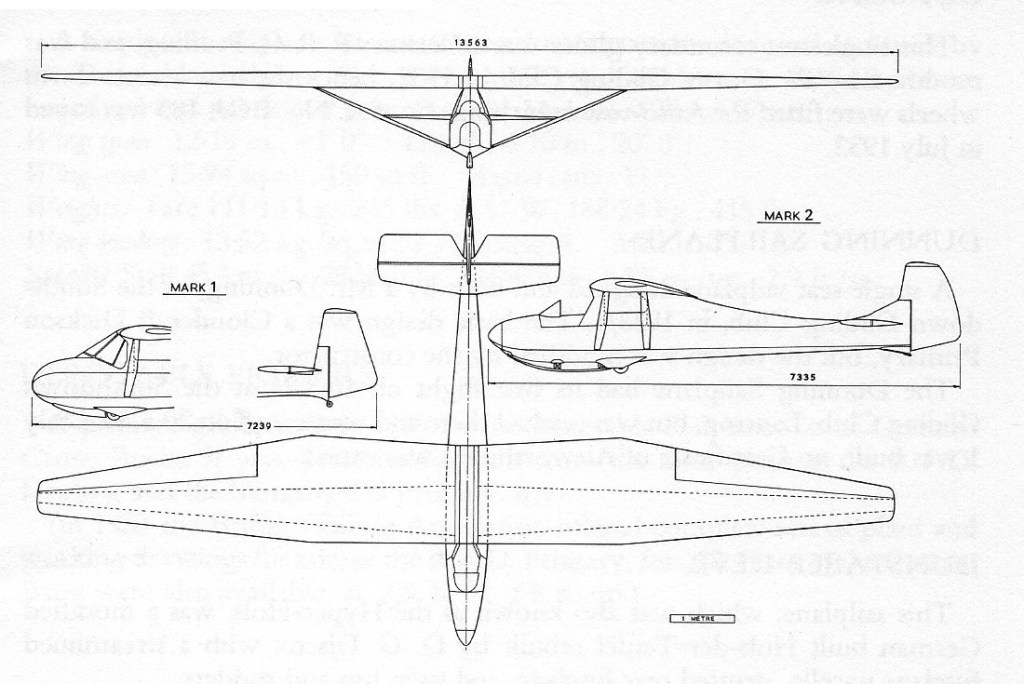
A two-seat tandem sailplane designed and built by F.Davis and F.Costin in 1953 and built at Portsmouth, UK.
Of conventional wooden construction, the wing was Go.426 mod. At the root, NACA 64, 110 at tip, special at mid-point. The wing was braced with two struts each side. No flaps or airbrakes were fitted but an emergency parachute was fitted.
It was first flown in 1952, it was rebuilt by P.Davis as a Series 2 with a longer nose and other detail alterations in 1960.
It was written off on 25 June 1961. Only the one was built and no C of A was issued.
Condor
Wingspan: 13.56 m / 44 ft 6 in
Length: 7.24 m / 23 ft 9 in
Wing area: 13.94 sq.m / 150 sq.ft
Aspect ratio: 10.4
Empty weight: 189.6 kg / 418 lb
Max L/D: 22 at 65 kph / 40 mph
Min sink: 0.76 m/sec / 2.5 f/se at 55 kph / 34 mph
Condor 2
Wingspan: 13.56 m / 44 ft 6 in
Length: 7.44 m / 24 ft 5 in
Wing area: 13.94 sq.m / 150 sq.ft
Aspect ratio: 10.4
Empty weight: 192.78 kg / 425 lb
Dart Totternhoe
A single-seat secondary glider designed and built by Dart Aircraft Ltd, Dunstable. Of conventional wooden construction, the braced wing had two struts on each side, and no air brakes or flaps were fitted.
The first glider had its test flights in May 1936.
Wing span: 11.8 m / 38 ft 8.5 in
Length: 6.55 m / 21 ft 6 in
Wing area: 17.84 sq.m / 192 sq.ft
Aspect ratio: 7.75
Wing section: Gottingen 532
Empty weight: 117.94 kg / 260 lb
AUW: 208.66 kg / 460 lb
Wing loading: 11.71 kg/sq.m / 2.4 lb/sq.ft
Max L/D: 23 at 42 kph / 26 mph

Dart Cambridge
A single-seat sailplane designed and built by Dart Aircraft Ltd, Dunstable, of conventional wooden construction.
It was similar to the German designed Grunau Baby but with a rounded monocoque fuselage. It featured strut-braced wings, with no flaps or airbrakes. The undercarriage was a main and tail skid.
The first flight of the prototype was at Dunstable, on 1 December 1935.
The Cambridge 2 was slightly lighter in weight, but with larger ailerons.
Wing span: 14.12 m / 46 ft 4 in
Length: 6.50 m / 21 ft 4 in
Wing area: 14.86 sq.m / 160 sq.ft
Aspect ratio: 13.24
Wing section: Gottingen 535
Empty weight: 111.13 kg / 245 lb
AUW: 204.12 kg / 450 lb
Wing loading: 13.71 kg/sq.m / 2.81lb/sq.ft
Max L/D: 19
Stall: 42 kph / 26 mph
Min sink: 0.91 m/sec / 3 ft/sec

Dunstable Sailplane Kestrel
Dunstable Sailplane offered kit drawings for the Kestrel
Wingspan: 40 ft
Length: 20 ft
Wing area: 150 sq.ft
Aspect ratio: 11
Empty weight: 245 lb
Gross weight: 415 lb
Min sink: 2.9 ft/sec
Glide ratio: 18-1
Dart Aircraft Co / Zander & Weyl / Dunstable Sailplane Co
Founded as Zander and Weyl Ltd at Luton Road, Dunstable in 1934 when E.P.Zander and A.R.Weyl went into partnership to build and repair gliders and light aircraft, along with the Dunstable Sailplane Company in 1935 with works at Hockliffe. W.L. Manuel joined as manager.
In July 1935 the company moved to new premises at the Luton Aerodrome, Barton-in-the-Clay, Bedfordshire, when Latimer-Neeham formed Luton Aircraft Ltd.
Several Zogling gliders were built and in 1935 a series of replicas of early gliders were made for the film “The Conquest of the Air” which was filmed by Alexander Korda at the Denham studios. These replicas included two Lilienthal types, a Wright 1902 glider, and one of Catley’s early gliders. Also, at the time the firm built a ‘Flying Flea’ from approved aircraft materials. This was the first powered aircraft built by Zander and Weyl.
The Flea was followed by the Dunstable Dart which was built after a suggestion, by members of the London Gliding Club, that the Slingsby Falcon 3 would possibly make a reasonable ultralight aircraft if it was fitted with a small engine. Weyl eventually came up with a completely new aircraft.
In 1936 to designs of A. R. Weyl, Zander & Weyl built the Dart Flittermouse single-seat ultralight aeroplane in 1936. Built aircraft subsequently as Dart Aircraft Ltd. First were Dunstable Dart, later named Dart Pup, and Flittermouse, both with parasol wing and pusher propellers. Three Dart Kittens were built in U.K., as well as one in Australia from plans.
In September 1936 the company moved to Phoenix Works at Gerrard Cross, Buckinghamshire, and concentrated on kits and plans for Minor aircraft for home constructors. At the same time Dunstable Sailplane offered kit drawings for the Kestrel sailplane.
In 1936 the company was re-organised financially and the name was changed to Dart Aircraft Ltd. New premises were obtained at 29 High Street North, in Dunstable. The Dunstable Dart aircraft was renamed the Dart Pup, and two new sailplanes were designed and built; the Cambridge and Totternhoe. Also introduced in 1936 was the Dart Flittermouse aircraft and, at the end of the year, the first Dart Kitten ultralight.
In 1937 a revised version of the Kitten was built but financial difficulties followed. E.P. Zander later left the firm to establish another company in Dunstable; Scott Light Aircraft.
Weyl continued to develop the Kitten and in 1938 designed a two-seat version as the Dart Weasel. This was an enlarged version of the Kitten, having tandem seating and a tricycle undercarriage, and was intended for possible Civil Air Guard training but it was not completed.
Operations ceased in 1939 and after the war Weyl continued development of the Kitten and introduced a Mark 3 version for homebuilt construction.
He died in 1965.
Darmstadt University Aviation Soc.
Klaus Holighaus started his career in gliding as an engineer when he was a student at the University of Darmstadt. With two of his fellow students, Waibel and Lemke he developed and built a prototype of the DG36. This was just the beginning of his revolutionary glider designs. After he completed his University Diploma he joined Schempp-Hirth.
DAR Rilski Orel
1935 Bulgarian single seat training parasol sailplane.
Wingspan: 15.82m
3 assembled –
Albatross
Chuchuliga (Lark)
Rilski Orel (Rilski Eagle)
Rilski Orel gained 1936 Olmpic gold.
DAR Zdravka Toprakchiev
1926 Bulgarian parasol sailplane
Hermann Winter, one assembled, named after Mjr Toprakchiev, a Bulgarian national hero.
 All Aero