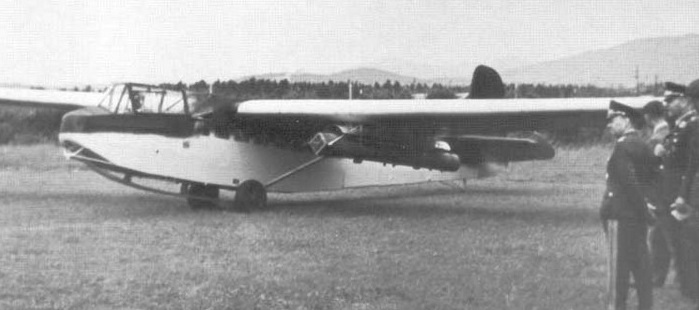
German assault glider. The major contribution of the Deutsches Forschungsinstitut for Segelflug (German Research Institute for Gliding) to Germany’s Second World War armoury was the DFS 230 assault glider of 1937. With a rectangular section fabric covered steel tube fuselage, and a long tapering wing covered in plywood and fabric and braced by metal struts to the fuselage, the glider could carry some 272 kg (600 lb) of freight in addition to the pilot plus nine troops and their equipment. Three prototypes were built and tested by the DFS, and further DFS 230s were produced by Gothaer Waggonfabrik, a series of A 0 pre production models being followed by production A 1s and dual control A 2s. Deliveries began in October 1939. Some modifications were incorporated in the B 1 and B 2 production series, notably a parachute pack for braking, a stronger landing skid and a mounting for a single MG 15 machine gun. The DFS 230 made its operational debut in the attack on Fort Eben Ernael and Albert Canal bridges in Belgium and Holland in May 1940. It went on to take part in attacks on the Corinth Canal, and in the airborne invasion of Crete in May 1941. However, such heavy losses were suffered during the later operation that thereafter DFS 230s were largely confined to transport duties in the Mediterranean and on the Eastern Front. One other spectacular operation involved DFS 230s, however, when DFS 230c 1s B 1s fitted with forward firing braking rockets in a special nose cone were used to land German commandos on the Matto Grosso as part of the rescue of Italian leader Benito Mussolini. A total between reported figures of 1022 and 1500 DFS 230s were produced, and the glider soldiered on in the supply role almost until the end of the war.
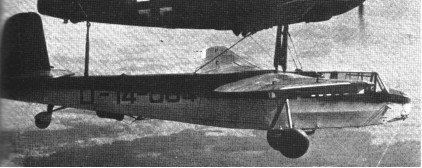
DFS230 glider with Argus AS014 pulsejets
DFS 230A-1 Wingspan: 68 ft 5.5 in / 20.87 m Length; 36 ft 10.5 in / 11.24m Height; 9 ft / 2.74 m Wing area; 444.55 sq.ft / 41.3 sq.m Empty weight; 1896 lb / 860 kg MAUW: 4630 lb / 2100 kg Max towed speed: 130 mph / 210 kph
DFS 230B 1 Span: 21.98 m (72 ft 11 in) Length: 11.24 m (36 ft 10.5 in) Gross weight: 2100 kg (4630 lb) Maximum speed: 290 km/h (180 mph)
After the Olympic games in Berlin in 1936 introduced gliding as an Olympic sport, plans were made to fly the 1940 Olympic championships with a standard design of sailplane to give each pilot the same chances. The FAI (Federation Aeronautique Internationale) duly announced a design competition for what was to be the Olympic sailplane. This specified a span of 15m (49ft 2.5 in), an empty weight of 160kg (353lb), a payload of 95kg (209lb) and a maximum speed of 200km/hour (124mph); only one material was to be used for construction throughout, air brakes were to be fitted but flaps or a retractable undercarriage were not allowed.
The competition was held at Sezze airfield in Italy between 20–26 February 1939 and was duly won by the Meise which had first flown earlier that year and which, like the other competing aircraft, was evaluated by six well known pilots from several other European countries.
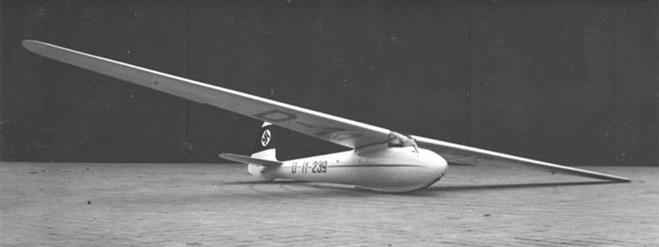
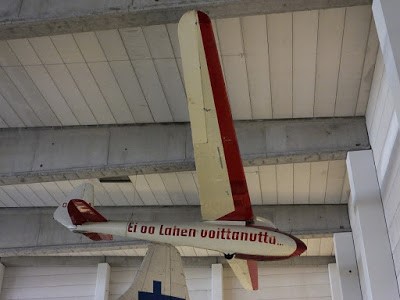
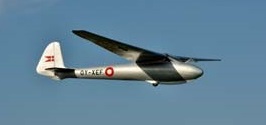
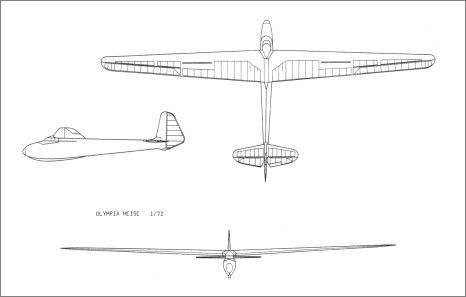
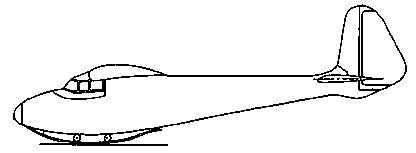
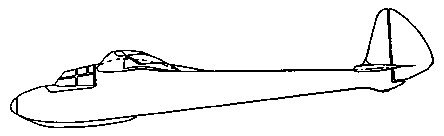
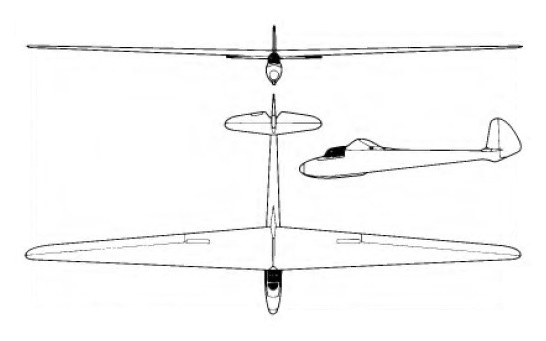
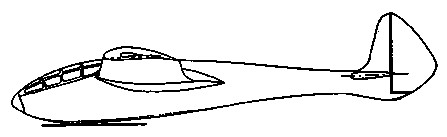
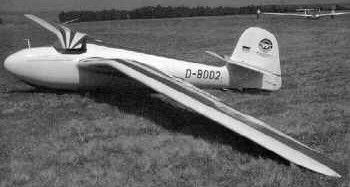
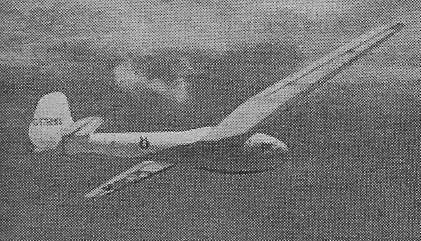
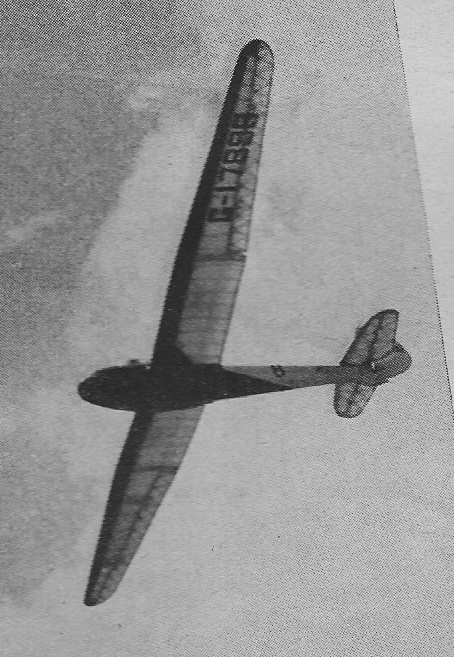
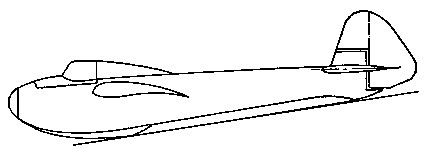
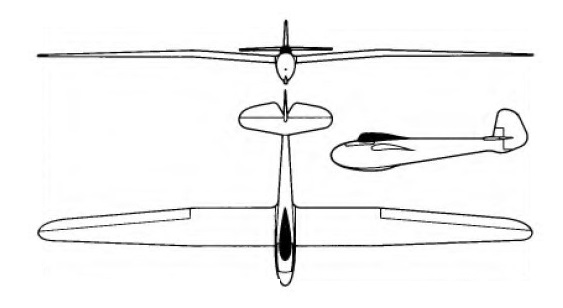
The Meise had been redesigned to fit into the new Olympic class specifications. The new ‘Olympia’ Meise had the prescribed wingspan of 15 m (49 ft 2 in), spoilers, but no flaps, and an undercarriage consisting of a skid and a non-retractable wheel. The pilot sat all-enclosed in an aerodynamically clean fuselage made of laminated wood and topped by an acrylic glass hood. The plane could be launched by winch as well by airplane. Its wood-and-fabric construction made it easy for flying clubs to maintain, to repair and even to build the gliders from kits. Approach control is by top and bottom Surface Schemmpp-Hirth type airbrakes. The original version used a takeoff dolly.
The Meise was in many respects a classic design with excellent flying qualities; its high cantilever wing was of wood and fabric construction and had DFS air brakes, while the fabric-covered wooden fuselage had a landing skid under the forward part, and the pilot sat under a detachable framed cockpit canopy in line with the wing leading edge.
When the Meise first flew it soon aroused interest in many countries in the few months before war broke out, and the German Aero Club supplied design details to a number of prospective customers.
Both the Meise as well as the Olympic class gained immediate enthusiastic support, and the 1940 Olympic gliding championship would probably have ended up as an all-Meise contest — if the Second World War had not intervened and the 1940 Olympics had not been cancelled.
Plans were distributed throughout the world for competing nations to produce their own Olympias. 626 Olympia Meises were built in Germany during the war by Flugzeugbau Ferdinand Schmetz Herzogenrath (601 built) and Flugzeugbau Schleicher (25). Most of the German production were among the 15,000 German gliders destroyed in 1945. 17 were also built at the time in Sweden.
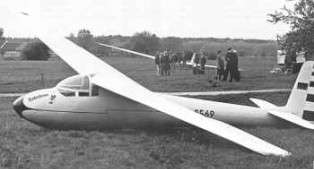
DFS 108 Olympia OH-OAA
Both the Meise as well as the Olympic class gained immediate enthusiastic support, and the 1940 Olympic gliding championship would probably have ended up as an all-Meise contest — if the Second World War had not intervened and the 1940 Olympics had not been cancelled.
626 Olympia Meises were built in Germany during the war by Flugzeugbau Ferdinand Schmetz Herzogenrath (601 built) and Flugzeugbau Schleicher (25). Most of the German production were among the 15,000 German gliders destroyed in 1945. 17 were also built at the time in Sweden.
The Meise, also sometimes known by the designation 108-70, set a pattern that lasted well into the postwar years, for it was built in France after the war as the Nord 2000. By November 1947, 100 Nord 2000 were ordered into production.
In Britain the design of the Olympia Meise was taken up by Chilton Aircraft Ltd., Elliotts of Newbury produced (as the EoN Type 5) the original skid version, and a modified version (Olypia 2B) with non-retractable main wheel.
The German drawings were not detailed and so entirely new drawings were made. Elliotts had been asked in 1945 by Chilton Aircraft Ltd to make one set of wings for the Chilton Olympia. An entirely new drawings were made by Chilton that merely retained the Meise Olympia’s aerodynamic shape. Otherwise it was a complete re-design and resulted in a stronger and heavier (+30 kg) aircraft.
To maintain employment at their factory, Elliotts refused to sell the wing jigs that they had made for the prototype. After building one prototype, which flew in 1946, the rights and drawings of the Chilton aircraft were taken up by Elliotts of Newbury (EoN) in the UK. Their first EoN Olympia flew in 1947. Later variations were produced by Elliotts into the late 1950s.
Production of the Olympia (originally called Type 5) started in 1946 as a batch of 100, and the first flight was made in January 1947. Elliotts and their design consultants Aviation & Engineering Products Ltd made improvements to the original design before starting production. Marks 1, 2 and 3 were produced, mainly distinguishable by the landing gear. The Mark 1 had only a skid whereas the Olympia 2 had a built-in main wheel. The Eon Olympia 3’s wheel was jettisonable after take off. The first batch of 100 was completed in 1947 but the market could not absorb such a large number, despite the low price of £425. Even by 1953, 40 of the first 100 Olympias were still unsold. Nevertheless, a second batch of 50 was built. Gliders from the second batch were still being offered for sale for £800 as late as 1957 in order to clear the stock, despite being below cost price.
After building three marks of the Olympia, another improved version, called the EoN Olympia 4 was produced in 1954. This is regarded as being sufficiently different from the original as being a new type. This type in turn led to a succession of variants.
The Olympia was also built after the war in Germany, in the Netherlands, in Spain, Switzerland (12), Hungary (35) with a further twenty modified as the Cinke, Australia (3), Austria and in Czechoslovakia as the Zlin Z-25 Šohaj, and Brazil (07).
The Vintage Sailplane Association has plans.
Structure: wood/fabric wings and tail, wood fuselage.
Variants: DFS Olympia Meise The original design for the 1940 Olympic gliding competition; built in large numbers during and after World War II, in Germany, Sweden, the Netherlands, Switzerland, Hungary, Austria and Brazil.
Chilton Olympia 2 A single prototype built in England, by Chilton Aircraft, in 1946.
Elliotts of Newbury EoN Olympia Further production in the UK after Elliotts acquired the rights to the design from Chilton. EoN Type 5 Olympia 1: Improved Olympia-Meise. Landing skid. EoN Type 5 Olympia 2: Fixed monowheel. EoN Type 5 Olympia 3: Jestisonable dolly wheels and skid. EoN Type 5 Olympia 4: New wing section, NACA 643618 at root, NACA 643421 at tip.
Nord 2000 Production in France post-war.
Zlin Z-25 Šohaj Production in Czechoslovakia post-war.
Cinke A modified version built in Hungary post-war.
Variations: Elliots of Newbury (EoN) EoN 10 Olympia Zlin Z-25 Šohaj
Specifications:
DFS Meise Wing span: 15.0 m / 49 ft 2.5 in Length: 7.27 m / 23 ft 10 in Wing area: 15.0 sq.m / 161.5 sq ft Wing section: Gottingen 549/676 Aspect ratio: 15.0 Empty weight: 160 kg / 353 lb Max weight: 255 kg / 562 lb Water ballast: None Max wing loading: 17.0 kg/sq.m / 3.48 lb/sq ft Max speed: 119 kt / 220 km/h Stalling speed: 29.5 kt / 55 km/h Min sinking speed: 0.67 m/sec / 2.2 ft/sec at 32 kt / 59 km/h Best glide ratio: 25.5 at 37 kt / 69 km/h
DFS Olympia Meise Length: 23.852 ft / 7.27 m Wingspan: 49.213 ft / 15.0 m Aspect ratio: 15.00 Airfoil: Go 549, root; 676, tip Wing area: 161.46 sq.ft / 15.0 sq.m Max take off weight: 661.5 lb / 300.0 kg Weight empty: 452.0 lb / 205.0 kg Max. weight carried: 209.5 lb / 95.0 kg Max. speed: 108 kts / 200 km/h Landing speed: 30 kts / 55 km/h Cruising speed: 35 kts / 65 km/h Wing loading: 4.1 lb/sq.ft / 20.0 kg/sq.m MinSink: 0.70 m/s / 2.3 fps / 1.36 kt at 37mph L/DMax: 25 66 kph/ 36 kt / 41 mph Glide ratio: 25.5:1 at 42.5mph Crew: 1
DFS Meise Wing span: 15.0 m / 49 ft 2.5 in Length: 7.27 m / 23 ft 10 in Wing area: 15.0 sq.m / 161.5 sq ft Wing section: Gottingen 549/676 Aspect ratio: 15.0 Empty weight: 160 kg / 353 lb Max weight: 255 kg / 562 lb Water ballast: None Max wing loading: 17.0 kg/sq.m / 3.48 lb/sq ft Max speed: 119 kt / 220 km/h Stalling speed: 29.5 kt / 55 km/h Min sinking speed: 0.67 m/sec / 2.2 ft/sec at 32 kt / 59 km/h Best glide ratio: 25.5 at 37 kt / 69 km/h
Olympia Meise 51 Wingspan: 15 m (49 ft 3 in) Wing area: 15 m2 (160 sq ft) Aspect ratio: 1.5 Length: 7.3 m (23 ft 11 in) Width: 0.58 m (1 ft 11 in) maximum fuselage width Empty weight: 165 kg (364 lb) equipped Max takeoff weight: 290 kg (639 lb) Never exceed speed: 220 km/h (137 mph; 119 kn) Aerotow speed: 100 km/h (62.1 mph; 54.0 kn) Winch launch speed: 80 km/h (49.7 mph; 43.2 kn) Maximum glide ratio: 25 at 70 km/h (43.5 mph; 37.8 kn) Rate of sink: 0.67 m/s (132 ft/min) at 60 km/h (37.3 mph; 32.4 kn) Wing loading: 17 kg/m2 (3.5 lb/sq ft) Crew: 1
EoN Olympia 2 Wingspan: 49 ft 3 in (15 m) Wing area: 160 sq ft (15 sq.m) Aspect ratio: 15 Airfoil: root:Göttingen 549 (mod.), tip:Göttingen 676 Length: 21 ft 8 in (6.61 m) Empty weight: 430 lb (195 kg) Max takeoff weight: 670 lb (304 kg) Stall speed: 31 mph; 27 kn (50 km/h) Never exceed speed: 129 mph; 112 kn (208 km/h) Rough air speed max: 128 km/h (79.5 mph; 69.1 kn) Aerotow speed: 100 km/h (62.1 mph; 54.0 kn) Winch launch speed: 100 km/h (62.1 mph; 54.0 kn) Maximum glide ratio: ~25 at 72.5 km/h (45.0 mph; 39.1 kn) Rate of sink: 132 ft/min (0.67 m/s) at 63 km/h (39.1 mph; 34.0 kn) Wing loading: 4.1 lb/sq ft (20 kg/m2) Crew: 1
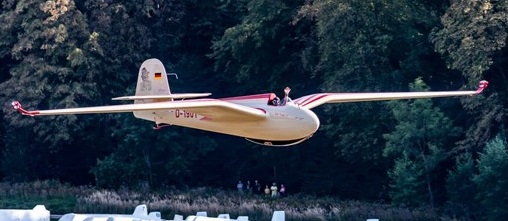
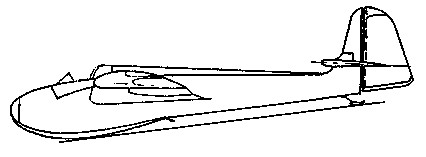
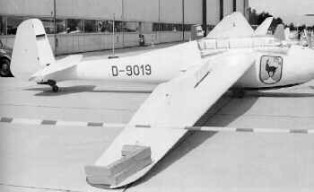
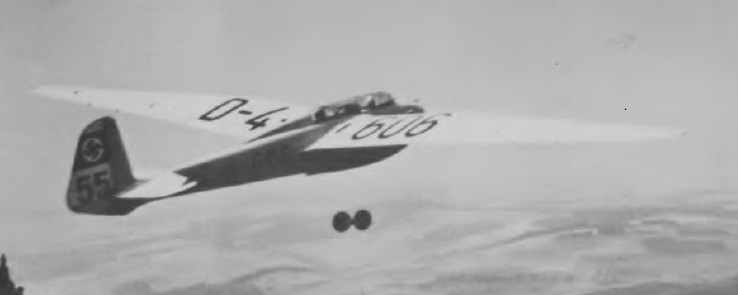
The Weihe single-seater high performance competition sailplane was designed for the DPS by Ing Hans Jacobs, who was responsible for so many of the leading prewar German types, such as the Meise, Kranich, Rhonadler and Rhonsperber. The Weihe was developed from an earlier gull wing design known as the Reiher and first flew in 1938, being placed fourth in the Rhon competition of that year.
Produced in large numbers by the Jacobs Schweyer factory and elsewhere in Germany before and during the war, it soon aroused the interest of prospective customers and more than 550 were eventually built in Spain, France, Sweden and Yugoslavia as well as Germany from the original German plans, and including a few built after the war as the Weihe 50 by the Focke-Wulf company when it was reconstituted at Bremen Airport as Focke-Wulf GmbH.
The Weihe remained in the front rank of competition sailplanes for a very long time; it took first place in the 1948 World Gliding Championships flown by Per-Axel Persson of Sweden, and at these championships no less than 13 out of 29 competitors were flying Weihes. The type also took the first two places in the 1950 World Championships and third place in the 1954 World contest, being able to hold its own with the many more advanced postwar designs then in use. Persson, who had won the 1948 World contest, had set a world height record of 26,411 ft in his Weihe the year before, and in 1959 a Weihe set another height record of 31,709ft.
The Schweyer version differed slightly from the D.F.S. model by having a slightly longer nose and larger canopy. Originally produced with D.F.S. airbrakes of limited effectiveness, some late production examples have Schempp-Hirth type airbrakes.
Schweyer Weihe
The 18m span wings have a thin Gottingen 549 aerofoil section, and small spoilers are fitted just inboard of the ailerons. For rigging the high cantilever wings are fitted into the fuselage with their tips on the ground, the tips then being raised and the wings locked into position with a bolt. The Weihe is of conventional wooden construction; the fuselage is rather long with a narrow cross section that makes for a somewhat cramped cockpit. The canopy was originally of the multi-framed type with a sliding window, but the later Weihe 50 had a more streamlined one-piece canopy. Take-offs are made on a jettisonable dolly wheel landing gear and there is a landing skid under the forward fuselage.
The Focke-Wulf produced Weihe 50 had a blown canopy, and some of which had a fixed main wheel instead of a jettisonable dolly. Nine Weihe 50s were built postwar by Focke-Wulf GmbH, the prototype of this series first flying on 14 March 1952.
DFS 108 Weihe Wingspan : 59.055 ft / 18.0 m Wing Area: 18.39 sq.m /198 sq.ft Aspect ratio: 17.46 Airfoil: Go 549-M2 Length : 26.247 ft / 8.0 m Empty Weight: 230 kg / 508 lb Payload: 105 kg / 230 lb Gross Weight: 335 kg / 738 lb Wing Load: 18.22kg/sq.m / 3.7lb/sq.ft Vne: 83 mph. Landing speed : 14 kts / 26 km/h Cruising speed : 38 kts / 70 km/h L/DMax: 29 76 kph / 41 kt / 47 mph MinSink: 0.61 m/s / 2.0 fps / 1.18 kt Glide ratio : 21.2 Crew : 1
DFS108-49 Grunau Baby Wingspan 13.6 m (45 ft) Length 5.9 m (20 ft) Height 1.5 m (4 ft 11 in) Empty weight 160 kg (353 lb)
Schleicher Weihe 50 Wingspan: 59.055 ft / 18.0 m Wing area: 197.4 sqft Aspect ratio: 17.7 Length: 26.706 ft / 8.14 m Empty weight: 507lb Max take off weight: 738.7 lb / 335.0 kg Max. speed: 92 kts / 170 km/h Min sinking speed: 1.9ft/sec at 37.5mph Best glide ratio: 29:1 at43.5mph Crew: 1
Habicht E Length : 21.49 ft / 6.55 m Wing span : 44.619 ft / 13.6 m Max take off weight : 639.5 lb / 290.0 kg Max. speed : 227 kts / 420 kph Glide ratio : 22.6 Crew : 1
The DFS Kranich (or Crane), which first flew in the autumn of 1935, was the real forerunner of this new breed of two-seater which could be used for competition flying and long distance soaring as well as dual-control training.
Designed by Ing Hans Jacobs and built by Ing Luck, the Kranich prototype was developed from an earlier Jacobs design, the Rhonsperber high performance single seater. After successful flight trials, the Kranich was put into production by Karl Schweyer A.G. at Mannheim, since the DFS did not manufacture aircraft of its own design except for prototypes, and altogether 400 Kranichs were built in Germany.
The type was also built under licence in Sweden, Poland, Yugoslavia, Czechoslovakia and Spain.
As late as 1952 Kranichs captured the first three places in the two-seater class in the World Gliding Championships held at Madrid and the type had previously set up more world records and many national ones. The two pilots sit in tandem under a long and narrow framed canopy with individual detachable sections, dual control being provided, and an unusual feature is a small transparent panel in each wing root to provide downward visibility for the instructor in the rear seat located behind the wing spar. Construction is of wood and fabric, the fuselage being of plywood. The mid-set gull wings were fitted with spoilers in the initial production version – use of these had been pioneered in the Rhonsperber – but the 1935 strengthened Kranich 2 was fitted with air brakes. Take-offs were made on a double wheel unit that was jettisoned when airborne, and there was a long ash skid under the forward fuselage for landing.
A Kranich 3 was used to flight test a special wing section for the Akaflieg Braunschweig SB-11, this wing section, of 1.5m span and 0.75m chord, being mounted on a steel tube framework on the tip of the nose in front of the cockpit, and having two large endplate surfaces on each side of it.
Kranch III
After the war 40 Kranich 3s were built by Focke-Wulf GmbH, the prototype of this series, registered D-3002, first flying on 28 May 1952. The Kranich 3 was different in several respects from the prewar versions; it had a new wing in the low-mid instead of mid position, with dihedral from the roots and straight taper instead of the gull wing with compound taper of prewar aircraft; aspect ratio was now 15.6 A longer forward fuselage was featured with the canopy top now flush with the fuselage top line; length was now 30ft 6.25in.
Kranich 3
In the early 1970s a powered version of this veteran design was produced by Eduard Schappert in Germany, who modified one of the Kranich 3s built postwar by Focke-Wulf GmbH to have a 35hp Fichtel & Sachs SA-2-440 engine mounted on a retractable pylon aft of the rear seat, and driving a two-blade tractor propeller. A fuel tank of glassfibre in the fuselage held 1.87 Imp gallons, and this variant was designated Kranich 3M. It had a maximum speed of 87mph with the engine on, a cruising speed of 62mph, a take-off run of 985ft and a maximum range of 74 miles.
Kranich Length : 25.262 ft / 7.7 m Wingspan : 59.055 ft / 18.0 m Crew : 2
Schweyer Kranich Wing span: 18.0 m (59 ft 0 in) Length: 7.7 m (25 ft 3 in) Wing area: 22.7 sq.m (244.4 sq.ft) Wing section: Gottingen 535 Aspect ratio: 14.3 Empty weight: 255 kg (562 lb) Max weight: 435 kg (959 lb) Water ballast: None Max wing loading: 19.16 kg/sq.m (3.92 lb/sq ft) Max speed: 116 kt (215 km/h) Stalling speed: 37.5 kt (70 km/h) Min sinking speed: 0.69 m/sec (2.3 ft/sec) Best glide ratio: 23.6
Kranich II Length : 25.262 ft / 7.7 m Wingspan: 59 ft 0.75 in / 18.0 m Wing area: 244.4 sq ft / 22.7sq.m Length: 25 ft 3.25 in Empty Weight: 562 lb / 290kg Max take off weight: 1025.3 lb / 465.0 kg Wing Loading: 20.5kg/sq.m Max. speed : 94 kts / 175 kph Crew: 2 L/DMax: 23.6 MinSink: 2.3 ft/sec / 0.69 m/s / 65 kph Aspect ratio: 14.27 Airfoil: Go 535
Kranch III Wing span: 59.383 ft / 18.1m Wing area: 21.06sq.m Length: 29.921 ft / 9.12 m Empty Weight: 330kg Max take off weight: 1146.6 lb / 520.0 kg Wing Load: 26.1kg/sq.m Max. speed: 100 kts / 185 kph MinSink: 0.70 m/s / 70 kph L/DMax: 30 80 kph Aspect ratio: 15.56 Airfoil: Go 549 Seats: 2
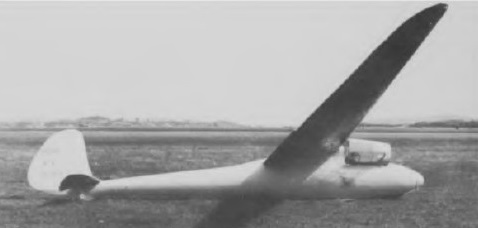
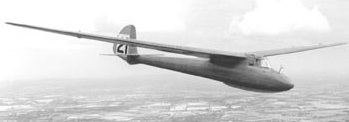
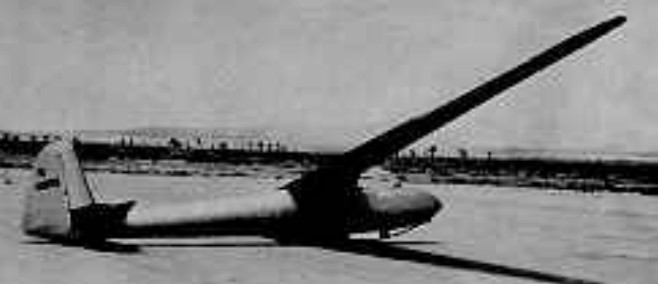
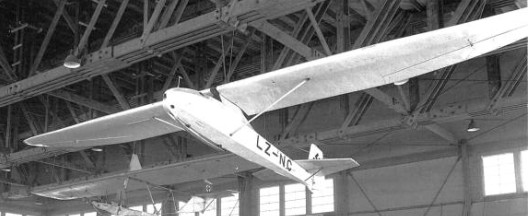
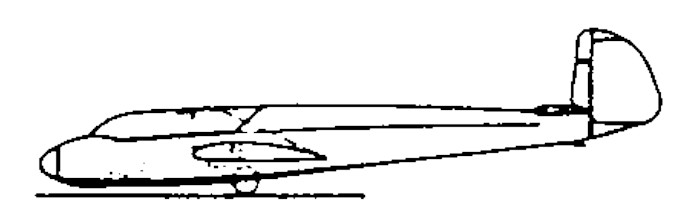
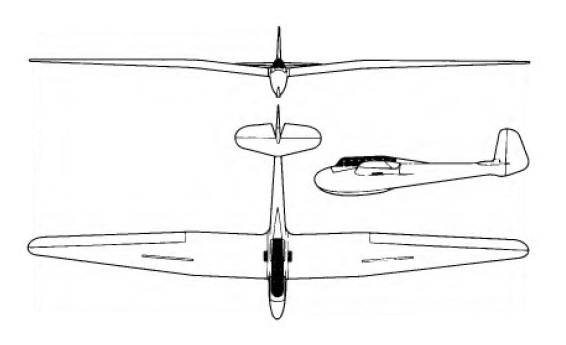
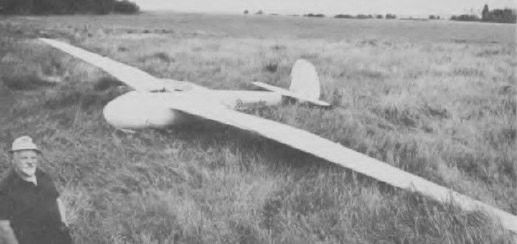
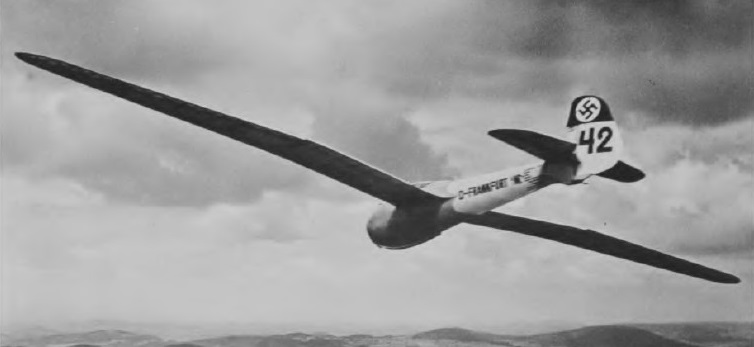
The Rhonsperber (or Rhon Sparrowhawk) was the second high perfromance single-seater designed by Hans Jacobs, and made use of the growing experience being gained in soaring in thermals at the Rhon competitions of 1932, when the Rhonadler had first appeared, and 1934. Developed from the Rhonbussard, and owing something to the earlier Rhonadler, the Rhonsperber differed from these types by having the cantilever gull wing lowered to the mid-set position, and slightly increased in span over the Rhonbussard’s. For the first time in a sailplane, spoilers were fitted into the wing upper surfaces, and these were later developed by Hans Jacobs into the DFS air brakes which were to be fitted to many other sailplane designs. Lowering the wing made possible a larger cockpit with better visibility above and behind, in which the instrument panel could be placed further from the pilot so as to enable him to see the whole panel at a glance; the pilot also had the benefit of an adjustable seat and rudder pedals for greater comfort on long soaring flights. Landing gear consists of a long wooden skid under the forward fuselage and a tail bumper fairing.
Of conventional wood and fabric construction, the Rhonsperber was put into production by the firm of Schweyer at Ludwigshafen, where about 100 were built; the prototype had first flown in 1935 and for the next two or three years the type was regarded as the leading German high performance sailplane.
It had many competition successes and made some notable long distance and record flights, including the first sailplane crossing of the Alps into Italy, made by Heini Dittmar in 1936, and a new world altitude record of 18,898ft set up in 1937 by Paul Steinig.
Span: 50 ft 2.5 in / 15.2 m Length: 19 ft 10.25 in / 6.05 m Wing area: 162.6 sqft Aspect ratio: 15.3 Empty weight: 357 lb Max weight: 562 lb Max speed: 124 mph Min sinking speed: 2.4 ft/sec Best glide ratio: 20:1 Crew: 1
Schweyer Rhonsperber Wing span: 15.3 m (50 ft 2 1/2 in) Length: 6.05 m (19 ft 10.25 in) Wing area: 15.1 sq.m (162.6 sq ft) Wing section: Gottingen 535 Aspect ratio: 15.3 Empty weight: 162 kg (357 lb) Max weight: 255 kg (562 lb) Water ballast: None Max wing loading: 16.9 kg/sq.m (3.46 lb/sq ft) Max speed: 108 kt (200 km/h) Stalling speed: 32.5 kt (60 km/h) Min sinking speed: 0.72 m/sec (2.4 ft/sec) Best glide ratio: 20
 All Aero