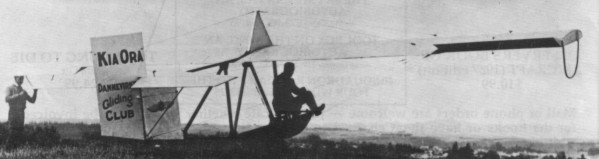
Dominion Aircraft Co Kia Ora
The Dominion Aircraft Company of Dannevirke, New Zealand, built a number of gliders in the early 1930s.
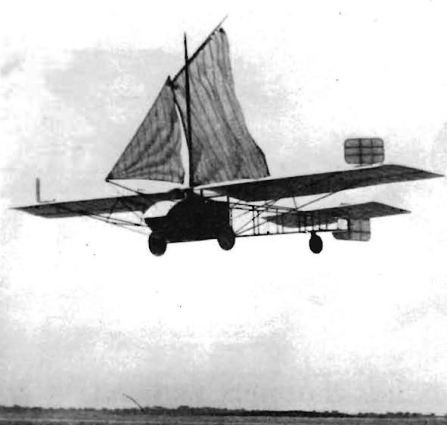
The Swiss (then) John Domenjoz was with Pegoud, the inventors of stunt flying; both were the first to complete a looping in 1913 while they worked at the Blériot School. By the late 20’s Domenjoz had got the idea to propel a glider by sail like the ancient ships. In 1930 he built at Pine Point, Maine, this glider; towed by a car at 50 mph it did reach an altitude of 200 feet above to sands at Old Orchard, but the sails proved to be utterly useless. The Domenjoz glider had an evident “Blériot connection” ….the Blériot XI type’s lattice fuselage and tail shape are all too obvious.
Victor Dmitriev was a teacher, truck driver, and aviation enthusiast in the Soviet Union. He pored over every bit of available information on American sport planes and taught himself how to design aircraft when the Soviet state considered such knowledge secret. Over the course of 24 years he built 30 aircraft, scrounging materials from the trash, now and then buying real aircraft parts through an illegal under-ground network. He modified a Czechoslovakian motorcycle engine for an airplane power plant. His de-sign studio, assembly plant, and hangar were all located in the four room apartment his family shared with two others in Beslickek (formerly Frunze) in Kirghizia, a republic between Kazakhstan and China.
Dmitriev built a whole series of tiny X planes over the years. “I built very many wings,” he said. “Without flaps. With one flap. With two flaps. With three flaps.”
Victor’s first attempt to build an airplane, in 1968, used a version of the Rogallo wing, a triangular kite-like device popular with early hang gliders. It didn’t work, but he was undeterred. In 1970, he got an aircraft off the ground; in 1979, he flew his first circle.
Dmitriev made contact with other closet airmen who helped one another. He said they sometimes sold aircraft parts under the table, and when he couldn’t find parts, he made them. He carved his own propellers with hand tools. He covered the wing and tail surfaces with parachute fabric, then shellacked and painted it for a smooth, drum tight surface. He made lightweight wing struts by shaping pieces of wood, cutting them in half, hollowing them out, and gluing them back together, and then epoxying on a layer of fiberglass cloth.
His work surfaced in the West in 1990 when the magazine Aviation Week & Space Technology published a photo of his machine. In 1991, he sent photographs of the X 14d in flight to the Experimental Aircraft Association (EAA) in Oshkosh, Wis., which published them in the magazine it sends to its members.
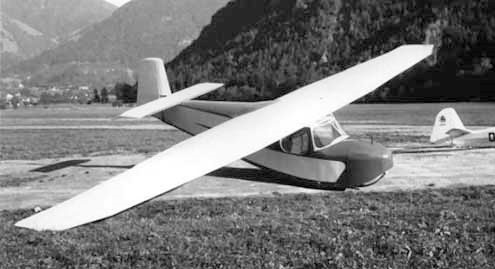
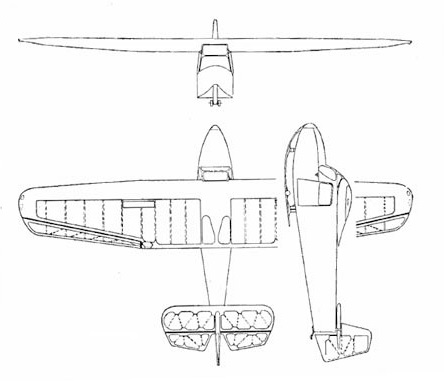
The Heini Dittmar designed wood and canvas HD 53 Möwe first flew in 1953.
Wingspan: 10.5m
Length: 6.2m
Height: 1.5m
Wing area: 16.8 m2
Empty weight: 225kg
MTOW: 520kg
Wing loading: 21.5 kg / m2
Minimum speed: 38 km/h
Maximum glide: 17 at 58 km/h
Minimum sink rate: 1.1 m/s at 45 km/h
Seats: 2
Inspired by his gliding brother Edgar, Heini Dittmar made an apprenticeship at the German Research Institute for gliding after leaving school. At the age of 18, he passed his A and B gliding test in 1929. In 1932, at the age of 21, he won the first victory of his class in the Rhön gliding competition with a self-made glider (Condor). Then he became involved as a research pilot.
After success with long-distance gliding, Dittmar became a member of the German gliding expedition to Argentina together with Hanna Reitsch and Wolf Hirth in 1934, where he set new world height records for gliders (February 16, 1934 over 4350 m). In 1934, Dittmar set another long-distance world record with Fafnir II and was awarded the Hindenburg Cup. In 1936, he made the first crossing of the Alps in a glider. Heini Dittmar crowned his career as a glider pilot with victory in the first international Rhön competition in 1937, which was later recognized as the first world championship in gliding. In addition, he was awarded the Golden Mark in Slide No. 1.
With the rocket aircraft Me 163 A-V4 KE + SW, Heini Dittmar reached 1003.67 km / h for the first time in a test flight on October 2, 1941 and was the first person to exceed the 1000 km / h mark in an aircraft. On July 6, 1944, Heini Dittmar reached a speed of 1130 km / h with Me 163 B V18 Komet VA + SP.
During and after World War II, Heini Dittmar worked as an aircraft designer and test pilot, but remained largely apolitical in the spirit of National Socialism. The National Socialists also used the enthusiasm for gliding that arose after the First World War to train young pilots and not least for the air force that was established. Heini Dittmar, who despite all modesty was also very popular abroad, represented the best possible advertisement for gliding through his appearance and success, which was carried out with books about Dittmar’s sporting achievements that were suitable for young people until the war.
A designer of high-performance sailplanes, Heine Dittmar produced a motorized version of his Segelmowein in 1953-1954 as the HD 153 Mowe two-seat light aircraft. Wing and tail detached for road transport. A small number of these aircraft, and of the later HD 156 three-seat aircraft, was built.
He died in 1960 when he crashed on a test flight with his own design HD-153 Motor-Möwe near Essen-Mülheim airfield. The machine, which was originally designed as a glider under the name HD 53 Möwe (later HD 153A-1 or HD 156A-1), had its first flight in 1953, but the type certification lasted until 1957. In the end, only eight or nine HD 153 and seven were built. HD 156 (more luxurious version of HD 153) of the machines equipped with a 71 kW Continental C-90 engine.
In his hometown, Mülheim an der Ruhr, as well as in Augsburg and Schweinfurt, the streets bear his name (Heini-Dittmar-Straße), as well as in Kiel-Holtenau (Dittmarweg).
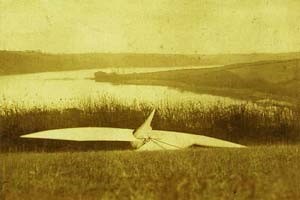
Designed and built by the Swiss engineer Albert Liwentaal while he was living in Devon, England, the Dittisham Aerostat of 1894 glider was tested twice, and crashed twice. The photograph, the image appearing to have been printed backwards, shows the result of the final trial, which took place near Bozomzeal, above Dittisham, Devon, along the River Dart.
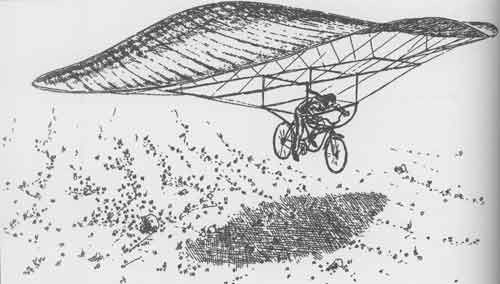
Guido Dinelli, an Italian shoemaker, was the second person in South America who is known to have made a gliding flight, while Pablo Suarez is believed to have been the first to do so. Both gliding flights took place at Tandil, Argentina, from atop Garibaldi Hill. Dinelli’s flight, on May 25, 1904, was made with a glider which he designed in late 1903. The glide was remarkable, covering 590 feet… a considerable distance.
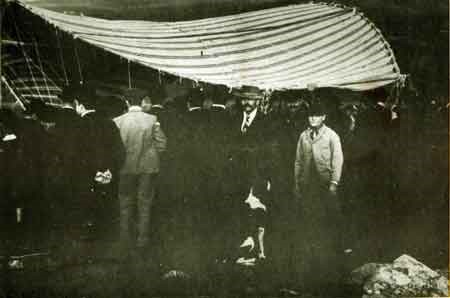
Dinelli and his “Aereoplano apparatus” weighed a combined total of 211 pounds and was controlled by a number of ropes pulled by the operator. The glider, constructed of steam-bent spruce covered with cotton fabric, apparently was attached to a bicycle. Dinelli seems to have garnered some construction advice from Frank Brown, an English clown with the Carlo Brothers Circus. The wing was arranged to tilt (in order to vary the angle of incidence) so Dinelli could choose when to gain lift. He pedaled the bicycle to gain speed and then tilted the wing to lift just as he left the edge of Garibaldi Hill, timed to take advantage of an updraft. Dinelli’s glide, apparently his last, ended with damage to his glider and bruises to himself.
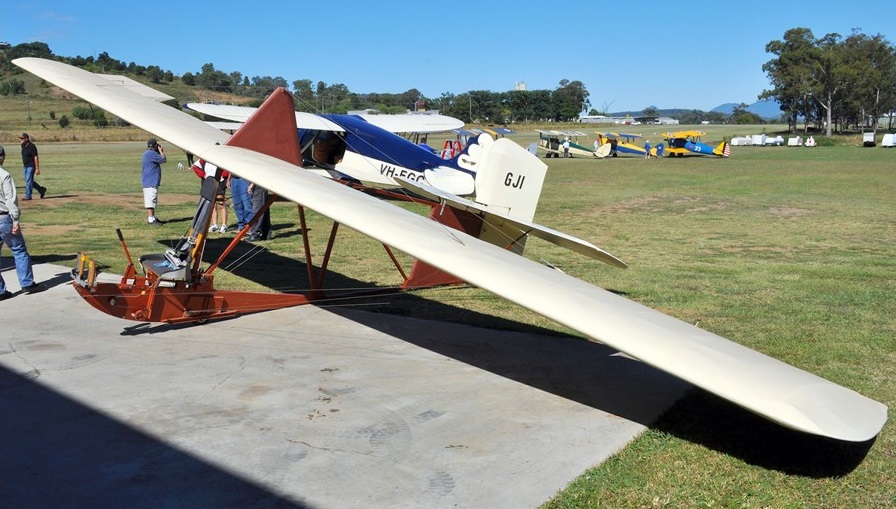
Designed by Roger S. Dickson and like other primary gliders of the 1930s, the Dickson Primary was aerodynamically unambitious, with its emphasis on low cost and simplicity. It was a wooden high wing aircraft, carrying the pilot on an open seat with a largely open, flat truss girder fuselage behind.
The wing had a two-spar fabric covered structure and was completely rectangular in plan. Ailerons occupied approximately ⅓ of the outer trailing edge. The wing was mounted on the horizontal upper beam of the three-bay fuselage Warren girder. The lower beam, angled slightly upwards rearwards, carried the pilot’s seat and controls at its forward end. Pairs of landing wires ran from a longitudinally-orientated inverted V-shaped pylon above the centre of the upper wing to the two spars near the inboard edge of the aileron. Similarly arranged flying wires ran from the same wing points to the keel. Bracing wires from the rear spar, at the same point as the flying wires, were anchored to the lower rear corner of the flat fuselage girder to limit sideways flexing.
The seat and exposed control column were located just ahead of the wing leading edge. A simple skid acted as undercarriage. At the rear, a fabric-covered tailplane, with swept leading edges and carrying rectangular elevators, was mounted on the upper fuselage beam over the whole of the aft fuselage bay. The rearmost vertical member of the girder carried a near-rectangular rudder, which projected above the fuselage led by a slender fin. Lateral stability was enhanced by the fabric covering of the rear bay of the fuselage.
The Dickson Primary flew for the first time in 1930. The designer of this glider has carried out extensive flight trials, and the machine behaved beautifully in every way, proving exceptionally stable. The only slight adjustment made was to fit the wires inside the rudder pedals instead of outside, to slightly reduce the gearing.
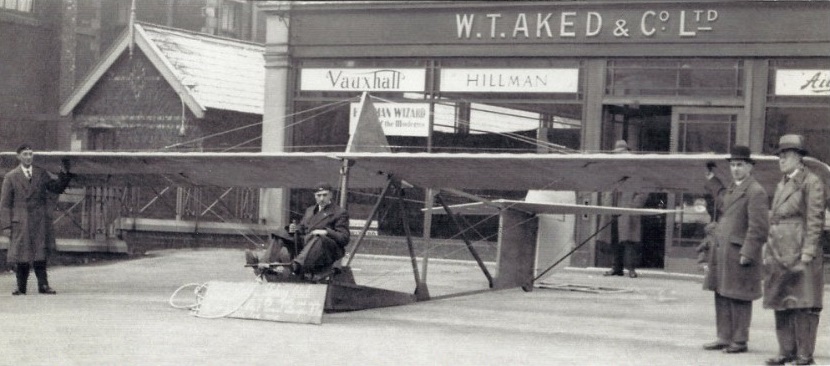
Only nine Dickson Primarys have established individual identities. However, a Cloudcraft Glider Co., Southampton, advertisement from July 1931 claimed that there were “over one hundred in use at the present time” in the UK, United States, Australia, New Zealand and South Africa. Some of these may have been built from kits, others from plans published in books and in or by magazines like Flight or bought from Cloudcraft. Certainly one example was built and flying in New Zealand by March 1931. UK gliding clubs (GC) flying Dickson Primarys included the London GC, operating at Dunstable, the Southampton GC and the Stockport GC. The last built their Dickson from plans. Seven years after the first flight, full working drawings were still on offer for 30/- (£1.50) from Flight itself, as they had been in 1931.
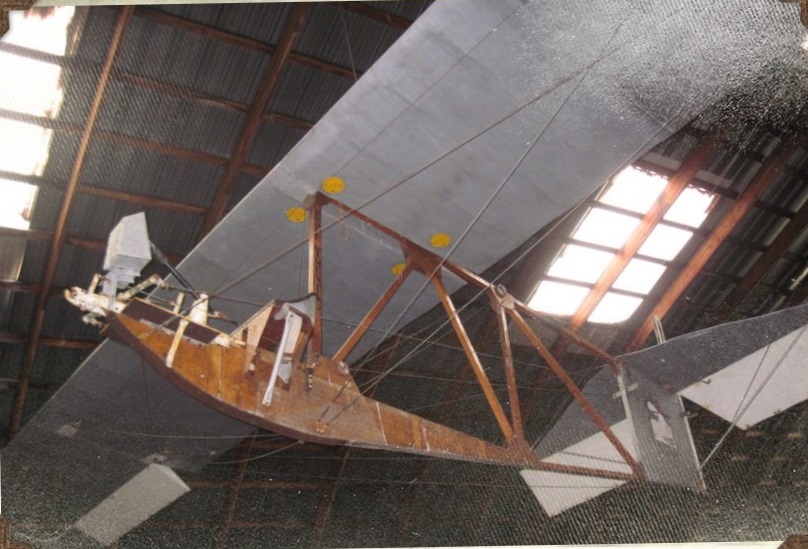
Dickson Primary
Wingspan: 34 ft 3 in (10.45 m)
Wing area: 170.0 sq ft (15.79 sq.m)
Airfoil: Clark YH
Aspect ratio: 7.0
Length: 17 ft 4 in (5.28 m)
Empty weight: 180 lb (82 kg)
Crew: 1
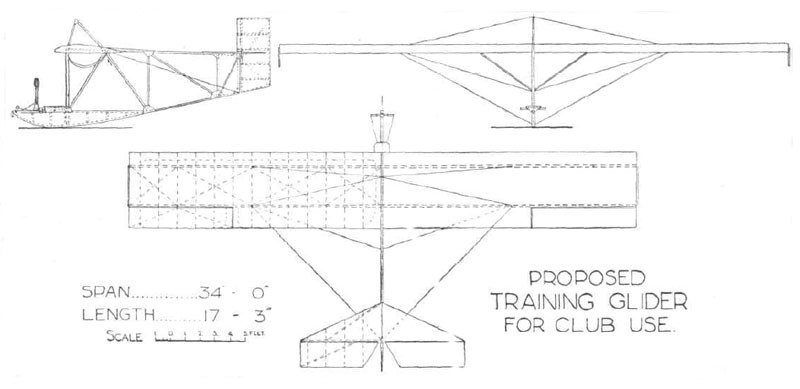
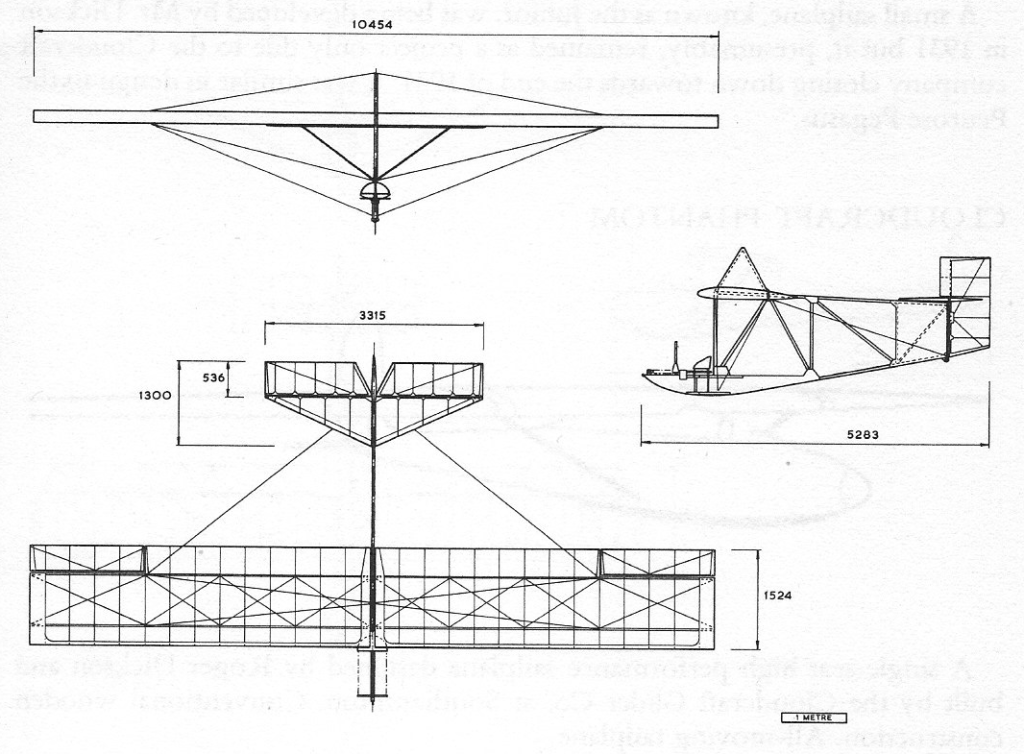
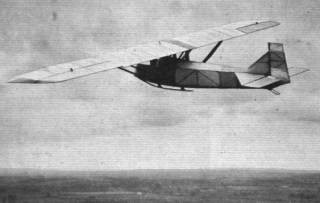
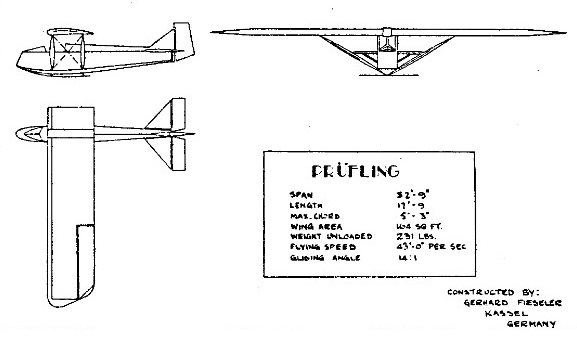
The German RRG Prufling of 1926 was a secondary training glider designed for club use. It was to be cheap to build, given the difficult financial situation of many Germans after the First world war, as well as simple enough that skilled non-professional builders and gliding clubs could successfully build them from plans.
The concept took shape shortly at the Martens gliding school at the Wasserkuppe in the rhön-Rossitten-Gesellschaft GBR at the end of 1925. Chief Martens instructor Fritz Stamer and Alexander Opisem were to produce two gliders in a few days; a Zogling and Prufling. Some parts, such as wings, and to a lesser extent, horizontal tails, the two aircraft were similar.
Both were almost rectangular in shape, two-spar wooden structures, with two-piece wings with fabric covering everywhere except the front edges of which were covered with plywood. In Pruflings the tips of the wings were more rounded and his wingspan 500 mm more. The ailerons were simple, though Pruflings were a little longer. Both had triangular tailplanes carrying elevators, which were rectangular pieces cut-out for rudder movement, though the tail Pruflings was more strongly swept and wider in chord.
The main difference between the two was in the fuselage. In the Zogling was very simple to open a longeron of the fuselage, Prufling more regular hexagonal cross section, wood-frame structure, covered with plywood forward from under the wing, and fabric aft. The wing was supported over the fuselage with a pair of parallel lift struts on each side, tying it almost in the middle of the span when the spars to the lower fuselage longerons. The open cockpit was under the wing center section was supported by two pairs of struts to the upper longerons of the fuselage. Front pair located in the front part of the cabin was a single, upright struts and in the back, just back, had a friend with an inverted V-steam. In the center there was a noticeable gap between the wings, connected by short wooden the link of the chord. The horizontal tail was located on the top longerons. with a triangular fin to wear vertically, straight edged balanced rudder, which was at an angle just below the heel and extended down to the keel. In Prufling landed on the rubber suspension below the frame forward the whole ply skin of the fuselage, helped a very small skid.
It first flew in 1926 and was soon in use with the corresponding RRT rhön Rossitten gliding clubs.
The plans were sold and many of them were built inside and outside of Germany. As an example, one was flying from the Lancashire Aero club and the other with the London gliding club in the early 1930s. Despite this success, Prufling was something of a disappointment as an additional training aircraft, for their performance was not much better than a typical primary. Handling also was not good, with lack of stability.
Wingspan: 10.50 m / 34 ft 5 in.
Wing area: 15.24 sq.m / 164.0 sq ft.
Aspect ratio: 7.23
Length: 5.484 m / 18 ft 0 in
Empty weight: 105 kg / 231 lb
Gross weight: 195 kg / 430 lb
Wing loading: 12.8 kg/sq.m / 2.6 lb/sq ft
Seats: One
 All Aero