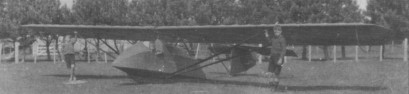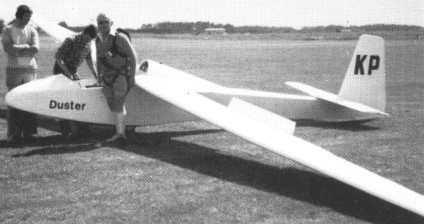
DSK Sailplanes BJ-1 Dynamite / DSK Sailplanes BJ-1B Duster            

The BJ-1b Duster is a development of the earlier 41.5 ft. span BJ-1 Dynamite (designed by Ben Jansson and Hank Thor). Intended for pleasure flying rather than contests or competitions, the BJ-1 Duster single-seater is specifically designed for homebuilt construction from plans and/or component kits. No component of the simple wooden structure exceeds 18ft in length so that it can be built at home and in the garage; the average construction time is approximately 600-700 hours.

Designed by Ben Jansson, an aerodynamicist who captained the Swedish teams in the 1968 and 1970 World Gliding Championships, and H.Einar Thor, the Duster is marketed by the DSK Aircraft Corporation of Van Nuys, California.
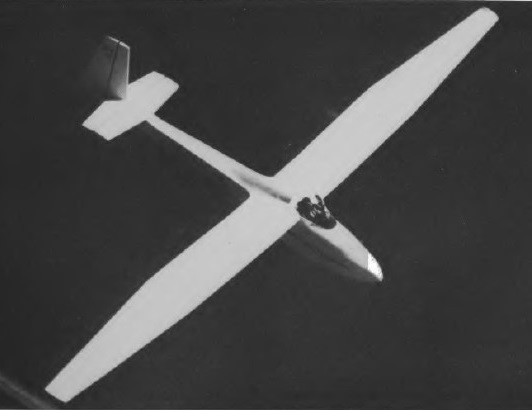
BJ-1

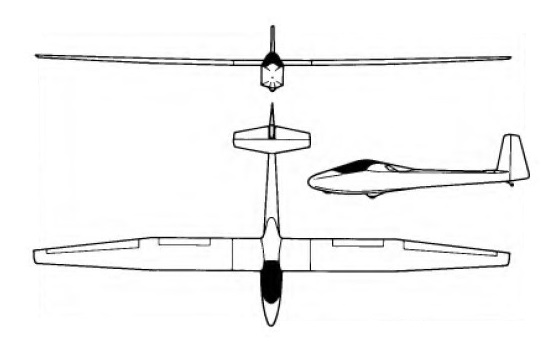
Design work began in early 1964 and the prototype BJ-1 first few in August 1966. The cantilever shoulder wing is built in three pieces – a 7ft span centre-section integral with the fuselage and two outer panels – and there is a single spruce main spar with plywood ribs and covering. The trailing edge flaps also act as air brakes. The straight-sided fir plywood fuselage has an elongated hexagonal cross-section in the cockpit area changing to a triangular cross-section aft of the wings. There is a ventral plywood keel reinforced by two bulkheads shaped to the seat contour and supporting a floor-mounted seat. There is a nonretractable semi-recessed monowheel beneath the keel, as well as a tailwheel; the fuselage nose cone and fairings are of glassfibre. The tailplane is mounted on top of the fuselage and the tail unit is of similar construction to the wings, all tail surfaces being plywood-covered.

The BJ-lb differs from the BJ-1 in having a slightly increased wing span, a reduced weight and a Plexiglas canopy reduced in height to allow the pilot to sit in a semi-reclining position; it can be flown with this one-piece flushfitting canopy or with an open cockpit and just a windscreen.

An auxiliary power package for the Duster was under development in 1977 using a 26hp engine mounted dorsally, and the plans provided give details of all the changes necessary to support an engine mounting, which can then be added when the builder so desires without further alteration of the airframe. Previously, a version of the BJ-1b powered by a 35hp Rockwell JLO-600LM ‘flat twin’ engine mounted behind the cockpit on struts and driving a two-blade fixed-pitch wooden pusher propeller was flown in 1973. This powered version was produced by the Duster’s co-designers, Hank Thor and Ben Jansson, and the engine is not retractable into the fuselage.
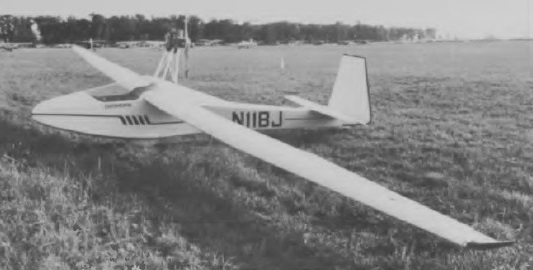
DSK BJ-1 Duster

Approximately 400 sets of plans and 150 component kits have been sold to homebuilders. In accordance with former OSTIV rules it has terminal-velocity-limiting dive brakes (216 kph/ 116 kt./ 134 mph. The Duster has been built in Canada and 10 other countries, and is type-certified in New Zealand. It is relatively simple to build but the 2.13 m/ 7 ft fixed center section provides a challenge for trailer design.
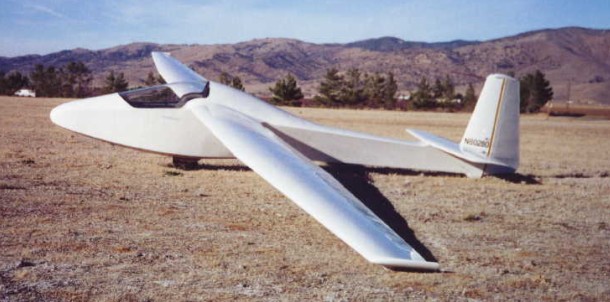
Duster BJ-1B

BJ-1 Dynamite
Wing span: 41.5 ft.

BJ-1 Duster
Wing span: 13.0 m (42 ft 7 in)
Length: 6.1 m (20 ft 0 in)
Wing area: 9.60 sq.m (103.3 sq ft)
Wing section: NACA 4415
Aspect ratio: 17.7
Empty weight: 159 kg (350 lb)
Max weight: 263 kg (580 lb)
Water ballast: None
Max wing loading: 27.4 kg/m 2 (5.61 lb/sq ft)
Max speed: 111 kt (206 km/h)
Stalling speed: 34.5 kt (64 km/h)
Min sinking speed at 67 kt (124 km/h): 1.8 m (5.9 ft)/sec
Max rough air speed: 80 kt (148 km/h)
Best glide ratio at 47 kt (87 km/h): 29

Thor BJ-1B Duster
Span 13.0 m / 42.7 ft
Wing Area 9.72 sq. m. / 104.65 sq.ft.
Aspect ratio 17.4
Airfoil NACA 4414 modified
Length: 20 ft 0 in
Empty weight 177 kg. / 390 lb.
Payload 104 kg. / 230 lb.
Gross weight 281 kg. / 620 lb.
Wing loading 28.91 kg. / sq. m. / 5.92 lb. / sq. ft.
Structure all wood
Max speed: 128 mph
L/D max. 28 85 kph / 46 kt / 53 mph
Best glide ratio: 29:1 at 54 mph
Min. sink 0.76 m/s / 2.5 fps / 1.48 kt at 72 kph / 39 kt / 45 mph
Min sinking speed: 5.9 ft/sec at 77mph
Seats: 1
BJ-1

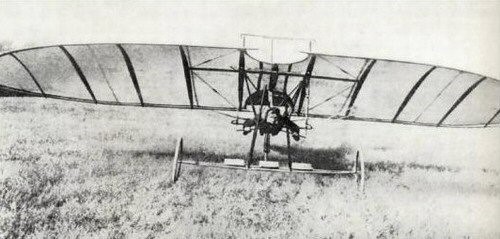
Drewet 1909 glider

Oliver H. Drewet (or Drewett, but definitely not Drewer) returned to Asansol, India to work as an engineer. It was there that he built his glider, based on a model that he had built before moving to India. A test flight, claimed to be the first in India, was made on 1 March 1909, down an inclined railway, on top of a truck. After 100 yards the machine left the truck with Drewet on board, and flew a distance of 20 yards before crashing.

Drewet, Oliver

Oliver H. Drewet (or Drewett, but definitely not Drewer) was born in Bombay, India in 1880 to European parents, who eventually settled in New Zealand in 1884. He returned to Asansol, India to work as an engineer. It was there that he built his glider.

When war broke out, Drewet joined the army as part of the New Zealand Expeditionary Force and was killed in action on 8 May, 1915 at Gapa Tepe, on the Gallipoli peninsula in Turkey.

Dorner-Begas 1908 Gleiter

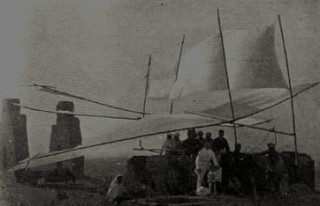
A parasol design started by Diplom Ingenieur Hermann Dorner in the spring of 1907 as a glider with a possibility of attaching an engine at a later time. He was financially assisted by Gottfried Begas, the son of the German sculptor Reinhold Begas. The machine was flown by towing it behind a horse and flights made were about 80 meters in distance at a maximum height of 10 meters. Dorner himself flew the machine and as can be seen in the photo, lay horizontally in the same way the Wright brothers would lie on the lower wing of their biplane gliders or early motorized biplanes.

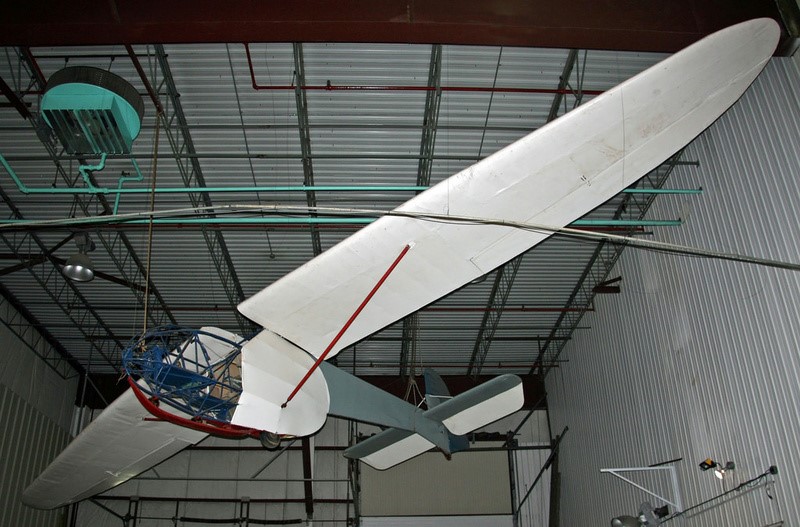
Doppelraab IV

Designed by Fritz Raab. A 1950 glider trainer that was well used after the war because its compactness and low cost. The instructor seat was elevated and had no controls. The instructor having to reach over the students shoulders to take the controls.

Wing span: 12.76m
Wing area: 18sq.m
Length: 29.692 ft / 9.05 m
Empty Weight: 185kg
Gross Weight: 350kg
Wing Load: 19.4kg/sq.m
Aspect ratio: 9.05
Airfoil: Go 550
MinSink: 0.85 m/s 50 kph
L/DMax: 20 @ 55 kph
No. of Seats: 2
No. Built: 220

Domrachiev D-2

The Domrachiev D-2 (Russian: Домрачев Д-2) was designed as a two-seater aerobatic glider. Its construction was carried out in the LENOAX construction workshops in 1934 with the aim of participating in the X National Sailing Competitions to be held that year in Koktebel.

The D-2 was designed as a high-bridged, two-seater glider with long wings and a high tail bar. The wing was braced by means of steel tapes that started from the wing intrados towards the landing ski and from the extrados towards a raised structure located on the longitudinal axis of the glider. This configuration made it possible to build an extremely light wing without detriment to its structural rigidity.

Another significant detail was the wing attachment to a vertical pile located above the head of the second crew member, which allowed excellent visibility and easy access to the cabins. This vertical pile had as a distinctive feature the possibility of being moved forward or backward in order to modify the aerodynamic centering of the glider.

The landing gear consisted of a fixed ski located in the ventral region of the nacelle, following the line of the glider axis.

The gondola with the tandem cabins also featured an additional luggage area with a capacity of 80 kg. In the rear cabin a shelf was to locate a telephone set that could be used for communication with the tug aircraft.

Built in Leningrad in 1934 and first flying that September, it participated in the X National Sailing Competitions, held in Crimea, where it was aero-towed. The acrobatic two-seater Domrachiev D-2 glider arrived at the competitions in Koktebel by air, towed by a plane.

D-2
Wingspan: 18.10 m
Wing area: 19.80 m²
Length: 8.05 m
Height: 2.68 m
Empty weight: 230 kg
Optimal speed: 61 km / h
Glide ratio: 20
Minimum descent speed: 0.78 m / s
Wing loading: 19.70 kg / m²
Surface of the horizontal plane: 2.82 m²
Vertical plane surface: 1.58 m²
Ailerons area: 2.10 m²
Wing elongation: 16.5
Accommodation: 2

Domrachiev, Yuri Vlarimirovich

Soviet aircraft builder Yuri Vlarimirovich Domrachiev (Russian: Юрий Владимирович Домрачев) designed and built several gliders in Leningrad in the 1930s.

From 1931 Domrachiev began to work in the aeronautical construction section of the NIAI under the direction of IM Zharnilski. By 1934 this section separated from the NIAI, becoming an independent Special Construction Bureau (OKB), initially subordinate to the Institute’s Student Combined and later to the LII GVF.

In the OKB the Lisichkin, Bedunkovich, Krylov, Domrachiev and later Bakshayev brigades were created. Each developed their own aircraft, but in many cases they were combined to achieve the end result.

In 1933 and 1934 Domrachiev created two competition planners that participated in the national competitions at Koktebel.

When the Institute of Engineers of the Leningrad Civil Air Fleet was created, Domrachiev went on to work in the research department. In 1937, together with LS Vildgrube, he designed and built a transport glider with an M-11 engine.