Empresa Aeronáutica Ypiranga began its activities with the realization of a glider, the EAY-101, in 1931. A copy of the German Stamer Lippisch Zögling, of which 6 examples were built.
Glider
EAY / Empresa Aeronáutica Ypiranga
Empresa Aeronáutica Ypiranga (EAY) is a Brazilian company created in São Paulo in 1931 on the initiative of the American Orthon Hoover, the Brazilian Henrique Dumont Villares and the German Fritz Roesler.
Having come to Brazil in 1914 to assemble three Curtiss seaplanes bought by the Brazilian Naval Air Force, Horton settled permanently in Brazil in 1928. He had collaborated with Frederico Brotero in the development of the IPT Bichinho. Henrique Dumont Villares was a nephew of Santos-Dumont and Fritz Roesler (born in Strasbourg), had been a fighter pilot during the First World War before reaching Brazil. Roesler had founded in 1923 in a district of São Paulo, Ypiranga, a flight school, then participated with George Coubisier, Francisco Matarazzo and others, in the creation of the airline VASP.
Empresa Aeronáutica Ypiranga began its activities with the realization of a glider, the EAY-101, a copy of the German Stamer Lippisch Zögling, of which 6 examples were built. The second achievement of the firm was copied from the Taylor Cub. The EAY-201 was a 40 hp Salmson 9Ad radial-engine, high-wing tandem tandem school two-seater which began testing in 1935. Only 5 were built. In 1942, EAY was absorbed by Companhia Aeronáutica Paulista (CAP), EAY-201 then becoming CAP-4 Paulistinha.
Działowscy Bydgoszczanka
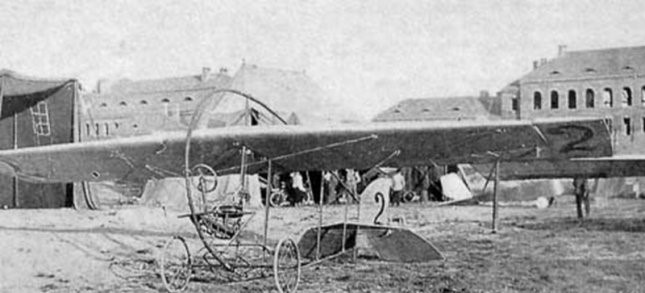
In mid-1924, brothers Stanisław and Mieczysław Działowscy started the construction of the “Bydgoszczanka” glider in their own project at the Pilotów School in Bydgoszcz.
A single-seat high wing aircraft with wooden structure. The Bydgoszczanka was a trapezoidal, double-girder flap, to the first girder covered with plywood, then with canvas. The wings are fastened to a reinforced rib, hull grids placed on vertical struts and stiffened with wires running to the upper and lower hull frame strips. Ailerons with large horn aerodynamic relief could be pivoted down or up simultaneously, supporting the operation of the elevator. Horizontal ballast and rudders were covered with canvas.
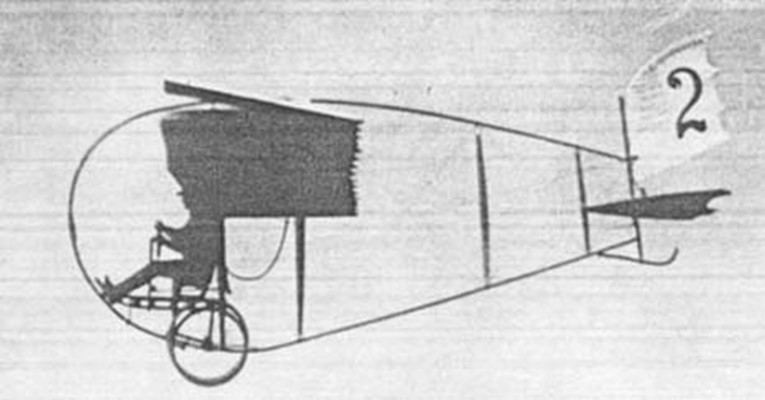
The hull in the form of a flat grate, consisting of an oval frame glued together from several layers of slats and vertical struts, crossed with wires. On the horizontal bar in the front of the fuselage, pilot’s seat. Chassis at first skids, later wheels.
The construction of the glider was completed in 1925. “Bydgoszczanka” took part in the Second Glider Competition in Oksywie, Gdynia, in May-June 1925, piloted by Strzelczyk. The first flight of 15 seconds was made on May 18, 1925.
During the competition, 8 flights were made on it in the total time of 1 min 12 s. The glider was broken at the end of the competition. Initially, the glider had a skid chassis, a high altitude rudder, and a high rudder rudder. After the failure after the failed start, the glider was processed, making a cut in the rudder (on the rudder) and placing the rudder downwards, and the chassis was changed to a wheel.
Bydgoszczanka
Span: 10.24 or 10.25 m
Length: 6.5 m
Height: 2.6 m
Wing area: 15 sq.m
Empty weight: 78 kg
Total weight: 148 kg
Działowski Brothers
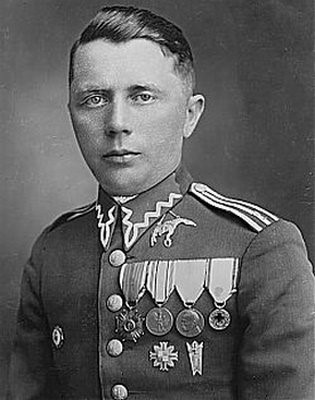
Stanisław Działowski was born on 11.04.1900 in Mielec. He completed six years of elementary school and two classes of high school. In the years 1914-1915 he was in locksmith practice in Vienna, which he did not finish. On December 3, 1916, he joined the air force in the Austro-Hungarian army in Vienna, from where he was sent to the aircraft construction school in Hungary (Szeged), where he stayed until the end of the First World War.
After returning to Poland, he joined the Polish army in November 1918 and, as a corporal, he became the head of the airfield assembly plant in the pilot school park, with which in 1919 he was transferred to Bydgoszcz. In this post he worked until 1926. On April 1 that same year, he joined the pilot school as a pilot student, after which (November 1, 1926) he was assigned as a pilot to the ITBL in Warsaw, at the same time acting as a pilot in the main port training squadron. In May 1927, he passed on his own request to the 2nd Air Regiment to Krakow, where he works as a pilot and constructor of the air park. In 1928, together with his brother Mieczysław Działowski, he founded the aviation company Bracia Działowscy in the park with the thought of producing airplanes for the army.
In 1936, he was released from the army and retired to the rank of senior pilot sergeant. He then worked as a civilian in the 2nd Air Regiment. In 1938, together with his brother, he started working at PZL Warszawa, Mokotów (WP-1) as master assembly master. In 1939, he was transferred to work in PZL WP-2 in Mielec , from where he moved to SHL in Kielce just before the war.
In the interwar period, he belonged to extremely talented aircraft designers. Resigned only to his own strength, working amateurishly, he built with his brother Mieczysław, five successful prototypes of sports aircraft, glider and the original car-plane (not completed due to lack of funds) so-called “Aeromobil” .
In 1925, they built the glider “Bydgoszczanka”, which competed in the Second National Glider Competition in Gdynia, Oksywie, where it received a diploma for a very original design. Shortly after the break-up of the “Bydgoszczanka” glider at the 2nd Glider Competition, they began to build the aircraft. Stanisław Działowski, who was the constructor of the aircraft, had nine years of experience in servicing aircraft and renovations, including five years as head of the Pilots Park Aviation Park in Bydgoszcz. The construction of the plane was made possible by the Bydgoszcz-based shoemaker Jan Krüger, an aviation enthusiast who bought the Haacke engine from Gabriel’s brothers. From here, the aircraft received the DKD-I designation, from the names of the contractors and the founder of the engine. In 1926, the brothers took the first Polish interurban flight from Bydgoszcz to Warsaw. The following airplane constructions of the Działowski brothers are: DKD-II , DKD-III (participated in 1927 in the National Awionete Competition and 3rd place for KKA in 1928), two DKD-IV (with Anzani engine and Siemens-Halske engine, the machine with this first engine has won the 1st place in the 2nd National Competition of Light Ships in 1928, with the second 5th place, both constructors – participants of the competition, also as pilots received for the 1st and 3rd place of their machines the prize of 13 thousand PLN), DKD-V (built on the Challenge in 1932, crashed during a forced landing) KKA in 1928), and pilot S. Działowski suffered severe injuries), DKD-VI , DKD-VII , DKD-VIII (the last two not fully built) and “Aeromobil” (air taxi, unfinished).
Before the outbreak of the war he gave up independent construction work, discouraged by constant financial difficulties and poor health after the crash.
In September 1939, he was appointed to the army and then found himself in Romania, from where he managed to get to France. In France he worked in the assembly plant of Lioré-et-Olivier LeO 451 aircraft. In March 1940, he became a pilot instructor at the 108th Aviation Battalion in Montpellier. After the fall of France, he was evacuated to Great Britain. On June 27, 1940, he was admitted to the RAF and, after training, he flew in the 2nd Anti-Aircraft Cooperation Unit (AACU – Anti-Aircraft Cooperation Unit). On 15.10.1941, he was wounded in a combat flight and sent to a military hospital in East Kilbrick, Scotland. On March 17, 1941, he was released from the RAF for health reasons. He died on 19.03.1942 at the RAF Sanatorium in Perth. Buried in the Wellhill Cemetery there.
As a pilot, he flew on 20 types of aircraft about 800 hours, he also made 12 parachute jumps. He had the following badges and decorations: Bronze Cross of Merit, Medal of the XII anniversary, Field Pilot Badge, Gold Honorary LOPP Badge and parachute badge.
DWLKK PW-2D
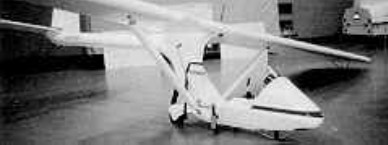
Designed by Politechnika Warszawsks, the lightweight open cockpit PW-2D was designed for both factory assembly and as a kit for homebuilding. Of composite construction with fabric covered control surfaces.
Wing span: 11m / 36.1ft
Wing area: 12.7sq.m /136.7sq.ft
Empty Weight: 110kg / 242lb
Payload: 110kg / 242lb
Gross Weight: 220kg / 484lb
Wing Load: 17.32kg/sq.m / 3.55lb/sq.ft
Airfoil: NACA 4415
Aspect ratio: 9.52
MinSink: 1.1 m/s / 3.6 fps / 2.13 kt
L/DMax: 16 69 kph / 37 kt / 43 mph
Seats: 1
DWLKK
2008:
Al. Krakowska 110/114
02-246 Warszawa
Poland
Glider manufacturer
Dunstable Kestrel
In January 1935 W.L.Manuel joined the Dunstable Sailplane Co and built a developed version of the Willow Wren which was named the Dunstable Kestrel.
The Dunstable Kestrel was manufactured by the company from designs by W.L. Manuel in 1935; production was limited to one sailplane with a British Gliding Association id of G221. Records comment that G221 was purchased by a trainee pilot who was still in his early stages of training with a primary glider. This Dunstable Kestrel passed to the Norfolk & Norwich Aero Club and crashed in 1938, however W.L. Manuel drew up plans for home builders which were offered for sale at the cost of £6. 6s. W.E. Godson purchased a set of plans and built a second British Kestrel whilst three more Kestrels were built in Australia by R. New, R. Basillie and the last by P. Pratt. Whilst no remains exist of the British built aircraft all three Australian-built ones are in museums.
Wingspan: 12.19 m / 40 ft 0 in
Length: 6.10 m / 20 ft 0 in
Wing area: 13.93 sq.m / 150 sq.ft
Aspect ratio: 11
Empty weight: 111.13 kg / 245 lb
AUW: 188.24 kg / 415 lb
Wing loading: 13.52 kg/sq.m / 2.77 lb/sq.ft
Max L/D: 18
Stall: 45 kph / 28 mph
Min sink: 0.95 m/sec / 2.9 ft/sec
Dunstable Sailplane Company
The Dunstable Sailplane Company was established in 1934 by W.L. Manuel and C.H. Latimer-Needham to design, manufacture and repair gliders from its workshop at Barton-Le-Clay Airfield in Bedfordshire, UK.
The Dunstable Kestrel was manufactured by the company from designs by W.L. Manuel in 1935; production was limited to one sailplane with a British Gliding Association id of G221.
W.L. Manuel drew up plans for home builders which were offered for sale at the cost of £6. 6s.
W. L. Manuel was born William Lancelot Manuel in 1903; parish records list his birthplace as Malling, Kent. Manuel spent his early life working at RAF Hawkinge Kent with 25 Fighter Squadron, He was a key member in the establishment of the Channel Gliding Club (1930), and built an estimated 14 aircraft over his 84-year life. William Manuel retired in 1965 from the AC Cars company of Thames Ditton; it is thought he was the company’s chief planning engineer on retirement.
Dunning 1934 sailplane
The basic design of the Cloudcraft Dickson Primary was modified and built by a Mr Dunning, of the Southdown Gliding Club, in 1933-34.
It was first flown from Lancing, UK, on 10 March 1934 only to be written off there on 20 May 1934.
Only one was built and no Certificate of Airworthiness was issued.
Dufour Glider No.1
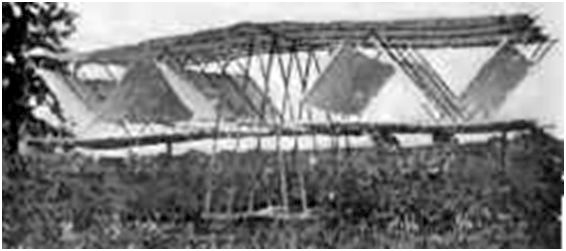
The first of several gliders tested by designer/builder Albert Q. Dufour, “not yet 20 years old”, in Milwaukee, Wisconsin, USA. It was launched from a 40 feet inclined runway ending 15 feet off the ground in 1907 and made flights of up to 100 feet.
 All Aero