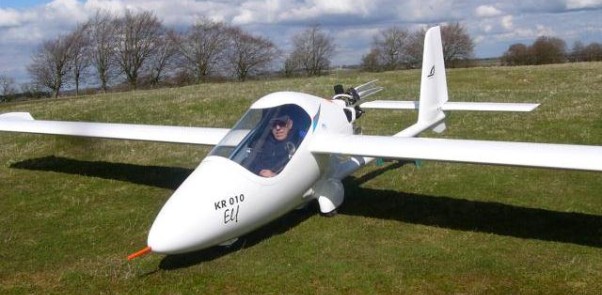
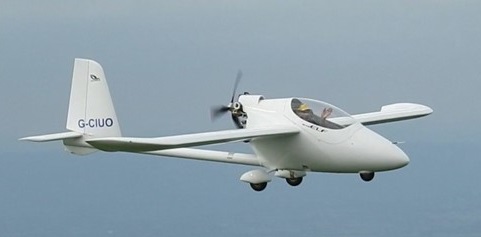
Jerzy Krawczyk, in addition to Ekolot’s Junior and Topaz, has several light aircraft, crop sprayer, and sailplane designs to his credit. In creating the self launching Elf sailplane, he employed composite sandwich and carbon structures to achieve the exceptional strength and durability required to pass UK BCAR Section ‘S’ airworthiness certification. The Elf prototype used the JPX 330 engine which, unfortunately, was withdrawn from production in 2006 after over 20 years in the market. Fortunately, Compact Radial Engines in Canada has produced a very similar unit. This is 20% more powerful than the JPX and also employs a clutch which eliminates folding prop ‘chatter’ on start-up and allows the prop to fold whilst the engine is on idle. This engine has displayed instant re-start capability. The Elf employs full span flapperons, and airbrakes, and has excellent rudder/stick co-ordination. The NN17-18 aerofoil possesses mild stall characteristics and overall, the handling conveys a strong sense of stability and security to the pilot.
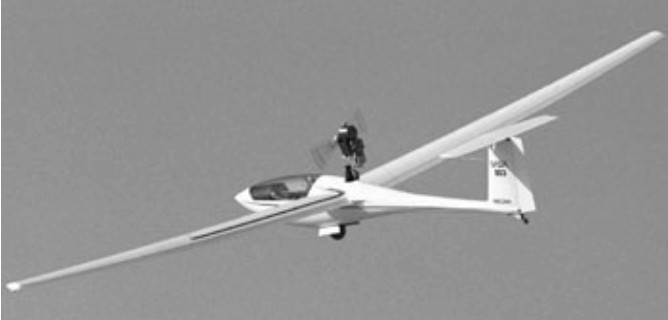
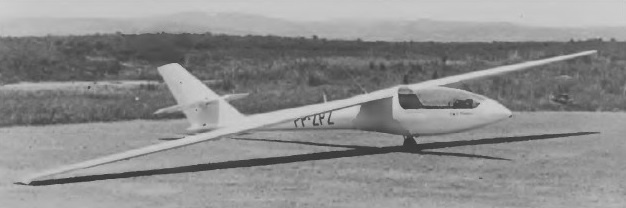
KR-010 “Elf” G-CIUO over Scotland
Production aircraft will have the more powerful Compact Radial engine and a 126cms prop with a projected climb rate of 500 ft/min. Engine off, the Elf with it’s 120 ft/min sink rate is capable of slowing down to exploit the slightest lift and core the smallest thermal. This is where the fun and skill challenge begins and where, if the pilot falls out of lift into sink, he can be confident of a quick engine restart and climb back to the area of lift.
Prototype Engine: JPX 330, 24 hp Prop dia: 116cms , folding Weight: 145 kg (with BRS) Gross Weight: 260 kg Area: 10.8 sq/m Span: 11.2 m Length: 5.7m Aerofoil: NN18-17 Fuel Capacity: 15 litres (3 hours + reserve) Proof Load: +6 / -3 Max Pilot Height: 1.9m (6’3”) Max Pilot Weight: 100kg (220lbs) Cruise: 50 mph at 5,100rpm Max Climb: 400ft/min at 30mph Stall: 27mph Best L/D: 26.4:1, 150ft/min at 45mph Min Sink: 120ft/min at 39 mph Airbrake: 300ft/min at 45mph (13:1) Fuel burn: 4.5 litres/hour
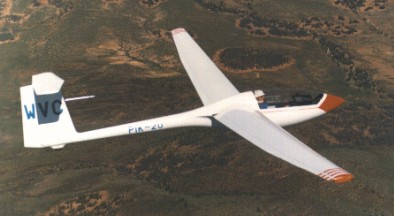
The single-seat high performance Unrestricted Class PIK-20, design work on which, by a team headed by Pekka Tammi, started on 1 May 1971, the first of two prototypes making its first flight on 10 October 1973. Three prototypes were built, followed by 24 of the first series.
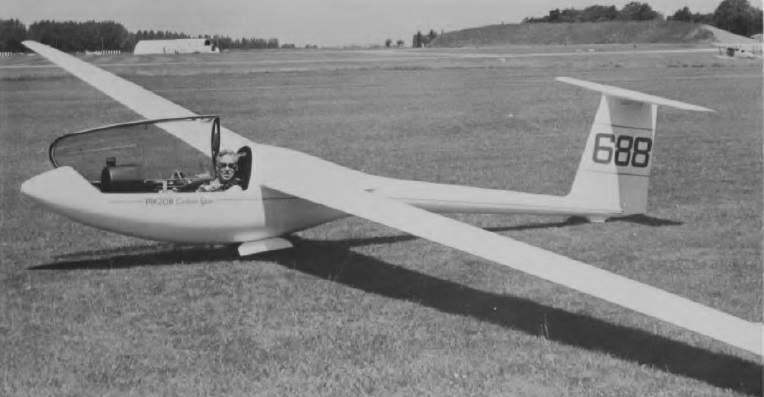
The Pik-20 is a 15 m. racing class, all-fiberglass sailplane with water ballast, retractable gear and 90 degrees trailing edge flaps for landing. Finnish certification of the PIK-20 was granted on 20 June 1974, followed by FAA certification exactly a year later.
There is a retractable Tost monowheel with a drum brake as well as a tailwheel. The T-tail is of similar construction to the wings, and the fixed-incidence tailplane has a one-piece elevator.
After over 425 were built, the PIK-20 was soon followed by the PIK-20B in 1975, the main production version, which had an increased gross weight, greater water ballast capacity of 309lb, interconnected flaps and ailerons for improved performance, which could be retrofitted to earlier models, and a pneumatically sealed sideways opening cockpit canopy. From aircraft No 20100 carbon-fibre spars became available as an option, but later became standard, reducing the empty weight to 496 lb. The PIK-20A designation was an unofficial designation used to distinguish the PIK-20 from the PIK-20B.
Ingo Renner won the 15 m. class at the 1976 World Championships at Rayskala, Finland in a B-model, and others finished 2nd, 3rd and 5th.
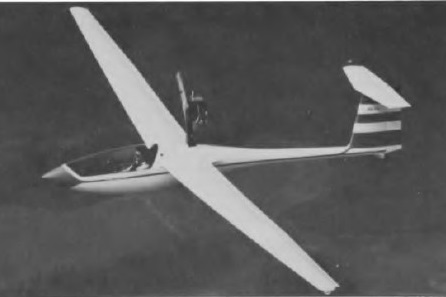
PIK-20B
The PIK-20C designation was not used, but reserved for the JT-6 proof-of-concept prototype for PIK-20E.
The PIK-20C designation was not used, but reserved for the JT-6 proof-of-concept prototype for PIK-20E.
The PIK-20D, first flown on 19 April 1976, superseded the B, and this has carbon-fibre spars as standard, and is fitted with Schempp-Hirth air brakes and improved flaps, or ‘flaperons’, which act as both flaps and ailerons for enhanced performance. The flaperons, operate differentially for roll control and deflect from -12 degrees to +16 degrees for cruise or approach control. The cockpit is enlarged and its layout improved, and carbon-fibre is also used to reinforce the fuselage. The wings and tail surfaces are glass-fiber reinforced plastic (GRP) sandwich with PVC core. The fuselage is a GRP monocoque structure reinforced with ribs of carbon fiber.
The -20D features carbon fiber spar caps and carbon reinforcement strips at critical locations in the fiberglass monocoque fuselage. The PIK-20D-78 production models the nose profile was sharpened, the tail moved 5 inches forward and fuselage fairings recontoured to reduce drag.
PIK-20 production was undertaken by Eiriavion O/Y, and by January 1979 a total of 149 PIK-20Bs and 150 PIK-20Ds had been delivered. The type soon made its mark in competitions, winning the first three places in the Standard class at the 1976 World Gliding Championships in Finland, and also winning several national championships.
PIK-20E
The PIK-20E is a -D sailplane with a retractable Rotax two-cylinder two-cycle engine, developed by Jukka Tervamaki, the chief designer of Finland’s Eiriavion O/Y, to meet the OSTIV airworthiness regulations for powered sailplanes. A manual crank handle requires about 15 turns to deploy or retract the engine and propeller.
Initial PIK-20E were powered by the Rotax 501 but the PIK-20E II featured a Rotax 505 (two spark plugs per cylinder). The Rotax 503 500cc two-stroke two-cylinder engine produces 43 hp at 6,200 RPM. With double carburetors and resonance exhaust system, the whole snowmobile engine has been redesigned and built to aircraft requirements. The Hoffmann two-blade wooden propeller is belt driven giving a 1:2 reduction. When not in use, the power plant is retracted into the fuselage by a manual crank and lever in the cockpit wall. The glider features fiberglass monocoque construction. Half of the fuselage/wing fairing has been taken to the wing so that the main rib and wing spar are 20 nm higher in order to save weight. The wings, flaps, and complete tail are of sandwich construction with fiberglass skin and PVCfoam core. Wing spars are made of carbon fiber. The PIK boasts a maximum L/D ratio of 40 to 1. With power on, takeoff can be accomplished in less than 1,000 feet if a 50′ obstacle has to be cleared and rate of climb is 787 fpm. Cruising speed is 84 mph at 75 percent power, burning 4.4 gph from the 8.7-gallon fuel tank.
The prototype PIK-20E was powered by a 30hp Kohler 440cc engine and first flew on 2 October 1976, making a four hour flight of which two hours were spent soaring with the engine retracted. The production prototype made its first (aero-tow) flight on 16 March 1978, and its first powered flight two days later, and series production began shortly after.
There is an electric starter for the engine, and the fuel tank behind the pilot’s seat holds 7.3 Imp gallons. Apart from the engine, the PIK-20E is very similar, structurally and otherwise, to the PIK-20D, with a longer nose, 25% more tailplane area, small fixed wheels at the wing tips and a rubber-sprung tailwheel now mounted on a steel sprung skid moved behind the fin spar to the base of the rudder so as to make it steerable; the water ballast capacity (an optional feature) is smaller than the D’s.
Eiri PIK-20E
The PIK-20F was available as a 15m Class variant (with 308lb of water ballast) or a Club Class variant, the latter having a fixed monowheel. The PIK-20F has carbon-fibre spars, a modified wing profile, a lower drag fuselage, a forward-opening carbon-reinforced cockpit canopy, a carbon-reinforced cockpit area, and a new wing/fuselage epoxy finish.
Production rights for the PIK-20E were sold in 1981 to the French firm Siren SA. Altogether 102 PIK-20Es had been built in Finland when production ceased there in the spring of 1981. By the spring of 1981 a total of 409 PIK-20s of all versions (including the motorised PIK-20E) had been built, of which 85% were for export.
PIK-20D Span: 49 ft 2.5 in/ 15.0 m Length: 21 ft 2 in / 6.45 m Height: 4 ft 6.75 in / 1.45 m Wing area: 107.6 sqft / 10.0 sq.m Aspect ratio: 22.5 Wing section: Wortmann FX-67-K-170/150 Empty weight: 480 lb / 220 kg Max weight: 992 lb / 450 kg Water ballast: 309 lb / 140 kg Max wing loading: 45kg/sq.m / 9.21 lb/sq.ft Max speed: 181 mph 158 kt / 292 km/h (in smooth air) Stalling speed: 32 kt / 60 km/h Max aero-tow speed: 118 mph / 130 kt / 240 km/h Min sinking speed: 2.17 ft/sec at 53.5 mph Min sinking speed: 0.56 m/sec / 1.84 ft/sec at 39 kt / 73 km/h Best glide ratio: 42:1 at 73 mph / 63 kt / 117 km/h
PIK-20E Engine: Rotax 503, 32 kW / 43 bhp Wing span: 15m / 49 ft 2.5 in Wing area: 10.0 sq.m / 107.6 sq.ft Airfoil: Wortmann FX 67-K-170/150 Aspect ratio: 22.5 Length: 6.53 m / 21 ft 5 in Height: 4 ft 8.75 in Empty Weight: 310kg / 684 lb Payload: 160kg / 352 lb Gross Weight: 470kg / 1036 lb Wing Load: 47kg/sq.m / 9.6 lb/sq.ft Water Ballast: 80kg / 176 lb L/DMax: 40 @ 110 kph / 63 kt / 73 mph MinSink: 0.66 m/s / 2.16 fps / 1.28 kt at 55 mph / 42 kt / 77 km/h (power off) Max speed: 177 mph 154 kt / 285 km/h (power off) Max cruising speed: 84 mph (power on) Stalling speed: 36 kt / 66 km/h Rate of climb: 4.0 m/sec / 13 ft/sec Take-off run: 1,640ft to 50ft Seats: 1
The PIK series of sailplanes get their name from the Polyteknikkojen llmailukerho, which was founded at Helsinki University of Technology in 1931, and their production is undertaken by Eiri avion O/Y.
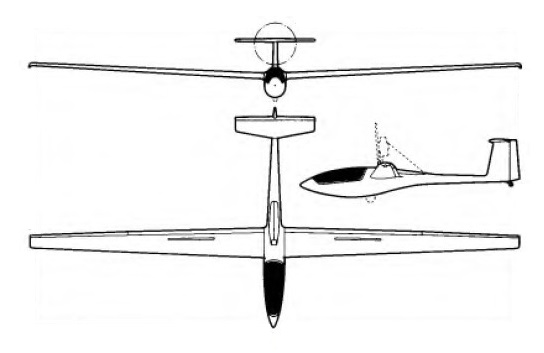
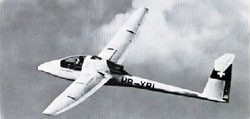
The Prometheus is a production of EFF / Entwicklungsgemeinschaft für Flugzeugbau / Association for the development project and airplane building. It is is a high performance side-by-side glider with two Microturbo 90 kp thrust engines. A self-launching glider, its engines can be stopped and reset running at will.
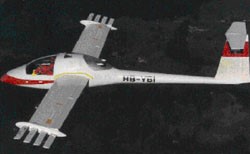
One was built, registered in 1978 as HB-YBI, and the name Prometheus PV.
With a wingspan of 19.4 m, it weighs 707 kg unladen and 900 at full load. Its radius of action powered flight exceeds 500 Km
In 1980, the manufacturer reported a radio navigation facility and a transponder allowing it to integrate seamlessly restriction in controlled airspace and major airport.
The Prometheus II is linked to an engineer in Switzerland, Ulrich La Roche , who sought to reproduce with WINGGRID, some aerodynamic effect on birds. This work began in the first wind tunnel at Emmen between 1993 and 1994. In 1996, an encounter with Prof . Dr. – Ing. Hans -Reinhard Meyer- Piening would offer the opportunity to validate the concept of a real WINGGRID demonstrator.
In 1997, the Prometheus was chosen for this experiment. To this end, the size was reduced to 12 m. They hoped a glide ratio of 15 to 17, but experience showed that it was 25. The Prometheus II is a high performance glider with a fineness approaching 40, but with a high wing loading.
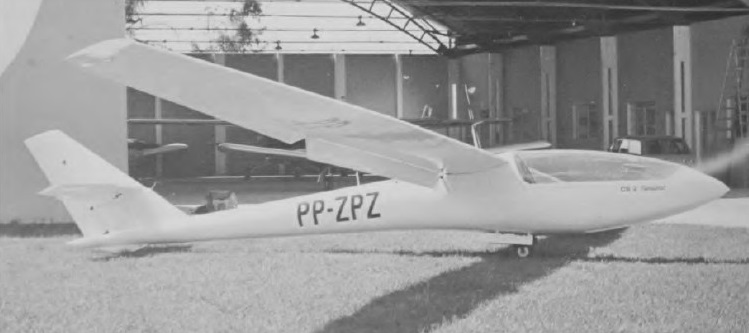
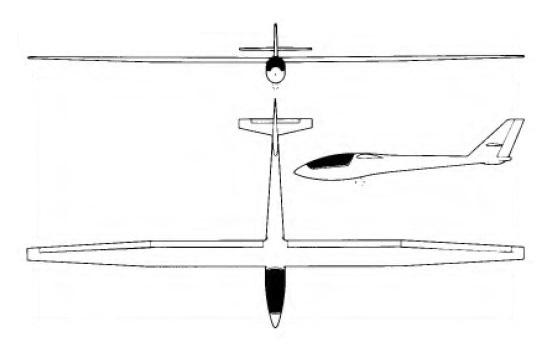
Named after a strong, cold wind common to southern Brazil, the Minuano high performance single-seater was designed by Professor Claudio Pinto de Barros, head of the CEA (Centro de Estudos Aeronauticos, or Air Research Centre) of the Engineering School at Minas Gerais Federal University – the Escola de Engenharia da Universidade Federal de Minas Gerais, or EEUFMG.
The Professor had completed his first sailplane design, the CB-1 Gaivota, when he was a student; design work on the Minuano began in 1969, construction started in 1971 and the prototype first flew on 20 December 1975. Four more Minuanos were ordered, the second being due for completion by the end of 1978, and this incorporates several modifications, being designated CB-2/B.
The cantilever high wing has a single aluminium alloy main par, and the wing skin is of plywood/glassfibre honeycomb sandwich. The flaps and ailerons, which are interconnected, are similar except for having wooden spars and the flaps can be used as air brakes by deflecting up to 90°. Up to 176lb of water ballast can be carried. The all-wood fuselage is a semimonocoque, and there is a retractable unsprung monowheel with an internal shoe brake, and a sprung tailskid. The tail surfaces are plywood covered, and stiffened with foam plastics, and the all-moving tailplane has a trim tab in each half.
CB-2 Minuano Wing span: 15.0 m / 49 ft 2.5 in Length: 7.0 m / 22 ft 11 in Height: 1.43 m / 4ft 8.25 in Wing area: 10.2 sq.m / 109.8 sq ft Wing section: Wortmann FX-61 -163/60-126 Aspect ratio: 22.0 Empty weight: 214 kg / 472 lb Max weight: 304 kg / 670 lb Water ballast: None Max wing loading: 29.8 kg/sq.m / 6.1 lb/sq ft Max speed: 140 kt / 260 km/h Stalling speed: 35 kt / 65 km/h Min sinking speed: 0.55m/sec / 1.8 ft/sec at 39 kt / 72 km/h Max rough air speed: 86.5 kt / 160 km/h Best glide ratio: 38 at 48.5 kt / 90 km/h
CB-2/B Span:49 ft 2.5 in Length: 22 ft 11.75 in Height: 4 ft 8.25 in Wing area: 109.8 sqft Aspect ratio: 22.0 Empty weight: 507 1b Max weight: 882 lb Max speed: 161 mph (in smooth air) Max aero-tow speed: 99 mph Min sinking speed: 1.97 ft/sec at 51.5 mph Best glide ratio: 39:1 at 59 mph
Professor Claudio Pinto de Barros was head of the CEA (Centro de Estudos Aeronauticos, or Air Research Centre) of the Engineering School at Minas Gerais Federal University – the Escola de Engenharia da Universidade Federal de Minas Gerais, or EEUFMG.
The CEA-311 Anequim was built by students of the Center for the study of Aeronautical Engineering at the Federal University of Minas Gerais in Belo Horizonte, Brazil, directed by Professor Paulo Iscold.
The school’s program was started in the early 1960s with a sailplane named CB-1 Gaviota, which was engineered by professor Cláudio Pinto de Barros, who founded CEA at age 25.
CEA stands for the Portuguese name for the Center for Aeronautical Studies. The number 3 denotes an airplane (1 is for sailplane and 2 is for ultralight). And the remaining two numbers are the order numbers for the design. Only seven airplanes have been built at the school, but Anequim is the 11th design produced.
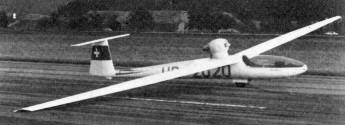
The Prometheus 1 was an experimental powered sailplane from Switzerland, based on the airframe of the FFA Diamant 18.
Design and construction began in late 1970, the wings, Fuselage, tail units and landing gear coming from an original Diamant 18. The aircraft flew for the first time on 21 June 1971, powered by a 176 lb (80 kg) Microturbo Eclair II turbojet engine mounted on a pylon above the wing center-section. This had been later replaced by a more powerful TRS 25 engine.
Engine: One 264 lb (120 kg) st Microturbo TRS 25 turbojet Fuel capacity: 2 x 8.75 Imp gallon (40 litre) wing tanks, 1 x 0.4 Imp gallon (1.8 litre) fuselage tank. Total fuel: 17.9 Imp gallons (81.8 litres). Oil capacity: 0.11 Imp gallons (0.5 litres). Wing span: 59 ft 0.5 in / 18,0 m Wing aspect ratio: 22,5 Length overall: 24 ft 9.5 in / 7,56 m Height over tail: 4 ft 5 in / 1,35 m Tailplane span: 9 ft 6,25 in / 2,90 m Weight empty: 639 lb / / 290 kg Max T-O weight: 1,102 lb / / 500 kg Max level speed / Vne: 146 knots / / 168 mph / / 270 km/h Max cruising speed at S/L: 113 knots / 130 mph / 210 km/h Econ cruising speed at SL: 92 knots / 106 mph / 170 km/h Stalling speed, flaps up: 43.5 knots / 50 mph / 80 km/h Stalling speed, flaps down: 37 knots / 42.5 mph / 68 km/h Max rate of climb at S/L: 591 fpm / 180 m/min Service ceiling: 36,100 ft / 11,000 m T-O run: 984 ft / 300 m T-O to 50 ft (15 m): 1,476 ft / 450 m Landing from 50 ft (15 m): 492 ft / 150 m Landing run: 164 ft / 50 m Range with max fuel: > 135 nm / > 155 miles / >250 km
Eighty percent of the 300-odd components are made from 6 mm and 10 mm fibrelam board. It is a very lightweight pre-cured composite sandwich board, with cross-plied glass fibre skins over an aramid honeycomb core. The same material is used in many airliner floors. It has a better strength-to-weight ratio than wood and the end result is a strong yet lighter aircraft than an equivalent in wooden or metal build. The material is not easy to cut accurately by hand, so computer controlled routing machines are used to cut parts to size. This is important for accuracy because the aircraft is only available for home-building from a kitset. Indeed, you can choose the amount of pre-finished components you have in the three grades of kitset. The basic kit consists of the fibrelam components ready to assemble. While it includes the preformed hard skins for the wing D box, fin and tailplane, the wing spar has to be assembled and no hardware is included. The intermediate kit includes the hardware and the wing spar is assembled, but considerable fitting is required. The deluxe kit has the fibrelam structure largely complete, all that is required is to put the fittings in and set up the control runs. None of the kits include the Ceconite fabric and the finishing materials. The wing is a Wortmann airfoil.
Vne: 125 kts. Stall: 32 kt. Max useful load: 135 kg. Wingspan: 15.7m.
 All Aero