This project was designed as a successor to the AV-10. Many improvements were incorporated into this new design. But the war stopped the development of this machine and it remained a project on the drawing board. The construction of an improved version, the AV-141, was studied in 1947 and a construction started at Estang-Aviation, in Marseilles, in July 1949. But this construction was never completed.
Wing span: 17.6 m Length: 7.2 m Wing area: 54.7 sq.m Empty weight: 1840 kg Max. gross weight: 3650 kg Max. speed: 220 km/h Cruise speed: 190 km/h Max. altitude: 3800 m
With the unexpected bankruptcy of the Guerchais enterprise and the end of financial support from the main investor, the Makhonine company, the development of the AV-2 stopped and was ultimately never finished. In a parallel effort, Charles Fauvel designed another prototype, a pure glider designated the AV-3. Thanks to the financial support of friends (former squadron friends), he was able to construct and test the AV-3, making the first flights in 1933 from the La Banne d’Ordanches airfield. He also allowed a famous glider pilot, Eric Nessler, to fly the glider, who confessed that he was very much impressed by Fauvel’s flying wing formula. The AV-3 was destroyed in 1936, when the aircraft hangar where it had been stored for the winter was virtually destroyed by a storm that took off the roof. This allowed rain to fall in torrents on the glider for more than a week and the water caused too much damage to consider repair. The AV-3 was the last pre-war glider of Charles Fauvel.
Wing span: 12.9 m Length: 3.62 m Wing area: 20 sq.m Airfoil: Fauvel Aspect ratio: 8.3 Empty weight: 107 kg Max speed (Vno): 250 km/h Glide ratio: 19:1 Sink rate: 0.8 m/sec
Charles Fauvel decided, after having obtained a patent on his formula for the flying wing, to put into work a prototype incorporating his theories. The AV-1 was intended only as the model to study the formula in laboratory studies.
Born 31 December 1904 at Angers, Charles Fauvel was attracted to aviation from an early age. From 1913 on, he built models, and Garros and Audemar’s acrobatic competition at Angers in 1914 permanently sealed his passion for aviation. He passed his latin-science-philosophy baccalaureat, then obtained a military flight training scholarship in 1923; he then entered the French Air Force Academy. In 1925 he witnessed his first soaring competition at Vauville, during which Alfred Auger officially beat the glider altitude record using the Peyret-Abrial “Vautour” with more than 700 meters. The same year, during his military service at Chateauroux, he made the acquaintance of Pierre Massenet, with whom he later participated in the foundation of the Club Aéronautique Universitaire (University Aero Club), one of the most renowned soaring clubs of the pre-1940 period. It was also in 1928 that Fauvel, watching the new Summer soaring competition at Vauville, formed his first flying wing concepts. Observing certain gliders with long, thin wings (Peyret-Abrial “Rapace”, Wolf Hirth…), he considered that to reduce parasitic losses to a minimum, one cannot indefinitely increase the aspect ratio of the wings. Reducing the size of the fuselage and the interaction with the horizontal empennage thus led to the “flying wing” formula, for which Fauvel registered a patent in 1929. Unlike the projects conceived at about the same time in Germany by the Horten brothers and by Lippisch, the work of Charles Fauvel, based on studies and experiments of Georges Abrial and René Arnoux, involved the use of a “stable” airfoil section providing both lift and stabilization, without recourse to a swept and twisted wing as on the German gliders. Still in 1928, toward the end of the year, Charles Fauvel put the finishing touches of a small light single-seater, the Peyret-Mauboussin PM-10, equipped with a 34 hp Scorpion ABC engine, whose best glide ratio was nearly 16 without engine fairing or wheel pants. It was with this machine that he beat, in September 1929, several international records in the under-400 kg category, including the international altitude record (5,193 meters) and the duration record (12 hours). In 1929, Fauvel participated in the creation of AVIA with Massenet, Auger and a few friends; this was a committee founded to promote the development of soaring. He then left the air force to join AVIA as sport director, while remaining chief pilot of the CAU. He prospected and discovered the airfields of Beynes (near Paris) and of la Banne d’Ordanche (in Auvergne). In the same period he received and perfected the single-seat AVIA 10 A designed by Jarlaud at the Béchereau works. In 1931, he had to leave AVIA, which was suffering financial difficulties, and re-enter the Air Force as a test pilot at the Villacoublay flight test center, until 1933. While on leave, he participated in the Vauville competition in 1931 in the AVIA 32 E, and managed the best French distance of the competition. In 1932, he passed his C license (no. 19) at la Banne d’Ordanche, on the AVIA 15 A. He then threw himself into the design of his first machine, the AV-1, followed by the AV-2, then by the first pure glider, AV-3, which appeared in 1933. In 1935 he flew the AV-10, a light two-seater touring craft with a Pobjoy engine. In 1940, Germany invaded France. Charles Fauvel was reassigned to Morocco a deputy group commander. Returning to France after the armistice, he passed in 1941 his instructor’s license at the Montagne Noire center, and was appointed chief of the military soaring center at Avignon. After the invasion of the free zone, he retired from the Air Force with the rank of lieutenant colonel. In May 1945, he was working at the air sports studies technical establishment at Castelnaudary. In 1954, Charles Fauvel started his own enterprise, the SURVOL company, at Cannes, whose purpose was to promote and facilitate the commercialization of his flying wings. In 1971, Charles Fauvel decided to stop commercial production of his gliders, but continued to distribute stacks of drawings to amateur builders. The Survol company offered the AV-361, the AV-451, as well as touring craft such as the AV-60. From 1972 on he was president of the Fayence soaring center and also participated in the OSTIV (Organisation Scientifique et Technique du Vol à Voile) congresses, notably in 1978 at Chateauroux, where he presented his report on the flying wing design formula. He died on 10 September 1979 at the controls of his airplane, a Gardan “Super Cab”, which struck the Alps at 735 meters altitude north of Genoa, in Italy. Recipient of the Croix de Guerre 40-45, Officer of the Legion of Honor, Médaille d’Outre-mer (Overseas Medal) 1926-1927, Aeronautical Medal, Grand Silver Medal of the Aéro-club de France, Grand Gold Medal of the FFVV, Charles Fauvel flew more than 200 different types of airplane and 50 types of glider.
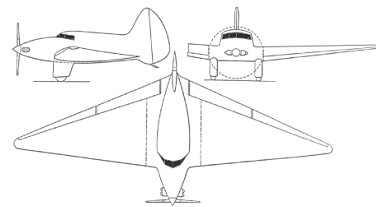
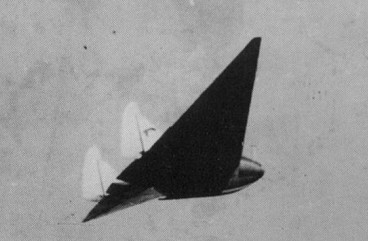
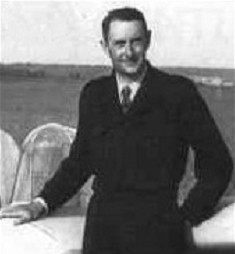
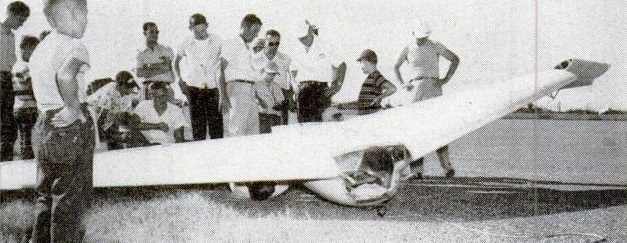
Designed and constructed by Demetrius F. Farrar Jr in 1962, the V-1 Flying Wing was an attempt to create a glider design based on the Northrop Corporation flying wing designs of the 1940s, such as the Northrop YB-49.
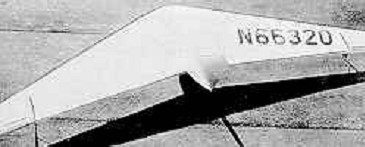
The aircraft is made from metal and wood, with doped aircraft fabric covering. Its 26 ft (7.9 m) span wing employs a modified Northrop airfoil and tip-mounted ailerons, in the form of rotating wing tips, of 2 ft (0.6 m) each. A single vertical stabilizer and rudder was mounted at the rear of the wing center trailing edge. The cockpit is located within the wing center section and the pilot flies in the prone position.
Only one V-1 was built and it was registered with the Federal Aviation Administration in the Experimental – Amateur-built category.
In August 2011 the sole V-1 was still listed on the FAA aircraft register and still owned by the designer, 49 years after it was completed.
V-1 Crew: one Wingspan: 26 ft 0 in (7.92 m) Wing area: 90 sq ft (8.36 sq.m) Aspect ratio: 7.51:1 Airfoil: modified Northrop Empty weight: 175 lb (79 kg) Gross weight: 350 lb (159 kg) Maximum glide ratio: 36:1 Rate of sink: 120 ft/min (0.61 m/s) Wing loading: 3.89 lb/sq ft (19.0 kg/sq.m) Water Ballast: 0 No. Built: 1
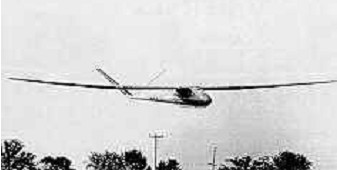
D.J.Farrar Jnrs (USA) design, which first flew in 1969, was sponsored by the National Science Foundation and used at Vanderbilt University in bird flight research, taking advantage of its low operating speed and sink rate. The design goals were a stalling speed of 32 kph/ 17 kt/ 20 mph a 1 fps sink rate. With an aluminum spar, wood and kevlar wing, and a balsa/GFRP sandwich fuselage The airfoil is a helicopter section with a zero pitching moment permitting moderate torsional loads in spite of the large wing area. Despite the low sink rate, the Bird Flight Machine has no approach control aids making landing challenging in most conditions. It was proposed to conduct further exploration of its design capabilities and microlift soaring techniques under the supervision of Gary Osoba.
Hans U. Farner was a Swiss aircraft designer whose footlaunched canard ultralight sailplane had briefly reached production in 1966. In November 1974 he filed a patent for a novel control system, particularly suitable for canards. This suggested mounting the canard on a slender tube which slid snugly within a second long forward tube that, together with a pod containing an engine, pilot and bearing mainplanes, formed the fuselage. Extension of the canard-carrying tube by means of fore and aft control column movement increased the canard’s moment arm and increased pitch. The angle of attack of the canard was automatically altered as this happened. Rotating the tube about its long axis by rudder pedal movement turned the canard away from the horizontal and caused yaw, removing the need for a vertical rudder. Wing mounted ailerons controlled roll in the usual way.
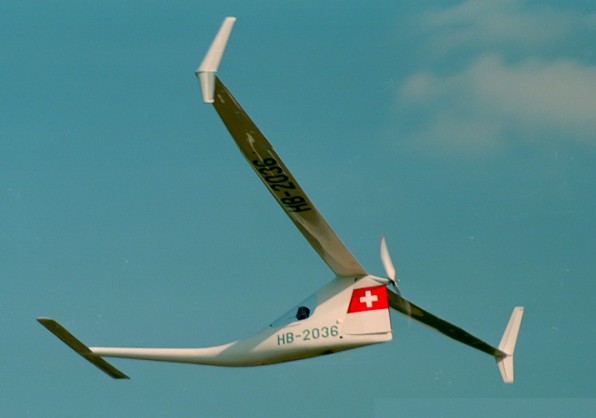
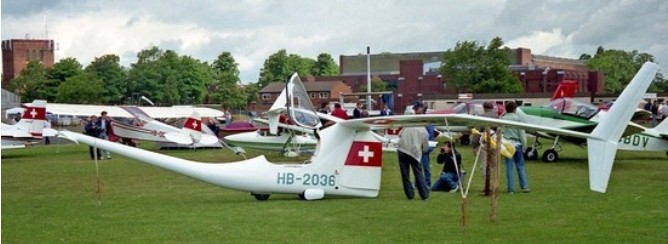
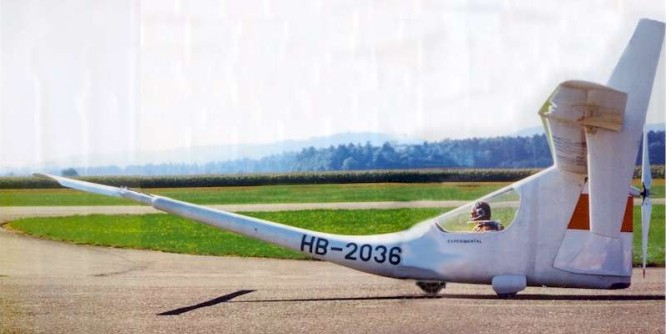
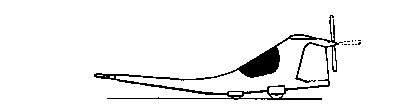
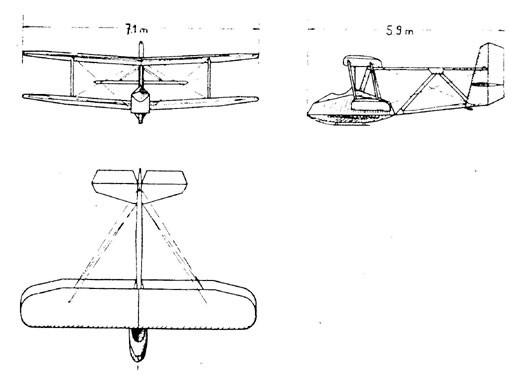
The Farner HF Colibri 1 SL motor glider, designed, built and test flown by Hans Farner in the late 1970s embodied these ideas. It had a very high aspect ratio (31.7) wing with a constant chord centre section carrying dihedral. Outer panels, with anhedral, combined with the inner section to form a cantilever gull wing. Thes outer panels had straight taper on the leading edges only, and rotated as all-moving ailerons or “tiperons” for roll control. The retractable tricycle landing gear is of narrow track limited by the fuselage width, and short wheelbase.
The wing was mounted on top of a narrow fuselage pod, with the pilot under a rear hinged canopy well forward of its leading edge. The Colibri was a twin engined motor glider, with two single cylinder two stroke McCulloch MC-101A, each of 10.1 kW (13.6 hp) driving a two blade pusher configuration propeller via reduction gear and a high positioned shaft, just below and a little way behind the trailing edge. The propeller blades can be folded to the rear when not in use, for soaring flight. Under the drive shaft the fuselage remained deep but tapered rearwards into two door like aerofoils with straight, vertical trailing edges that could be opened symmetrically outwards as an airbrake. Positioned well behind the centre of gravity, they closed together as the only fin. Forward of the cockpit the fuselage curved gently upwards into a tubular, straight, tapering, rising boom. The parallel chord, unswept, high aspect ratio canard, carried on its constant diameter tube in the manner described in the patent, providing lift and both yaw and pitch control. The main gull wing is of very high aspect ratio (31.7) mounted on top of the fuselage at the rear, and unbraced. It has dihedral on the constant chord and constant section (Wortmann FX-61-184) inner panels, and anhedral on the all moving outer panels which have leading edge taper and a Wortmann FX-60-1261 aerofoil section, the same as that of the canard foreplane. No flaps or ailerons are fitted.
The first flight date is uncertain but the Colibri was complete by late 1979. The written record post-1980 is sparse but photographs show it was still flying in 1990, when it appeared at a display in Belgium. It had visited the UK in 1989, coming to the PFA meeting at Cranfield. During the 1980s it had undergone considerable modification to the novel control system, with high aspect ratio, swept fins on the wings first at the outer end of the centre section, just before the start of the rotating tiperons, and then at the wing tips. These images suggest that conventional flight control surfaces were added to both fore and aft wings as well as to the fins. The extensible fuselage also seems to have been abandoned by 1989. It was still flying in 1990.
Hans U. Farner was a Swiss aircraft designer whose footlaunched canard ultralight sailplane had briefly reached production in 1966. In November 1974 he filed a patent for a novel control system, particularly suitable for canards. This suggested mounting the canard on a slender tube which slid snugly within a second long forward tube that, together with a pod containing an engine, pilot and bearing mainplanes, formed the fuselage.
In November 1976, the team moved to an old mill in Wald (Switzerland). In February 1977 Ernst Ruppert, Hans Farner and Heinrich Bucher (who provide the funds) set up Aviafiber AG, with a view to marketing Canard 2FL. In the same year, the company became Canard Aviation AG after an agreement with the Avia oil company. The inaugural flight took place on 13 August 1978. Subsequently, numerous other flights were carried out, totaling about 60 hours, and improvements made.
The HF 1-SL Colibri canard designer was Dipl-Ing Hans U Farner, a professor at Universität Zürich. Aerodynamicist Hans Farner was killed testing Canard 2FL HB-3000 in 1980. His Canard 2FL, Canard SC, and Canard SCM designs were then withdrawn from the market by his financer and business partner, Heinrich Bucher.
 All Aero