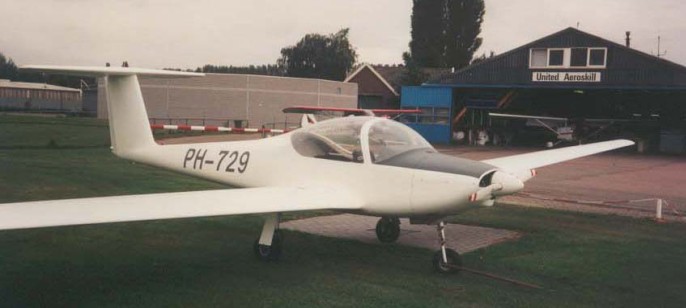
Valentin Taifun

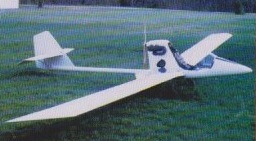
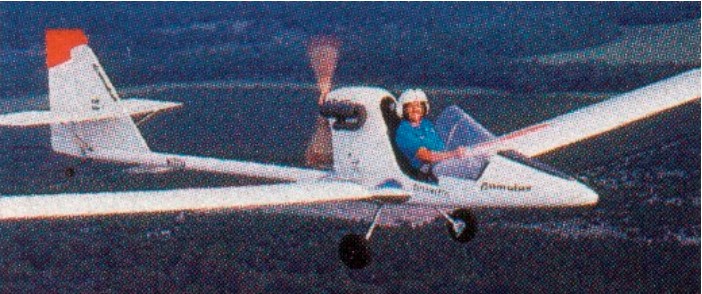
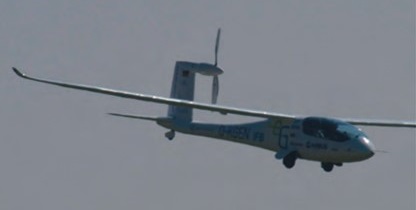
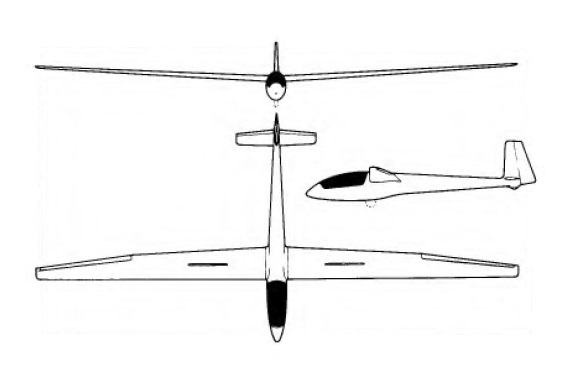
The Taifun two-seater motor glider was designed by Thomas Fischer and Dipl-lng Jorg B. Stieber for Valentin GmbH Gerateund Maschinenbau, makers of high-quality aircraft switches.

The Taifun is a cantilever low wing monoplane with a T-tail; the one-spar wings and ailerons are of glassfibre/foam sandwich construction, with all glassfibre flaps. The wings can be folded flat along the fuselage for easier hangar stowage, and Schempp-Hirth air brakes are fitted in their upper surfaces. The stressed skin fuselage is also a glassfibre/foam sandwich structure as are the fixed incidence tailplane and elevator. All versions have disc brakes on the main wheels, and the nosewheel of the 15E and 17E is steerable; the undercarriage of both these variants is fully enclosed when retracted. The pilots are seated side-by-side under the rear sliding canopy, with dual controls as standard. Engine is an 80hp Limbach L2000 EB ‘flat four’ driving a Hoffman HO-V62 three-position two bladed
propeller.

Construction of the prototype had begun in July 1979. The prototype, a Taifun 17E registered D-KONO, made its first flight late in February 1981, as the Valentin Taifun, when more than 25 had been ordered.

Four versions of the Taifun were to be produced: the Taifun 15S is the basic model with 15m span wings and a fixed tailwheel undercarriage, the Taifun 17S has the same undercarriage as the 15S and 17m span wings, the Taifun 15E has 15m span wings and a retractable nosewheel undercarriage, and the Taifun 17E has the same undercarriage as the 15E but has 17m span wings.

Taifun 15E
Span: 49 ft 2.5 in
Length: 25 ft 6.5 in
Height: 7 ft 1 in
Wing area: 176.0 sqft
Aspect ratio: 13.8
Empty weight: 1,058 lb
Max take-off weight: 1,598 lb
Max speed: 165 mph (in smooth air)
Max cruising speed: 132 mph
Min sinking speed: 3.25 ft/sec at 54 mph
Best glide ratio: 28:1 at 75 mph
Max rate of climb: 531 ft/min at sea level
Range with max fuel: 652 miles

Taifun 15S
Span: 49 ft 2.5 in
Length: 25 ft 6.5 in
Height: 7ft 1 in
Wing area: 176.0 sqft
Aspect ratio: 13.8

Taifun 17E
Span: 55 ft 9.25 in
Length: 25 ft 6.5 in
Height: 7ft 1 in
Wing area: 189.4 sq ft
Aspect ratio: 16.4

Taifun 17S
Span: 55 ft 9.25 in
Length: 25 ft 6.5 in
Height: 7ft 1 in
Wing area: 189.4 sq ft
Aspect ratio: 16.4

TWI Taifun 17E II
Engine: 67 kW/ 90 bhp Limbach L 2400 EB1.b
Wing span: 17 m / 55.7 ft
Wing area: 17.6 sq.m / 189.4 sq.ft
Aspect ratio: 16.4
Airfoil: Wortmann FX-67-K-170/7
Empty Weight: 610 kg / 1345 lb
Payload: 240 kg / 529 lb
Gross Weight: 850 kg / 1874 lb
Wing Load: 48.3 kg/sq.m / 9.9 lb/sq.ft
L/DMax: 30 115 kph / 62 kt / 71 mph
MinSink: 0.95 m/s / 3.12 fps / 1.85 kt
Seats: 2

US Aviation SuperFloater / Wind Walker Aircraft Co Super Floater

A remake of Klaus Hill’s design of the 1970’s primary glider. Designed by Klaus Hill and Larry Hall. An ultalight sailplane, the Super Floater is designed to accommodate a ballistic recovery emergency parachute and comply with U.S. FAA part 103 rules. It has full span ailerons which, as an option, can be configured as flaperons.
Price (1998) US$9995

US Aviation SuperFloater Article

The Super Floater was produced by US Aviation initially and later by Wind Walker Aircraft Co.

Span: 11.6m / 38ft
Area: 15.5 sq.m / 168sq.ft
Height: 5 ft
Length: 20 ft
Empty Weight: 81kg / 179lb
Payload: 100kg / 221lb
Gross Weight: 182kg / 400lb
Wing Load: 11.74kg/sq.m 2.38lb/sq.ft
L/DMax: 15 56 kph / 30 kt / 35 mph
Speed max: 60 mph
Cruise: 55 mph
Stall: 23 mph
MinSink: 0.9 m/s / 3.0 fps / 1.78 kt
Water Ballast: 0
Aspect ratio: 8.4
L/D: 15-1
Seats: 1
Landing gear: single main wheel

US Aviation Cumulus

The Cumulus has a foldable cantilever wing in riveted sheet dural, dacron covered, and a welded steel spaceframe fuselage and a composite cockpit.

In 1998 the Cumulus returned to the market after and inflight failure of the spar involving the designer.

An Ultralight / Microlight Motorglider Construction is steel and fabric, first flown in 1995. Was available as a kit manufactured by AeroDreams, for $9995. 2009 Price: 7995 US$ airframe only.

Engine: Rotax 277, 28 hp
HP range: 28-35
Height: 4.5 ft
Length: 20.5 ft
Wing span: 43 ft
Wing area: 141 sq.ft
Fuel cap: 5 USG
Weight empty: 320 lbs
Gross: 560 lbs
Speed max: 90 mph
Cruise: 82 mph
Range: 275 sm
Stall: 27 mph
ROC: 600 fpm
Take-off dist: 120 ft
Landing dist: 170 ft
Service ceiling: 15,000 ft
Seats: 1
Landing gear: tail wheel
Glide: 20:1@ 43 mph
Sink: 195 fpm @ 30 mph
Fuel: 1 USG/h.

Engine: Rotax 447, 28 hp
HP range: 28-40
Height: 4.5 ft
Length: 20.5 ft
Wing span: 43 ft
Wing area: 140 sq.ft
Fuel capacity: 5 USG
Empty weight: 163 kg / 360 lbs
Gross weight: 290 kg / 640 lb
Top speed: 90 mph
Cruise: 56 kt / 65 mph / 105 kmh
Stall: 29 mph
VNE: 78 kt / 90 mph / 145 kmh
Aspect ratio: 13-1 sm
L/D: 20-1 fpm
Landing dist: 250 ft
Service ceiling: 15,000 ft
Seats: 1
Landing gear: tailwheel
ROC: 800 ft/min / 4 m/s
Range: 275 sm
Glide Ratio: 20.1
Take-off distance: 170 ft / 52 m
LSA: yes

Engine: Rotax 447, 42 hp
Wing span: 13.1 m
Wing area: 12.7 sq.m
MAUW: 291 kg
Empty weight: 164 kg
Fuel capacity: 19 lt
Max speed: 144 kph
Cruise speed: 97 kph
Minimum speed: 55 kph
Climb rate: 5 m/s
Seats: 1
Fuel consumption: 6 lt/hr
Kit price (1998): $7995

Ursinus Glider

In 1909 Engineer Oscar Ursinus of Frankfurt formed a team to promote the application of motorless flight. This team, mostly technical high school teenagers, studied early Otto Lilienthal theory and his bold experiments. After fabricating a glider of their own design they transported it to Rhön for trials. Oscar Ursinus became the first person to successfully fly a glider from the cliffs of Wasserkuppe.

TWK Clarke Glider

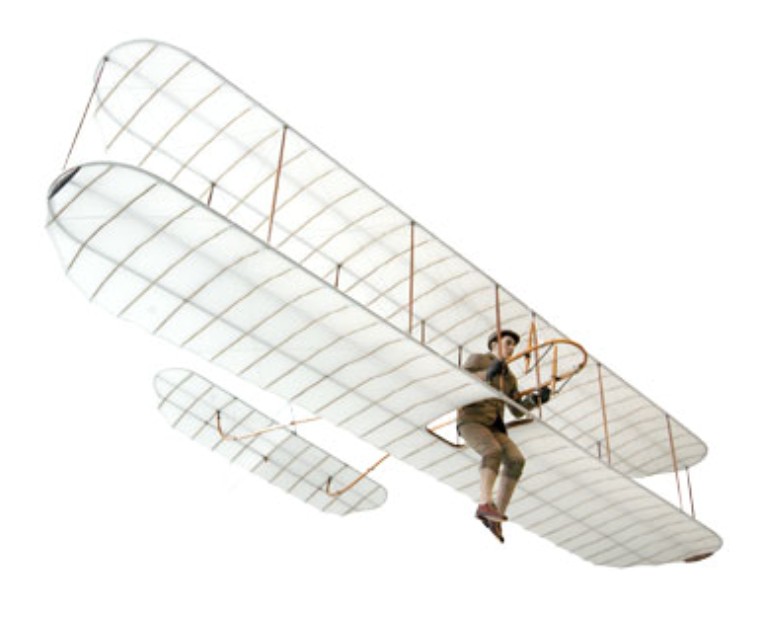
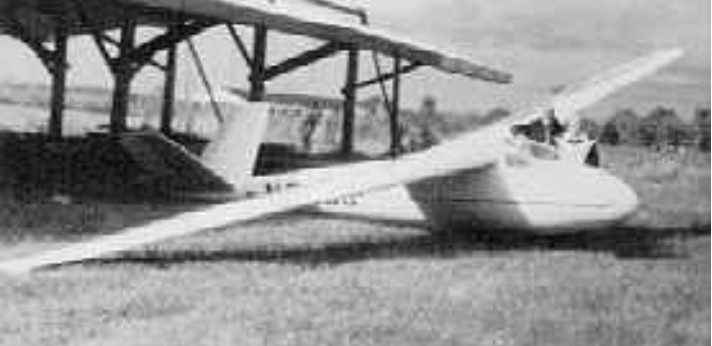
In 1910 TWK Clarke and Co., a Kingston-on-Thames manufacturer of aircraft, accessories and flying models, produced a range of four biplane gliders. This machine, based on a configuration evolved by the American pioneer Octave Chanute, was the third largest of the range and resembled the Wright brothers’ aircraft in general construction. It could be bought as a kit for 10 guineas (£10.50) or completely assembled and covered for £34.
The machine was flown as a hang-glider with the pilot resting his armpits on the padded cushions, while the two control levers, connected in unison, operated the rudder when moved from side to side and the one-piece elevator when moved backwards or forwards. Banking in turns was achieved by the pilot swinging his body and legs towards the inside of the anticipated turn.

Gliding and hang-gliding are now popular leisure pastimes, but at the time T.W.K. Clarke built this glider, powered and controlled flight had yet take place. Gliders were used by many pioneers to perfect their skill at flying and also the machines they were building.

Tsybin Ts-25 / NK-25

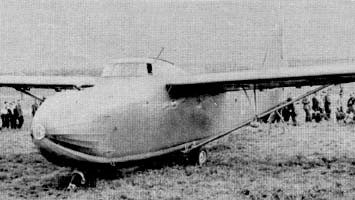
Designed by Pavel Tsybin to a 1944 specification, the Ts-25 was of a high-wing design, with a box-shaped fuselage featuring a hinged nose for ease of loading the aircraft’s cargo. The aircraft had a fixed tricycle landing gear, with skids to aid in landing, and was of steel-tube-braced wooden construction with the nose covered in fabric. The fuselage was otherwise covered in plywood; the wing was tapered, with its spar being steel-tube strut braced. The intended load of the aircraft consisted of a jeep-type vehicle and a 57 mm (2.2 in) anti-tank gun.

Following flight tests that completed in 1948, the Ts-25 was accepted for production;[1] it is regarded as the first domestically produced glider to be built in significant quantities for the Soviet Airborne Forces (VDV). It was first publicly displayed at the 1948 Tushino Air Display. Eventually up to 480 of the aircraft were built at the Chkalovsk manufacturing plant between 1948 and 1954. Some were used by the VDV in training maneuvers. One was modified with 25 passenger seats for evaluation for potential civilian use on routes including Moscow, Gorki, and Novosibirsk. Two were supplied to the Czechoslovak Air Force in 1952 and given the desigation NK-25; the Yakovlev Yak-14 was preferred by the Czechs.

In 1950 two Ts-25s, towed by Ilyushin Il-12 transports, were used to resupply Polar Station SP-2.

Variants

Ts-25
Main production version, 480 built.

Ts-25M
Powered version; one built. Powered by two Shvetsov M-11FR-1 radial engines each producing 165 hp (123 kW).

NK-25
Czech designation for Ts-25.

Wingspan: 24.38 m (79 ft 11.875 in)
Length: 16.15 m (52 ft 11.8 in)
Height: 5 m (16 ft 5 in)
Wing area: 75.0 m2 (807 sq ft)
Empty weight: 1,787 kg (3,940 lb)
Max takeoff weight: 4,200 kg (9,259 lb)
Maximum speed: 230 km/h (140 mph, 120 kn) in tow
Landing speed: 90 km/h (56 mph; 49 kn)
Crew: two pilots
Capacity: 25 troops or 2,500 kg (5,500 lb) cargo

Trager-Bierens Alibi T-3

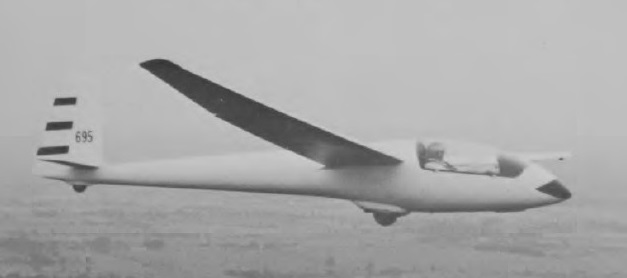
Designed by Kempes Trager and John Bierens, the T-3, which first flew in 1951, uses a set of Laister-Kauffmann LK-10A wings with a new all-metal fuselage with V-tail and retractable wheel. Later the wing was rebuilt and a new all-metal tail was incorporated.

Wing span: 15.24 m / 50 ft
Wing area: 13 sq.m / 140 sq.ft
Aspect ratio: 17
Airfoil: NACA 4418
Empty Weight: 227 kg / 500 lb
Payload: 113 kg / 250 lb
Gross Weight: 340 kg / 750 lb
Wing Load: 26.15 kg/sq.m / 5.1 lb/sq.ft
MinSink: 0.67 m/s / 2.2 fps / 1.30 kt
L/DMax: 28 77 kph / 42 kt / 48 mph
Seats: 1
No. Built: 1
Structure: wood/ fabric wings. Metal fuselage and tail.

Torva 15 / TA 1 / TA 2 Sprites

Torva 15 Sport

This Standard Class single-seater was designed by John Sellers, who was also responsible for the Slingsby T53, for Torva Sailplanes Ltd of Scarborough, Yorkshire, which company he had formed in September 1969 with Chris Riddell, and it was intended to be a moderately priced type with good performance suitable both for clubs and the private owner and competition pilot, for whom two production versions were to have been marketed.

These were the Torva 15 Standard for club use and the Torva 15 Sport for the private owner and contest flying, the latter being fitted with flaps and having a retractable monowheel, while the Standard had provision for up to 130lb of water ballast. The Torva 15 was noteworthy as being the first British designed sailplane to be constructed largely of glass-reinforced plastics (GRP), although the wings have plywood ribs and the fuselage has plywood and foam sandwich frames to support its GRP shell and side longerons. Design work began on 6 October 1969 and construction of the Torva 15 Sport prototype (also known as the Torva TA 1) commenced on 16 March 1970; this first flew on 8 May 1971 in the hands of Chris Riddell. A modified Wortmann aerofoil section was chosen for the cantilever shoulder wings to give a very high lift coefficent for achieving a good rate of climb in weak British thermals, and also to give a low stalling speed for short-field landings. The wings have a GRP spar with ply webs and GRP/balsa shell; both the ailerons and flaps are of GRP with a foam core, the ailerons having variable differential and drooping with the flaps, but being isolated from the latter at the flap full-down position. Light alloy Schempp-Hirth air brakes are also fitted. The fuselage and canopy shape were computer calculated to achieve a good aerodynamic shape and roomy cockpit; the pilot sits under a Suntex lift-off transparent one-piece canopy and has a GQ five-point seat harness. The tail surfaces have GRP/balsa shells and plywood webs, the tailplane being an all-moving surface with a geared anti-balance tab. The retractable rubber-sprung monowheel is located forward of the eg and is manually retracted, with an internal expanding brake; there is also a GRP sprung tailskid with a small wheel.

Only three more Torva 15s were built after the prototype, as the company was forced to close down; these were also known as TA 2 Sprites.

Torva 15 Standard
Span: 15.0 m / 49 ft 2.5 in
Length: 7.11 m / 23 ft 3.25 in
Height: 5 ft 0 in
Wing area: 11.3 sq,m / 121.5 sq.ft
Aspect ratio: 20.0
Empty weight: 238 kg / 525 lb
Max weight: 408 kg / 900 lb
Water ballast: 59 kg / 130 lb
Max speed: 134 mph / 116 kt / 216 km/h (in smooth air)
Max rough air speed: 80 kt / 148 km/h
Stall speed: 35 kt / 65 km/h
Min sinking speed: 0.62 m/sec / 2.03 ft/sec at 50 mph / 43.5 kt / 81 km/h
Best glide ratio: 37:1 at 51 mph / 44 kt / 82 km/h

Torva 15 Sport