Flight Team Sinus

The Sinus is an all composite motorglider. The prop folds into a housing in the engine cver.

Engine: Rotax 503, 52 hp
Wing span: 14.95 m
Wing area: 12.80 sq.m
MAUW: 450 kg
Empty weight: 225 kg
Fuel capacity: 64 lt
Max speed: 186 kph
Cruise speed: 165 kph
Minimum speed: 55 kph
Climb rate: 3.5 m/s
Fuel consumption: 9 lt/hr
Certification: vVz
Seats: 2
Price (1998): 60 950 DM

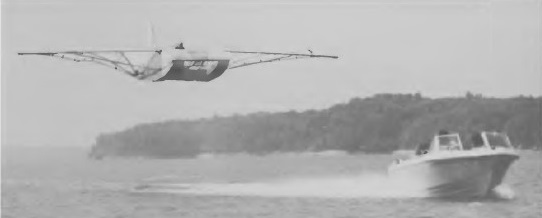
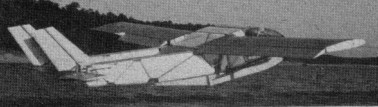
Flight Dynamics Seasprite

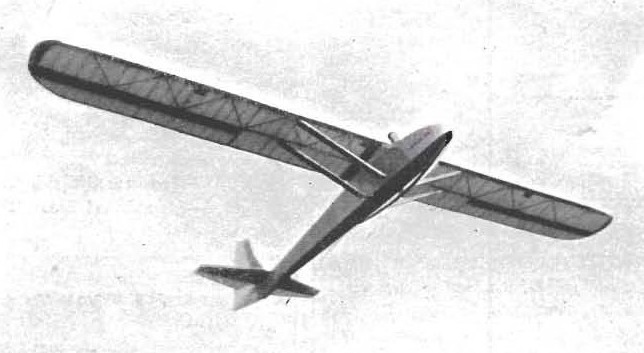
This single- or two-seat homebuilt glider is distinguished by an aerofoil-shaped fuselage and bat-like sailwing type wings, the tail unit being carried on an aluminium boom. It is an unpowered Stage 1 version of an aircraft which, in fully developed powered form, will be known as the Flightsail VII, the Seasprite being of more simplified construction, and it is being marketed as plans to amateur constructors.

The fuselage is a framework of aluminium tubing, the sides and top of which are covered with polyethylene foil, except for the upper part of the nose section, which has a transparent covering of polyester film and Plexiglas. Alternatively, the structure can be covered with aluminium foil for only a minimal weight increase, and this has a much longer life. The underside of the fuselage has catamaran-type twin floats, built of plastics with a plywood covering, enabling the Seasprite to be operated off water if so desired.

The wings are of triangular planform with aluminium tube leading edges and wire trailing edges, the whole being covered in polyethylene. They can be folded rearwards when not in use but are otherwise braced to the fuselage sides. The wing tips pivot about their leading edges to provide roll control. The tail is built as a single fin/tailplane unit pivoting only in the vertical plane for control in pitch.

The pilot sits in an open cockpit in the centre section, to the right of the aluminium boom carrying the tail unit, and his weight is balanced by a counterweight at the port wing tip if a second pilot or passenger is not carried.

One Seasprite has been fitted with twin tail booms preparatory to adding a small pusher engine between them, this being an interim stage, as the Seasprite II, in the development of the Flightsail VII.

Wingspan 34 ft 0 in
Length 20 ft 0 in
Height 8 ft 0 in
Wing area: 166.0 sqft
Aspect ratio: 6.96
Empty weight: 165 lb
Max weight: 500 lb
Lift off speed 30 mph
Cruise speed 35 mph
Max aero-tow speed: 35 mph
Best glide ratio: 6:1 at 50 mph
Flight Dynamics Flightsail VII

Design begun in 1966 and first first flown in October 1970, the Flightsail VII can either be towed behind a 70-hp ski boat or it can have a 90-hp Continental pylon mounted above the fuselage to fly the Flightsail under its own power. The structure is built from bolted aluminum, foam and epoxy. This two-seater amphi¬bian features twin booms and twin tails.

Engine 90-hp Continental
Gross wt. 1600 lb
Empty wt. 1100 lb
Fuel capacity 12 USG
Wingspan 39 ft

Length 29 ft
Top speed 95 mph
Cruise 80 mph
Stall 35 mph.
Climb rate 500 fpm.
Takeoff time 20 sec
Range 200 miles

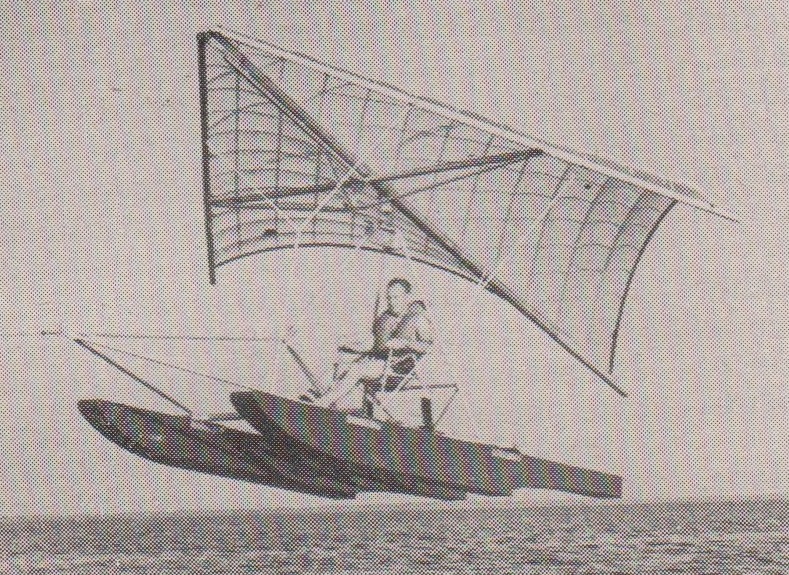
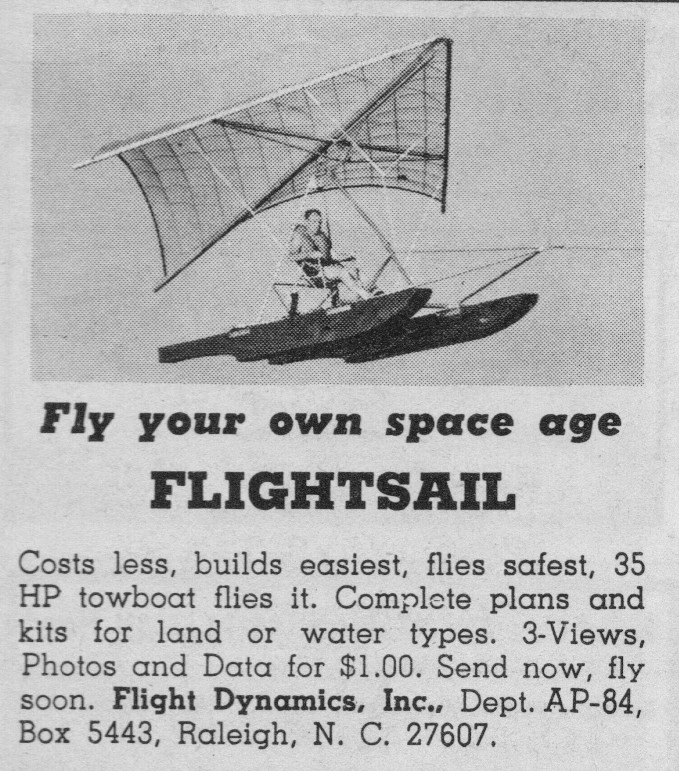
Flight Dynamics Flightsail

Flight Dynamics Inc, of Raleigh, NC, were promoting in 1963 The Flightsail. An adaptation to sport of the flexible wing developed for the National Aeronautics and Space Administraion. The wing is a polyethylene covering on an airframe of commercial aluminium tubing and angle stock.

Capable of taking off from land or water, Flightsail is controlled in flight by an aircraft-type control stick that regulates the tilt of the wing.

Easily towed aloft by a 40 – 50 hp outboard, flying is best with a breeze of about 5 mph, lift-off being between 25-50 mph ground speed.

In 1963 it was claimed the Flightsail could be built at a total cost of US$250, including wheels and floats.

April 1964 – January 1965

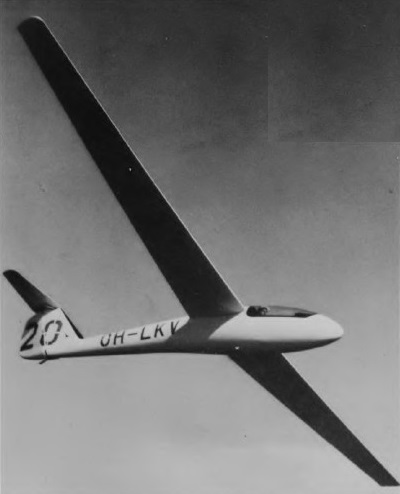
Fibrera KK-1 Utu

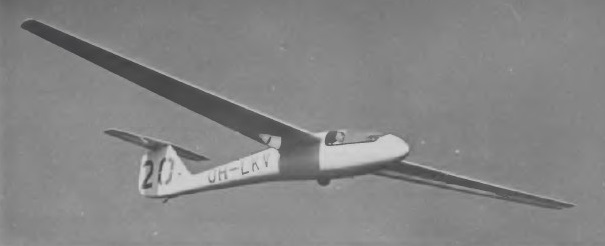
The Finnish Utu is a Standard Class single-seater that was designed and built over a three year period by a team of engineers of OY Fibera AB, a company specialising in glassfibre manufacture.

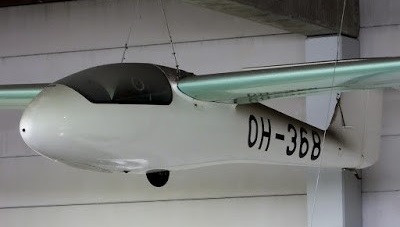
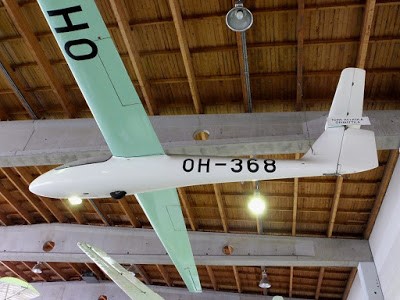
Fibera KK-1e UTU OH-368

The design team was headed by Dipl-lng Ahto Anttila, and the Utu was intended to investigate the structural applications to sailplanes of plastic laminates stabilised with polyurethane foam. The prototype, designated KK-1a, first flew on 14 August 1964, and was followed by four more prototypes, designated KK-1b, c,d and e, each with structural modifications resulting from variations in the constructional techniques used. Tests with these proved the superiority of plastics over conventional wooden construction, and the Utu in due course went into small-scale production, a total of 22 having been built when production ended early in 1970.

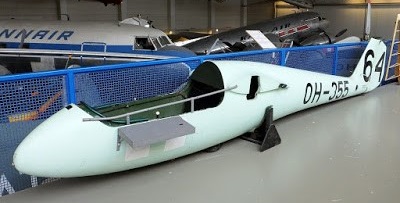
Fibera KK-1e Utu OH-355 / 64

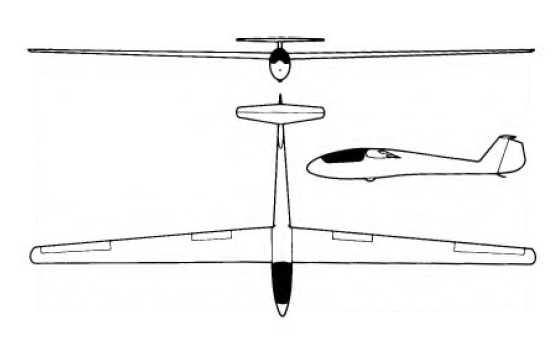
The high cantilever wings have single I-spars and no ribs, each wing consisting of a polyester/glassfibre laminate sandwich shell with foam plastic core. The upper-surface hinged ailerons are of glassfibre reinforced plastic shell construction with foam plastic stiffening; there are no spoilers but flaps are fitted. The Utu has a trailing-edge split spoiler/terminal-velocity brake. One surface rotates up like a spoiler and the other splits down like a flap and the resultant air deflection from the upper spoiler drives the wing down in a strong negative lift configuration.

The fuselage is a double shell monocoque with a polyester/glassfibre laminate outer shell and a sandwich-type inner shell of similar construction to the wing. The fin is moulded integrally with the fuselage and has the tailplane mounted on top of it; the tail surfaces are glassfibre-reinforced plastic shells stiffened with foam plastic. There is a nonretractable monowheel with a drum brake, and a tail skid. The one-piece canopy is blended into the forward fuselage shape, and oxygen and radio is installed aft of the pilot’s seat.

Fibera KK-1e Utu

Fibera KK-1 Utu
Wing span: 15m / 49.2ft
Wing area: 11.24sq.m / 121sq.ft
Length: 6.5 m / 21 ft 4 in
Height: 1.22 m / 4ft 0 in
Empty Weight: 200kg / 441lb
Payload: 110kg / 242lb
Gross Weight: 310kg / 683lb
Wing Load: 27.58kg/sq.m / 5.65lb/sq.ft
Water Ballast: 0kg / 0lb
Aspect ratio: 20
Airfoil: NACA 63 (3)-618 root. 63(1)-612 tip
Max speed (smooth air): 135 kt / 250 km/h
Stalling speed: 34 kt / 63 km/h
Max rough air speed: 113 kt / 210 km/h
L/DMax: 35 @80 kph / 43kt / 50 mph
MinSink: 0.61 m/s / 2.0 fps / 1.18 kt at 40 kt / 74 km/h
No. of Seats: 1
No. Built: 22

KK-1e
Span:49 ft 2.5 in
Length: 21 ft 4 in
Height: 4 ft 0 in
Wing area: 121.6 sqft
Aspect ratio: 20.0
Empty weight: 441 lb
Max weight: 684 lb
Max speed: 155 mph (in smooth air)
Max aero-tow speed: 124 mph
Min sinking speed: 2 ft/sec at 46 mph
Best glide ratio: 35:1 at 50 mph