Fokker made the headlines in August 1922 when he participated in the Rhon gliding competition with his FG.1 and FG.II, single and two seat gliders. At the start he made a few modest hops, but it soon became obvious that this type of flying was no problem to him either.
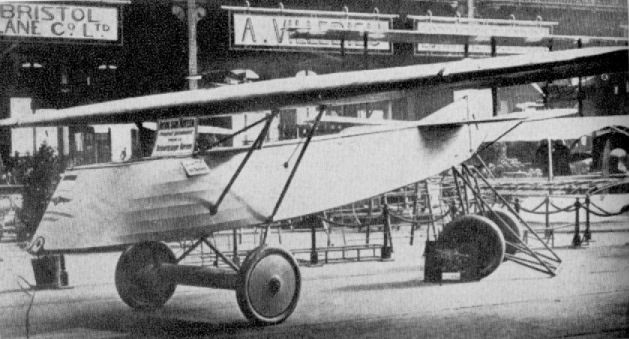
The glider V.30 identity is nowhere to be seen in contemporary reports of the Paris exposition, just the Fokker glider or ‘planeur’. So this identity has crept in through the years.
Till now no original documents on the Fokker glider / or glider bomb has been found.
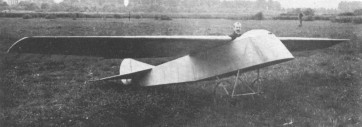
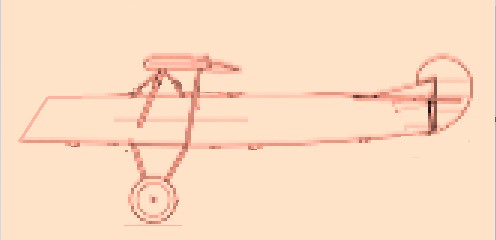
The V 30 was a V.26 converted into a glider with the pilot’s cockpit moved to the extreme nose. One such machine was exhibited at the Paris Aero Salon in 1921.
A Fokker V.31 was equipped with a hook to tow the V.30 glider.
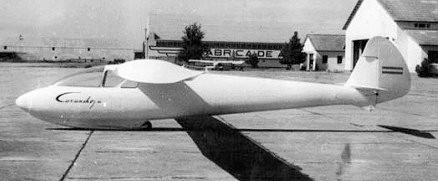
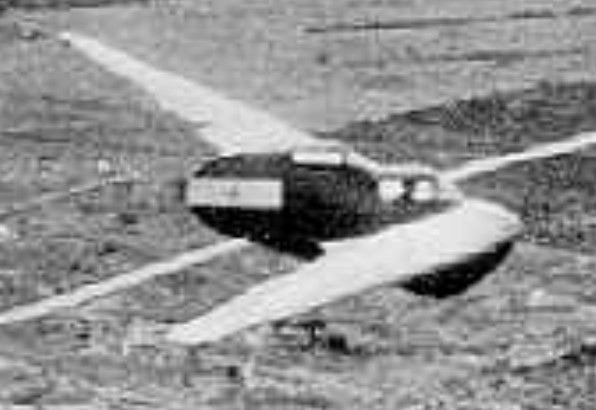
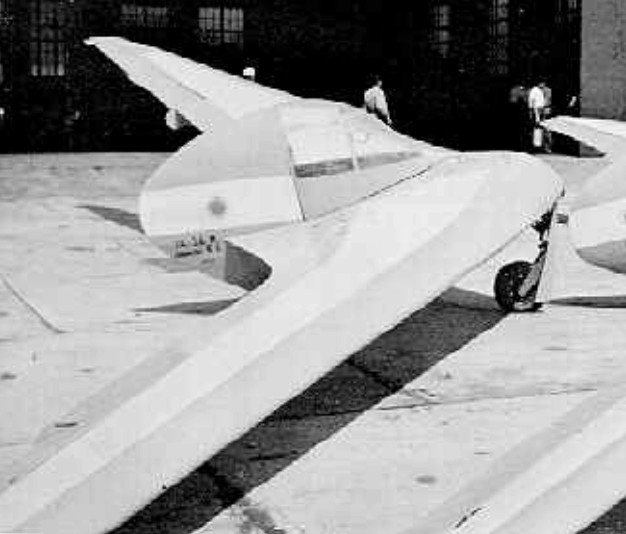
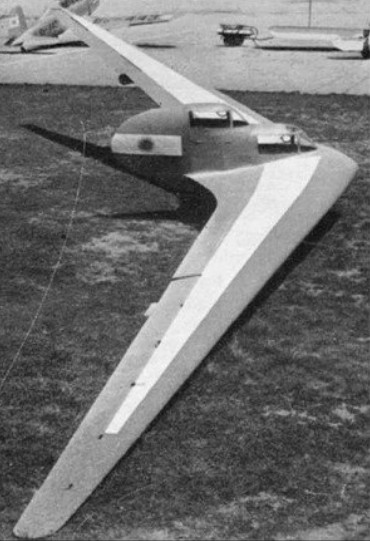
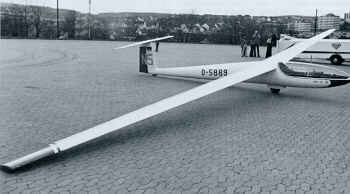
In October 1963 the Argentine state aircraft factory DINFIA began construction of the prototype IA 54 two-seat research sailplane intended to test a new 19m (62ft 3.5in) span wing; the fuselage was based on that of a Schleicher Condor 4 and the all-wood wing, of 18% thickness/chord ratio, had down-turned wing tips, Frise ailerons, unslotted flaps and – inboard of the flaps – metal trailing edge air brakes.
Wingspan; 19.00 m / 62 ft 4 in Length; 8.00 m / 26 ft 3 in Wing area; 29.00 sq.m / 312.15 sq ft Max take-off weight; 548 kg / 1208 lb Max. speed; 240 km/h / 149 mph Crew; 2
Wingspan; 18.00 m / 59 ft 1 in Length; 4.40 m / 14 ft 5 in Height; 1.90 m / 6 ft 3 in Wing area; 28.00 sq.m / 301.39 sq ft Length; 4.40 m / 14 ft 5 in Height; 1.90 m / 6 ft 3 in Max. speed; 180 km/h / 112 mph Empty weight; 250 kg / 551 lb Max. speed; 180 km/h / 112 mph Crew; 1
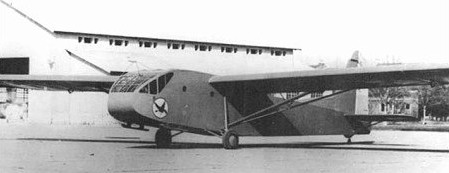
Length; 14.70 m / 48 ft 3 in Height; 3.84 m / 13 ft 7 in Wing area; 79.10 sq.m / 851.42 sq ft Empty weight; 2460 kg / 5423 lb Wingspan; 25.50 m / 84 ft 8 in Max. speed; 220 km/h/ 137 mph Crew; 1 Passengers; 16
Originally founded in 1927 as the Fabrica Militar de Aviones SA (FMA), for aeronautical research and production at Cordoba.
The biggest aeronautical development and production center in Argentina was the Fábrica Militar de Aviones in Córdoba, an inland city 700 kilometers from Buenos Aires. The company first built airplaces (1929) and engines (1930) under license and later began building its own planes the Ae.C.1, a three-seated passenger plane with a covered cockpit.
Redesignated Institute Aerotecnico 20 October 1943. As Industrias Aeronauticas y Mecanicas del Estado (IAME) formed March 28,1952 to take over State activities concerning military and civil aircraft, and incorporating the Institute Aerotecnico (formerly Fabrica Militar de Aviones). I.A.35 was twin-engined multipurpose monoplane; I.A.33 Pulqui II (first flown February 1951) a swept-wing jet fighter designed by Kurt Tank. Six Pulqui built 1955/56. Nationalized 1957, with aircraft works at the Fabrica Militar de Aviones at Cordoba, under DINFIA (Direccion Nacional de Fabricaciones e Investigaciones Aeronauticas) name. Began with design and construction of IA 46 light aircraft, twin-engined transports IA 35, IA 45, the IA 38 four-engined tailless transport designed by Dr. Reimar Horten, and the IA 37, a small delta-wing aircraft. In 1966 began license construction of Cessna 182 and indigenous light turboprop and piston-engined transports. Reverted to name FMA in 1968, becoming part of Area de Materiel Cordoba division of the Argentine Air Force. December 1994 agreement between the Government of Argentina and Lockheed Aircraft Service Company to privatize FMA aircraft factory and maintenance depot at Cordoba, with Lockheed operating as the management organization from July 1995. License-production 1927-1943 included Avro 504R, Dewoitine D.21 C, Bristol F.2B, Focke-Wulf Fw 44J, Curtiss Hawk 75. Indigenous designs included Ae.C-1 three-seat monoplane, Ae.C-2 trainer of 1932, Ae.T-1 fiveseater of 1933, Ae.C-3 light aircraft of 1934, and Ae.M- 01 built for Argentine Army. El Boyero two-seater built 1939-1940. Production of the IA.58 Pucara twin-turboprop COIN aircraft for Argentine Air Force ended in 1986. First flight of IA.63 Pampa advanced and weapon training jet trainer, and also for light attack, took place in October 1984.
In 1995 FMA was closed and privatized in 1995 to Lockheed Martin Corporation.
To practically test the position of the pilot, the Flugtechnische Fachgruppe (Aero-technical Group) Stuttgart constructed the FS17 research aircraft. The FS17 was a glider that was designed to withstand forces up to 14g. After the completion of the test program an order was given by the DVL ((Deutsche Versuchanstalt für Luftfahrt e.V. Berlin-Aldershof) (German Experimental Department for Aerospace Reg.) to the FFG Berlin ((Flugtechnische Fachgruppe)(Aero-technical Group)) to construct a powered aircraft. FFG Berlin was chosen as it possessed the necessary workshops and technicians. In the Spring of 1943 the FFG Berlin constructed the Berlin B9 to the specifications provided.
The ideal of an all-glassfibre sailplane was achieved in several stages, the first being development of the fuselage and tail unit designed by Thomas Bircher and J von Voornveld at the Swiss Federal Institute of Technology in Zurich under the direction of Professor Rauscher. A prototype fuselage was built in 1962 and was flown with the plywood and fabric wings of a Schleicher Ka 6CR, the resulting aircraft being designated Ka-Bi-Vo.
The Diamant’s development was now gradually taken over by Plug- und Fahrzeugwerke AG FFA, and the next stage was the HBV-Diamant 15 which used the 15m span Hutter H-30TS wings of the Glasflugel H 301 Libelle. This first flew on 5 September 1964 and 13 of this variant were subsequently built; the Libelle’s wings being glassfibre balsa sandwich shells without ribs, featuring ailerons that gave partial downward movement when the flaps were lowered, and there were glassfibre dive brakes forward of the flaps.
The HBV-Diamant 15 was followed by the generally similar Diamant 16.5, with wings of increased span (16.5m) designed and built by FFA; a total of 41 of this variant were built. This was the first all glass fiber production sailplane, not using balsa or other wood sandwiched between the fiberglass layers.
1967
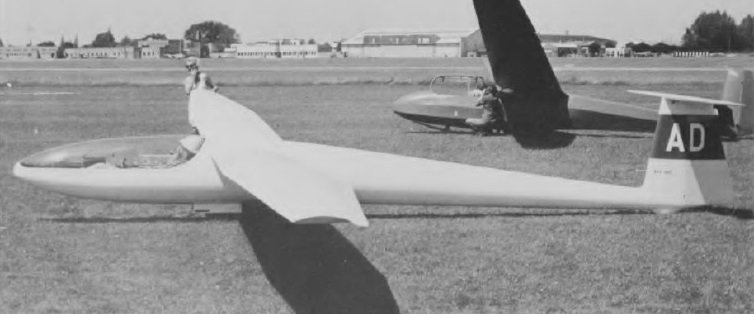
The Diamant 18 is an 18 m development of the 16.5, first flying in February 1968, with extended inboard wing and flap sections and a new wingtip cap. like the Diamant 16.5, water ballast an be carried in the wing roots. The monocoque fuselage is an epoxy-glassfibre sandwich with foam inserts, and the tail unit is of the same construction, the allmoving one-piece tailplane being mounted on top of the fin. As well as a small tailwheel (a tailskid is optional) there is a manually-retractable monowheel with a brake, and another feature is a glassfibre ring spring shock absorber; the tow release retracts with the landing gear. The pilot sits in a semi-reclining position under a long forward sliding one-piece canopy, and there is provision for radio and oxygen.
At least one Diamant 18 was substantially modified by Dan Pierson of Los Angeles, CA to have a 19.0 m / 62.3 ft wing carrying 145 kg / 320 lb of water ballast bringing the gross weight up to 673 kg/ 1,480 lb.
The HBV Diamant and Diamant 16.5 are ATC, while the Diamant 18 is EXP.
A powered version of the Diamant 18 known as the EFF Prometheus 1 made its first flight on 21 June 1971, powered by a 176lb st Microturbo Eclair II turbojet mounted behind the cockpit. The Prometheus was developed by EFF – Entwicklungsgemeinschaft fur Flugzeugbau der Akademischen Fluggruppe, and it was later converted back to a standard Diamant 18.



 All Aero