Fournier RF5 / RF55

Fournier’s plant in central France was shut down as unable to compete with the French Government. Fournier’s motorgliders were still being manufactured in Germany.

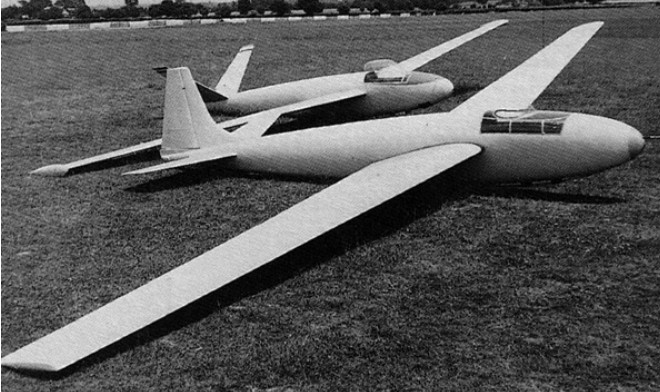
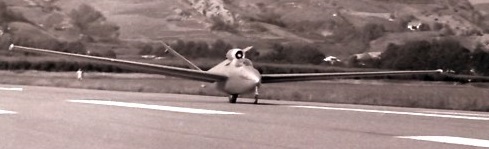
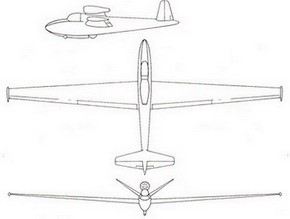
The RF5 is basically a tandem two-seater version of the RF4D and RF3, differing from them mainly in having wings of increased span, with folding outer sections to facilitate hangar storage, and a more powerful engine. The wood and fabric, two in tandem RF5 is a sailplane with a single main wheel, and tip outriggers. The wings fold inboard at their halfway points to reduce hangar space; the locking pins for the wing fold are easily checked from the cockpit. There are glider style spoilers and a five piece snap in harness, to encourage aerobatics. Dual controls are fitted, the pupil sitting in the forward seat when under instruction, this seat being occupied by the pilot when the aircraft is flown solo. The pilot and pupil or passenger sit under a one-piece sideways-hinged Plexiglas canopy, with a small baggage space aft of the rear seat; rudder pedals are adjustable and the canopy can be jettisoned in emergency.

The wings are very similar structurally to the RF4D’s with slightly less dihedral (3° 15′) at the main spar centre-line; the outer wing panels fold inwards, and the same type of metal-skinned spoilers are fitted in the upper surfaces. The wooden oval-section fuselage is made up of bulkheads and stringers, and is ply and fabric covered. The cantilever wooden tail unit is similarly covered, and has a fixed-incidence tailplane with a Flettner trim tab in the port elevator; the entire tail can be removed for transportation. Landing gear is similar to the RF4D’s, the single Tost mainwheel having twin oleo-pneumatic shock absorbers and a manually-operated brake and retracting forward with spring assistance; there is a steerable tailwheel with oleo-pneumatic shock absorber, and small outrigger wheels under each wing, just inboard of the fold line. The powerplant is a 68hp Sportavia-Limbach SL 1700E Comet ‘flat four’ engine with a maximum continuous rating of 63hp and driving a Hoffman two-blade fixed-pitch metal propeller of 4ft 9.75in diameter. Two metal fuel tanks in the wing root leading edges give a total capacity of 13.8 Imp gallons. The converted 68 horsepower Volkswagen engine has single ignition, despite which the Fourniers are generally certificated throughout Europe; the FAA alone won’t approve it.
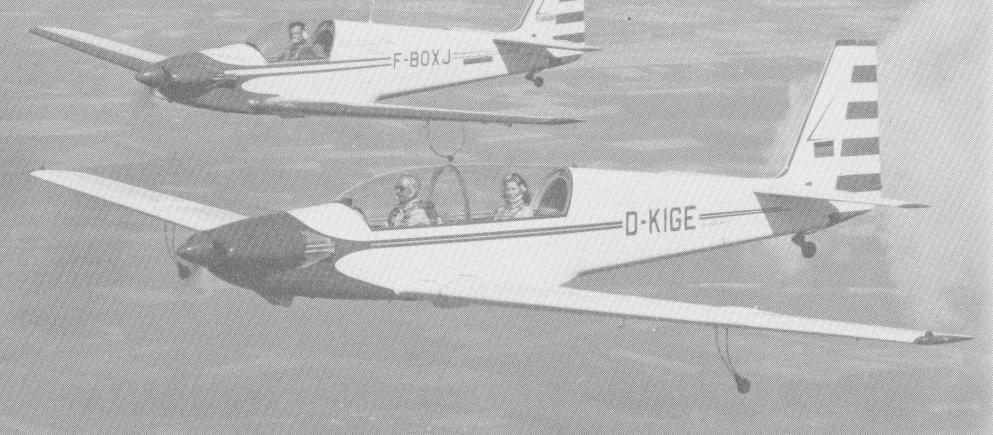
RF5 (RF4D behind)

Construction of the prototype RF5, registered D-KOLT, was started in the summer of 1967, and it first flew in January 1968. The RF5 received its German domestic type certification in the powered sailplane category in March 1969. Production started late 1968, and a total of 145 RF5s had been delivered by the end of 1978; production ended in the spring of 1979.

The RF5’s maximum cruise is 102 knots. Consumption is about four gallons per hour, for an endurance of four hours and a range of about 410 nautical miles. Best glide ratio is 22/1, and minimum sink is 4.6 feet per second: not bad, considering the fixed pitch non-feathering prop. The RF-5 has an electric starter.
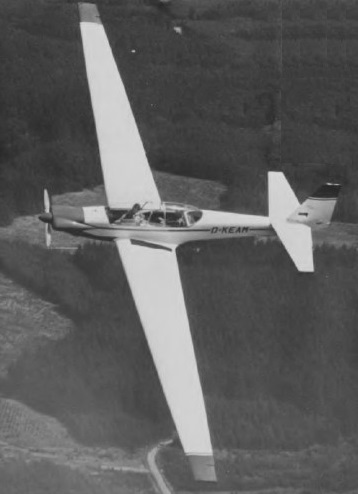
Aerobatics are glider like but it’s hard not to exceed the 145 knot redline. The approach is best flown as a sailplane: leave the power alone and control your descent with the spoilers. The spoilers reduce lift as well as increasing drag and should be all the way out as you cross the fence; deployng them fully just as you round out can knock the tailwheel off or jam the main so it won’t retract.

Some 150 RF5s have been built by Sportavia, a company partly owned by VFW Fokker. Their production includes the RF5B Sperber.

The RF5B Sperber (or Sparrowhawk) is an improved version of the RF5 differing from it chiefly in having the wing span increased by 10ft 9in and the rear fuselage cut down to give improved rearward visibility from the new bulged sideways-opening cockpit canopy, and to reduce the side area. The wing is an all-wood single-spar structure with plywood and fabric covering. The RF-5B outer wing sections fold to reduce the span to 11.3 m/ 37 ft for hangers, and features outrigger wheels for taxiing, spoilers and a full electrical system and a shorter fuselage. There is space for 5 kg (11 lb) of baggage behind the rear seat. The fuselage is an all-wood oval section structure of bulkheads and stringers covered with a plywood skin and the two pilots sit in tandem beneath a one-piece Plexiglas canopy hinged sideways. Powered by a 50.7 kW (68 hp) Sportavia Limbach SL 1700E Comet engine it has a choice of two types of Hoffmann propeller: a 1.45 m (57 in) diameter two-blade fixed-pitch, or a 1.5 m (59 in) diameter two-blade three-position variable pitch propeller. Fuel is carried in wing-root leading edge metal tanks with a total capacity of 38 litres (8.4 Imp gal).

Construction of the prototype began in early 1971 and it first flew in May of that year. The RF5B received German certification in the motor glider category in March 1972, and by the spring of 1977 a total of 80 RF-5Bs had been delivered; from 1979 it was only available to a firm order.
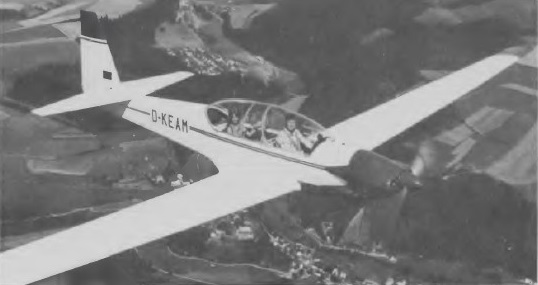
Sportavia RF5B Sperber

In 1973 several modifications were introduced on production aircraft including an improved cabin heating system; an engine muffler to decrease exterior and cabin noise levels; an adjustable ventilation system; optional disc brakes and a wider range of instrument and equipment optional ‘extras’, which included an artificial horizon, electric compass and a flight data computer. The same 68hp Sportavia-Limbach SL 1700E Comet engine as on the RF5 is fitted, although the SL 1700E1 of the same horsepower could be fitted optionally, this variant being equipped to drive the Hoffman HO-V62R two-blade three position variable-pitch propeller that was available as an alternative to the fixed-pitch prop. All fuel was then contained in a single fuselage fuel tank of 8.6 Imp gallons capacity.

The RF55, which first flew in 1972, was a modified version of the RF5B fitted with a slightly-modified 60hp Franklin 2A-120-A engine to meet overseas certification requirements; an electric fuel pump was featured, as well as a larger fuel tank; this version did not go into production.

The RF5D is an improved 1974 model of the RF5 incorporating the full range of improvements introduced on the RF5B Sperber in 1973, and with a more powerful (74hp) Sportavia-Limbach SL 1700ED engine.

Gallery

RF-5
Engine: 59 kw/80hp Limbach L 2000 EOI
Wing span: 13.74 m / 45 ft 1 in
Wing area: 15.12 sq.m / 162.8 sq.ft
Length: 7.80 m / 25 ft 7.25 in
Height: 6 ft 5 in
Empty Weight: 420 kg / 926 lb
MTOW aerobatic: 660 kg / 1333 lb
MTOW utility: 650 kg / 1455 lb
Wing Load: 42.8kg/sq.m / 8.77lb/sq.ft
Water Ballast: 0kg / 0lb
Aspect ratio: 12.25
Min sinking speed: 4.59 ft/sec
Best glide ratio: 22:1
Airfoil: NACA 23015 @ root, 23012 @ tip.
Max level speed: 124 mph at sea level
Max cruising speed: 118 mph / 102 kt / 190 kph
Service ceiling: 19,675 ft / 6000 m
Take-off run: 655 ft
Range with max fuel: 472 miles / 410 nm / 760 km
No. of Seats: 2
Baggage capacity: 22 lb / 10 kg

Sportavia RF5B Sperber
Engine: Limbach SL 1700E, 51kW/68 bhp
Span: 17.02m / 55 ft 10 in
Length: 7.71 m / 25 ft 3.25 in
Height: 1.96 m / 6 ft 5 in
Wing area: 19 sq.m / 204.5 sq ft
Aspect ratio: 15.25
Airfoil: NACA 23015/23012
Folded span: 35.8ft.
Empty weight: 470kg /1036lb
Max weight: 680kg /1499lb
Payload: 210kg /463lb
Wing Load: 35.7kg/sq.m /7.31lb/sq.ft
Max level speed: 118 mph / 102 kt / 190 km/h
Max cruising speed: 112 mph
Stall speed: 37 kt / 68 km/h
L/DMax: 26 at 98 kph / 53 kt / 61 mph
Min sinking speed: 0.89 m/s / 2.92 ft/sec / 1.73 kt at 46.5 mph / 40.5 kt / 75 km/h
Max rate of climb at S/L: 180 m/ min / 590 ft/min
Take-off run: 187 m / 615 ft
Range with max fuel: 261 miles / 420 km / 227 nm
No. of Seats: 2

RF55
Engine: Franklin 2A-120-A, 60 hp
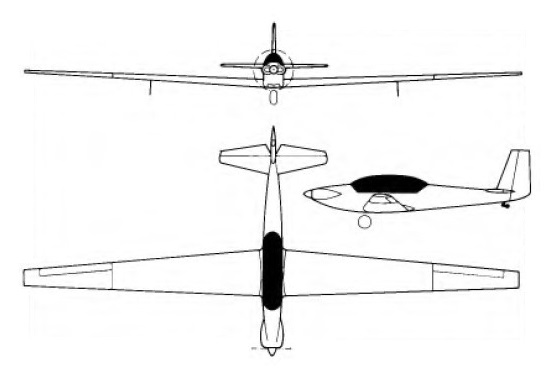
Fournier RF-01 Avion-Planeur

Rene Fournier was a ceramist by trade, and started off as a homebuilder with a design he called the RF 01 Avion Planeur (airplane glider). A single-seat light aircraft/powered sailplane with modified Volkswagen engine, first flown July 6, 1960. The aircraft caught the fancy of someone in the French Government, which provides grants-in aid to projects it considers worthwhile. A second prototype was built, and then Fournier entered into partnership with Antoine d’Assche, who was then producing Jodel two-seaters in a hangar at Gap in the French Alps under the trade name of Alpavia. They produced quite a number of the little airplanes, which were not exactly powered sailplanes but airplanes with an unusually shallow angle of glide; successive improvements brought about the RF4 (the second prototype having been the 2, and the original production version the 3).

Fournier

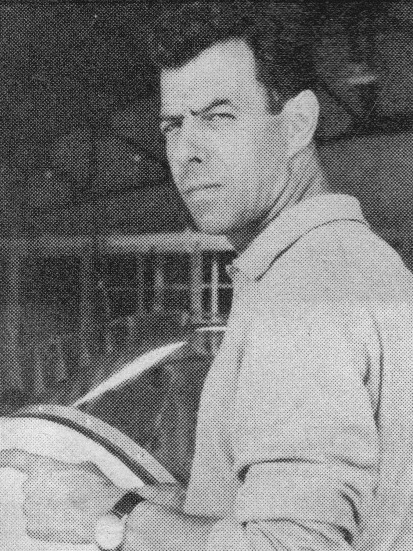
Rene Fournier

Rene Fournier was a ceramist by trade, and started off as a homebuilder with a design he called the RF 01 Avion Planeur (airplane glider). The RF.01 was a single-seat light aircraft/powered sailplane with modified Volkswagen engine, first flown July 6,1960. Government assistance for development of improved RF-2, with 34 hp Rectimo-VW engine, subsequently produced by Alpavia as RF-3, with slightly uprated engine, first flown March 1963. M. Fournier designed a series of light aircraft of similar configuration for Sportavia-Putzer and Indraero. Established subsequently Avions Fournier to develop revised version of his RF-6 Sportsman, designated RF-6B; first flown March 12, 1974. Produced RF-9 motorglider 1982.

Fouga CM.8 / Castel-Mauboussin CM.8

CM.8/13 & CM.8/15

The CM.8 was a 1942 Castel-Mauboussin project 1-seat wooden gull-wing acrobatic glider, 13.5 m span
The CM.8 Acro was a scaled-down, single-seat development of CM.7 Adour, leading to CM-8/13.

Turbomeca designed and built after the end of World War Two the Pimene turbojet which was rated at 242 lbst (110kgst). This design was successfully flown on July 14, 1949 in a Fouga Cyclone powered glider. The experience so gained enabled Turbomeca to put into production a family of small gas turbine engines which included the Palas of 160kgst (353 lbst), the Marbore of 300kgst (660 lbst) and the Marbore II of 400kgst (880 lbst).

Experience with CM.8-R.9 Cyclipe and with the Gemeaux led to development of the CM.170R Magister jet trainer, first flown 23 July 1952 and subsequently built in quantity for French Air Force and overseas customers.

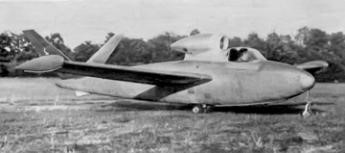
The C.M. 8R-13 Cyclone is a jet-powered version of C.M. 8-13 Sailplane. The C.M. 8R-13 had been intended to serve as a test-bed for the Turboméca Piméné light axial-flow turbo-jet engine which has a maximum static thrust of 100 kg. (220 lb.). On July. 14, 1949, Fouga chief test pilot Léon Bourriau flew the first flight of the Fouga CM8 R13, which was named Cyclone.

Fouga CM8 R13 – Cyclone [Sylphe I]

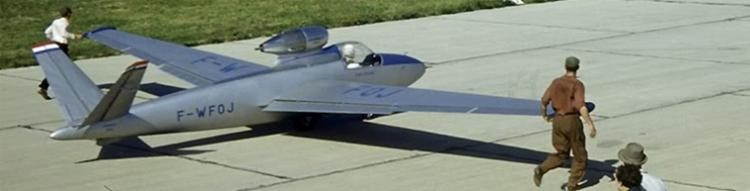
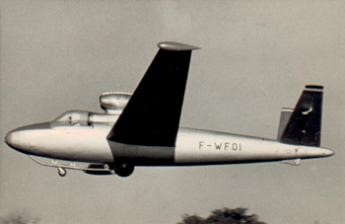
Only 2 CM8 R13 Cyclone (Sylphe I) were built. They appeared on the French civil register as : F-WFOI [later F-BFOI] and F-WFOJ [later F-BFOJ]. The Turbomeca turbojet, which weighs 64 Kg (141 lb) fully equiped, was mounted above the fuselage just after the pilot’s cockpit. Tha aircraft has the “butter-fly” tail fitted to the CM8-15 sailplane.

Fouga Cyclone N°1 (Sylphe I), F-WFOI

Fouga demonstrated the CM 8 R 13 Sylph I in France and then in Miami in January 1950, flown by Fred Nicole.

In May 1950, the piston engines manufacturer, Wright, sent a letter to Aire sur Adour requesting that the CM 8 R 13 name be changed from “Cyclone”, which was assigned to one of their world famous engines. M Mauboussin accepted and give “Sylph” in CM8 R 13.

A number of changes were implemented summers, especially the integrated front runner on No. 1 was instead attached to the front runner, and in the case of No. 2, the engine cowling was evolved.

The wings were mid-wing cantilever monoplane. NACA 230 wing section. Aspect ratio 13. Single-spare all-wood stressed-skin structure. Metal framed, fabric-covered slotted flaps and slotted ailerons. Retractable air-brakes in upper and lower wing surfaces.

An oval wood monocoque fuselage structure. The tail unit was a “butterfly type”. Fixed surfaces all-wood, movable surfaces all-metal. Area fixed surface 1,35 m² (14.52 sq. ft.), Area movable surfaces 1,09 m² (11.73 sq. ft.). Landing gear was a fixed single-track type.

The CM8 R9,8 Cyclope I is a single-seat training and aerobatic version of the Sylphe, from which it differs by having wings of reduced span and area, a single track landing gear with twin main wheel (later replaced by a single one) and retractable wing-tip skids. The turbojet engine remain a Turbomeca Pimene. Fouga CM8 R 9.8 Cyclope was flown by Leon Bourriau 31 August 1950.

Fouga CM8 R9,8 – Cyclope I

Five month later, on 3 January 1951, The Cyclope successfuly flown with a Turbomeca Palas (160 Kp version).

The CM8 R13 – Sylphe II can be considered an evolution of the Cyclone [Sylph I] prototype [F-WFOI / F-BFOI] which has been specially modified. The little dolly always present (the nose wheel not making its appearance with the Sylph III), the cockpit with a canopy with closed side, and Pimen having a much lower position make it a very different.

The Sylph III is a direct result of an evolution of cylcone [Sylph] Sylph in II. It is, like its predecessors, a single-seater glider with auxiliary engine. The first flew on January 2, 1952.

Fouga CM8 R13 – Sylphe III

The Sylph III led to the deletion of the small wheel, a single wheel nose.

The most significant change for performance was the Turbomeca Pimene, which is more powerful than previous versions installed on the Sylph or cyclone version as delivering more than 100 kgf.

The wing is NACA 23014 to the root, at the end 23012. A mid-wing cantilever monoplane, monolongeron-skin, entirely from wood. The fins are slotted alloy and stretched canvas, and flaps trailing edge slot, alloy and stretched canvas. The V-tail is fixed plan wood, coated with plywood.
Moving parts are light-alloy coated sheet. The undercarriage is a monotrack fixed type, with steerable front wheel, combined with auxiliary rudder and rear skid.

Gallery

Variants:
CM.8 — 1949 single-seat sailplane, aka Fouga CM.8, aka CM-8/13
CM.8 Acro: [Project] 1942
CM.8/13: 13m span prototype with conventional empennage, 1 built
CM.8/15: 15m span prototype with a V-tail, 1 built

CM.8R: Turbomeca Piméné-powered vers., 13m span with V-tail, aka CM.8R13
CM.8R13: 1949 Sylph I, aka Cyclone (renamed at insistance of Wright)
Cyclone/Sylph I: July 1949, 2 built, F-WFOI and F-WFOJ [F-BFOJ]
CM.8R13: 1950 Sylph II, changes to Piméné jet and canopy, 1 built
CM.8R13: 1952 Sylph III, 100+ kg Piméné, revised canopy and u/c
Sylph III, 4 built F-BFDH, F-BFDI, F-BFDJ, and F-BFDK
CM-08R9.8 Cyclope I: 1951 short-span Sylph, 1 x 110 kg Piméné, 1 built
CM-08R9.8 Cyclope II: 1951 short-span Sylph, 1 x 160 kg Palas, 1 built
CM.8/13 Sylphe démotorisé: CM-8R/13 with motorization option removed

Fouga CM8 R13 – Cyclone [Sylphe I]
Engine: One Turbomeca Pimene turbojet: 100 kg / 220 lb. St
Span: 13,00 m (42 ft.7,5 in).
Gross wing area: 13 m² (140 sq. ft.)
Length: 6,70 m (21 ft.11 in.)
Height: 1,85 m (6 ft.1 in.)
Weight empty 435 Kg (958lb.)
Pilot weight: 88 Kg / 194 lb
Fuel and oil: 110 Kg (242 lb.)
Weight loaded: 633 Kg (1394 lb.)
Max speed at sea level: 240 Km/h (149 mph)
Max speed at 3500 m: 250 Km/h (155 mph)
Max Speed with AB: 150 Km/h / 93 mph
Max. speed at sea level: 149 mph.
Max. speed at 11,500 ft: 155 mph.
Initial rate of climb: 790 ft./min.
Climb to 1200 ft: 1 min. 45 sec.
Climb to 11,500 ft: 18 min.
Climb to ceiling: 1 hr.
Service ceiling: 27,225 ft.
Max. range at 13,000 ft: 186 miles
Take-off run to 66 ft: 460 yards

Fouga CM8 R9,8 – Cyclope I
Engine: One Turbomeca Pimene turbojet: 100 kg / 220 lb. St
Span: 8,76 m (28 ft.9 in.)
Length: 6,66 m (21 ft.10 in.)
Wing area: 9,80 m²
Weight empty: 394 kg (867 lb.)
Fuel and oil: 77 kg (170 lb.)
Weight loaded: 554 kg (1,220 lb.)
Wing loading: 56,5 Kg/m² (11.58 lb./sq.ft)
Max speed at sea level): 280 km/h / 174 mph
Max speed at 13120 ft: 300 km/h / 186 mph
Initial rate of climb: 288 m/min / 945 ft/min
Climb to 1180 ft: 1 min 30 sec
Service ceiling: 8 500m / 27,880 ft
Take-off distance (66 ft): 460 m / 503 yards
Range at 13120 ft: 280 km / 150 miles

Fouga CM8 R13 – Sylphe III
Engine: Turbomeca Pimene
Wingspan: 13,00 m
Length: 6.70 m
Height: 1.85 m
Wing area: 13,00 m²
Empty weight: 435 kg
MAUW: 633 kg
Max cruise speed: 300 km / h
Cruise speed: 100-150 km / h
Fuel: Kerosene
Fuel capacity: 2 x 40 lt in wing, one 50 lt central fuselage tank

Fouga CM8 R13 – Cyclone [Sylphe I]

Fouga CM.10 / CM.100 / CM.101R /  Castel-Mauboussin CM.10

CM.100

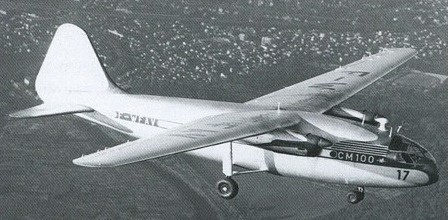
The Castel-Mauboussin CM.10 transport glider was built for French military forces, also the CM.100 powered version with two Renault engines. In the latter CM-101R Renault engines were augmented by two Turbomeca Pimene turbojets.

CM.10 — 1947 wooden assault glider, 35 troops, 26.96 m span, 2 prototypes
CM.10: Fouga-built glider prototypes evaluated by Armée de terre, 1947
Prod. order for 25 (SNCAN-built) cancelled after crash of CM.10 n° 1
CM.100: 1949 powered vers., 2 x Snecma 12S (As 411), 1 built (F-WFAV)
NB: study begun Nov 1944 for Armée but civil vers. envisioned by SGAC
CM.101R: F-WFAV with added wingtip-mounted Turboméca Piméné turbojets
CM.103R: [Project] military CM.101R variant, 2 x Turboméca Marbore turbojets

Fouga C.25S / Castel C.25S

The Castel C.25S, sometimes known as the Aire, is a French training glider, the design, by Robert Castello, began soon after the Franco-German Armistice of June 1940. The C.25S was intended to increase the number of machines available for recreational gliding in the southern, unoccupied region of France.

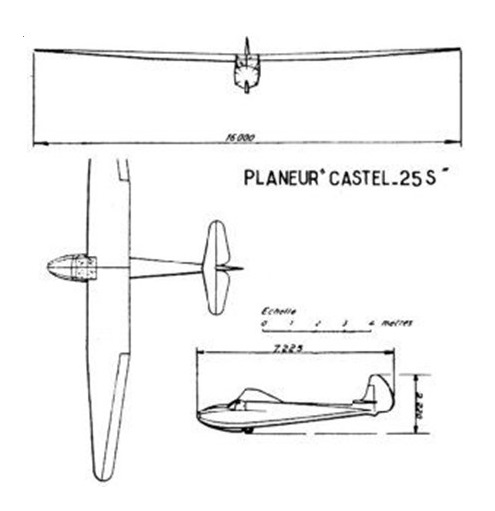
The C.25S is an all wood aircraft with a monocoque fuselage skinned with plywood and fabric covered, wooden framed wings. The cantilever, high mounted, constant dihedral wings have a constant chord inner section, occupying about 40% of the span, and outer, straight tapered panels with rounded wing tips and ailerons filling their trailing edges. Airbrakes are mounted at mid-chord on the inner-outer panel junction, opening above the wings.

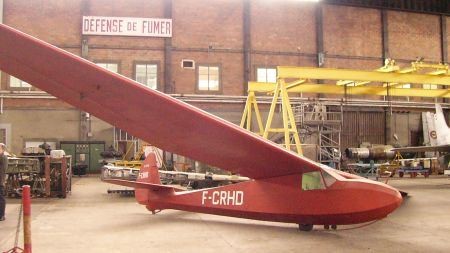
Castel C 25 S 192 F-CRQF

The fuselage has parallel, flat sides and is polygonal in cross-section, tapering to the tail. The crew are seated beneath the leading edge of the wing in side-by-side seating equipped with dual control, enclosed by a canopy which is hinged at the leading edge of the wing. The C.23S has a narrow fin with a shallow forward extension that mounts the tapered tailplane clear of the fuselage. Its rudder is horn balanced, has a curved trailing edge and extends down to the keel, requiring a cut-out between the separate elevators for its movement. The C.25S has a fixed monowheel undercarriage, assisted by a forward mounted main skid and small tailskid.

The first two prototypes of the C.25S both flew in 1942. 100 C.25S were ordered by the French Air Ministry to assist the post-war revival of aviation in France. These were built in Fouga’s factory at Aire-sur-Adour between 1945 and 1948 and delivered to French gliding clubs.

Significantly more may have been built; some sources say that another 30 were built during the war and others asserts a total of 200 were built. The C.25Ss with the Caudron C.800s provided the backbone of the French glider basic training fleet until the arrival of the Wassmer WA 30 Bijave in the early 1960s.

The C.25S proved to be a successful long distance flyer, setting several records in the early 1950s.

  • 05/09/1953, France record away with fixed goal, La Ferte – Cognac or 370 km, crew and LEPANSE ROBOAM,
  • 05/12/1953, France record away and return with goal set La Ferte – Blois is 250 km, and crew LEPANSE DICICO,
  • 04/16/1954, record feminine France free distance, La Ferte – Niort is 322 km, crew ABADIE and CARPENTER,
  • 18/04/1954, women’s world record away and go back to La Ferte – Blois 251 km, crew ABADIE and CARPENTER,
  • 04/17/1955, women’s record away free, Beynes – Mirambeau 445 km per crew and Marcelle CHOISNET Nadette of Abelenda (to … 3 km world record).

A pair of C.25S had a role in one of the most commercially successful French films, the 1966 comedy La Grande Vadrouille.

Castel C 25 S 192 F-CRQF

About a dozen examples of the C 25S were still on the French civil register in 1979. Five remained on the French civil aircraft register in 2010.

Gallery

Specifications
Length: 7.23 m (23 ft 9 in)
Wingspan: 16.0 m (52 ft 6 in)
Height: 2.22 m (7 ft 3 in)
Wing area: 20.0 sq.m (215 sq ft)
Aspect ratio: 12.8
Profile at the root: Gö 535
Profile at the end: NACA 23010
Dihedral: 1 ° 30
Empty weight: 261 kg (575 lb)
Gross weight: 441 kg (972 lb)
Never exceed speed: 140 km/h (87 mph; 76 kn)
Rough air speed max: 90 km/h (55.9 mph; 48.6 kn)
Aerotow speed: 100 km/h (62.1 mph; 54.0 kn)
Maximum glide ratio: about 25 at 67–69 km/h (41.6–42.9 mph; 36.2–37.3 kn)
Rate of sink: 0.73 m/s (144 ft/min) minimum, at 62 km/h (38.5 mph; 33.5 kn)
Rate of sink: 2 m / s at 65 – 100 km / h
Wing loading: 22.0 kg/sq.m (4.5 lb/sq ft)
Crew: Two

Fouga

Fouga et Cie
Air Fouga
Potez Air Fouga

Fouga’s aircraft department formed 1936, subsequently building designs of M. Pierre Mauboussin who, with M. Castello, developed Castel-Mauboussin gliders and sailplanes. Operated postwar as Etablissements Fouga et Cie, becoming Air Fouga September 1956 when company was taken over, in equal shares, by Breguet, Dassault, Morane-Saulnier, Sud Est and Ouest Aviation.
Acquired by Henry Potez May 1958, renamed Potez Air Fouga. Early activities included production of Mauboussin 123 trainer, Castel C.25S, C.30S, and C.300S gliders. Castel- Mauboussin CM.10 transport glider built for French military forces, also CM.100 powered version with two Renault engines. In the latter CM-101R Renault engines augmented by two Turbomeca Pimene turbojets. Experience with CM.8-R.9 Cyclipe and with the Gemeaux led to development of the CM.170R Magister jet trainer, first flown 23 July 1952 and subsequently built in quantity for French Air Force and overseas customers.
The company operated as Potez Air Fouga until September 23,1961, when it was completely absorbed into Etablissements Henry Potez SARL. Continued development of CM.170 Magister and CM.175 Zephyr naval version, which were first flown as production aircraft on May 30,1959.

Fokker FG.II

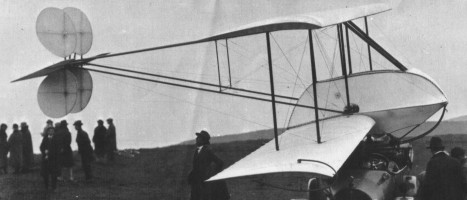
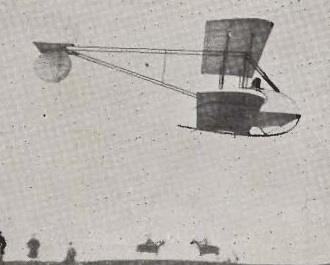
Fokker made the headlines in August 1922 when he participated in the Rhon gliding competition with his FG.1 and FG.II, single and two seat gliders. At the start he made a few modest hops, but it soon became obvious that this type of flying was no problem to him either. With the FG.II he made the first passenger carrying glider flight in the world.

Pilot G.P.Olley

Seats: 2