Around 1942 Bowlus began work on a twin boom flying-wing glider for military transport work. In order to test his design he began work on a half-scale proof-of-concept flying model, forming the Airborne Transport Company in Los Angeles, California for the purpose.
Construction of the test model was carried out in his tiny shop, a former dry cleaning shop where there was just sufficient room to build the two-seat open-cockpit prototype. On completion, the glider was flown at Muroc Dry Lake, now the sight of Edwards AFB. The glider flew well and Bowlus and partner Albert Criz set about designing, building and marketing the full-size glider, the XCG-16.
Glider
General Airbourne Transport Co / Bowlus XCG-7 / XCG-8
Early in 1942 Bowlus was awarded a contract by the USAAF for two troop gliders – the eight-place XCG-7 and the 15-place XCG-8. The smaller glider was structurally unsound and failed official tests. The larger XCG-8 was really too large for Bowlus to handle and Douglas Aircraft came to the rescue. But this glider, too, failed to come up to scratch structurally; and both projects came to nothing.
Gehrlein GP-1
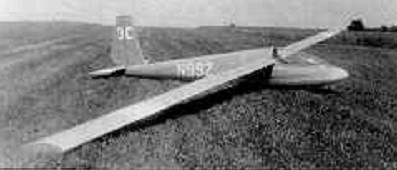
The GP-1, which first flew in 1968, was designed by Jay and Rod Gehrlein as a simple kit-built sailplane. The all metal ship features a constant-chord (76 cm/ 30 in) wing with scissors-type airbrakes.
Wing span: 15m / 49.2ft
Wing area: 11.5sq.m / 120sq.ft
Empty Weight: 208kg / 458lb
Payload: 92kg / 204lb
Gross Weight: 300kg / 662lb
Wing Load: 26.91kg/sq.m / 5.5lb/sq.ft
Aspect ratio: 20
L/DMax: 35 @ 97 kph / 52 kt / 60 mph
Airfoil: Wortmann FX-61-184
MinSink: 0.61 m/s / 2.0 fps / 1.18 kt
No. of Seats: 1
Structure: all metal
No. Built: 5
Gardner Cumulus
A single-seat light-wind sailplane designed and built by L. Gardner at Dunstable, Bedfordshire, in 1949. Conventional wooden construction but very lightly built as it was designed to soar in light winds only.
It resembled the R.F.D. 2 sailplane but with angular fuselage nose and tail surfaces.
The one test-flight was carried out in ‘rather a strong wind’ by Mr Gardner, but the Cumulus was blown into the top of the Dunstable Downs and was wrecked.
Gabriel Bros
Poland
Brothers Paweł and Jan Gabriel from Bydgoszcz began building gliders already before World War One. In 1921 they built diminutive plane P.V (wingspan: 5 m, length: 4 m) inspired by Fokker E.V, first flown in 1921. Encouraged by its good quality designed several larger aircraft, largely inspired by Fokker D.VII. Of these only one, P.VI was actually built and flown in 1924. Although very good plane, it unfortunately didn’t get any orders, leading brother to lose interest in aviation.
Funk FK-3 / VFW-Fokker FK-3
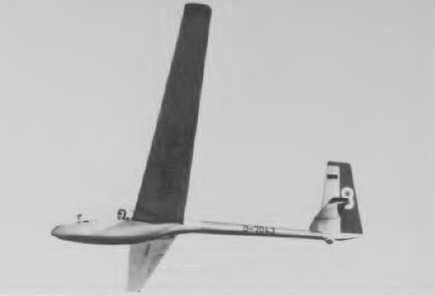
Designed by Dipl-lng Otto Funk especially for weak thermal conditions, the FK-3 is distinguished by a pod-and-boom fuselage and a very tall fin and rudder. The cantilever shoulder wings have a thickness/chord ratio of 15.3% and are of an unusual metal and foamed honeycomb construction, bending loads being carried by a single metal spar which tapers from a T-section to a U profile, and drag and torsion loads being carried by a light alloy nose spar which transmits these loads to the fuselage fittings. The wing ribs are of light alloy and plastic foam sandwich construction, spaced at intervals of approximately 4ft 7in, and supporting a 0.5mm thick light alloy skin. Between the ribs a foamed honeycomb known as Conticell 60 gives additional support to protect the skin from minor damage, and the overall wing finish is very smooth. The camber-changing flaps are divided into inner and outer sections and Schempp-Hirth air brakes are fitted. Up to 110lb of water ballast can be carried if desired in two rubber tanks in the wings with the dump valve positioned in the fuselage aft of the retractable monowheel. The fuselage nose section is of steel tube construction covered with a glassfibre-reinforced shell, and the tail boom, of small cross section, is built of riveted light metal sheet without frames or stringers, the lower part incorporating a rubbing strip to minimise damage in a rough landing. The tail unit is similar in construction to the wings, the rudder being fabric covered. The monowheel is manually-retracted and has a drum brake; there is also a tailwheel. The pilot sits in a semi-reclining position on an adjustable seat and has adjustable rudder pedals; the long onepiece Plexiglas canopy is removable, except for a small front portion.
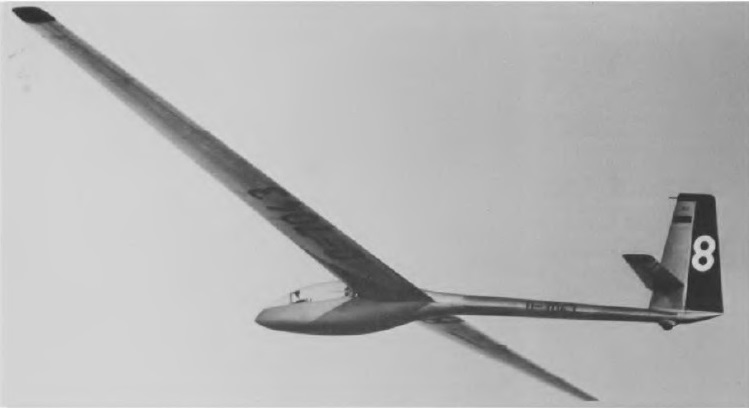
A high performance Open Class single-seater, the prototype was built by apprentices at VFW-Fokker’s Speyer plant in Germany in the course of their regular training.
It first flew on 24 April 1968 and production started in January 1969, soon building up to a rate of three or four per month. In its first competition, flown by Dr Rolf Spa’nig, the prototype won the Open Class in the 1968 Italian Championships, and two FK-3s later gained first and second places in the Austrian Championships.
FK-3
Span: 17.4m / 57 ft 1 in
Wing area: 13.8 sq.m / 148.54 sq ft
Length: 7.2 m / 23 ft 7.5 in
Empty Weight: 260 kg / 529 lb
Height over tailplane: 5 ft 11 in
Gross Weight: 400 kg / 882 lb
Water ballast: 50 kg / 110 lb
Wing Load: 29.0 kg/sq.m / 5.94 lb/sq ft
Max speed: 168 mph / 146 kt / 270 km/h
Max aero-tow speed: 87 mph
Max rough air speed: 146 kt / 270 km/h
Stalling speed: 27-30 kt / 50-55 km/h
MinSink: 0.50 m/s / 1.64 ft/sec at 34.5 kt / 64 kph / 40 mph
L/DMax: 42 at 47.5 kt / 88 kph / 55 mph
Aspect ratio: 21.9
Airfoil: Wortmann FX 61-K-153
Seats: 1
No. Built: 11
Frankfort Cinema II / Cinema B / TG-1
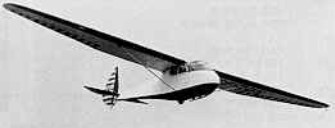
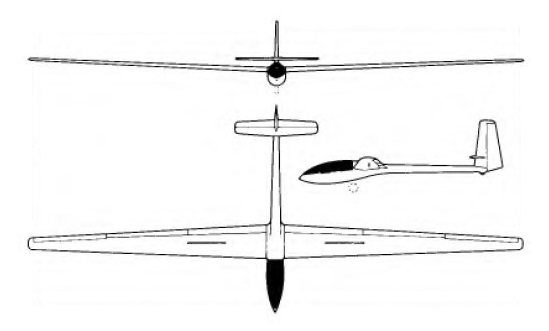
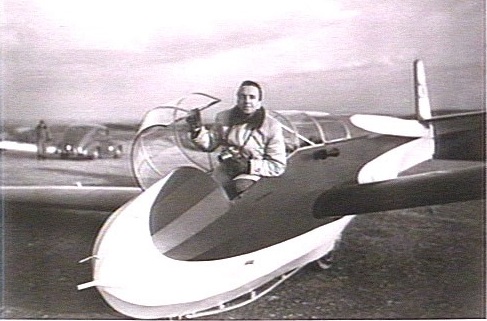
Designed by Stanley Corcoran, the two-place tandem Cinema II was developed in 1940 from the single-place Cinema I. The Cinema has wood/fabric wings and tail, steel-tube/fabric fuselage, and I-strut braced wings. Original versions had small, all-moving tails but the military TG-1A’s had conventional tails. The few civilian models, also known as Cinema B’s, became TG-1B’s, C’s, or D’s, largely dependent on when they were acquired.
Sixty-two were built.
One TG-1A was donated to the Smithsonian Air & Space Museum. The Vintage Sailplane Association has copies of the military manuals, drawings of the military paint scheme and colour chips available.
Cinema II
Wing span: 14.1m / 46.27ft
Wing area: 18.05sq.m / 194.3sq.ft
Empty Weight: 227kg / 500lb
Payload: 190kg / 420lb
Gross Weight: 417kg / 920lb
Wing Load: 23.1kg/sq.m / 4.7lb/sq.ft
Water Ballast: 0
Airfoil: Go 549
Aspect ratio: 10.7
L/DMax: 20
MinSink: 0.97 m/s / 3.2 fps / 1.90 kt
Seats: 2
Frankfort Cinema I
Franklin PS-2 / Taxaco Eaglet
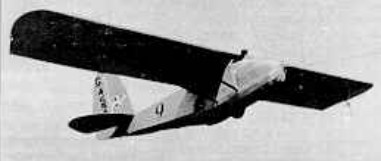
The Franklin PS-2 of the 1930’s won three of the first four U.S. Championships. It gave a start in soaring to notables such as Richard du pont, Warren Eaton, Floyd Sweet, Stan Smith and many others. The designation PS-2 was coined for the intended function of the glider, a primary and a secondary too. The ship has no spoilers, wood/fabric wings, and a steel-tube/fabric fuselage. Several cross-country tow experiments were made with the ship.
The long-wing prototype, the Taxaco Eaglet was towed from California to Elmira by Frank Hawks in 1931. That ship is now at the Smithsonian Air & Space Museum.
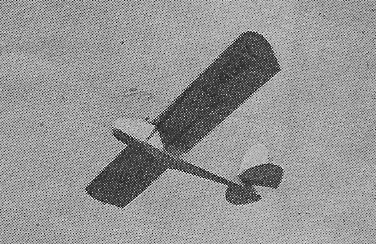
The 1934 Lustig Skytrain experiment had Jack O’Meara, R.E. Franklin and Stan Smith towed nose to tail behind a towplane, starting in New York, dropping a glider in Philadelphia one in Baltimore and ending in Washington.
In a more normal application, Ralph Barnaby directed a U.S. Navy primary flight training experiment in Pensacola, FL using PS-2’s in 1934.
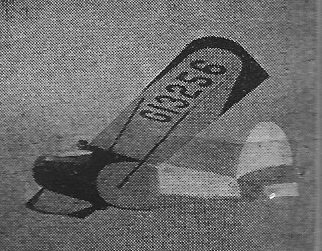
The National Soaring Museum has two examples and another (the last of the 6 acquired for the U.S. Navy experiment) belongs to the National Museum of Naval Aviation at Pensacola, FL.
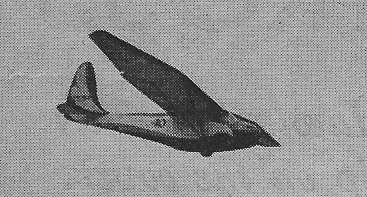
Wing span: 10.98m / 36ft
Wing area: 6.72sq.m / 180sq.ft
Empty Weight: 100kg / 220lb
Payload: 82kg / 180lb
Gross Weight: 182kg / 400lb
Wing Load: 10.88kg/sq.m / 2.2lb/sq.ft
Water Ballast: 0
L/DMax: 15
MinSink: 0.76 m/s / 2.5 fps / 1.48 kt
No. of Seats: 1
Aspect ratio: 7.2
Franke and Erhard Doppel-Eindecker
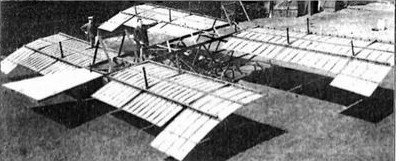
A big tandem monoplane glider, weighing 250 kg and with a wing area of 40 sq.m. It was tested at the Pfaffendorfer Weise outside Halle in 1911, towed by a 20 hp automobile. It would take off at a speed of 25 km/h. During a following flight the towing rope broke and the plane crashed to the ground when it lost speed, breaking all upper rigging wires. After the crash it was abandoned because the two young men could not raise enough money to repair it.
 All Aero