Designed and built by B. de Lagarde of GEPAS – Groupe d’Etudes Pour I’Aviation Sportive – the Compact is a homebuilt single-seater of conventional modern appearance and glassfibre construction, and the prototype was due to make its first flight in May 1978. This cantilever mid wing monoplane is built of glassfibre and epoxy resin, with a non-retractable monowheel and flaps that also act as air brakes. The tailplane is low-set and the pilot sits under a one piece flush fitting cockpit canopy.
Span: 42 ft 0 in Length: 19 ft 8.25 in Wing area: 102.3 sqft Aspect ratio: 17.2 Max weight :586 lb Best glide ratio: 31:1
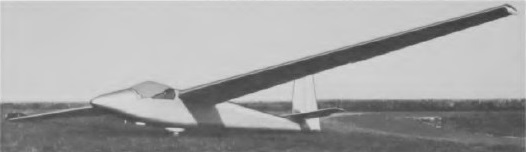
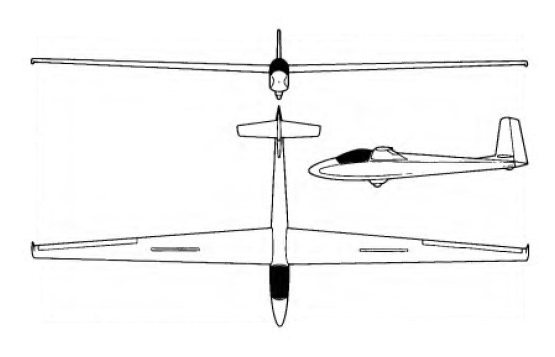
The TCV-03 is a Standard Class single-seater designed by Dr Pierre Vaysse, head of the sailplane amateur construction department of the Federation Francaise de Vol a Voile – FFVV, and it was built by the Groupe d’Etudes Georges Payre – GEP.
The Trucavaysse started as a redesigned version of the Breguet 905 Fauvette to make it suitable for amateur construction, but with a new, more slender fuselage and a conventional tail instead of the Fauvette’s V-tail, it evolved into a new type bearing little resemblance to the Breguet design; other changes include recovered wings with an improved control system and reinforced trailing edges, and the removal of the landing skid.
Design work began in October 1968 and prototype construction started in the following February, the prototype, which was actually built by the Aero Club de Norois, making its first flight on 14 July 1973.
The single spar cantilever shoulder wings have plywood/Klegecel sandwich leading edges and slotted wooden ailerons; there are DFS metal airbrakes on both upper and lower surfaces but no flaps. The wooden fuselage is plywood-covered, and the wooden tail unit has a low set one-piece all-moving tailplane with anti-tabs. There is a fixed monowheel and a tailskid utilising rubber shock absorbers.
The type is sold in kit form for amateur or club construction, and several have been built by amateur constructors.
Under development in 1977, the TCV-04 is basically a modified TCV-03 fuselage and tail unit, with a longer one-piece cockpit canopy and small dorsal fin, married to the wings of a Siren C-30 Edelweiss mounted in the shoulder position, thus following Dr Vaysse’s design philosophy of utilising components of existing designs.
TCV-03 Span: 15.0 m / 49 ft 2.5 in Length: 6.7 m / 21 ft 11.75 in Height: 1.8 m / 5 ft 11 in Wing area: 11.25 sq.m / 121.1 sqft Wing section: NACA 63-420/513 Aspect ratio: 20.0 Empty weight: 192 kg / 423 lb Max weight: 302 kg / 665 lb Water ballast: None Max wing loading: 26.9 kg/sq.m / 5.51 lb/sq ft Max speed: 130 mph / 113 kt / 210 km/h (in smooth air) Max rough air speed: 81 kt / 150 km/h Stalling speed: 27 kt / 50 km/h Min sinking speed: 0.8 m/sec / 2.62 ft/sec at 37.5 mph / 32.5 kt / 60 km/h Best glide ratio: 28:1 at 50 mph / 43 kt / 80 km/h
Long Island, New York, USA The company was established at Lowell, Massachusetts to build an aircraft designed by Doctor Otto C. Koppen, a professor of aeronautics from the Massachusetts Institute of Technology. The aircraft was the G1-80 Skyfarer, a two-seat cabin high-wing braced monoplane.
Before the company could produce the aircraft in any numbers the Second World War intervened, and the Skyfarer programme was abandoned after 17 examples had been built. Situated on Long Island, New York, the company became a manufacturer of the Waco CG-4A troop glider and the interests in the Wayfarer were sold to Grand Rapids Industries in 1943.
In 1969, the company bought the Helio Aircraft Company which specialised in building STOL aircraft for use by government agencies in south east Asia. The company ceased to manufacture aircraft in October 1976 when it sold the production rights and assets of its Helio Aircraft division.
The fourth glider in the GAL.56 research series was built as the GAL.61. The GAL.61 placed the pilot in a blister on the pot side whilst the observer was in a prone position on the starboard side with a window in the wing leading edge.
The glider was of all wooden construction. No fins or rudders were fitted, directional control being by drag rudders in the wingtips. The wing was symmetrical with cusped trailing edge. Split trailing edge flaps of 20% chord were hydraulically operated.
The undercarriage was hydraulically operated retractable tricycle.
Wingspan: 15.84 m / 51 ft 11.5 in Overall length: 7.53 m / 24 ft 8.3 in Aspect ratio: 5.94 Wing area: 41.8 sq.m / 450 sq.ft Empty weight: 1972 kg / 4348 lb AUW: 2350 kg / 5174 lb Mean sweepback: 35 degrees Max speed: 322 kph / 200 mph Towing speed: 242 kph / 150 mph
A series of tailless research gliders built by General Aircraft Ltd, having differing plan forms with various degrees of sweepback. Designed from 1943 to 1947 three were built under the designation of G.A.L. 56 having a common fuselage nacelle built from steel tubing covered with wooden formers and plywood.
The wings were of wooden construction covered with sheets of low-grade wood interspread with processed paper. On flight trials the gliders were towed by a Spitfire Mk.9.
Flight tests commenced in mid-November 1944.
The GAL.56/02 Medium U was as the GAL.56/01 but with small parallel centre section.
The GAL.56/03 Maximum V was as the GAL.56/01 but with 36.40 degrees sweepback.
The fourth glider in the series was built as the GAL.61.
G.A.L. 56/01 Medium V Wingspan: 13.92 m / 45 ft 4 in Overall length: 5.69 m / 18 ft 8 in Wing area: 32.51 sq.m / 350 sq.ft Aspect ratio: 5.8 Wing section: RAF 34 modified Sweepback: 28.4 deg at 25% chord Pneumatically operated trailing edge flaps Empty weight: 1472 kg / 3244 lb AUW: 2000 kg / 4400 lb Wing loading: 61.37 kg/sq.m / 12.57 lb/sq.ft Max tow speed: 241 kph / 150 mph Max dive speed: 322 kph / 200 mph Stall: 93 kph / 58 mph
GAL.56/02 Medium U Wingspan: 15.5 m / 51 ft 0 in Length: 6.4 m / 21 ft 0 in Wing area: 41.80 sq.m / 450 sq.ft AUW: 2540 kg / 5600 lb
GAL.56/03 Maximum V Wingspan: 13.82 m / 45 ft 4 in Overall length: 7.16m / 23 ft 6 in Sweepback: 36.40 degrees AUW: 2268 kg / 5000 lb
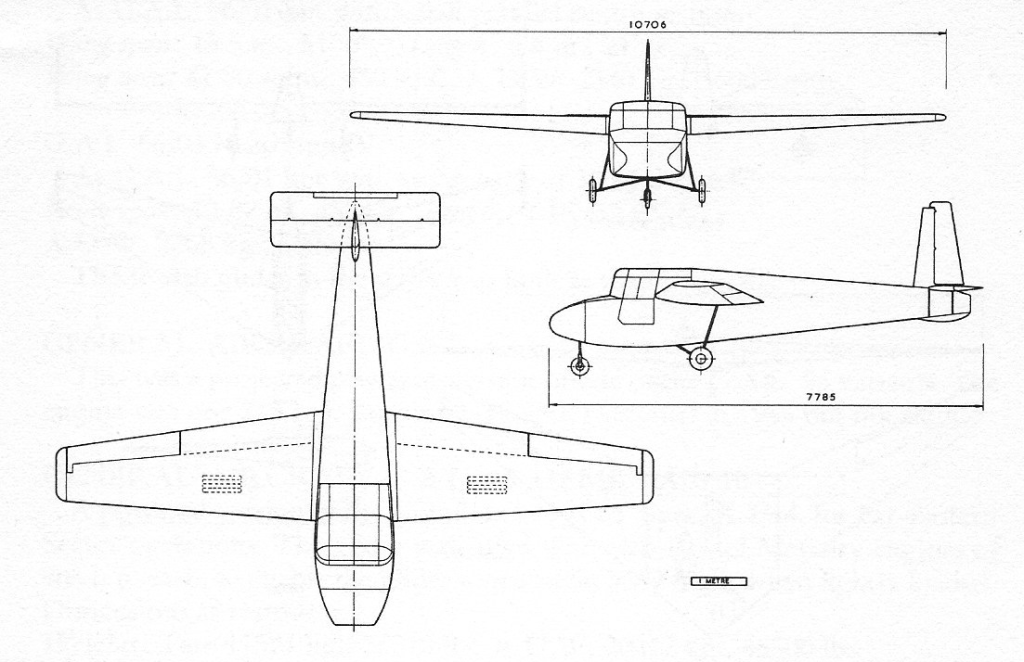
The General Aircraft GAL.55 was a two-seat training glider designed and built by General Aircraft Ltd to AM Spec TX.3/43 to train transport glider pilots.
Wings were built from spruce and plywood, the fuselage being made out of steel tubes faired with wooden formers and fabric covered.
Side-by-side seating with amber panels for daytime night flying.
The undercarriage was tricycle, of fixed centres, plus tail bumper. Dive brakes were fitted, plus bellows-operated split tailing edge flaps.
The first flights wee around the end of 1943, a Westland Lysander being used for towing.
Wingspan: 10.71 m / 35 ft 1.5 in Length: 7.79 m / 25 ft 6.5 in Wing area: 16.74 sq.m / 182 sq.ft Aspect ratio: 6.8 Empty weight: 747.4 kg / 1650 lb AUW: 1066 kg / 2350 lb Max speed: 362 kph / 225 mph Max tow speed: 282 kph / 175 mph Stall: 100 kph / 62 mph flaps up / 87 kph / 54 mph flaps down
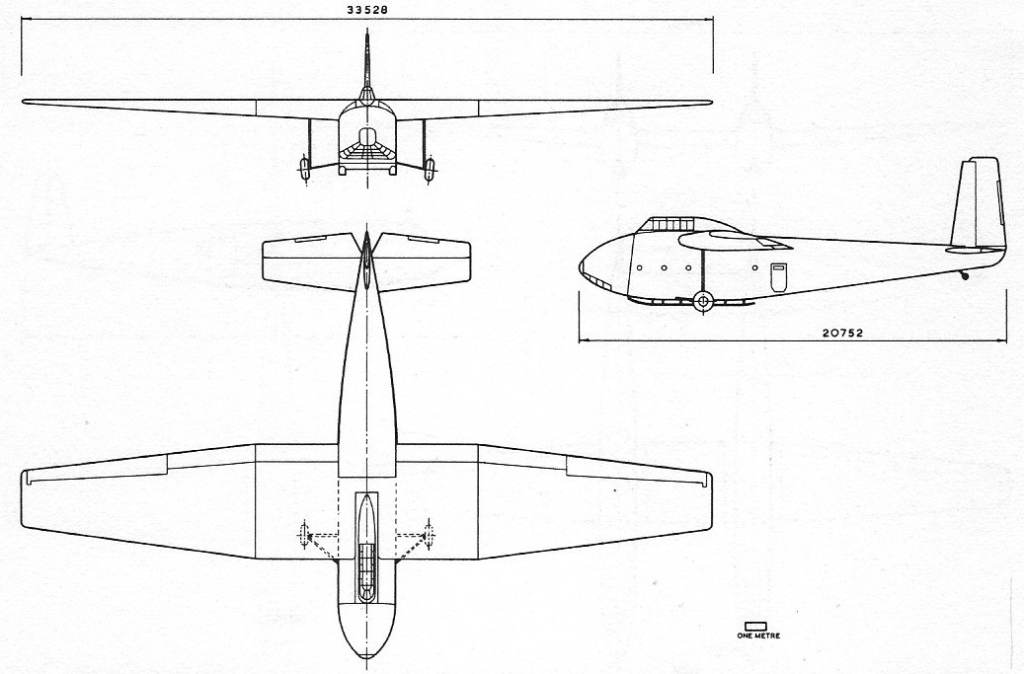
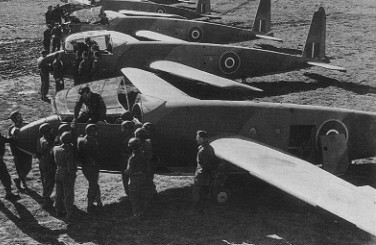
The General Aircraft GAL 49 Hamilcar 1 was a large transport glider of wooden construction, designed to A.M. Spec. X.27/40 to carry a crew of two and either 60 troops or a flight 7-ton tank.
A hinged nose section was fitted for loading. The undercarriage was jettisonable mainwheels and two steel sprung main skids. Trailing edge flaps were fitted.
They were built by General Aircraft Ltd and various sub-contractors. The first flight of the prototype was on 27 Mach 1942.
Variation General Aircraft GAL.58 Hamilcar
Wing span: 110.007 ft / 33.53 m Wing area: 1657.441 sq.ft / 153.980 sq.m Length: 68.012 ft / 20.73 m Height: 20.243 ft / 6.17 m Max take off weight: 36005.4 lb / 16329.0 kg Weight empty: 18402.9 lb / 8346.0 kg Aspect ratio: 7.3 Wing section: RAF 34 modified Max. speed: 130 kts / 241 kph Max tow speed: 241 kph / 150 mph Stall: 104 kph / 65 mph Landing speed: 57 kts / 105 kph Wing load: 21.73 lb/sq.ft / 106.0 kg/sq.m Crew: 1
The General Aircraft GAL 48 Hotspur I was an eight-seat troop carrying glider of all wood construction designed to Air Ministry Specification X.10/40 and built by General Aircraft and Slingsby Sailplanes in 1941.
The prototype first flew in 1941.
The General Aircraft Hotspur 8 seat assault training glider was first intended to be released at 20,000ft for long gliding missions, but 16ft was lopped off the span and it was used for training as the Hotspur 2.
The GAL.48 Hotspur 2 were built by Harris Lebus and other sub-contractors, in 1941.
The GAL.48 Hotspur 3 were Hotspur 2 fitted with dual controls.
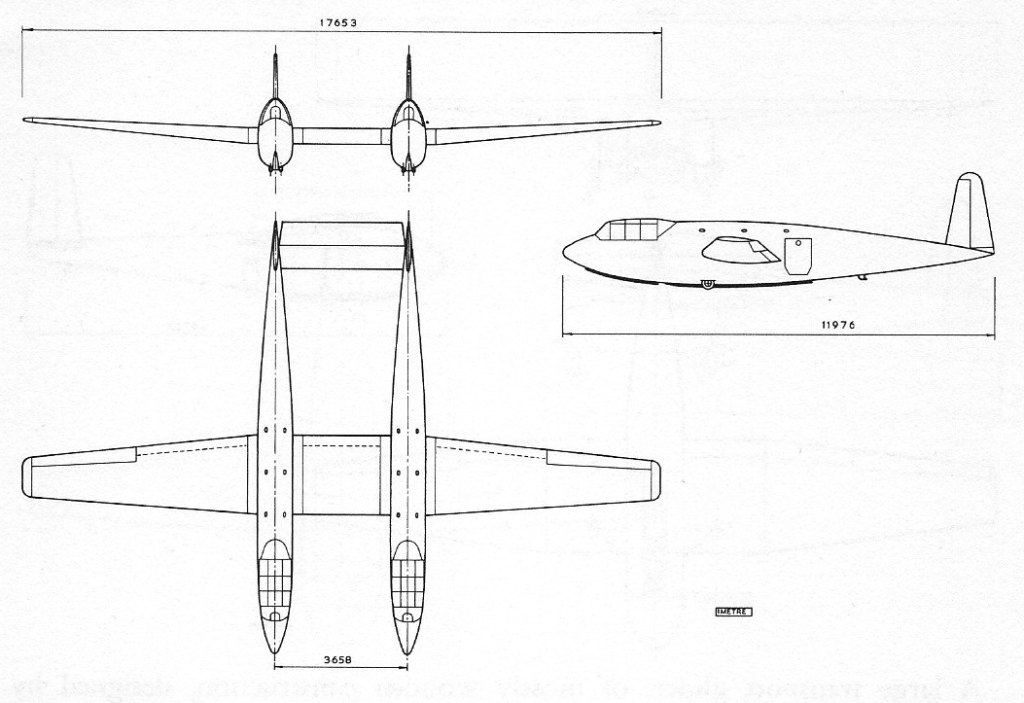
The GAL.48B Twin Hotspur was a sixteen-seat troop transport glider built by General Aircraft Ltd in 1942. It was two Hotspur 2 fuselages joined together with a short centre wing. The first flight of the prototype was in August 1942. It was flown from the port fuselage, there being no controls in the starboard cockpit.
General Aircraft GAL 48 Hotspur Training glider, United Kingdom, 1940 Length: 39.304 ft / 11.98 m Height: 10.827 ft / 3.3 m Wing span: 61.909 ft / 18.87 m Wing area: 272.006 sq.ft / 25.27 sq.m Max take off weight: 3598.6 lb / 1632.0 kg Weight empty: 1660.4 lb / 753.0 kg Max. speed: 113 kts / 209 kph Landing speed: 49 kts / 90 kph Cruising speed: 78 kts / 145 kph Cruising altitude: 20013 ft / 6100 m Wing loading: 13.33 lb/sq.ft / 65.0 kg/sq.m Range: 72 nm / 134 km Crew: 8
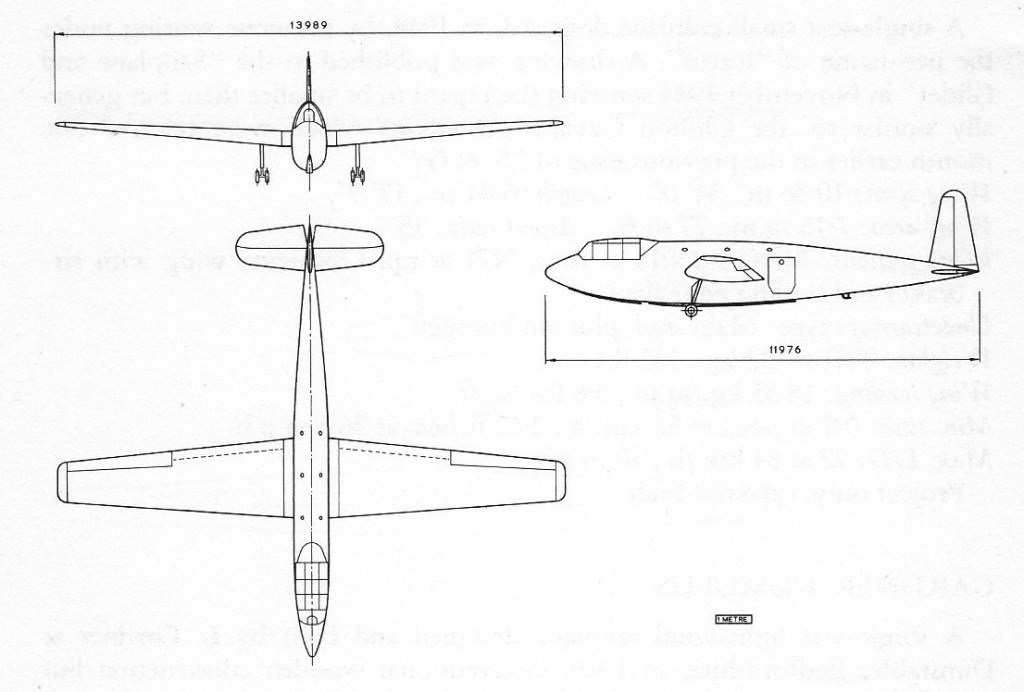
GAL 48 Hotspur 2 Wing span: 13.99 m / 45 ft 10.75 in Length: 11.98 m / 39 ft 3.5 in Wing area: 25.04 sq.m / 272 sq.ft Aspect ratio: 7.7 Empty weight: 753.4 kg / 1661 lb AUW: 1632 kg / 3598 lb Wing loading: 71.77 kg/sq.m / 14.7 lb/sq.ft Max speed: 273 kph / 170 mph Normal glide: 129 kph / 80 mph
GAL.48B Twin Hotspur Wingspan: 17.65 m / 57 ft 11 in Length: 11.98 m / 39 ft 3.5 in Wing area: 33.9 sq.m / 365 sq.ft Aspect ratio: 9.25 Empty weight: 1456 kg / 3210 lb AUW: 2925.7 kg / 6450 lb Max speed: 249 kph / 155 mph Stall: 105 kph / 65 mph
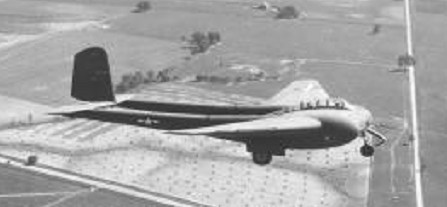
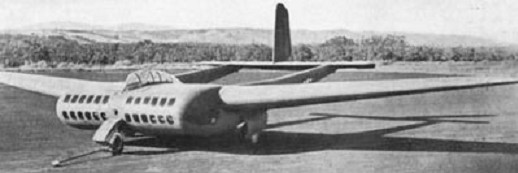
William Hawley Bowlus, a sailplane and glider manufacturer, designed a flying wing glider, the MC-1 in February 1942. Its design was a departure from single fuselage designs and incorporated a twin boom design. The MC-1 was an all-wood twin boom military transport glider of 91ft 10in span, featuring an aerofoil-sectioned lifting fuselage between the booms in which either cargo or troops could be carried in two 16ft x 7ft compartments. The load could be four tons of cargo or 48 armed troops. The front of the wing opened upwards and downwards like a pair of jaws, the bottom doors doubling as a loading ramp. A mock-up of the troop accommodation shows that the compartment tapered towards the trailing edge, allowing little headroom for those unfortunates at the back. The crew of two sat in tandem beneath a continuous canopy atop the centre section.
A single fin and rudder was mounted on the tailplane between the booms. The tricycle landing gear was retractable, and flaps were fitted to the outer wing panels and the fuselage centre section. The MC-1 was constructed mainly of plywood, although all flying surfaces and flaps were fabric-covered. Early test flights of a full scale model proved disastrous when unsecured weighted bags shifted causing it to become unbalanced and killing the pilot and several passengers. Hawley’s General Airbourne Transport Company received a contract in November 1943 to build the glider. The first glider was delivered six months late at three times the cost in the summer of 1943. The MC-1 was test flown by the company and Richard duPont was the instigator of a demonstration for the military on September 11, 1943 from March Field. The pilot of the glider was Col P. E. Gable, deputy director of the Army Air Corps assault glider program. The copilot was Howard Morrison, a long time associate of Bowlus and a test pilot. Several VIPs set off on the flight. They included Richard Dupont, special assistant to Gen Arnold; Col Ernest Gabel, another glider specialist on the staff of the Chief of Staff of the Air Force, and C. C. Chandler, thrice soaring champion. In order to bring the glider up to more-or-less full load, bags of sand and lead shot were loaded aboard but apparently were in securely lashed some reports say they were not lashed to the glider at all. The glider was towed off from March Field by a Lockheed C-60. During turbulence the bags shifted aft and set up a porpoising moment. The tow release did not release at first pull but released on the third porpoise of the MC-1. It released from the glider. The glider entered a flat spin from which it failed to recover. Three managed to take to their parachutes but the other occupants, including Dupont, perished. Only one survived the jump. One report says that Gable had less than 6 hours total time on gliders and allowed the XCG-16 to fly into the wake of the C-60, causing the glidcr to pitch violently and breaking the cable. The ballast shifted aft, and the glider entered the flat spin.
Despite this tragic occurrence the company persevered with a further XCG-16, albeit six months late and costing three times the estimate. It was tested at Clinton Army Air Field and at Orlando, Florida. This is probably the aircraft tested by GAT test pilot Paul E. Tuntland and Northrop test pilot J. Meyers together with army officers from the glider branch at Dayton Ohio. Total flying time for the tests was 34 hours, including 50 landings made under Service operating conditions. Once the factory flight tests on the XCG-16 were completed, glider pilots at CCAAF flew the XCG-16 on over 70 flights in October of 1944 before the glider was rejected. In his pilot’s test report summary, Tuntland had this to say about the handling of the XCG-16: “In my opinion the XCG-16 has excellent handling qualities. During the flight tests I had the impression of flying a large sail plane. It is laterally stable in that it has a tendency to over-bank in steep spirals. I always had good lateral control at the slower airspeeds and higher angles of attack. Longitudinal control was normal with high elevator forces noted at increased airspeeds. “Directional control was good throughout the normal speed range. There was sufficient vertical area in the tail group to maintain good directional control throughout the approach and landing roll, even in moderate crosswinds. There was no tendency to yaw before or during the landing roll except in a crosswind, where normal correction was satisfactory. The subject aircraft is very maneuverable, being capable of rolling from one vertical turn to another in a minimum of time. On one occasion I was able to soar the aircraft in moderate lift conditions. Stalling characteristics are excellent. The first stall warning is indicated about 15 m.p.h. above actual stalling speed. This aircraft made normal landings at between 40 and 75 m.p.h. with the average about 48 m.p.h. A minimum of longitudinal trimming control was necessary in a c.g. shift from 24 per cent MAC to 36 per cent MAC. Normal landings were made with the flaps retracted at approximately 70 m.p.h. “The copilot’s lateral vision is rather poor from the rear cockpit. The pilot’s front cockpit vision is excellent forward, and good towards the sides. “The ground cushioning effect is very noticeable and is a desirable feature of the type, assisting soft ground contact from a rough approach. “Any glider of either tricycle or conventional landing gear that has sufficient vertical tail surfaces for directional stability will tend to turn into the wind during crosswind landings at high or low angles of attack. In this respect the XCG-16 glider has absolutely no objectionable qualities compared to any other aircraft with which I have had experience. The tendency to turn could be readily corrected by the action of the rudder and of the brakes at slow speeds.” The report is dated October 31, 1944. Despite the favorable flying qualities of the XCG-16 there were a number of operational snags; rather too many, as it turned out. These included: inadequate protection in the event of a crash; insufficient exits for crew in the event of an emergency; unsatisfactory loading ramps; poor location of flight equipment, and critical lateral loading. After tests by the AAF Board at Clinton Army Air Field and at Orlando, the contract for the XCG-16 was cancelled on November 30, 1944.
Span: 91 ft 10 in. Length: 48 ft 4 in Height: 18 ft 4 in. Aspect ratio:7.4:1 All up weight: 19,580 lb. Empty weight: 9,500 lb Cargo: 10,080 lb. Max speed: 220 mph Stall speed flaps down: 58 mph Stall speed flaps up: 62 mph


 All Aero