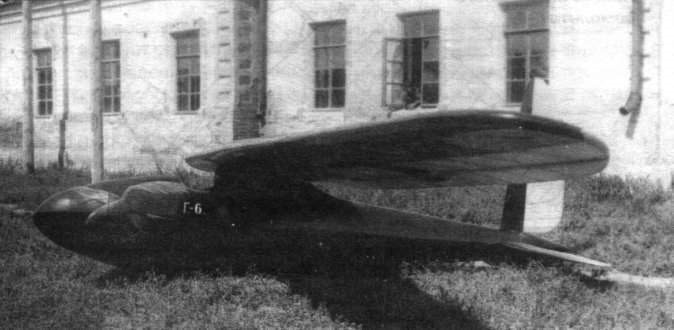
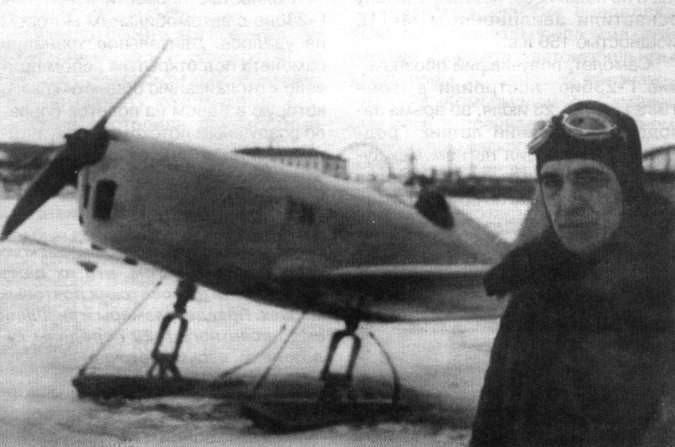
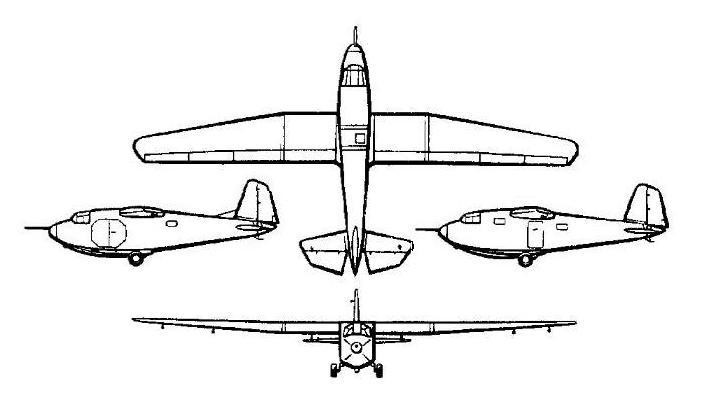
The Gribovski G-6 (Russian: Грибовский Г-6) was designed as a record-setting glider taking into account the theoretical principles that established the superiority of the high wing for the glider’s flight conditions.
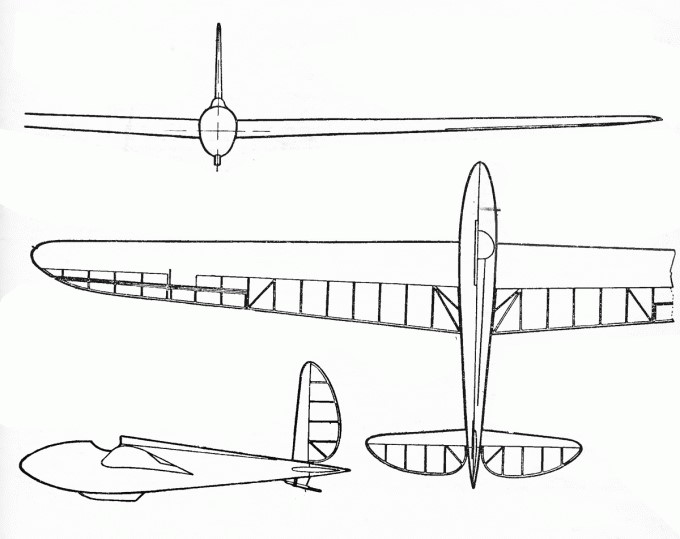
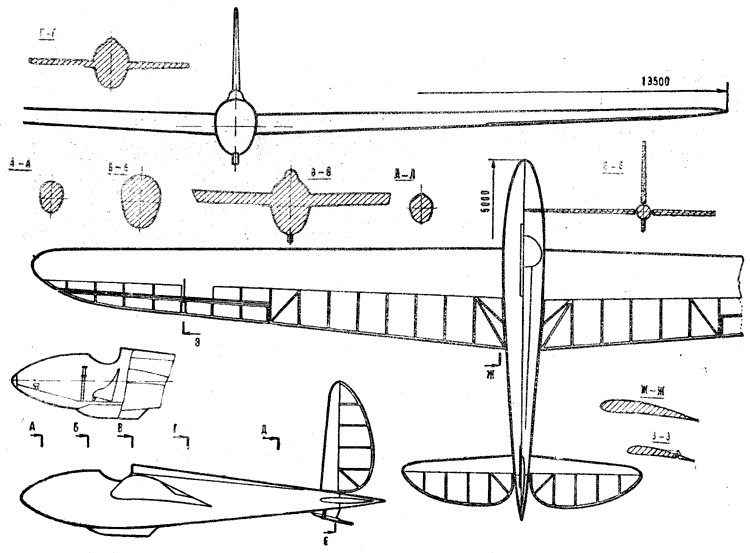
The G-6 was built entirely of wood. The G-6 glider differed from its predecessor G-2 fundamentally in the location of the cantilever wing in a high position behind the cockpit.
Its fuselage was covered with birch planks and featured an oval cross section and landing gear with a central ski.
The tail was of the conventional monoplane type, and maintained the high-rise tail of the G-2 glider.
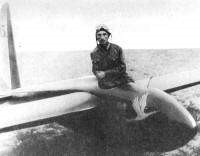
The G-6 glider was painted dark cherry-red and in its bow section, on the left gunwale, an eagle was painted in flight with its wings spread.
The construction of the G-6 was started at the school in Orenburg in the winter of 1928 and by September of that year the glider could be successfully presented to the V National Sailing Competitions. At the end of the competitions, the G-6 was handed over to the Sinferópol Flight School.
A year later, in 1929, the G-6 would participate together with the G-2 and the G-7 in the VI competitions.
Despite showing acceptable results, the new scheme did not report noticeable advantages and for this reason this glider did not have a further development.
After long enough use the G-6 glider was damaged. It is known that its builder kept the piece of coating with the drawing of the eagle among his personal belongings for a long time.
G-6 Wingspan: 13.00 m Wing area: 13.00 m² Length: 5.00 m Horizontal plane surface: 1.6 m² Vertical plane surface: 0.7 m² Spoiler area: 1.4 m² Empty weight: 101 kg Wing loading: 14 kg / m² Glide ratio: 20 Accommodation: 1
In 1926 and almost in parallel with the construction of the G-2 (Russian: Грибовский Г-3) glider, Gribovski would begin the construction of a four-seater transport glider that received the G-3 designation.
Unlike the previous models, the G-3 had a double fuselage composition, in each one of which two crew members or the corresponding load weight were located.
Unfortunately, the idea of transport gliders had not yet been sufficiently valued in the USSR, so the project did not receive the approval of the OSOVIAJIM Technical Committee and for that reason it was not produced.
In 1932 Gribovski would try again to venture into the design of double fuselage transport gliders with the G-11, which was also unsuccessful.
After returning from the competitions in Koktebel in 1925, Gribovski was transferred to serve as an instructor at the Higher School of Aerial Shooting and Bombing known popularly as “Strelba” (Shooting), located in the city of Serpukhov.
Gribovski set to the construction of a new and improved competition glider known as G-2 (Russian: Грибовский Г-2). Like all Gribovski gliders, the G-2 was built entirely in wood and quite simply. The attachment points for the rudders and ailerons were quite simple and the attachments were made with normal screws. In his gliders Gribovski would hardly use welding, mainly due to the lack of a productive base with the necessary equipment.
The G-2 glider differed from its predecessor in its fuselage structure, constructed of birch planks and featuring an oval cross-section and landing gear with a central ski, which innovatively included air-cushioning using a bicycle inner tube.
The large wing was located in the middle position of the fuselage and was designed with the PR-385 wing profile. This wing consisted of two long trapezoidal consoles with rounded ends. Each console consisted of two box-type stringers, made of wood and 16 ribs. The entire forward part of the wing, up to the location of the second spar, was covered in plywood. From there and up to the trailing edge the covering would be made of fabric. This would be a distinctive feature of most of Gribovski’s wing designs. Long louvered ailerons were located on the wing trailing edge.
The tail was of the conventional monoplane type, with a very tall tail. The planes could pivot on their axis integrally, which, according to Gribovski, should facilitate the control of the glider. During the evaluation before the competition, the technical committee expressed doubts regarding the effectiveness of its short horizontal planes. Practice would show that they were unfounded.
The pilot sat in an open cockpit just ahead of the wing leading edge and was protected by a transparent celluloid windshield.
The G-2 glider was built in 1927, first flown that September, and successfully participated in the IV National Sailing Competitions held that year, showing quite good performance. The G-2 was the first Soviet glider capable of harnessing thermals for free flight.
On September 27, taking off in the valley, he managed to reach a good height and fly over the southern slope of the Klementiev Mountains. The flights carried out in the G-2 were noted for their good stability and behavior, which contributed to the popularity that the model would soon achieve. On October 4, flying from Klementiev Mountain, would land beyond the competition staff.
In 1928 the G-2 was the glider that opened the annual event at Koktebel. In these competitions Gribovski, taking advantage of a weak wind, took off from Feodosia and landed after traveling seven kilometers. The next flight on the G-2 ended with a landing over a vineyard, causing the glider to be damaged.
A year later the G-2 would appear again during the VI National Sailing Competitions, this time accompanying the G-6 and G-7 gliders.
Its results in the competitions in Koktebel between 1927 and 1929 were so positive that soon flying clubs throughout the USSR began to build it.
The 31 of October of 1932, during the VIII convocation of skills, the glider G-2, piloted by NG Baruzdin set a national record of a 43.5 km uninterrupted flight.
G-2
The G-2bis appeared in 1930 as an improved development of the G-2. The main changes introduced included a decrease in the sensitivity of the rudders to the controls.
This glider was built by a considerable number of sailing clubs and workshops throughout the country until a date as late as 1935.
Taking into account the popularity acquired by the model, the organization “Snabosoaviajim” developed the set of plans with explanation of the main construction details and assembly forms, which considerably facilitated the construction of the model in workshops and by aviation enthusiasts. The own “Snabosoaviajim”, predecessor of the Factory of Gliders of Túshino, built two copies of the model.
The G-2bis played a very important role in the preparation of the Soviet plane pilots. Despite being a somewhat difficult model to control in flight, it would become the main training glider in its time in the USSR. At the Kacha flight school instructors VA Stepanchonok and MA Nyuxtikov trained Soviet pilots in glide flight using this model.
The G-2bis would be used in the drag take-off tests carried out in Moscow by the pilot PM Stefanovski. For this purpose Gribovski developed a fixing system for the cable, which was successfully tested.
G-2bis
G-2 Wingspan: 13.00 m Wing area: 14.00 m² Length: 4.90 m Height: 1.90 m Empty weight: 98.5 kg Wing loading: 12.7 kg / m² Elevator area: 1.7 m² Rudder surface area: 0.85 m² Ailerons surface: 1.4 m² Glide ratio: 18 Accommodation: 1
After his participation in the First National Gliding Competitions, held in Crimea, Gribovski entertained the idea of building a glider of his own design.
The Gribovski G-1 (Russian: Грибовский Г-1) was the first glider built by Vladislav Konstantinovich Gribovski. This glider was constructed entirely of wood and featured plywood and fabric overlay. Structurally, it was a high-wing cantilever-type monoplane with wing profile PR-426. The glider was noted for its constructive cleanliness.
The fuselage had a rectangular section with a forward cockpit for the pilot. The weight of the wing with the ailerons was 34 kg, while the fuselage and empennage weighed only 30 kg. A speed measurement instrument designed and built by Gribovski himself was installed on the G-1.
The tailplanes and empennage were highlighted by the large rudder area. A distinctive feature of this glider was the presence of a landing gear with wooden wheels, located on the sides of the fuselage, under the wing.
In the spare time that he was leaving the service and with the help of a group of colleagues who served in the same unit in Kiev, in the winter of 1924 – 1925 the glider was built.
In the fall of 1925 the Gribovski G-1 glider was included in the list of competitors of the III National Sailing Competitions in Koktebel. The evaluation committee made a positive assessment of the model.
The constructor carried out a series of short flights that demonstrated the rationality of the construction and quite acceptable flight characteristics.
On the 22 of September of 1925, dragging to the point of start, The G-1 was hit by a gust of wind land that launched it to one side, damaging it considerably. The wing was preserved, it suffered little and was later used by Professor VP Vietchinkin for static tests, which demonstrated the validity of its constructor’s calculations in relation to structural resistance.
G-1 Wingspan: 11.2 m Wing area: 15.00 m² Length: 5.3 m Empty weight: 71 kg Wing loading: 10.2 kg / m² Elevator surface: 2.5 m² Surface of the fixed part of the empennage: 0.34 m² Rudder surface area: 1.2 m² Spoiler area: 2.7 m² Glide ratio: 5.2 Accommodation: 1
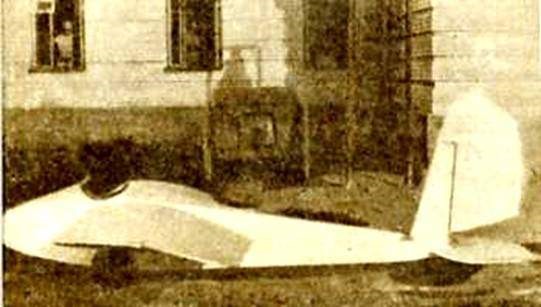
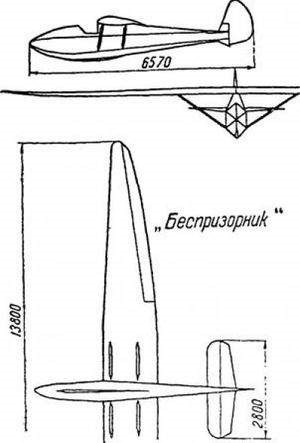
The Gribovski Biezprizornik (Russian: Грибовский “Беспризорник”) competition glider came from a Gribovski concept project. Its designer barely had time to pay attention to its construction, so it was decided not to include it in the numbering sequence of his creations. Rejected by his “father” the model would be jokingly nicknamed “Biezprizornik” (neglected or neglected).
The Biezprizornik construction was carried out by Groshiev, Sirken and Filyushkin, belonging to the Construction Bureau of the Union of Defense and Aviation Assistance Societies-Chemical Construction of the USSR (OSOVIAJIM).
Construction was carried out at the Moscow OSOVIAJIM Glider Factory during 1932.
Constructively, it was a high-wing monoplane with a sunshade, braced to the lower fuselage structure by four struts.
With the aim of reducing construction times and being able to participate in the 1932 competitions, instead of the original Gribovski wing, the brigade adapted the wing of an Antonov “Upar” (Ps-1) glider to the model. In its central part, this wing had a rectangular shape, but towards the ends the chord was tapering until it ended almost at a point. Much of the trailing edge of these outer sections was occupied by long louvered ailerons. The selected wing profile was the TsBPK (ЦБПК) and the entire construction was made of wood, with fabric covering.
The fuselage featured a hexagonal section with lightened frames and six stringers, constructed of 12 x 12 mm slats. Due to a mistake by the constructors, the glider received a too long nose, which resulted in a deterioration of its handling in turns. A landing skid was located in the ventral region of the fuselage.
The tail was of the monoplane type with a large area rudder attached to a small keel built integrally with the fuselage. The two horizontal planes shared a single spar. The assembly process for these plans was very labor intensive, as the builders left very small hatches on the sides for service.
The pilot was located in a cockpit just in front of the wing leading edge. The control from the cabin was carried out with the help of the lever and pedals. The transmission system to the ailerons was copied from that of the Antonov Us-4 and Ps-2 gliders. An interesting detail was that the bow, up to the first frame, could be pivoted open to one side, to give easy access to the control systems.
Gribovski, busy with the problems of keeping the MKB open, could not devote much attention to monitoring the construction, so he decided not to assign the glider its numbering, although he did not refuse to register it under his authorship.
The name “Biezprizornik” was given to the glider in jest. Once the initial tests were completed, the glider was sent in a railway car to the Koktebel Superior School of Planning . In some inexplicable way the glider got lost on the way and for about six months it travelled along the railroad tracks until it finally reached the school, well into 1933. The flight instructors at Koktebel decided to nickname it “Biezprizornik” in reference to the lack of a “Owner” who cares about his delivery for the competitions.
During the glider tests it was decided to change the wing attack angle, but this modification had little influence on the behaviour. The rudder control system had to be revised on several occasions and the ski was replaced, which suffered ruptures due to the great gap between its points of support and the lack of a suspension system.
It participated in the IX and X editions of the National Sailing Competitions. During the IX call the glider “Biezprizornik” would achieve the longest flight of the competition by staying in the air for 62 hours and 30 minutes.
The glider was used for several years as a trainer at the Koktebel High School of Planerismo. From 1933 on in the pilot training practice, aerobatic flights on gliders were included. The Gribovski G-9 and Sheremetiev Sh-5 gliders were used for this purpose. Preliminary preparation was carried out on the “Biezprizornik” glider and included the execution of barrels, eights and the entry training in thermal currents, with a duration of 5 hours of flight.
Only the one copy was built.
Biezprizornik Wingspan: 13.8 m Wing area: 17.00 m² Length: 6.57 m Height: 1.42 m Empty weight: 117 kg Wing loading: 11.0 kg / m² Glide ratio: 15.20 Stabilizers surface: 1.1 m² Elevator area: 0.85 m² Empennage surface: 0.07 m² Rudder surface area: 0.70 m² Ailerons surface: 1.72 m² Accommodation: 1
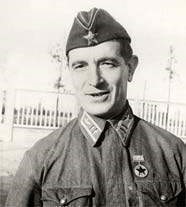
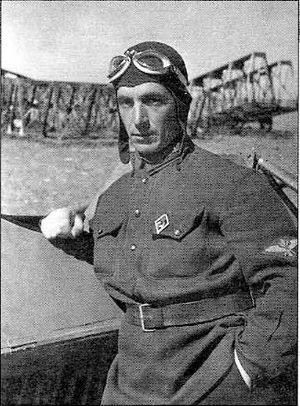
Vladislav Konstantinovich Gribovski (Russian: Владислав Константинович Грибовский) was born on September 7, 1899 in Saint Petersburg. Soon his parents died and Gribovski was forced to enter an orphanage in Gatchina where he would receive high school education. In 1909 during an excursion he visited the local airfield and according to his own statement, from that moment he fell in love with aviation. From an early age he began to read all the materials he found on aviation, made a series of model airplanes and helped the mechanics at the airfield. In 1919 he would leave the orphanage, joining the Red Army. He tried to enter the aviation school, but did not succeed, being assigned to the artillery courses in Petrograd. As part of a group of cadets from the school he would participate in combat against Yudenish, being wounded. In the fall of 1920 he was promoted to commander in the Second Moscow Artillery Brigade.
In 1921, he was finally able to enter the Yegorevsk Aviation Theoretical School. He would continue his pilot studies at the Kacha (Sevastopol) and Moscow (VAShL) flight schools in 1923. In 1924 he passed the Higher School of Aerial Shooting and Bombing in Serpukhov. In this way, in just three years, he passed the entire program of preparation courses and became a fighter pilot. Upon graduation in 1924 Gribovski would be assigned to serve in the 3rd Fighter Squadron based in Kiev.
VK Gribovski began flying gliders practically from the moment he joined the unit in Kiev.
In 1924 in Kiev he designed his first glider, the G-1. This aircraft was included in the list of competitors of the III National Sailing Competitions in Koktebel. After some short test flights, the 22 of September of 1925 the G-1 was hit by a gust of wind that destroyed land.
In 1924 he participated in the II National Sailing Competitions in Koktebel and was one of the first pilots who managed to keep his glider in horizontal flight for some time. In these tests, the category of pilot-planerista was established, which was reached after achieving 5 flights with a total duration of 60 seconds of which, at least one, had to exceed 30 seconds. The title of “paritiel” pilot or thermal exploiter was received by those who managed to keep their glider in flight without losing altitude for 3 minutes.
In the II National Competitions of 1924 Artseúlov, Gribovski, Zernov, Kalan, Kravtsov, Rudzig, Seregeyev, Tarasov and Yakovchuk received the title of pilots “paritiel”.
VK Gribovski.
Gribovski became an instructor at the Serpukhov Flight School in 1927. In the workshops of this institution he would build his second glider, which was launched as G-2 in 1927. The G-2 would fly with great success in the IV, V and VI National Sailing Competitions, becoming one of the main Soviet training gliders in those early years.
In parallel with the G-2, Gribovski designed in 1926 a 4-seater transport glider that received the designation G-3 and was not approved. The G-4 was a never-completed project for a low-power Bristol Cherub-powered light aircraft, designed in conjunction with AB Yumashiev. Its construction also began in 1926 in the workshops of the Serpukhov Flight School. Following the transfer of the flight school to Orenburg, Gribovski would successfully build and fly the G-5 light aircraft.
The G-6 (1928) and G-7 (1929) gliders were also built in Orenburg. The G-7 was one of the best gliders among the participants in the VI National Sailing Competitions. In this glider, the renowned pilot VA Stepanchonok set the Soviet record for flight duration by staying in the air for more than 10 hours.
At the beginning of 1930 Gribovski was appointed head of the OSOVIAJIM Flight School in Moscow. Based on his initiative, the famous Túshino aerodrome was built and the OSOVIAJIM Central Aeroclub was created on the basis of the school. Towing tests of Gribovski’s G-2bis glider were carried out in the autumn of 1931 in Túshino and from their results the G-9 towed glider was built, which was manufactured in series and became one of the main training gliders. of the USSR in the pre-war period.
In 1931, in the workshops of the OSOVIA Flight School, Jim Gribovski would build the excellent G-8 light single-seater training aircraft. This small plane with a takeoff weight of only 483 kg and a 60 hp engine reached a speed of 150 km / h and a flight height of 3000 meters. In the autumn of 1932 the G-8 was used by the pilot D. Koshits to carry out a flight that covered a dozen cities in the USSR, covering a total of 4,500 km.
In 1932 Gribovski began working at the Bureau of Construction of Moscow (MKB) of OSOVIAJIM and a year later would steer. The MKB was financed from donation funds and was located in an apartment in the basements of building No19 on Sadovo-Spaskaya Street in Moscow. In addition to the MKB, the founders of the GIRD – creators of the first Soviet rockets – were also located in this basement. Currently at the entrance is a memorial plaque.
Under Gribovski’s direction, the G-512 and G-16 hydro-gliders were built. In the latter, for the first time in the USSR, a takeoff was made from the water in a glider, towed by a Shavrov Sh-2. Another interesting example was the G-14 towed glider, used for different tow tests. The G-14TsL-2A tanker glider was built on the basis of this model in the “Aviajim” factory for the first time in the world, conceived for long-distance flights from the refueling of the tow plane from the glider itself.
Also noteworthy are the G-15 light tourist aircraft and the G-22 and G-23 single – seaters. In the G-22 the pilot Ye. Miednikov set a world speed record in its category in July 1938 by reaching 165 km / h and pilot I. Grodzyanski in the G-23 set a height record of 7266 meters.
Among light Gribovski models include the G-20 in 1935. With a 100 hp M-11 engine this light aircraft reached 210 km / h and a ceiling of 4000 meters. In 1937, after the installation of a more powerful 150 hp engine, the pilots of the aero club began to perform high school acrobatics on this airplane.
In 1938 on the basis of the MKB OSOVIAJIM and the glider factory, the Experimental Department (Opitni Otdiel – OO) was created under the leadership of Gribovski. Its latest models for OSOVIAJIM were built in this department: the G-26 fast plane and the G-27 twin – engine trainer . This latest model was designed as a crew trainer for the newly introduced Túpolev SB and Ilyushin DB-3 bombers. Although the G-27 in weight did not exceed the Polikarpov U-2, it introduced a two-seater cabin for the pilots and a glass nose for the navigator. This aircraft presented excellent performance but was too demanding in piloting, so it was not considered suitable for teaching. The builders proposed to improve it, but this was never realized. At the beginning of 1939 the glider factory was closed.
VK Gribovski with the G-26 light aircraft during testing.
The Glider Factory of the OSOVIAJIM, in which the Gribovski models were built, was closed in March 1939 and its facilities transferred to Professor Lievkov, who would build air-cushioned aircraft there. The experimental department was dissolved and Gribovski went into the reserve of the Aviation Directorate of the Union of Defense and Aviation Assistance Societies-Chemical Construction of the USSR (OSOVIAJIM). Through his own efforts, Gribovski managed to be transferred to the system of the Commissariat of the Aeronautical Industry (NKAP). Initially, in December 1939, a new Construction Bureau was created as a subsidiary of Factory No.301. This new organization was based on a garage under construction belonging to the “Mosvoyentorg” located in the Pavshino village, belonging to the Moscow suburbs.In March 1940 Gribovski was appointed to command the newly created OKB-28 and by May 22 of next year the Gr-28 “Krechet” (TI-28) training fighter had been created under his leadership. The cockpit of this trainer had been configured to allow training in day and night flight. The TI-28 featured a synchronized ShKAS machine gun, a photo-machine gun and a collimator for aiming. Under the wings it could carry training bombs of up to 40 kg. The beginning of the war prevented its production.
With the start of the war the OKB was tasked with building an 11-seater landing glider. To carry out this task, Gribovski asked only 2 months. AS Yakovlev thought the answer was not serious and asked the builder to put this in writing. Work on the new glider, known as Gr-29 (serially as G-11), began on July 7 and its maiden flight was made on September 2. After a week of test flights, its series production was decided. This model was produced until June 1942.
When the production of the G-11 ceased in 1942, the OKB-28 collective was integrated into the technical staff of Factory No. 471, re-destined to produce the Yakovlev Yak-6. Gribovski was placed at the disposal of the Commissariat for the Aviation Industry.
For the invaluable contribution of his planners in the tasks of support to the guerrilla groups of Belarus, Vladislav Cheranovski was one of the few Soviet servicemen in the rear to be awarded the 2nd rank “Guerrilla of the Patriotic War” medal.
In 1943, production of the G-11 was re – established in Ryazan, where Gribovski was appointed chief builder and factory manager. The production of this model was maintained until 1948 in different versions.
In these years Gribovski would work on the development of an improved version of the G-11 glider, which, called G-31, was not approved because priority was given to the Moscaliov SAM-28 (which would not be produced either).
In 1946 he would work on the 3 and 6 ton transport glider projects that would not be built either. A year later Gribovski would be tasked with designing a two-seater training glider with spacious cabins located in tandem. Two specimens were produced that began to fly in the spring of 1948. The dissolution of Gribovski’s KB prevented further work.
In 1948 Gribovski would present a new design for a primary training two-seater aircraft with tandem seats and a 90 hp M-10 engine, conceived to participate in the light aircraft competition promoted by DOSAV. This would be his last “official” job. In 1948 his KB had been disintegrated as part of the process of reorganization and contraction of the aeronautical industry.
After the liquidation of the Construction Bureau (KB) in 1948, Gribovski received proposals to go on to work in the Scientific-Technical Committee of the VVS, to dedicate himself to the development of aeronautical technology. Declining this proposal, he requested his retirement from the ranks of the Red Army, passing to the reserve with the military rank of colonel.
In later years he would participate in various sports glider projection competitions and would work on sports boat design, photography and painting.
Vladislav Konstantinovich Gribovski designed 20 gliders and 14 airplanes between 1925 and 1948, not counting the unrealized or finished projects. Virtually all of his designs were successful and some of his gliders were mass-built. Their small collective included specialists including VV Abramov and BK Landyshev.
It should be noted that despite his activity as an aeronautical constructor, Vladislav Gribovski flew actively. He was generally the first to test his designs in flight. He personally participated in various aviation competitions, public demonstrations and propaganda flights.
Most of his designs, built basically in wood, were characterized by their simplicity. For this same reason, their models did not stand out for their performance, but in all cases they were characterized by their robustness and ease of maintenance.
Gribovski was a great defender of the airplane accessible to anyone and fought for the development of sports and tourist aviation.
The pilot and aeronautical constructor Vladislav Gribovski passed away in 1977.
Shortly after the German attack in 1941, the Soviet headquarters realized a need for transport gliders and ordered the development of several designs. Vladimir Gribovski agreed to design a light glider in two months and the tests of a prototype started on 1 September 1941. Given the Gribovsky designation G-29, it was accepted for production under the VVS designation G-11 (for Gribovski, 11-men including pilot).
G-11s were produced from late 1941 until mid-1942 in two factories: 138 were built in Shumerlya (factory no. 471) and 170 in Kozlovka village (factory no. 494), for a total of 308. Production restarted in 1944 at Ryazan remaining in production until 1948. From October 1944 the G-11U training glider with twin controls was also in production. There are no data for a total production number, but it is estimated that 500-600 were eventually completed.
A powered version designated G-11M by the VVS (Gribovsky designation G-30) had a M-11 radial engine mounted above the fuselage. It was tested from the Summer of 1942 but did not enter production. Design
The G-11 was a high-wing, all-wooden construction, plywood-covered transport glider. The fuselage was rectangular in cross-section with a single-seat cockpit in the nose, accessed by an upward opening canopy. Behind the cockpit was the 3.24 m × 1.25 m × 1.36 m (10.6 ft × 4.1 ft × 4.5 ft) cargo hold / passenger cabin. There were two 1.2 m × 0.7 m (3.9 ft × 2.3 ft) doors on opposite fuselage sides. Later series had only one 1.4 m × 0.7 m (4.6 ft × 2.3 ft) hatch on the left side. Troops sat on folding benches along the sides, lit by two small rectangular windows on each side. Wings were three-part, fitted with flaps for landing and the landing gear was fixed, but could be folded by the pilot in order to shorten the landing, using the main fuselage skid for landing. Operational history
G-11s, along with the Antonov A-7 constituted a majority of Soviet transport gliders. They were mainly used from mid-1942 for supplying Soviet partisans with provisions, weapons, equipment and trained men, towed mainly by SB or DB-3 bombers. Most intensive use was from March to November 1943 in Belarus, in the Polotsk-Begoml-Lepel area, on the Kalinin Front. Several hundred Soviet gliders (of all types) were used in night supply flights there. After landing, the gliders were destroyed and pilots were sometimes returned by aircraft. The only known instance of a glider returning from the field occurred in April 1943, when a famous glider and test pilot Sergei Anokhin evacuated two wounded partisan commanders in a G-11, towed by a Tupolev SB bomber, piloted by Yuriy Zhelutov, on a 10 m (33 ft) short towrope.
Gliders were also used to supply partisans in some areas in 1944 and to transport sabotage groups behind enemy lines. G-11 gliders were also used in at least one small-scale airborne operation, the Dnepr crossing, carrying anti-tank guns and mortars.
A less typical action was an airbridge from Moscow to the Stalingrad area in November 1942, to rapidly deliver anti-freeze coolant for tanks, during the battle of Stalingrad.
The G-11 enjoyed relative success as a light transport glider design, having more capacity than the Antonov A-7, and its transport compartment was a better fit for cargo, although light guns could only be carried in parts due to small hatches.
Wingspan: 18 m (59 ft 1 in) Length: 9.8 m (32 ft 2 in) Height: 2.7 m (8 ft 10 in) Wing area: 30 m2 (320 sq ft) Empty weight: 1,200 kg (2,646 lb) Gross weight: 2,400 kg (5,291 lb) Never exceed speed: 280 km/h (170 mph, 150 kn) (aerotow) Aerotow speed: 146 km/h (91 mph; 79 kn) Rate of sink: 2.2 m/s (430 ft/min) Lift-to-drag: 16:1 Wing loading: 83 kg/m2 (17 lb/sq ft) Crew: 1 Capacity: 10 troops or cargo / 1,200 kg (2,646 lb)
In August 1922 the Daily Mail newspaper offered a £1,000 prize for the longest duration flight by an unpowered, heavier than air aircraft. The competition was to be organized by the Royal Aero Club, who chose the site (Itford Hill, on the Sussex South Downs near Lewes) and the date (16–21 October). This gave competitors six weeks to design, build and transport their entries. Thirteen arrived in time and one of these was the aircraft nicknamed Brokker, competition number 31.
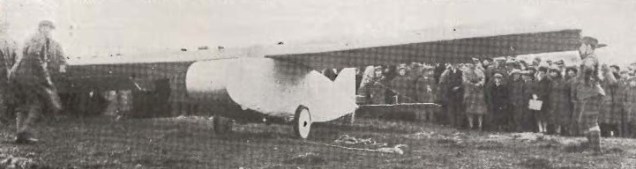
Built by Sqn. Ldr. Alec Gray and F/O W. J. Buchanan, the Brokker was, as its name suggested, a fusion of a Bristol and a Fokker aircraft. Specifically, the upper wing of a Fokker D.VII married to the engineless fuselage of a Bristol Fighter.
The Brokker was a glider which got its name from the fact that it was constructed from the wings of a Fokker D.VII and the fuselage (less engine) of a Bristol F.2B Fighter. It was put together from two of the cheap and unwanted airframes left at the end of World War I; the wings and fuselage each cost 5/- (25 p), with 8/6 (42.5 p) chiefly for dope and plywood, a total of 18/6 or 92.5 p.
The Fokker D.VII wing had advantages over most other World War I fighters as it was one of the few to use a thick airfoil. The merits of these only emerged towards the end of the war, and then only in Germany: structurally, they could be internally braced and more importantly they produced lower drag and higher lift, particularly at high angles of attack, than the usual thin wings.
On the Brokker, the D.VII wing was simply clamped to the top of the rectangular cross section Bristol fuselage, forming a high wing cantilever monoplane. Since there was no propeller to need ground clearance, the Fighter’s tall undercarriage was replaced with a pair of wheels mounted outside the lower longerons. The now empty nose of the Bristol was enclosed with a new, single curvature fairing.
It first flew on 21 October 1922 at Itford Hill, on the South Downs near Lewes, East Sussex.
The Brokker arrived late at the Iford meeting and was not flown until the final day. Its first launch was not successful but the next resulted in a flight of over 90 mins ended only by darkness, the third longest flight of the week. The relative steadiness of the heavy Brokker in the strong winds of the last day, compared with all other competitors with their low wing loadings, was noted. Gray received the Royal Aero Club prize of £50 third longest flight.
After the competition Gray took it to Salisbury Plain where he was to conduct tests for the Air Ministry on the suitability of gliders in pilot training programmes.
The aircraft was lost in a fatal glider accident on 28 August 1923. The pilot, Neville Charles Waltho, was thrown out of the cockpit when the Brokker stalled on a hillside near Pewsey.
According to a contemporary report in Flight dated September 6 1923:
“LAST week the first fatal glider accident in England occurred when Flight-Lieut. Neville Charles Waltho was piloting a monoplane glider at Milton Hill, near Pewsey, Wilts. It appears that Waltho had been gliding for several minutes and was about to land, when the machine went into a dive.
The pilot was thrown out and killed instantly. The machine used was, we believe, the ” Brokker,” flown by Squadron Leader Gray at Itford last year.”
It was the first fatal glider accident in England since Percy Pilcher’s death in 1899.
Wingspan: 29 ft 4 in (8.93 m) Gross weight: 500 lb (227 kg) approx Seats: 1
 All Aero