After Slingsby Aircraft Company Ltd had gone into liquidation in July 1969 the firm was reorganised as part of the Vickers Group, at first as Slingsby Sailplanes, later trading as and then as Slingsby Engineering Ltd.
Glider
Verzilov Staliniets 5
Encouraged by the excellent results obtained by his gliders in the competitions of 1934 and 1937, for the XII National Competitions, Verzilov presented a last model called “Staliniets-5” (Russian: Верзилов “Сталинец-5”), designed as a record-breaking single-seater for long-range flights and also built in the facilities. from the Yeisk Naval Pilot School.
The “Staliniets-5” was designed as a single-seater monoplane with a cantilever wing of medium implantation, characterized by its gull-like shape. The shape in the plane was trapezoidal with a marked decrease in the chord and an R-III profile. The trailing edge featured long louvered ailerons covering the entire span to the point of angle change.
The glider was characterized by the presence of a closed celluloid-coated cockpit, equipped with instrumentation to be able to carry out night and blind flights and with radio equipment to maintain contact with the ground.
The landing gear consisted of a wooden ski with an extension located at the bottom of the keel.
Like the previous models, the “Staliniets-5” stood out for its good construction finish.
The atmospheric conditions during the 1937 XII National Sailing Competitions (of the 18 days only 4 allowed to fly) did not offer the possibility of obtaining appreciable results.
From 1937 the development of gliders in Yeisk died. For various reasons its developers were assigned to other units. Yeremeyev left Yeisk in 1936, Sujomlin and Lisitsyn in the summer of 1937. Verzilov would also drop out of school shortly thereafter.
Staliniets-5
Wingspan: 18.00 m
Wing area: 14.60 m²
Aspect ratio: 22.2
Length: 6.84 m
Height: 1.62 m
Empty weight: 280 kg
Wing loading: 24.7 kg / m²
Glide ratio: 24
Minimum descent speed: 0.73 m / s
Surface of the horizontal planes: 1.00 m²
Vertical plane surface: 1.3 m²
Ailerons surface: 2.00 m²
Accommodation: 1

Verzilov Staliniets 4
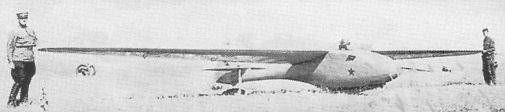
For the XI National Flying Competition held in Koktebel, Vladimir Verzilov developed two new gliders: the two-seater trailed “Staliniets-2bis”, built as a development of the “Staliniets-2” and the single-seater “Staliniets-4” (Russian: Верзилов “Сталинец-4”). Both were valued by the technical commission, receiving approval for the flights without objections.
The “Staliniets-4” glider was designed as a single-seater training and competition monoplane.
Structurally, it was a high-wing glider with variable chord cantilever wings and a trapezoidal shape in the plane. The wing, with a single spar, was constructed of wood with plywood covering and featured a P3-2 profile. The trailing edge featured long louvered ailerons covering 2/3 of the wingspan.
The tail was of the conventional type, with the horizontal planes located near the base of the empennage.
The landing gear consisted of a non-depreciated wooden ski with an extension located at the bottom of the keel.
The pilot was located in an open cockpit located in the bow. A notable feature was the use of a radio in the glider, which allowed communication with the ground.
Built at the VVS RKKA Naval Pilot School, this glider successfully participated in the XI National Competitions Gliding in Koktebel between 6 September and 6 October 1935. In the opinion of the pilot Iván M. Sujomlin, the glider was very obedient to the controls and stable in flight. The only defect noted was its one-piece wing construction, which caused problems during transport and maintenance actions.
With the pilot IM Sujomlin at the controls, this glider managed, between October 2 and 3, to stay in the air for 38 hours and 10 minutes, which meant a new record. The Stalinits-4 received a special award in the competition’s training glider category.
These were the last gliding competitions in which the duration of the flight was competed. In the new competitions, they moved the mountainous Crimea, to new sites such as Rostov and the Moscow airfields.
In 1937 the “Staliniets-4” glider was produced by various organizations in the country. Many competitors built developments of this model for participation in competitions. The XII national competitions, which took place between 10 and 28 of July 1937 at the airfield of the sports society “Spartak” near the village Tioply Stan (now a suburb of Moscow) participated with three copies under the name ” Staliniets-4bis “.
Staliniets-4
Wingspan: 14.00 m
Wing area: 11.30 m²
Aspect ratio: 17.3
Length: 6.15 m
Height: 1.30 m
Empty weight: 173 kg
Wing loading: 22.4 kg / m²
Glide ratio: 19.8
Surface of the horizontal planes: 1.57 m²
Rudder surface: 0.80 m²
Aileron surface: 1.35 m²
Accommodation: 1
Verzilov Staliniets-2bis
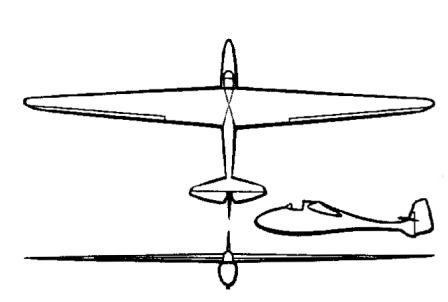
A development of the “Staliniets-2” built in 1935, the “Staliniets-2bis” (Russian: Верзилов “Сталинец-2бис”) glider was designed as a towed two-seater.
Structurally it was designed as a monoplane with a high wing in parasol, braced by uprights. The wing featured an R-II profile with a single spar structure and was built in two independent sections, which were fixed to the upper fuselage structure, featuring an upright on each side to ensure the necessary structural rigidity. The entire wing was covered by 1.5 – 2 mm thick plywood sheets and had a total weight of 158 kg.
The fuselage featured oval section and plywood overlay. Eighteen frames and four main spars were included in its structure.
The vibration problems presented by the previous “Staliniets-2” made it necessary to locate the tail planes somewhat lower in the empennage. The stabilizer was attached to the keel structure at two points and a bracing post.
The landing gear consisted of a rigid, trunk-shaped ski, to which a trolley was attached, which could be released after take-off from the second seat.
The two crew members sat in tandem seats. The second position was located just above the center of gravity of the glider, so the absence of its occupant did not bring problems of variation of the centering.
As a result of the modifications made, the new glider was 25 kg heavier than its predecessor.
For the XI National Competition gliding in Koktebel between 6 September and 6 October of 1935 both “Staliniets- 2” and the “Staliniets-4” were valued by the technical commission, receiving approval for the flights without objections.
During the XI National Sailing Competitions on the “Staliniets-2bis”, test pilot Valentin V. Licitsyn with passenger B. Dolya set a new world record for flight duration for a two-seater glider by staying in the air between 2 and October 3 for 38 hours and 40 minutes. Again the record was recognized only as a national one, because the USSR in those years was not a member of the FAI.
Staliniets-2bis
Wingspan: 20.10 m
Wing area: 25.00 m²
Aspect ratio: 16.2
Length: 8.22 m
Height: 1.60 m
Empty weight: 320 kg
Wing loading: 19.2 kg / m²
Ailerons area: 4.20 m²
Glide ratio: 21
Accommodation: 2

Verzilov Staliniets-2
From a visit to the IX National Competition gliding, which took place in the town of Koktebel in Crimea between 12 August and 20 September of 1933, a group of students and instructors Pilot School Navales of the RKKA VVS named Stalin decided to develop self-built gliders to participate in these competitions. The gliders carried the name Staliniets (Сталинец), which can be translated as Staliniano, in relation to the name of the school.
With more desire than experience and using the facilities of the local carpentry they began to work.
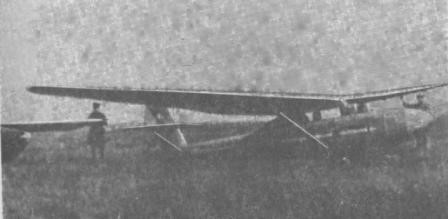
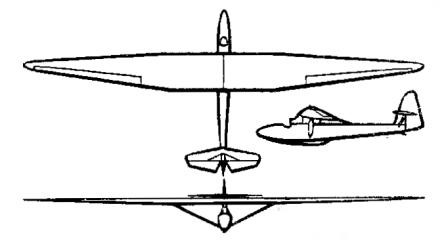
The “Staliniets-2” was designed as a two-seater competition glider.
Structurally it was designed as a monoplane with a high wing in parasol, braced by uprights. The wing featured an R-II profile with a single spar structure and was built in two independent sections, which were fixed to the upper fuselage structure, featuring an upright on each side to ensure the necessary structural rigidity. The central section of the wing was rectangular in shape, which became trapezoidal towards the ends. The entire wing was covered by 1.5 – 2 mm thick plywood sheets and had a total weight of 158 kg.
The fuselage featured oval section and plywood overlay. Eighteen frames and four main spars were included in its structure.
The tail planes were located high on the empennage. The stabilizer was attached to the keel structure at two points and a bracing post.
The landing gear consisted of a rigid, trunk-shaped ski, to which a trolley was attached, which could be released after take-off from the second seat.
The two crew members sat in tandem seats. The second position was located just above the center of gravity of the glider, so the absence of its occupant did not bring problems of variation of the centering.
The “Staliniets-2” (Russian: Верзилов “Сталинец-2”) was manufactured between June and September 1934 and this glider stood out for its good finish.
In the next competition, held also in Koktebel from 1 September to the 6 October of 1934 two gliders were presented: the “Staliniets-1” developed by the instructor flying school Pavel Yeyemeyev and two – seater “Staliniets -2 ”developed by Vladimir Verzilov.
The “Staliniets-2” glider successfully participated in the X National Sailing Competition, held in Koktebel.
Unlike the unsuccessful “Staliniets-1” of Yeremeyev, the “Staliniets-2” flown by instructor pilot Ivan M. Sujomlin established a new record in the competition extension flight to stay airborne 24 hours and 10 minutes between on October 18 and 19. Despite surpassing international results, this record was recognized only as national because the USSR was not a member of the FAI.
As a positive feature of the glider, it is worth highlighting its excellent longitudinal and transverse stability, as well as the excellent balance achieved by its builders.
Its disadvantages include the operation of the large unbalanced ailerons, which required a great effort o and some vibration in the tail, due to an ineffective location of the stabilizer.
Staliniets-2
Wingspan: 20.20 m
Wing area: 25.00 m²
Aspect ratio: 16.3
Length: 8.05 m
Height: 1.95 m
Empty weight: 295 kg
Wing loading: 18.2 kg / m²
Surface of the horizontal planes: 3.16 m²
Vertical plane surface: 1.72 m²
Ailerons surface: 3.68 m²
Accommodation: 2
Verzilov, Vladimir N.
It is known that in the 1920s Vladimir N. Verzilov (Russian: Владимир Н. Верзилов) began work on the development of gliders in Simferopol.
In the late 1920s he worked together with AN Sharapov on the construction of a pair of gliders that participated in competitions at Koktebel.
He transferred to the Yeisk Naval Pilot School in 1934, working there as an instructor until 1937. On 25 May 1936 VN Verzilov was awarded the Order of the Red Banner.
During his stay in Yeisk, Verzilov was responsible for the creation of four types of gliders of which three set national records. After dropping out of the Yeisk school, Verzilov worked as a test pilot.
Verzilov went on to establish several national records.
Verzilov gliders in Simferopol
”Piervieniets” – Competition (1927).
”Buyán” -Trainer (1928).
Verzilov gliders Yeisk
“Staliniets-2” – two-seater glider, record holder (1934).
“Staliniets-2bis” – two-seater glider, record holder (1935).
”Staliniets-4” – single-seater glider, record holder (1935).
“Staliniets-5” – long-range single-seater glider (1937).
VEB Apparatebau Lom-57 Libelle

Designed by VEB Apparatebau Lommatzsch.
Lom-57 Libelle
Wing span: 16.5m
Wing area: 14.85sq.m
Empty Weight: 230kg
Gross Weight: 330kg
Wing Load: 22.2kg/sq.m
Aspect ratio: 18.33
Airfoil: Go 549
MinSink: 0.66 m/s 68 kph
L/DMax: 31.5 78 kph
Seats: 1
No. Built: 1
Vazduhoplovno Tehnicki Centar / Jastreb Fabrika Aviona Jedrilica
The Standard Cirrus was manufactured in Serbia by Vazduhoplovno Tehnicki Centar (later Jastreb Fabrika Aviona Jedrilica), first the Cirrus 75 and 75B version, and subsequently a modified Cirrus 81 with roomier cockpit and variable incidence tailplane.
Vaxmistrov AVF-8
During his student years at the Air Fleet Academy, Valdimir Vaxmistrov was swept away by the enthusiasm for glider manufacturing that existed at the institution.
In 1924 Vaxmistrov designed a single-seater training glider. Designated ” Kondor ” by its constructor, it received the consecutive 8 in the control of the academy. It was built on the transport base of the Sovnarkom in Moscow.
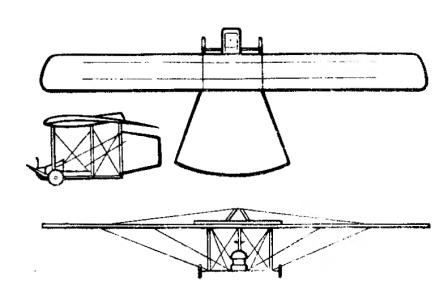
The Vaxmistrov AVF-8 “Kondor” (Russian: Вахмистров АВФ-8 «Кондор») was designed as a strut-braced monoplane with a triangular tail unit and a large-area rectangular rudder. The structure was made of wood with a fabric covering.
This single-seat glider first flew on September 22, 1924. It was damaged during the II National Sailing Competitions.
AVF-8 “Kondor”
Wingspan: 13.8 m
Wing area: 22.6 m²
Aspect ratio: 8.4
Length: 4.6 m
Height: 2.6 m
Empty weight: 70 kg.
Wing loading: 6.2 kg / m²
Elevator area: 3 m²
Rudder surface area: 1.2 m²
Accommodation: 1
Vaxmistrov, Vladimir Sergueyevich

Vladimir Vaxmistrov was born on June 27, 1897 in Moscow. In 1915 he finished his studies at the Royal School in Moscow. At the age of 17 he voluntarily entered the army and was posted to the Mikhailovsk Artillery School (Petrogradsky). At the age of 19 he participated in several combats, but his interests were far from artillery. In 1916 he managed to be admitted as an aviation observer (partly thanks to his brother Boris who commanded a brigade in this group.
With the triumph of the October Revolution he joined the Red Army. He already participated as a pilot in battles over Orenburg and later the aviation group in which he served was sent to Turkistan. In 1921 he was able to continue his studies, initially at the Turkistan State University and later at the Air Fleet Academy.
The study stage coincided with the period of development of gliding in the USSR. His first design was the AVF-8 “Kondor” of 1924. Together with MK Tijonrarov he built the AVF-22 “Zmei Gorinich” glider in 1925. This glider was so effective that it was selected to participate in international flying competitions in Penske, Germany.
From that year on, Vaxmistrov participated in all competitions in Crimea. In 1927, together with Dubrovin and Tijonrarov, he presented the “Zhar-Ptitsa” glider, which established a 15 km range record in the competitions of that year. A year later these three friends presented the “Gamayún” glider in which for the first time in the USSR the pilot AB Yumashiev soared in a thermal over the plain for 375 meters. The “Skif” glider, also built by the trio, established in the VI National Competitions in 1929a Soviet altitude record at 1,520 meters and an improved version of the “Zhar Ptitsa-2” glider set a new range record of 32 km with return.
Between February and April 1926 Vaxmistrov participated as a crew member during the state tests of the Túpolev R-3 (ANT-3) reconnaissance aircraft, which were flown by MM Gromov.
Upon finishing his studies at the Air Fleet Academy in 1930, VS Vaxmistrov went on to work at the NII VVS, where he was able to develop his idea of combined aircraft. The first step in this direction came through a competition for an aerial target promoted by the institute and in which the idea presented by Vaxmistrov was the winner. The aerial target was fixed to a Polikarpov R-1 and at the precise moment it was released. The mother plane left the firing zone as the target began gliding.
The idea of transporting a small plane on a larger plane gradually took shape and became the famous “Zvenó” or “Chains”. In the next few years Vaxmistrov’s work was directly linked to the development of these combined flying structures that were used successfully in some missions during the initial stage of the Great Patriotic War.
In 1937 after the arrest of Mikhail Tukhachevsky the project of the “Zvenó” was stopped. Vaxmistrov was able to escape the process with only a demotion from principal constructor to brigade chief in KB-29 itself. Between 1937 and 1940 new versions of the “Zvenó” were developed. A version known as SPB was used successfully at the beginning of World War II in the attack against a bridge of strategic value in Romania.
In the pre-war years the KB-29 under the leadership of Vaxmistrov also developed a novel idea of fighting against enemy bomber formations known as PTP. It was a three kilogram bomb tied to a 100 meter rope that ended in a parachute. These bombs were to be dropped in large quantities to meet the bomber formation. When the enemy plane’s wings or fuselage met the rope, the resistance of the parachute caused the rope to move upwards. Making contact with the body of the plane activated the fuse that made the bomb explode. Despite satisfactory results in state tests, this method was never used.
From 1940, Vaxmistrov went to work in the OKB of NN Polikarpov, being soon appointed his replacement in aircraft development group and directed parallel the repair of I-16.
Between 1943 and 1945 Vaxmistrov worked on two new composite aircraft projects. The first known as TP (Transport Glider) was composed of gliders linked by fighters that guaranteed the motive power and the second included fighters linked with bomb planes.
After the Great Patriotic War, Vaxmistrov kept working in the aeronautical industry. In 1949 he worked on the development of an in-flight refuelling system.
He died in 1972 in Moscow.
Aeronautical production
Stage at the Air Fleet Academy
AVF-8 “Kondor” Glider (1924)
Glider AVF-22 “Zmiei Gorinich” (1925)
Glider “Zhar-Ptitsa” (1927)
Glider “Gamayún” (1928)
Glider “Skif” (1928)
Glider “Konsomolskaya Pravda” or “Zhar Ptitsa-2” (1929)
Glider “Skif-2” (1931 ).
Stage at TsAGI and KB-29
Zvenó or Zvenó-1 (1931).
Zvenó-1A (1933).
Zvenó-2 (1932) Project.
Zvenó-2A (1934)
Zvenó-3 (1934)
Zvenó-4 (1934)
Zvenó-5 (1935)
Zvenó-6 (1935)
Zvenó Aviamatka PVO (1935)
Zvenó-SPB (1937)
Vaxmistrov I-Ze (1937) Project.
Zvenó-7 (1938)
Other projects
An unrealized project of Vaxmistrov’s composite aircraft based on a TB-7 bomber.
Vladimir Vaxmistrov designed even other more complex versions such as the I-16 8-fighter transport project(Two fighters under the wing, and the other 6 in special structures located on the wing structure). Five of these fighters had to fly with the engines running to ensure the necessary power thrust. To avoid wasting its own fuel, the feeding was conceived directly from the tanks of the mother plane. The patrol time of this version was estimated at 6.5 hours, which was quite high for the time. Once the mission was over, the planes made contact with the bomber at a speed of 150 – 170 km / h. The bomber crew had to manually ensure the fixation of the fighter to the attachment point on the structure. The fighter-bomber contact system was tested in 1938 by the experienced NII VVS test pilots. Stepán Suprún and Piotr Stefanovski , demonstrating the feasibility of the system. However this version of 8 fighters was never built.
In the first half of the 1930s VS Vaxmistrov presented the preliminary design of a flying aircraft carrier which he also called Aviamatka. Vaxmistrov’s Aviamatka was designed as a monoplane with a parabolic-shaped flying wing scheme. 10 M-34FRN engines were placed in pairs on the wing leading edge moving 5 traction propellers. The parasitic fighters were located semi-inserted in the thick wing and were raised to the extraction by means of elevators, as is customary in aircraft carriers. This gigantic aircraft was also envisioned as a transport and tanker aircraft.
After the successful realization of the SPB project, Vaxmistrov conceived other improved variants of “Zvenó” SPB among which the following stand out:
A Pe-8 bomber (ANT-42 or TB-7) loading two I-16 SPBs or two more modern MiG-3 or Lavochkin-Gorbunov-Goudkov LaGG-3 fighters with two FAB-250 bombs each. The maximum takeoff weight of this configuration did not exceed 33,500 kg and the maximum speed had to reach 405–420 km / h at 6,000 meters of altitude working the six engines at nominal speed, with a range of 1,320–1450 km. The Petlyakov Pe-8 was withdrawn from production in 1942 and the project was left on paper.
A flying boat GST (version the Consolidated PBY Catalina in the USSR ) carrying an I-16SPB on each wing.
An MTB-2 (ANT-44) heavy hydrofoil with two fighters.
Other projects included:
A composite transport glider raised by fighters installed under the wings and designed to guarantee the change of base of fighter squadrons in the absence of transport aircraft.
A double empennage glider attached to a fighter with two 1000 kg FAB-1000 ropes, one on each tail cone (a concept generally similar to the German Mistel of the final stage of the war).
A missile with delta wing configuration propelled by a ramjet and combined with a fighter.
None of these projects went beyond the drawing board. Vaxmistrov never managed to realize his idea of winged aircraft carriers.
 All Aero