The Shenyang HU-1 Seagull is a Chinese powered glider built by the Shenyang Sailplane Factory at Shenyang.
The Seagull is a two-seat powered glider made from aluminium alloy with parts also made of wood, glassfibre and fabric. It has an overwing mounted 116 hp (87 kW) Lycoming O-235-N2A engine.
Wing Span: 17 m Length: 7.6 m Height: 1.7 m MTOW: 1000 kg Maximum Range: 480 Nm Take Off Distance: 180 m Absolute Ceiling: 15,000 ft Optimum Ceiling: 10,000 ft Maximum Speed: 121 kts Optimum Speed: 86 kts Maximum Climb Rate: 780 ft/min Seats: 2
Powered flight – one of the defining inventions of the 20th Century – was achieved in the US but, if not for a tragedy exactly 125 years ago, it could have been very different. As aviation pioneer Percy Pilcher soared into the air above Leicestershire, watched by his sister and a group of potential investors, it seemed like the dream of powered flight was within their grasp – but then there was the loud crack of breaking wood. Percy’s journey to this point began in earnest as he honed his engineering skills in Victorian Britain’s powerful navy. Percy’s biographer Philip Jarrett said: “Ella said he was fascinated by flight from an early age. “And he, on long navy voyages, watched the birds like the albatross just ride the winds, seemingly without effort. “But building something to carry a man was anything but effortless. “There were no textbooks, no calculations or examples, they were, both literally and figuratively, stepping into thin air.”
Percy, with Ella alongside, put his ideas to the test through a series of what he called “soaring machines”
Percy corresponded with fellow enthusiasts around the globe including Lawrence Hargrave in Australia, Octave Chanute in the US and Otto Lilienthal in Germany. Lilienthal freely shared his breakthrough of the aerofoil, the curved surface which produced more lift than drag, which is fundamental to building a successful wing. Fired with enthusiasm, Percy designed a series of gliders, which he called “soaring machines”, built out of sailcloth, bamboo and piano wire.
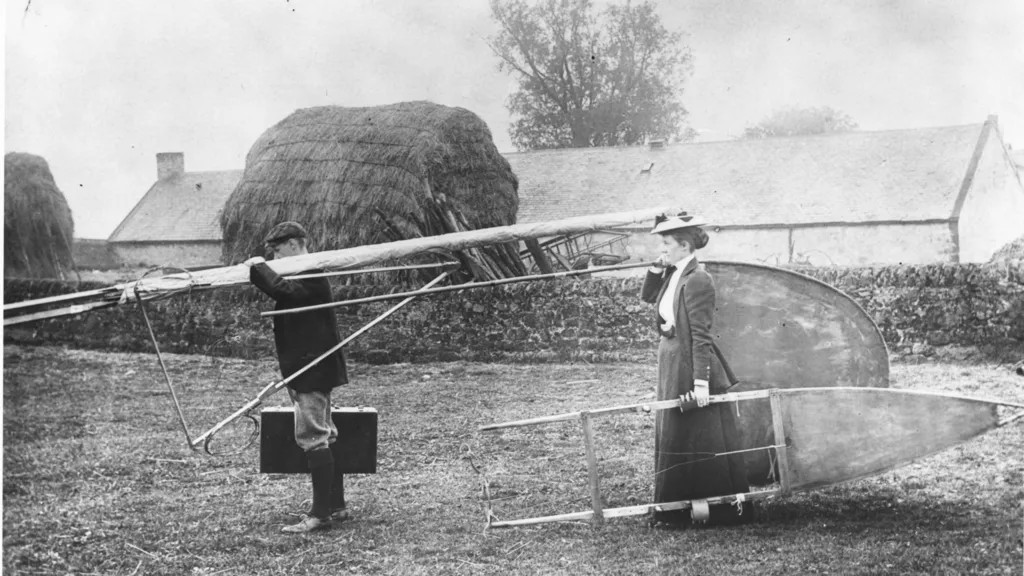
Test flights often involved the Pilchers carrying dismantled gliders to suitable fields
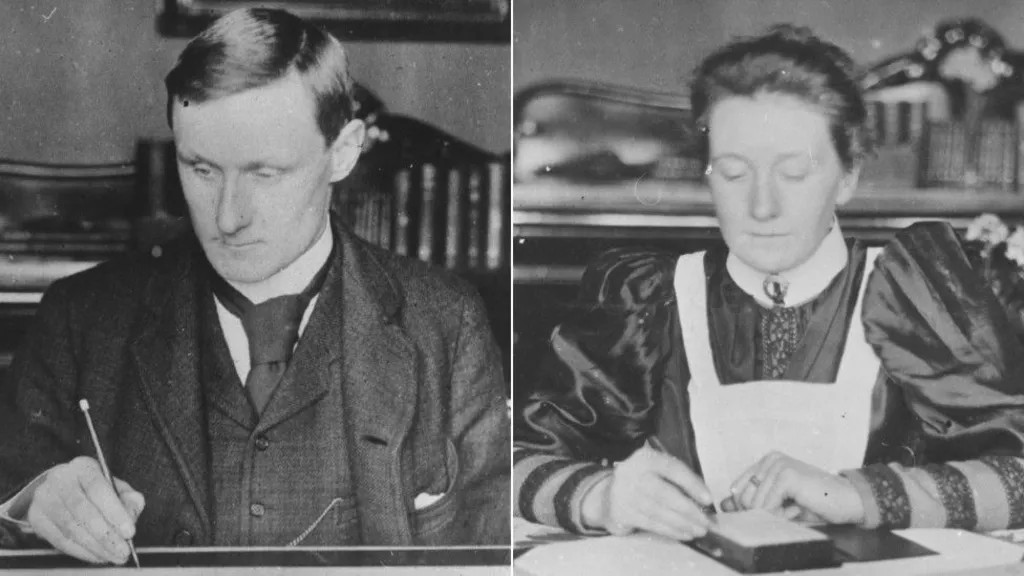
During long hours in rented houses, university rooms and draughty barns, Ella used her sewing skills to create sweeping wing surfaces, carefully engineered to the tolerances Percy required. Aviation historians say this probably makes her the first woman to be involved in the construction of fixed wing aircraft. Filmmaker and historian Lily Ford said: “This kind of flying had seen centuries of failure and was kind of seen by some as quite ridiculous and they thought it would never happen. “And even the chair of Natural History at Glasgow University, Lord Kelvin, who actually was a kind of sponsor of Percy Pilcher, said in 1896 – so this was after Percy and Ella were already experimenting – that he had no faith in flying by any other means [than balloon]. “So I think having somebody as a kind of accomplice, a collaborative, supportive person who believed in you, who believed that you could do it and who was totally prepared to roll up their sleeves, was a huge help to Percy.”
Gliders without mechanical controls or safety features were prone to frequent and dangerous crashes
Percy conducted a series of increasingly ambitious – and therefore dangerous – test flights in Glasgow and Kent. The risks of operating at the very edge of technical knowledge were emphasised in 1896 with Lilienthal’s death during an experimental flight. But as Percy achieved greater distances – up to 250m (820ft) in 1897 – his reputation grew. Mr Jarrett said: “He worked through ideas via a series of increasingly sophisticated designs with names like the Bat, Beetle and Hawk. “He was dogged in working on problems until he had a solution.”
With his Hawk glider, Percy Pilcher achieved distances which brought global attention
During one of these tests, Ella agreed to be strapped in, so becoming the first female glider pilot in the UK, said Dr Ford. She added: “She managed publicity. She sent people photographs. She may well have organised the photographs to be taken in the first place. “She’s in all the photographs, which is a wonderful thing. “So she was really his collaborator, but because of how things were for women at that point, there just wasn’t scope for her to be seen as a technological pioneer. “There was no mould that she could fit in.” But Percy knew the real prize was powered flight, not gliders. This had become a serious possibility with the development of the internal combustion engine. Mr Jarrett said: “Pilcher initially simply put an engine in the Hawk glider. “But the extra weight meant he needed bigger wings – but this meant more superstructure, which meant yet more weight. He found himself in a vicious circle. “Then appeared a letter from Octave Chanute which detailed the use of multiple small wings stacked on top of each other. “Percy had a way forward and began work on an entirely new aircraft.”
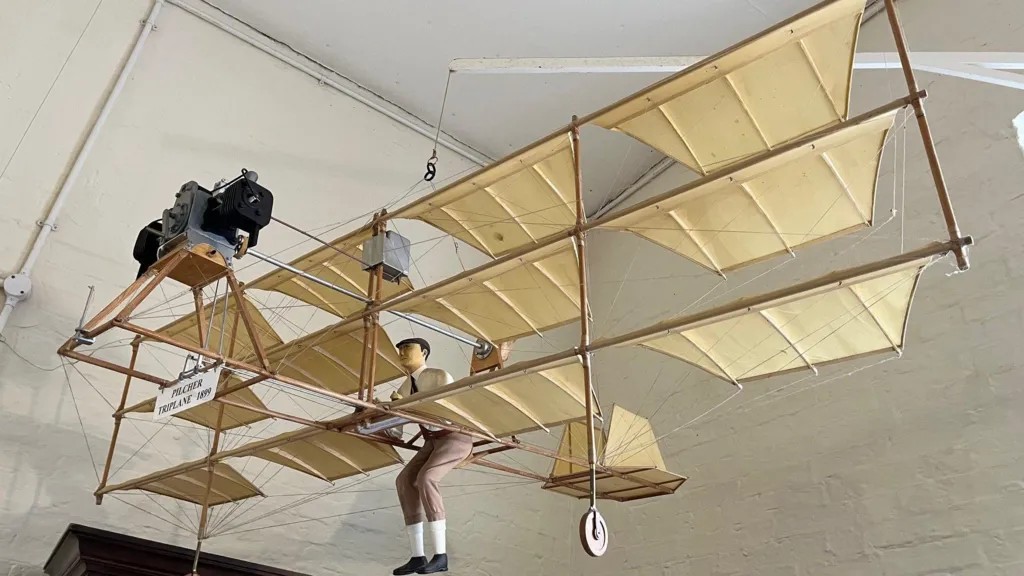
The ground-breaking triplane design was never tested and no photographs are known to exist
After constructing the triplane itself and having an engine built to go in it, Percy, again accompanied by Ella, gathered potential investors at Stanford Hall on 30 September 1899 for what promised to be the first powered flight in history. After years of struggle, all the Pilchers needed was a fair wind and some luck. But they were to get neither. Greg Wurr, a guide at the hall, said: “There were some important people present, including an MP, but shortly before the first demonstration of the triplane, part of the engine broke. “Percy didn’t want to disappoint the crowd or lose the opportunity to impress, so he got the Hawk out instead. “It was a damp, blustery day and the Hawk was hard to handle but Percy got it into the air. “As he was getting some height, part of the tail broke away and it plunged to the ground. “Percy was badly injured and died at the hall three days later, aged just 32, with Ella by his side.” Within weeks of Percy’s death, Ella, who had worked so hard and so closely with her brother, left England, sailing to South Africa to work as a nurse in the Boer War. She continued to promote her and Percy’s work, writing to the Royal Aeronautical Society, saying: “I should not like our name to be taken off your lists. “As I always helped my dear brother in his experiments, I am able to take great interest in the subject.” Soon after, a vote at the society made Ella Pilcher its first honorary member.
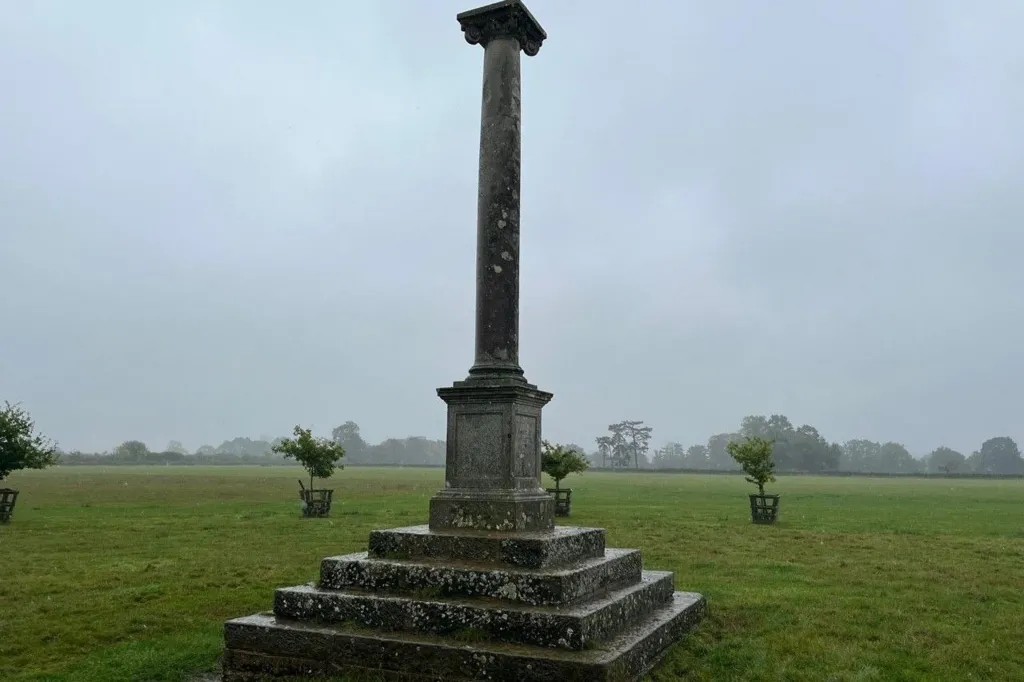
The monument built where Percy Pilcher crashed describes him as “the other Icarus”
The untested triplane was put into storage and, neglected, slowly fell to pieces and was lost. The fate of the specially designed engine is also unknown. So how close was Percy to achieving the centuries old dream of powered flight, a full four years before the Wright brothers claimed the prize? In 2003 a team, including Mr Jarrett, pieced together the fragmentary evidence for Percy’s triplane. A triplane, based on drawings left by aviation pioneer Percy Pilcher, takes to the air Dr Bill Brooks, an aircraft designer, was part of the project and actually piloted the reconstruction. He said: “The basic configuration was remarkably good but there were a few things about it which weren’t. “There were cut-outs in the wings which reduced lift and his control system of just shifting his weight hanging from his arms was very limited. “Also the power from his engine, which would have been between two and four horsepower, wasn’t sufficient. “So we had to surmise he would have recognised these and worked his way round them – the pace of development at the time was rapid. “He had made more progress on a shoestring budget than people with big wallets had and, with time, I think he would have been the first, or among the first, to succeed.” After just two days of testing, the triplane achieved a flight time of one minute 25 seconds – beating the Wright brothers’ best initial time by 19 seconds.
The glider is probably pre 1914 and located in the Hawke’s Bay, New Zealand, area. The occupant appears to have a car steering wheel-type control at his disposal but no obvious foot controls. The undercarriage appears to be a basic bicycle forks and wheel construction. NZ Wings June 1982
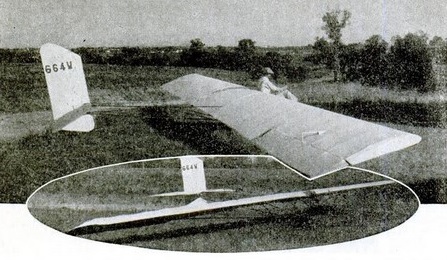
Built in 1930 in Oklahoma City, the Aerobat glider was made entirely of aircraft steel dural and hib-lum covered with flightex fabric. It had an adjustable seat to provide balance for and weight pilot.
In its trial flight this primary glider gained over 300 feet altitude with 4 minutes 30 seconds duration, taking off at 12 mph by auto-tow.
The glider was priced at $395 and pontoon equipment was optional at $100 extra.
Wingspan: 42 ft Wing chord: 5 ft 6 in Length: 16 ft 6 in Glide ratio: 16-1 Landing speed: 15 mph
The Akaflieg Braunschweig SB-8 is an experimental, single-seat, high performance glider built in Germany in the 1960s, constructed largely from glass fibre skin over built up balsa wood structure. Two were built; the second of which was later fitted with a high aspect ratio (30:1) wing, becoming the Akaflieg Braunschweig SB-9 Stratus.
The Akaflieg Braunschweig or Akademische Fliegergruppe Braunschweig (English: The Brunswick Academic Flying Group) is one of fourteen German undergraduate student flying groups sponsored by their home technical university. Several have designed and built aircraft, often technically advanced and leading the development of gliders in particular. The Brunswick students had been exploring the use of GRP in a series of related gliders, beginning with the SB-6. From the SB-8 to the SB-10, wingspan and aspect ratio were progressively increased. The aspect ratio was increased from 23 to 36.6, resulting in aeroelastic problems.
The SB-8 is similar to the SB-7, which also had an aspect ratio of 23. It performed well but had difficult handling characteristics, attributed to its Eppler aerofoil section. The SB-8 has an 18 m (59 ft 1 in) wingspan, a two-piece wing of Wortmann FX 62 profile with an unswept leading edge, a slightly tapered center section, and more strongly tapered outer sections. It is built around a box beam, with balsa ribs and a torsion shell of glass fibre laid over balsa. The wing is shoulder mounted at 1.5° dihedral, with Schempp-Hirth airbrakes at mid-chord midway along the center section and ailerons on the outer panels. Both SB-8 built have camber flaps on the inboard wing panel and ailerons which are coupled to the flaps (flaperons) on the outboard panels.
The fuselage of the SB-8 is built with a fibreglass skin, over a balsa shell, with balsa vertical frames and two pine plywood main formers in the region between the wings. The nose is pointed and slightly drooped, with a short, single piece, canopy just ahead of the wings, tapering gently aft to a straight tapered balsa/GRP T-tail unit. The tailplane carries a conventional single-piece elevator and the rudder is fabric covered. On the ground the SB-8 is supported by a retractable, unsprang monowheel undercarriage, assisted by a tail bumper.
The first flight was made from Brunswick airport on 25 April 1967; testing confirmed that the glass fibre structure was too flexible and at high speeds the SB-8 exhibited wing flutter, limiting its maximum permitted speed to 170 km/h (105.6 mph; 91.8 kn). The low wing loading also limited its smooth air cross country speed as there was no provision for ballast. Later, removable steel tubes filled with lead pellets were added to the wing roots of the SB-8 V1 to increase wing loading. A second aircraft, SB-8 V2, was therefore built with a stiffened, heavier wing and provision for water ballast, which addressed both aero-elasticity and wing loading problems, allowing the glider to fly safely, without flutter, at 200 km/h (124.3 mph; 108.0 kn).
The SB-8 V2 had shown that glass-fibre wings could be made stiff enough to avoid aeroelastic flutter problems and that the higher aspect ratio produced the expected improvement in glide angle. It was natural for the next Akaflieg Braunschweig design to have a wing of greater span, replacing the wing of the SB-8 V2 airframe with a four-panel wing of similar construction but 22 m (72 ft 2 in) span. At the time of its first flight in January 1969 the SB-9 had probably the greatest span of any glider then flying, though the 22 m (72 ft 2 in)-span Holighaus Nimbus 1 flew only three days later. The increase in aspect ratio over the SB-8 increased the measured best glide ratio from 40:1 to 46:1 and decreased the measured minimum sink rate from 0.61 m/s (120.08 ft/min) to 0.51 m/s (100.39 ft/min). The new wing took advantage of the flexibility of glass fibre to implement elastic flaps. The intention was to avoid the interruption to the wing profile at the hinge, particularly on the critical upper surface, and leakage through it by bending the upper surface instead. This method had been used earlier in the wooden-winged HKS-1 glider of 1953.
Both SB-8s competed at the German National Championships of 1968, Wolfgang Beduhn finishing fifth in the V1 and Helmut Treiber seventh in the V2. The V2 went on to become the SB-9, but the V1 remained in regular use at Brunswick until 1989. It remained airworthy after that, though flown less often, and was still on the German Civil Aircraft register in 2010.
The SB-9 was used by the Akaflieg students in competitions between 1969 and 1971. It also gave them the opportunity to film and study the alarming motions of the wing when fluttering, recording their observations on film in slow motion and in the air. Two antisymmetric, odd, sine-like lateral displacement modes were observed at 90 km/h (55.9 mph; 48.6 kn). The fundamental mode was seen, at a frequency of 3.3 Hz but at 140 km/h (87.0 mph; 75.6 kn) the wing oscillated at 5.8 Hz in a second harmonic mode. During these largely vertical excursions, the wing also twisted and its overall motion excited vibrations in the rear fuselage and tail unit. The flutter problems were addressed by mass-balancing, the ailerons, and by a span reduction to 21 m (68 ft 11 in).
Neil Armstrong was given the opportunity to fly the SB-8 large sailplane, innovative for its use of structural composite materials.
The career of the SB-9 ended in 1972, when it was decided to use its wing on the SB-10 two-seater, a new design with a very different fuselage and the span increased still further with an 8.7 m (28t ft 7 in) centre section.
Variants
SB-8 V1 Original aircraft, empty weight of 260 kg (570 lb) and a maximum take-off weight of 365 kg (805 lb).[3] Flutter restricted maximum permitted speed to 170 km/h (110 mph; 92 kn). SB-8 V2 Stiffened wing, weights increased by 40 kg (88 lb). Provision for water ballast, maximum permitted speed increased to 200 km/h (120 mph; 110 kn) SB-9 Stratus The SB-8V2 was modified with a four-part wing of 22 m (72 ft 2 in) span, fitted with elastic flaps. SB-9 Stratus was first flown in January 1969. It is Empty weight, 325 kg (717 lb), maximum in flight weight, ballasted, 421 kg (928 lb). Flutter problems were tackled with a span reduction to 21 m (68 ft 11 in) and mass-balancing the ailerons.
Crew: 1 Length: 7.505 m (24 ft 7 in) Wingspan: 18 m (59 ft 1 in) Wing area: 14.1 sq.m (152 sq ft) Aspect ratio: 23 Airfoil: root:Wortmann FX 62-K-153, mid:Wortmann FX 62-K-131, tip:Wortmann FX 60-126 Empty weight: 301 kg (664 lb) Gross weight: 403 kg (888 lb) Max takeoff weight: 451 kg (994 lb) Never exceed speed: 200 km/h (120 mph, 110 kn) Maximum glide ratio: 41.6 at 85 km/h (53 mph; 46 kn) Rate of sink: 0.61 m/s (120 ft/min) at 88 km/h (55 mph; 48 kn) at 27.7 kg/m2 (5.7 lb/sq ft) and 385 kg (849 lb) Wing loading: 28.6 kg/m2 (5.9 lb/sq ft)
The LG-130 Kmotr (or Z-130) soaring plane was a product of Moravan Otrokovice (aka Zlin).
Zlin Z 130 Kmotr Length : 24.836 ft / 7.57 m Wingspan : 52.493 ft / 16.0 m Wing area : 234.655 sq.ft / 21.8 sq.m Max take off weight : 981.2 lb / 445.0 kg Weight empty : 606.4 lb / 275.0 kg Wing load : 4.1 lb/sq.ft / 20.0 kg/sq.m Crew : 2






 All Aero