Rose RP-4

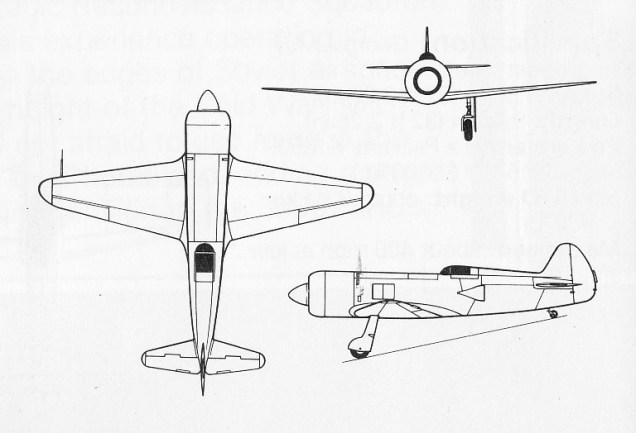
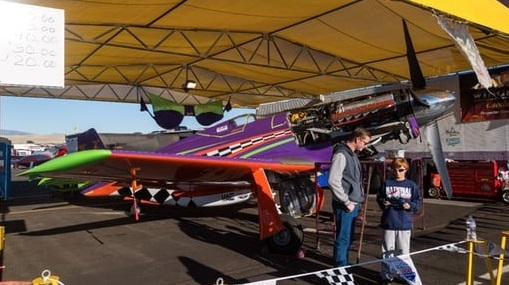
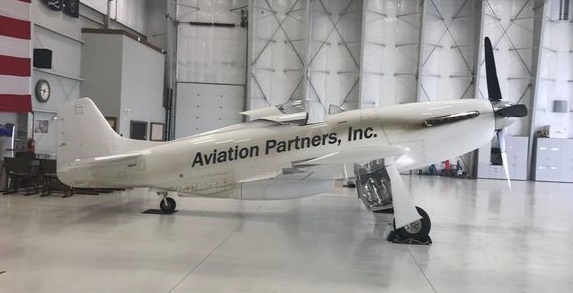
David Rose built the overpowered RP-4 for speed. The experimental counter-rotating propellers, inspired by a NASA project, run at 4800 rpm. Rose can connect both propellers directly to their engines without heavy reduction gearing. The props can change pitch for maximum efficiency at any speed. “It’s a drag-racer frame with skin on it to keep the wind out,” says Jerry Baer, a former pilot who helped Rose build RP-4.

Intended to compete in the Unlimited Class at the Reno Air Races, work began on the David Rose RP-4 project in 2005. Designed by Mr. Rose and built primarily be Eric Hereth, both of San Diego, at slightly over 4,600 pounds, 100 more than the minimum allowable, it was estimated that the racer would tour the course at upwards of 600 miles per hour, at least 100 mph faster than the then record holder.

Power is provided by two 600 cubic inch displacement V-8 engines designed originally for drag racing and, in that configuration, each is capable of producing as much as 2,500 horsepower (hp). Detuned to approximately 1200 hp. each, the engines were expected to withstand the rigors of running at full throttle for eight minutes, the time required to complete each heat at Stead Field in Reno.

The engines are mounted in tandem, each with its own independent systems, and each driving its own propeller. The engines are pressure-fed by two Pro-Charger F3-R centrifugal type superchargers with refrigerated intercoolers. The induction system is custom made from the 6” diameter throttle plate, to the attachment at the cylinder heads. The fuel is delivered by an electronic fuel injection system, also custom made for this application. Two-inch diameter stainless steel headers converge into collectors at the bottom of the fuselage exiting rearward and providing additional thrust in the process.

The contra-rotating propellers are reflective of those used in a ducted-fan experiment in the 1960s. Very efficient, but noisy, they split the job of delivering thrust and also cancel the negative torque reactions resulting from the P-factor, making such a high-power aircraft of small dimensions much more easily controlled.
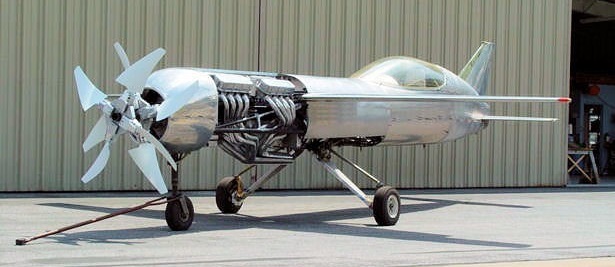
The racer employs a unique engine cooling system. To eliminate any unnecessary parasitic drag on the fuselage, all scoops typically found in this type application are absent. Water from the engine cooling jackets is directed through the wings in parallel tubing, while the wings themselves are filled with water. Heat is transferred from the tubing into the water and heat from the water is transferred overboard through the wing skins. The wing will hold about 50 gallons of water adding about 400 pounds to the weight of the aircraft, which will help it reach the unlimited class weight limit.

All custom crafted by Eric Hereth, the fuselage is 31 inches in diameter with the canopy protruding 12 inches above its top line. It is constructed of welded chromoly tubing, stressed for over 10 g’s and covered in aluminum sheeting. Spinner to tail the aircraft measures 28 feet, with a wingspan of 20 feet and a cord length of four feet at the root. Wing area is 58 square feet, resulting in a wing loading of nearly 100 pounds per square foot.

A change in the rules instituted by the Reno Air Racing Association (RARA) prevented the racer from completing in the unlimited category, and as a result, work on the nearly completed aircraft was halted in 2012.
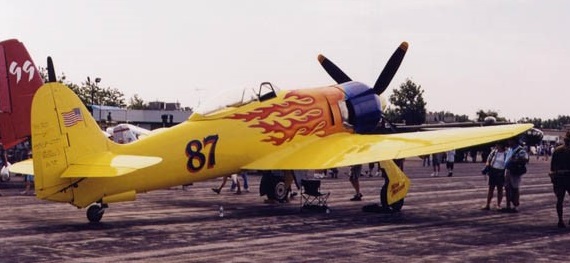
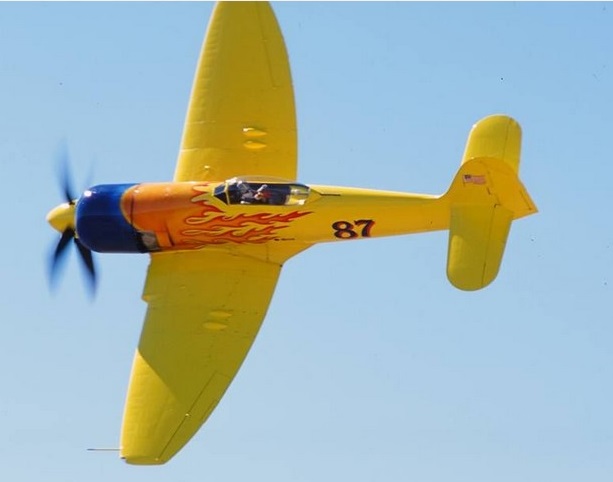
Miss Merced / Signal Sea Fury / Super Chief

Miss Merced was delivered to RCN as WG567 and brought on charge on August 28, 1951.

Ending service on February 8, 1957, it was owned by Robert P. Vanderveken, Pierrefords, Quebec, from September 1961-1965 and registered as CF-VAN.

Owned by Michael D. Carroll, Long Beach, CA, 1965-1969, it was registered as N878M and modifed as racer. Military equipment removed, airframe lightened. Outer wing panels clipped (removing 6.5 ft. total). Small bubble canopy installed.

The first race appearance was at Reno 1966. It was flown as race #87/”Signal Sea Fury” by Lyle Shelton.

Owned by Sherman Cooper, Merced, CA, 1969-1972, it flew as Race #87/Miss Merced.

Reno – 1970 – Unlimited Class – Hawker Siddeley Sea Fury FB Mk.11 (#87) “Miss Merced” (N878M) William (Sherm) Cooper Finished 3rd (Gold) Speed 412.583 mph

Reno 1970

It nosed over during forced landing after engine failure near Mojave, CA, November 13, 1971.

Frank C. Sanders, Chino, CA, acquired the wreck in 1980-1981, who sold to James A. Mott, South Gate, CA, in 1984. It was rebuilt at Chino, 1984-1988 and flew as race #42/Super Chief.

Stephen Bolander and Jim Michaels/J&S Aviation, Oconomowoc, WI, owned N878M March 24, 1999-2002, trucking it from Chino to Ione, CA for restoration. Fitted with Wright R-3350 and additional racing mods. First flight, Ione, CA, March 2000, and flown as race #87/Miss Merced.

Owned by Eric Woelbing, Franksville, WI, July 21, 2003-2004. Flown as race #87/Miss Merced. Based at Kenosha Airport, WI.

Yak-11

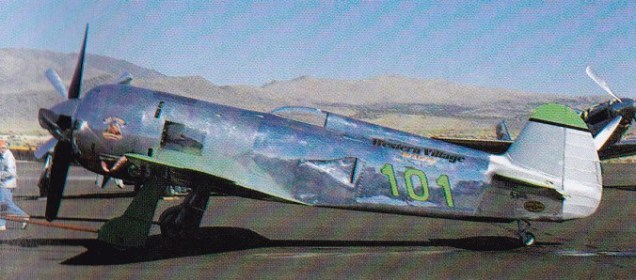
Frenchman Jean Salis recovered some 42 Yakovlev Yak-11 airframes from Egypt. Though a large number of these aircraft have been rebuilt as warbird fighters, some have also been adopted as air racing machines, many being re-engined with American powerplants. Oregon-based Bob Yancey took one such airframe and extensively rebuilt and modified it with the R-2800 engine from a Vought F4U-4 Corsair, a much larger and more reliable powerplant than the stock Shvetsov unit. Large areas of the previously fabric covered Yak were skinned in metal, and the wings were modified slightly. The Yak-11 is a very fast aircraft in its stock form and many believed the much-modified, re-engined Yancey airframe would be an ideal pylon racer and would take victory early on. However, despite this the aeroplane has proved disappointing in speed performance.

YanceyYak-11
Span: 8.5 m (30 ft 10 in)
Length: about 8.5 m (27 ft 10.75 in)
Powerplant: 1 x Pratt & Whitney R-2800, about 1640 kW (2,200 hp)
Max TO weight: about 2540 kg (5,600 lb)
Max speed: about 420 mph

Voodoo

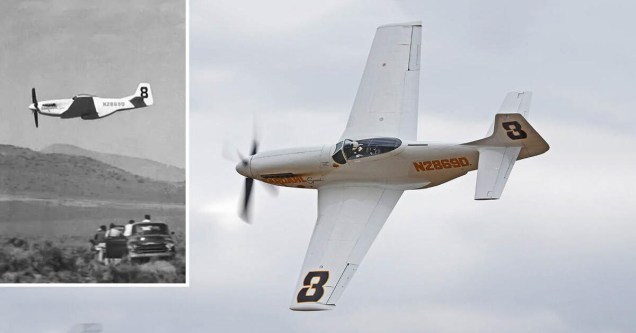
A modified P-51 Mustang, Voodoo was built from parts. It was built in the 90s and started racing right from the get go, in a stock configuration.It was slowly modified over the last 25 years into a full-blown racer. The wingspan is reduced by two and a half feet on each side. There’s a production break on the wing, so the outboard portion is removed. The canopy is much smaller. It has a smaller radiator scoop and hat to supplement the cooling with a spray bar system. The aircraft doesn’t have any automatic systems, it’s all manual. Three different wheels in the cockpit adjust water flows and methanol flows.

The biggest modification is the engine. The stock Rolls Royce Merlin put out around 1,700 horsepower, Voodoo has 34 to 3,600 horsepower. Ground speed on the course is about 540 miles per hour (869 km/h) compared to stock Mustangs are doing about 340 (547 km/h).

After five days of qualifying, heats, and semi-finals, the 2013 Reno Air Races came to a finish on Sunday with Steve Hinton, Jr., flying the modified P-51 Mustang known as “Voodoo,” winning the Unlimited Class Breitling Gold Race, with a time of 7:59.313 and an average speed of 482.074 MPH.

Hinton beat the second place finisher, Matt Jackson flying “Strega,” by more than seven seconds. Sherman Smoot, flying the Yak 11 “Czech Mate,” finished third.

Steve Hinton, pilot/Mechanic, won the Unlimited class Gold for 2016.

Steven Hinton, pilot, broke the speed record for an internal combustion engine-powered airplane, Class C-1e, on a 3 km closed course in September 2017. Hinton was flying the highly-modified P-51 Mustang named Voodoo.

Over four laps, Hinton took Voodoo to an average speed of 531 mph. The fastest lap was nearly 555 mph according to Pursuit Aviation, an aerial cinematography company that documented the flight. The previous record was set at 318 mph in 2012 by Will Whiteside Jr. in a Yak-3U named Steadfast.

The ultimate goal was to break the speed record over a 3 km closed course set in 1989 by Lyle Shelton in Rare Bear — a Grumman F8F-2 Bearcat. While Hinton’s speed was slightly quicker than Shelton’s, had the rules not changed the record would have to beat by 1 percent, translating to 533 mph.

Steven Hinton is the son of Steve Hinton, a pilot in his own right who held the 3 km speed record before Shelton, from 1979 to 1989. Hinton Sr. is the president of Planes of Fame Air Museum in Chino, California.

Vendetta

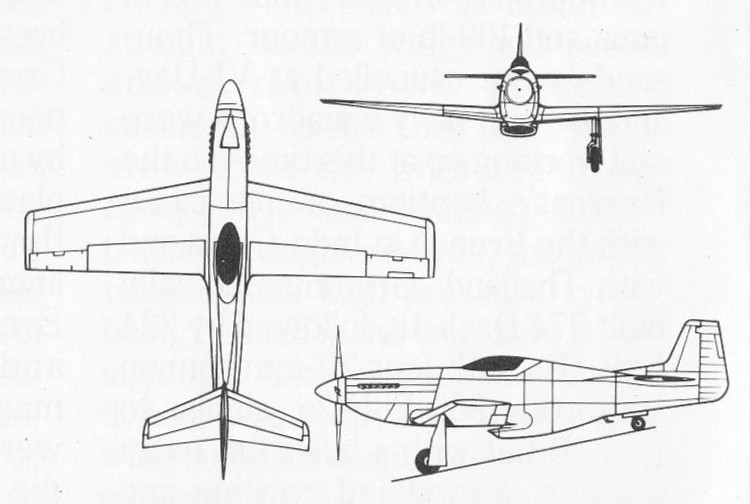
Conceived by John Dilley and Tom Kelley of Fort Wayne Air Service, Indiana, an experienced aerodynamics team was assembled to design the aircraft, which was to be based on a P-51D Mustang fuselage from a crash wreck and a new wing (without tip tanks) from an executive Lear Jet. The type is generally known as the Learstang by Unlimited class racing afficionados. The Lear mainplane was mated to the Mustang fuselage and the aircraft also utilised the Lear’s swept horizontal stabiliser. The engine was specially designed and initially Jack Hovey built the special racing Merlin but the task was later taken on by Fort Wayne Air Service’s own Merlin shop

Vendetta
Length: 9.83 m (32 ft 3 in)
Powerplant: 1 x Rolls-Royce Merlin 622, about 2423 kW (3,250 hp)
Max TO weight: about 3289 kg (7,250 lb)
Max speed: 480+ mph at low altitude

Tsunami

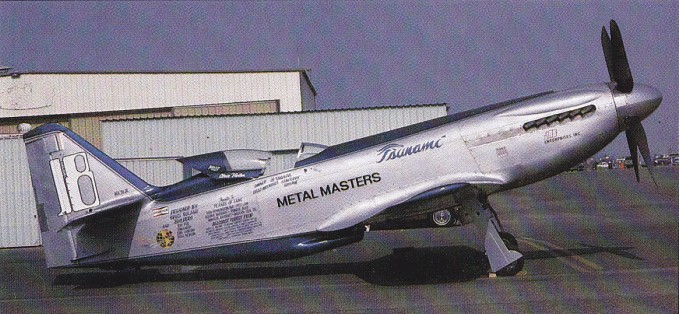
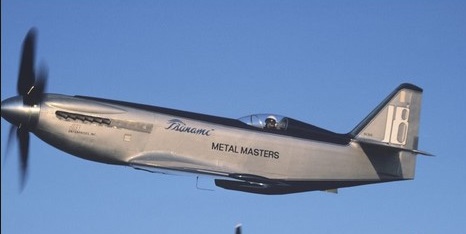
This Unlimited racer evolved as a direct result of John Sandberg and Bruce Boland. Both had been involved in the world’s fastest motor sport for the last 25 years, Boland as a design aerodynamicist with Lockheed’s advanced projects’ engineering department, and Sandberg as a powerplant specialist and accomplished pilot. His engine shop, JRS Enterprises, rebuilds Merlin and Allison inline engines for warbirds, though its speciality is the larger radial powerplants. When discussions began on the design and construction of a custom-built Unlimited in the early 1970s, a lightweight, Allison-powered racer was envisaged. However, as the project evolved and both men put their considerable input into the design, a slightly larger and racey-looking Merlin-powered aeroplane emerged.

Tsunami first flew in 1986.

Tsunarni
Powerplant: l x hybrid Merlin based on the Packard V-1650-7 with elements of the Rolls-Royce Merlin 624 and 724, 2684 kW (3,600 hp)
Max speed: 500+ mph at low altitude

Sumthin’ Else / Miss Foxy Lady

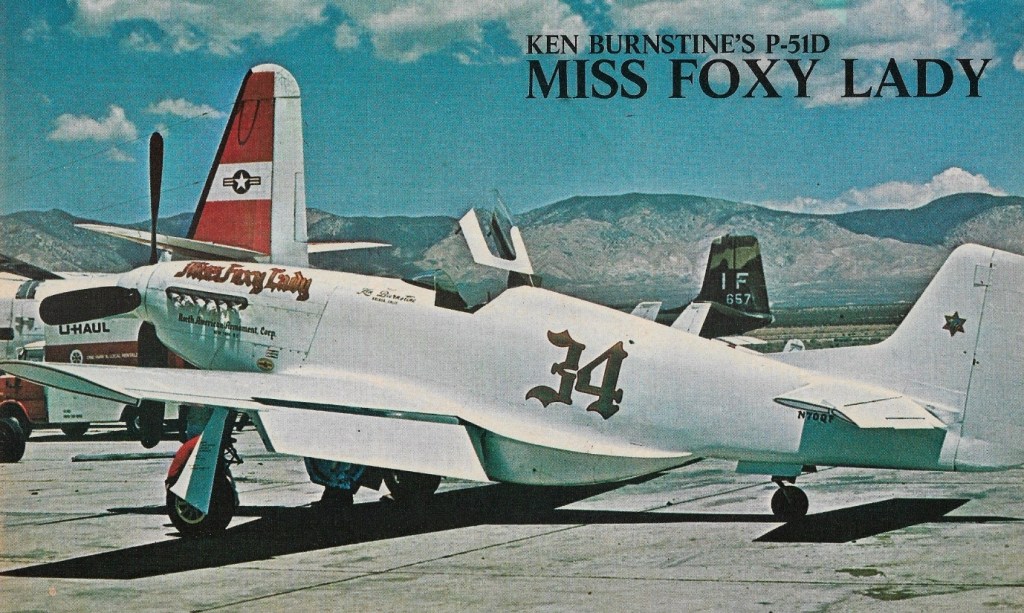
A P-51 Mustang-based racer, Surnthin’ Else belonged to World Airlines chief pilot John Crocker. Equipped with clipped wings and Hoerner wing tips, faired low-profile canopy and a Hovey machine products racing Merlin, this was one of the first Mustangs so modified. It was built up by Ken Burnstine, who was killed in another Mustang) and previously raced as Miss Foxy Lady.

Carrying the racing number six, Sumthin’ Else sports a colour scheme of white with a black spinner and nose that becomes a black fuselage stripe, and a black tail unit.

It took first place in the Unlimited Gold Championship race at Reno in 1979, with John Crocker at the controls, but has not been very competitive since.

Sumthin’Else
Span: clipped from 11.89 m (37 ft 0.75 in)
Length: 9.83 m (32 ft 3 in)
Powerplant: 1 x Packard V-1650 Merlin, 2088 kW (2,800 hp)
Max TO weight: about 3175 kg (7,000 lb)
Max speed: about 460 mph at low altitude

Super Corsair

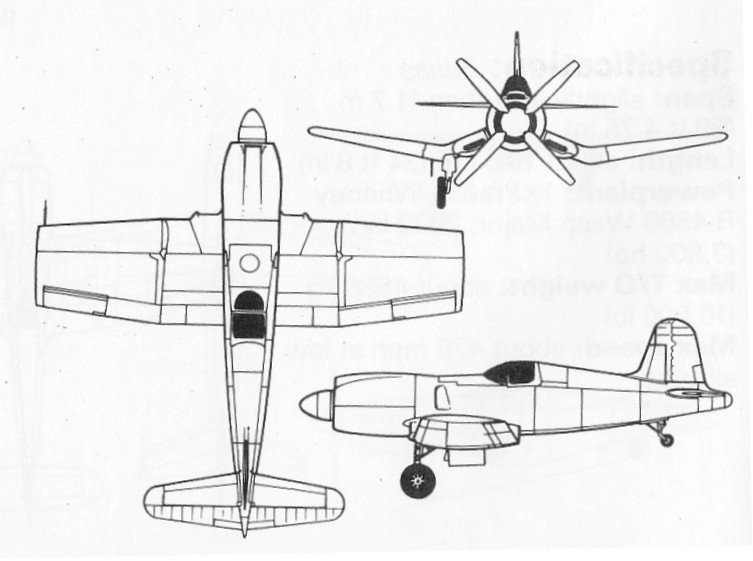
The airframe started life as an F4U-4 Corsair but was transformed into an F2G variant with the John Sandberg-built Pratt & Whitney engine. Reminiscent of the specially modified Corsairs flown by Cook Cleland at the post-war races at Cleveland, the Super Corsair is powered by an R-4360 engine. The clipped wings have square-cut tips just outboard of the ailerons and an airframe extensively cleaned up to reduce drag. Built at Chino, California, by Fighter Rebuilders, the Super Corsair first appeared at Reno in 1982. This was the first time an R-4360 engine had been heard on a race course since Cleveland in 1949.

Gallery

Super Corsair
Span: clipped from 12.48 m (40 ft 11.75 in)
Length: 10.17 m (33 ft 4.5 in)
Powerplant: 1 x Pratt & Whitney R-4360 Wasp Major, 2833 kW (3,800 hp)
Max TO weight: about 3946 kg (8,700 lb)
Max speed: about 490 mph at low Altitude