2024 aluminium
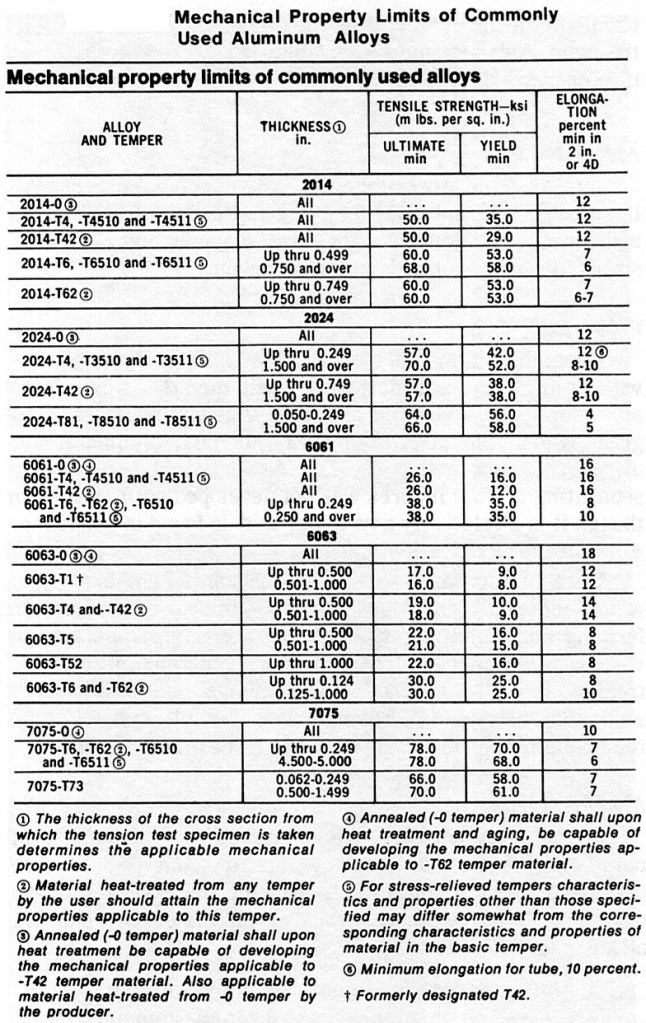
2024 aluminium alloy is an aluminium alloy, with copper as the primary alloying element. It is used in applications requiring high strength-to-weight ratio, as well as good fatigue resistance. It is weldable only through friction welding, and has average machinability. Due to poor corrosion resistance, it is often clad with aluminium or Al-1Zn for protection, although this may reduce the fatigue strength. In older systems of terminology, 2XXX series alloys were known as duralumin, and this alloy was named 24ST.
2024 is commonly extruded, and also available in alclad sheet and plate forms. It is not commonly forged (the related 2014 aluminium alloy is, though).
Due to its high strength and fatigue resistance, 2024 is widely used in aircraft, especially wing and fuselage structures under tension. Additionally, since the material is susceptible to thermal shock, 2024 is used in qualification of liquid penetrant tests outside of normal temperature ranges.
4130 Steel
41xx steel is a family of SAE steel grades, as specified by the Society of Automotive Engineers (SAE). Alloying elements include chromium and molybdenum, and as a result these materials are often informally referred to as chromoly steel (common variant stylings include chrome-moly, cro-moly, CrMo, CRMO, CR-MOLY, and similar). They have an excellent strength to weight ratio and are considerably stronger and harder than standard 1020 steel, but are not easily welded, requiring thermal treatment both before and after welding to avoid cold cracking.
While these grades of steel do contain chromium, it is not in great enough quantities to provide the corrosion resistance found in stainless steel.
Examples of applications for 4130, 4140, and 4145 include structural tubing, bicycle frames, gas bottles for transportation of pressurized gases, firearm parts, clutch and flywheel components, and roll cages. 4150 stands out as being one of the steels accepted for use in M16 rifle and M4 carbine barrels by the United States military. These steels are also used in aircraft parts and therefore 41xx grade structural tubing is sometimes referred to as “aircraft tubing”.
6061 aluminium
6061 aluminium alloy (Unified Numbering System (UNS) designation A96061) is a precipitation-hardened aluminium alloy, containing magnesium and silicon as its major alloying elements. Originally called “Alloy 61S”, it was developed in 1935.[2] It has good mechanical properties, exhibits good weldability, and is very commonly extruded (second in popularity only to 6063).[3] It is one of the most common alloys of aluminium for general-purpose use.
It is commonly available in pre-tempered grades such as 6061-O (annealed), tempered grades such as 6061-T6 (solutionized and artificially aged) and 6061-T651 (solutionized, stress-relieved stretched and artificially aged).
6061 is commonly used for the construction of aircraft structures, such as wings and fuselages, more commonly in homebuilt aircraft than commercial or military aircraft.[17] 2024 alloy is somewhat stronger, but 6061 is more easily worked and remains resistant to corrosion even when the surface is abraded. This is not the case for 2024, which is usually used with a thin Alclad coating for corrosion resistance.
7075 aluminium
7075 aluminium alloy (AA7075) is an aluminium alloy with zinc as the primary alloying element. It has excellent mechanical properties and exhibits good ductility, high strength, toughness, and good resistance to fatigue. It is more susceptible to embrittlement than many other aluminium alloys because of microsegregation, but has significantly better corrosion resistance than the alloys from the 2000 series. It is one of the most commonly used aluminium alloys for highly stressed structural applications and has been extensively used in aircraft structural parts.
AAM – Air-to-air missile
Absolute Altitude
The measureable height of an aircraft above the actual terrain.
Absolute Ceiling
The maximum altitude above sea level at which an aircraft can maintain level flight under Standard Air conditions.
Accelerated Stall
Any stall made to occur at other than 1g.
Accessory Group
Mechanical and electrical units mounted on an engine necessary for its operation, such as starter, magnetos, fuel pumps, etc.
Ace
A combat pilot who has brought down five or more enemy planes.
Ack-Ack
An anti-aircraft gun or anti-aircraft fire.
AD
Airworthiness directive
Adcock Range
National low-frequency radio navigation system (c.1930-c.1950) replaced by an omnirange (VOR) system. It consisted of four segmented quadrants broadcasting Morse Code “A” (dot-dash) and “N” (dash-dot) signals in opposing quadrants so that pilots could orient their position relative to a “beam” broadcasting a steady tone, and a Morse Code station identifier. Using a “build-and-fade” technique, a pilot could (ideally) pinpoint his location by the strength or weakness of a signal.
ADF
Automatic Direction Finding via automated radio.
Adiabatic
Occurring without loss or gain of heat.
ADS-B
Automatic Dependent Surveillance – Broadcast
Position based on GPS. More accurate and with greater coverage than radar
ADS-B IN
Receives data about aircraft in the area, adding to situational awareness.
ADS-B OUT
Transmits accurate aircraft position data
AEW
Airborne Early Warning
ADV
Air Defence Variant
Adverse yaw
The tendency of aircraft to always yaw in the opposite direction to the turn when aileron is applied. Caused by drag of the downwards aileron and counter-acted by rudder application.
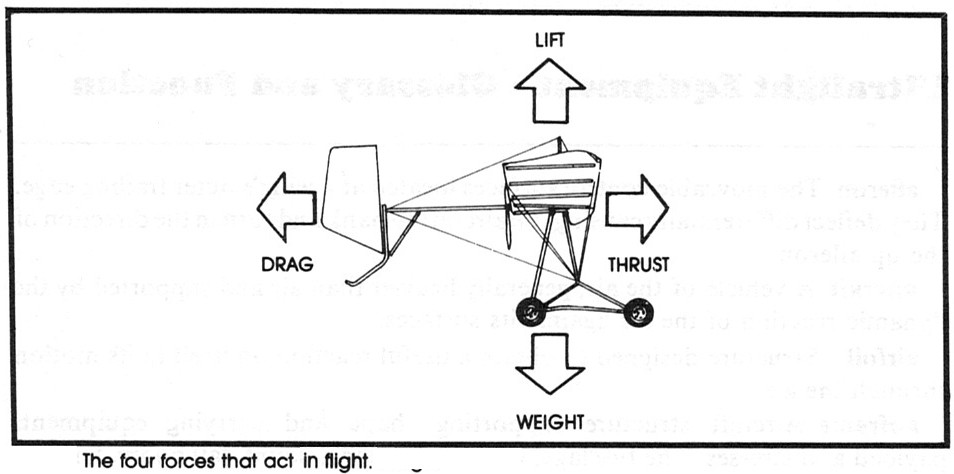
Aerodynamic Forces
Aerodynamics
The science of air in motion.
Aeronaut
One who operates or travels in an airship or balloon.
Aeronautics
The science of aircraft operations.
AFB
Air Force Base
Afterburner
A device incorporated in the tailpipe of a turbojet engine for injecting fuel into the hot exhaust and burning it to provide extra thrust.
AGL
Above ground level – altitude.
AGM
Air-to-ground Missile
Aileron
A control surface on the trailing edge of the wing which creates bank or helps reduce roll.
Air foil / Aerofoil
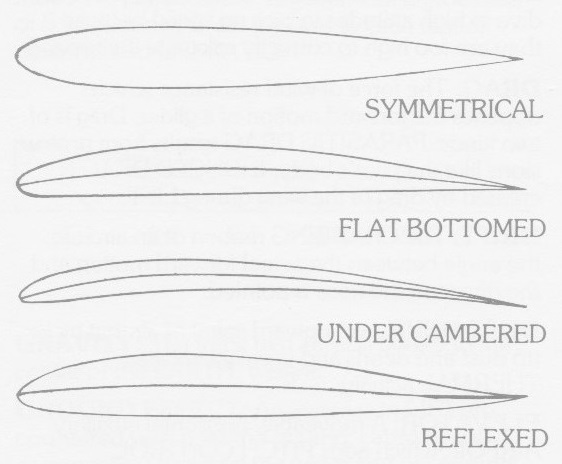
Any surface designed to react to the air through which it moves. Four basic types:
- Symmetrical – curved on top and bottom
- Flat bottomed
- Under cambered – the bottom surface follows the camber of the upper surface; as in a flexible wing
- Reflexed – characterised by the turned up trailing edge
Airframe
The main structure of an aircraft.
Airspeed
The speed of the aircraft through the air.
Amphibian
An aircraft which, equipped with a hull or floats in addition to a wheeled undercarriage, can operate from land or water.
AMRAAM
Advanced Medium-Range Air-to-air Missile
ANG
Air National Guard
Angle of Attack
The angle of the wing in relation to the direction of the wind’s motion. The angle is created by the intersection of the line of the chord of the wing and wind flow.

Anhedral
The angle between each wing and the horizontal when the wingtips are inclined downwards towards the tips.
Anodising
An electrolytic process of corrosion protection for aluminium.
Apex
The point of an angle made by the two wing leading edges.
ASL
Above sea level – altitude
ASM
Anti-ship Missile
Aspect ratio
Wingspan divided by average chord.
For tapered or elliptical wing – square of the wingspan divided by wing area.
Atmosphere
A unit of pressure equal to the pressure of air at sea level or about 14.7 lb/sq.in (10 newtons/sq.cm)
Autogiro
The autogiro has an engine-driven propeller like a fixed-wing aeroplane, and a rotor which is not engine-driven but is purely and simply a rotating wing. In flight the propeller drives the Autogiro forward, while the motion of the air now turns the rotor automatically (known as auto-rotation). As the rotor turns, air passes over its aerofoil shaped blades, developing lift in the same way as the wing of an aeroplane. As long as the Autogiro maintains a forward speed the rotor will develop sufficient lift to keep the machine airborne. If forward speed drops the rotor will still be turned, but lift will be reduced, and the Autogiro will glide to earth.
(In the direct take-off type of Autogiro, the rotor is geared to the engine temporarily prior to take-off, permitting a jump-start, without forward run.)

Autopilot
A gyroscopic device invented by Dr. Elmer Sperry in 1913 to provide automatic stabilisation of an aircraft.
Avionics
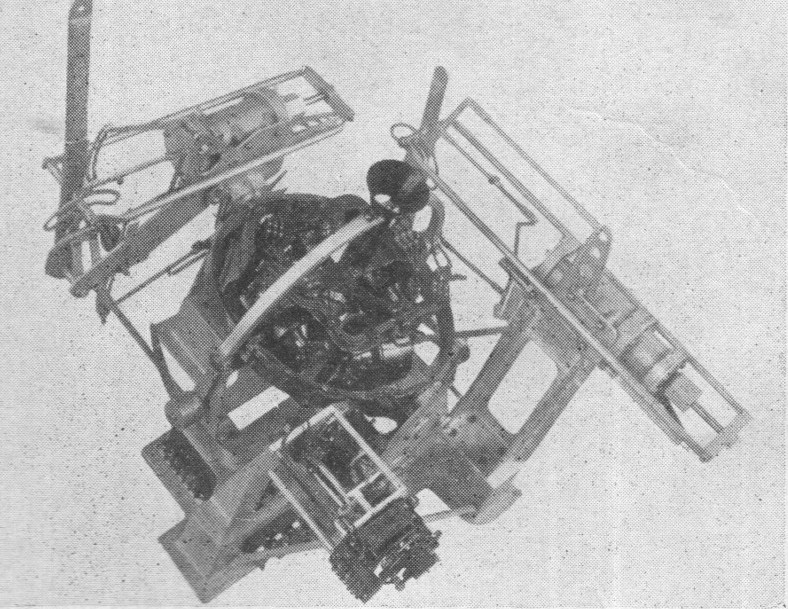
Any electronic system used to control the working of an aircraft
Axis
The line of any of the three planes (longitudinal, lateral, or vertical) that pass through an aircraft’s centre of gravity.

Balance, Aerodynamic
The arrangement of hinged control surfaces, such as rudder and elevators, so that the pressure of the airflow on the smaller area forward of the hinge tends to balance the pressure on the main control surface behind the hinge.
Balance, Mass or Static
The arrangement of hinged control surfaces, such as rudder and elevators, so that the moment of the part forward of the hinge balances that of the aft part.
Bank
The angle of lean to the side, or roll.
Barrel roll
An aeroplane manoeuvre in which a complete revolution about the longitudinal axis is made.
Battens
Strips of light wood or fibreglass inserted into pockets at the trailing edge of a wing to reduce flutter.
Bay
Biplane wings supported by interplane struts which sub-divide the span into sections termed ‘bays’.
Beta mode
A constant speed prop in reverse thrust to act as a airbrake when activated in flight. Also allows reversing when activated on the ground.
Billow
The upward curve of the flexibly lifting surface when filled with air. Billow substantially influences the handling on a hang glider.

Biplane
The type of aircraft that has two wings, one above the other.
Blimp
A non-rigid airship.
Bombardier
A bomber crew member who releases the bombs.
Cabane Strut
A wing strut which is attached to the fuselage.
Camber
The curvature revealed by a cross-section of a wing.

Canard
An aircraft that flies tail first, with its main lift surface at the aft end of its structure.
Canard Design
The canard configuration involves a tail-mounted wing and nose mounted foreplanes.
The nose of a normal tailless delta aircraft can be raised only by the application of up-elevon, which produces a down-load at the tail that must be subtracted from the overall wing lift in any lift equation. This translates to a longer take-off run – since the landing gear is being pushed down onto the runway, the aeroplane has to accelerate to a higher speed to compensate for what is effectively a smaller wing – and an increase in the radius of any turn, since the tail is being pulled away from the origin of the turn radius. With a canard configuration the take-off run is shortened, since the elevons on both the tail and node deltas are deflected downwards, creating uploads that must be added to the overall wing/canard lift, and the turning radius is reduced as the foreplane pulls the nose in towards the origin of the turn radius.
Secondly, the canards create powerful vortices that stream back and out over the upper surfaces of the wings, re-energising the sluggish boundary layer vortices of those surfaces and delaying breakaway of the airflow over their all-important outer panels. This is particularly important at high angles of attack.
Cannular
Type of combustion chamber for jet engines in which individual flame tubes are mounted inside an annular or circular chamber.
Cantilever
A fixed wing which has no external wires for bracing.
Carb ice
When liquid fuel is vapourised and mixed with induction air it causes a large drop in temperature. The carburettor venturi effect further cools the airflow. If the carburettor temperature falls below zero degrees Celsius the water vapour condenses into ice. This may cause reduced power, rough running, or stoppage.
CCV – Control-Configured Vehicle
A conventional aircraft is naturally stable, with its centre of gravity located forward of the centre of lift, and requires balance by a constant down elevator, resulting in a down-load at the tail which is increased considerably in supersonic flight. A CCV is naturally unstable, with its centre of gravity well aft of its centre of lift: control is effectively powerful aerodynamic surfaces working in association with a computer directed automatic flight control system, resulting in up-load at the tail in subsonic flight and only modest down-load in supersonic flight. The key to CCV design is relaxed static stability, which means that left to itself the airframe would turn end-over-end immediately after take-off. However, automatic flight control system uses its air data system, accelerometers and rate gyros to sense any such tendency immediately, and can apply corrective control-surface deflections at a rate of more than 100 per second.
Given an automatic flight-control system the weight distribution of the CCV aeroplane can be optimised for agility rather than stability, the computers ensuring that safe flight is maintained and that the pilot’s control inputs are immediately translated into the optimum control movements.
Centre of Gravity / C of G
The pivotal point within the aircraft mass around which all forces are balanced,
Centre of Pressure
The point of an airfoil where there is the most concentrated lift.
CFIT
Controlled flight into terrain
CFZ
Common frequency zone
Chaff / Window
Simple tinfoil strips could be dropped that would reflect spurious electromagnetic impulses onto watching radar screens, and their jamming effect was most effective when the strips were cut to half the wavelength of the radar device they were meant to delude.
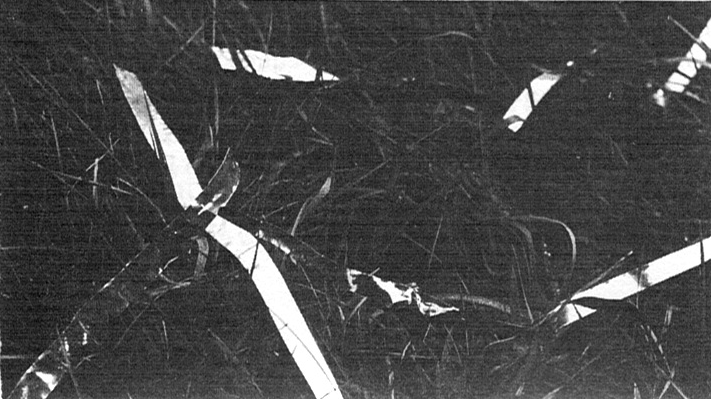
The British called the tinfoil strips ‘Window’, and the Germans called theirs ‘Düppel’ (radar chaff).
In the summer of 1942, both the British and Germans worked intensively on experiments with tinfoil strips as the best means for jamming enemy radar. But British scientists concluded that the strips could not be used because they might give away the secret to the enemy, and the Britain’s radar-based air defence system would become useless. Meanwhile German scientists reached the same conclusion. The Germans actually halted their experiments with anti-jamming techniques, to keep Britain from finding out about radar-chaff jamming.
In August 1942, while the tinfoil strip concept was being strictly guarded along both sides of the English Channel, the Japanese were serenely dropping giman-shi (‘tricking paper’) virtually every night in their bombing raids on Guadalcanal, to paralyze US radar-guided anti-aircraft guns. The idea of gluing thin electrical wires between paper stripes approximately 1 inch wide and 30 inches long – equal to half the wave length of the US gun-laying radar – came from Corvette Captain Hajime Sudo, chief of radar defense for the Imperial Japanese Navy. The strips, dropped in packets of 20 strips each, cut down substantially on Japanese loses in night bombing raids.
Neither the Japanese nor the Americans informed their allies about this novel device, and almost one year went by before the British decided to remove ‘Window’, their tinfoil strip jamming device, from the list of classified materials, and to deploy it over Germany for the first time.
It was decided that Bomber Command would start using the tin-foil strip radar jamming device on its raids beginning 23 July 1943. During their run in each bomber crew dropped one loose bundle of tinfoil strips per minute; each bundle contained 2000 strips and weighed 1.5 lb, and each was designed to simulate one heavy bomber. Every bundle formed a tinfoil cloud that for approximately 15 minutes mimicked the profile of one aircraft on a German radar screen. The German radar-guided searchlights and radar guided flak were jammed so that aimed fire became impossible. The Würzburg radar sets at the ground control stations were unable to guide a single night fighter. The Lichtenstein BC airborne radar carried by the German night fighters also completely failed.
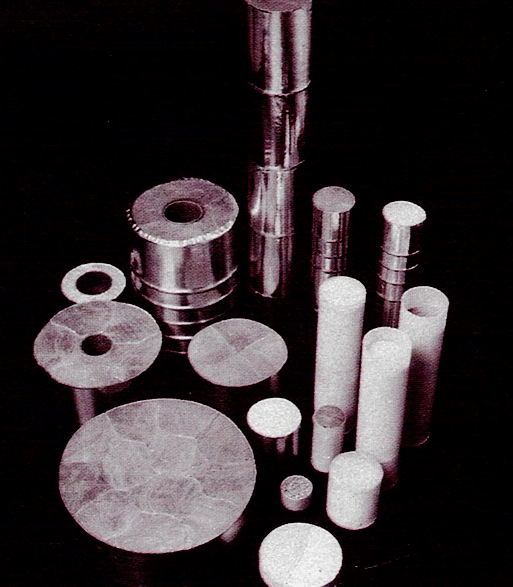
Modern chaff is normally loaded as rolls and automatically cut to the desired length as it is released.
Chord
The width of the wing measured parallel to the centre line of the aircraft from the leading edge to trailing edge.
Cluster Bomb
An air delivered, free fall weapon that contains numerous submunitions or bomblets.
Co-Axial Propellers
Two propellers mounted one behind the other and driven independently in opposite directions.
Compression strut
Structural member between leading and trailing edge to prevent twist.
Compressibility Drag
The increase of drag arising from the compression of air when flying at high speeds.
Conical Wing
A straight leading edge on a Rogallo wing produces a Conical sail.
Constant Speed Propeller
Consists of a governor, a constant speed unit (CSU) which hydraulically maintains set engine revolutions by automatically altering the pitch of the propeller blades in flight.
Contrail
Streaks of condensed water vapour created in the air by an airplane at high altitude.
Control Bar
The bar below the frame that controls the direction of the glider via weight shift. On the early Rogallos the control bar was two parallel bars from which the pilot ‘hung’ by the armpits. Later control bars are triangular.
Control surfaces
The air deflection surfaces which control roll, pitch, and yaw of an aircraft.
Conventional weapons
Non-nuclear weapons
Convertiplane
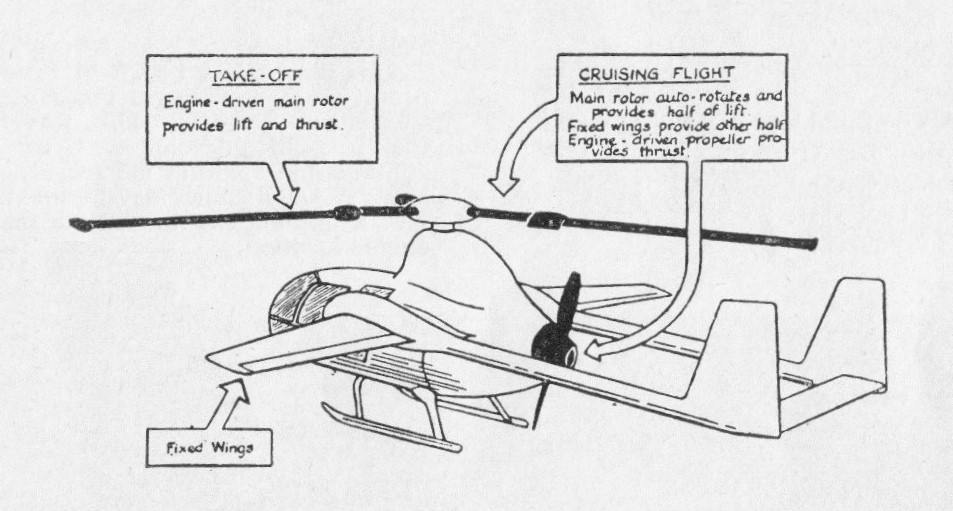
The Convertiplane is an aircraft which takes off as a helicopter and “converts” into an Autogiro or fixed wing aeroplane for forward flight. Its rotor is engine-driven and it takes of like a normal helicopter. In the air, engine power is gradually transferred from the rotor to orthodox propellers. These propellers provide thrust (and counter torque), and the rotor is used solely to provide lift and control, as in an Autogiro.
Convertiplanes usually have small fixed wings as well as a rotor, and these provide most of the lift required in cruising flight, with the rotor in auto-rotation. Examples are the Farfadet, McDonnell XV-1, and Rotodyne.
Other types of convertiplane have rotors that tilt through 90 degrees to serve as propellers for cruising flight. Examples are the Bell XV-3 and Transcendental Model I-G.
Convection currents
A series of localised air currents which are both ascending and descending. They are the cause of turbulence and can also provide lift.
Cowling
Streamline form which more or less encloses the engine.
Crabbing
Pointing the nose slightly upwind to counteract drift and maintain a track.
Cross Spar
The lateral tube of a hang glider which connects both wing spars and the keel spar and maintains their spread. The control bar is mounted directly below the cross spar.
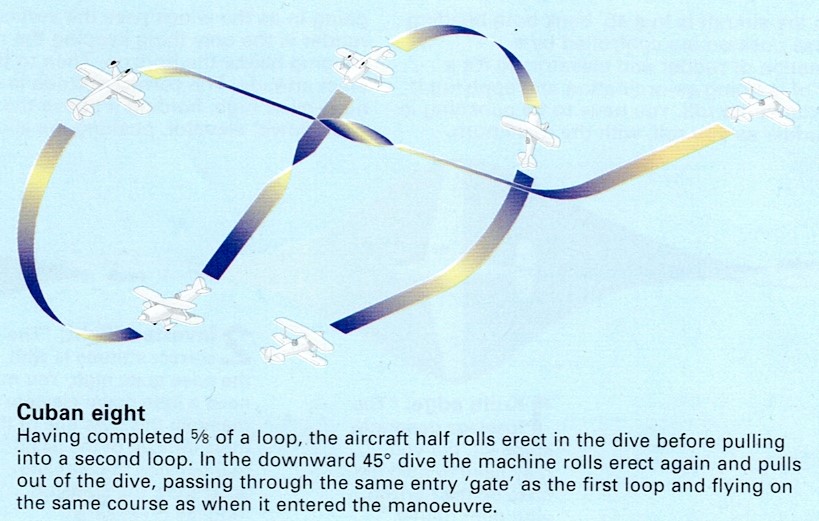
Cuban eight
Cut-away
Regular outline shape altered to enlarge the pilot’s field of view or give controls etc greater clearance.
CVR
Cockpit voice recorder
Cockpit video recorder
Cyclic Pitch Control
Means of changing the pitch of a helicopter rotor blades progressively, to provide a horizontal thrust component for flight in any horizontal direction. Alters the angle of a helicopter main rotor blades through a centrally mounted joystick allowing the helicopter to be pivoted, down, up, and to the left and right.
Cylindrical wing
A helical twist of the leading edge of a Rogallo hang-glider produces a cylindrical sail.
Dead man’s curve
The dead man’s curve, also known as the height-velocity (H/V) diagram, is a chart that shows the safe and unsafe flight profiles for a specific helicopter:
The shaded area of the chart indicates combinations of altitude and airspeed that make it difficult or impossible to land safely after an engine failure. The term “dead man’s curve” is used because flying outside of the safe area can be fatal if the helicopter loses power or transmission.
Dead reckoning
The determination of the position of an aircraft solely from the record of the direction and distance of its course.
Deflexers
Outrigger cables which counteract the tendency of the leading edge to bend while in flight.
Dihedral
The angle which the spanwise axis of an aerofoil makes the fuselage when the wing or tailplane tip is higher than its root attachment (positive dihedral). The upward angle of the wings on the vertical plane for the purpose of greater stability.
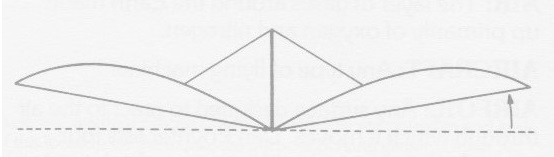
Dirigible
Airship
Distance
1 kilometre = 0.62 statute miles = 0.54 nautical miles
1 nautical mile = 1.15 statute miles – 1.85 kilometres
1 nautical mile per hour = 1 knot
Diurnal Winds
The daily wind pattern over a particular area.
Dive
A steep downward flight through the air.
Dive brakes
Flaps, special fairings, or other movable surfaces that can be turned into to airflow to increase resistance/drag to reduce diving speed.
Doppler Radar
Radar that uses Doppler Effect (the frequency shift in propagated electromagnetic caused by the relative motion of the source of the energy and of a reflecting object; ie, the target
Dorsal
Relating to located on the upper surface.
Drag
The force of wind resistance which opposes the forward motion:
Drag chute
A heavy-duty parachute attached to the aircraft structure to slow the aircraft on landing.
Drift
The crabbing motion – the angle between the actual forward motion and the direction the nose is pointed.
Drop tank
Additional fuel tank that can be dropped when empty
Delta
A triangular shape – generally of the wing.
Drogue
A small parachute slowing down or stabilising something.
Duralumin
A wrought alloy of aluminium with small quantities of copper, magnesium and manganese added.
Dust devil
An upward spiral of air that picks up dust and debris and usually indicates thermal activity.
ECM
Electronic Counter Measures – Airborne equipment used to reduce the effectiveness of an enemy’s radar or other devices which generate electromagnetic radiation.
EASA – European Union Aviation Safety Agency
EFIS
Electronic Flight Information System
Elevator
Movable control surface on the trailing edge of an aircraft’s tailplane to control pitching movement.
Elevon
Dual purpose control surface on flying wings for angle of attack and roll control.
Elint
Electronic Intelligence
Empennage
The tail surfaces
EW
Electronic Warfare
Fairing
The streamlining of a surface to reduce the drag.
Fan-Jet
- A jet engine having a fan in its forward end that draws in extra air whose compression and expulsion provide extra thrust.
- An aircraft powered by a fan-jet engine.
Fat Man
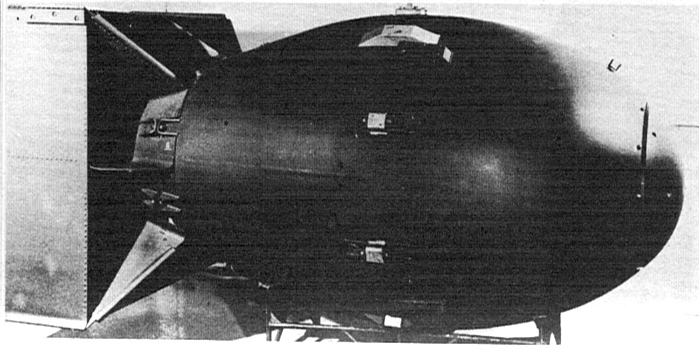
The second atomic bomb, dropped on Nagasaki, Japan, at noon, Thursday 9 August 1945 captioned by Major Sweeny. There were 40,000 dead and 60,000 wounded and destroyed 1.8 sq/miles / 4.7 sq/km from this, the first plutonium bomb.
Length: 10 ft +
Diameter: 5 ft
Weight: 11,000 lb
21 kiloton
Fenestron
Fenestron tails are generally slower to respond than standard tail rotors.

Fido
Fog Investigation Dispersal Operations
Based on the idea Churchill had formed in 1942, gasoline reactors were set up along the main runways of 15 of airfields in Great Britain. They warmed the air causing the ground fog to dissolve so that the aircraft could take-off and land more safely. During the 1944 Ardennes offensive only Fido enabled the aerial force to take-off.

Fillet
An extension of the wing or other surface at the attachment to the fuselage. Usually curved and streamlined to improve airflow.
Fin
The fixed, vertical surface at the tail to which the rudder is attached.
Flaps
Movable surfaces controlled by the pilot to serve as variable camber devices to improve lift at low speed, and to serve as air brakes.
Flare
The raising of an aircraft nose to arrest sink and reduce speed.
Flex
The curvature of a hang glider keel bar.
Flexible wing
Refers to the inflatable billow of the Rogallo wing.
Float
A buoyant watertight support fitted to the undercarriage of seaplanes or to the underside of the wings of flying boats as stabilisers.
Floatplane
An aeroplane designed to operate from water where floats replace wheels.
Flying-boat
An aeroplane where the fuselage is replaced by a sea-worthy hull for operations on water.
Flying wires
The cables below a wing which carry the normal flying loads.
Foot launch
A hang glider take-off unassisted by other sources of power.
Fuselage
The main body of an aircraft that holds the crew, passengers, and cargo.
G / G-Force
The unit of measurement for bodies undergoing acceleration that is equal to the acceleration of gravity: approximately 32.2 feet/second at sea level.
Gap
Distance between the upper and lower wings of a biplane.
Geodetic construction
Developed largely by Sir Barnes Wallis for a series of airships built by Vickers, it takes its name from the geodetic line, the shortest line between two points on a surface.
Geodetic construction involves the creation of curved space frames whose individual members follow geodetic lines along the surface, each undergoing either compression or tension. The resultant structure looks open weave, but has great strength for the weight. As well as a fail-safe structure it obviates the need for a stressed skin covering and, in 1930, was relatively straight forward to build.
G-LOC – Gravity induced loss of consciousness.
Influenced by G-force, fitness and fatigue. Occurs when a pilot is subjected to a rapid increase in g to a high level (above 5 g) or when sustained high g-loads are followed by a further increase. The body’s normal defence mechanism, increased heart rate and blood pressure, do not work rapidly or effectively enough to maintain blood pressure in the brain. Below a critical level the pilot loses consciousness suddenly and completely.
Unlike G-induce ‘blackout’ where recovery takes reduced G loading, G-LOC unconsciousness will last for 10-30 seconds followed by a phase of conscious but unresponsive before recovery with re-oxygenation of the brain.
Ground effect
The effect on the wings in close proximity to ground or water. Increases wing efficiency because the higher pressure under the wing obstructs floe around the wingtip. Also lowers the stalling speed.
Gull-wing
Wings having a marked change in dihedral in the wing span.
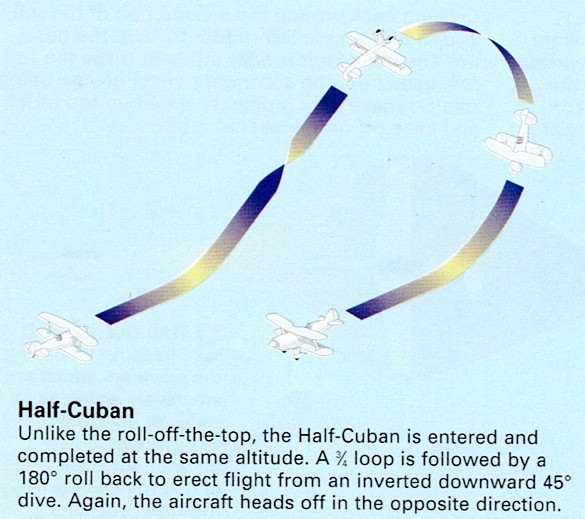
Half Cuban
Hardpoint
A reinforced position in the wings or fuselage to which external loads can be attached.
Hedge-hop
To fly an aircraft very close to the ground.
Helicopter
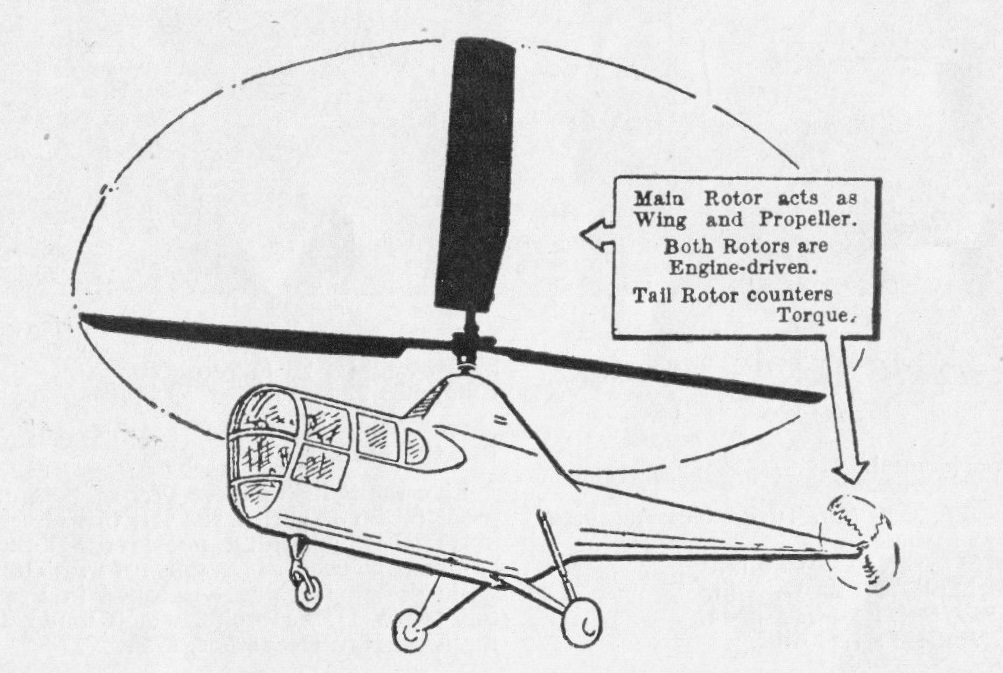
The helicopter’s rotor is turned continuously by the engine, and provides both lift and propulsion. It creates sufficient lift to keep the helicopter airborne without any forward speed. Thus the helicopter can take off and land vertically, and hover. Progress in any direction is achieved by tilting the whole rotor assembly, to provide thrust as well as lift: for example, by tilting it forward the helicopter is propelled forward. A helicopter can, therefore, fly forward, backward or sideways. Most single-rotor helicopters have a small tail rotor to counter torque of the main rotor, which would otherwise tend to rotate the whole fuselage in the opposite direction to the rotor.
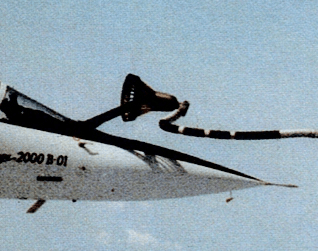
Hose and drogue
Airborne fuelling system
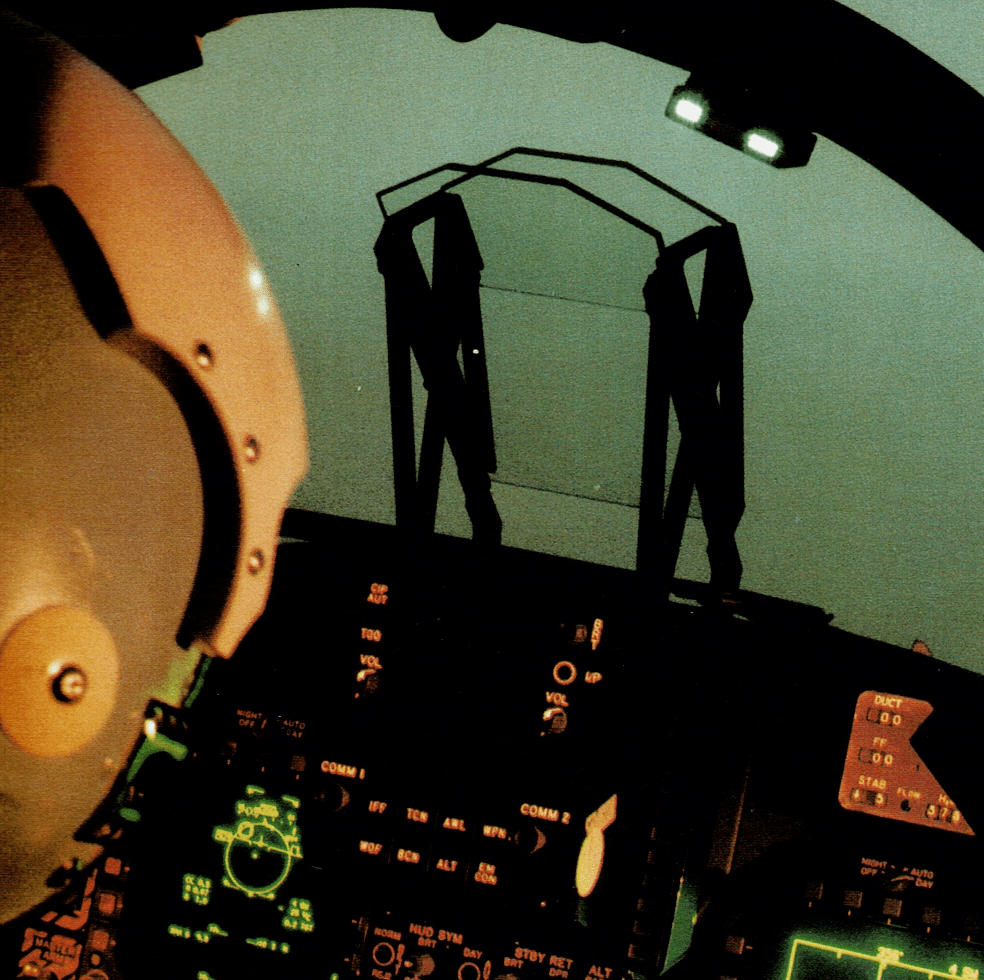
HUD – Head Up Display
Enables data to be projected onto an inclined glass panel in front of the pilots’ eyes. The pilot does not need to look down, the relevant data being presented in a stylised form focussed at infinity so there is no need to refocus his eyes.
The HUD can also accept data from laser range finders and forward-looking infra-red (FLIR) systems.
Humidity
The amount of atmospheric moisture.
Hydraulic lock
The entering of liquid (fuel or oil) into engine cylinders, by seepage or over-priming, causing increased pressures causing damage, usually in the form of a bent conrod.
IATA
International Air Transport Association
ICAO
International Civil Air Organisation
IDF
Israeli Defence Forces
IFF
Identification Friend or Foe – An electronic device to interrogate approaching aircraft.
IFR
Instrument Flight Rules – Flight by reference to on board instruments under conditions of poor visibility or darkness.
Unofficially;
- I Follow Roads
- I Follow Rivers
- I Follow Railways
ILS
Instrument Landing System
IMC – Instrument Meteorological Conditions
Incidence angle
Angle between the chord of a wing and the horizontal centre line of the aircraft
Induced drag
Drag created by the generation of lift.
Inline
Usually engine cylinder – forming a straight line in the engine block.
Seating – one behind the other.
Inversion
An increase in temperature with altitude through a layer of air.
IR
Infra-Red
ISA
Agreed International Standard Atmosphere to permit accurate comparison of performance figures – 1013.2 millibars at 15 deg C.
Isobar
A line on a map connecting places of equal barometric pressure.
Isotherm
A line on a map connecting points having the same temperature.
JASDF
Japanese Air Self Defence Force
JATO
Jet assisted takeoff – utilising solid or liquid fuel rockets to augment the takeoff power of an aircraft’s engines.
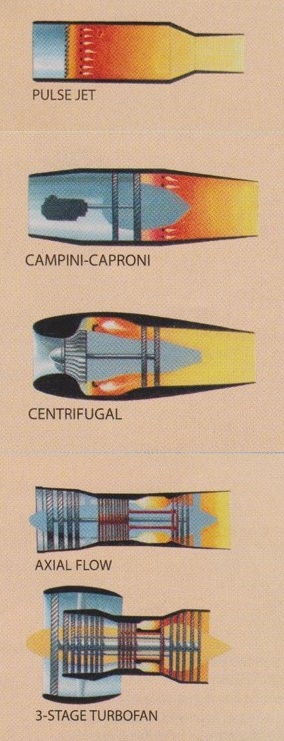
Jets
Jetstream
A long narrow high-altitude current of high-speed winds blowing generally from the west.
Joystick
Control lever normally connects to aileron and elevator on three-axis control aircraft.
Operates rudder and elevator on two-axis control aircraft.
JSTAR
Joint Surveillance and Targeting Aperture Radar System.
High-tech surveillance suite, carried over a battlefield in a Boeing 707-type aircraft. Provided a highly accurate wide-area coverage of any moving vehicle on the ground, tracking them accurately enough to target them precisely if needed.
Kinetic heating
Heating of an aircraft’s structure as a result of air friction.
Kingpost
Tubes above the wing centre anchoring landing wires and transferring negative loads to the fuselage.
Kite
Usually a tethered heavier than air aircraft, sustained in the air by its aerofoil surfaces inclined to the wing to generate lift.
kN
Kilo-Newton – measurement of force. The force necessary to provide a mass of 1 kg with an acceleration of 1 m/sec.
Krüger flap
A leading-edge device forming part of the undersurface of the leading edge, being hinged to swing down and forward to create a bluff leading edge suitable for low airspeeds on a high-speed wing.
Landing weight
The maximum weight at which an aircraft is permitted to land.
Landing wires
External bracing wires which support the wings when the aircraft is on the ground.
L/D
Lift / drag ratio
Leading edge
The front edge of an aerofoil, tailplane, fins, etc which first meets the airstream in normal flight.
Leech
The conical billow in the trailing edge of a hang glider sail.
Lift
The force generated by an aerofoil section, acting at right angles to the airstream flowing past it.
Little Boy
The atomic bomb dropped by Col. Paul W. Tibbets of the 509th Composite Group from B-29 ‘Enola Gay’ (named after Tibbets’ mother), on Hiroshima, Japan, on Monday 6 August 1945.
The explosive material used was uranium 235 which, unlike plutonium, had not yet been tested. On 26 July 1945, the atomic bomb case arrived at Tiniana Island aboard the cruiser Indianapolis. Part of the uranium was shipped on the same vessel, and the amount needed to make the critical mass was transported to the island by Douglas C-54 Skymaster. When the C-54 had landed at Hawaii, the authorities argued a regulation would not allow the plane to cross the Pacific with a cargo that weighed only one metric hundred-weight (110 lb); they insisted the plane be fully loaded.
At the 2:45am take-off from Tinian airfield, the B-29 carried a crew of 12 and 1400 gallons of fuel.
The first atomic bomb was dropped on Hiroshima from 30,000 ft at 8:15am.
It destroyed 80% of the city, killing 92,167 people and injuring 37,425.
Weight: approx. 5 ton
Length: 10 ft
Diameter: approx. 2 ft 6 in
Power: 16 kiloton

Lomcevak
Translated from Czech – berserk-head-ache.
It begins as an outside climbing snap roll but becomes a tail-over-nose tumble of one-and-a-half rotations for a properly executed Lomcevak. Usual recovery is a vertical dive.
To enter a Lomcevak, from upside-down position apply hard down elevator and ailerons in the direction of the desired roll with hard full opposite rudder. Controls remain in this position throughout the entire manoeuvre, however engine power is reduced immediat ely following entry. Critical functions determining whether the inverted snap roll progresses into the end-over-end tumble are exact airspeed, angle of climb and the ‘G’ break on entry. These factors vary with different aircraft but are 130 mph, 45 degrees and 4 – 5 ‘G’ in a Great Lakes, slightly higher in the Pitts Special.
Flying the Lomcevak
Longeron
A main structural load bearing fore and aft axis member within the fuselage.
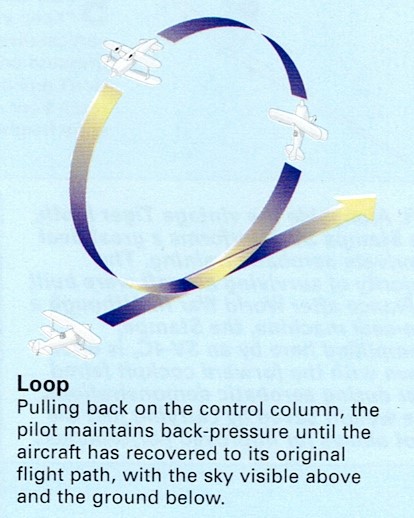
Loop
LORAN
A long range radio based navigational aid
LSA – Light Sport Aircraft
Can be used as a microlight or general aviation aircraft, depending on the pilot or instructor qualification.
Luftwaffe
German Air Force
MAC
Military Airlift Command
Mach
A means of recording speed as a ratio of the speed of sound in the same ambient conditions.
Named after the Austrian physicist Ernst Mach
MAD
Magnetic Anomaly Detector – carried by maritime reconnaissance aircraft to locate submarines beneath the surface.
Mayday
Distress call
MBZ
Mandatory broadcast zone
Monocoque
A structure in which the outer skin carries the primary stresses and is free from internal bracing.
Monoplane
An airplane with only one set of wings.
NAA
National Aeronautic Association of the USA
Charted in 1922 to promote the advancement of aviation and space flight in the USA. The US representative to the worldwide Federation Aeronautique Internationale. The NAA documents and certified flight records by US aircraft and spacecraft.
NACA
National Advisory Committee for Aeronautics (later NASA)
Nacelles
Streamlined housings which usually enclose the engines.
Napalm
Napthenic Acid and Palmitate, a jellied incendiary used as a filler for bombs.
NASA
National Aeronautics and Space Administration
Conducts and coordinates United Staes non-military research into problems of flight within and beyond the earth’s atmosphere.
Established in 1958 as an independent agency, with headquarters in Washington DC. It absorbed the National Advisory Committee for Aeronautics (NACA).
NATO
North Atlantic Treaty Organisation
NDT
Non-destructive testing
N Number
The United States did not formally register aircraft until 1927. In January 1927 temporary numbers were issued to existing aircraft. Later in 1927 permanent registrations began to be issued (with NC26: 1 to 25 were reserved by the Dept of Commerce). The US used a NC / C / R / NR / NS / X / NX prefix depending upon the licence status.
NORAD
North American Air Defence Command
Responsible for the air defence of the United States and Canada. Bands of radar stations in Canada and off the west coast of the USA watch for attacking aircraft. Aircraft patrol the Arctic and Atlantic and Pacific oceans.
Octane number
A number that is used to measure the anti-knock properties of gasoline and that increases as the likelihood of knocking decreases.
OCU
Operational Conversion Unit
OKB / Bureau of Experimental Constructions
(Russian: ОКБ). Name given in the Soviet period to organizations dedicated to the projection and construction of new aeronautical techniques.
Construction bureaus received an identification number and sometimes a name, however, there were a number of projection bureaus that simply kept the name of the main builder or the organization to which they belonged.
Generally, the OKB had a work group dedicated to developing the engineering projects and a production facility that executed the prototypes and developed the first phase of tests, called factory tests. In most cases the number assigned to the OKB was also assigned to the factory that was assigned to it. Thus, for example: OKB-155 could be interpreted as the Project Bureau associated with Factory No. 155.
• OKB-1 — Korolev, Sergei Pablovich
• OKB-1-MAI – Grushin, Pyotr Dmitievich
• OKB-2— Nadiradze, Alexander Davidovich
• OKB-2-155 (subsidiary OKB-155, MKB Raduga) — Bereznyak, Alexandr Yakovlevich
• OKB-2 (MKB Fakel) — Grushin, Piotr Dmitievich
• OKB-3-MAI – Bratukhin, Ivan Pavlovich
• OKB-4 (KB Molnya) – Bisnovat, Matius Ruvimovich
• OKB-8 (*OKB Vovator) — Liuliev, Liev Vieniaminovich
• OKB-15 — Tikhomirov, Victor Vasilyevich
• OKB-16 (Detailed Machining KB) — Nudelman, А. AND.
• OKB-16-2 (Gas Dynamics Laboratory – ГДЛ)
• OKB-21 — Alexeyev, Semyon Mikhailovich
• OKB-21 — Lavochkin, Semyon Alexeyevich (Gorky city from Nov-1940 to Oct-1945)
• OKB-22 – Putilov, Alexander Ivanovich
• OKB-23 — Myasichev, Vladimir Mikhailovich
• OKB-29 — Omsk MKB (first director. — Glushenkov V. А.)
• OKB-31 – Moscaliev, Alexander Sergeyevich
• OKB-39 — Ilyushin, Sergei Vladimirovich
• OKB-43 – Led by II Toropov)
• OKB-49 — Beriev, Georgy Mikhailovich
• OKB-51 — Sukhoi, Pavel Osipovich
• OKB-52 — Chelomei, Vladimir Nikolayevich (NPO of machine-building ( НПО машиностроения))
• OKB-86— Bartini, Robert Liudovigovich
• OKB-115 — Yakovlev, Alexander Sergeyevich
• OKB-134 – (GosMKB Vympel)
• OKB-153 — Antonov, Oleg Konstantinovich
• OKB-155 — Mikoyan, Artem Ivanovich and Gurievich, Mikhail Yosifovich
• OKB-156 — Tupolev, Andrei Nikolayevich
• OKB-240 – Yermolaiev, Vladimir Grigorievich
• OKB-240 — Ilyushin, Sergei Vladimirovich (since 1942)
• OKB-256 — Tsybin, Pavel Vladimirovich
• OKB-276 — Kuznietsov, Nicolay Dmitrievich
• OKB-293 (GosMKB Vympel) — Bisnovat, Matus Rubimovich
• OKB-301 — Lavochkin, Semyon Alexeyevich (since Oct-1945)
• OKB-456 — Glushko, Valentin Petrovich (Energy Machine-Building KB (КБ энергетического машиностроения) – KBEM (КБЭМ), NPOEM (НПОЭМ), NPO Energomash)
• OKB-478 — Ivchenko, Alexander Georgievich
• OKB-482 — Myasichev, Vladimir Mikhailovich
• OKB-586 — Yangel Mikhail , Мijail Кiusmich (KB Yuzhnoye)
• OKB-938 — Kamov, Nikolai Ilyich
OKB not numbered
• OKB Bolkhovitinov – Bolkhovitinov, Victor Fyodorovich
• OKB Chetverikov – Chetverikov, Igor Vyacheslavovich
• OKB Gribovsky – Gribovsky, Vladimir Konstantinovich
• OKB Grigorovich – Grigorovich, Dmitry Pavlovich
• OKB Kalinin – Kalinin, Konstantin Alexeyevich
• OKB Liebediev – Liebediev, Vladimir Alexandrovich
• OKB Litvinov – Litvinov, V. Ya.
• OKB Shavrov – Shavrov, Vadim Borisovich
• OKB Scherbakov – Scherbakov, A. Ya.
• OKB MEI – Bureau of Special Constructions of the Moscow Power Institute
• OKB Thousand – Thousand, Mikhail Leontievich
• OKB Naguibin – Naguibin, MV
• OKB Petlyakov – Petlyakov, Vladimir Mikhailovich
• OKB Polikarpov – Nikolai Polikarpov
• OSKBES MAI (ОСКБЭС МАИ) — Experimental Construction Bureau of the Moscow Aviation Institute.
• Russian – Baltic Carriage Factory — Sikorsky, Igor Ivanovich
• Dux Factory
• Subsidiary № 1 (OKB-293 — development of reactive engines)
• Subsidiary № 2 (KB-2 MSJM (МСХМ)) — development of jet rockets)
• JHA – Kharkov Aviation Institute
• JK Leniniets – Leniniets Holding Type Company
• KB-82 (MKB Biuriviestnik)
• LII Gromov
• NII-1 (RNII (РНИИ), Moscow Institute of Technology)
• NII-10 (GosNPO Altair)
• NII-30 — jet rocket department
• NII-147 (GNPP Splav)
• NII-642 (OKB Vympel)
• NII VVS (GLITs)
• SB-1 (MKB Striela) — Beria
• SB-1 (TsKB Almaz)
• SKB-30 (TsNPO Vympel)
• SKB-203 (GSKB for compressor construction)
• SKB-385 — Makieyev, Victor Petrovich
• SKB-733 (GSKB SpietsMash) — Barmin, Vladimir Pablovich
• TsAGI
• TsIAM Baranov
Ornithopter
Designed to fly by flapping its wings like a bird. No successful ornithopter has been built. Some small-scale models have flown but none carrying people.
English philosopher Roger Bacon suggested the idea of the ornithopter in 1250.
There are two types;
- Uses various forms of wings for support in the air, and fastens the wings to a person’s body, and;
- Uses a cabin or cockpit to house the pilot. The wings are attached and operated from the cockpit.
OTU
Operational Training Unit
Pancaking
Landing an aircraft at an abnormally high rate of descent or low landing speed.
Parasitic Drag
Drag created by the aircraft structure.
PBN – Performance Based Navigation
Pitch
1.The angle of incidence at which a propeller or rotor blade is set.
2.Rotation of an aircraft about its lateral axis (nose up or down.
Pitching
The angular motion about the lateral axis.
Pitot tube
A small open ended tube for measuring airspeed and pressure.
Planning
When the float moves at great enough speed to cause it to ride up on the surface of the water, with the afterbody completely clear.
Pontoon
A float of an aeroplane
Pressurisation
Artificially increased pressure in an aircraft to compensate for the reduced external pressure as the aircraft gains altitude.
Primary Surveillance Radar – relies on transmissions reflecting off the body of an aircraft.
Prototype
The first airworthy example of a new aircraft design or variant.
QFE
Altimeter set to read zero when the aircraft is on the ground. Give altitude above ground level.
QNH
Altimeter set so if at sea level it would read zero. Gives altitude above sea level.
Radar – Radio Detection and Ranging
A system for detecting objects by broadcasting radio waves. The waves that a reflected back are interpreted to determine the size, speed and location of objects.
Radial engine
Engine in which cylinders are arranged around a central crankshaft. The cylinder block being stationary.
RAF
Royal Air Force
RCAF
Royal Canadian Air Force
Reflex
Slight upward curve designed into the rear part of a wing/Airfoil to provide pitch stability.
Rib
Aerofoil shaped part that defines the wing’s profile
Rigid Wing Hang Glider
Both leading edge and trailing edges are attached to and supported by the frame. Use various lateral controls, like tip rudders, spoilers or natural rudders to augment weight shift control. Sink rates vary from 180-250 fpm and the glide ratio is usually above 8-1.
Rime ice
Frost like ice tufts formed from fog or cloud on the windward side of exposed objects.
Rip-stop
A fabric woven in such a way that small tears do not spread.
Rogallo
Standard Rogallo – Hang gliders with the leading edge of usually between 15 and 20 feet long and the keel the same. The nose angle is between 80 and 90 degrees with a sail billow of 3 to 5 degrees. The trailing edge is unconnected to the frame. The glide ratio is in the range of 4-1 to 6-1.
Roll coupling / Inertial coupling / Roll divergence
Aerodynamic difficulties brought about by shorter sweptback wings, denser shapes, and a much greater mass concentration around their fuselages. Higher roll rates creating divergency yaw.
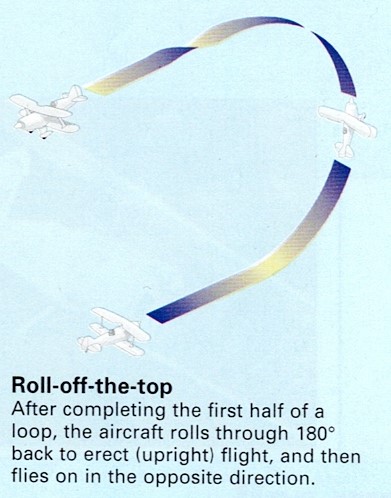
Roll off the top
Rozière (balloon)

A roziere or air balloon is a mixed balloon made up of a gas balloon and a hot air balloon. It owes its name to its inventor, Pilâtre de Rozier. A roziere is made up of two compartments: a sealed compartment containing a gas lighter than air, generally helium, and an open compartment containing air which is heated with a burner which generally operates at propane. The gas balloon ensures general buoyancy and the altitude is varied by controlling the temperature of the hot air part (which also heats the gas). This technology is still used in modern times because it allows greater autonomy than the technique which consists in controlling the altitude by rejecting gas (to descend) or ballast (to climb).
Compared to the other two types of balloon, the rozière is an aerostat which consumes remarkably little and has considerable autonomy.

A : Parachute panel and gas valve
B : Helium cell
C : Helium filling handle
D : Hot air cone
E : Carrycot
RNZAF
Royal New Zealand Air Force
Rotor
A system of rotating horizontal blades for supporting a helicopter or gyrocopter.
rpg
Rounds per gun
Rudder
Movable control Surface hinged at he fin in the vertical to provide yaw control.
Ruddervattor
Dual purpose surface on V-tails used to control pitch and yaw
SAAF
South African Air Force
SAC
Strategic Air Command
Sailplane
Glider
S.C.A.M.P.F.R.S.
Float plane acronym: Switches, Carb heat, Area, Mixture, Prop, Flaps, Rudder, and Stick.
Secondary Surveillance Radar – with line of sight coverage, receives a signal from an aircraft transponder including a code, altitude, and can include heading and airspeed.
Service Ceiling
The altitude at which the rate of climb falls below 100 feet per minute.
Sesquiplane
A biplane with one wing smaller than the other. Literally – ‘one and a half’ planes.
Sideslip
To apply rudder causing an aircraft to fly sideways. Creates drag to loose altitude or for landing in a cross wind.
Slab-sided
A fuselage with flat sides.
Slots
Small slats of streamline section fitted near the leading edge of the wings providing better airflow and lift.
Can operated by angle of attack, by selection, or be fixed.
SL
Sea level.
The level of the surface of the sea at its mean position midway between high and low water.
Slow roll

Smallest Airplane
| Several of the World’s Smallest Planes | |||||||
| Builder | Plane | Length | Wingspan | Empty Wt | MTOW | Propulsion | Max Speed |
| Bee Aviation | Wee Bee | 14’2″ | 18’0″ | ? | ? | 30-hp Kiekhaefer | 82 mph |
| Stits | Junior | 10’10” to 11’4″ | 8’10” to 9’4″ | ? | ? | 75-hp Continental C-75 | 150 mph |
| Staib | Little Bit | 11’0″ | 7’6″ | 390 lb | ? | 85-hp Continental C-65 | ? |
| Stits | Sky Baby | 9’10” | 7’2″ | 452 lb | 666 lb | 65-hp Continental C-65 | 185 mph |
| Starr | Bumble Bee | 9’4″ | 6’6″ | 547 lb | 725 lb | 85-hp Continental C-85 | 180 mph |
| Stits | Baby Bird | 11’0″ | 6’3″ | 252 lb | ? | 55-hp Hirth | 110 mph |
| Starr | Bumble Bee II | 8’10” | 5’6″ | 396 lb | ? | 85-hp Continental C-85 | 190 mph |
Spar
Wing’s primary load carrying member.
Spat
Fairings to partially enclose wheels for streamlining.
Spoiler
A wing control surface when deflected reduces lift and increases drag. They roll the aircraft when deflected singly, and control glide path when deflected simultaneously.
SRAM
Short Range Attack Missile
Stagger
Positioning of a biplane or multiple wings in relation to each other. Upper wing forward id positive stagger. Upper wing behind lower wig is negative stagger.
Stalling speed
The speed at which lift generated by the wings is insufficient to lift the weight of the aircraft, with loss of sustained flight.
Stall turn

Standing wave
Currents of rising and falling air caused by air that has been forced over a mountain and continue to rise and fall for several oscillations.
Step Taxiing
Moving through water at a speed which causes the forebody to plane or ride on the surface of the water with minimum displacement.
STOL
Short take-off and Landing
Streamline
So shaped as to reduce the resistance to the airflow.
Strut
Commonly refers to tubes used to brace the wing to the fuselage. Transmit both flying and landing loads to the fuselage.
Suction
The tendency of a float to ‘stick’ to the water during take off, due to surface tension and other factors.
Supercritical wing
Characterised by a fairly bluff leading edge, a bulged underside, a flat top and a down curved trailing edge. The aerodynamics delay maximum acceleration and shock formation, allowing a wing with less sweep and a thicker section, which in turn provides extra volume and reduces structural weight.
Supersonic
Relating to speeds from one to five times the speed of sound.
Survivability
The capability of an aircraft to avoid and withstand a man-made hostile environment without sustaining any impairment of its ability to accomplish its designed mission.
Sweepback
The angular setting of wings in plan form. Sweepback in inclined towards the tail.
Stub wings Sponsons
Very shot wings built on to the hull of flying boats near the waterline. They have a stabilising effect in a heavy sea, and in this respect replace wing floats.
TAC
Tactical Air Command
Tailplane
The fixed part of the horizontal control surfaces for pitch.
Tail unit
Complete assembly of the tailplane, elevator, and rudder.
Tandem
Arranged in line one behind the other.
Tip dragger
Vertical surface at the wingtip that acts as rudders by increasing drag at the tip towards the direction in which the turn is to be made.
TIS
Time in service
TOW
Tracked optically wire-guided missile.
Anti-tank missile including optical sight system which when fired ‘spools’ a fine wire behind it that connects the computer in the missile to the optical sight. Corrections can be made to the flight by the gunner over the 4500 m range.
Trailing edge
The rearward edge of the wing, tailplane, rudder, etc.
Transitional lift
A helicopter moving from the disturbed air caused by the hover into undisturbed air, reaching an airspeed of approximately 15 knots, for the rotors to become more effective and able to create 25% more lift than at the hover.
Transonic
Moving at a speed that is about that of sound in air or about 741 mph / 1185 kph
Trapezoid
A four-sided plane with two and only two side panels.
TSO
Time since overhaul
Trousers
Streamlining enclosing undercarriage legs.
TTIS
Total time in service
Turbofan
A fan that is directly connected to and driven by a turbine and is used to supply air for cooling, ventilation or combustion.
Turbojet
A jet engine having a turbine driven air compressor supplying compressed air to the combustion chamber.
Turboprop
A jet engine having a turbine-driven propeller but usually obtaining additional thrust from the discharge of a jet of hot gases.
Twin tail
Compound tail unit having two fins and two rudders.
UFO – Unidentified flying object.
Refers to any unrecognised thing in the sky.
Unicom
Universal Communications
Unicom service facilitates traffic at uncontrolled aerodromes by providing basic aerodrome information, such as weather conditions, runway in use, and general location of other aircraft. Unicom is not an air traffic service managing traffic, but advises only.
USAF
United States Air Force
USCG
United States Coast Guard
USMC
United States Marine Corp
USN
United States Navy
VFR – Visual Flight Rules
VIFFing
Vectoring in Forward Flight
A Harrier pilot can roll into a turn and select thrust 90 degrees down: all the engines thrust is then directed straight into the direction of the turn reducing its radius significantly.
As the thrust-vectoring system allows a maximum of 110 degrees deflecting (20 degrees forward of straight down) the system can also be used to brake the Harrier.
Vne
Maximum speed permitted. Never exceed or Redline.
VOR
VHF Omni-directional Receiver
VRP
Visual reporting point
VSTOL
Vertical / Short take-off and landing
VTOL
Vertical take-off and landing
Washout
Upward set of wingtip trailing edge to minimise tip stall.
WIGE
Wing In Ground Effect
Wind gradient
Lessening of wind strength near the ground due to surface friction.
Window
see Chaff
Windsock
A conical streamer on an airfield to indicate wind direction and strength at ground level.
Winglet
Developed largely on the basis of research by Richard T. Whitcomb, a modern aerodynamist, the winglet is and effective way of boosting the cruise efficiency of the wing. The winglet comprises an extension of the main wing at the tip; turned either up or down, it serves the double purpose of reducing the wingtip vortex, thereby recovering the energy that would otherwise be lost in the vortex, and improving the circulation – and therefore lift – of the outer wing panel. The wingtip vortex is a high-energy rotational movement of air which streams back, out and generally down from the tip, producing considerable drag: generally fitted over the rear half of the tip chord and angled outward slightly, the winglet serves both to reduce and to control this vortex.
The winglet also helps prevent spanwise separation of the airflow over the upper surface of the wing and reduce the leakage of higher-pressure air from the under surface of the wing round the tip to the lower-pressure air flowing over the upper surface. As this pressure differential is the feature that creates lift, its maximisation by the winglet allows overall area and structural weight to be reduced.
Wing loading
The gross take-off weight of an aircraft divided by its wing area.
Wing warping
A method of lateral control used by early builders where the wing is flexible and is twisted or warped by the pilot to provide roll control.
W/no
Works number
Yaw
The movement of an aircraft about its vertical axis.
Yoke
The control wheel of an aircraft, akin to an automobile steering wheel.
Zooming
Using kinetic energy of an aircraft’s motion to gain height.









 All Aero