Doblhoff WNF 342

WHF 342 V-2

The WNF-342 was the work of three engineers – Friedrich von Doblhoff, A.Stepan and Theodor Laufer – at the Wiener Neustadter Flugzeugwerke in Vienna. The operating principle was to use a conventional piston engine driving a compressor to provide a compressed air supply, which, after mixing with fuel, was fed as a combustible mixture up through the rotor hub and out through the three hollow rotor blades to be burnt in tip-mounted combustion chambers, thereby generating thrust.

Doblhoff WNF 342 Article

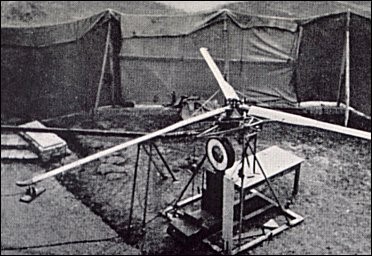
Doblhoff first built, in 1942, a ground test rig to prove the principle of his proposed rotor drive system, consisting basically of a trio of hollow rotor blades mounted on a scaffold with the fuel/air mixture fed through each blade to a small jet unit at the tip. A compressed air tube entered the rotor hub, and vaporized petrol was added by special tubing. The mixture was ignited at the blade tip by an automobile sparking plug. The demonstration proved so successful that the rotor actually ‘took off’ from its moorings, lifting about a yard into the air an anvil that had been attached to it to hold it down. Encouraged by this success, Doblhoff and his team then applied the principle in the small single-seat WNF-342V1 which he hoped would meet a German Navy requirement for an observation helicopter to be carried by submarines or small naval vessels.
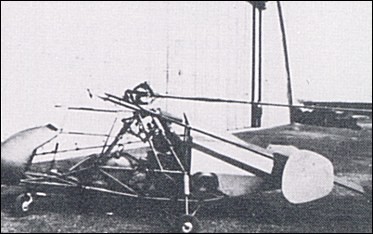
This first prototype, powered by a 60hp Walter Mikron II engine, was flown in spring 1943. The airframe, constructed from welded steel tube and fabric covered, had a gross weight of 360kg, twin tail fins and a tricycle undercarriage. The rotor was fitted with flapping and drag hinges.

WNF-342 V1

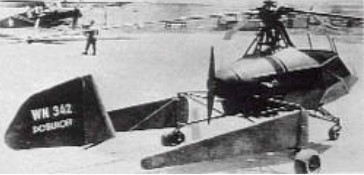
Flight testing revealed the need for rather more side area, but performance was otherwise satisfactory, and when the WNF factory was superficially damaged during an Allied air attack in mid-August 1943 the aircraft was moved to a safer site west of Vienna, at Obergraffendorf. Here a second machine, the WNF-342 V2, was built, being a somewhat heavier aircraft at 460kg gross weight, despite its open-framework fuselage. The main difference lay in the sail-like tail unit, this comprising a large single rectangular fin and an elongated rudder pivoting about a horizontal axis. The 60hp Walter Mikron engine was replaced by a 90hp Walter Mikron engine.
WNF-342 V2

A conventional piston engine drove a compressor, in this particular case the supercharger blower of an Argus 411 engine. The mass flow of compressed air produced by this blower was mixed with fuel before passing through the hollow rotor blades to chrome steel combustion chambers situated at the blade tips. Combustion of this fuel-air mixture occurred at a rate of approximately 280 times per second.

Doblhoff WNF-342 V2

Starting with the V3 machine, increases were made in rotor diameter, and both the V3 and V4 used the extra power of the 140hp BMW Bramo Sh 14A engine to drive the compressor. In all designs, an Argus As 411 supercharger was adapted as a compressor. Before the end of the war, consideration was being given to replacing the compressor system with rotor mounted pulse-jets or even miniature turbo-jets. Within their limited performance, the V1 and V2 machines flew smoothly enough, but serious vibration manifested itself in the V3 machine and ground resonance vibration eventually destroyed it.

WNF-342 V2

Each of the first three machines (V1, V2, and V3) was provided with only a small rear propeller to blow air at the tail surfaces for steering. For the first three machines, although flapping and dragging rotor hinges were provided, no blade pitch-change arrangement was made since this was not required for early tests, vertical control being provided simply by varying the rotor speed.

Experience with the first two machines showed that the high fuel consumption of the tip-jets would make the WNF-342’s operating costs prohibitive, and so a major design change was introduced in the V3 and V4 prototypes. The tip-drive system was retained for take-off, hovering and landing only, a selective clutch enabling the engine (now a 140hp Siemens-Halske Sh.14A radial) to drive a conventional pusher propeller for forward flight while the rotor blades ‘free-wheeled’ in autorotative pitch. To clear this propeller the rotor pylon was raised above the cabin and the tail unit was redesigned as a twin-boom assembly, that of the V3 carrying two end-plate oval fins and rudders while that of the V4 had a single fin and rudder mounted on the tailplane centre. Gross weight of the V3, a single-seater with 9.88m diameter rotors, was 548kg.

By the time the WNF 342 V4 was built a control method had been devised to provide both collective and cyclic pitch control. Each rotor blade was connected to the rotor head by means of a flexibly coupled tube flanked by steel-strip leaf-type spring straps connected to an upper aluminium alloy casting. This upper casting rotated in a lower fixed casting, a seal being provided between the two, and fuel mixture flowed into this hollow assembly to be piped out to each blade. Passing up through the casting was a hollow fixed shaft which carried a bearing for the upper casting and which was flexibly connected to the helicopter framework. Inside this hollow shaft, a solid shaft rotated in a spherically seated bearing to carry the blade pitch control spider at its head. Thus, angular displacement of this solid shaft tilted the spider to give appropriate cyclic pitch control. For collective pitch control, the spider was connected to the solid shaft by means of a pressure regulator connected to the upper casting (containing the pressurized fuel mixture) by a pipeline. The spider was given a vertical movement according to the mixture pressure opposed by springs within the regulator. In addition, collective pitch was governed by the torsional stiffness of the centrifugally-loaded spring straps. When the pilot moved the throttle control, a rapid increase (for example) of mixture pressure and jet thrust followed by an increase in collective pitch ensued, while the rotor rpm remained constant.
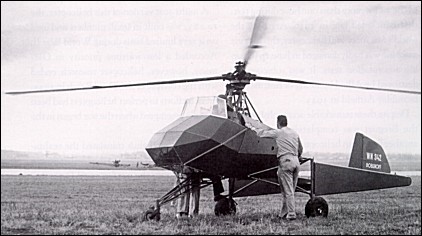
WNF-342 V4

The V4 had a second propeller mounted co-axially to provide thrust for forward flight when clutched to the compressor motor. Thus, by gradual development, the rotor jets (which had a high fuel consumption) were only used for take-off, hovering and landing, and the rotor blades turned by autorotation for forward flight in the manner of an autogyro. The V4 had side-by-side open cockpits for a crew of two.

The V4 was hovered for a total of 25 hours, it was not tested in forward flight above 40 to 48km/h before the programme had to be halted. In April 1945, Soviet troops approaching Vienna caused Doblhoff’s team to withdraw hastily to Zell am See where the V2 and V4 machines were captured by United States’ forces. Doblhoff later accompanying it back to the United States to assist with further tests before joining McDonnell to work on development of the XV-1. Stepan, who had done most of the test flying on the WNF-342, joined Fairey in the United Kingdom after the war, while Laufer went to work for the SNCA du Sud-Ouest in France where he worked on the jet-propelled Djinn.

On September 9, 1946, the General Electric Company (specifically, the Thermal Power Systems Division of its General Engineering and Consulting Laboratory) was permitted by the USAAF to evaluate the WNF 342 V4 in connection with that company’s work on the power plant of the XR-17 helicopter, which would later become the Hughes XH-17. It was shipped by a Fairchild C-82 to Schenectady, New York on December 6, 1946, where it was tested and studied by General Electric under Army Air Force Contract No. W-33-038-AC-16283. This article presents their evaluation report dating from April 30, 1948.

General Electric Company Doblhoff
WNF 342 V4 Evaluation Report

Igor Bensen, one of the primary authors of the report, would go on to perform many test flights of the WNF 342. Unfortunately, he suffered severe spinal injuries when the helicopter was destroyed in a ground resonance accident; these injuries would plague him throughout his life. However, they did not stop him from playing a significant role in the development of the Hughes XH-17 and eventually founding his own company, Bensen Aircraft, which produced a successful line of gyrogliders and autogyros over the course of several decades. Doblhoff was also involved with the XH-17 program, as well as the McDonnell XV-1 convertiplane, among others.

The WNF 342 V4 has been preserved by the Smithsonian Institution, Washington.

Gallery

WNF-342 V1
Engine: 1 Walter Mikron II, 60hp
Weight fully loaded: 360kg
Empty weight: 240kg
Number of seats: 1

WNF-342 V2
Engine: 1 x Walter Mikron, 90hp
Weight fully loaded: 460kg
Empty weight: 340kg
Number of seats: 1

WNF-342 V3
Rotor diameter: 9.88m
Gross weight: 548kg
Seats: 1

WNF 342 V4
Engine: 1 x BMW-Bramo Sh.14A, 105kW / 140 hp
Main rotor area: 78.54 m2 / 845.42 ft2
Main rotor diameter: 9.96m / 32 ft 9¾ in
Fuselage length: 5.07m
Height: 2.40m
Max take-off weight: 640kg / 1,411 lb
Empty weight: 431kg / 948 lb
Max speed: 48km/h / 30 mph
Crew: 2

Doak Aircraft Co Inc

Incorporated in 1940 in Los Angeles, California, developing the Model 16 VZ-4Da, with ducted propellers rotating at wingtips, under contract to the U.S. Army Transportation Research and Engineering Command, 1958. This was transferred to NASA for further evaluation. Doak sold out to Douglas Aircraft Company in early 1960s. Doak finally closed its doors early in 1961.

Dixon Flying Car

Jess Dixon, of Andalusia, Alabama, got tired of being tied up in traffic jams, so he designed and built this novel flying vehicle around 1940. It was a combination of automobile, helicopter, autogiro, and motorcycle. It had two large lifting rotos in a single head, revolving in opposite directions. It was powered by an air-cooled 40 h.p. motor. He claimed his machine was capable of speeds up to 100 miles an hour, according to Modern Mechanics (Nov, 1941).

Diepen

In 1946 Frits Diepen founded the Frits Diepen Aircraft Co Ltd, which was to deal with the sale, repair and overhaul of aircraft, the transport passengers by air taxis, publicity flightsand the running of Ypenburg Airfield.
On February 16th, 1954 Avio Diepen ¬became a subsidiary of Fokker

DFS 230

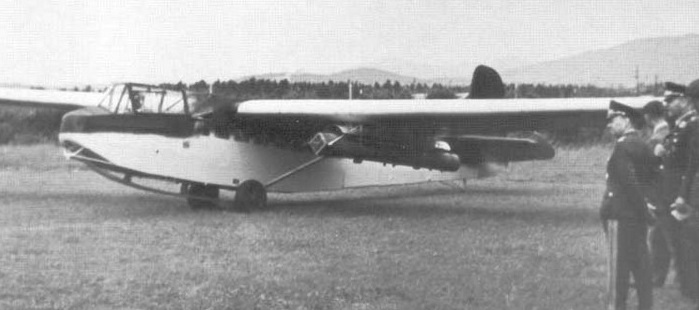
German assault glider. The major contribution of the Deutsches Forschungsinstitut for Segelflug (German Research Institute for Gliding) to Germany’s Second World War armoury was the DFS 230 assault glider of 1937. With a rectangular section fabric covered steel tube fuselage, and a long tapering wing covered in plywood and fabric and braced by metal struts to the fuselage, the glider could carry some 272 kg (600 lb) of freight in addition to the pilot plus nine troops and their equipment. Three prototypes were built and tested by the DFS, and further DFS 230s were produced by Gothaer Waggonfabrik, a series of A 0 pre production models being followed by production A 1s and dual control A 2s. Deliveries began in October 1939. Some modifications were incorporated in the B 1 and B 2 production series, notably a parachute pack for braking, a stronger landing skid and a mounting for a single MG 15 machine gun.
The DFS 230 made its operational debut in the attack on Fort Eben Ernael and Albert Canal bridges in Belgium and Holland in May 1940. It went on to take part in attacks on the Corinth Canal, and in the airborne invasion of Crete in May 1941. However, such heavy losses were suffered during the later operation that thereafter DFS 230s were largely confined to transport duties in the Mediterranean and on the Eastern Front. One other spectacular operation involved DFS 230s, however, when DFS 230c 1s B 1s fitted with forward firing braking rockets in a special nose cone were used to land German commandos on the Matto Grosso as part of the rescue of Italian leader Benito Mussolini. A total between reported figures of 1022 and 1500 DFS 230s were produced, and the glider soldiered on in the supply role almost until the end of the war.

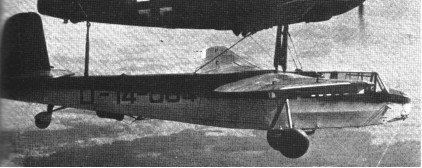
DFS230 glider with Argus AS014 pulsejets

DFS 230A-1
Wingspan: 68 ft 5.5 in / 20.87 m
Length; 36 ft 10.5 in / 11.24m
Height; 9 ft / 2.74 m
Wing area; 444.55 sq.ft / 41.3 sq.m
Empty weight; 1896 lb / 860 kg
MAUW: 4630 lb / 2100 kg
Max towed speed: 130 mph / 210 kph

DFS 230B 1
Span: 21.98 m (72 ft 11 in)
Length: 11.24 m (36 ft 10.5 in)
Gross weight: 2100 kg (4630 lb)
Maximum speed: 290 km/h (180 mph)

DFS / Deutsche Forschungsinstitut Für Segelflug / German Research Institute for Gliding / Rhon-Rossiten-Gesellschaft

Established as the Rhon-Rossiten-Gesellschaft at Wasserkuppe in 1925.
Became DFS on moving to Darmstadt in 1933 and undertook glider research. Designed and built the successful DFS 230 assault glider in the Second World War, and the DFS 228, an air-launched rocket aircraft used as a research vehicle for the DFS 346, a swept-wing reconnaissance project expected to reach 1,650mph (2,655kmh) at 66,000 ft (20,120 m). Also undertook development of Me 163 and Mistel composite bomber. Experimented with delta designs by Dr. Alexander Lippisch and evolved piloted V-1. In 1946 the DFS 346 project and its engineering design staff were taken by the Soviets to Podberczhye, where the project was said to have been completed.

Dewoitine D.520

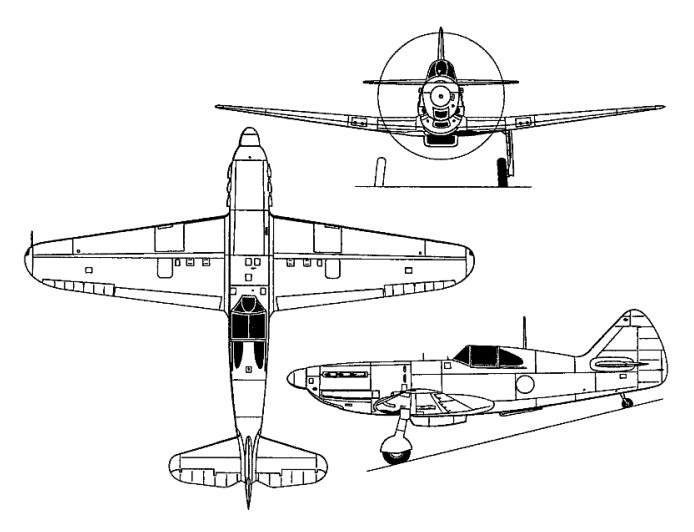
The Dewoitine company was nationalized in 1936, becoming part of the SNCAM (Societe Nationale de Constructions Aeronautiques du Midi), and on the outbreak of the Second World War the D 520, designed by Robert Castello, was the French air forces’s most advanced fighter. Designed a new fighter to meet the French Air Ministry Programme A23, which in its revised form called for a maximum speed of 520km/h, was the was inspiration to give it the designation D.520.

Dewoitine D.520 Article

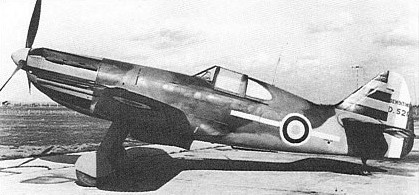
Three prototypes were ordered by the French government in April 1938, the first (D 520 01), powered by an 664-kW (890-hp) Hispano Suiza 12Y 21 engine, flying on October 2 of that year with Marcel Doret at the controls. With this powerplant the aircraft did not achieve its required speed of 520 km/h (323 mph), but with an uprated 12Y 29 engine with jet exhaust manifold, the design speed was reached.
Even before the first flight of the third prototype in May 1939 the company had received orders for 200 of the new and potentially decisive fighter, the figure rising to 710 within two months.
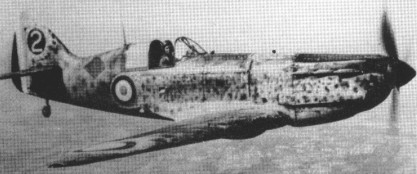
The second prototype (D 520 02) with a redesigned tail, wing radiators replaced with a ventral unit, introduced a sliding cockpit hood, and other aerodynamic improvements flew for the first time on January 28, 1939. It was fitted with a provi¬sional armament of one HS 404 20 mm (0.79¬in) Hispano cannon firing through the propel¬ler hub and two 7.5 mm (0. 295 in) MAC 1934-¬M39 machine guns in underwing fairings. It was powered by a 12Y 29 (later 12Y 31) and reached a speed of 550 km/h (342 mph). The D 520 03 third prototype was similar to the second, and first flew on March 15, 1939. It had a steerable tail wheel instead of the tailskid of the other two aircraft.
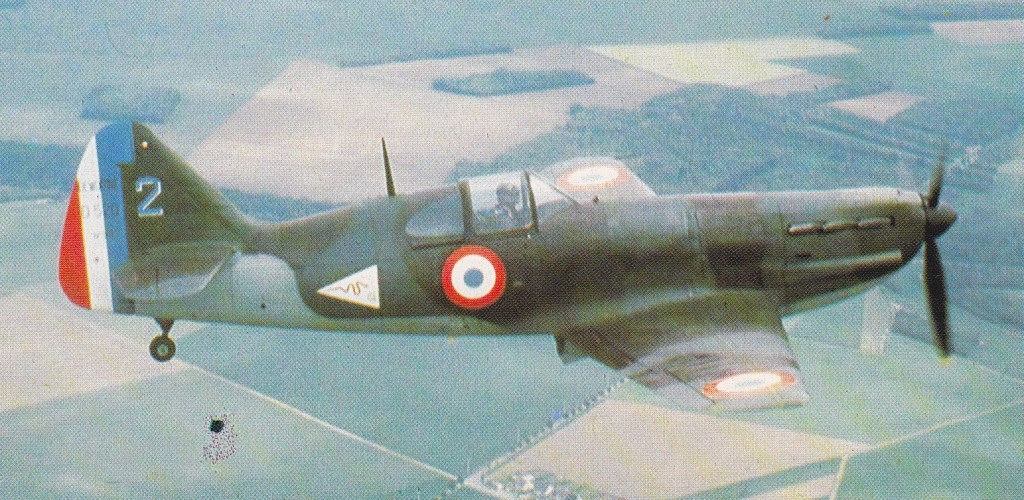
Powered by a supercharged 678kW Hispano-Suiza 12Y45 engine, the D.520 was armed with an engine-mounted HS-404 20mm cannon and four wing-mounted 7.5mm MAC machine-guns. The wing was a single-spar structure with duralumin skinning. Ailerons were fabric-covered and flaps pneumatically operated. The fuselage was an all-metal monocoque structure and the wide-track undercarriage legs retracted inwards into the wing profile.
Main production lines were at the SNCAM Toulouse factories. For the first time in France women joined the workforce and sub-contractors previously outside the aircraft industry were employed. Each aircraft required only half the man-hours needed to build the main French fighter at that time, the MS 406.
The first production example, from an initial order for 200 placed in April 1939, flew on November 2, 1939, powered by a 930 hp Hispano Suiza 12Y 45 engine. Many modifications were required and by the time the German Blitzkrieg was launched only 50 D.520s were with front-line units.
Orders up to April 1940 required 2200 for the Armee de l’Air and 120 for the Aeronavale, but many were cancelled due to difficulties in maintaining the production rate. Fewer than 300 had been delivered by the time of Germany’s invasion of France in May 1940, rising to 403 by the time of the Armistice. The fuselage of the production machines was lengthened by 51 cm (20 in), the engine cowling was modified, two additional fuel tanks were fitted within the wing leading edges and armour protection was provided for the pilot. The armament was increased by a further two 7.5 mm (0.295 in) M39 guns enclosed in the wings.
Deliveries began in January 1940, but when the German armed forces made their attack against France on May 10, 1940, only 36 D 520s, equipping GC 1/3, were in service. They flew their first operational sorties three days later and proved extremely effective under fire, establishing a 2/1 ‘kill ratio’ over Luft¬waffe opponents. As deliveries increased, D 520s served with five Groupes de Chasse during May and June, and by June 25, 1940, a total of 437 had been completed.
By the time of the fall of France the D.520 had claimed 114 victories and 38 probables.

After the armistice with France, Germany permitted her a limited air arm (Armistice air force), but there were no D 520 units in the occupied country. Over 300 aircraft, how¬ever, remained in unoccupied France and North Africa and were used by the Vichy French air force.
The German authorities ordered a further 550 D 520s to replace all other single engined fighters in French service, and, although they saw considerable action against many British aircraft, their losses were few. In November 1942 the Germans entered the hitherto ‘Free’ French areas and commandeered 246 D 520s plus a further 169 in various stages of production. The SNCA de Sud Est received a contract from the Germans to complete 150 of these machines, and by the summer of 1944 they had been delivered, bringing total D 520 production to 905 machines. A few of these were used as by the Luftwaffe Jagdgeschwadern in the USSR, and D 520s also equipped JG 105 at Chartres, JG 103 in Austria and JG 101 in Pau Long. Sixty D 520s were allocated to the Regia Aeronautica as trainers and second line fighters; 120 formed the basic strength of the Bulgarian air arm, and a few saw service with the Romanian air force.
As the Germans retreated in the autumn of 1944, the liberated French recaptured about 75 D 520s. These helped reform the French air force on December 1, 1944, and they flew with the Forces Francaises de l’Interieur during the closing months of the war. In late 1945, one of the 17 Dewoitines still in use as trainers at Tours was converted to two seat configuration and designated D 520 DC; 12 were thus modified.
Some D 520s were phased out of service through lack of spares in mid 1948 and the last unit was disbanded in September 1953. This aircraft had been originally designed to accept a 1300 hp engine, in order to reach a speed of 595 km/h (370 mph), but no reliable engine of this power was ever available for trial or production aircraft. Variants were mooted and trialled with different engines.

Gallery

D.520
Engine: l x Hispano-Suiza 12Y-45, 687 kW / 935 hp.
Span: 10.2m (33 ft 5.5 in).
Length: 8.6m (28 ft 2.5 in).
Height: 2.57 m / 8 ft 5 in
Wing area: 15.97 sq.m / 171.90 sq ft
Max T/O weight: 2677 kg (5,902 lb).
Empty weight: 2123 kg / 4680 lb
Max speed: 332 mph at 18,045 ft / 342 mph at 13,120 ft.
Service ceiling: 36,090 ft / 11,000m
Climb to 13,125 ft / 4000 m: 5 min 49 sec
Max range: 1540 km / 957 miles
Operational range: 553 mi / 900 km
Crew: 1
Armament: 1×20-mm Hispano-Suiza cannon and 4 x 7.5-mm / 0.295-in MAC machine-guns.

Dewoitine

Societe Aeronautique Dewoitine

Founded at Toulouse in 1922 by Emile Dewoitine to build all-metal aircraft. His first fighter, the D.1, appeared that year and his ultralight D.7 of 1923 was demonstrated in the USA. Designed and built a number of fighters, of which the D.21 of 1927 was built in Switzerland and France, and in 1929 in the Argentine. As no French orders were forthcoming, Dewoitine went to Switzerland in 1927 and formed the Societe Aeronautique Dewoitine. Returned to France 1930, establishing a manufacturing agreement with Liore et Olivier, which was entrusted with the redesign of his D.531 to become the D.37 for the Armee de I’Air. He produced two long-range aircraft, both lost on record attempts, and airliners for Air France, but in the main developed a successful family of fighters, the last of which, the D.520 of 1938-1940, was known as the “French Spitfire.”

Dewoitine fighters were eventually responsibility of SNCAM. Meanwhile, D.37 series of parasol-wing monoplane fighters was developed by Liore et Olivier, though name Dewoitine was sustained in fighter field primarily by the low-wing D.500 series, many of which were built by Liore et Olivier. Societe Aeronautique Frangaise gained greatest publicity with record-breaking D.332 Emeraude, first flown 1933, and with D.338 as used extensively by Air France in late 1930s. This latter aircraft was, perhaps, the finest 3-engined airliner in service before Second World War, and continued in use after fall of France.

In France, the Socialist Government of the so called Popular Front brought all the companies building military aircraft, aero engines and armament under its control in 1936. The im¬mediate result was the socialized oblivion of such established companies as Marcel Bloch, Bleriot, Nieuport, Potez, Dewoitine, Hanriot and Farman within half a dozen nationalized groups or Societies Nationales, named according to their geographical location (Nord, Ouest, Centre, Midi and so on).
During the war the Group formed the Societe Industrielle pour I’Aviation with the organization that represented General Motors in France, building the Arado Ar 196 and Ar 199 and developing the Ar 296.

De Schelde

The aircraft department of a dockyard, opened in 1935, employing technicians from Pander. Built S.12 four-seat cabin monoplane, Scheldmusche light single-seat pusher biplane; best known for Scheldmeeuw single-seat flyingboat, which was built in all-metal and composite versions.
It took over the designs of Pander and Zonen when that company went out of business in 1934. Schelde had taken over the aircraft construction department of the Pander furniture factory in The Hague at the end 1934.
From 1939 made wings for Dornier Do 24 flying-boats, Aviolanda building the hulls.
After 1945 began glider construction and Dakota conversion. In 1951 acquired license for production of Saab Safir.
The aircraft construction department of the Royal Company De Schelde, joined Fokker on May lst, 1954.