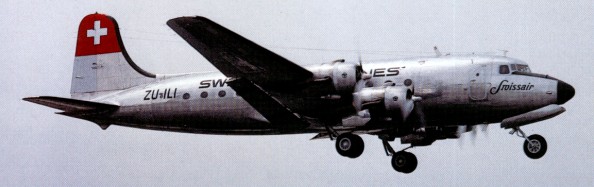
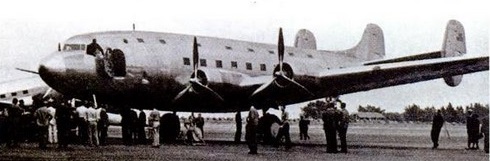
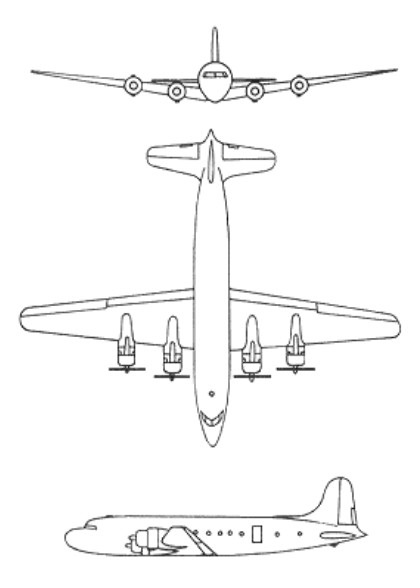
In response to the requirements of five major US airlines, Douglas designed and built the large 52-passenger DC-4, which made its first flight on 7 June 1938. This type was not put into production; instead 61 smaller unpressurised development were ordered by American, Eastern and United Air Lines. This, too, bore the designation DC-4 and the original aeroplane became the DC-4E.
DC-4 prototype
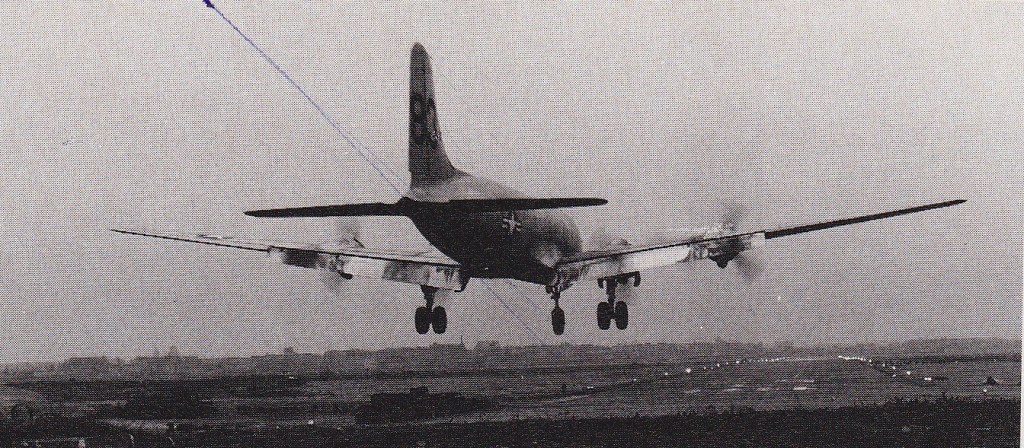
The DC 4 actually saw its first service as the wartime C 54 Skyrnaster (first flight 14 February 1942) when all 24 DC-4A built were taken by the armed forces (designated R5D Skymaster by the Navy).
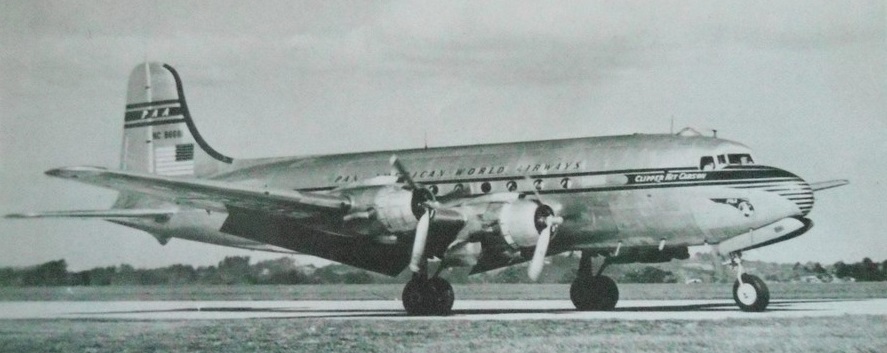
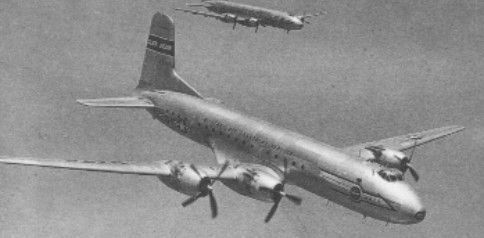
The DC-4 had a retractable nosewheel undercarriage and was powered by four 820-1,080kW Pratt & Whitney Twin Wasps. It was a long-range heavy logistic transport with a payload of up to 9,980kg. A total of 207 C-54A were built, followed by increased-capacity C-54B, similar C-54D with Pratt & Whitney R-2000-11 radials, C-54E with convertible cargo/passenger interiors, and C-54G with new engines. Nine hundred and fifty-two Skymasters were completed for the USAAF and 211 for the US Navy. The C 54D-15DC (USAAF variant of the DC 4, with the DC suffix indicating Douglas Chicago) with four 1,200 hp Pratt and Whitney R2000 7 radials, was operational for the last year of WW2. USAAF C¬54s were allocated to the USN in July 1945; 92 so transferred. The C 54Q had R2000 11 engines. After the war Douglas built 79 civil DC-4-1009 and many of the military aircraft became available for airline operation – mostly with 44 seats but later with as many as 86. On 7 March 1946 American Airlines was first to introduce DC-4 on US domestic services, between New York and Los Angeles. However in October 1945 American Overseas Airlines had introduced DC-4 on North Atlantic services.
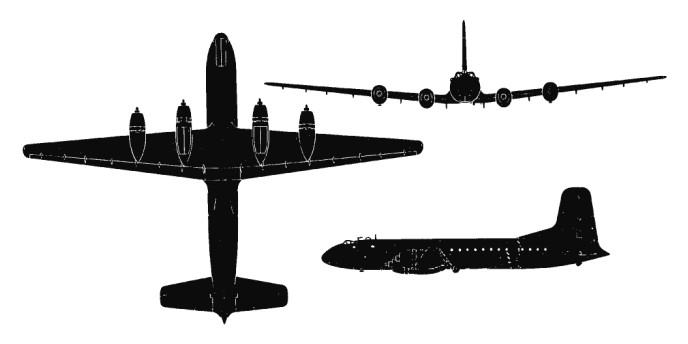
From it were developed the larger DC 6 and DC 7 series the Merlin engined Canadair C 4 and the Aviation Traders Carvair nose loading vehicle transport.
One, the VC-54C-DO Sacred Cow, served as President Roosevelt’s special aircraft and a C-54B-1-DO was used by Prime Minister Winston Churchill.
During the first years of the Berlin Airlift corridors, the pilots had to be wary about mock attacks by Soviet MiG fighters or near misses. The mutual mistrust inevitably caused a number of incidents. In April 1952 an Air France DC-4 was shot-up in one of the Airlift corridors by two Russian MiG-15a. A stewardess and two passengers were seriously injured.
A C-54 made the Berlin Airlift’s last flight on 30 September 1949.
C-54 Skymaster
The 1956 R5D2-2 radar and radio research aircraft in the US Navy featured a retractable mast with instruments.
R5D2-2
When production ceased in 1947, 1,242 had been built, of which hundreds served to re-equip civil airlines during the first postwar years.
In 1963 the Peruvian Air Force bought three DC-4B’s from US dealer Aircraft Corp of Charlotte, NC. Two for passenger transport and the third for use by Peru’s president.
DC 4 Engines: 4 x Pratt & Whitney R 2000 SD13G Twin Wasp, 1,450 hp. Wing span: 117 ft 6 in (35.80 m). Length: 93 ft 11 in (28,63 m). Gross weight: 73,000 lb (33,112 kg). Typical cruising speed: 204 mph (328 kph) at 10,000 ft (3,050 m). Accommodation: Crew of 5 plus 44 86 passengers. Typical range: 2,140 miles (3,444 km) with max payload at 201 mph (323 kph).
DC 4 Engines: 4 x P&W R-2000-25, 1065kW Max take-off weight: 33140 kg / 73062 lb Empty weight: 20000 kg / 44093 lb Wingspan: 35.8 m / 117 ft 5 in Length: 28.6 m / 93 ft 10 in Height: 8.4 m / 27 ft 7 in Wing area: 136.0 sq.m / 1463.89 sq ft Max. speed: 450 km/h / 280 mph Cruise speed: 365 km/h / 227 mph Ceiling: 6900 m / 22650 ft Range w/max.fuel: 6000 km / 3728 miles Range w/max.payload: 2200 km / 1367 miles Crew: 4 Passengers: 40-44
Douglas C 54 B Skymaster Engine : 4 x Pratt&Whitney R-2000-7, 1332 hp Length : 93.93 ft / 28.63 m Height : 27.526 ft / 8.39 m Wingspan : 117.487 ft / 35.81 m Wing area : 1462.935 sq.ft / 135.91 sq.m Max take off weight : 73012.0 lb / 33112.0 kg Weight empty : 38206.0 lb / 17327.0 kg Max. speed : 238 kt / 441 km/h Cruising speed : 208 kt / 385 km/h Service ceiling : 21998 ft / 6705 m Cruising altitude : 15207 ft / 4635 m Wing load : 50.02 lb/sq.ft / 244.0 kg/sq.m Range : 3389 nm / 6276 km
C-54M Skymaster Engines: 4x Pratt & Whitney R2000-11, 1,350 h.p. Wingspan: 117 ft. 6 in. Length: 93 ft. 10 in. Loaded weight: 73,000 lb Max. speed: 274 m.p.h. Ceiling: 22,500 ft. Typical range: 1,500 miles at 220 mph at 10,000 ft. Crew: 6 Capacity: 50 passengers, 30 stretchers or cargo.
C 54D-15DC Engines: 4 x Pratt and Whitney R2000 7, 1,200 hp.
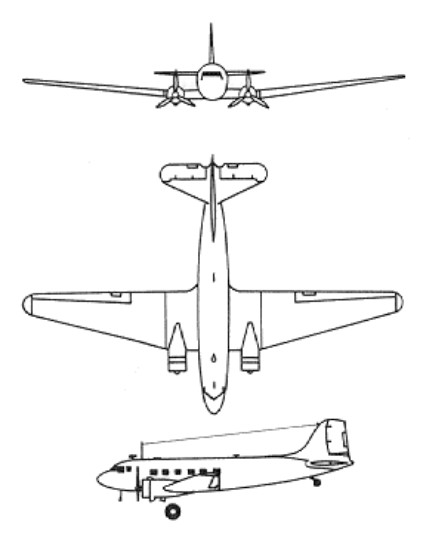
The DC-3 resulted from American Airlines’ requirement for a sleeper aircraft for its US transcontinental route. The DC-2 fuselage was too small for this, so, reluctantly, in the autumn of 1934 Douglas agreed to build the DST (Douglas Sleeper Transport) as an enlarged DC-2, with lengthened fuselage, increased span and, an increase of 66cm in fuselage width – allowing up to 28 seats or 14 sleeping berths. The prototype DST, with 633.4-745kW Wright Cyclone SGR-1820 engines, made its first flight on 17 December 1935. The type entered service with American Airlines on 25 June 1936 over the New York-Chicago route, with transcontinental sleeper services starting on 18 September. The DC-3/DST soon proved itself and orders grew rapidly, with KLM becoming the first operator outside the US.
The first military version, the C 39, was an odd mixture of the new wing mated with the small DC 2 body. Similar aircraft procured in smaller numbers were the C 38 personnel trans¬port with Cyclones and the corresponding C-41 with Twin Wasps. Discounting about four civil DC 3s sold as VIP transports to overseas air forces, there was no true military DC 3 until October 1941, when deliveries began from Santa Monica of the C 53 Skytrooper. This simple conversion of the DC 3 had a wooden floor, fixed aluminium seats for 28 troops, and a glider towing cleat. Some were later supplied to the RAF as the Dakota II, and the US Navy and Marines as the R4D 3, and subsequent versions included the C 53B, C and D.
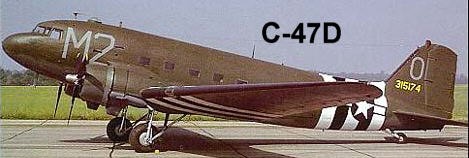
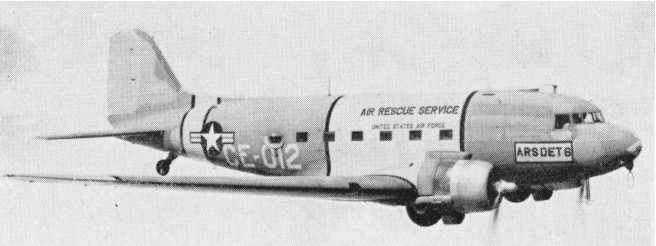
The main military type, put into large scale production in late 1941 at Santa Monica, Tulsa and Oklahoma City, was the C 47 Skytrain. This had been designed earlier in 1941 hence the earlier type number as an all purpose military transport with strong freight floor, large double doors, tie down fittings and folding wooden troop seats. The engine chosen was the 1200 hp R 1830 92 Twin Wasp. A first batch of 953 was followed in 1942 43 by 4991 C 47A with 24 volt electrics, and in 1943 by 3108 C 47B for high airfields (especially in India and China) with R 1830 90C engines with two stage blowers. Named Skytrain by all US forces, and designated R4D by the Navy, some 1200 C 47, 47A and 47B were supplied to the RAF under lend lease as the Dakota I, III and IV, respectively. Douglas also built 133 TC 47B trainers (R4D 7) with navigation classroom interiors, and one C 47C twin float amphibian version. The U.S. Navy version is designated R4D; but by 1955 most of these had been modified into R4D-8s, with more powerful engines, more swept wings with tips, taller squared-off fin and rudder with long dorsal fin, and room for up to 38 passengers.
C-47D
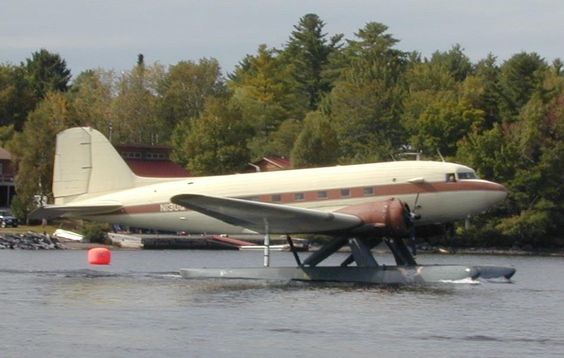
The single C 47C amphibious floatplane was a 1943 conversion of a C 47A Skytrain intended to increase the type’s versatility.
The sole 1943 XC-47C, 42-5671, had Edo amphibious floats with nose-wheels in addition to wheels under the steps, and each housed a 300 gal fuel tank.
Other oddballs included the XCG 17 glider converted from a production C 47A, and the unique DC 2½ flown out of China in an emergency with one DC 3 wing and one DC 2 wing, the original having been damaged beyond immediate repair. The glider was outstandingly successful, carrying 40 troops, towing at 464 kph (288 mph) behind a C 54 and landing at only 56 km/h (35 mph), but only one was built.
Wartime impressed civil DC 3s included the C 48 (R 1830) with civil furnishing (some were DST sleeper transports), C 49 (R 1820) usually with cargo floor and astrodome, C 50 (R 1820), C 51 (R 1820) for paratroops, C 52 (R 1830) taken over on the civil production line and completed as paratroop transports, C 68 (R 1830) previously the DC 3A late 1930s civil type, and C 84 (R 1820) previously the DC 3B. In 1945 17 purpose built VIP transports were delivered, designated C 117A. The DC-3/DST was operated as the C-38 transport.
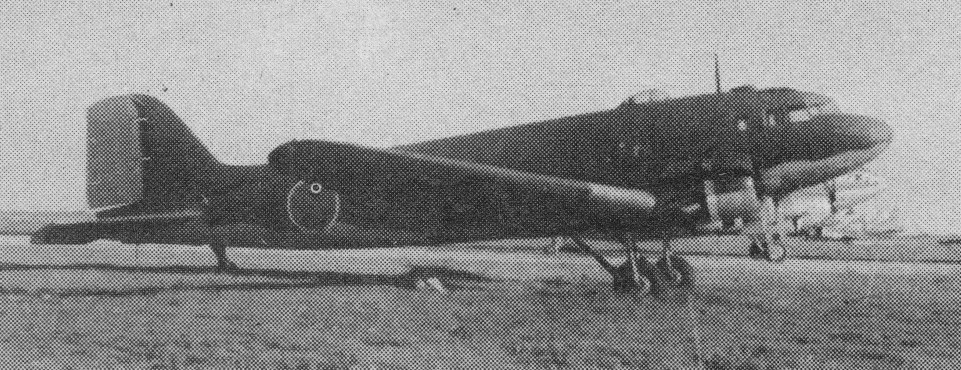
In 1940 the Japanese navy introduced the Type 0 transport, a Showa built version of the 21 passenger DC 3.
On 21 February 1942, some 25 Douglas DC-3 aircraft built under Japanese licence but bearing US national insignia, appeared over the city of Kupang on the Portuguese-owned Pacific island of Timor and dropped 250 troops from an altitude of only 300 ft. this was the first airborne operation carried out by the DC-3.
Operation Husky, the Allied invasion of Sicily beginning 10 July 1943, involved 400 Dakota C-47 transport aircraft and 170 Waco CG-4A cargo gliders. The operation verged on failure. Ninety-seven of the British and US gliders released from their towropes too early plunged into the sea, and another 24 were reported missing: only 12 of the gliders, all British, landed in the target zone. Then strong anti-aircraft fire confused the paratroops in the Dakotas, so they jumped too soon and were scattered over almost 60 miles. Six of the Dakotas were shot down, and only 73 British paratroops reached their target, the Ponte Grande bridge.
In mid-June 1943, for the first time, a Dakota FD900 of RAF Transport Command landed in Prestwick, Scotland, towing a glider. The two planes had taken off twenty-four hours earlier from Dorval (Montreal). Piloted by Sqn.Ldrs. Seys and Gobel, the Waco CG-4A had been built in a New York piano factory, and carried a full load of vaccine and radio and engine parts for the Soviet Union.
Accomplishments of the DC 3 in the Second World War include almost 1000 crossed the Channel on the night of D Day, June 6, 1944, many towing gliders, while in China a C 47 took off at a high altitude strip with 75 evacuees on board. Total wartime output by the US (almost all Douglas) was 10123.
In 1949 Douglas built two prototypes of a much improved Super DC 3, aimed chiefly at the airlines, with 1475 hp R 1820 C9HE engines and greatly altered airframe. Few, were sold, the main customers being the US Navy/Marines (R4D 8) and Air Force (C-117D).
Circa 1949-50, British European Airways Dakotas received cockpit and cabin upgrades and become known as the Pioneer in passenger service and Pioneer Leopard for cargo.
In February 1938 Mitsui in Japan acquired a licence to build the DC 3, on the secret orders of the Japanese navy. During 1939 45 the Japanese companies Showa and Nakajima respectively delivered 416 and 71 of the L2D 1 to L2D 4 versions, with 1300 hp Kinsei engines and cockpit windows extending much further aft than in the US aircraft. These machines received the Allied code name ‘Tabby’.
Lisunov Li-2
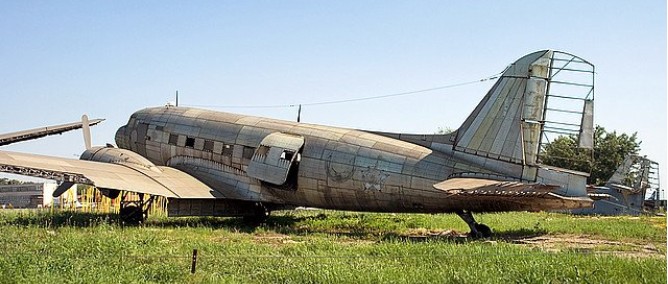
Much greater licence production was undertaken in the Soviet Union. Under Boris Lisunov, who had studied the DC 3 at Santa Monica, the Li 2 version considerably altered incorporating 1293 changes, and with entrance on the right and was in full production during 1939 43, about 3500 being built. The Li-2 used various engines, including the ASh-621R driving SISh-21 propellors, or AV-7N or AV-161 engines. Originally powered by 671kW Shvetsov M-62 radials in the PS-84 first version, but later fitted with uprated Shvetsov ASh-62 radials, most had the M 621R engine, and many had a gun turret behind the flight deck. Some were used as bombers with four 250kg bombs under the centre section and six light bombs on the outer wings.
Postwar Allied reporting name was ‘Cab’, this also covering the 707 lend lease C 47A and B which reached the Soviet Union in 1942 43. The Li-2 was designated PS-84 in Aeroflot service. Production comprised a number of variants, some of them armed with turreted armament; the Li-2G freighter, Li-2P personnel transport, Li-2PG convertible model and the Li-2V high-altitude model are best known of the variants.
The Yugoslav Air Force operated at least 11 Li-2s between 1945 and 1959. After the deterioratiom of relations between the Soviet Union and Yugoslavia in 1948, spare parts became difficult to obtain, and so ten aircraft were re-engined with Pratt & Whitney R-1830-900 engines and Hamilton Standard propellers from 1953 onwards. These aircraft were unofficially designated Li-3 by the Yugoslav Air Force. All Li-3s were on strengrh of the 111 ppa (transport regiment) at Zagreb. At least five of them seem to have been re-serialled from the four-digit 70xx series to the five-digit 711xx series, probably in late 1969. Shortly afterwards all Li-3s may have been withdrawn from use.
Lisunov Li-3
The most dramatic of all conversions has been the various series of AC 47 night interdiction gunships usually armed with three 7.62 mm (0.30 in) General Electric Miniguns with no fewer than 54 000 rounds of ammunition. While the basic air¬craft had become familiarly called the ‘Gooney Bird’ at least to US personnel the AC 47 was also known as ‘Puff the Magic Dragon’ or ‘Spooky’. The 25 initial conversions proved so useful in Vietnam that they spurred on the later AC 119 and AC 130 programmes.
404 C-53 variant were purchased or impressed. They were called Dakota Is and this version was powered by Pratt & Whitney R-1830-92 (1.200 hp) engines. It was primarily used as a troop transport and glider tug. A single XC-53A aircraft (42-6480), with full-span, slotted flaps and hot-air leading edge de-icing equipment.
In 1949 the Cyclone 9HE weighed less than 1400 lb and delivered nearly 1500 bhp. The first two were delivered to Douglas for installation in the new DC-3 Super. Apart from new engines, the DC-3 Super has a new tail unit and outer-wing panels, a strengthened undercarriage with complete wheel retraction, and re-arranged internal accommodation. The Cyclone 9HE engines would boost speed by 45 mph to 234 mph and maximum loaded weight increase from 25,200 lb to 27,300 lb.
In World War II the RCAF had three Dakota squadrons. In 1944, 437 was created in England and served in Northwest Europe; in that same year, 435 and 436 Squadrons were formed in India for service with the British XIV Army in Burma. Between 1943 and 1989 the RCAF and Canadian Forces (CF) Air Command employed 169 Dakotas.
The DC-3 was built in numerous versions and with a wide range of Wright Cyclone and Pratt & Whitney Twin Wasp engines ranging in power from 742 to 894kW. The aircraft were operated on wheels and skis – one even had floats (the XC-47G-DL) – and there was the XCG-17 experimental troop-carrying glider version. Original US military contracts covered 10,047 aircraft of which more than 9,500 were versions of the C-47 Skytrain with reinforced floor and double doors, and 380 C-53 Skytroopers. The US Navy ordered the DC-3 as the R4D. A wide range of military designations was given to civil aircraft impressed by the services before delivery including C-48, C-49, C-50, C-51, C-52, C-68 and C-84. Many military DC-3 were supplied to the US’s allies and the 1,900 plus supplied to the RAF were given the name Dakota – a name which has been widely used in place of the DC-3 designation.
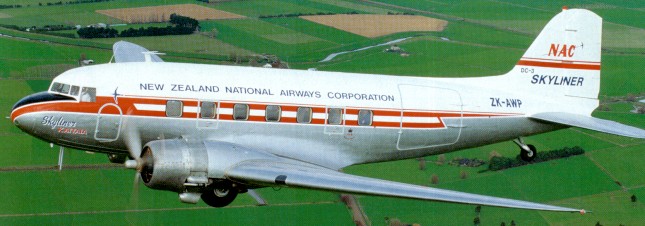
National Airways Corporation operated three models of DC-3 and applied its own model suffixes, unique to New Zealand versions. The DC-3C was the basic internal passenger version with double rear doors on the port side of the fuselage. The DC-3C freighter retained the dual rear doors on the port side, with the exception of ZK-BKE, which was the only genuine DC-3 to serve in the fleet, having been built in 1941 for United Airlines and had starboard side doors before being called up into military service. The DC-3D, with the smaller single door of prewar DC-3, an astrodome and a wireless operator’s station, was used initially on regional services. NAC ran its DC-3 with a maximum all-up weight of 26,900 lb for landing and take-off. The DC-3C Freighter could lift a payload of 4,244 lb, the DC-3C passenger 3,344 lb and the DC3D 3,244 lb. The DC-3C Freighter was the lightest, with a fleet operating weight of 17,400 lb compared with 18,200 lb for the DC-3C and 18,400 lb for the DC-3D.
Prior to Skyliner conversion in the 1960s, they could carry up to 4,824 lb of fuel in two 168 imperial gallon tanks between the front and centre spars in the centre section. The aircraft also had two auxiliary tanks each of 167 imperial gallons between the centre and rear spars on the centre line, but these were removed in the Skyliner conversion, although provision for one remained on all but the DC-3D, which retained provision for two.
The LC 47H was a winterised C 47H. Prior to 1962, before a change in the US Navy designation system, the aircraft would have been a R4D 5L. The R4D 8s were a Super DC 3 with modified outer wing panels, longer fuselage, enlarged tailplane, tall square topped fin, fully enclosable undercarriage and powered by 2 x 9 cylinder Wright Cyclone R1820 80s of 1,475hp. Principal versions – C-47, R4D-1 and Dakota Mk I (initial model), C-47A, R4D-5 and Dakota MkIII (revised electrical system), C-47B, R4D-6 and Dakota Mk IV (high ¬altitude blowers), Lisunov Li-2 (2,000+ Soviet-built aircraft), and Nakajima/ShowaL2D “Tabby” (485 Japanese aircraft).
In 1963 Libya started its own Air Force when the US turned over two T-33 and a C-47 at Wheelus AFB.
Nakajima L2D Type 0
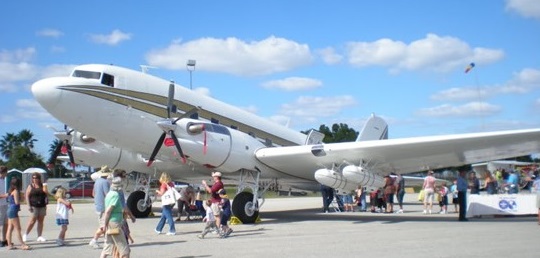
Basler Conversions of Wisconsin have FAA approval to fit Pratt and Whitney PT6A 67R turboprop engines driving Hartzell five-bladed propellers to DC 3s, enabling up to 42 passengers or a useful load of around 5900 kgs in the revitalised aircraft, being marketed as the Turbo 67R. The fuselage is stretched approximately 42 inches from its original length, with all-new electrics, and extended fuel storage with an additional 200 gallons of fuel carried in the engine nacelle-mounted fuel tanks.
Schafer Aircraft Modifications Inc was founded 1977, and from 1979 developed modifications for other aircraft. Included was developing a turboprop conversion and fuselage stretch for the DC-3 as DC-3-65TP Cargomaster.
The aircraft was ordered in very large numbers by the US armed forces and when production ceased in 1947, Douglas had built 10,654 examples of all civil and military variants. Nakajima and Showa in Japan built 485 (L2D) and about 2,000 had been built in the USSR as PS-84, but later redesignated Lisunov Li-2. As late as 1990 there were 3,500 Dakotas still flying world wide.
Prototype DST (Douglas Sleeper Transport) / C 38 Engines: 2 x Wright Cyclone SGR-1820, 633.4-745kW
Douglas DC-3 Engines: Two Pratt & Whitney R-1830-92, 1200 hp / 880kW Maximum speed: 237 mph (379 km/h) Maximum weight: 28,000 lb (12,600 kg) Range: 1110 miles (1776 km) Maximum passengers: 28 Span: 95 ft (28.5 m) Length: 64 ft 5 in (19.3 m) Height: 16 ft 11 in (5 m) Wing area: 987 sq ft (91.7 sq m) Crew: 2
DC 3 Engines: 2 x 900 h.p. Wright Cyclones. Length: 64.5 ft. (19.6 m.) Wing span: 95 ft. (29 m.) Weight empty: 16,290 lb. (7,390 kg.). Crew: 2. Pax cap: 21. Max cruise: 185 m.p.h. (298 km.p.h.). Ceiling: 23,000 ft. (7,000 m.). Range: 1,500 miles (2,400 km.).
NAC DC-3C Payload: 3,344 lb Operating weight: 18,200 lb Maximum all-up weight: 26,900 lb Fuel capacity: 4,824 lb / two x 168 imperial gallon tanks
NAC DC-3C Freighter Payload: 4,244 lb Operating weight: 17,400 lb Maximum all-up weight: 26,900 lb Fuel capacity: 4,824 lb / two x 168 imperial gallon tanks
NAC DC3D Payload: 3,244 lb. Operating weight: 18,400 lb Maximum all-up weight: 26,900 lb Fuel capacity: 4,824 lb / two x 168 imperial gallon tanks
C 39
C-¬41 Engines: 2 x Twin Wasps.
C 47 Skytrain / R4D / Dakota I Engines : 2 x Wright Cyclone R-1820-G202A, 1200 hp Wing Span : 95ft (28.96m) Length : 64ft 5.5in (19.65m) Height : 16ft 11in (5.16m) Range : 1,500 miles (2,414km) Speed : 229 mph (369 km/h) MTOW: 25,200 lb
C 47A Skytrain / R4D / Dakota III Engines: 2 x Pratt&Whitney R-1830-93, 1200 hp Length: 64.206 ft / 19.57 m Height: 16.929 ft / 5.16 m Wingspan: 95.013 ft / 28.96 m Wing area: 986.951 sqft / 91.69 sq.m Max take off weight: 26030.0 lb / 11805.0 kg Weight empty: 16974.1 lb / 7698.0 kg Max. speed: 199 kts / 369 km/h Cruising speed: 161 kts / 298 km/h Service ceiling: 23196 ft / 7070 m Cruising altitude: 10007 ft / 3050 m Wing load: 26.45 lb/sq.ft / 129.0 kg/sq.m Range: 1304 nm / 2415 km Crew: 3+28 Elec¬trics: 24 volt
C 47B Skytrain / R4D / Dakota IV Engines: two 1,200-hp (895-kW) Pratt & Whitney R-1830 90C Twin Wasp radial piston. Max speed: 230 mph.
C-47 Skytrain Engines: two 1,200-hp (895-kW) Pratt & Whitney R-1830-92 Twin Wasp radial Maximum speed 229 mph (368 kph) at 7,500 ft (2,290 m) Initial climb rate 1,130 ft (345 m) per minute Service ceiling 23,200 ft (7,075 m) Range 1,500 miles (2,401 km) Empty weight 16,970 lb (7,705 kg) Maximum take-off: 13290 kg (29 300 lb) (sometimes 14 080 kg, 31004 lb). Wing span 95 ft 0 in (28.90 m) Length 64 ft 5.5 in (19.63 m) Height 16 ft 11 in (5.20 m) Wing area 987.0 sq ft (91.70 sq.m) Payload: 28 troops, or 18 litters, or 10,000 lb (4,536 kg) of freight.
C-47B-35-DK Engines: two 1,000 hp Curtiss-Wright R-1820-G2 Cyclone 9 cylinder radials, or 1,200 hp Pratt & Whitney R-1830-92 twin Wasp two-row 14 cylinder radials. Wingspan: 28.96 m Length 19.66 m Height 5.17 m Cruising speed 266 km/h Ceiling 21,900 ft
TC 47B / R4D 7
C 47C Undercarriage: twin float amphibian Ex-C 47A
C-47D Engines: 2 x Pratt & Whitney R1830-90, 1,200 h.p. Wingspan: 95 ft Length: 63 ft. 9 in. Loaded weight: 30,000 lb. Max speed: 224 m.p.h. Ceiling: 24,100 ft. Typical range: 1,500 miles at 185 m.p.h. at 10,000 ft. with normal load Crew: 3 Capacity: 21 passengers
LC 47H / R4D 5L Skytrain
AC 47 Armament: 3 x 7.62 mm (0.30 in) General Electric Miniguns / 54 000 rounds
C 48 impressed civil DC 3 Engines: R 1830
C 49 impressed civil DC 3 Engines: R 1820
C 50 impressed civil DC 3 Engines: R 1820
C 51 impressed civil DC 3 Engines: R 1820
C 52 impressed civil DC 3 Engines: R 1830
XC-53A No built: 1 (42-6480)
C 53 Skytrooper / Dakota II / R4D 3 Engines: 2 x Pratt & Whitney R-1830-92, 1.200 hp
C 53B Engines: 2 x Pratt & Whitney R-1830-92, 1.200 hp
C 53C Engines: 2 x Pratt & Whitney R-1830-92, 1.200 hp
C 53D Engines: 2 x Pratt & Whitney R-1830-92, 1.200 hp
DC 3A / C 68 impressed civil DC 3 Engines: R 1830
DC 3B / C 84 impressed civil DC 3 Engines: R 1820
C 117A VIP transports 17 built
C-117A-11-KK
R4D 8 / C¬117D Engines: 2 x Wright Cyclone R 1820 C9HE, 1475 hp
XCG 17 glider – ex-C 47A Capacity: 40 troops Tow speed: 464 kph (288 mph) Landing speed: 56 km/h (35 mph) No built: 1
Basler Conversions Turbo 67R. Engines: 2 x Pratt and Whitney PT6A 67R turboprop Passengers: 42 Useful load: 5900 kgs
Lisunov Li 2 Engines: 2 x Shvetsov ASh-621R, 1000 hp Propellors: SISh-21 Wingspan: 95 ft 0 in Max speed: 225 mph
Lisunov Li 2 Engines: AV-7N
Lisunov Li 2 Engines: AV-161
Lisunov Li 2 / PS-84 Engines: 671kW Shvetsov M-62 radials
PS-84I Medevac version
Lisunov Li 2 Engines: Shvetsov ASh-62 radials
Lisunov Li 2 Engines: M 621R
Lisunov Li-2DB Long range fuel tanks.
Li-2F Aerial photography
Lisunov Li-2G Freighter
Li-2LL Flying labratory
Li-2 Metro Flying labratory
Lisunov Li-2P Passenger transport
Lisunov Li-2PG convertible
Li-2PR Glass nose
Lisunov Li-2R Survey aircraft with bulged windows.
Li-2RE Flying labratory
Li-2REO Flying labratory
Lisunov Li-2T Cargo and troop carrying Cargo door on left hand side
UChShLi-2 Navigator trainer
Li-2US Navigator trainer
Lisunov Li-2V high-altitude model Ski equipped, boosted engines.
In 1936 Douglas began its Model 7 as a light attack bomber as a private venture, produced to the order of the French government. Begun by Jack Northrop and completed by Ed Heinmann, after considerable refinement this flew on 26 October 1938 as the Model 7B private-venture prototype with 1,100-hp (820-kW) Pratt & Whitney R-1830 radials. The type was maneuverable and fast, and soon elicited a French order for 100 somewhat revised DB-7s.
The first production DB-7 flew on 17 August 1939. When France fell the undelivered aircraft outstanding from French contracts were taken over by the British government and given the name Boston. Only 60 were delivered, and 20 more passed to Great Britain.
Further French orders covered 100 DB-7As and 481 DB-7Bs. Most of these served with the Royal Air Force as Havoc Mk II night fighters and Boston Mk II bombers respectively. Later Bostons were patterned on A-20 aircraft for the US Army Air Forces, and served mainly over North-West Europe. As delivered to the RAF from the French contracts, the Boston I was powered by two Pratt & Whitney R-1830-S3G-4G engines. It was used mainly for training duties, although some were converted for night fighting and given the British name Havoc. The A-20 was the first of the series built to a US Army specification and was powered by two 1,112kW Wright R-2600-7 Cyclone engines with exhaust-driven turbo-superchargers. It was fitted with American armament and equipment. As the Boston II for the RAF, the A-20 had R-2600-A5B engines and British armament. Those converted into night fighters became Havocs each with a lengthened nose fitted with 12 forward-firing 7.62mm guns, AI radar and other special equipment depending on the sub-variant – one carried a high-power searchlight in the nose. As an intruder it carried a crew of three and full armament and bombs. The A-20A for the USAAC/USAAF was powered by two 1,192kW Wright R-2600-11 engines with integral two-speed superchargers. The A-20B was an experimental development of the A-20A, armed with two 12.7mm guns firing forward, one 12.7mm upper flexible gun, one 7.62mm lower flexible gun, and one 7.62mm gun in the tail of each engine nacelle, firing aft. Nacelle guns were remotely controlled by a foot trigger in the rear compartment. The A-20C was powered by two similarly rated R-2600-23 engines. Armament comprised four fixed guns (two on each side of the transparent nose), two on a flexible mounting in the rear cockpit, and one in the lower rear-firing position – all 7.62mm (A20G) or 7.69mm (British Boston Ill). Ejector-type exhaust stacks replaced the collector rings used on the earlier models and range was increased by the addition of a self-sealing fuel tank in the forward and rear bomb-bay compartments. Provision was also made on some aircraft to carry a 900kg naval torpedo.
Douglas A-20 Havocs, 1939
The observer (not only bomb aimer) was completely cut off from the pilot. Because of this the gunner had at the back a duplicate joystick. On high level operations a Vickers K gun was mounted in the rear entrance hatch. A camera was also carried mounted in this hatch.
It may be of interest that the very first operation carried out by the USA against Europe was on July 4, 1942, when six of their Bostons were led by six 226 Squadron Bostons.
A-20 Havoc
The Boston III was powered by R-2600-A5B engines and carried a crew of four as a bomber. The Boston IIIA was similar but built by Boeing. Some Boston III/IIIA were fitted as intruders with four 20mm cannon under the forward fuselage, four 7.69mm guns in the nose, and two 7.69mm guns in the upper flexible position.
Following the experimental XA-20E, with a 37mm nose cannon and General Electric turrets, the A-20G appeared. This was similar to the A-20C except that the transparent bombardier nose was replaced by a solid nose fitted (in earlier versions) with four 20mm cannon and two 12.7mm machine-guns and ultimately with six 12.7mm guns. A few also had a single 12.7mm upper flexible gun, but this was soon replaced by a power-driven turret armed with two 12.7mm guns. Thicker armour for increased crew protection on ground-attack missions was also added. The A-20H was powered by two 1,267kW R-2600-29 engines and incorporated minor improvements. The A-20J was identical to the later version of the A-20G except that the attack nose was replaced by a moulded-plastic bombardier’s nose incorporating bombing controls and flight navigation instruments. One in ten A-20G were completed as A-20J to serve as squadron lead planes. Armament consisted of two 12.7mm machine-guns (one in each side of the transparent nose), two in the power-operated dorsal turret and one in the lower rear firing position. The A-20K was identical to the A-20H except that the attack nose was replaced by a bombardier’s nose, as with the A-20J. The British Boston V was similar. Special US versions of the A-20 appeared as the P-70 night fighter with R-2600-11 engines and armed with four 20mm cannon mounted in a fairing beneath the fuselage bomb bay; the P-70A conversion of the A-20G with R-2600-23 engines and six 12.7mm machine-guns in a solid nose and dorsal and lower guns; the P-70B development of the P-70A for training, with six 12.7mm ‘package’ guns and special radar (converted A-20G/J); the F-3A night photographic-reconnaissance conversion of the A-20J/K; and BD-1/2 target tugs for the US Navy.
Production for the RAF, USAAF, US Navy and Russia ceased on 20 September 1944 after 7,478 had been built (7008 by Douglas and 380 by Boeing). Russia received twice as many as the RAF and only some 800 less than the US Army.
Principal versions DB-7 (R-1830) DB-7A (Wright R-2600, many passed to Great Britain as Havoc Mk Is) DB-7B (revised systems and larger vertical tail) Boston Mk I (taken-over DB-7s) Boston Mk II (taken¬over DB-7Bs converted to Havoc Mk I) Boston Mk III (British DB-7Bs) Boston Mk IIIA (200 Lend-Lease A-20Cs with British equip¬ment) Boston Mk IV (169 Lend-Lease A-20Js with heavier fixed armament) Boston Mk V (90 Lend-Lease A-20Ks with more power). P-70 version of the A-20 became an early night fighter.
DB-7B / Boston Mk III Engines: two 1,500-hp (1,119-kW) Wright R-2600-A5B Cyclone radial Maximum speed 311 mph (500 km/h) at sea level Initial climb rate 2,000 ft (610 m) per minute Service ceiling 25,170 ft (7,670 m) Range 525 miles (845 km) Empty weights: 15,051 lb (6,827 kg) Maximum take-off 21,580 lb (9,790 kg) Wingspan 61 ft 4 in (18.69 m) Length 47 ft 3 in (14.40 m) Height 18 ft 1 in (5.51 m) Wing area 464.0 sq ft (43.11 sq.m) Armament: seven 0.303-in (7.7-mm) machine guns, and up to 2,000 lb (907 kg) of bombs.
A-20G Havoc Engines: 2 x Wright R-2600-23 Cyclone 14, 1578 hp / 1193kW Max take-off weight: 12338 kg / 27201 lb Empty weight: 7250 kg / 15984 lb Wingspan: 18.69 m / 61 ft 4 in Length: 14.63 m / 47 ft 12 in Height: 5.36 m / 17 ft 7 in Wing area: 43.20 sq.m / 465.00 sq ft Wing loading: 58.63 lb/sq.ft / 286.00 kg/sq.m Max. speed: 275 kts / 510 km/h / 317 mph Cruise speed: 200 kts / 370 km/h / 230 mph Service ceiling : 25000 ft / 7620 m Range: 891 nm / 1650 km / 1025 miles Crew: 4 Armament: 9 x 12.7mm 50 MG (12,7mm) machine-guns, 1800kg of bombs
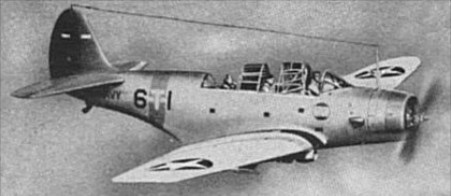
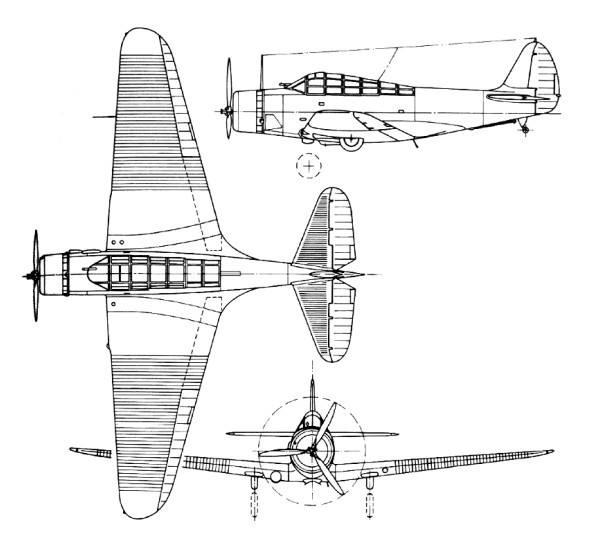
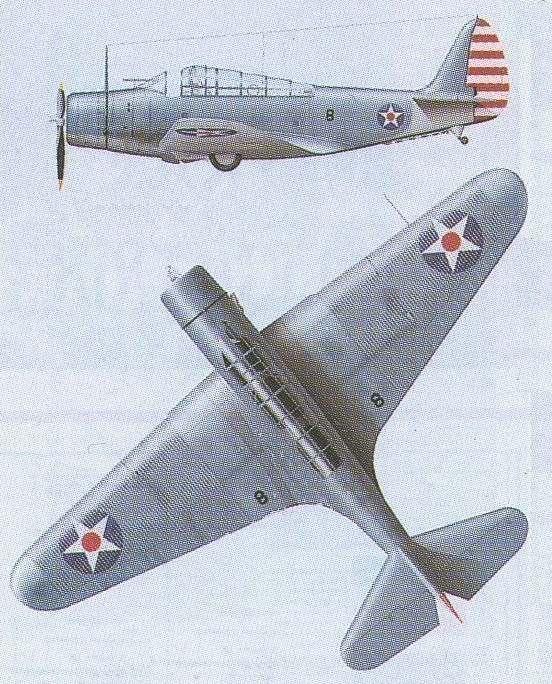
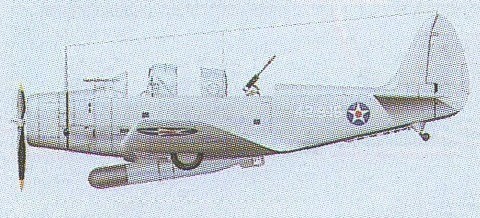
The prototype of the Devastator torpedo bomber flew for the first time on 15 April 1935. It was the first monoplane selected for aircraft-carrier operations, the first of 129 ordered by the US Navy entering service in 1937.
For the first time in a Navy bomber the TBD featured an enclosed cockpit and all-metal construction.
Armed with only one forward-firing and one rear-mounted machine-gun (plus a 533mm torpedo or 450kg bomb), it was vulnerable to enemy attack and a lack of self-sealing fuel tanks contributed to the Devastator’s failure in combat. Heavy losses were suffered in action against the Japanese during the early part of World War II, especially during the Battle of the Coral Sea when the type operated from USS Lexington and Yorktown. The Battle of Midway, fought between 4 and 7 June 1942, was the Devastator’s last major action: it was relegated to non-combat duties after suffering heavy losses during the battle.
Engine: 1 x 900hp Pratt & Whitney R-1830-64 Twin Wasp Wingspan: 15.24 m / 50 ft 0 in Length: 10.67 m / 35 ft 0 in Height: 4.60 m / 15 ft 1 in Wing area: 421.949 sqft / 39.2 sq.m Max take-Off Weight: 4624 kg / 10194 lb Weight empty: 6182.8 lb / 2804.0 kg Wing loading: 24.19 lb/sq.ft / 118.0 kg/sq.m Max. Speed: 179 kts / 332 km/h / 206 mph Cruising speed: 111 kts / 206 km/h Range (max. weight): 361 nm / 669 km Service ceiling: 19701 ft / 6005 m Crew: 3 Armament: 2xMG 0.3cal (7,62mm), Torp/Bomb 454kg
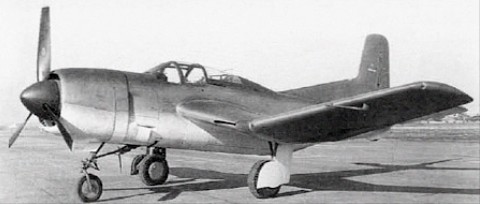
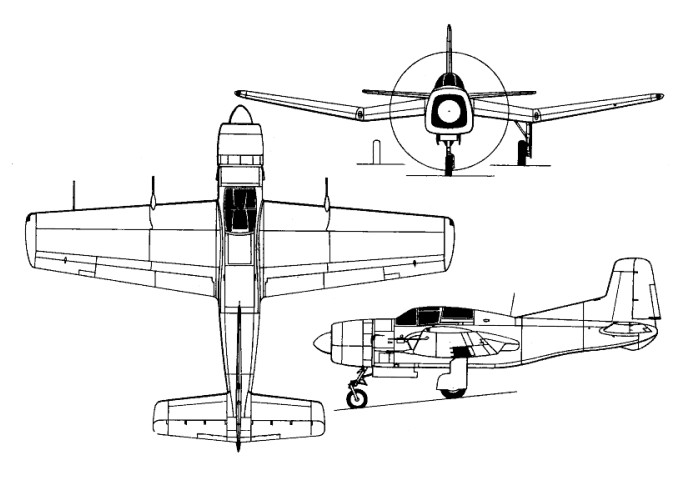
The US Navy had initiated the procurement of an advanced dive-bomber, leading to the development by Douglas of a two-seat aircraft in this category. Two prototypes were ordered by the US Navy in June 1941, designated Douglas XSB2D-1 Destroyer, the first prototype made its initial flight on 8 April 1943.
The prototype was a two-seat dive-bomber, introducing an internal bomb bay and, for the first time for an aircraft to operate from an aircraft-carrier, retractable tricycle landing gear. The US Navy’s new requirement was for a single-seat torpedo/dive-bomber, and the XSB2D-1 was modified for this new role by conversion to a single-seat cockpit, the addition of two wing-mounted 20mm cannon, enlargement of the bomb bay and the provision of increased fuel capacity. Airbrakes were installed in each side of the fuselage, and the Wright Cyclone 18 engine of the XSB2D-1 was retained to give the requisite high performance. A contract on 31 August 1943 increased earlier orders for this aircraft, designated BTD-1 and retaining the name Destroyer, to 358. Deliveries of production aircraft began in June 1944, but only 28 had been delivered before contract cancellation was initiated soon after VJ-Day. The Destroyer’s performance was disappointing and it appears the type was not used operationally. Two aircraft were provided experimentally with a mixed powerplant, a 680kg thrust Westinghouse WE-19XA turbojet being fitted in the rear fuselage and fed with air through a dorsal inlet aft of the cockpit. Thus designated XBTD-2, the aircraft were the first jet-powered machines of Douglas and the US Navy. A first flight was made in May 1945, but at speeds over 322km/h the downward-angled turbojet could not be used. The project was cancelled in late 1945.
BTD-1 Engine: 1 x Wright R-3350-14 Cyclone 18 radial, 2268 hp / 1715kW Max take-off weight: 8618 kg / 19000 lb Empty weight: 5244 kg / 11561 lb Wingspan: 13.72 m / 45 ft 0 in Wing loading: 51.05 lb/sq.ft / 249.0 kg/sq.m Length: 11.76 m / 38 ft 7 in Height: 5.05 m / 16 ft 7 in Wing area: 34.65 sq.m / 372.97 sq ft Max. Speed: 299 kts / 554 km/h / 344 mph Service Ceiling: 7195 m / 23600 ft Range: 1286 nm / 2382 km / 1480 miles Armament: 2 x 20mm cannon, one torpedo or 1450kg of bombs Crew: 1
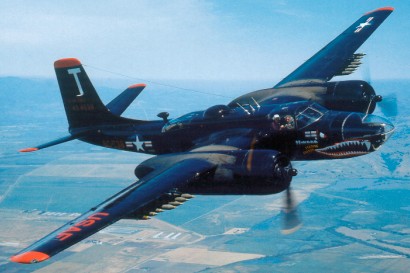
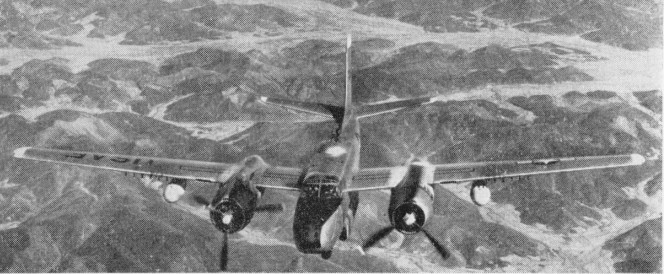
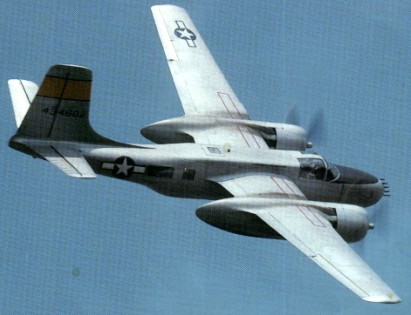
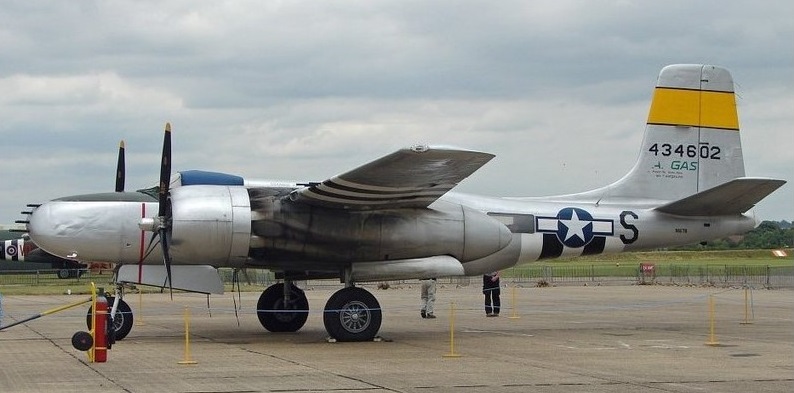
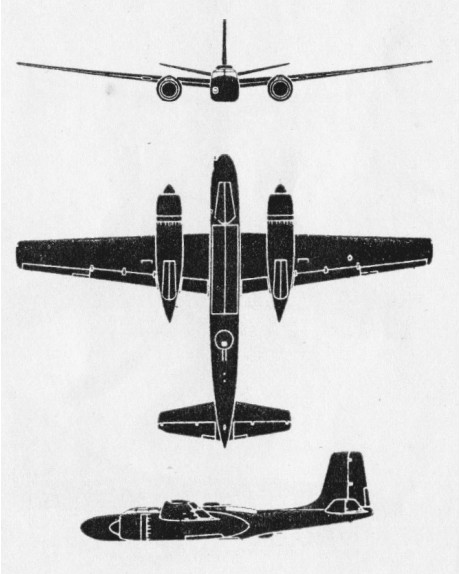
Designed to fulfil a USAAF requirement for an attack bomber to replace the B 26 Marauder, the B 25 Mitchell and the A 20 Havoc, the Douglas A 26 Invader first prototype flew on 10 July 1942. Three prototypes had been ordered in differing configurations: the Douglas XA-26 attack bomber with a bomb-aimer’s position; the XA-26A heavily-armed night-fighter; and the XA-26B attack aircraft with a 75mm cannon. After flight testing and careful examination of reports from Europe and the Pacific, the A-26B Invader was ordered into production, and deliveries to operational units began in December 1943. By the end of World War Two, production of the Invader had ceased. A total of 2,446 were built.
The A-26B Invader had six 12.7mm machine-guns in the nose, remotely controlled dorsal and ventral turrets each with two 12.7mm guns, and up to 10 more 12.7mm guns in underwing and underfuselage packs. Heavily armoured, and able to carry up to 1814kg of bombs, the A-26Bs two, 1491kW Pratt & Whitney R-2800 engines conferred a maximum speed of 375 mph / 571km/h, making the A-26 the fastest US bomber of World War II.
B-26B
Missions with the 9th Air Force in Europe began in November 1944, and at the same time the type became operational in the Pacific. The A-26C with a bomb-aimer’s position and only two guns in the nose entered service in 1945, but saw only limited use before World War II ended. A-26C production totalled 1,091. With little employment ahead of them, so far as anyone could see, one A-26B and one A-26C were converted to XJD-1 configuration, this pair being followed by 150 A-26Cs converted as target tugs for the US Navy with the designation JD-1; some were converted later to launch and control missile test vehicles and drones, under the designation JD-1D. These designations became UB-26J and DB-26J in 1962.
In 1948 the Martin Marauder was finally retired from service and the Invader took over the B 26 designation, it having previously been designated an ‘Attack’ aircraft as the A 26. Two principal sub types were in operation at this time, B 26B and C. The B 26B had a solid nose containing its main armament of six 0.5in Browning machine-guns and the remotely controlled dorsal and ventral turrets, each mounting two similar guns. The B 26C had a transparent nose.
Throughout the 1950s, the B 26 operated with the US Air Forces Europe (USAFE) as a light bomber, target tug and tactical reconnaissance aircraft. The build up of American forces in Europe, which had commenced in 1949 under the leadership of Lt General Curtis E LeMay, proceeded apace in the early 1950s. The B 26B arrived at Laon in France with the 126th Light Bombardment Wing in July 1952; and in December of that year the 7554th Tow Target Flight located to Furstenfeldbruck airbase in Germany. This unit flew the TB 26B variant.
A-26
The RB‑26s did not get off to an auspicious start. Primarily this was due to a lack of equipment, spares and appropriate facilities. On arrival in Germany only 15 days’ supply had been brought over from the US. In addition to this, their all‑important night photo missions were held up for some weeks because no one had made the necessary arrangements for a suitable range for the use of flash bomb cartridges. Eventually arrangements were made with Strategic Air Command to use the ranges at Lakenheath.
Flying for an RB‑26 crew for the first few days of their deployment in Europe consisted of familiarisation flights over their new homeland. Even this became restricted when, in May and early June, a refinery strike in the US severely restricted the use of fuel. For the period of the emergency each pilot was only allowed to for 20 hours.
The RB‑26s were fitted with the comparatively new ‘Hell Roarer’ magnesium illuminator system with split vertical camera installation using the A18 magazine. The ‘Hell Roarer’ was demonstrated to interested parties on November 5 over the Bay of Naples. It turned out to be a veritable firework bonanza. In the cold light of dawn, on November 6 the demonstrating RB‑26 was seen to have a badly scorched tail.
The RB‑26s suffered particularly from severe icing and were grounded for long periods when the temperatures were very low. In late 1953 the problems with the RB‑26 were such that the USAFE prepared to re‑equip the 1st and the 30th TRS with the ‘state‑of‑the‑art’ Martin RB‑57A Canberra. As early as December, crews were being checked out on their respective wings’ Lockheed T‑33s prior to going to Shaw AFB in the USA, home of the 363rd Tactical Reconnaissance Group, a unit also destined to receive the RB‑57A.
Significantly, while the 1st and 30th TRS were preparing to re‑equip with the RB‑57A and relinquish their RB‑26s, in March 1954 another squadron was activated at Spangdahlem with the 10th TRW which began to equip with the older aircraft. The 42nd TRS was activated on March 18.
The 42nd was divided into two flights ‑W and B. W Flight was for weather reconnaissance, and S had the electronic mission. The first RB26 was assigned to W Flight on June 18 and it was not until December that the first aircraft was assigned to B Flight. By this time the weather flight had received its full complement of aircraft.
The aircraft of B Flight increased in sophistication throughout their service with the squadron until replaced in 1956 with the Douglas RB‑66C. The RB‑26s of W Flight were replaced by T‑33As in 1955.
Used also for reconnaissance and target towing, and by Air National Guard. U.S. Navy uses same type as JD-1 for target towing.
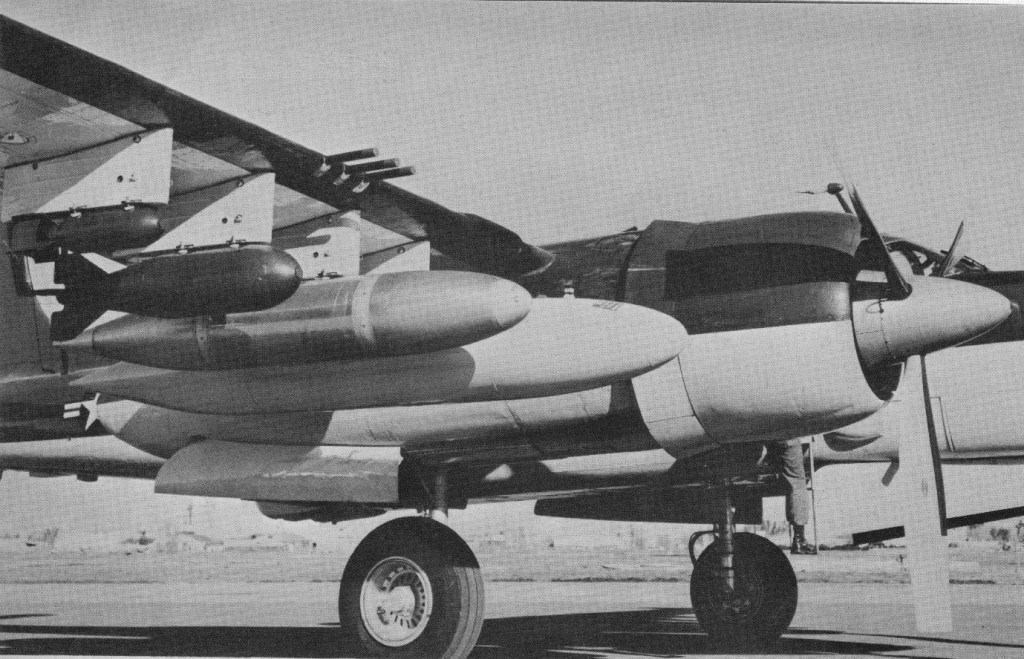
A special COIN version with very heavy armament and extra power was developed by On Mark Engineering in 1963, a prototype being designated YB-26K and named Counter Invader. Subsequently about 70 B-26s were converted to B-26K standard, 40 later being redesignated A-26A. Some were deployed in Vietnam, and others were supplied to friendly nations under the Military Assistance Program. B-26s were used also for training (TB-26B and TB-26C), transport (CB-26B freighter and VB-26B staff transport), RPV control (DB-26C), night reconnaissance. (FA-26C, from 1948 redesignated RB-26C) and missile guidance research (EB-26C). After the war, many A-26s were converted to executive, survey, photographic and even fire-fighting aircraft.
The YB-26K was the test ship for a series of highly modified B-25Ks ordered by the USAF from On Mark Engineering. The production version was to utilise clip-on gun pods instead of wing mounted guns and eliminate JATO racks seen on the YB-26K. The On Mark received old B-26’s from Davis-Monthan AFB storage or Tactical Air Command. $13,000,000 was allotted to rebuild and extensively modify the bombers.
YB-26K
Changes between the B-26B and YB-26K included the wingspan increased 2 feet to 72 ft; normal gross weight up 5000 lb to 41,000 lb; engine horsepower up 500hp each to 2500hp; maximum speed up 31kt to 345 kt; stall speed lowered 9kt to 76kt; rate of climb up 255fpm to 2990fpm; service ceiling raised 7000ft to 30,000ft; and combat radius increased 290nm to 500nm.
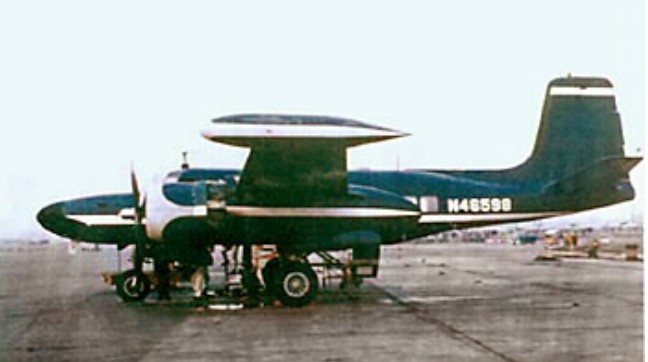
Air America’s night drop bird, 598, aka The Blue Goose or the Blivit. Parked on the Ramp at Udorn in June of 1967. It had an F111 a Terrain Following Radar (TFR) in the nose. This feature allowed low level, jungle top resupply drops at night along the Ho Chi Minh trail between the Mu Gia Pass to Tchepone. 598 had a drop ramp in the aft section and two supply pallets could be carried/dropped. It had a crew of four. Two pilots, a navigator, and a kicker or Air Freight Specialist as they were officially titled.
In total 1,355 were built.
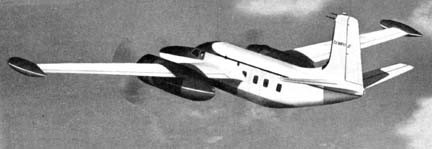
L B Smith Aircraft Corp of Miami FL., produced an executive transport version of surplus Douglas B-26 as the Smith Tempo II in 1959.
A 26B Invader Engines: 2 Pratt & Whitney R-2800. Top speed: 355 mph.
Douglas A 26 C Invader Engine : 2 x Pratt&Whitney R 2800-70 Double Wasp, 1973 hp Length : 51.247 ft / 15.62 m Height: 18.241 ft / 5.56 m Wingspan : 70.013 ft / 21.34 m Wing area : 540.030 sq.ft / 50.170 sq.m Max take off weight : 35006.6 lb / 15876.0 kg Weight empty : 22854.8 lb / 10365.0 kg Max. speed : 324 kts / 600 km/h Cruising speed : 247 kts / 457 km/h Service ceiling : 22096 ft / 6735 m Wing load : 64.78 lb/sq.ft / 316.0 kg/sq.m Range : 1217 nm / 2253 km Crew : 3 Armament : 6x cal.50 MG (12,7mm), Bombload 1814kg
B-26B Engines: 2 x Pratt & Whitney R-2800-27 or -79 Double Wasp, 1491kW Wingspan: 21.34 m / 70 ft 0 in Length: 15.24 m / 49 ft 11 in Height: 5.64 m / 18 ft 6 in Wing area: 50.17 sq.m / 540.02 sq ft Max take-off weight: 15876 kg / 35000 lb Empty weight: 10365 kg / 22851 lb Fuel capacity: 770-1590 gal Max speed: 571 km/h / 355 mph at 15,000 ft Cruise speed: 457 km/h / 284 mph Service ceiling: 6735 m / 22100 ft Range max load: 2253 km / 1400 miles Armament: 10 x 12.7mm machine-guns, 4000 lb / 1814kg of bombs Crew: 3
B-26B Engines: 2 x Pratt & Whitney R2800-79. 2,000 h.p. Wingspan: 70 ft Length: 50 ft. 8 in. Loaded weight: 35,000 lb. Max. speed: 359 m.p.h. Ceiling: over 28,000 ft. Max. range: 1,900 Miles. Armament: 10 x 0.50 in. machine-guns, 6,000 lb. bombs, 14 x 5 in. rockets. Crew: 3
RB-26 Invader
Smith Aircraft Corp Tempo II Engines: 2 x P&W R-2800-C, 2100hp Wingspan: 73’6″ Length: 60’4″ Max speed: 365 mph Cruise: 350 mph Stall: 102 mph Seats: 12
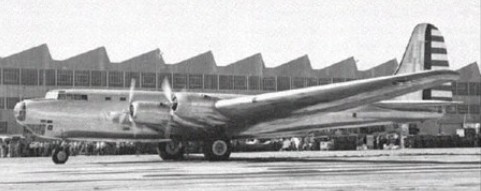
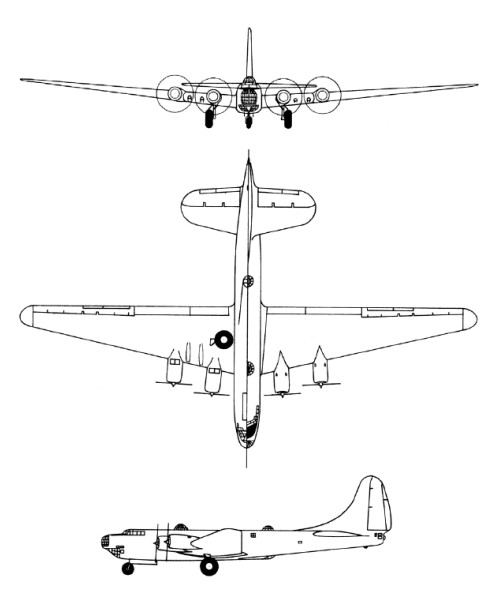
In 1942 Douglas began to design a larger, would-be successor to the Douglas C-54. The new model, identified in project form as the Model 415, had the same four-engine, low-wing layout as its predecessor, but it was about half again as large dimensionally and twice as heavy. With 3,250hp (2,420kW) Pratt & Whitney R-4360-27 Wasp Major engines, it would cruise at 296mph (476km/h), considerably faster than the C-54. The pilot and co-pilot were separately enclosed in side-by-side bubble canopies, an arrangement later found far from satisfactory from a crew communication standpoint. It was a cantilever low-wing monoplane of all-metal construction, with a conventional tail unit, and retractable tricycle landing gear with twin wheels on each unit. The C-74’s fuselage provided accommodation for the crew and 125 troops, or 115 stretchers with medical attendants, or up to 21840kg of cargo. Orders were received for 50 examples of a military version known as the C-74 Globemaster. In 1945, Pan American Airways also recognized the new model’s potential and ordered 26 with seats for 108 passengers. As ‘DC-6’ was already assigned, the civilian version was called the DC-7. Unlike the C-54, the DC-7 was to have a pressurized cabin. By the time of the first flight on September 5, 1945, the military order had been reduced to 14 units. One, with 103 passengers and crew, flown from the USA to the UK on 18 November 1949, was the first aircraft to fly across the North Atlantic with more than 100 persons on board. With development costs shared by fewer military airplanes, the cost of the DC-7s rose accordingly. Pan American reassessed its needs, as well as the increased cost of the DC-7s, and elected to cancel its order altogether. Although the DC-7 failed as a civil airliner, Douglas did redesign the fuselage of the C-74 to create the C-124 Globemaster II.
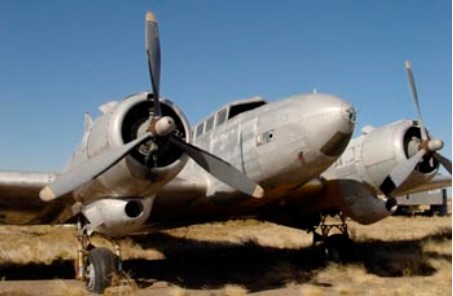
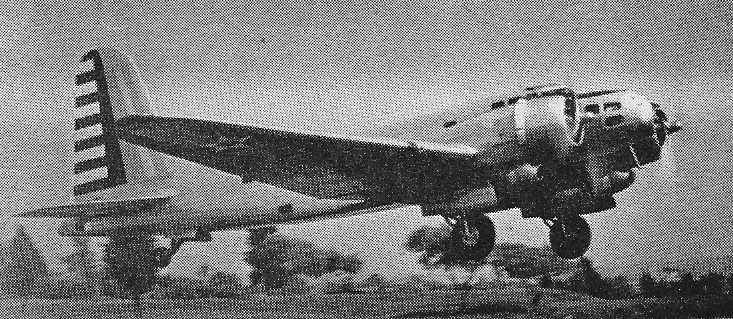
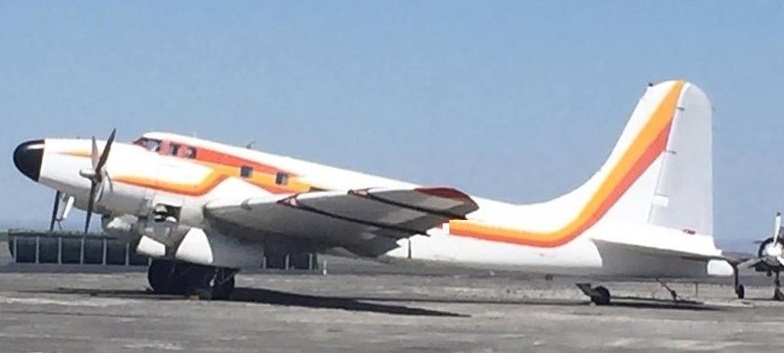
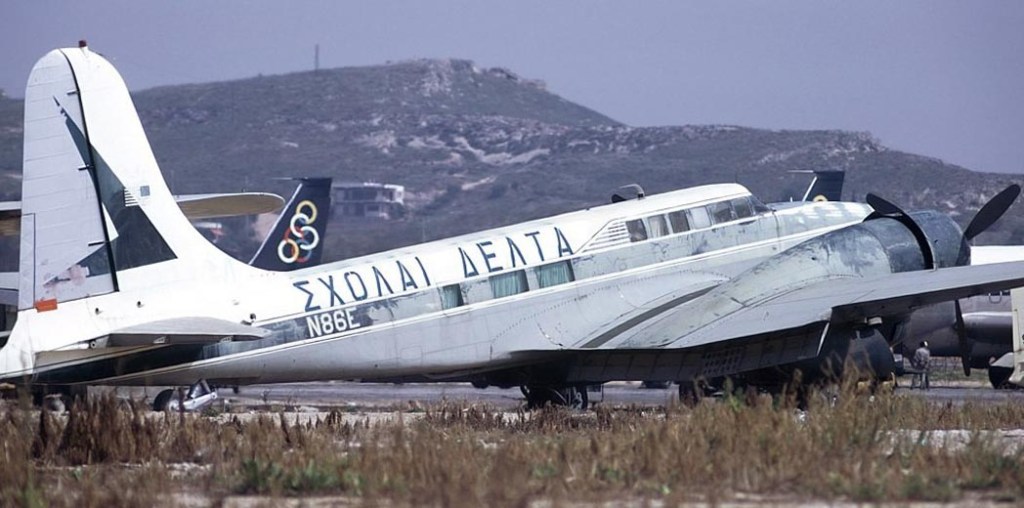
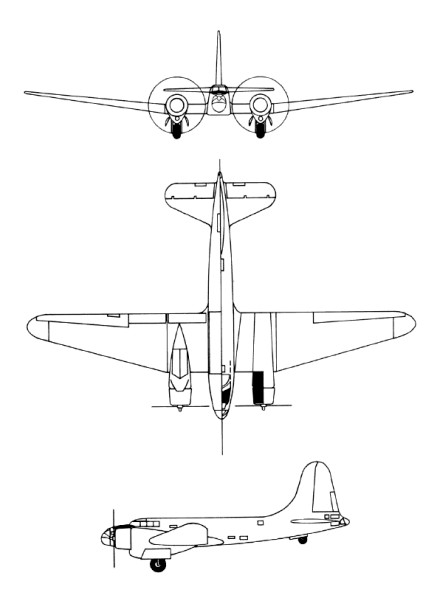
In an attempt to rectify the shortcomings of their DB-1 design, Douglas developed in 1938 an improved version and the proposal seemed sufficiently attractive for the US Army to award a contract for 38 of these aircraft under the designation B-23 and with the name Dragon.
Landing gear was retractable tailwheel type, but the engine nacelles had been extended so that when the main units were lowered in flight they were faired by the nacelle extensions and created far less drag.
The main difference was the switch to much more powerful engines (the most powerful then available), the 1450 hp Wright R 2600 1 Cy¬clone 14. The army adopted the proposal as the B 22, but soon switched to a further improvement designated B 23. The B 23 Dragon included the first US Army tail gun position, a hand aimed .03 in (12.7¬mm). Nose, dorsal and ventral positions each had one 0.30 in (7.62 mm). The tail wheel is offset to allow the tail gunner to access his position from the fuselage. Maximum bomb¬load was 2177 kg (4800 lb), all internal.
In the Fiscal Year 1939, a batch of 38 B 23 Dragons was funded, following successful trials with the prototype in the summer of 1939.
First flown on 27 July 1939, the B-23s were all delivered to the US Army during that year. Early evaluation had shown that performance and flight characteristics were disappointing. Furthermore, information received from the European theatre during 1940 made it clear that development would be unlikely to result in range, bombload and armament capabilities to compare with the bomber aircraft then in service with the combatant nations, or already beginning to emerge in the USA. As a result these aircraft saw only limited service in a patrol capacity along the US Pacific coastline before being relegated to training duties.
During 1942 about 15 of these aircraft were converted to serve as utility transports under the designation UC-67, and some of the remainder were used for a variety of purposes including engine testbeds, glider towing experiments and weapons evaluation. They were popular executive transports after the war.
Douglas UC-67 Dragon
A total of 38 examples were built, all powered by Wright R-2600 Cyclone engines.
Douglas UC-67 Dragon (C-67)
In 1963 Juan T. Trippe, Pan Am president flew in a B-23 owned by Pan Am, carrying no identification, flown by Pan Am pilots and based at Butler Aviation on LaGuardia. Trippe flew between New York and Washington regularly.
B-23 Engines: 2 x Wright R-2600-3 Cyclone 14, 1193kW / 1578 hp Max take-off weight: 13824 kg / 30477 lb Empty weight: 8659 kg / 19090 lb Wingspan: 28.04 m / 92 ft 0 in Length: 17.78 m / 58 ft 4 in Height: 5.63 m / 18 ft 6 in Wing area: 92.25 sq.m / 992.97 sq ft Max. speed: 454 km/h / 282 mph Cruise speed: 338 km/h / 210 mph Ceiling: 9630 m / 31600 ft Range: 2253 km / 1400 miles Crew: 4-5 Armament: 1 x 12.7mm (0.50in) + 3 x 7.62mm (0.30in) machine-guns, 2000kg of bombs
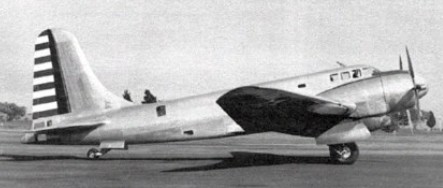
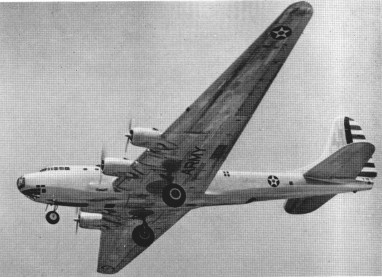
Originally designated XBLR-2 (eXperimental Bomber Long-Range 2), the XB-19 was essentially used as a test bed for very large bomber construction techniques and flight characteristics. The Douglas Aircraft Company had wanted to cancel the project because of the expense and extended construction time which made the aircraft obsolete before it ever flew. However, the Army Air Corps insisted the aircraft be completed for test use. The XB-19’s first flight was 27 June 1941, more than 3 years after the construction contract was awarded. In 1943, the original radial engines were replaced by Allison V-3420 in-line engines and the aircraft was redesignated XB-19A. After testing was completed, the XB-19A was used as a cargo/transport aircraft until 1949 when it was scrapped.
Engines: 4 x 2000hp Max take-off weight: 73467 kg/ 161968 lb Wingspan: 64.62 m / 212 ft 0 in Length: 40.23 m / 131 ft 12 in Height: 13.03 m / 42 ft 9 in Max. speed: 360 km/h / 224 mph Ceiling: 7015 m / 23000 ft Range: 8372 km / 5202 miles Crew: 11 Armament: 2 x 37mm cannon, 5 x 12.7mm + 6 x 7.62mm machine-guns , 16330kg of bombs
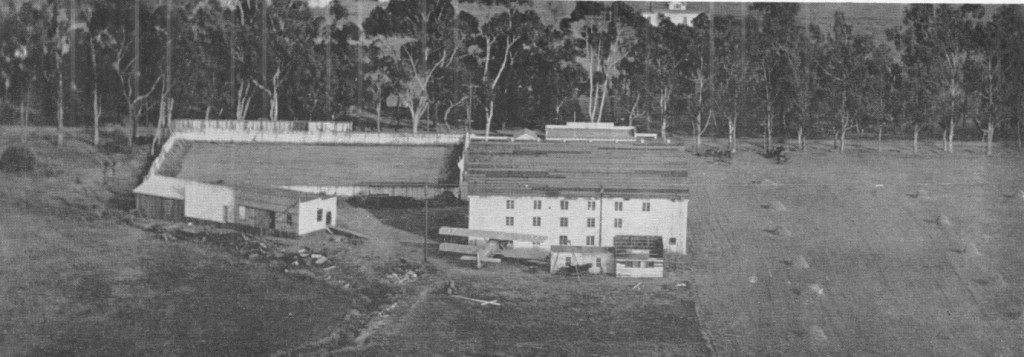
Donald Douglas, the son of a bank cashier in Brooklyn, came to Los Angeles in 1915 with a degree from the Massachusetts Institute of Technology. By 1922 he had established a factory with a capital of $350 in an abandoned motion-picture studio in Santa Monica, where he built torpedo plane for the US Navy. Two years later he had signed for his first export order, to Norway.
Douglas Aircraft, Santa Monica, California, 1920s
The Davis-Douglas Cloudster of 1920, Donald W. Douglas’s first design, was followed in 1921 by the DT torpedo- bomber for the U.S. Navy, the largest single-engined aircraft in the U.S.A. at the time. Four modified DTs, known as Douglas World Cruisers, made the first round-the-world flight in 1924, with Army crews. The Douglas Aircraft Company was formed in 1928, and in July 1929 a former Douglas engineer, Jack Northrop, set up the Northrop Aircraft Company and produced an all-metal low-wing dive-bomber, the XBT-1/A-17.
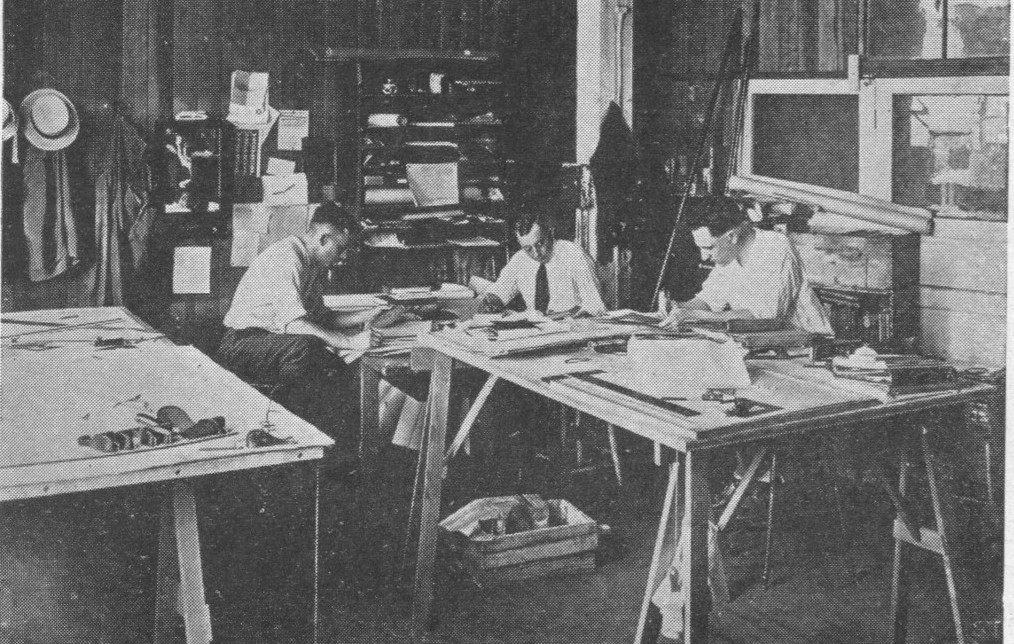
Donald Douglas, at left, working on the Cloudster design.
With the help of designer Jack Northrop, Lockheed built the F1, but it was turned down by the Navy. In 1923 Northrop left to take a job with Donald Douglas, and later founded his own corporation.
Northrop and Douglas merged in 1937 (Douglas with a majority stockholding), and in 1938 it became Douglas-El Segundo. The dive-bomber design progressed, via the Douglas TBD Devastator of 1934, to become the U.S. Navy’s first monoplane, and was followed by the Dauntless SBD. Ultimate Douglas development of the single-engined piston-engined attack-bomber was the 1945 Skyraider, which served in many roles until 1968, both in Korea and Vietnam. Last single-engined military designs by Douglas were the small delta-wing F4D Skyray jet fighter (first flown January 1951) and highly successful A4D Skyhawk jet attack-bomber (first flown June 1954 and 2,960 built up to 1979; current programs around the world keep substantial numbers of Skyhawks operationally capable with foreign forces).
The first twin-engined Douglas design appeared in 1925; the T2D for the U.S. Navy. The B7 of 1930 was the first of a series for the U.S. Army, and was followed by the B-18 in 1935. The most famous twin, however, was the DB-7/A-20 Boston (and nightfighter Havoc), which first saw action in June 1940. A total of 7,385 was built, of which 3,125 went to Russia. The A-26/B-26 Invader of 1945, developed from the A-20, served in Korea and Vietnam, and the Boston/Havoc concept was taken into the jet age by the Skywarrior and Skynight. A version of the former became the B-66 Destroyer, Douglas’s (and the USAF’s) last conventional light-attack bomber.
In 1933, under pressure from United Airlines’ Boeing 247, Transcontinental & Western Air turned to Douglas to provide a competing aircraft. The first DC-1 (Douglas Commercial) appeared in prototype only, but 131 DC-2s followed in 1932-1936. The first commercial orders were in 1933 for 40 DC-2 for the new Trans World Airways. A wide-bodied sleeper version, the DST, led to the DC-3 in 1936, which was to be the most famous airliner of all time. In 1940 the USAAC ordered it as the C-47 transport. Douglas built 9,255 of the 10,125 produced, and in 1961 1,000 were still in military use, and 600 civil DC-3s remained in operation in the U.S.A. in 1974. Douglas, consulting five airlines, developed a four-engined version, the DC-4, in 1941. The Army commandeered all civil DC-4s on U.S. entry into the war, and 1,162 military C-54s were built. After the war many reverted to DC-4 status, to be succeeded by the DC-6 and DC-7.
At Santa Monica, the Douglas company had made 29,000 aircraft during World War 2, but produced 127 in 1946.
Douglas temporarily lost its lead in transport when Boeing produced the Model 707, but then produced the very effective DC-8 and DC-9 jet.
Military transport design continued with the big C-124 Globemaster in 1950, and C-133 Cargomaster of 1957, a heavy strategic freighter capable of carrying all the thencurrent IRBMs or ICBMs. In 1947 Douglas went supersonic with the jet D-558-1 Skystreak and D-558-2 rocket Skyrocket, built for NASA. The latter held the world speed record in 1953 at 1,981km/h and achieved Mach 2.01 at 19,810m in 1953. The later X-3 research aircraft was intended for flight at up to Mach 3. There was a brief involvement with executive jets with the PD-808 Vespa-jet, production being transferred from El Segundo to Rinaldo Piaggio before, in 1967, the company merged with McDonnell Aircraft to become McDonnell Douglas.
Douglas files bankruptcy and was forced to sell at a knocked down price to McDonnell of St. Louis, which had been making handsome profits out of its F-4 Phantom, supplied to the air force in Vietnam.





 All Aero