As a result of the recognition achieved with the KRA Midget, Kreider-Reisner began manufacturing the Challenger, which became a popular sport plane in the 1920s. In the Spring of 1929, Fairchild acquired 82% of the common stock in Kreider-Reisner, making the Hagerstown company a subsidary of the Fairchild Aviation Corporation, which eventually became Fairchild Aircraft Company.
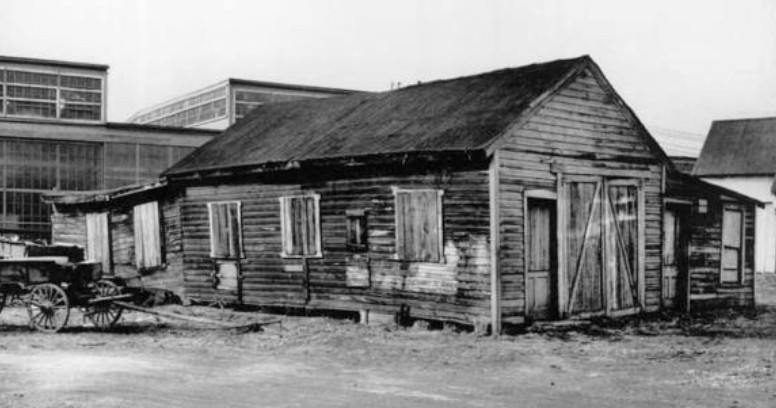
The “Little Green Shed” off Pennsylvania Avenue in Hagerstown was part of the original Kreider-Reisner factory complex.
Sherman Fairchild founded Fairchild Airplane Manufacturing Corporation in 1925. Changed to Fairchild Aviation Corporation in 1929 with premises at Lonqueil, Quebec, and the parent company withdrew manufacturing license from Canadian Vickers. When The Aviation Corporation acquired a controlling interest.
Sherman Fairchild withdrew in 1931, retaining a subsidiary, Kreider-Reisner Corporation, Hagerstown, Maryland, which was renamed Fairchild Aircraft Corporation in 1935. This became Fairchild Aircraft Division, Fairchild Engine and Airplane Corporation, in 1939; Fairchild Stratos Corporation in 1961. Fairchild Hiller Corporation in 1964 on acquisition of Hiller Aircraft Company.
In 1964 Fairchild-Stratos Corp purchased Hiller Aircraft with cash, not stock transactions. Hiller capabilities fitted into one of Fairchild’s primary goals – vertical takeoff and landing aircraft. The Hiller plant was to remain in Palo Alto.
Acquiring Republic Aviation Corporation in September 1965 and this becoming the Republic Aviation Division of Fairchild Hiller Corporation and, later, the Fairchild Republic Company division of Fairchild Industries; Fairchild Industries Inc in 1971 (acquired 90 percent interest in Swearingen Aviation Corporation in November 1971, which became Fairchild Aircraft Corporation in 1982). Metro Aviation, with 97 percent shareholding in Fairchild Aircraft Corporation, sold by Fairchild Industries to GMF Investments, but in 1990 Fairchild Aircraft filed for bankruptcy protection and was sold to Fairchild Acquisition Incorporated that year. The name for producer of Metro, Merlin, and Expediter series of twin-turboprop commuter airliner, executive transport and freighter aircraft (plus MMSA multi-mission surveillance aircraft variant of Metro 23) became Fairchild Aircraft Incorporated. Finally, in June 1996 parent company Fairchild Aerospace bought 80% of the German manufacturer Dornier Luftfahrt from Daimler-Benz Aerospace, resulting in Fairchild Aerospace owning all of the renamed Fairchild Dornier U.S.A. Fairchild Aircraft Incorporated and 80% of Fairchild Dornier Germany Dornier Luftfahrt GmbH.
Fairchild built FC-1, FC-2 and Model 71 lightplanes 1925-1931. Continued production of Kreider-Reisner Model 24C8, later supplied in four-seat version as USAAF UC-61 Forwarder and as RAF Argus. M-62 Cornell trainer introduced 1940 with variety of engines. Wartime production was Bristol Bolingbroke for RCAF, and 300 Curtiss Helldivers for U.S. Navy 1943-1945. AT-21 gunnery trainer entered production in 1942. C-82 Packet twinboom cargo/troop transport flown September 1944; superseded by developed C-119, first flown November 1947. In the early 1950s, the number of Fairchild employees reached approximately 10,000 who built 1112 C-119s between 1948 and 1952. Manufactured 326 C-123 Providers 1954-1958, designed by Chase Aircraft. License-production of Fokker F-27/FH- 227 airliner began 1957; 205 built. Hiller UH-12 and H-1100 helicopters continued in production after acquisition of Hiller company. Production of Pilatus Turbo-Porters begun June 1966; 15 of COIN version delivered to USAF as AU-23A Peacemaker, transferred to Royal Thai Air Force. In 1967 work initiated on 52 USAF AC-119 gunships. Contracts awarded after acquisition of Republic for weapons delivery enhancement of F-105 Thunderchief, subcontract assemblies for McDonnell Douglas F-4, Boeing 747.
In 1964 Fairchild-Stratos Corp purchased Hiller Aircraft with cash, not stock transactions. Hiller capabilities fitted into one of Fairchild’s primary goals – vertical takeoff and landing aircraft. The Hiller plant was to remain in Palo Alto.
Won USAF A-X competition for close-support aircraft, prototype YA-10A flown 10 May 1972; production of A- 10A Thunderbolt II ended 1984 after 713 built, and were in U.S. service in A-10A attack and OA-10A forward air control variants with the USAF, Air National Guard and Air Force. Main feature of A-10A is nose-mounted GAU-8/A Avenger 30 mm seven-barrel cannon with 1,174 rounds of armor-piercing ammunition. Also manufactured wings for Merlin and Metro twin-turboprop aircraft.
USA Formed 1942. Made several experimental types, notably FW-5 (“The Wing”), having center section built integrally with the fuselage, and a low-wing monoplane in which a tubular steel spar formed the fuel tank. Latter type revived after the war as E.F.100 Winglet.
Though this company became part of British Aircraft Corporation in 1960, its origins date back to 1911 at its Coventry Works (Coventry Ordnance Works Ltd.), where quantity production of other manufacturers’ designs was undertaken during First World War. After the Armistice development centered on the Kingston flying-boats, following the lines of the Cork, a product of the Phoenix Dynamo Manufacturing Company Ltd., which was then also part of English Electric. Original features manifest in Ayr flying-boat and Wren ultralight monoplane (1923), but aircraft work ceased in the mid-1920s. In 1938 it was resumed, with contracts for the Handley Page Hampden (followed by the Halifax). In May 1944 an order was placed for de Havilland Vampire jet fighters. Over 1,000 Vampires built before production got under way on company’s own Canberra, the first British jet bomber and the first to serve with the RAF. Canberra production continued for ten years, totaling over 1,300 examples, including 403 license-built Martin B-57s for the USAF. Numerous variants developed, notably for reconnaissance; other countries using the type included Ecuador, France, Peru, Rhodesia, Sweden, and Venezuela. Many records broken (e.g. London-Cape Town December 1953). Lightning twin-jet single-seat fighter of 1952 was RAF’s first supersonic fighter (in level flight); entered service December 1959. Much development of this type was undertaken by British Aircraft Corporation, but two-seat version emanated from English Electric. British Aircraft Corporation was formed out of Bristol, English Electric, Vickers-Armstrong and Hunting Aircraft Ltd, in 1960.
Two M.S.406H fighters were supplied to Switzerland in September 1938 and April 1939 to serve as pattern aircraft for a licence-manufactured version. These were hybrids, mating the M.S.405 airframe with the HS 12Y31 engine of the M.S.406 and Swiss-specified instrumentation, armament and radio. Production was initiated by the Eidgenossisches Konstruktions-Werkstatte as the D-3800, the Hispano-Suiza 12Y31 engine being manufactured by Adolph Saurer AG. The drum-fed 7.5mm wing guns were replaced by belt-fed weapons, the two-pitch Chauviere propeller was supplanted by an Escher-Wyss EW-V3 controllable-pitch unit, and the original M.S.405 wing structure was retained (rather than the simplified and lighter wing of the M.S.406). A pre-series of eight D-3800s was built in 1939, and the first series aircraft was delivered in January 1940. Seventy-four series D-3800s were built, the last of these being delivered on 29 August 1940, and later, in 1942, two further aircraft were assembled from spares. During 1943, all D-3800s underwent modification of cooling and hydraulic systems to standardise with the D-3801, and were fitted with similar ejector exhausts. Employed for advanced training after withdrawal from first-line service, the last D-3800s were scrapped in 1954.
Take-off weight; 2480 kg / 5467 lb Empty weight; 1800 kg / 3968 lb Wingspan; 10.62 m / 34 ft 10 in Length; 8.17 m / 26 ft 10 in Height; 2.71 m / 8 ft 11 in Wing area; 17.10 sq.m / 184.06 sq ft Max. speed; 475 km/h / 295 mph
In 1934, the Swiss air arm, or Fliegertruppe, called upon the EKW (Eidgenossische Konstruktions Werkstätte, or Federal Construction Workshop) to design a new airplane that could combine the roles of fighter, reconnaissance and tactical sup¬port aircraft. EKW’s efforts to fulfill such a difficult requirement produced two very different blueprints. The C-35 biplane and the C-36, a mono¬plane with a metal cantilever-wing structure. The Swiss government judged the C-35 a surer prospect and the first of 80 production aircraft entered service at the end of 1937. When war broke out in Europe in September 1939, the Fliegertruppe stepped up its patrols to guard its borders against both German and Allied intruders. At the same time, the C-36 blueprints were reconsidered.
By this time EKW had become EFW (Eidgenossische Flugzeug Werke), and the team at Emmen flew the first of the new aircraft on 23 February 1939.
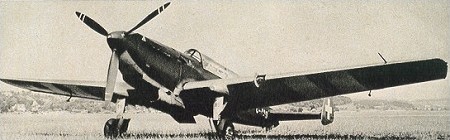
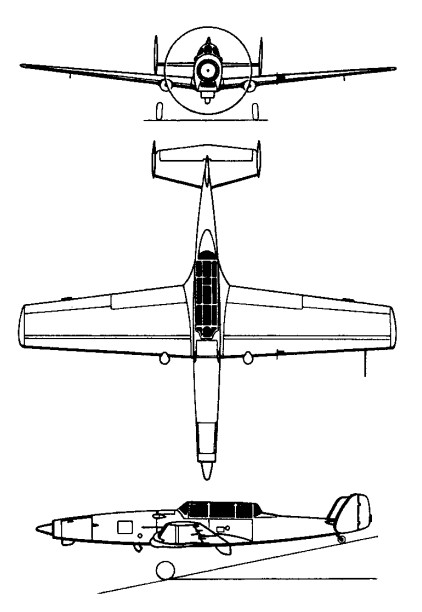
The C 36 had developed into a modified sub type with twin tail fins designated C-3601, powered by the same 860 hp Hispano-Suiza 12Yers engine as the C 35 but now with a variable pitch propeller. On November 30, a second. aircraft, designated C 3602, flew with a 1000 hp Saurer built 12Y 51 engine and more reasonable speed of 510 km/h (317 mph).
Following flight tests, modifications were made and an initial batch entered production as the C-3603, first flown on November 23, 1941. Ten were built, and after service evaluation a further 142 followed, serving with the Swiss air force between 1942 and 1952 in the combat role.
Ordered into production by three manufacturers—the Eidgenossische Flugzeugwerke (Federal Aircraft Factory, or EFW) at Emmen, Doflug at Alterirhein and Pilatus Allgemeine Gesellschaft at Stans, in 1942, the C-3603, as the principal operational variant was designated, entered service with the Fliegertruppe as a long-range reconnaissance and ground support plane.
Two others, designated C-3603-1 TR, were produced for training and parachute tests. In 1945 a C-3603-1 was converted for target-towing.
Further improvements followed, and in 1946 Farner-Werke at Grenchen converted a C-3603-1 into a more advanced target-tug. A long tube was fitted from the rear cockpit to eject the target sleeve above the taiiplane and between the twin fins, with a cable-cutting device available to the pilot. Twenty C-3603s were converted to this standard.
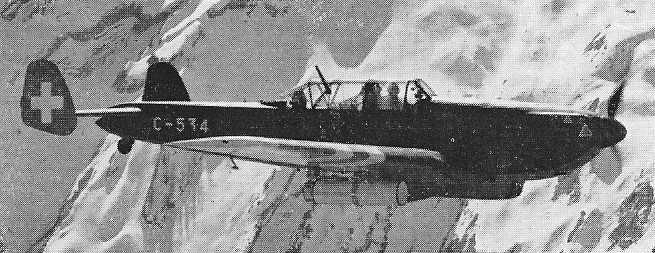
Unlike its predecessors the C 3603 had retractable landing gear, the legs folding to the rear with the wheels turning 90 degrees to lie inside the wings. Pilot and radio operator/ navigator sat under a ‘greenhouse’ canopy, the latter having a pair of 7.5 mm (0.295 in) machine guns. Two more such guns were fixed in the wings, and a 20 mm (0.79 in) Hispano fired through the propeller hub (engine was the same as the C 3602). Racks under the wings carried up to four 100 kg (220 lb) bombs or ten rocket projectiles (from 1945). By 1944 a total of 160 had been delivered and they remained in operational service until 1953.
The C-3603 was designed under the direction of EKW chief designer, J.Branger, and was just entering production when the Fliegertruppe was faced with a choice regarding engines and fuel. Until 1939, Swiss aircraft had relied on normal, high-octane petroleum fuel, which had to be imported and which might be in short supply due to the exigencies of war. If so, their flights would have to be limited to conserve existing stocks of the fuel. The alternative was to use K fuel, a wartime synthetic fuel produced at the Ems wood-processing plant. In order to maintain the level of crew training, the Swiss military decided to use the K fuel. The C-3603s then had to be modified to use the synthetic substance, and the designers were able to in¬corporate the necessary modifications into the C-3603-1 smoothly enough for production at the EFW plant of that newer variant to proceed in 1942, without a lag in overall production of the C-36 series. The C-3603-1 was powered by a 1,000-hp 12-cylinder Hispano-Suiza HS-51 12Y engine, built under license by SLM Winterthur and Adolph Saurer Allgemeine Gesellschaft in Arbon.
C-3603
Another wartime modification of the C-3603s was a change in the landing gear. After all Swiss tactical airfields were provided with paved runways, the plane’s wheel fairings, which were very unpopular with the maintenance staff, were removed. A floodlight was installed in the front portion of each undercarriage fairing to illuminate the taxiways during night flying operations.
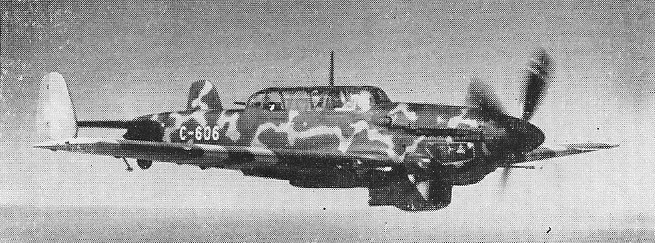
By 1944, 144 C-3603s had been built, and six C-3603-ls would be added between 1947 and 1948. Stored components then were assembled into 11 complete aircraft, given 1,250-hp / 933kW Saurer YS-2 engines and designated C-3604s. On August 21, 1944 the faster C 3604, with three forward firing cannon, made its first flight and was rewarded by an order for 100. The type entering service in 1947-48. Spares produced for the C-3603 and not used enabled a further six C-3603-1 s to be assembled in 1948.
But within a year negotiations had been opened with de Havilland for manufacture of Vampire jets, and only 13 of the C 3604 model were built. All these machines stayed on Flugwaffe strength.
C-3604
In 1945, a C-3603-1 was converted into a Sehlepp, or target tug, and in 1946, the Farner Werke at Grenchen a more advanced version was evolved and fitted to 20 other aircraft within a year. During the early 1950s a requirement for an aircraft to tow illuminated targets at night was met with the conversion of a C-3603-1, and this machine remained in service until replaced by the C-3605 in 1972. By 1953, all 60 surviving aircraft had been converted to that role.
Further conversions of 40 C-3603-1 s to target-tugs began in 1953, while another aircraft was fitted beneath one wing with a winch built by ML Aviation in the UK for high-speed towing, and a ballast tank beneath the other wing. In the same year, 20 more C-3603-1s were converted by the military at Dubendorf for catastrophe relief using underwing supply containers.
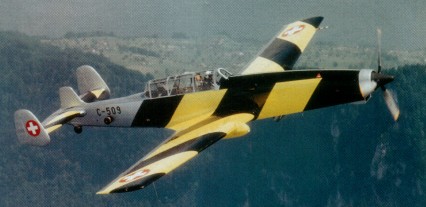
In the mid-1960s, Jean-Pierre Weibel, in charge of the EFW’s Structures Department, proposed that a new engine be adapted to the existing airframes when the Hispano-Suiza engines of the 40 C-3603-1 conversions began to wear out. The choice of a suitable engine was an 1,150-hp Avco Lycoming T53-L-7 turbo¬prop. In September 1967 the idea was approved and work began on the conversion, which was to involve the minimum possible amount of alteration to the airframe. At 555 pounds, the T53-L-7 was less than half the weight of the original piston engine. That made it necessary to add an additional section to the nose to compensate for a serious change in the aircraft’s center of gravity. The 10-foot-9-inch-diameter Escher-Wyss V7 propeller was replaced by a Hamilton Standard 53C51 with a diameter of 9 feet 9.5 inches. New wheels with disc brakes updated the landing gear. The layout and instrumentation of the pilot’s cockpit was modernized, while a hydraulic drive supplemented the mechanical impeller for the SZW-52 winch in the rear cockpit. A third, central, fin was added.
C-3605
The overall result was a fuselage—now 39 feet 5¾ inches long— that seemed to extend as far forward of the wing as behind it. More startling than the airplane’s appearance, however, was its performance when the first prototype (actually, a modification of the 102nd production C-3603), serial No. C-502, began flight testing on August 19, 1968. Its handling qualities were excellent, and pilots also praised its short takeoff and landing capabilities (a takeoff run of 336 feet to reach an altitude of 50 feet, and 564 feet to land from an altitude of 50 feet). An impressive rate of climb (2,407 feet per minute) resulted from its new turboprop engine.
All of those capabilities were especially appreciated for the low-level flying over mountainous terrain that the target tugs would be called upon to perform. Maxi¬mum speed was 268 mph at 10,000 feet, with an economy cruising speed of 217 mph. Empty weight was 5,806 pounds, while the normal loaded weight was 7,275 pounds. By December 1968, when the plane underwent military evaluation, the only further modification deemed necessary was the addition of a small central tail fin to improve stability.
The cost-effectiveness of the program exceeded all expectations, although it was not until 1971 that the Swiss mili¬tary ordered the EFW at Emmen to begin conversion work on the next five exam¬ples of what was by then designated the C-3605. A budget of 30 million Swiss francs was delegated to pay for a total of 23 converted aircraft – an order completed by January 1973. At the same time, the target tugs also underwent a change in color scheme to identify them to the anti¬aircraft crews—from red striping to broad diagonal black and yellow bands over the wings, horizontal stabilizers and forward part of the fuselage.
All 23 C-3605s were still flying late as 1978. The C-3605s began experiencing a disturbing recurrence of forced landings in the mid-1980s, which were generally diagnosed as being due to a loss of torque and overall power. The turboprop engines had worn out before the airframes, and spare parts for them were running low. Rather than re-engining the aging veteran yet again, the Swiss judged it more economical to replace it with a new, purpose-built aircraft, equipped with the latest model turboprop engine and a fixed target-towing installation – the Pilatus PC-9. In April 1987, C-3605s flew their last missions.
C-3603 Engine: Saurer/Hispano-Suiza 12Y-51 Take-off weight; 3590 kg / 7915 lb Empty weight; 2315 kg / 5104 lb Max load: 3,402 lb Wingspan; 13.7 m / 44 ft 11 in Length; 10.2 m / 33 ft 6 in Height; 4.1 m / 13 ft 5 in Wing area; 28.7 sq.m / 308.92 sq ft Max. Speed; 477 km/h / 296 mph Cruise speed; 430 km/h / 267 mph Ceiling; 10000 m / 32800 ft Range w/max.fuel; 680 km / 423 miles Armament; 1 x 20mm cannon, 4 x 7.5mm machine-guns, 400kg of bombs Crew; 2
C-3603-1 Engine: Hispano-Suiza HS-51 12Y 12-cylinder, 1,000-hp. Max speed: 246 mph. ROC: 34 feet per second. Ceiling: 28,540 ft. Endurance: 2 hr. Range: 422 miles.
C-3604 Engine: Saurer YS-2 / Hispano-Suiza 12Y-52. 1,250-hp. Wingspan: 45 ft 1 in Length: 33 ft 7.5 in Height: 11 ft Wing area: 307.8 sq.ft Empty weight: 6260 lb Loaded weight: 9480 lb Max speed at 14,764 ft: 348 mph Max speed SL: 298 mph Cruise: 226 mph at 15,750 ft Seats: 2 Armament: 3 x 20mm cann, 4 x 7.5mm mg
C-3605 Engine; 1 x Avco Lycoming T53-L-7, 820kW / 1150-hp Max take-off weight; 3716 kg / 8192 lb Empty weight; 2634 kg / 5807 lb Wingspan; 13.74 m / 45 ft 1 in Length; 12.03 m / 39 ft 6 in Height; 4.05 m / 13 ft 3 in Wing area; 28.7 sq.m / 308.92 sq ft Max. Speed; 432 km/h / 268 mph at 10,000 ft Cruise speed; 350 km/h / 217 mph Ceiling; 10000 m / 32800 ft ROC: 2,407 fpm Range w/max fuel; 980 km / 609 miles TO dist to 50ft: 336 ft. Ldg dist from 50 ft: 564 ft. Crew; 2
Eidgenössiche (Constructions) Werkstätte was formed at Thun early in First World War. Made aircraft to designs of A. Haefeli, who was earlier with Farman and Ago. First was DH-1 pusher (six built in 1916) showing Ago influence; DH-2 was tractor which went into production as developed DH-3 (110 of these two-seaters built). DH-4 was fighter prototype of 1918; DH-5 (1919; 60 built) a DH-3 replacement; DH-5A a higher-powered version of 1928, with steel-tube fuselage (22 built). To a government specification of 1934 it built the C-35 multipurpose two-seat biplane as a replacement for the Fokker C.V-E, which it resembled, and which the company had produced jointly with Dornier since 1932. The Eidgenos¬sische Konstruktions Werkstatte (EKW) built the Fokker C.V E under licence. EKW (Eidgenossische Konstruktions Werkstätte, or Federal Construction Workshop) became EFW. In 1932 Dornier production was resumed in Germany. The Swiss factory subsequently became the Eidgenossisches Flugzeugwerk. Founded 1934 as government-run R&D organization, with manufacturing, maintenance and upgrading capabilities. In an official specification of 1934 the company had designed the C-36 monoplane. Newly named EFW, it revived the design in 1938 and built 160 as C-3603. Of C-3604 development, only 13 were built. EFW began in 1955 manufacturing the Ilyushin Il-14P under licence, as well as development of the Baade 152.
After the war became responsible for Swiss license production of various foreign aircraft for Swiss Air Force, including the British Vampire, Venom and Hunter (under Hawker Siddeley contract), several versions of French Mirage and US F-5E/F combat aircraft, plus French Alouette III helicopter. Produced C-3605 as turboprop conversion of wartime C-3603 fighter-bomber, used for target-towing. Adopted F + W title in 1972 from former EFW and two other used names. Subsequent work has included assembly of Hawk trainers, Hornet fighters, component production for Airbus and McDonnell Douglas airliners, manufacture of missiles, and more. Later became a subsidiary of the European Aeronautic Defence and Space Company (EADS),
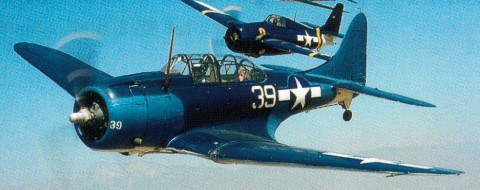
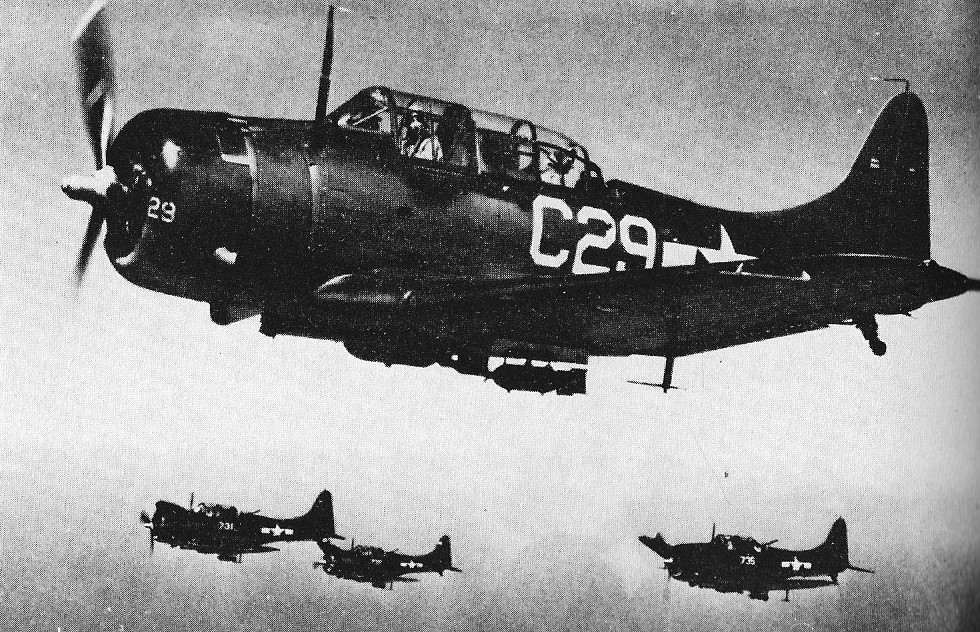
The SBD entered production in 1940. Crewed by a pilot and an observer/gunner the SBD-3, which appeared in March 1941, was powered by a l000hp R-1820-52. In contrast to the earlier models, the SBD-3 had 0.50 armour in the cowling, self-sealing tanks, and protective armour, 584 had been built by December 1941. Seven hundred and eighty SBD-4 models were built at El Segundo, California while 2,409 of the SBD-5s were built at the Douglas plant at Tulsa, Oklahoma.
SBD-3 Max speed: 275 mph Max range; 875 miles Crew: 2 Armament: 2 x .50 mg Bombload: 1 x 500 lb bomb
SBD-4 Engine: Wright R1820-60 Cyclone, l200hp. Max speed: 245mph at 15,800ft. Initial rate of climb: 1190 ft/min.
SBD-5 Engine: Wright R1820-60 Cyclone, l200hp. Length: 33.005 ft / 10.06 m Height: 12.927 ft / 3.94 m Wingspan: 41.503 ft / 12.65 m Wing area: 324.965 sqft / 30.19 sq.m Max take off weight: 9521.2 lb / 4318.0 kg Weight empty: 6535.6 lb / 2964.0 kg Max speed: 221 kts / 410 km/h / 245mph at 15,800ft. Cruising speed: 161 kts / 298 km/h Service ceiling: 25197 ft / 7680 m Cruising altitude: 14000 ft / 4265 m Wing loading: 29.32 lb/sq.ft / 143.00 kg/sq.m Range: 672 nm / 1244 km Initial rate of climb: 1190 ft/min. Crew: 2 Armament: 2x MG 0.5cal (12,7mm), 2xMG 0.3cal (7,62mm), 726kg + 295kg bomb.
SBD-6 Crew: 2 Engine: 1 x Wright R-1820-6 Cyclone 9, 1007kW Max take-off weight: 4318 kg / 9520 lb Empty weight: 2964 kg / 6535 lb Wingspan: 12.65 m / 41 ft 6 in Length: 10.06 m / 33 ft 0 in Height: 3.94 m / 12 ft 11 in Wing area: 30.19 sq.m / 324.96 sq ft Max. speed: 410 km/h / 255 mph Cruise speed: 298 km/h / 185 mph Ceiling: 7680 m / 25200 ft Range: 1244 km / 773 miles Armament: 2 x 12.7mm machine-guns, 2 x 7.62mm machine-guns, 725kg of bombs


 All Aero