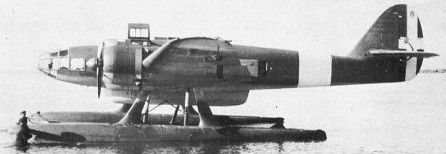
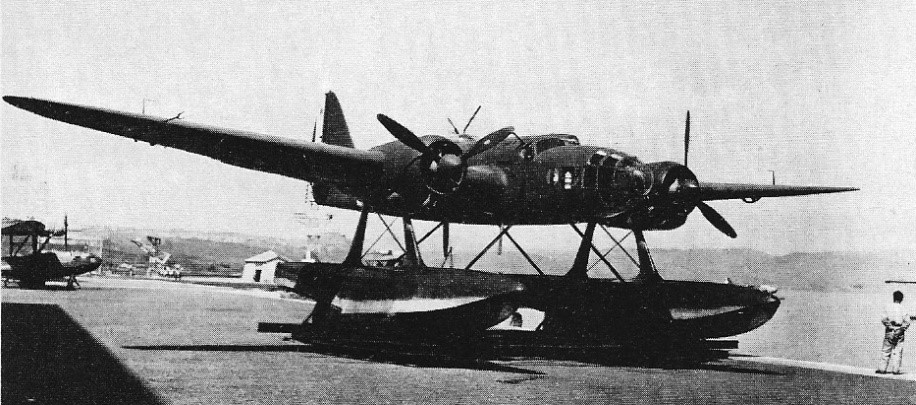
On receiving a joint requirement from the air force and the navy, CMASA, a FIAT subsidiary, developed the RS.14 a floatplane for maritime reconnaissance. 152 examples were produced (including the prototypes), and were used with great success. The aircraft could also be converted for attack missions by fitting a canoe-shaped belly pod able to carry to 400 kg of bombs.
In the summer of 1943 a land-based version with retractable landing gear and 6 12,7 mm machine-guns and a 37 mm cannon was produced and designated A.S. 14. 184 plus 2 prototypes were built.
Fiat R.S. 14 Engines: 2 Fiat A.74 RC.38, 649 kW(882 hp) Empty weight: 5470 kg Takeoff weight: 8470 kg Wingspan: 19,54 m Lenght: 14,10 m Height: 5,63 m Wing Area: 50,00 square metres Max speed: 390 km/h Ceiling: 6300 m Range: 2500 km Climb to 5000 m: 15 minutes Armament: 1×12,7 mm machine-gun in the dorsal turret; one 7,7 machine-gun on each side; 400kg of bombs in a ventral canoe-shaped pod . Crew: 5
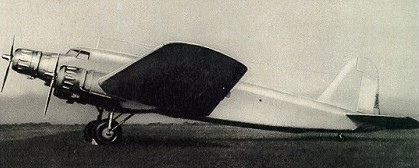
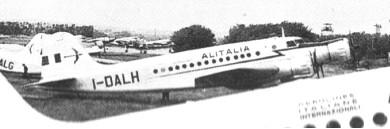
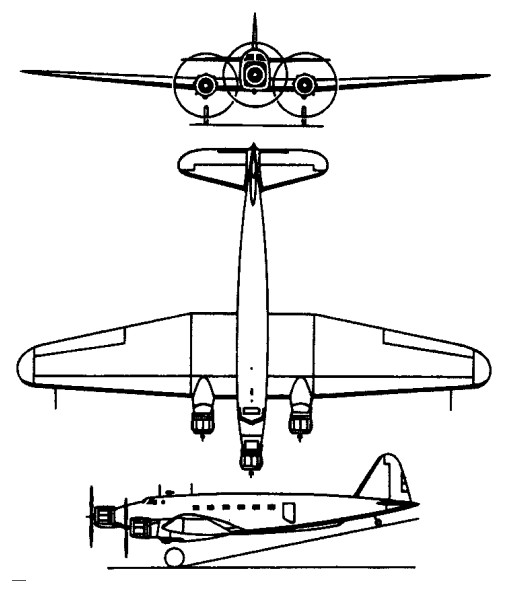
G.12C Engine: 3 x FIAT A.74 RC 42, 574kW Wingspan: 28.6 m / 93 ft 10 in Length: 20.16 m / 66 ft 2 in Height: 4.9 m / 16 ft 1 in Wing area: 113.5 sq.m / 1221.70 sq ft Max take-off weight: 12800 kg / 28219 lb Loaded weight: 8890 kg / 19599 lb Max. Speed: 396 km/h / 246 mph Cruise speed: 308 km/h / 191 mph Ceiling: 8000 m / 26250 ft Range: 1740 km / 1081 miles Crew: 3 Passengers: 14
G.12L Engines: 3 x Fiat A.74 RC.42, 770 hp. Crew: 4. Pax cap: 13.
ITALY Aeronautica d’ltalia SA was the aeronautical branch of Fiat, occupying the factories of the old Ansaldo company which it had absorbed by the 1920s, although the Ansaldo name was still used. For this company and the Societa Italiano Aviazione the name Fiat (or Fiat-Aviazione, or Fiat- Divisione Aviazione) was used after 1924. Renamed FIAT, SOCIETA PER AZIONE 1949 to succeed Aeronautica d’ltalia, inheriting its plant and program. (Fiat’s Divisione Aviazione merged subsequently with Aerfer as Aeritalia formed November 12,1969, fully operational January 1,1972.) Fiat G49 advanced trainer flown September 1952. G80 jet trainer with de Havilland Goblin 35 engine, first flown December 9,1951, was first postwar Italian jet aircraft. In conjunction with Macchi built 80 de Havilland Vampire FB.52As; built 221 F-86K all-weather fighters for Italy, France, and West Germany, first example completed June 1955. G91 adopted as NATO light tactical fighter; prototype flown August 9,1956 and several hundred built subsequently. Prototype of G91Y variant first flew December 27,1966; 65 built for Italian Air Force. License-built 205 F-104S Starfighters for Italian Air Force. G222 twin-turboprop military transport project initiated before establishment of Aeritalia. Aeritalia was created in 1969 by a merger of Fiat’s aviation divisions with two smaller companies.
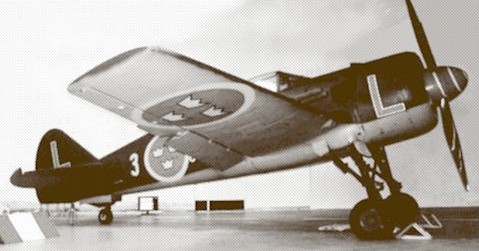
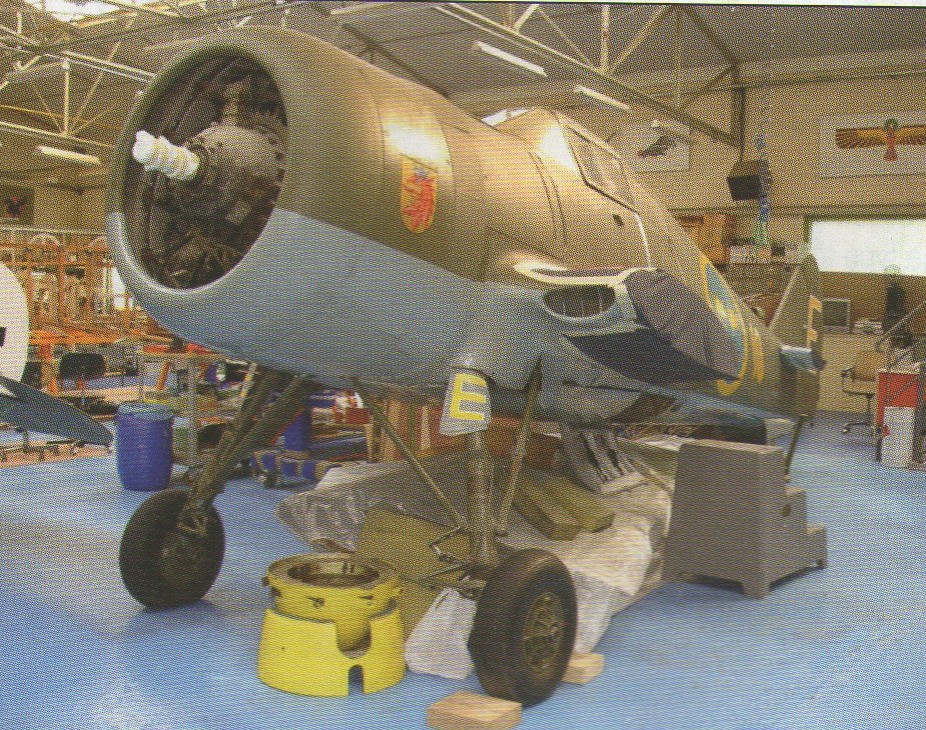
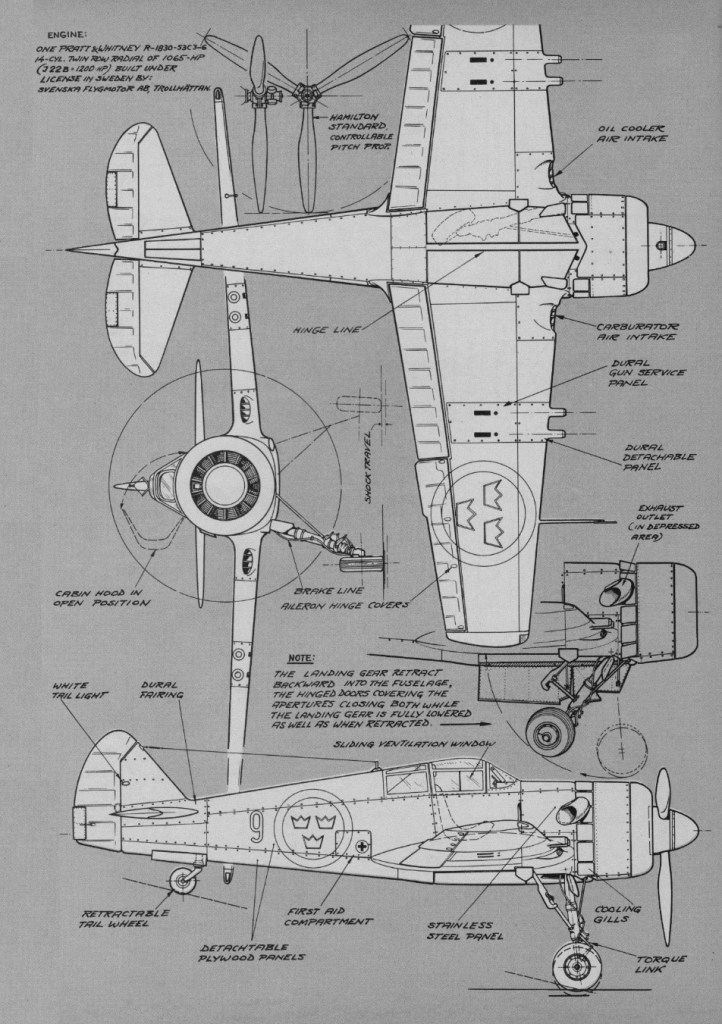
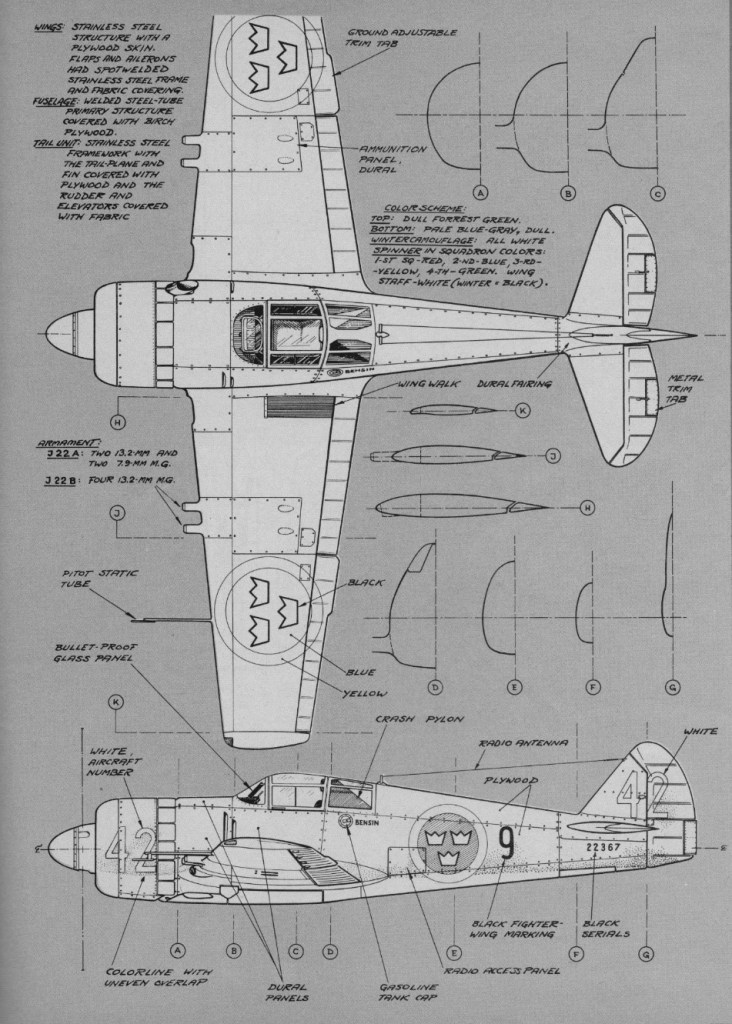
In 1939-1940, the Swedish air force had only a single fighter wing, equipped with 50-60 Gloster Gladiators with the Swedish designation J 8 (J = Jakt, interceptor or fighter). The government decided to equip two new wings and a total of 264 fighters of the types Seversky Republic EP-1 and Vultee Vanguard 48C 1 were ordered in the USA. 60 of the 120 EP-1s were delivered via Petsamo and were given the Swedish designation J 9. In July 1940 all export of fighters from the USA was stopped by a US Government embargo. An indigenous fighter design was required, but with SAAB busy producing its B17 bomber, Flygforvaitninggens Verkstad (FFVS) was formed and designer Bo Lundberg was appointed to design a machine using non-strategic materials. The air force chief instructed the aircraft designer Bo Lundberg to start planning for a Swedish made fighter. Lundberg had been in charge of the Swedish Air Commission in USA and before that chief designer of Götaverken’s aircraft division during the time they designed the GP 8 bomber which competed with SAAB 18 and the cancelled GP 9 fighter. When Lundberg returned to Sweden at the end of 1940, he had already started planning for the new fighter. Requirements was that it should use the same engine as EP-1, STWC-3, a Swedish made Pratt and Whitney Twin Wasp, should be small and light, be made of components that could be made by a large number of subcontractors. The project was designated P 22 and a temporary air force branch was instituted to run the project, Flygförvaltningens Verkstad i Stockholm (FFVS). The aircraft was from the outset designed for the Pratt&Whitney Twin Wasp, an American engine not available to Sweden. Even worse, the Severskies using the same engine had been delivered without spare engines so the shortage was really acute! However, Flygmotor at Trollhättan started an ambitious programme to copy an original Pratt&Whitney Twin Wasp engine – without any drawings or material data at all. Working hard, they almost managed to meet the schedule. In 1942, to compensate for the lag in the engine project, Sweden managed to purchase a batch of 100 engines from the French Vichy regime via Germany. The Swedish-made engines, designated STWC-3, proved very good. One of them was still flying in the late 1980s, now mounted in one of the Swedish Airforce’s last flying C-47s. Since the GV GP 9 was designed to use aluminum, it couldn’t be used as a basis for the new fighter, but its landing gear where the wheels were rotated as the were retracted back into the fuselage was used. The landing gear was made to accept skis, but as the air force’s ability to clear snow off runways had improved, they never were fitted on J 22. Since a wooden wing couldn’t be made strong enough if it was made thin enough for a fast fighter, so the aircraft was made of steel tubing covered with moulded birch plywood. The windshield was made either of 6 mm laminated Gemax or acrylic. The center part was 60 mm thick for ballistic protection. The first prototype of the aircraft which was to be designated J 22 was built in the workshop of Flygtekniska Försöksanstalten (FFA) near Bromma airport, and first flew on September 20,1942, and deliveries began to F9 at Gothenburg in September 1943. Both protypes crashed, one probably due to oxygen starvation of the pilot, the other due to engine failure during landing. Of the 17000 component parts, 12000 were made at 500 subcontractors all over Sweden, with final assembly in a hangar at Bromma, except for the final 18 which were assembled at the air force central workshop at Arboga (CVA), which was set up in 1944 to be the central maintenance facility.
198 aircraft were built and delivered 1943-46. Of these the first 143 were of the version J 22A and the rest J 22B. The only difference between them was that J 22A was armed with two 13.2 mm and two 8 mm guns in the wings, and J 22B with four 13.2 mm guns. The sight was a fixed reflex sight. The J 22 was a light and very manoeuvrable aircraft with good acceleration but when it entered service it was no match for the fighters then current. Tests were made against the P-51 after the war and even if the J 22 could hold its own for a while, especially with a skilled pilot, there is no doubt that the Mustang was the better fighter by a safe margin. In 1945 J 22A was redesignated J 22-1, J 22B into J 22-2 and S 22 became S 22-3. The last ones were retired in 1952. Nine J 22A were converted into reconnaissance aircraft in 1946 and redesignated S 22 (S = Spaning, reconnaissance) and converted back into fighters in 1947.
Engine: STWC-3, 1065 hp Span: 10 m Length: 7.8 m Height: 3.6 m Wing area: 16 sq.m Empty weight: 2020 kg Combat weight: 2835 kg Fuel load:525 litres Max speed: 575 km/h Cruise speed: 440 km/h Landing speed: 140 km/h Range: 1270 km Endurance: 2.9 h Max altitude: 9300 m Armament: 2 x 13.2 mm + 2 x 8 mm guns or 4 x 13.2 mm
On January 1,1941 the Air Board of the Royal Swedish Air Force instituted Flygforvaitningens Verkstad and its own design, which became the FFVS J-22 fighter, first flown September 1942. Subcontracted program with final assembly at Air Board Workshops, Ulvsunda; the first of more than 200 was delivered September 1,1943.
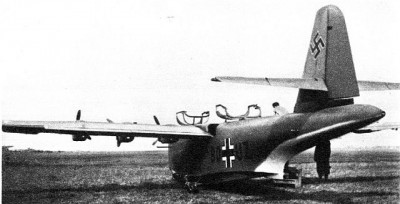
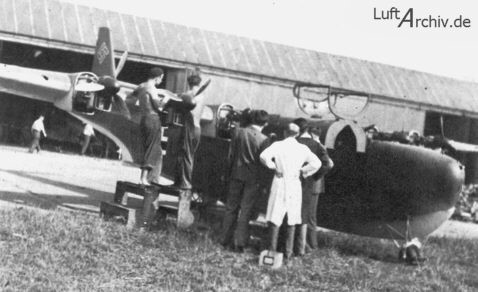
The quarter scale FFG Prag Fg227 was powered by 6 ILO 2 stroke engines rated at 21hp each. It was a ¼ scale BV.238 built by students at Prag under the direction of Dipl.Ing. Ludwig Karch.
A quarter-scale testbed called the FGP 227, registered as BQ+UZ, was deemed necessary to test the aerodynamics and water handling.
Intended to allow flight tests to commence from the manufacturers airfield, the FGP 227 refused to take-off from the grass airfield.
The aircraft was dismantled and transported to Erprobungsstelle See, Travemünde (E-Stelle – flying boat testing station). During transport French prisoners of war loading the wing onto flat-bed trucks allowed it to fall from a crane causing damage which was not repaired until September 1944.
Flight tests commenced in September 1944 as soon as the repairs were completed, but all six engines stopped due to fuel starvation soon after take-off, resulting in a heavy landing on the water. The FGP 227 was again repaired after which the aircraft flew several more times. By this time construction and testing of the BV 238 had started, so no useful data was gleaned from the programme.
Powerplant: 6 × ILO F 12/400 air-cooled two-stroke piston engines, 15.7 kW (21.1 hp) each Propellers: 3-bladed fixed pitch propellers Wingspan: 15.25 m (50 ft 0 in) Length: 11.95 m (39 ft 2 in) Height: 3.54 m (11 ft 7 in) Wing area: 24.24 sq.m (260.9 sq ft) Empty weight: 1,250 kg (2,756 lb) Gross weight: 1,640 kg (3,616 lb) Crew: 2
Set up as Canadian Crown Company to coordinate production of Avro Anson navigation trainers for use under British Commonwealth Air Training Plan. Developed Anson II with revised hydraulically operated undercarriage and flaps, Anson V with molded plywood fuselage. Later assumed coordination responsibility for Canadian Lancaster, Mosquito and other programs. Disbanded 30 June 1946.
Aircraft operator, founded by Elmer Faucett, owning airport at Santa Cruz, Lima. Developed aircraft in 1930s for its own airline use and for Huff-Daland Dusters Inc., which it managed. Designs, based on Stinson, included F.19 eight-passenger cabin monoplane. Production discontinued 1947.
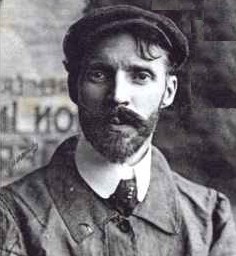
On November 9,1907 Henri Farman, in aVoisin-50 Antoinette biplane, made the first powered flight in Europe to last over a minute. At a 1909 Reims meeting he flew his own Farman III, the first aircraft with effective ailerons. Brother Maurice was also a designer; the two formed Avions Henri et Maurice
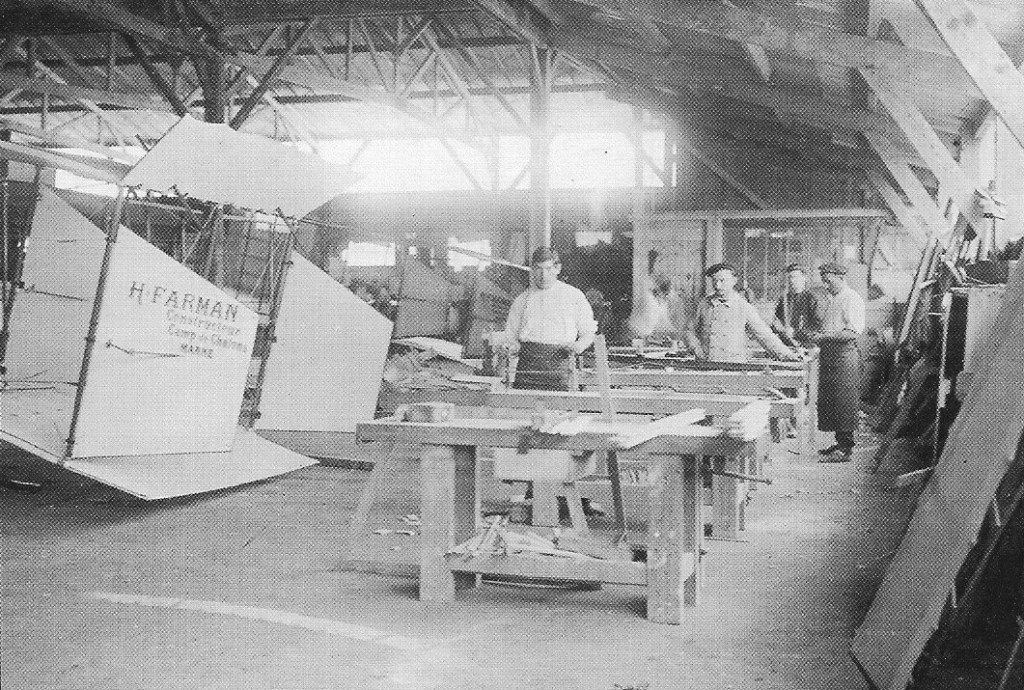
Maurice Farman designed the MF-7 Longhorn (1913) and MF-11 Shorthorn (1914), both used as trainer and observation aircraft by the Allied forces. Farman F.20 and F.40 developed, the latter with streamlined two-seat nacelle and powered by 135hp Renault engine. Farman F.50 night bomber followed; four-engined F.140 night bomber introduced 1925, replaced by F.221 and F.222 in 1937, the latter used subsequently by Vichy air force after June 1940 as a transport. Civil airliners included the F.60 Goliath. Twin-engined F.180 biplane, F.190 single-engined monoplane introduced 1928, three-engined F.300 in 1930.
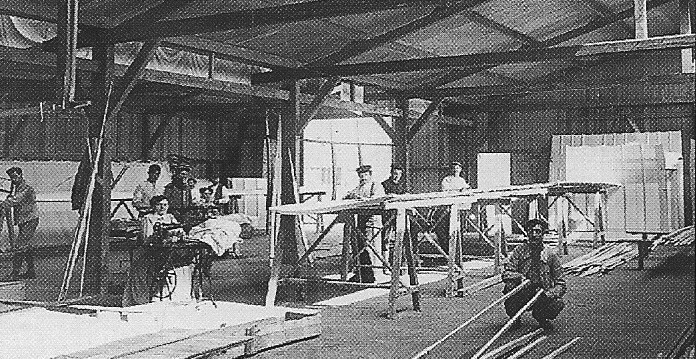
The French aircraft manufacturer Socété des Avions H. M. et D. Farman, with factories at Billancourt (Seine), began aircraft engine design and manufacture aimed at civil aviation shortly after WWI.
In France, the Socialist Government of the so called Popular Front brought all the companies building military aircraft, aero engines and armament under its control in 1936. The immediate result was the socialized oblivion of such established companies as Marcel Bloch, Bleriot, Nieuport, Potez, Dewoitine, Hanriot and Farman within half a dozen nationalized groups or Societies Nationales, named according to their geographical location (Nord, Ouest, Centre, Midi and so on). Hanriot joined Farman at Billancourt in 1936, eventually nationalized in 1937, to become SNCA du Centre.
Farman becoming part of SNCAC. After nationalization, in 1939 the Farman brothers acquired the license to manufacture the Stampe SV.4 trainer biplane. Although SNCAC was assigned manufacturing rights postwar, Farman retained license and with Jean Stampe the Societe Anonyme des Usines Farman developed Monitor I monoplane powered by 140 hp Renault engine. Variants included the II, III and IV, the latter being taken over by Stampe et Renard, Brussels.
The Comper Scamp or Fly was not completed and Capt. Gerard Fane, a supporter of Comper, redesigned the design with was in 1940 build and flown in 1941, the Fane F.1/40.
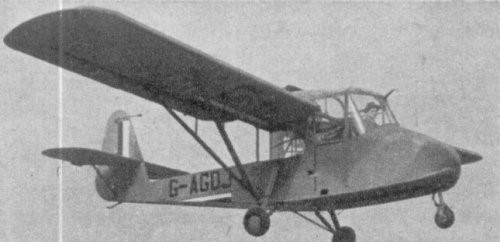
The Fane F.1/40 was a 1940s British Air Observation Post aircraft design by Captain Gerald Fane’s Fane Aircraft Company. The Comper Scamp or Fly was not completed and Capt. Gerard Fane, a supporter of Comper, redesigned the design to Air Ministry specification F.1/40. The Scamp had been designed by Nicholas Comper as a two-seater but he had not built it but redesigned it as a single seater, the Comper Fly. Fane took the Scamp design and reworked it as the F.1. It was of pusher configuration with a high wing set behind the pilot.
A single example of the Fane F1 (later f1/40), registered G.AGDJ, serial number T1788 was flown and tested by the Air Ministry at Heston Aerodrome on 21 March 1941.
It was in competition with the General Aircraft GAL.47 but neither were selected for service use. In September 1941 the F.1/40 was registered G-AGDJ as the Fane F1 to the builders, but was scrapped sometime during the war.
Engine: 1 × Continental A-80, 80 hp (60 kW) Wingspan: 37 ft 0 in (11.28 m) Length: 23 ft 5 in (7.14 m) Max takeoff weight: 1,500 lb (680 kg) Crew: 2



 All Aero