Fisher entered aircraft production in the 1940s with design team headed by Don Berlin, formerly of Curtiss. Developed the Eagle fighter with an Allison engine, and the prototype first flew on September 30,1943. Eight XP-75s and five P-75As were built before the program ended.
World War 2
Firestone XR-9 / GA-45
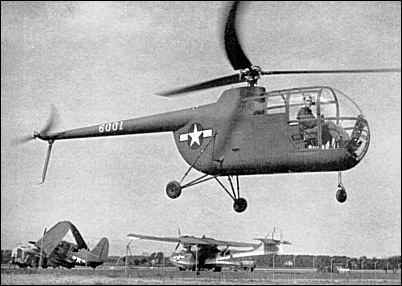
In 1943 Firestone absorbed G and A Aircraft of Pitcairn Field, Willow Grove, and this included the CG-4A, a troop-carrying glider, and the XO-61, a pusher-type autogyro. Between 1943 and 1945 the G and A was modified and developed into a dual tandem helicopter, the XR-9B.
G&A Aircraft had previously built six examples of the XO-61 two-seat gyroplane for the U.S. Army. This experience was applied to the design of a new helicopter for the U.S. Army, designated Model 45.
Conceived in 1943, the Model 45 was a conventional pod and boom helicopter with tandem seating, a fixed tricycle undercarriage and a three-blade main rotor. Completed in 1944 with co-operation from the Army Air Force’s Air Technical Service Command, the main rotor had three blades (and a fixed-type head); the tail rotor was 1.98 metres in diameter.
The helicopter was made of welded steel tube covered with an alloy skin, while the tail boom had a balsa-wood core covered with alcad. For storage purposes this helicopter could be broken down into three parts: rotor blades, fuselage and boom assembly.
The prototype incorporated an experimental electro-hydraulic governor, which by acting on the simultaneous pitch control maintained a constant predetermined rotor speed, irrespective of the power used. With automatic assistance from this governor, the pilot could rise or descend vertically just by using his throttle.
The original Model 45B design used a 126hp XO-290-5 engine and the Model 45C (military XR-9A) was a development with a two-blade rotor. Neither of these were actually built and the prototype (which carried the identity 6001) was designated XR-9B and was fitted with a 135hp Lycoming O-290-5 engine.
Firestone also built a civil version, the Model 45D (NX58457), with side-by-side seating but development of helicopters was abandoned by Firestone in 1947.
XR-9B
Number of seats: 2
Engine: 1 x Lycoming O-290-7, 135hp
Rotor diameter: 8.53m
Length: 8.41m
Width at landing wheels: 2.74m
Height: 2.6m
Gross weight: 800kg
Cruising speed: 128km/h
Inclined climb: 305m/min
Absolute ceiling: 3050m
Range: 400km
Firestone / Pitcairn Autogiro Co / Pitcairn-Larsen Autogiro Co Inc / Pitcairn-Cierva Autogiro Company (PCA) / AGA Aviation Corp / G&A Aircraft Inc
The youngest son of John Pitcairn, co-founder of Pittsburgh Plate Glass Company, Harold was born in 1897 and took an early interest in aviation. Inspired by the first flight of the Wright brothers in 1903, he began flight training as an air cadet in the last days of WWI, and would eventually earn a pilot’s license signed by Orville Wright.
1924: (Harold F) Pitcairn Air Service
air field, flight school, FBO
Bryn Athyn PA.
USA
Pitcairn was established in the mid-1920s in Philadelphia, Pennsylvania. Pitcairn and Agnew Larsen, who he had met in pilot training, produced the Mailwing airmail series biplanes including PA- 5 Mailwing high-performance single-seat mailplane used on U.S. Air Mail routes.
1925: Pitcairn Air Lines
sold to Eastern Air Transport in 1929 as origin of Eastern Air Lines
1925: Pitcairn Aircraft Inc
Pitcairn Air Field #2
Willow Grove PA.
USA
In 1928 Harold Pitcairn ordered a Cierva C.8W (the W was for the American Wright Whirlwind engine), which arrived at Pitcairn Field, Willow Grove, Philadelphia, PA and on December 18, 1928. It made the first rotary-wing flight in America, piloted by Cierva pilot H. C. A. “Dizzy” Rawson, followed the next day by Pitcairn.
In early 1929, Cierva and Pitcairn negotiators agreed that the Pitcairn-Cierva Autogiro Company (PCA) would be formed in America with the rights to license Cierva’s patents. Pitcairn threw himself into the development and promotion of the Autogiro – and the results of the next 16 months would earn him and his associates the Collier Trophy for the greatest aviation achievement for 1930.
1929: Autogyro operations as Pitcairn-(Juan de la) Cierva Autogiro Co.
c.1930: Autogiro Co of America (aka AGA) as patent licensee (to Buhl, Kellett, Sikorsky, etc).
Pitcairn Aviation Inc turned to autogiro construction with PAA-1 of 1931 and the name changed to Pitcairn Autogiro Company in the early 1930s. They sold a number of PA-18 and -19 autogiros, including a military version of the PA-34 two-seater to the USAAC. Plant and contracts were taken over in 1940 by Pitcairn-Larsen Autogiro Company, in turn succeeded very shortly afterwards by Aga Aviation Corporation.
Feb 1941: Pitcairn-(Agnew E) Larsen Autogiro Co Inc.
Dec 1941: Renamed AGA Aviation Corp (pres: Virgil H Frazier).
In 1943 G and A was acquired by the Firestone Aircraft Company of Akron, Ohio, together with almost 200 patents concerned with rotary-wing aircraft. G and A built gliders and experimental autogiros in the Second World War, and carried out subcontract manufacture.
1946: Acquired by G&A (Gliders & Aircraft) Div, Firestone Rubber Co.
After the company became the G & A Aircraft Division of Firestone, the emergence of Bell and Sikorsky in a depleted post-war market discouraged continuing the helicopter development in the early 1940s.
Firestone was formed in 1946 by name change from G&A Aircraft Inc., a subsidiary of Firestone Tire and Rubber Company.
1947: Firestone Aircraft Co.
Fieseler Fi-156 Storch / Ms.500 Criquet / Ms.502 Criquet / Ms.505 Criquet
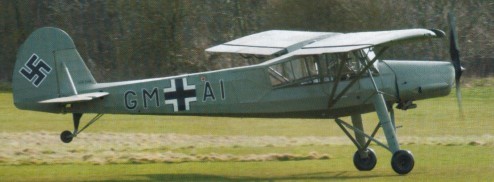
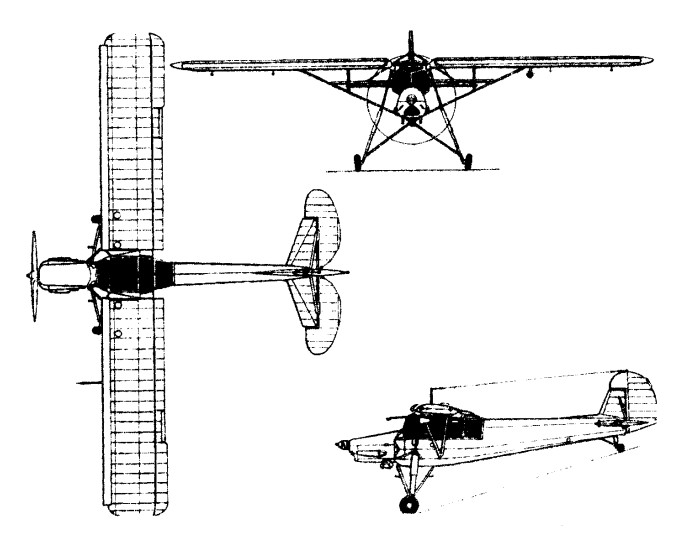
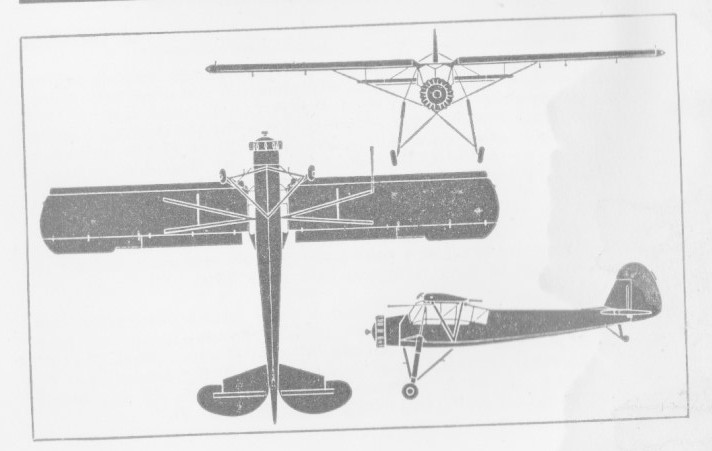
In the summer of 1935, Fiesler Chairman Gerhard Fieseler, Chief Designer Reinhold Mewes and Technical Director Erich Bachem designed a practical STOL aircraft, the Fieseler Fi 156. It was seen as fulfilling numerous roles both in civil life and for the recently resurgent Luftwaffe. The Fieseler Fi 156 Storch (Stork) was a STOL (short take-off and landing) aircraft, a three-seat extensively glazed cabin, high-winged machine with the wing liberally endowed with slats and flaps and a stalky landing gear arrangement, well suited to cushioning arrivals at unprecedentedly steep angles. The high-lift devices allowed a take¬off run of only about 60 m (200 ft) and it could land in about one-third of that distance. Fieseler’s chief designer, Reinhold Mewes, decided for ease of maintenance that the airplane should be completely conventional in its construction, and so utilized a steel tubing and fabric fuselage with wooden wings with a conventional braced tail unit and fixed tailskid landing gear. The wings were made of wood simply because they could be made in low grade factories using forced labour. The original wooden wings contained only 2 x 74 lt tanks. The engine was the then-common Argus As 10C inverted V-8 aircooled 240-hp model.
Fieseler Fi-156 Storch Article
The big 46-foot wing had full-length fixed slats (projected movable slats never materialized), Fowler-type flaps that increased wing area by 18 percent, and ailerons that drooped with the flaps when they were extended past 20 degrees. The wings could be folded back along the fuselage, allowing it to be carried on a trailer or even towed slowly behind a vehicle. The long legs of the landing gear contained oil and spring shock absorbers that compressed about 450 mm (18 inches) on landing, allowing the plane to set down almost anywhere. In flight they hung down, giving the aircraft the appearance of a very long-legged, big-winged bird, hence its nickname, Storch. With its very low landing speed the Storch often landed “in place” or sometimes even backwards, if the wind was blowing strongly from directly ahead.
The Fieseler Fi 156 Storch (stork) V1 prototype was first flown during the early months of 1936. The Argus As 10C V8 engine gave the plane a top speed of only 175 km/h (109 mph), enabling the Storch to fly as slow as 50 km/h (32 mph), take off into a light wind in less than 45 m (150 ft), and land in 18 m (60 ft). In response to the prototype, in 1937 the RLM (Reichsluftfahrtministerium, Reich Aviation Ministry) put out a tender for a new Luftwaffe aircraft suitable for liaison, army co-operation – today called Forward Air Control – and medical evacuation to several companies.
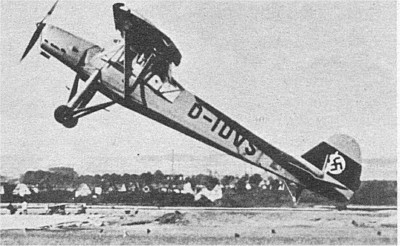
Designs from from Messerschmitt (the Bf 163) and Siebel (the Si 201) and an auto gyro from Focke-Wulf (the Fw 186) based on Cierva technology were submitted, but the Fieseler entry was by far and away the most advanced in terms of STOL performance, needing a take-off run of only about 200 ft (60 m) and landing in about one-third of that distance. The first Fi 156 prototype was followed up by the second V2 prototype and then the third V3 prototype, the ski-equipped V4, plus one V5 and ten Fi 156A-0 pre-production aircraft. Flight testing of the first three prototypes (Fi 156 V1, V2 and V3) showed that the capability of this aircraft more than exceeded its STOL expectations, with little more than a light breeze blowing it could take off inonly a few feet. One of these prototypes was demonstrated publicly for the first time at an international flying meeting at the end of July 1937 in Zürich, by which time the general-purpose Fi 156A-1 was in production. The Storch repeatedly demonstrated full-load take-offs after a ground run of never more than 148 ft (45 m), and a fully controllable speed range of 32-108 mph (51-174 km/h). Service tests confirmed that Ger¬many’s armed forces had acquired a ‘go-anywhere aircraft, and for the re¬mainder of World War II the Storch was found virtually everywhere Ger¬man forces operated.
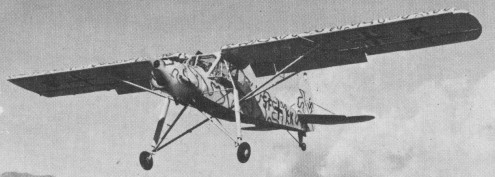
It was immediately ordered into production by the Luftwaffe with an order for 16 planes, and the first Fi 156A-1 production aircraft entered service in mid-1937. Fieseler then offered the Fi 156B, which allowed for the retraction of the leading edge slats and had a number of minor aerodynamic cleanups, boosting the speed to 208 km/h (130 mph). The Luftwaffe didn’t consider such a small difference to be important, and Fieseler instead moved on to the main production version, the C.
The Fi 156C was essentially a “flexible” version of the A model. A small run of C-0s were followed by the C-1 three-seater liaison version, and the C-2 two-seat observation type carrying a single camera (which had a rear-mounted MG 15 machine gun for defense). Both models entered service in 1939. Some late examples of the Fi 156 C-2 were equipped to carry one stretcher for casualty evacuation.
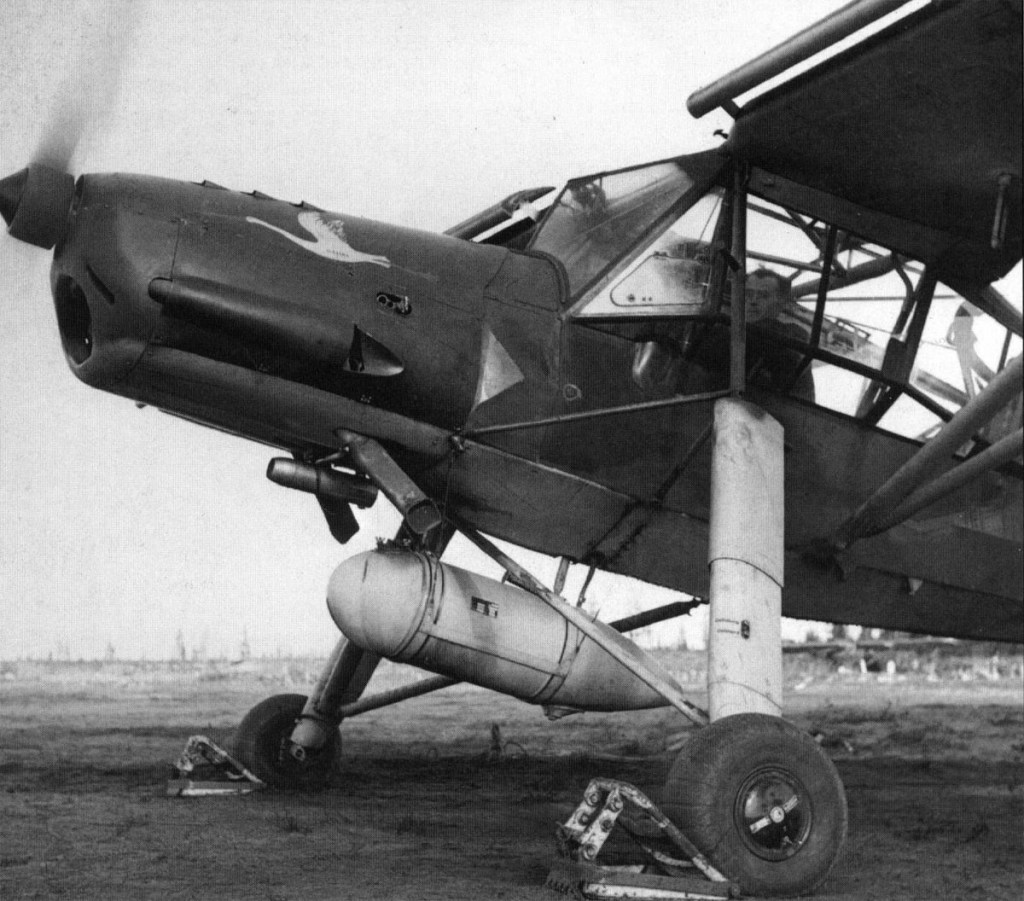
In 1941, both were replaced by the “universal cockpit” C-3. The Fl 156C-3 was the first to be a equipped for multi-purpose use, the majority of the type being powered by the Argus As 10P engine, which was also standard in the generally similar Fi 156C-5 which had provision to carry an under fuselage camera or jettisonable fuel tank. Last of the Cs, the C-5, a C-3 with a belly hardpoint for a camera pod or drop tank. Some were fitted with skis, rather than wheels, for operations on snow.
Other versions of the Fi 156 were the C-3/Trop, which was a tropicalised version of the Fi 156C-5, and the Fi 156D which was an air ambulance version. The first two Fi 156D models were the D-0 pre-production aircraft, and the D-1 production aircraft, powered by an Argus As 10P engine.
Ten unusual pre-production aircraft were built under the designation Fi 156E-0, intended for operation from rough terrain with the standard landing gear was replaced by main units that each incorporated two wheels in tandem, the wheels of each unit, being linked by pneumatic rubber track.
A total of about 2,900 Fi 156s, mostly Cs, were produced from 1937 to 1945. When the main Fieseler plant switched to building Bf 109s in 1943, Storch production was shifted to the Mráz factory in Choceň, Czechoslovakia as the Benes-Mráz J-65 ‘Èáp’.
During the occupation of France, the Fi 156 was built by the Morane-Saulnier company at its Puteaux factory as the Morane Ms.502, and post-war as the MS.505. A lot of Luftwafe parts were collected by Morane Saulnier and reused to build the MS.500 Criquet. The wings on the original were wood but Moraine Saulnier reproduced the wings, tail and controls in metal. While heavier, the wings contained additional fuel. The original wooden wings held 2 x 74 lt tanks, and the MS wings an additional 100 lt in each wing. Moraine Saulnier used the Argus engines until supplies dried up.
A large number were also built at the captured Morane-Saulnier factory in France, starting in April 1942, as the M.S.500 Criquet.
French production models included the MS-500 (Argus As 410C), the MS-501 (Renault 6Q), and the MS-502 (Salmson 9AB). In early 1964 a re-engined version, the MS-505 with a 300 hp Jacobs R-915A began trials.
Both factories continued to produce the planes after the war for local civilian markets (in Czechoslovakia it was made as K-65 Čáp, 138 were made by 1949). Licenced production was also started in Romainia in 1943 at the ICAR (Īntreprinderea de construcţii aeronautice româneşti) factory in Bucharest. Only 10 were built by the time Romania switched sides, with a further 70 aircraft being built by the Romanians before production ended in 1946. During the war at least 60 Storchs were captured by the Allies, one becoming the personal aircraft of Field Marshal Montgomery.
A total of 2,549 Fi 156s were built.
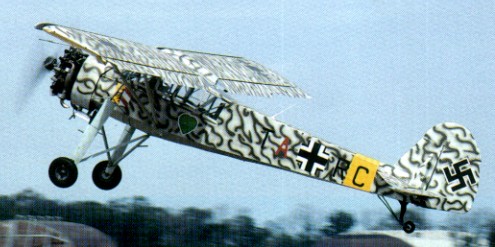
Tests against fighters appeared to confirm that, at around 34 mph (55 km/h), it was a very difficult target for fighters. There was almost trouble when Udet’s camera-gun film showed not one picture of the elusive Storch. Another Fi 156A-0 was tested with three SC-50 (50 kg/110 lbs) bombs, with aim marks painted on the Plexiglas windows, while another did successful trials against a U-boat with inert 298 lbs (135 kg) depth charges. Less unexpected were supply-dropping tests and trials with smoke apparatus.
Between 1940 and 1943, Germany exported 34 Fieseler Fi 156Cs to Romania. A further Storch was assigned for Marshall Ion Antonescu’s personal use. Further Fi 156s were received in 1944 and some were probably captured after August 23, 1944, from the retreating German forces. In the so called ‘People’s Democracy’ the remaining dozens of Storchs received civilian registrations and were relegated to AVIASAN, the Romanian national air ambulance service. The last ones were finally retired in the late 1960s.
The Ilmavoimat / Maavoimat / VL Team evaluated the aircraft and carried out a series of flight tests early in 1938. As expected, the Fi 156 rated highly, with the STOL performance in particular impressing the the test team. Excerpts from the Flight Test reports written at the time reveal some of the impressions that aircraft made on the Test Pilots:
“…..nothing could possibly convey its general ungainliness. It stands so high off the ground that an average man can barely see in the side windows…”
“…..once in the cockpit, the nose didn’t even begin to block my vision because I was sitting so high above it. The cockpit area is huge, big enough to stand up in, and it’s cluttered with cranks, wheels and levers, all labeled in German. The stick and rudder are where they should be, but the rudders are big cast-aluminum footprints with safety straps of their own and the stick resembles a telephone pole. The flaps are lowered by a crank, not a dainty little crank, but a man-sized Model “T” Ford type crank that sticks out of the left wall. By winding in the Aus direction, wing-size boards flop out of the trailing edges and the ailerons race to catch up. In the spar carry-through structure over the pilot’s head is a pointer that indicates how much flap is hanging out, and in this airplane, any flap at all is a lot……”
“….. I must have made at least 15 takeoffs and landings, all of them incredibly short and none of them where I wanted them to be. On takeoff, I found that even with the correct trim, I couldn’t pull back hard enough to come even close to stalling it. As soon as I had a minimum of 35 knots, I could pull back all I wanted and do nothing but climb. I had absolutely no head-wind component and my initial climb angle was nearly 45 degrees. This airplane really will leap off the ground. Taking off three-point in a headwind, I doubt that it would need more than 20 feet to get off, although I was using close to 100 most of the time……”
“……To make short-field landings on a chosen spot, you usually like to get the airplane slow enough so you have to use power to drag it in. I was constantly frustrated in the Storch, because I never got it slow enough to need power. Almost every landing was power-off, and eventually I was so exasperated that I was approaching at 25 knots indicated. At that speed, I needed power to soften the touchdown, but it still wasn’t slow enough to hang on the prop. …… the really hot-shot German Pilot that instructed us in the Fi 156 would come creeping in over the trees at practically zero airspeed, letting it fall on command and catching it at the last moment with a burst of power…..”
“….. I tried to stall it while at altitude and found that it not only refuses to stall, but as long as I had the slightest amount of power in to give it elevator effectiveness, I could easily fly the airplane where I wanted while holding the stick all the way back. Once you master that kind of approach, you could land backwards on an outhouse roof…..”
“……I had a lot of silly things happen while flying this airplane but the silliest was when I tried slipping it. I was high, per usual, so I figured I’d just use a max deflection slip. It works on other airplanes, why not? As I leaned the aileron into it and got on the opposite rudder everything was going just fine until I got about half rudder. At that point, the rudder pressure disappeared and the rudder pedal sank to the floor with no effort from me and stayed there. So, there I was, coming down final sideways with a rudder that was stuck to the floor of its own accord. That scared the living hell out of me! I had to practically stand on the other rudder to get things straighted out. I guess the aerodynamic balance on the rudder is so big that when enough of it catches the wind, it overpowers the surface and yanks it to full deflection……”
“….Maneuvering in the Storch is a real physical workout. The controls feel the way the airplane looks—gawky and loose. The stick forces are anything but light and to keep it completely coordinated, your feet have to thrash in and out as if you were working a treadle sewing machine….”
Given the low cost of the Fieseler Fi 156, this was a feasible proposition and in August 1938, the Ilmavoimat announced twenty Fi 156’s were to be bought direct from Fiesler – delivery was rapid and these aircraft were shipped and arrived before the end of the year. Additionally, a manufacturing license was bought from Fiesler and the Finnish company Veljekset Karhumäki was awarded a contract to build an initial 100 aircraft (Veljekset Karhumäki were also advised that further orders would be placed, with the objective being to ensure that all Regimental Battle Groups were fully equipped). This was a large expansion in business for Veljekset Karhumäki and two additional factory buildings were acquired, one to construct the Argus engines and one to construct the aircraft. Setup moved as rapidly as possible with production starting towards the end of 1938 and the first Finnish-manufactured Fi 156 rolling out the doors in early February 1939. Delivery averaged six Fi 156’s per month through the first half of 1939, increasing to 2 per week from July on and in the event, some 70 Fiesler Fi 156’s had been delivered by Veljekset Karhumäki by the time the Winter War broke out.
Finland entered the Winter War with some forty Fw 189 aircraft in service, in addition to the ninety odd Fieseler Fi 156 Storch’s. When the Winter War broke out, it was obvious that despite the intensive manufacturing effort over the previous six months there were nowhere near enough of the aircraft, even with the older aircraft being utilised. Despite limited numbers of observation aircraft being bought abroad and continuous production from Veljekset Karhumäki (some 10 per month by January 1940), demand for the aircraft always exceeded the supply available throughout the Winter War.
The Ilmavoimat Fi 156 production variant was a two crew (Pilot and Observer / Controller) with an enlarged loading/unloading hatch for a single stretcher so as to allow for casualty evacuation. A more powerful engine was fitted and the aircraft could carry up to three passengers in addition to the crew of two. Given that the aircraft was expected to operate from rough terrain, the standard landing gear was replaced by main units that each incorporated two wheels in tandem. For Forward Air and Artillery Control, provision was made for additional Finnish-supplied radio equipment to be installed to allow for simultaneous communication with ground units, artillery and aircraft. Mountings for 30lb phosphorus “marker” bombs were also installed and a single machinegun was fitted.
The Finnish Fieseler Fi 156 Storchs remained in service until 1960.
The Storch could be found on every front throughout the European and North African theaters of operation in World War II. It will probably always be most famous for its role in Operation Eiche, the rescue of deposed Italian dictator Benito Mussolini from a boulder-strewn mountain top near the Gran Sasso, surrounded by Italian troops on 12 September 1943. German commando Otto Skorzeny dropped with 90 paratroopers onto the peak and quickly captured it, but the problem remained of how to get back off. A Focke Achgelis Fa 223 helicopter was sent, but it broke down en route. Instead, pilot Walter Gerlach flew in a Storch, landed in 30 m (100 ft), took aboard Mussolini and Skorzeny, and took off again in under 80 m (250 ft), even though the plane was overloaded.
Replica:
RagWing Aviation RW19 Stork
Slepcev Aircraft Storch
Fieseler Fi 156 Storch
Engine : Argus 10 E/1, 175 hp
Length : 32.48 ft / 9.9 m
Height : 10.007 ft / 3.05 m
Wingspan : 46.752 ft / 14.25 m
Wing area : 279.864 sqft / 26.0 sq.m
Max take off weight : 2910.6 lb / 1320.0 kg
Weight empty : 1896.3 lb / 860.0 kg
Payload: 837.9 lb / 380.0 kg
Max. speed : 94 kts / 175 km/h
Initial climb rate : 1574.80 ft/min / 8.00 m/s
Service ceiling : 17388 ft / 5300 m
Wing load : 10.46 lb/sq.ft / 51.0 kg/sq.m
Range : 324 nm / 600 km
Endurance : 5 h
Crew : 1+2
Fi 156A-1
Fi.156C-2
Engine: 1 x Argus As 10C-3, 179kW (240-hp)
Max take-off weight: 1325 kg / 2921 lb
Empty weight: 930 kg / 2050 lb
Wingspan: 14.25 m / 46 ft 9 in
Length: 9.9 m / 32 ft 6 in
Height: 3.05 m / 10 ft 0 in
Wing area: 26 sq.m / 279.86 sq ft
Maximum speed 170 kmh (109 mph) at sea level
Economical cruising speed 130 km/h (81 mph)
Landing speed: 25 mph
Slow cruise: 31 mph
Service Ceiling: 4600 m / 15100 ft
Range: 385 km / 239 miles
Armament: one rear-firing 7.92-mm (031-in) machine-gun on trainable mount
Fi 156D-0 –
M.S.502
Engine: 230 hp Salmson 9AB
Wingspan: 46 ft 9 in
Wing area: 279.7 sq,ft
Length: 31 ft 8 in
Height: 10 ft
Empty weight: 2100 lb
Loaded weight: 3140 lb
Max speed: 106 mph at SL
Cruise: 85 mph
Service ceiling: 14,100 ft
Climb to 3280 ft: 5.5 min
Range: 435 mi at 72 mph
Fieseler Fi 103R Reichenberg
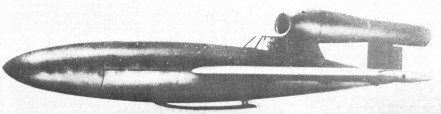
SS officer Otto Skorzeny is credited with the idea of a piloted version of the Argus pulsejet powered Fieseler Fi 103 V-1 flying bomb able to make precision attacks, and design began before the first unguided V-1s fell on London in June 1944. To study why many test V-1s crashed soon after launch an earlier piloted version was tested. Two pilots were injured before famed woman test pilot Hanna Reitsch confirmed that the engine noise was vibrating the airframe off course.
Fieseler Fi 103R Reichenberg Article
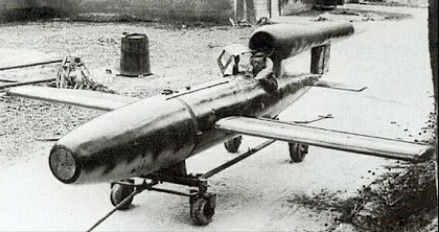
Proposals were made to launch the manned bomb from be¬neath a carrier aircraft. On operations the piloted flying bomb would have been carried and launched in pairs from modified Heinkel He 111 bombers.
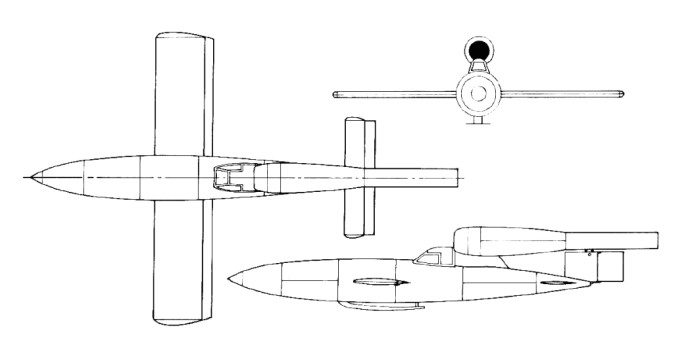
A total of about 175 piloted Fi 103Rs (Reichenberg being the oper¬ational codename covering the pro¬ject) were completed: the R-I, R II and R III were test and training versions, and the R IV was intended for oper-ational use. The Reichenberg IV had only basic instrumentation and could supposedly be flown after minimal training training. The cockpit had only four instruments. Testing was undertaken by Rechlin pilots but after two had crashed development flying was taken over by DFS test pilots Hanna Reitsch and Heinz Kensche. Handling in the air was fairly straightforward but landing was extremely tricky owing to the rudimentary control provided and the very high landing speed.
The 100 volunteers who signed up to fly the bombs were known unofficially as ‘Selbstopfermaenner’ or ‘Self-sacrifice Men’ for special unit KG 200, but none were actually used operationally and development stopped in October 1944.
Fi 103R-IV
Powerplant: one 350 kg (772 1b) thrust Argus 109 014 pulsejet.
Max powered level speed 650 kph (404 mph) at sea level
Endurance (limited by pulsejet life) 20 min.
Weight: at launch 2180 kg (4,806 lb).
Wing span: 5.715 m (18 ft 9 in)
Length 8.00 m (26 ft 3 in)
Height: 1.42 m / 4 ft 8 in
Maximum fuselage diameter 0.838 m (2 ft 9 in)
Warhead: 850 kg (1,874 lb).
Gerhard Fieseler Werke GmbH
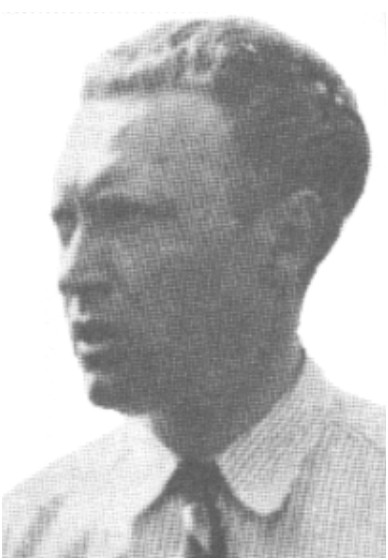
Gerhard Fieseler Werke GmbH established by the aerobatic pilot in 1930. Fi 2 Tiger produced for Fieseler’s own use. Fi 5R two-seat lightplane and Fi 97 four-seat cabin monoplane preceded Fi 156 Storch liaison and communications aircraft with high-lift slots and flaps. Also built Fi 167 torpedo bomber/reconnaissance biplane, designed for carrier operation. Manufactured Messerschmitt Bf 109 fighters.
Fiat A.80
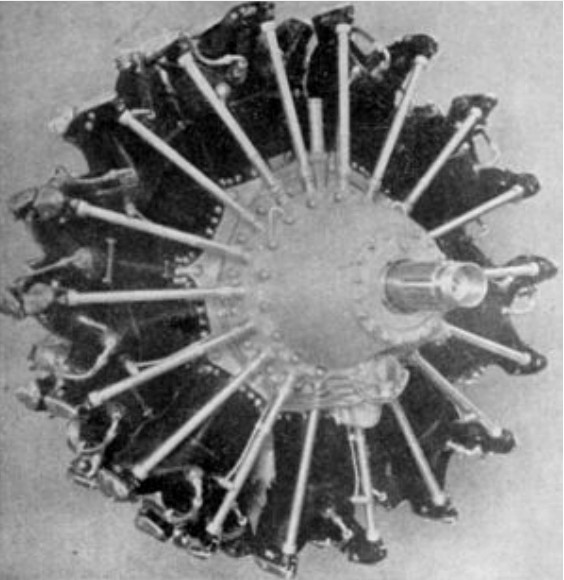
The Fiat A.80 was an 18-cylinder, twin-row, air-cooled, radial aircraft engine produced during World War II. Rated at 1,000 hp (745 kW), it was a more powerful development of the Fiat A.74.
Applications:
Aeronautica Umbra Trojani AUT.18
Breda Ba.65
CANSA FC.20
Fiat BR.20
Savoia-Marchetti SM.79
Variants:
R.C.41
Specifications:
A.80
Type: 18-cylinder air-cooled radial
Bore: 140 mm (5.51 in)
Stroke: 165 mm (6.50 in)
Displacement: 45.72 L (2789.9 cu in)
Length: 1,155 mm (45.47 in)
Width: 653 mm (25.71 in)
Height: 1,335 mm (52.56 in)
Dry weight: 725 kg (1598.4 lb)
Valvetrain: One intake and one sodium-cooled exhaust valve per cylinder
Supercharger: Single Speed, Single Stage. 4,100 m rated altitude
Fuel system: 1 Fiat carburettor
Fuel type: 87 octane
Cooling system: air-cooled
Power output: 1,000 hp at 2,100 rpm at 4,100 m, 1,100 hp at 2,100rpm at Sea Level
Compression ratio: 6.7:1
Power-to-weight ratio: 0.6 hp/lb at cruise speed
Fiat G.55 Centauro
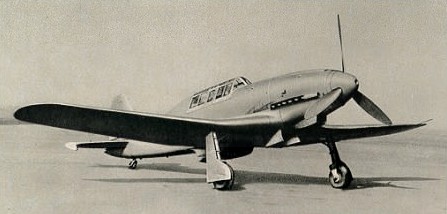
The Centauro (centaur) was a development of the G.50 with a Daimler-Benz DB 605A-1 inline built under licence in Italy. The type evolved from the DB 601-powered G.50V, and the first of three prototypes was flown on 30 April 1942.
The Fiat G.55 Centauro (centaur) was an all-metal low-wing monoplane single seat fighter designed by Giuseppe Gabrielli, with fully-retractable landing gear and a raised cockpit.
Flight trials confirmed that this was an excellent fighter, but production was slow to start and only a few of the eventual total of 200 aircraft had been delivered before Italy’s armistice with the Allies in September 1943.
The third prototype (MM 493) was the only one to carry armament, comprising one engine mounted cannon and four fuselage mounted machine-guns. It was evaluated under operational conditions from March 1943, but by then the Italian air ministry had already decided on mass production of the G.55.
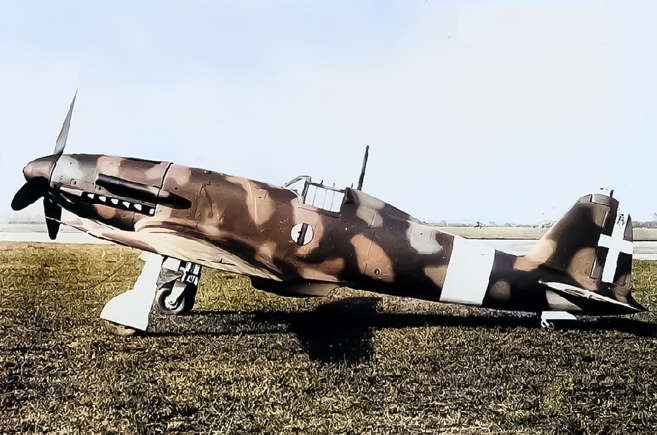
However, only 16 G.55/0 preproduction and 15 G.55/1 initial production aircraft had been delivered to the Regia Aeronautica by September 1943, production from then being for the Fascist air arm flying alongside the Luftwaffe. Before wartime production ended 274 more were completed and a further 37 were abandoned at an advanced construction stage.
Most G.55s thus fought with the fascist air arm on the German side in northern Italy. Three prototypes and eight pre-production aircraft were followed by about 185 G.55 Series 1 fighters. There were also about 10 examples of the G.55S torpedo strike fighter, but none of the G.55 Serie2 bomber destroyer with five 20-mm cannon. After the war 85 more aircraft were delivered as G.55A single-seat fighter trainers and G.55B two-seat advanced trainers.
Before the armistice of September 1943, G.55s had participated in the defence of Rome with the 353º Squadriglia of the Regia Aeronautica. The postarmistice operations were mainly with the Fascist air arm’s Squadriglia ‘Montefusco’, based at Venezia Reale, then with the three squadriglie which formed the 2º Gruppo Caccia Terrestre, but losses were heavy, as a result mainly of Allied attacks on the airfields. While the war was still in progress, Fiat flew two prototypes of the G.56, which was developed from the G.55 to accept the more powerful Daimler-Benz DB 603A engine. Built during the spring of 1944, they incorporated minor structural changes and had the fuselage mounted machine-guns deleted.
The first prototype survived the war and was used subsequently by Fiat as a test-bed.
FIAT G 55 Centauro
Engine: Fiat RA 1050 RC. 58 Tifone (DB 605 A), 1455 hp
Length: 30.741 ft / 9.37 m
Height: 10.269 ft / 3.13 m
Wingspan: 38.878 ft / 11.85 m
Wing area: 227.228 sqft / 21.11 sq.m
Max take off weight: 8198.2 lb / 3718.0 kg
Weight empty: 5799.2 lb / 2630.0 kg
Max. speed: 340 kts / 630 km/h at 22,965ft
Service ceiling: 41667 ft / 12700 m
Wing load: 36.08 lb/sq.ft / 176.00 kg/sq.m
Range: 648 nm /1200 km
Crew: 1
Armament: 3x MG 151 20mm Mauser, 2x MG 12,7mm Breda-SAFAT, 320 kg (706 lb) Bomb.
G.55A
G.55B
G.55S
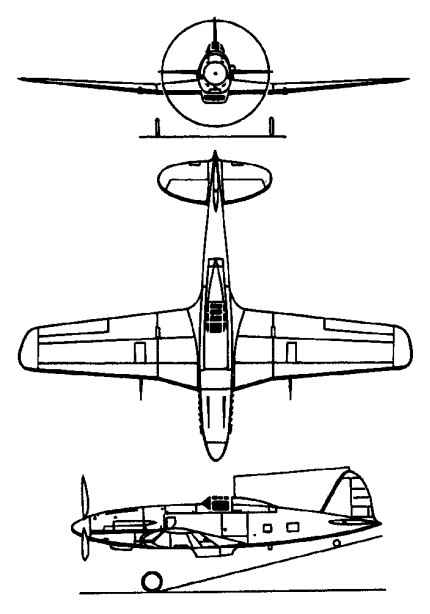
Fiat G.50 Freccia / G.51 / G.52
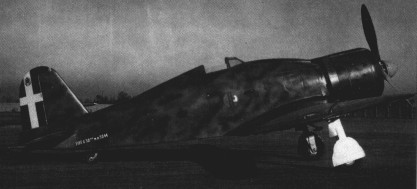
Fiat’s Giuseppe Gabrielli produced his proposals for the G.50 single seat monoplane prototype in 1936, at which time it was the most modern fighter design in Italy. Although a contemporary of the Spitfire and Hurricane, it remained to the end extremely lightly armed. The Freccia (arrow) was the first all-metal monoplane with a retractable undercarriage to be evaluated by the Italian air force; the prototype flew for the first time on February 26, 1937, and proved light to handle, with a high degree of manoeuvrability, but somewhat lacking in both engine and fire power. Its powerplant was the 840 hp Fiat A.74 RC 38 14-cylinder two row radial, fitted with a super¬charger and driving a Fiat built Hamilton three blade variable pitch metal propeller. The armament comprised two 12.7 mm (0.5in) Breda SAFAT machine guns mounted forward of the cockpit in the top of the fuselage, synchronized to fire through the propeller arc. The 150 rounds for each gun could be fired in single shots or in salvo.
Fiat G.50 Freccia / G.51 / G.52 Article
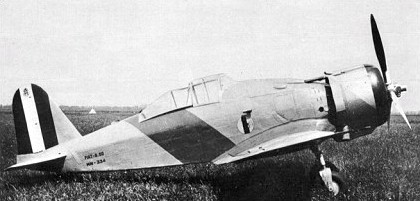
Production was undertaken both by Fiat and CMASA, a subsidiary, and the first 12 were delivered to the Italian expeditionary forces in Spain in January 1939 towards the end of the civil war. Although too late to give a true indication of their potential under battle conditions, it was decided to continue with a further order for 200 aircraft. The first 45 production G.50s had an enclosed cockpit but Italian pilots preferred the open variety and after testing several designs, an open canopy with hinged, transparent side flaps was adopted as standard. Upon Italy’s entry into the Second World War in June 1940, a total of 118 G.50s were in service: 97 with operational units and the other 21 awaiting either delivery or repair. The 51o Stormo CT at Ciampino was composed entirely of G.50s, and G.50s in company with Fiat C.R.32s made up the 52o Stormo in Tuscany; they were used mainly as escorts during the early days of the war.
Fiat G.50s also formed part of the 56o Stormo, based at Maldegern in Belgium, to assist the Luftwaffe during the Battle of Britain, but they achieved no great success in that theatre and most had been returned to Italy by April 1941. Better results were achieved by the 35 G.50s ordered by Finland in late 1939, although deliveries were initially sporadic due to German interference. How¬ever, after the start of the so called ‘continu¬ation war’ in Finland in June 1941, the Finnish G.50s gave excellent service until withdrawn from the front line in May 1944.
A two seat trainer version, also manufactured by CMASA, was pro¬duced. Designated G.50B, it had a second cockpit with dual controls added and the armament installation removed. One hundred and eight were produced, and gave satisfac¬tory service at Regia Aeronautica training units.
The initial production series of 246 aircraft were followed by 421 examples of the G.50bis with greater fuel capacity, improved radio and a modified wing.
The Regia Aeronautica, meanwhile, utilized its G.50s in Greece, the Balkans, the Mediterranean and North Africa before they began to be replaced by the superior G.50bis The prototype of this was flown for the first time on September 9, 1940, and differed from the original aircraft in having improved fuse¬lage contours, increased fuel capacity, more modern radio equipment, an enlarged rudder, and a modified canopy and armour protection for the pilot. A total of 421 G.50bis were built, and served mainly in North Africa (Libya) from late 1940 until December 1941. Nine were supplied to the Croatian air force. Some G.50bis were fitted with underwing racks at this time, to carry small bombs.
The basic G.50B airframe formed the basis of the G.50bis/A two-seat carrierborne fighter with four 12.7-mm (0.5-in) machine-guns. The G.50bis A was an enlarged two seat fighter bomber with better armament and a bigger bombload, plus an arrester hook for service aboard the planned aircraft carriers Aquila and Sparviero. It flew for the first time on October 3, 1942, but after Italy’s surrender all further development ceased and none was produced.
This latter was flown only in prototype form, and other prototypes (G.50ter, G.50V, G.51 and G.52) were developed round imported German engines or their Italian licence-built versions. The basic type was also exported to Croatia and Finland.
FIAT G. 50 Freccia
Length : 25.558 ft / 7.79 m
Height: 9.711 ft / 2.96 m
Wingspan : 35.958 ft / 10.96 m
Wing area : 195.367 sq.ft / 18.15 sq.m
Max take off weight : 5325.1 lb / 2415.0 kg
Weight empty : 4354.9 lb / 1975.0 kg
Max. speed : 255 kts / 472 km/h
Service ceiling : 32267 ft / 9835 m
Wing load : 27.27 lb/sq.ft / 133.0 kg/sq.m
Range : 362 nm / 670 km
Engine : Fiat A. 74 RC.38, 828 hp
Crew : 1
Armament : 2x MG 12,7mm Breda-SAFAT
G-50bis
Engine: l x Fiat A.74 RC 38, 626kW (840 hp).
Span: 10.9m (36 ft 0.75in).
Length: 7.8m (25ft7in).
Normal T/O weight: 2522 kg (5,560 lb).
Max speed: 293 mph at 14,765ft.
Operational range: 420 miles.
Armament: 2 x 12.7-mm (0.5-in) mg plus 300 kg (661 lb) of bombs
G-50B
G-50bis/A
G-50ter
G-50V
Engine: Daimler-Benz DB 601.
G-51
G-52
Fiat CR.42 Falco
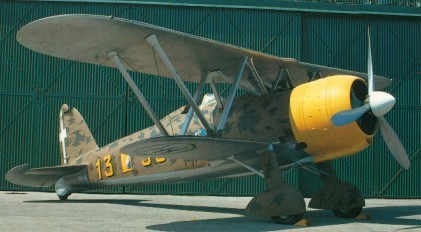
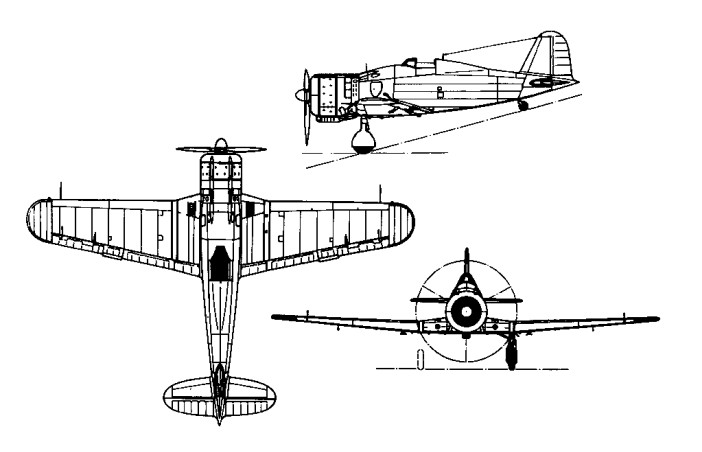
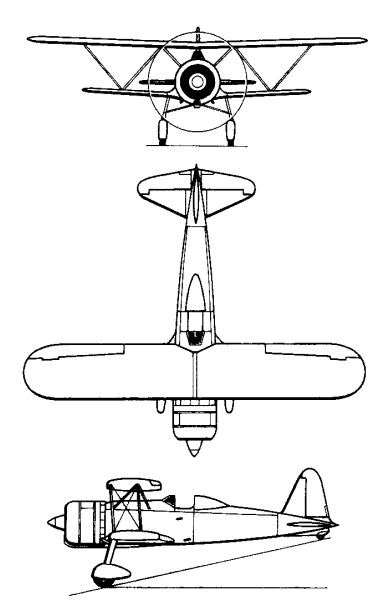
The C.R.42 Falco (Falcon), designed by Celestino Rosatelli, was the last in the family, begun in 1923 with the C.R.20 and 30 series and followed by the C.R.33, 40 and 41 prototypes, to become one of these succes¬ses. It had the distinction of being the last fighter biplane manufactured by any of World War Two’s combatants. It was an unequal span biplane, with an oval section fuselage. Employing the same Warren truss system of interplane struts as the 1933 CR.32, from which it was developed, Celestino Rosatelli’s CR.42 was powered by a 626kW Fiat A74 R1C 38 radial and had a top speed of 441km/h. The fixed two leg undercarriage was fitted with oleo pneumatic shock absorbers and enclosed in streamlined fairings. The tailwheel was retractable on the prototype, but fixed on production aircraft. The CR42 first flew on May 23,1938 and, powered by an 840 hp Fiat A74R.IC. 38 two row radial engine, the prototype proved to be highly manoeuvrable, with a rapid rate of climb and a maximum speed of 441 km/h (274 mph).
It was put into production the same year deliveries to the Regia Aeronautica commenced in April 1939, and when Italy entered the war on June 10, 1940, a total of some 330 were in front line service with Stormi or Gruppi of the Regia Aeronautica in Italy and in North and East Africa. Armament comprised one 7.7 mm (0.303 in) and one 12.7 mm (0.54in) Breda¬SAFAT machine gun, which both fired through the disc of the Fiat 3D41 propeller, and a rounds counter was fitted in the instru¬ment panel. On later production models, the 7.7 mm (0.303 in) gun was replaced by another of 12.7 mm (0.5 in) calibre. For some inexplicable reason, radio equipment was not installed.
Italian C.R.42s drew their first blood on June 13, 1940, attacking air bases at Fayence and Hyeres in southern France; they also escorted Fiat B.R.20s on bombing missions over Toulon harbour during the battle for France. They met opposition from French Dewoitine D 520s and Bloch 152s, but losses were minimal and during the remainder of the campaign they were also used on escort duties with S.M.79 bombers over the Mediterranean and North Africa.
On the strength of the achievement in this theatre, the Italian government decided on a closer collaboration with the Luftwaffe, and created the Corpo Aereo Italiano (Italian Air Corps) to assist mainly in the Battle of Britain. Fifty C.R.42s and 48 Fiat G.50s, together with other Italian fighter, bomber and reconnaissance aircraft, formed the con¬tingent. They were sent to Ursel and Maldeghem in Belgium. Unfortunately, the speedier German Bf 109s found it a hard task to keep formation with the biplanes, and the latter’s lack of radio also hampered activities. Nevertheless, it was decided to send the Falcos into combat against Hurricanes and Spitfires. Their first raid was on Harwich on November 11, 1940. They also participated in action off the Kent coast a few days later, and substantial victory claims were made by the Italians, although RAF records give a different picture. Their inefficiency against superior aircraft, together with the Italian need for more air power in the Mediterranean, instigated the return of the Falcos to Italy in January 1941.
Falcos served extensively in Libya during 1940 41 and were used for attacks on Malta in the same period, as well as acting as escorts to bombers attacking Allied shipping in the Mediterranean. In October 1940, when Greece entered the war, the three squadrons of C.R.42s (together with other Italian aircraft) sent to the area showed marked superiority over the somewhat motley Greek air arm, which was soon defeated. Falco fighter units then combined with Luftwaffe forces to take the island of Crete, and remained in the Aegean theatre until they were replaced by Fiat G.50s in November 1941. After the Italian conquest of Ethiopia, bases there had, initially, little or no trouble in getting new C.R.42s or spares. However, after June 1941, increased Allied activity in North Africa, bad weather conditions and lack of radio equipment in the aircraft, all took their toll. By November 1941, all Falcos from the region had been either evacuated or destroyed.
In the early stages of the desert campaigns in North Africa, during mid 1940 to 1941, C.R.42s were used extensively as fighters, until the advent of more advanced opposition in the form of Hurricanes and Tomahawks. They could not hope to compete against such types and were put to use in the ground attack role. Although improvements and modifications had been made to the original design the C.R.42bis had two additional 12.7 mm (0.5in) guns in underwing fairings (ordered by Sweden as the J 11). Parts of North Africa still covered by the ubiquitous little biplanes included Cyrenaica, where they were fitted with underwing racks for two 100 kg (220 lb) bombs the C.R.42AS (Africa Settentrionale: North Africa) was fitted with a special oil and air sand filter to cope with desert conditions, and a few were armed with two 20 mm (0.79¬in) cannon under the lower wings.
As fighter bombers, Falcos also participated in raids around Tobruk, Alexandria and Mersa Matruh and in the siege of Tripoli. Surviving aircraft from this last battle (some 82 Falcos) went back to Italy and were used in attacks on Allied convoys in the Mediterreanean. They were phased out of this duty in favour of more modern types. In October 1941, a C.R.42CN night fighter unit was formed in Sicily and, although it did not see a great deal of active service there, it was reasonably effective later, in 1942 43, against RAF bombers over the industrial areas of northern Italy.
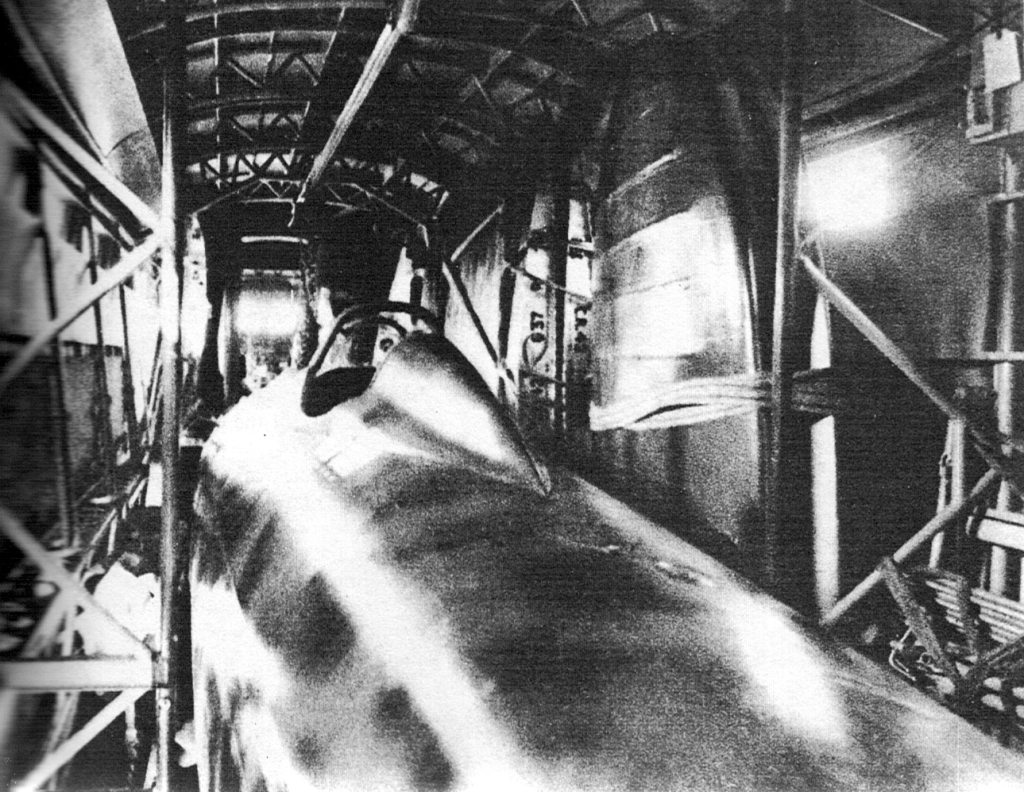
In their 1941 battles against the advancing British and their allies in East Africa, the numbers of Italian fighter planes equipped to ward off bombing raids was melting away day by day. The dense sea and land blockade surrounding Italian East Africa made it impossible for the Italians to supply their troops with fresh aircraft from Italy. Soon they had no fighters left except for a dozen Fiat CR.42 Falco biplanes which although they had outstanding flight characteristics were powerless against superior numbers oft the British Gladiator fighters. In this desperate situation they seized on an inspiration of Colonel Galante, and transported the needed fighter planes in dissembled pieces inside the fuselage of Savoia-Marchetti SM.82 Canguro (Kangaroo) transport planes whose range made it possible for them to ferry their cargo to East Africa from Libya. By the Spring of 1941, over 50 Falco fighters had landed in Ethiopia by this method.
When used for night attacks, the C.R.42CN (Caccia Notturna) limited night-fighter conversion was equipped with radio and was also fitted with twin underwing searchlights and exhaust flame dampers.
One Falco, designated C.R.42B, had a 1010 hp Daimler¬Benz DB 601 inverted V type engine instal¬led, with which it was hoped the aircraft would achieve a speed of 520 km/h (323 mph), but this did not leave the experimental stage. Neither did the CMASA built IC.R.42 (I = Idrovolante: seaplane), which was fitted with twin floats and was much heavier than the landplane, though speed loss from the increased weight was negligible.
After the Italian Armistice, 2,000 examples of the slightly modified CR.42LW were ordered from Aeronautica d’Italia (based in Northern Italy) for the Luftwaffe. Intended for nocturnal attack missions, the CR.42LW served with the Nachtschlactgruppen, the Luftwaffe receiving 112 of some 150 completed. These aircraft were used by the Luftwaffe during 1943 44, being flown against the Allies from bases in Austria, Italy and Yugoslavia. The last operations flown by CR.42s took place in May 1945.
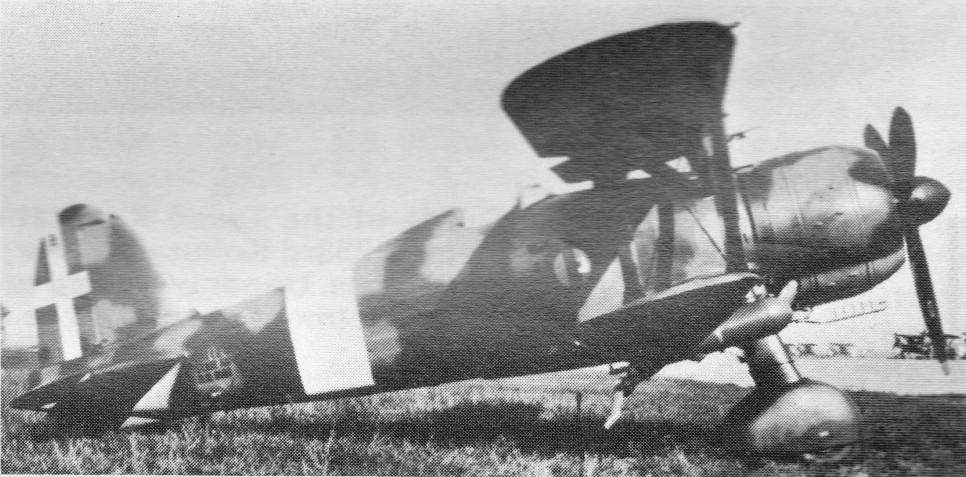
Experimental versions included the CR.42DB, which was tested in prototype form with a 753-kW (1,010-hp) Daimler Benz DB 601A engine for a speed of 323 mph, and the ICR.42 (alias CR.42 Idro) twin float fighter.
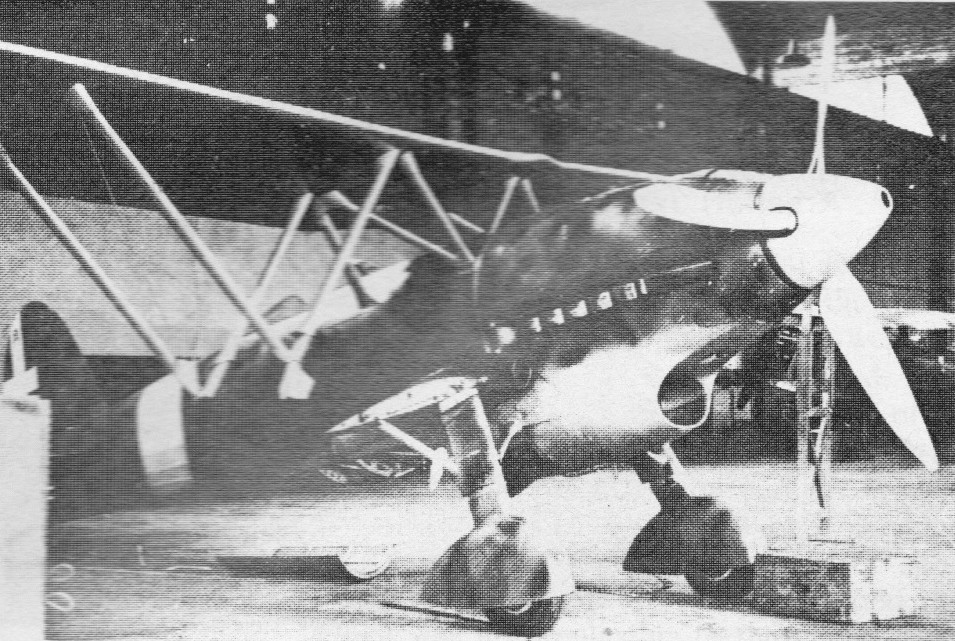
The CR.42DB, flown in March 1941, had a 1175 hp Daimler-Benz DB 601E engine and attained a max speed of 323 mph / 20 kph, and climbed to 9840 ft / 3000 m in 3.34 minutes.
Production totalled at least 1,780, and variants included the initial CR.42 Falco (falcon) with one 12.7-mm (0.5-in) and one 7.7-mm (0.303-in) machine-guns for Belgian, Hungarian and Italian orders, and the CR.42ter version of the CR.42bis with two additional 12.7-mm (0.5-in) machine-guns.
In 1939, 34 were ordered by the Belgian air force; delivered from January 1940 (although in the event received only 25). Fifty-two were exported to Hungary, appearing on the Eastern Front from mid 1941; and in 1940 41 the Swedish air force took delivery of 72 aircraft. Designated J11, they remained in service until 1945, after which a few remained in civil use.
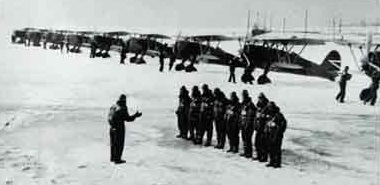
Production of the type ceased in late 1942 when a total of 1781 had been built. Only 113 remained when the Italians surrendered in September 1943, of which 64 were still ser¬viceable. Most of these were seized by the Luftwaffe or employed with the Repubblica Sociale Italiana, Mussolini’s short lived pup¬pet regime, based at Salo, northern Italy; but a few escaped to join the Italian co-¬belligerent air force that fought on the Allied side, and continued with that Italian air arm until 1945, when they were finally declared obsolete. Some still remained, as modified two seat trainers, until as late as 1950.
FIAT CR 42 Falco
Length : 27 ft 2 in / 8.27 m
Height: 11 ft 9 in / 3.59 m
Wingspan : 31 ft 10 in / 9.7 m
Wing area : 241.114 sq.ft / 22.4 sq.m
Max take off weight : 5060.5 lb / 2295.0 kg
Weight empty : 3929.3 lb / 1782.0 kg
Max. speed : 227 kts / 420 km/h
Service ceiling : 33465 ft / 10200 m
Wing load : 20.91 lb/sq.ft / 102.0 kg/sq.m
Range : 418 nm / 775 km
Engine : Fiat A. 74 R1C.38, 828 hp / 626kW
Crew : 1
Armament : 2x MG 12,7mm Breda-SAFAT
CR.42 Falco
Engine: Fiat A.74 R1C.38, 840 hp.
Prop: three bladed wooden.
Span: 31ft 10in.
Length: 27ft 1.5in.
Height: 11ft 9.25in.
Wing area: 241.12sq.ft.
Empty wt: 3,790 lb.
Loaded wt: 5,070 lb.
Max speed: 267 mph.
Service ceiling: 34,450ft.
Initial climb: 2,400ft/min.
Endurance: 4hr.
Armament: 3 x 12.7mm and one 7.7mm machine gun
CR.42AS Falco
Engine: l x Fiat A.74 RC 38, 626kW (840 hp).
Span: 9.70m (31 ft 9.75in)
Length: 8.26m (27 ft 1 in)
Armament: 2 x 12.7-mm (0.5-in) mg plus 200 kg (441 lb) bombs
Normal T/O weight: 2295 kg (5,060 lb).
Max speed: 280 mph at 17,485ft.
Operational range: 480 miles.
CR.42B
Engine: Daimler-Benz DB 601, 753-kW (1,010-hp).
Max speed: 323 mph.
CR.42bis
Armament: 2 x 12.7-mm (0.5-in) mg.
CR.42CN
CR.42ter
Armament: 4 x 12.7-mm (0.5-in) mg.
 All Aero