Engine; 1 x 450hp Wright Whirlwind 975-E-3 Wingspan; 12.00 m / 39 ft 4 in Length; 8.52 m / 28 ft 11 in Height; 2.60 m / 9 ft 6 in Wing area; 22.30 sq.m / 240.03 sq ft Max take-off weight; 2330 kg / 5137 lb Empty weight; 1550 kg / 3417 lb Max. speed; 300 km/h / 186 mph Cruise speed; 240 km/h / 149 mph Ceiling; 6200 m / 20350 ft Range; 1200 km / 746 miles Crew; 2
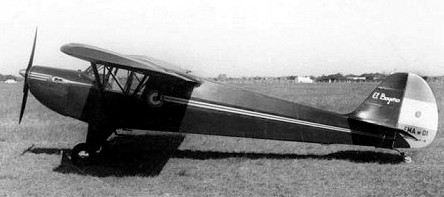
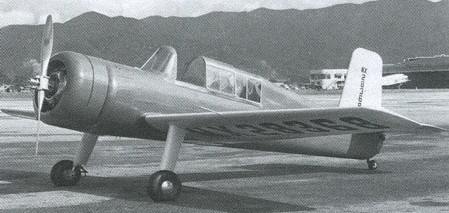
The two-seat El Boyero was designed by the Fabrica Militar de Aviones in 1939 and the first of two prototypes were flown on 2 November 1940.
The FMA’s preoccupation with the manufacture of military aircraft necessitated the transfer of production to SA Sfreddo y Paolini. However, the inability of the company to acquire the necessary materials resulted in production of El Boyero being shelved until 1949 when manufacture was undertaken by Petrolini Hermanos on behalf of the Direccion General de Aeronautica Civil, 130 being produced of which a number were delivered to the Air Force and Army for liaison and AOP tasks.
Whereas the prototypes were powered by the 50 hp Continental A-50 engine, the production model had 65 hp Continental A-65-8 engines.
The FMA.20-B has a 75 hp Continental A-75.
Petrolini took over production of the El Boyero two-seat light monoplane from the Instituto Aerotecnico in late 1940s, and built 160 to government contracts for flying clubs and schools.
Engine; 1 x 65hp Continental A-65-8 Wingspan; 11.50 m / 38 ft 9 in Length; 7.10 m / 23 ft 4 in Height; 1.80 m / 6 ft 11 in Wing area; 17.70 sq.m / 190.52 sq ft Max take-off weight; 500 kg / 1102 lb Empty weight; 225 kg / 496 lb Max. speed; 160 km/h / 99 mph Cruise speed; 145 km/h / 90 mph Ceiling; 4000 m / 13100 ft Range; 650 km / 404 miles Crew; 2
Originally founded in 1927 as the Fabrica Militar de Aviones SA (FMA), for aeronautical research and production at Cordoba.
The biggest aeronautical development and production center in Argentina was the Fábrica Militar de Aviones in Córdoba, an inland city 700 kilometers from Buenos Aires. The company first built airplaces (1929) and engines (1930) under license and later began building its own planes the Ae.C.1, a three-seated passenger plane with a covered cockpit.
Redesignated Institute Aerotecnico 20 October 1943. As Industrias Aeronauticas y Mecanicas del Estado (IAME) formed March 28,1952 to take over State activities concerning military and civil aircraft, and incorporating the Institute Aerotecnico (formerly Fabrica Militar de Aviones). I.A.35 was twin-engined multipurpose monoplane; I.A.33 Pulqui II (first flown February 1951) a swept-wing jet fighter designed by Kurt Tank. Six Pulqui built 1955/56. Nationalized 1957, with aircraft works at the Fabrica Militar de Aviones at Cordoba, under DINFIA (Direccion Nacional de Fabricaciones e Investigaciones Aeronauticas) name. Began with design and construction of IA 46 light aircraft, twin-engined transports IA 35, IA 45, the IA 38 four-engined tailless transport designed by Dr. Reimar Horten, and the IA 37, a small delta-wing aircraft. In 1966 began license construction of Cessna 182 and indigenous light turboprop and piston-engined transports. Reverted to name FMA in 1968, becoming part of Area de Materiel Cordoba division of the Argentine Air Force. December 1994 agreement between the Government of Argentina and Lockheed Aircraft Service Company to privatize FMA aircraft factory and maintenance depot at Cordoba, with Lockheed operating as the management organization from July 1995. License-production 1927-1943 included Avro 504R, Dewoitine D.21 C, Bristol F.2B, Focke-Wulf Fw 44J, Curtiss Hawk 75. Indigenous designs included Ae.C-1 three-seat monoplane, Ae.C-2 trainer of 1932, Ae.T-1 fiveseater of 1933, Ae.C-3 light aircraft of 1934, and Ae.M- 01 built for Argentine Army. El Boyero two-seater built 1939-1940. Production of the IA.58 Pucara twin-turboprop COIN aircraft for Argentine Air Force ended in 1986. First flight of IA.63 Pampa advanced and weapon training jet trainer, and also for light attack, took place in October 1984.
In 1995 FMA was closed and privatized in 1995 to Lockheed Martin Corporation.
To practically test the position of the pilot, the Flugtechnische Fachgruppe (Aero-technical Group) Stuttgart constructed the FS17 research aircraft. The FS17 was a glider that was designed to withstand forces up to 14g. After the completion of the test program an order was given by the DVL ((Deutsche Versuchanstalt für Luftfahrt e.V. Berlin-Aldershof) (German Experimental Department for Aerospace Reg.) to the FFG Berlin ((Flugtechnische Fachgruppe)(Aero-technical Group)) to construct a powered aircraft. FFG Berlin was chosen as it possessed the necessary workshops and technicians. In the Spring of 1943 the FFG Berlin constructed the Berlin B9 to the specifications provided.
Ilya Florentievich Florov (Russian: Илья Флорентьевич Флоров) was born on 5 August of 1908 in Novocherkassk, son of a military engineer who reached colonel in the Russian Army and participated in the Russo-Japanese War.
His father disappeared during the civil war and mother, with her children, moved to Yekaterinodar. In this city Florov completed high school and in 1926 he entered the mechanics department of the Novocherkask Aviation Institute, graduating in 1931.
After graduating he began working at Gorky Aviation Factory No.21 in the construction and drawing department (ChKO), dedicated to meeting the needs of the factory’s series production. At that time Factory No.21 was mass-producing the Polikarpov I-5 fighter and the VVS urgently needed a new training aircraft for this fighter.
For this purpose, a new group was created at the factory, led by engineer BV Kupryanov, including Ilya Florov and Alexei Borovkov . The new model was known as UTI-1 and about 20 copies were built. This was Florov’s first serious aircraft construction work. Later he would participate in the development of several versions of training aircraft on the I-16 fighter known as UTI-2, 3 and 4.
In 1936 the ChKO was divided into two independent departments: The Special Construction Bureau (BOK) and the Mass Production Monitoring Bureau. The BOK soon became known as the Experimental Construction Bureau (OKO), after the acronym for Opitni Konstruktorskoye Biuró. 43 BOK technicians and specialists and another 10 from Moscow were integrated into this organization. IF Florov was appointed as head of the OKO and therefore replacement for Nikolai Polikarpov,.
In 1935 Florov, together with AA Borovkov, developed a compact biplane fighter with no connection between the planes. The VVS management decided to support this initiative and a new OKB was soon created at Factory No.207 for the development of this project. In 1937 the first example of this aircraft was created with an 800 hp M-85 engine that would lead to the I-207. Various configurations were tested until the beginning of the Great Patriotic War.
From 1941 Florov began to work in Bolkhovitinov’s OKB as head of department and substitute for the main constructor, participating in the creation of the first reactive interceptor of the USSR, the Bereznyak / Isayev BI.
Starting in 1944, Florov developed in the NII-1 a group of investigations on the development prospects of aviation with different types of power plants. Here under his direction a reactive powerplant aircraft designed to use an AM Isayev engine (Airplane No.4302) or an LS Dushkin engine (Airplane No.4303) was created and tested. These works were continued until 1948, when the aviation sector of the NII-1 was closed.
In 1948 the NII-1 was absorbed by the TsIAM and under the direction of Florov these works were continued in the aviation department of this institution, directed by him until 1952 and then between 1957 and 1982.
Florov received two Order of the Red Banner of Labor and the Order of the October Revolution.
Ilya Florentievich Florov died in Moscow in 1983. In December 2003 a plaque was unveiled in Moscow in memory of Ilya Florov.
At least two other Flettner helicopters were under development when the war ended. These were the Fl 285, another fleet spotter with an Argus As.10C engine, capable of making a 2-hour flight and carrying two small bombs; and the Fl 339, a large transport helicopter project powered by a BMW 132A engine.
In 1940, Hitler ‘s Kriegsmarine (German Navy) made a request for a naval helicopter for operate from its units.
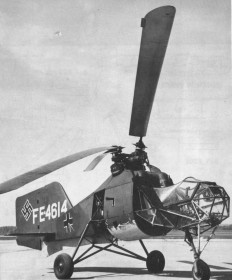
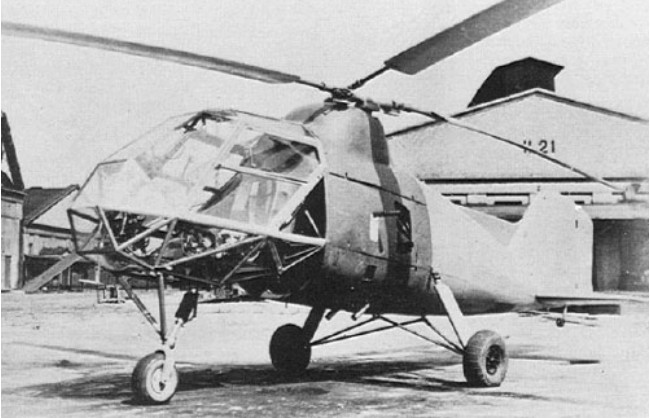
The Flettner Fl 282 Kolibri was designed from the outset as a two-seater, so that, at the expense of range, an observer could be carried, with obvious benefits in the roles of army and navy spotting and anti-submarine work. The observer was to be accommodated in a seat facing rearwards and positioned behind the rotor shafts, and the design provided for a permissible c of G travel which allowed the helicopter to fly with or without the observer without trim changes. The design was finalized by about July 1940 and work began on 30 prototypes and 15 pre-production machines at Flettner’s Johannisthal and Bad Tolz factories. For early flight trials, which began in 1941, the first three Fl 282 prototypes were built as single-seaters and had enclosed Plexiglas-panelled cabins.
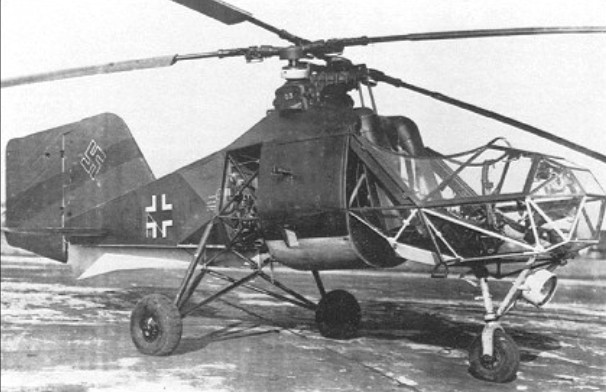
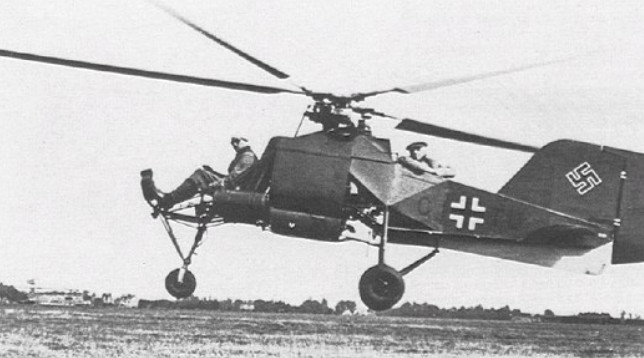
The first three prototypes were completed as single-seaters and had fully enclosed cabins made up of a series of optically flat Plexiglas panels, faired-in rotor pylons and well-contoured fuselages. The Fl 282V3 was fitted with endplate auxiliary fins and a long underfin beneath the rear fuselage. Later two-seater machines had more utilitarian bodies and some had semi-enclosed cockpits; others, like the example illustrated, had a completely open pilot’s seat.
By mid-August 1941 work on the Fl 282 V1 had progressed to the point where it could be used on the ground as a transmission unit test bed. The test bed was anchored but could climb the length of the restraint to a certain height and hover. 125 hours and 39 minutes were spent in these tests, which lasted until November 21, 1941. In the event of the destruction of the V1 or a lengthy interruption of testing due to some other problem, it was planned to use the Fl 282 V4 as a replacement test bed.
For early flight trials the first three Fl 282 prototypes were built as single-seaters and had enclosed Plexiglas-panelled cabins.
The first three prototypes were completed as single-seaters and had fully enclosed cabins made up of a series of optically flat Plexiglas panels, faired-in rotor pylons and well-contoured fuselages. The Fl 282V3 was fitted with endplate auxiliary fins and a long underfin beneath the rear fuselage. Later two-seater machines had more utilitarian bodies and some had semi-enclosed cockpits; others had a completely open pilot’s seat.
The first free flight was made by the Fl 282 V2 on October 30, 1941. At the controls was test pilot Ludwig Hoffmann, who had joined Flettner as the successor to company pilot Perlia. Tests resumed in March 1942 following design changes to the cardan shaft; the tests revealed a significant improvement in the helicopter’s handling. The Fl 282 V2 was taken out of service on May 25, 1942; the aircraft’s transmission and engine were removed for use in other prototypes.
Hoffmann carried out two altitude flights in the Fl 282 V3 on April 27, 1942. On the first he reached a height of 3,500 meters over the takeoff point and on the second (from 1517 to 1610 hours) 3,800 meters in 36 minutes.
The Fl 282 V5, which featured a number of changes compared to the V3 (tail surfaces, fuselage, pilot seat), began flying in January 1942. It also remains to be mentioned that the Fl 282 V2 and V3 had a fully-glazed cockpit. From the V5 on the pilot seat was either entirely open or had a plexiglass shield in front or on the sides.
Various empennage arrangements were also tested. The V3 had a horizontal stabilizer right and left with end fins. A V-shaped stabilizer, similar to that of the Cierva C 30, was installed on the V23.
Calculations revealed that reversing the direction of rotation of the rotor should significantly improve directional stability, especially at low power settings. The V8 was rigged up as a test bed to confirm this. Flight tests with the V9 and V15 began in September 1942 and confirmed the theoretical findings. Directional stability was so good, that the entire fuselage section aft of the firewall was simply left off the V9. Flight tests were problem free. The V9 was the prototype for a version to be operated by the Navy from large submarines and designated “Modified Model in Form of a Standing Cylinder” (Fl 282 U).
The Fl 282 was more highly developed and flew more hours than any other German helicopter, and very extensive tests and measurements were made of all flight aspects. Most of this test work was done by Flettner’s chief pilot, Hans E. Fuisting, who also undertook blind flying and trained many of the 50 pilots who learned to fly the Fl 282. Some new pilots ran into trouble when flying near the ground, because, as they turned with the wind, they lost lift and struck the ground. One new pilot had a fatal accident when flying his Fl 282 blind in cloud, and the assumed cause of the accident was that the machine had been dived and the controls then pulled back so violently that the blades were forced into each other or into the tail. The diving speed thereafter was restricted to 175km/h. On occasions, the Kolibri was landed autogyro fashion and without the use of collective pitch. This was done by descending vertically, diving nose-down and then pulling back on the controls to land, but, on one occasion at least, the tail hit the ground and was damaged.
Extremely manoeuvrable and very stable, even in gusty conditions, the machine could be flown hands-off in forward flight above 60km/h for indefinite periods by making an adjustment to neutralize the loads on the controls. However, in forward flight at speeds below 60km/h there was some longitudinal instability which reached a maximum at about 40km/h. Another slight criticism of the Fl 282 was that it vibrated rather badly while the rotor was running up on the ground, but this vibration decreased upon lifting off, although there was still a certain amount of vibration transmitted to the control column, which was sluggish and tended to overshoot the requisite amount of movement. Although many of the mechanical components were unnecessarily complicated and heavy, the general design and workmanship were of excellent quality, and, as an endurance test, one machine was flown 95 hours in all without replacements or repairs. The engine was said to be capable of 400 hours between overhauls.
The Fl 282 V21 and V23 were built as two-seaters; an observer sat with his back to the pilot in the fuselage behind the engine block. This made necessary the removal of the fuselage fuel tank; it was replaced by two unprotected, cylindrical tanks mounted externally on both sides of the pilot seat. Furthermore, a different rotor arrangement – two three-blade rotors – was tried out on the test bed. It proved to run extraordinarily smoothly, however this was not a consideration for military use.
The entire Fl 282 flight test program was not conducted at Rechlin, as was customary for land-based aircraft; instead, from August 1942, trials were carried out at E-Stelle See Travemünde. In charge of helicopter and autogiro testing there was Fliegerstabsingenieur Dipl. Ins. Hans Fischer; his assistant was Fliegerstabsingenieur Dipl. Ing. Otto Dumke. After Fischer was badly hurt in the crash of one of the E-Stelle’s Do-217’s, Fliegerstabsingenieur Dipl.lng. Gerhard Geike assumed responsibility for the workings of this group.
Travemünde was selected because the air traffic safety ship Greif was based there and could be used for deck landing trials. The site also simplified helicopter sea trials with the navy, it was also imperative to move the site of the trials from Flettner’s facility in Berlin, where there was a greater risk from the growing Allied bombing raids.
One special experiment took place in cooperation with the DVL’s Institute for Marine Aviation. It involved “towing tests with a 50kg gliding body.” The proposal originated from the director of the Erprobungs- und Lehrkommando (Testing and Instruction Detachment) 20, Hauptmann von Winterfeldt, who carried out the towing flights from an antisubmarine vessel in Gotenhafen on May 3 and 4,1943. In addition to its role as a reconnaissance aircraft in support of the sub-chasers, armed with bombs the Fl 282 was also to participate actively in the anti-submarine role.
The following extract from the E-Stelle Travemunde’s monthly report of June 1944 is also worthy of mention:
“A mock combat between the Fl 282 (Flettner company pilot Fuisting) and a Fw 190 (pilot Ltn. Eisenlohr of E.Kdo.25) took place at Schweidnitz on 22.06.1944, in order to investigate the chances of a fighter hitting a helicopter. At present the evaluation of the film and the pilot reports have not yet arrived. At heights above 100 meters the fighter was able to get the helicopter in its sights briefly. Near the ground, especially in difficult terrain, the fighter has little chance against a helicopter.”
Vulnerability to gunfire was also investigated, whereby they proceeded on the assumption that the mathematical probability of a moving rotor blade being hit was much less than that of a fixed wing. Another consideration was that it should be extremely difficult to fire on and hit the slow-moving helicopter from a fast fighter. The latter could escape by making brief evasive movements, which the fighter could not follow. Furthermore, tests involving ground firing at the moving rotor blades were carried out, as the helicopter was felt to be more vulnerable to gunfire from the ground than from the air. An unmanned, tethered Kolibri was used; in spite of several hits in the rotor blades ground fire failed to bring down the helicopter.
Fl 282 V2 with fully glazed cockpit. First flight October 30, 1941
The Fl 282 was more highly developed and flew more hours than any other German helicopter, and very extensive tests and measurements were made of all flight aspects. Most of this test work was done by Flettner’s chief pilot, Hans E. Fuisting, who also undertook blind flying and trained many of the 50 pilots who learned to fly the Fl 282. Some new pilots ran into trouble when flying near the ground, because, as they turned with the wind, they lost lift and struck the ground. One new pilot had a fatal accident when flying his Fl 282 blind in cloud, and the assumed cause of the accident was that the machine had been dived and the controls then pulled back so violently that the blades were forced into each other or into the tail. The diving speed thereafter was restricted to 175km/h. On occasions, the Kolibri was landed autogyro fashion and without the use of collective pitch. This was done by descending vertically, diving nose-down and then pulling back on the controls to land, but, on one occasion at least, the tail hit the ground and was damaged.
Extremely manoeuvrable and very stable, even in gusty conditions, the machine could be flown hands-off in forward flight above 60km/h for indefinite periods by making an adjustment to neutralize the loads on the controls. However, in forward flight at speeds below 60km/h there was some longitudinal instability which reached a maximum at about 40km/h. Another slight criticism of the Fl 282 was that it vibrated rather badly while the rotor was running up on the ground, but this vibration decreased upon lifting off, although there was still a certain amount of vibration transmitted to the control column, which was sluggish and tended to overshoot the requisite amount of movement. Although many of the mechanical components were unnecessarily complicated and heavy, the general design and workmanship were of excellent quality, and, as an endurance test, one machine was flown 95 hours in all without replacements or repairs. The engine was said to be capable of 400 hours between overhauls.
Beginning in 1942 with the Fl 282 V5, the German Navy held a series of trials in the Baltic, the machine behaving well under the worst weather conditions. The Fl 282s in these trials operated from a platform mounted on one of the gun turrets of the cruiser Köln.
The German navy, finding the type extremely manoeuvrable, stable in poor weather conditions, and so reliable that in 1943 about 20 of the 24 prototypes were operating from warships in the Aegean and Mediterranean for convoy protection duties. It was discovered that as pilots gained experience the Fl 282s could be flown in really bad weather, leading to an order for 1,000 production aircraft.
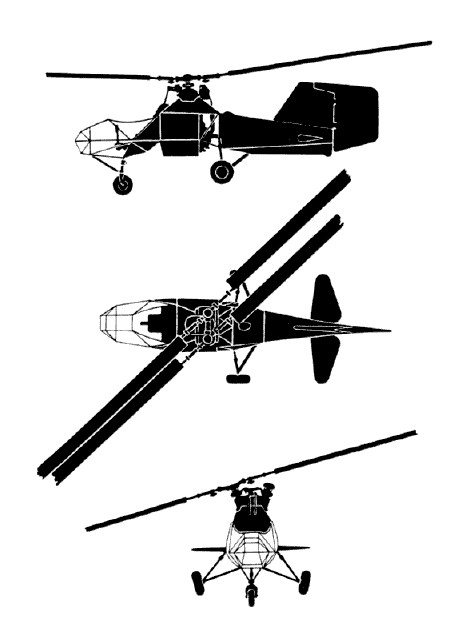
The fuselage consisted of a welded tubular-steel structure with metal panelling enclosing the centre (engine) section and fabric the rear section and vertical surfaces. The undercarriage was of the non-retractable tricycle type with the nosewheel connected to the rudder pedals for steering.
Fl 282 V21, a two-seater, with company pilot Fuisting at the controls. In the rear seat is Anton Flettner
It is known that Luft-Transportstaffel 40, based at Ainring in April 1945, had at least three Fl 282s (and also three Focke Achgelis Fa 223s) at its disposal. It was possibly one of this unit’s Fl 282s that flew Gauleiter Hanke out of besieged Breslau just before the capture of that city.
The great success of the Kolibri, which was even better than the Fl 265, resulted in a production order for 1,000 machines being given in 1944 to the Bayerische Motorenwerke (BMW), which prepared the requisite tooling-up only to have production forestalled by Allied bombing of the Munich and Eisenach works. The Flettner Johannisthal factory was also bombed, and, by the end of the war, only 32 preproduction aircraft in all were completed. Of these, only three were discovered by the Allies in a serviceable condition for testing, the Fl 282 V15 and V23 being taken to the USA and a third machine to the USSR. The remainder having been destroyed to prevent them being captured. Examples known to have survived are the Fl 282 (c/n 28368) at the Cranfield Institute of Technology, and the Fl 282 V23 at the United States Air Force Museum, Dayton, Ohio.
During 1944, when the Fl 282 was considered fully developed, Anton Flettner turned to the design of the Fl 339, using all the experience gained with the Fl 282. The Fl 339, which never got beyond the project stage, was to have been a much larger helicopter weighing some 3,000kg empty, carrying about 20 passengers and being powered by a single engine.
Technical description of the Fl 282 B-0 and B-1 (as of 23.12.1943)
Purpose: I. Reconnaissance aircraft (land); II. Shipboard reconnaissance aircraft.
Design: Single-engined helicopter and gyroplane of mixed construction with two rotors.
(a) Fuselage: Welded steel tube, truss-type construction. Forward section with open (B-0) or enclosed (plexiglass] cockpit (B-1). Recess for back-type parachute in rear wall of seat. The fuselage center-section contains the entire power plant, the outer skin consists of removable doors, hoods and panels. Oval cross-section. The rear fuselage is fabric-covered with a rectangular cross-section.
(b) Rotor Blades: A tubular steel spar with riveted-on wooden ribs and plywood skin with fabric covering. Rectangular outline with rounded tips. Attached to rotor head with delta and alpha hinges. Receptacle for balance weight at end of spar (scrap). The axes of both rotors are angled outboard at 12° from the vertical. Seen from above, the right rotor rotates clockwise, the left counterclockwise.
(c) Control Surfaces: No elevator. Two-part horizontal stabilizer with single spar. Tubular steel spar with riveted-on wooden ribs. Plywood leading edge, fabric-covering, cantilever construction. Angle of incidence adjustable between -15 and +5° from cockpit.Rudder: wooden construction, fabric-covered, deflection to 40°. Vertical stabilizer: wooden construction with plywood leading edge and fabric covering, bolted to fuselage frame. No ailerons.
(d) Undercarriage: Braced fixed nosewheel with VDM oil shock-absorber leg, coupled with rudder foot pedals (steerable nosewheel). Nosewheel: EC tire 350 x 150mm. Mainwheels: EC tires 465 x 165mm.
Power Plant
(a) Engine Type: 1 BMW 314 E. Output: 160hp, compression ratio 1:6.0, rotor reduction ratio: 1:12.
(b) Transmission: Lower transmission flange-mounted on front of engine, in front cooling fan on extended crankshaft. Upper transmission, linked to the lower by a double cardan shaft. Firewall over and behind the engine.
(c) Fuel Tank: An unprotected metal tank located behind the firewall in the aft fuselage, consumable content 105 liters.
(d) Oil Tank: An unprotected 10-liter metal tank flange-mounted on the lower gearbox. Oil content of upper gearbox = 5l.
(e) Type of Fuel: 87 octane aviation gasoline.
(f) Cooling System: Continuous cooling provided by an eight-blade wooden cooling fan with direct drive from the engine. Oil cooler which is switched off for cold-weather operalion.
(g) Control System: Control about all three axes by means of periodic or constant changes in angle of incidence of the rotor blades by means of stick and rudder pedals, to which the rudder is connected. Change-over from helicopter to autogiro (autorotation) flight and reverse achieved by means of a speed-sensitive hydraulic regulator controlled by a hand-operated control lever; change-over to autorotation mode is automatic in the event of engine failure.
(c) Radio and Signalling Equipment: 1 FuG 19 radio installation, 1 rigidly-mounted single-barrel flare pistol, 1 rigidly-mounted signal lamp (shipboard reconnaissance version).
(d) Bomb-Release Mechanism: 1 bomb magazine for two 5kg explosive devices (ship board reconnaissance version). 1 magazine for smoke buoys (shipboard reconnaissance version).
Special Equipment: Deck-landing equipment, consisting of: 1 tether with landing cable and electrical release.
Dimensions: Length of aircraft: 6150mm. Width, including undercarriage and tail surfaces: 2400mm. Height with rotor blades removed: 2400mm. Rotor diameter: 12000mm.
Technical Data: (a) construction group: H 3; (b) maximum allowable flying weight: 1.000kg; (c) wing loading: 8.84 kg/m2 (based on rotor surface area); (d) maximum allowable speeds: as helicopter: forward: 80 km/h, backward: 30km/h, sideways: 20km/h; as autogiro: 60km/h; (e) minimum allowable speeds: as helicopter: no limitations; as autogiro: 40km/h, aerobatic forbidden!
Performance: (a) Speed: Speed is temporarily limited to 80km/h in horizontal flight in helicopter mode for reasons of structural strength, 60km/h in autogiro mode.
(b) Rate of climb: 4.5m/s at sea level, 3.5m/s at 1000m, 3.0m/s at 1500m. Maximum altitude temporarily restricted to 1500 meters for flight safety reasons.
(c) Takeoff and Landing Performance: Takeoff and landing are made vertically. Autorotation landing in event of engine failure. Landing distance from height of 20m: 50m, stopping distance 15m (with wind speed of 5m/s).
Range: Endurance of 2 hours 5 minutes at maximum allowable speed of 80km/h and a range of 168km. The “Technical Description Fl 282 B-0 and B-1” presented above was prepared with the Fl 282 V12.
Flettner FL 282 Kolibri Engine: Bramo Sh 14A radial 7 cylinders, 160 hp Speed: 150 km/h Service Ceiling: 3300 m Range: 170 km Empty weight: 760 kg Max weight: 1000 Width: 25.55 m Length: 6.56 m Height: 2.20 m Rotor Span: 11.96 m Disc Area: 224 sq.m each
Fl 282 V21 Engine: 1 x Bramo Sh.14A 7-cylinder radial, 119kW Rotor diameter: 11.96m Fuselage length: 6.56m Height: 2.2m Max take-off weight: 1000kg Empty weight: 760kg Max speed at sea level: 150km/h Hovering ceiling: 300m Service ceiling: 3300m Range with one pilot: 300km Range with full crew: 170km
Anton Flettner G.m.b.H Anton Flettner (1885-1961) was born in Germany and attended the Fulda State Teachers College in Germany. On finishing his studies, he was employed by Zeppelin on development work into remote-control systems for lighter-than-air craft. When he was teaching mathematics and physics in a high school in Frankfurt, he began to develop ideas leading to his work for Germany in World War I.
After the war, he was named managing director of the Institute for Aero and Hydro Dynamics, Amsterdam, The Netherlands. He held that post until 1931.
From 1926 to 1945, Mr. Flettner was president of the Anton Flettner Aircraft Corporation in Berlin.
The “Anton Flettner G.m.b.H.” was a small engineering company dedicated to helicopters. It is believed that the firm was founded in Berlin in 1935. The earliest document the author has been able to find is a letter from the Military Economics inspectorate (W.I.) III, Berlin to the RLM concerning firms involved in production for the Luftwaffe and dated October 2, 1936. The letter states that the W.I. III first became aware that the firm had been given important work by the RLM (LC II) as the result of a formal application for an exemption from military service for one of Flettner’s skilled workers.
The same inspectorate sent the secrecy agreements to the Flettner Company, Berlin-Johannisthal, Segelfliegerdamm 27, for signature on January 22, 1937.
Due to the growing number of air raids on Berlin, in August 1943 the company began transferring its operations to Schweidnitz in Silesia (approx. 50 km SW of Breslau); due to the deterioration of the transportation system the operation took several months. The Fl 282s on hand with the company were also flown to Schweidnitz to continue the test program. In February 1944 the workforce reached approximately 120 men, its highest level ever.
With the Red Army approaching Silesia, in January/February 1945 the company moved back to Berlin-Tempelhof. Any systematic work or further production was of course out of the question under these circumstances. To make matters worse, two days after its arrival the rest of the company’s equipment was destroyed in a night raid on Tempelhof. What was left of Flettner was subsequently evacuated to Bad Tolz (Upper Bavaria); two Fl 282s were also flown there. The history of the Anton Flettner G.m.b.H. ended there with the arrival of American troops.
Fletcher Aviation Corporation was an aircraft manufacturer founded by three brothers, Wendell, Frank, Maurice Fletcher, in Pasadena, California in 1941, developing FBT-2 trainer and CQ-1A two-seat target-control aircraft. The initial aim of the company was to produce a wooden basic trainer aircraft (the FBT-2) that Wendell had designed, but despite brief interest by the Army in the type to use as a target drone, nothing came of this aircraft. FL-23 two-seat observation/liaison aircraft built for 1950 USAF competition, followed in 1953 by FD-25 Defender light ground-support aircraft. After relocating to Rosemead, California, later projects involved a family of related designs, including (the 1954 FU-24) with 296 produced in New Zealand as an agricultural aircraft with many still operating today.
During the Korean War the company purchased Rosemead Airport from Bob and Jack Heasley. The roughly triangular property is located south of the 10 freeway, although the airport pre-dates the freeway. The property extended from Rosemead Boulevard on the west to the Rio Hondo river basin on the south and east.
In 1953, the same year the FU-24 debuted, they also produced a prototype amphibious vehicle known as the Fletcher Flair. The vehicle was powered by a 4-cylinder Porsche 356 drivetrain, modified to make it a four-wheel drive. The company hoped to sell the vehicle to the US Army but the vehicle performed poorly in the water and the Army passed.
Purchased by AJ Industries, it changed its name to Flair Aviation in 1960, and produced aircraft fuelling equipment, including drop tanks and hose reels for inflight refuelling. Moved to El Monte, California, its name was changed back to Fletcher and then Sargent Fletcher in 1964 before abandoning aircraft manufacturing in 1966. Manufacturing and sales rights for FU-24 series sold to Air Parts (NZ) Ltd. in 1964.

 All Aero