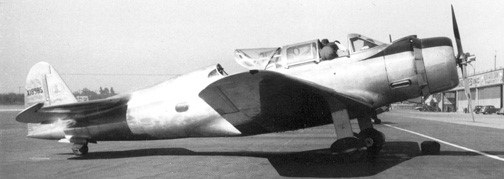
The 1941 Vultee-Stinson V-76 NX27772 was a modified Stinson 105 with a 185hp Lycoming O-435 engine. Designed by A P Fontaine, it was first flown on 28 June 1941, piloted by Al Schramm, it was equipped with full-span slots, which created a problem during testing with near-fatal results.
With modification to half-span slots and enlarged tail surfaces it became final prototype for the Stinson L-5.
The 1942 XBT-16 was BT-13A 41-9777 rebuilt with a plastic-impregnated plywood (Duramold) fuselage, tail section, and wing sections by Universal Products Corp, Bristol VA (aka Vidal Research Corp). A wartime experiment to replace vital aluminum with a less expensive material that didn’t prove too successful. It reportedly ended up heavier than the original metal-clad ship. Only one was built.
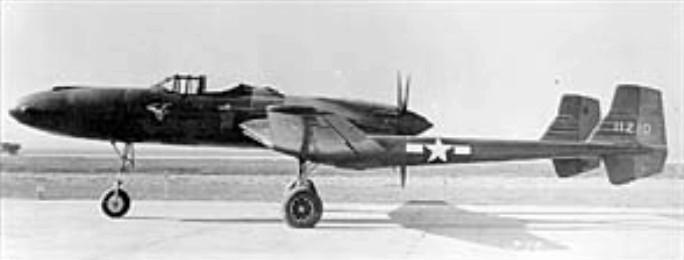
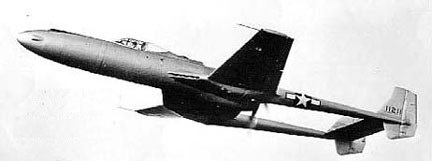
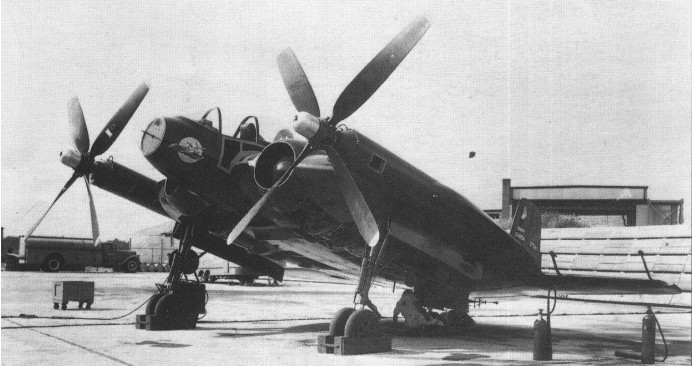
The XP-54, Vultee Model 70, was designed as a fast interceptor using the Pratt & Whitney X-1800-4AG engine. When the engine program was canceled, the aircraft was redesigned for the Lycoming XH-2470 and redesignated Vultee Model 84. With a pressurized cockpit, a pilot emergency ejection was downward, through a hole in the floor.
The first of two XP-54s built (S/N 41-1210) made its initial flight on 15 January 1943, piloted by Frank Davis, and flew 86 times before it was grounded by engine problems. The second aircraft (S/N 41-1211) flew only once, on 24 May 1944.
Vultee XP-54 – The only flight of 41-1211
The XP-54 nose section had a very unusual design feature. It tilted slightly upwards when firing its 37mm cannon to increase the firing range while the .50-cal. machine guns were tilted down at the same time. All had compensating gunsights.
Both were eventually scrapped.
XP-54 Span: 53 ft. 10 in. Length: 54 ft. 9 in. Height: 13 ft. 0 in. Weight: 15,262 lbs. empty/18,233 lbs. gross Armament: Two 37mm cannon and two .50-cal. machine guns Engine: Lycoming XH-2470 of 2,200 hp. Maximum speed: 381 mph. at 28,500 ft. Service ceiling: 37,000 ft. Range: 500 miles
The Vultee A-31 Vengeance dive-bomber was designed led by Richard Palmer to meet French air force requirements.
The RA-31 (Model V-72) export model (as prototype V-85) first flew on 30 March 1941 piloted by Vance Breese. There was a second prototype with twin tails, but pilot Vance Breese refused to fly after finding dangerous tendencies during taxi tests, and it was quickly modified with a single tail. It first flew (as Vengeance I) on 30 November 1941, piloted by Moye Stephens.
400 went to the RAF as Vengeance I/IA, subcontracted to Northrop Corp for production during 1941-42, of which 99 went to the RAAF, plus 300 to the USAAF as RA-31 in a special Restricted classification (41-30848 – 41-31047, and 41-31048 – 41-31147), the last batch of 100 built by Northrop; 300 to RAF as Vengeance II, plus 243 to USAAF with type re-designation as model 85 in 1942; 100 as Vengeance III, becoming Army A-31C, with subsequent production as A-35.
Vultee RA-31
The 1942 V-86 was a single place version of the A-31.
The XA-31A Model 85 of 1942 (42-35824) was a test-bed for the 3000hp P&W XR-4360 engine. It was re-designated XA-31B Model 86 for flight tests.
The A-31C of 1942 was t first production of the Vengeance III. One hundred were built; 41-30148 – 41-31147.
The XA-31C of 1942 was a test-bed for the 2200hp Wright R-3350 engine.
Five YA-31C were built in 1942 and went to Wright Field for testing of four-bladed props in the B-29 development program.
The A-35 Vengeance (Model 88) were A-31 for the USAAF, with similar data, but improved armament.
Vultee A-35A 41-31166
The 1942 A-35A were the second production of Vengeance III. Ninety-nine were built; 41-31148 – 42-31246.
781 A-35B of 1942 were built; 41-31247 – 41-31447, 42-94149 – 42-94548, and 42-101236 – 42-101465. Contradicting factory records show 831 A-35Bs built, with 562 going to the RAF and RAAF as Vengeance IV, and 29 to Brazil AF. (67 A-35A and -35B were supplied to the Free French, but it is unclear whether these were culled or a separate production.)
Vultee A-35B
All models were powered by Wright R-2600 Cyclone engine.
The BC-3 (Model 51 aka BC-51) Army basic combat trainer first flew on 24 March 1939 (piloted by Eddie Allen). The only one built, 39-720, was tested by the Army, who purchased the test model for upgrading as BC-3, one of the only three BC classifications (the other two were North Americans).
Vultee BC-3 39-720
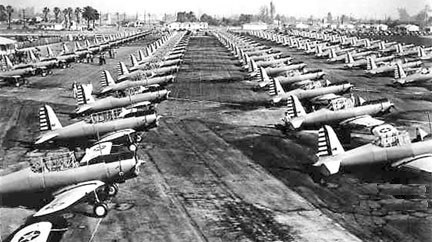
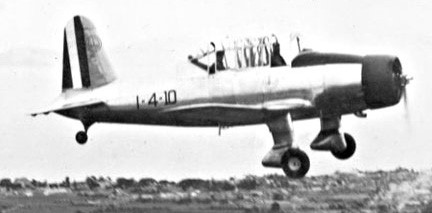
Following 1939 tests with the BC-3 variant with retractable landing gear and a 447-kW (600-hp) Pratt & Whitney R-1320-45 radial, the army opted for the lower-powered Model 54 with fixed landing gear. Designed by Richard Palmer, Walt Hite, and others, the initial contract called for 300 aircraft (40-810-1109).
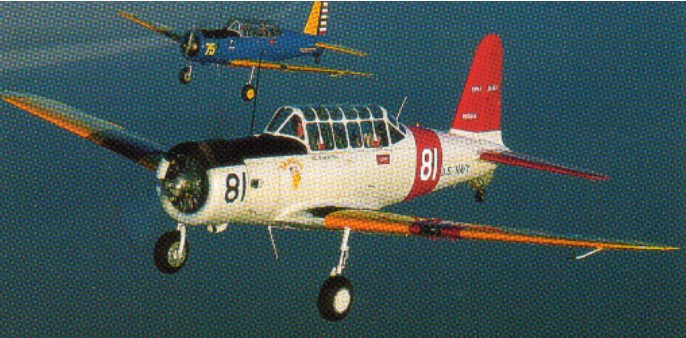
Vultee BT-13
The 1939 V54 (Model 51D) was a retractable-gear export model demonstrator with a 600hp R-1340-S1 engine. The one prototype built, NX21753 c/n 140, first flew on 15 November 1939 piloted by Gil Clark), but crashed on 16 November 1939.
Vultee V-54 / 51D NX21753
The 1940 V54-A NX21754 c/n 141 was a faired, fixed gear, 450hp R-985-AN-1 powered prototype of the BT-13. It first flew on 28 July 1940.
Vultee V54-A NX21754
The BT-13s were followed by orders for no fewer than 6,407 BT-l3As and 1,125 BT-l3Bs with a 24- rather than 12-volt electrical system.
The 1940 BT-13A was powered by a 450hp R-985-AN-1 engine. Gear fairings were deleted in 1941. A total of 7,037 were built: 41-1211-1710, 41-9587-9979, 41-10410-11586, 41-21162-23161, 42-1164-1743, 42-42201-43257, and 42-88674-89573, plus 430 (41-09980-10409) to the USN and USCG as SNV-1, and 12 to the Peruvian AF.
Vultee BT-13A
Vultee 54 Peru export with fairings
The 1941 BT-13B featured a 24v electrical system. 1,125 were built (42-89574-90698, and 44-31511-32160), with the last batch of 650 transferred to USN as SNV-2. Totals of all models include Lend-Lease exports to China, France, Haiti, Indonesia, Israel, the Philippines, and South American nations.
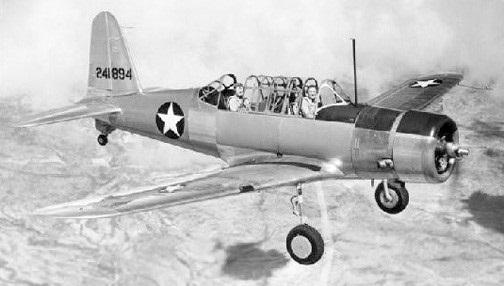
Demand far outstripped engine supplies, however, and in 1941 the USAAF ordered the BT-15 variant with the 336-kW (450-hp) Wright R-975-11 radial, and production of this model totalled 1,263. (41-9980-10409, 42-1744-2063, and 42-41258-42200)
Vultee BT-15 42-41894
The US Navy procurement began with the 1940 US Navy SNV-1, the same as BT-13A. 1,125 (02983-03182, 05675-05874, and 12492-12991) (USN serials total 1,350, but is unexplained—perhaps includes a cancelled batch), with 2 (V222 and V223) to USCG, plus 450 (34135-34584) transferred from USAAF (44-31511-32160, et al) aircraft were retired soon after the war.
Vultee SNV-1 N56319
These were followed by 650 SNV-2s, equivalent to the BT-13B, in 1944. They were BT-13B transferred from the USAAF (44-31511-32010 became 52050-52549, and 32011-32160 became 44038-44187).
Circa 1950 of 3 Vultee BT-13s at Puente Sky Ranch
When production ceased in 1944, 11,537 had been built.
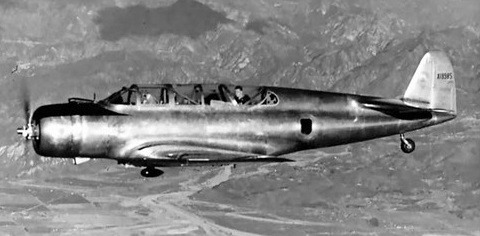
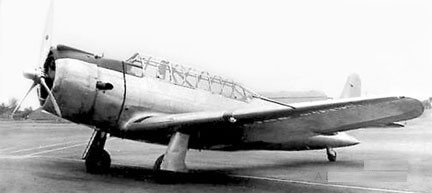
A later development of the Vultee V-11 was the V-12, a streamlined alternative to the largely unsuccessful type. First flown on 13 September 1938, the prototype aircraft (NX18985) was sold to Pratt and Whitney aircraft as a test bed until scrapped in 1950.
The 1939 export designation for the AB-2 (Model V-12) first flew (as V-12C) in February 1940. The single prototype was registered NX28367.
Vultee V-12D
An order from China for 26 V-12C (with 1100hp Wright R-1820) and 52 V-12D (with 1600hp Wright R-2600) resulted in shipment of one each, the rest were delivered in parts for assembly overseas.
1923: Acquisition by Reuben H Fleet of Gallaudet and Dayton-Wright interests 1924: Buffalo NY. Vultee entered aircraft manufacturing in mid-1930s, having formed in 1932 the Airplane Development Corporation, which two years later was acquired by the Aviation Manufacturing Corporation-AVCO, Downey CA (old Emsco plant). A Vultee Aircraft Division of the latter company was formed in 1936, becoming (Gerard Freebairn) Vultee Aircraft Inc. when it acquired the parent corporation’s assets in 1939.
First product was the V-1 eight-passenger monoplane, but became better known for its military aircraft, of which most notable were the V-11 two/three-seat attack monoplane, built for Brazil, China, and Turkey, and a license sold to the USSR; the improved V-12 for China; more than 11,000 BT-13/BT-15 and SNV Valiant two-seat basic trainers for the USAAF and USN between 1940 and 1944; V- 48 Vanguard single-seat fighters for China and USAAF: and V-72 Vengeance dive-bombers for the RAF, USAAF and Brazil between 1941 -1942.
Gerard Vultee was killed in a crash of his personal Stinson in 1938; Richard Palmer as president.
1940: Vultee Aircraft Inc, on acqusition of Barkley-Grow and Stinson Divisions of AVCO. 1940: Nashville (TN) Div.
Vultee purchased Stinson Aircraft Division of the Aviation Manufacturing Corporation in 1940, producing Stinson Model 74s for the USAAF as L-1 Vigilant during Second World War. In December 1941 Vultee bought a 34 percent controlling interest in another subsidiary of The Aviation Corporation, Consolidated Aircraft Inc, with which it merged in 1943 to form the Consolidated Vultee Aircraft Corporation.
1942: Name changed to Convair.
Except only for V-1, V-11, V-12, V-72, and V-77, the prefix was not used at the factory or design levels, and was most likely the doing of media scribes who presumed a “V” for Vultee would follow other manufacturers’ styles—”NA” for North American, “L” for Lockheed, etc.
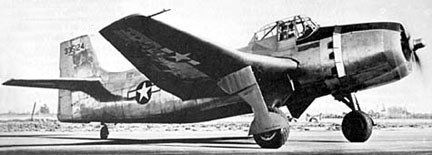
The Vultee XA-41 (Model 90) of 1944 was the last of the two A-type designations, the other being Beech XA-38.
First flying on 11 February 1944 piloted by Frank Davis, one XA-41 prototype was built, 43-35124, for testing as ground-attack by USAAF and USN, then civil re-registered NX60373 by Pratt & Whitney for supercharger testing.
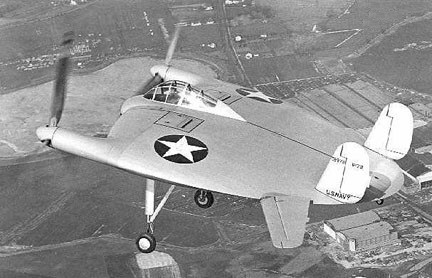
The Vought XF5U based on the V-173 aerodynamic research aeroplane. The XF5U had a basically circular wing with twin vertical surfaces at its rear ‘corners’ outside two stability flaps and inside two projecting ‘ailavators’ for pitch and roll control. The primary structure was of Metalite, a material of bonded aluminium and balsa that offered exceptional strength with great lightness. The powerplant comprised two 1600-hp (1193-kW) Pratt & Whitney R-2000-7 radials buried in the thick inner portions of the wings and driving, via a complex double right angle transmission system of shafts and gearboxes, two 4.88 m (16 ft) four-blade propellers located on the forward ‘corners’ of the wing. The propeller blades were articulated and could be moved fore and aft on their shafts in the manner of a helicopter’s rotors, permitting the craft to ‘hang’ on its propellers in a semi hover at low airspeed.
Vought’s specification for the Flapjack called for a maximum speed of 811 kph (504 mph) at 6100m (20,000 ft), while the landing speed was to be as low as 32 kph (20 mph). A proposed turbine engined variant would have been even faster. The aircraft was to have been armed with six 12.7 mm (03 in) machine guns or four 20 mm cannon, or two 454 kg (1000 lb) bombs.
The prototype XF5U 1 33958 first began engine tests in August 1945, but it was not until 1947 that the articulating propellers became available and the Flying Flapjack began taxying trials at Vought’s Stratford, Connecticut plant.
On 17 March 1947 the US Navy had cancelled the programme in favour of jet powered fighters, and the prototype, the sole XF5U was ordered scrapped, but a crane’s wrecking ball merely bounced off the tough little prototype, and it finally took workers with blowtorches to reduce it to salvageable scrap.










 All Aero