Gloster Aircraft Co Ltd / Gloucestershire Aircraft Company Ltd

Formed in 1917 as the Gloucestershire Aircraft Company Ltd. to take over subcontract work from the Aircraft Manufacturing Company and H. H. Martyn & Co Ltd. of Cheltenham. D.H.4 and D.H.6 fuselages had been built by Martyn, and by the end of the war the company had supplied 461 Bristol Fighters and 165 RAF F.E.2bs, as well as Nieuport Nighthawks and other fuselages.
Fifty Nighthawks, renamed Sparrowhawks, were built for Japan to a 1920 order, and were shortly followed by the first true Gloucester aircraft, the Bamel single-seat racing biplane, designed and built in less than four weeks. H. P. Folland, joined the company soon after the Bamel’s completion. A line of biplane fighters followed, the Grebe and Gamecock being notable successes, and in 1926 the company was renamed Gloster Aircraft Company Ltd. moving its main factory to Hucclecote, Gloucester.
Up to 1930, all but one of their machines had been single-engined, the exception being the A.S.31, which was not originally a Gloster design but based on the de Havilland DH.67B.

Joining the Hawker Siddeley Group in 1934, Gloster continued fighter production with the Gauntlet and Gladiator, the latter being the RAF’s last biplane fighter. Henry Folland, Gloster’s chief designer, would leave Gloster when it was taken over by Hawker in 1937.

During the Second World War Gloster built 2,750 Hurricanes and 3,330 Typhoons, and produced Britain’s first jet aircraft to specification E.28/39, the first of two single-jet prototypes flying in 1941 and leading to the twin-jet Meteor of 1944. A total of 3,545 Meteors was produced by Gloster and Armstrong Whitworth. Gloster’s final production aircraft was the twin-jet delta-wing Javelin all-weather interceptor, flown in 1951, of which 435 were produced for the RAF. Gloster ceased aircraft production in 1956.
Gloster, Armstrong Whitworth and Avro joined Hawker Siddeley Aviation in 1965.
Globe Aircraft Corp / Bennett Aircraft Corp

Formed originally as the Bennett Aircraft Corporation to manufacture aircraft from Duraloid, a new type of bonded plywood. Produced twin-engine eight-seat monoplane, the BTC-1, about 1940. Company reorganized and renamed Globe Aircraft Corporation in 1941. First design under new name was the GC-1 Swift, a two-seat light monoplane with retractable landing gear and Continental engine. Development stopped by war, but produced postwar from 1945. Company built also Beech 18s for U.S. Government during Second World War.

General Electric T31 / TG-100

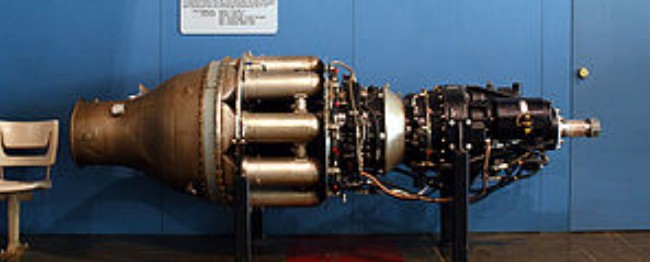
The first American turboprop engine was the General Electric XT31, first used in the experimental Consolidated Vultee XP-81. The XP-81 first flew in December 1945, the first aircraft to use a combination of turboprop and turbojet power.

The T31 engine was the first American turboprop engine to power an aircraft. First run in May 1945, it made its initial flight in the Consolidated Vultee XP-81 on 21 December 1945. The T31 was mounted in the nose; a J33 turbojet engine mounted in the rear fuselage provided added thrust. The T31 was also used on the Navy XF2R-1, similarly powered by a turboprop/turbojet engine combination.

The engine was to have been flown experimentally on a Curtiss XC-113 (a converted C-46), but the experiment was abandoned after the XC-113 was involved in a ground accident. Only 28 T31s were built; none were used in production aircraft, but improved production turboprop engines were developed from the technology pioneered by the T31.

A derivative of the T31, the General Electric TG-110, given the military designation T41, was ordered but subsequently cancelled.

Applications:
Consolidated Vultee XP-81
Curtiss-Wright XC-113
XF2R Dark Shark

Specifications:

XT31
Type: Turboprop
Dry weight: 1,980 lb
Maximum power output: 2,300 shp (design) at 13,000 rpm. (1,145 propeller rpm)

General Electric I-40 / J33 / Allison J33

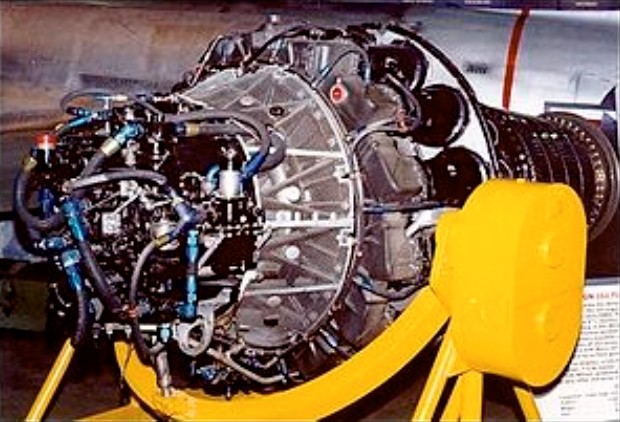
Allison J33-A-35 Turbojet Engine

The J33 was originally developed by General Electric as a follow-on to their work with the designs of Frank Whittle during World War II. Their first engine was known as the I-A, but after major changes to adapt it to US production and to increase thrust, it started limited production as the I-16 in 1942, the 16 referring to its 1,600 lbf (7,100 N) thrust. Full production started as the J31 when the United States Army Air Forces introduced common naming for all their engine projects.

Along with the I-16, GE also started work on an enlarged version, known as the I-40. As the name implied, the engine was designed to provide 4,000 lbf / 18 kN (ending at 4,600 lbf (20 kN) with an additional low-altitude boost to 5,400 lbf / 24,000 N with water-alcohol injection). Design work started in mid-1943 and the first prototype underwent static testing on January 13, 1944.

Lockheed was in the midst of the XP-80 project at the time, originally intending to power their design with a US-produced version of the Halford H-1 of about 3,000 lbf (13 kN). Production of the H-1 ran into delays, and since the I-40 would dramatically improve performance, plans were made to fit the prototypes with the I-40 instead.

The I-40 became important to the USAAF’s plans when the I-16 powered P-59 was skipped over in favor of the I-40 powered P-80 as the US’s first production jet fighter. In 1945 the license to actually produce the engine was not given to General Electric, but Allison instead. Allison, working largely from government-owned wartime factories, could produce the engine in quantity more quickly and cheaply.

By the time the production lines were shut down Allison had built over 6,600 J33’s, and General Electric another 300 (mostly the early runs).

In 1958, surplus J33s were used in jet donkeys pushing dead loads at 200 knots to test aircraft carrier arresting gear cables and tailhooks at Lakehurst.

The General Electric/Allison J33 was a development of the General Electric J31, enlarged to produce significantly greater thrust, starting at 4,000 lbf (18 kN) and

Variants:
J33-A-21: 4,500 lbf (20.0 kN) thrust
J33-A-23: 4,600 lbf (20.5 kN) thrust
J33-A-35: 5,400 lbf (24.0 kN) thrust
J33-A-33: 6,000 lbf (26.7 kN) afterburning thrust
J33-A-24: 6,100 lbf (27.1 kN) thrust

Applications:
Convair XF-92
Lockheed P-80 Shooting Star
Lockheed T-33 Shooting Star
Lockheed F-94A/B Starfire
MGM-1 Matador
MGM-13 Mace
SSM-N-8 Regulus

Specifications:
General Electric I-40
Type: Centrifugal compressor turbojet
Length: 103 in (2,616.2 mm)
Diameter: 52 in (1,320.8 mm)
Dry weight: 1,850 lb (839.1 kg)
Compressor: single-stage double-sided centrifugal compressor
Combustors: 14 can type stainless steel combustion chambers
Turbine: Single-stage axial
Fuel type: Kerosene (AN-F-32) or 100/130 gasoline
Oil system: pressure spray at 20 psi (137.9 kPa) dry sump, 60 S.U. secs (10.2 cs) (AN-0-6A) grade oil
Maximum thrust: 4,000 lbf (17.79 kN) at 11,500 rpm at sea level
Overall pressure ratio: 4.1:1
Turbine inlet temperature: 1,472 °F (800 °C)
Specific fuel consumption: 1.18 lb/lbf/hr (120.28 kg/kN/hr)
Thrust-to-weight ratio: 2.174 lbf/lb (0.0213 kN/kg)
Normal thrust, static: 3,200 lbf (14.23 kN) at 11,000 rpm at sea level
Military thrust, static: 4,000 lbf (17.79 kN) at 11,500 rpm at sea level
Idle thrust, static: 120 lbf (0.53 kN) at 3,500 rpm at sea level

General Aircraft Corp / GAC G1-80 Skyfarer

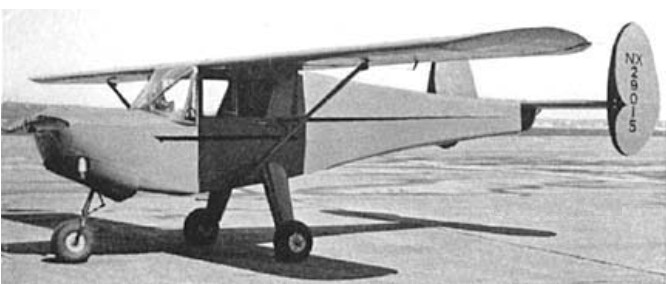
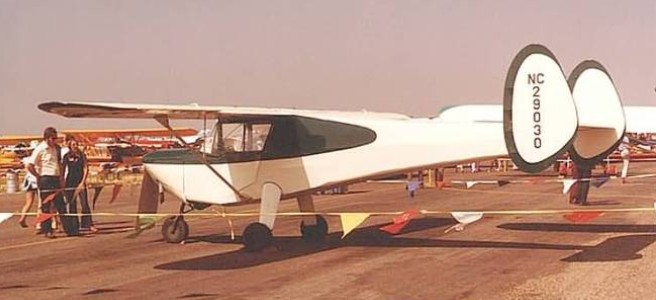
The General Aircraft Corporation was established to build an aircraft designed by Doctor Otto C. Koppen from the Massachusetts Institute of Technology. The aircraft was the G1-80 Skyfarer, a two-seat cabin high-wing braced monoplane with a light alloy basic structure and a mixed steel tube and fabric covering. It had an unusual tail unit, a cantilever tailplane with the elevator mounted on the upper surface of the tail with aluminum endplate fins and no movable rudders. It was powered by a 75 hp (56 kW) Avco Lycoming GO-145-C2 geared air-cooled four-cylinder engine.

The aircraft incorporated aerodynamic control principles covered by patents issued to Fred Weick, an early aeronautical engineer who went on to design and market the Ercoupe. Since it had no rudders (or rudder pedals), it was simpler to fly (it had a single control wheel, which controlled the ailerons and elevator), and was considered spin-proof. The aircraft was certified in 1941 with a placard that stated the aircraft was characteristically incapable of spinning. The company also made a comment to Popular Science in a September 1941 article, with first public photos that an “average” person could learn to fly the Skyfarer …in an hour or so…

It was anticipated that many aircraft would be ordered and built, but the United States became involved in the Second World War and the Skyfarer programme was abandoned after 17 examples had been built. The rights and tooling passed to Grand Rapids Industries in 1943, who built 2 aircraft before stopping production. The company became a manufacturer of the Waco CG-4A troop glider.

L.W. DuVon and Dr. David O. Kime of Western Union College convinced the type holder Grand Rapids Industries, to give the equipment, tools and one of the finished planes to the college in 1944. They then found local investors who formed Mars Corporation in 1945. The aircraft was later licenced as the Mars M1-80 Skycoupe with a 100 hp engine. One example was built and production plans were estimated to be as high as 75 planes in its first year. The glut of aircraft produced after the war left little market for the aircraft. The facility to manufacture the aircraft was sold by 1946.

The aircraft NC29030 resides in the Plymouth County, Iowa Historical Museum.

Gallery

G1-80 Skyfarer
Engine: 1 × Lycoming GO-145-C2, 75 hp (56 kW)
Wingspan: 31 ft 5 in (9.58 m)
Wing area: 121.3 sq.ft (11.27 sq.m)
Length: 22 ft 0 in (6.71 m)
Height: 8 ft 8 in (2.64 m)
Empty weight: 890 lb (404 kg)
Gross weight: 1350 lb (612 kg)
Maximum speed: 144 mph ( km/h)
Cruise speed: 100 mph (161 km/h)
Range: 350 miles (563 km)
Service ceiling: 10,000 ft (3050 m)
Seats: 1 pilot, 1 passenger, side-by-side

General Aircraft Corp / GAC

Long Island, New York, USA
The company was established at Lowell, Massachusetts to build an aircraft designed by Doctor Otto C. Koppen, a professor of aeronautics from the Massachusetts Institute of Technology. The aircraft was the G1-80 Skyfarer, a two-seat cabin high-wing braced monoplane.

Before the company could produce the aircraft in any numbers the Second World War intervened, and the Skyfarer programme was abandoned after 17 examples had been built. Situated on Long Island, New York, the company became a manufacturer of the Waco CG-4A troop glider and the interests in the Wayfarer were sold to Grand Rapids Industries in 1943.

In 1969, the company bought the Helio Aircraft Company which specialised in building STOL aircraft for use by government agencies in south east Asia. The company ceased to manufacture aircraft in October 1976 when it sold the production rights and assets of its Helio Aircraft division.

General Aircraft GAL.61

The fourth glider in the GAL.56 research series was built as the GAL.61. The GAL.61 placed the pilot in a blister on the pot side whilst the observer was in a prone position on the starboard side with a window in the wing leading edge.

The glider was of all wooden construction. No fins or rudders were fitted, directional control being by drag rudders in the wingtips. The wing was symmetrical with cusped trailing edge. Split trailing edge flaps of 20% chord were hydraulically operated.

The undercarriage was hydraulically operated retractable tricycle.

Wingspan: 15.84 m / 51 ft 11.5 in
Overall length: 7.53 m / 24 ft 8.3 in
Aspect ratio: 5.94
Wing area: 41.8 sq.m / 450 sq.ft
Empty weight: 1972 kg / 4348 lb
AUW: 2350 kg / 5174 lb
Mean sweepback: 35 degrees
Max speed: 322 kph / 200 mph
Towing speed: 242 kph / 150 mph

General Aircraft GAL.58 Hamilcar 10

The General Aircraft GAL.58 Hamilcar 10 was a powered version of the Hamilcar 1 to AM Spec X.4/44, for Far-Easton Sector operations. The glider was fitted with two Bristol Mercury engines of 965 hp each, to enable the glider to maintain level flight when lightly loaded.

Wing span: 110.007 ft / 33.53 m
Wing area: 1657.441 sq.ft / 153.980 sq.m
Length: 68.012 ft / 20.73 m
Height: 20.243 ft / 6.17 m
Max take off weight: 45,500 lb / 20,412 kg
Weight empty: 25,510 lb / 11,571 kg
Aspect ratio: 7.3
Wing section: RAF 34 modified
Max speed: 145 mph / 233 kg
Max speed: 112 mph at 32,500 lb
Cruise: 180 kph at 14,742 kg

General Aircraft GAL.56

A series of tailless research gliders built by General Aircraft Ltd, having differing plan forms with various degrees of sweepback. Designed from 1943 to 1947 three were built under the designation of G.A.L. 56 having a common fuselage nacelle built from steel tubing covered with wooden formers and plywood.

The wings were of wooden construction covered with sheets of low-grade wood interspread with processed paper. On flight trials the gliders were towed by a Spitfire Mk.9.

Flight tests commenced in mid-November 1944.

The GAL.56/02 Medium U was as the GAL.56/01 but with small parallel centre section.

The GAL.56/03 Maximum V was as the GAL.56/01 but with 36.40 degrees sweepback.

The fourth glider in the series was built as the GAL.61.

G.A.L. 56/01 Medium V
Wingspan: 13.92 m / 45 ft 4 in
Overall length: 5.69 m / 18 ft 8 in
Wing area: 32.51 sq.m / 350 sq.ft
Aspect ratio: 5.8
Wing section: RAF 34 modified
Sweepback: 28.4 deg at 25% chord
Pneumatically operated trailing edge flaps
Empty weight: 1472 kg / 3244 lb
AUW: 2000 kg / 4400 lb
Wing loading: 61.37 kg/sq.m / 12.57 lb/sq.ft
Max tow speed: 241 kph / 150 mph
Max dive speed: 322 kph / 200 mph
Stall: 93 kph / 58 mph

GAL.56/02 Medium U
Wingspan: 15.5 m / 51 ft 0 in
Length: 6.4 m / 21 ft 0 in
Wing area: 41.80 sq.m / 450 sq.ft
AUW: 2540 kg / 5600 lb

GAL.56/03 Maximum V
Wingspan: 13.82 m / 45 ft 4 in
Overall length: 7.16m / 23 ft 6 in
Sweepback: 36.40 degrees
AUW: 2268 kg / 5000 lb