Grumman G-34 / XF5F-1 Skyrocket

G-34 / XF5F-1 Skyrocket

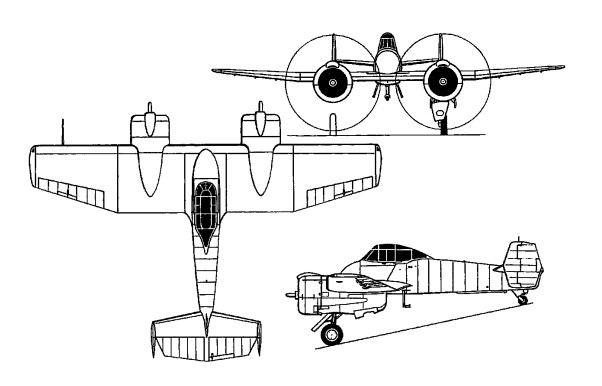
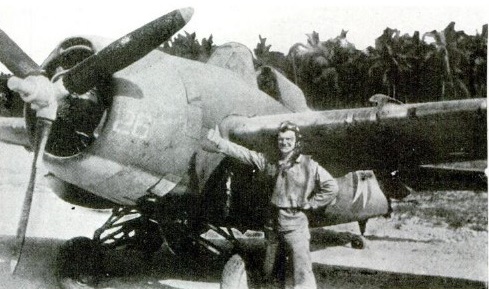
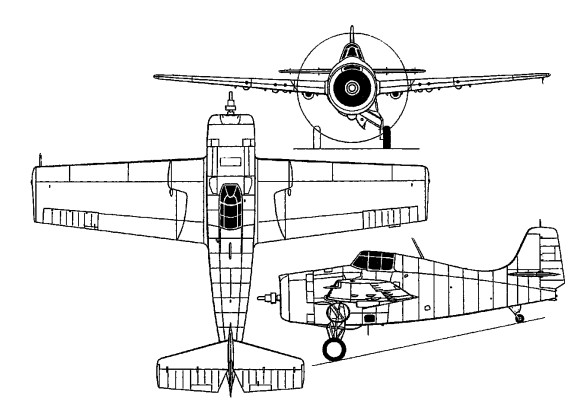
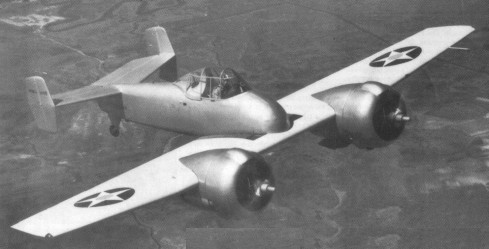
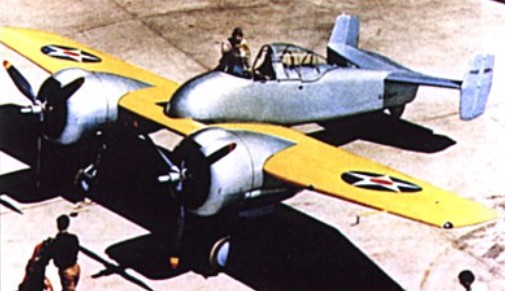
Ordered as a prototype on 30 June 1938 by the US Navy Bureau of Aeronautics, the XF5F-1 was of radical concept in that it was intended as a twin engined shipboard fighter, and this at a time when the first single engined shipboard fighter monoplanes were only just commencing flight test. Conceived as the G 34 Skyrocket, the XF5F-1 was flown on 1 April 1940, and, in its initial form, had a singular appearance resulting from an abbreviated forward fuselage, the wing leading edge extending ahead of the fighter’s nose. Powered by two 1,200 hp Wright XR 1820 40/42 radials and having provision for two 23 mm Madsen cannon, the XF5F 1 underwent some redesign as a result of testing, the engine nacelles being lengthened, the fuselage nose being extended, etc. Flight testing of the XF5F-1 provided information utilised in the development of the more advanced XF7F 1 (G 51).
Despite the economic circumstances and America’s declining influence in world affairs, Congress loosened its purse strings wide enough to allow the Navy to modernise its naval air arm. As a result, the Navy became involved in three new fighter projects the Grumman XF5F 1 and similar USAAF XP 50, the Bell XF1 1 and the Vought XF4U 1. The long term intention was to bolster the Navy’s sagging carrier forces whose squadrons flew the Grumman F3F 2 biplane fighter harking back to the mid1930s

G-34 / XF5F-1 Skyrocket

The introduction of speedier and more heavily armed low wing fighters emerging from Europe such as Britain’s Supermarine Spitfire and Germany’s Messerschmitt Bf 109 capable of speeds well over 300mph (483km/h) made the Navy’s task ever more urgent. In addition, the changing military environment, along with the gathering storm clouds of impending war in Europe, spurred Navy officials to investigate new concepts in aircraft design the XF5F 1 Skyrocket. Ordered by the navy as the XF5F-1 [1442] on 30 June 1938, it was flown on 1 April 1940 piloted by R A “Bud” Gillies.

Not only was the G-34 an advanced concept, in its original form it was a most unusual-looking aircraft, with the leading edge of its low-set monoplane wing forward of the fuselage nose. The tail unit had twin endplate fins and rudders, and the landing gear was of the retractable tailwheel type, with the main units retracting aft into the wing-mounted engine nacelles. The engines were two Wright R-1820 Cyclones, each with a three-bladed propeller, these being geared to counter-rotate to offset the effects of propeller torque.

Flight test data early on in the Grumman G 34 (factory designation) revealed the Skyrocket was capable of outstripping in speed practically all other fighters then in both air services. At 16,000ft (4,877m), it achieved a top speed of 380mph and had an initial climb of 4,000ft (1,200m) per minute. Armament consisted of four 0.50 calibre Brownings.

In the summer of 1941, XF5F-1 was tested in competition against F2A, F4F, XF4U, XFL-1, P-39, P-40, and British Hurricane and Spitfire. After familiarization flights in each aircraft, pilots flew a specified series of maneuvers, then submitted pilot reports on each. LtCdr John Crommelin had this to say about F5F:
“I remember testing against XF4U in a climb to 10,000’… I pulled away from the Corsair so fast I thought he was having engine trouble. F5F was a carrier pilot’s dream … opposite- rotating props eliminated all torque, and you had no engine in front to look around to see the LSO (Landing Signal Officer). Analysis of all data favored F5F, and Spitfire came in a distant second.” Availability of spare parts at the time and other particulars cancelled F5F, and the Navy chose F4F instead for production.

Despite the glowing performance figures the Skyrocket’s future was suddenly scrapped by the Navy, mainly for a combination of technical reasons and doubts over what some considered to be radical features. The Navy’s enthusiasm blunted by several problems in the Skyrocket testing programme such as engine cooling, instability in certain flight conditions and the wing’s odd position obstructing the view forward during carrier landings. Modified under a Dick Hutton design, the F5F received inward-rotating props, a new canopy and longer nose in 1941.

Grumman XF5F-1 long-nose

After completing 211 test flights, the XF5F 1 (BuNo 1442) was cancelled in early 1941. It did, however, lead to the XP-50 for the Army Air Corps.

Grumman XF5F-1 Third revision [1442]

XF5F-1
Engine: 2 x Wright XR-1840-40/42 Cyclone, 1,200-hp.
Wingspan: 12.80 m / 42 ft 0 in
Length: 8.75 m / 28 ft 8 in
Height: 3.45 m / 11 ft 4 in
Wing area: 28.19 sq.m / 303.43 sq ft
Max take-off weight: 4599 kg / 10139 lb
Empty weight: 3677 kg / 8106 lb
Loaded weight, 10,138 lb (4599 kg).
Max. speed: 616 km/h / 383 mph at sea level, 380 mph (611 km/h) at 16,500 ft (5030 m)
Range: 1930 km / 1199 miles at 210 mph (338 km/h)
Max climb, 4,00ceiling: 33,000′ ft
Seats: 1

Grumman XF5F Skyrocket

Grumman G-18 / G-36 / F4F Wildcat

F-4F-3

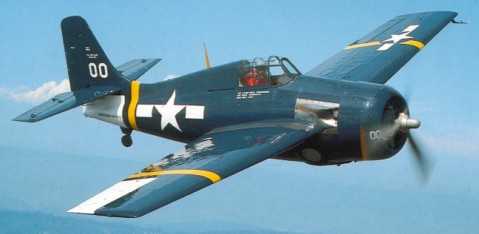
Designed in 1937 by Robert L. Hall, the company’s first carrier-based fighter of monoplane configuration was designed to meet a US Navy requirement which originated in 1935, but it was not until July 1936 that the Navy ordered this aircraft, under the designation XF4F-2 (G-18).

Grumman F4F Wildcat Article

The model G-18 was powered by the Pratt & Whitney R-1830-66 Twin Wasp engine, a two-row, fourteen-cylinder radial. A Hamilton Standard two-position propeller was fitted. The armament installation was basically the same as that of the XF4F-1, with two 0.50 guns with 200 rounds each in the top of the engine cowling, and provision for two 100lb bombs under the wings. The gross weight of the aircraft was 5635lb, a substantial increase over the XF4F-1 biplane. The G-18 was ordered on 28 July 1936. Despite the substantial differences to the G-16, the designation XF4F-2 was applied. The prototype, BuNo 0383, was first flown on 2 September 1937. During trials it demonstrated a maximum level speed of 290mph, which was faster than the XF2A-1, but still below the USN requirement of 300mph.

The XF4F-2 was delivered to NAS Anacostia on 23 December 1937 for evaluation. During trials the prototype suffered from a series of snags and accidents. None of these was particularly serious, but their undermined the confidence of the USN. The XF4F-2 suffered repeated engine crankshaft failures. The arrestor hook proved too weak. On 24 February 1938 there was an on board fire when ballast bags in the aft fuselage began to burn. And on 11 April 1938 the XF4F-2 suffered a crash when the engine failed during a simulated deck landing. As a result, the US Navy selected the more reliable Brewster F2A-1 Buffalo for production, after NACA tests had suggested that minor aerodynamic improvements could boost the speed of the XF2A-1 by 30mph. The USN ordered 54 F2A-1s on 11 June 1938. Despite this setback, the USN continued to show interest in the F4F. This was probably partly due to its unwillingness to rely fully on the production of Brewster: The order for the F2A-1 was the first production contract for Brewster, and the manufacturer did not even possess a factory which was adequate for the production of aircraft. Grumman had already built the FF, F2F and F3F for the Navy, and the F4F showed some promise. A development contract was awarded in October 1938.
To overcome the shortcomings of the XF4F-2, a new prototype was built with a more powerful two-stage supercharged engine, and airframe revisions which increased wing span and brought changes to wingtips and tail surfaces. In this form the XF4F-3 flew for the first time on 12 February 1939.
In July 1936 the navy ordered the prototype XF4F-2, with one of the new 900-hp Pratt & Whitney R-1830 Twin Wasps at the front of a rather tubby fuselage which carried the monoplane wing an inch or two below the mid position. The R-1830S C5 G went into production in 1940 to power the Grumman F4F 3 Wildcat fighter. This was the first production aircraft with two stage supercharging. The hand¬cranked landing gear was re¬tained, and the pilot could look down through two windows in the floor of the comfortable cockpit. Bob Hall, designer of the faintly similar Gee Bee racers, took the XF4F-2 on its first flight on 2 Sep¬tember 1937. Armed with two 0.5-in guns and two 100-lb bombs, this showed promise but suffered from prolonged engine problems. First flown on 12 February 1939, the XF4F-3 had a com¬pletely revised airframe, with broad square-tipped wings and a much-improved tail. It also had a far better Twin Wasp, with a two-stage two-speed supercharger. Armament was increased to two 0.3-in in the fuselage and two 0.5-in in the outer wings. Though by far the heaviest Grumman fighter yet, the Dash-3 proved a fine aircraft, with excellent manoeuvrability, a speed of 333 mph and service ceiling of 33,500 ft. In August 1939 the navy ordered the first batch of 54 F4F-3s, with a longer fuselage, four 0.5-in guns in the wings and, later, armour and self-sealing fuel tanks. This order was soon in¬creased.
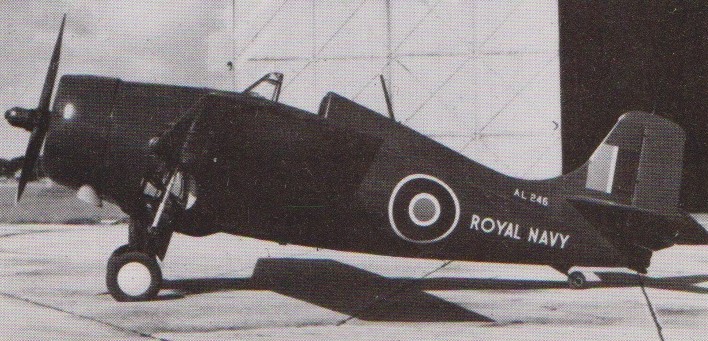
Grumman offered an export version of the F4F 3 ordered by the US Navy as the G 36A, a contract for 81 aircraft being placed on behalf of France’s Marine Nationale, and France added 81 of a version called the G.36A with Cyclone engines. Seven were in various stages of assembly when France fell and the entire batch was transferred to Britain which also placed a contract for 100 G 36As on its own account. Britain’s Fleet Air Arm put in British non-metric instruments and a throttle lever that worked in the normal sense (the French pulled the lever back for take-off). The six 7.5-mm French guns in the wings were retained.

They proved far better than any other fighter in the Fleet Air Arm, and opened their score on Christmas Day 1940 when two from 804 Squadron shot down a Ju 88 in the north of Scotland.

G-36A Martlet I

Whereas the French contract aircraft were powered by the 1,200 hp Wright R 1820 G205A Cyclone, Britain selected the Pratt & Whitney S3C4 G Twin Wasp of similar power. The first (French contract) G 36A flew on 11 May 1940 and entered British service as the Martlet I, a contractual change resulting in the British order being switched to the G 36B with folding wings, this entering service as the Martlet II (although the first 10 were accepted with fixed wings). The 30 F4F 3As that had been assigned to Greece were also taken into the Royal Navy inventory as Martlet IIIs, and with the passage of the Lend-Lease Act, 220 aircraft essentially similar to the F4F-4 but with the single stage R 1820 40B engine were assigned to the Royal Navy as Martlet IVs (F4F 4Bs), these becoming Wildcat IVs when British and US names were standardised in March 1944.

Churchill regarded the production of Fulmars vital and the greater need for land Spitfires, the diversion of resources to a new navalised variant would reduce Spitfire’s production numbers. To cover the gap until the Fulmar’s replacement (the Fairey Firefly) was able to enter service, Grumman Wildcats were ordered for the FAA. These entered service towards the end of 1940 as the Martlet, but these were unavailable in sufficient numbers, while Sea Hurricanes, without folding wings, were also not advanced enough as a solution.

The appearance of the A6M2 N float fighter in the Aleutians prompted US Navy interest in a float equipped version of the F4F 3 shipboard fighter. One example was therefore fitted with Edo designed and manufactured single step metal floats, and with auxiliary rudders mounted near the tips of the tailplane flew on 28 February 1943. The need for additional keel area aft was revealed by initial trials and a large ventral fin was added to improve yaw stability. The floats and their bracing struts raised the fighter’s weight by only some 500 lb (227 kg), and from calm water at normal loaded weight the F4F 3S could take off within 34 seconds. However, the dramatic effect of float drag on speed performance led to an earlier contract to complete 100 F4F 3 Wildcats as float fighters being cancelled.
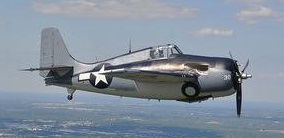
Altogether Grumman built 369 F4F-3s for the US Navy, followed by 95 Dash-3As with the R-1830-90 engine. Some were converted to F4F-3P photo air¬craft and BuNo 4038 was fitted with twin floats. The navy allotted the name Wildcat, thereby estab¬lishing the famous series of Grum¬man ‘cat’ fighters, and the British changed to the same name in January 1944. The chief drawback of the otherwise outstanding F4F-3 was its size, which did not fit too well with the constricted decks of the new escort carriers. Leroy Grum-man took two paperclips and, after bending them in various direc¬tions, stuck them into a pencil eraser. He thus proceeded to demonstrate the principle of what at first was called the ‘sto-wing’. By attaching the outer wings by oblique skewed hinges they were made to fold back on each side of the fuselage, upper surface out¬wards. The company made abso¬lutely sure it worked before com¬mitting it to production at the 163rd aircraft, subsequent delive¬ries being designated F4F-4s, or Martlet IIs. These had the 1,200-hp R-1830-86 engine and the heavy armament of six 0.5-in guns in the outer wings. They were by far the most important Allied fighters in the Pacific from Pearl Harbor until the summer of 1943. Grumman completed the last of 1,971 F4F-4s on the last day of 1942, subsequently needing every inch of floor for the TBF and F6F. Small numbers were built of the experimental Dash-5 to -8.
In January 1942 General Motors formed its Eastern Aircraft Divi¬sion to build aircraft in under-used car factories. In 1942 the manufacture of the Wildcat was transferred to the Eastern Aircraft Division of the General Motors Corporation. The first FM-1 Wildcat, assembled from parts supplied by Grumman, flew on 1 September 1942. The FM-1, fitted with a Pratt & Whitney R-1830-86 engine, was virtually the same as the F4F-4 (Wildcat IV). By 11 April 1944 the Eastern Aircraft Division had produced its 2,500th Wildcat.
Manufacture of the F4F-4 continued in slightly modified form as the FM 1 Wildcat, the R 1830 86 Twin Wasp engine being retained but wing armament being reduced from six to four 0.5 in (12,7¬ mm) guns and ammunition capacity being raised (from 1,440 to 1,720 rounds). The first FM 1 was flown on 31 August 1942, at Linden, New Jer¬sey, a total of 1,151 subsequently being built of which 312 were assigned to Britain as Martlet (later Wildcat) Vs.

The version of the Wildcat built in largest numbers by General Motors, however, was the FM 2, the first version of the fighter produced for the US Navy to standardise on the 1,350-hp R-1820-56 Cyclone engine. The FM 2 was the production version of the XF4F 8, two prototypes of which were built by Grumman with the first flying on 8 November 1942. Distinguished by its short cowling and redesigned, taller tail. FM-2 Wild¬cats had the oil coolers removed from the under surface of the centre-section to the cowling, which was revised in shape. The removal of the oil coolers permitted the installation of universal racks under the inner wings for bombs or auxiliary fuel tanks, six 0.5-in guns, and (from No. 3,301) six 5-in rockets. This version was called the Wildcat V by the Fleet Air Arm.

FM-2 Wildcat

A total of 4,777 FM 2 Wildcats was built, the last delivery in August 1945, of which 370 were assigned to Britain as Wildcat VIs.
Excluding prototypes a total of 7,898 F4Fs and FMs were built.

These were used operationally by the US Navy on a wide scale in the Pacific (FM-2 in particular serving as light escort carrier fighters), participating in the battles of the Coral Sea and Midway, and were used extensively in the attack on Guadalcanal. The type remained in first-line service until the end of the war. British Martlets initially replaced Sea Gladiators and, like their US Navy counterparts, remained operational until the end of the war.

Lieut. Millard Thrash USNR 1944 at Guadalcanal after WASP sinking

Gallery

XF4F-2
Engine: Pratt & Whitney R-1830-66 Twin Wasp, 900-hp.
Wing span: 34 ft.
Armament: two 0.5-in guns & two 100-lb bombs.

XF4F-2
Engine: Pratt & Whitney R-1830-66 Twin Wasp, 1050 hp
Wingspan: 38 ft 0 in / 11.6 m
Length: 28 ft 9 in
Height: 11 ft 11 in / 3.6 m

XF4F-3
Engine: Pratt & Whitney R-1830 Twin Wasp.
Armament: 4 x 0.5-in mg.
Max speed: 333 mph.
Service ceiling: 33,500 ft.

G.36A Martlet I / Wildcat
Engine: Wright R-1820G 205A Cyclone, 1200 hp
Wingspan: 38 ft 0 in / 11.6 m
Length: 28 ft 9 in
Height: 11 ft 11 in / 3.6 m
Armament: six 7.5-mm mg.

F4F-3
Engine: Pratt & Whitney R-1830-76 Twin Wasp, 1200 hp
Wingspan: 38 ft 0 in / 11.6 m
Length: 28 ft 9 in
Height: 11 ft 11 in / 3.6 m
Empty weight: 4425 lb
Loaded weight: 5876 lb
Max speed: 325 mph / 523 kph

F4F-3A
Engine: R-1830-90.

F4F-3P
Photo air¬craft.

G-36 / F4F 3S
Max speed, 266 mph (428 kph) at 20,300 ft (6 185 m).
Initial climb, 2,460 ft/min (12,5 m/sec).
Max range, 600 mls (965 km).
Empty weight, 5,804 lb (2 633kg).
Loaded weight, 7,506 lb (3405 kg).
Span, 38 ft 0 in (11,59 m).
Length, 39 ft 1 in (11,91 m).
Height, 18 ft 13 in (5,53 m).
Wing area, 260 sq ft (24,15 sq.m).

F4F-4 / Martlet II / Wildcat
Engine: Pratt & Whitney R-1830-36/40 Twin Wasp, 1,200-hp / 895kW
Wing span: 38 ft / 11.58 m
Length: 8.76 m / 28 ft 9 in
Height: 2.81 m / 9 ft 3 in
Wing area: 24.15 sq.m / 259.95 sq ft
Max speed, 293mph (471 km/h) at 13,000 ft (3 965 m).
Cruise speed: 249 km/h / 155 mph
Initial climb, 3,050 ft/min (15,49 m/sec).
Ceiling: 12010 m / 39400 ft
Max range (clean), 890 mls (1432 km).
Empty weight, 5,425 lb (2461 kg).
Normal loaded weight, 7,580 lb (3 438 kg).
Armament: six 0.5-in mg, 2 x 45kg bombs.
Crew: 1

F4F-5

F4F-6

F4F-7

F4F-8

FM-1 Wildcat
Engine: Pratt & Whitney R-1830-86 Twin Wasp, 1200 hp
Wingspan: 38 ft 0 in / 11.6 m
Length: 28 ft 9 in
Height: 11 ft 11 in / 3.6 m
Max speed: 318 mph / 509 kph
Armament: 4 x 0.5-in mg.

FM-2 Wildcat V
Engine: Wright R-1820-56 Cyclone, 1,350-hp.
Armament: six 0.5-in guns, and (from No. 3,301) six 5-in rockets.
Max speed, 289 mph (465 km/h) at sea level, 319 mph (513 km/h) at 19,600 ft (5 980 m).
Time to 10,000 ft (3 050 m), 4.5 min.
Max range (clean), 780 mls (1255 km).
Empty weight, 5,542 lb (2 516 kg).
Max loaded weight, 8,221 lb (3 732 kg).
Span, 38 ft 0 in (11,59 m).
Length, 28 ft 9 in (8,77 m).
Height, 11 ft 5 in (3,48 m).
Wing area, 260 sq ft (24,15 sq.m).

Wildcat VI
Engine: Pratt & Whitney R-1830-56 Twin Wasp, 1350 hp
Wingspan: 38 ft 0 in / 11.6 m
Length: 28 ft 9 in
Height: 11 ft 11 in / 3.6 m

Grumman F4F-4 Wildcat

Grumman

As an ensign in the Navy, Leroy Randle Grumman had worked with Albert and Grover Loening on a Navy monoplane contract. Upon resigning his naval commission in 1920, Grumman joined the Loenings as test pilot for their Air Yacht amphibians, and over the next several years, he took over full responsibility for the company’s aircraft design.
The Loenings sold out their company in 1929 and backed Grumman in a venture of his own incorporated in 1929 at Farmingdale, New York. With their investment of $30,000 making up almost half of the initial capital, Grumman and five other engineers opened the Grumman Aircraft Engineering Corporation in an abandoned garage in Baldwin, Long Island.
Contractor to U.S. Navy and Coast Guard. Built FF-1 (first flown 1931) and SF-1 two-seat biplane fighters with retractable landing gear, followed by single-seat F2F (first flown October 1933) and F3F (delivered 1936), plus all-metal amphibian as the JF-1 (first flown May 1933), later known as the Duck.
In 1936 Grumman moved to Bethpage, Long Island, NY.
Subsequent production, mainly for the U.S. Navy and Marine Corps, included F4F Wildcat fighter (first Grumman monoplane, first flown September 1937), TBM Avenger torpedo-bomber (first flown August 1941), F6F Hellcat fighter (delivered from 1943), F7F Tigercat twin-engined carrier fighter-bomber (first flown December 1943) and F8F Bearcat fighter (first flown August 1944) during Second World War, plus Widgeon and Goose (delivered from 1939) amphibians.
By 1943 his staff had grown from six to 25,000 employees.
Postwar aircraft included the antisubmarine Guardian (first flown December 1945), Albatross amphibian (first flown October 1947), F9F Panther as its first jet fighter (first flown November 1947), and F11F Tiger day jet fighter (first flown July 1954 in original F9F-9 form).
Grumman’s entry into specialized electronic warfare aircraft began in December 1952 with the first flight of its S2F Tracker (later S-2), though this was a carrierborne antisubmarine aircraft. From Tracker were developed variants for carrier transport operations; the C-1 Trader and, more importantly, the WF (later E-1) for airborne early-warning, with an over-fuselage radome (first flown March 1957) and based on the S-2A. Such was the success of the E-1 concept that the much improved E-2 Hawkeye was developed, which first flew in October 1960 (originally as W2F-1) and remains in production in 1999 by Northrop Grumman, itself leading to the C-2 Greyhound transport derivative (first flown November 1964). Grumman also developed the OV-1 Mohawk for the U.S. Army for observation, first flown April 1959 and also using the successful twin-turboprop engine layout.
In April 1960 Grumman flew the A2F-1, which in production form became the A-6 Intruder twin-jet carrier borne long-range and low-level strike aircraft, finally withdrawn from service in the late 1990s. Intruder itself spawned an electronic warfare variant, the EA-6 Prowler, first flown May 1968 and still in service in 1999. The final fighter to carry the Grumman name was the F-14 Tomcat, designed as a carrier based variable-geometry long-range type armed with super-long-range Phoenix air-to-air missiles (first flown December 1970, entering service with the U.S. Navy from 1972 and exported to Iran for land-based operations from 1976).
Grumman merged with American Aviation to form Grumman American.
By the time Tomcat had flown company had been divided (1969) into Grumman Aerospace and other individual corporations via the Grumman Corporation holding company. American Aviation Corporation became part of Grumman American Aviation Corporation in 1973. In May 1994 Grumman and Northrop merged to form Northrop Grumman.

Grigorovich, Dmitry Pavlovich / Grigorovič

Dmitry Pavlovich Grigorovich was born on February 6 (January 25, old style) in 1883 in Kiev. His father, Pavel Dmitrievich, a great-nephew of the famous Russian writer Dmitry Vasilievich Grigorovich, first served in a sugar factory, later – in the quartermaster of the military department. Mother, Yadviga Konstantinovna, was the daughter of a rural doctor. The parents sent their son to the Kiev real school. Quite a lot of lessons were devoted to practical training in workshops and laboratories.

Graduates of a real school had the right to enrol in polytechnic institutes and, after graduating from a real school in 1902, Dmitry Grigorovich chose for his further education the mechanical department of the Kiev Polytechnic Institute of Emperor Alexander II.

Dmitry Grigorovich actively participated in the Aeronautical Circle KPI, founded in 1905. It was supervised by Nikolai Borisovich Delone, a student of Nikolai Yegorovich Zhukovsky, a professor of mechanics. Members of the circle listened to N.Delone’s lectures on the basics of aeronautics and were actively engaged in the design and manufacture of their own aircraft.

Before the end of the KPI, Dmitry went to the Belgian city of Liege, where he attended two semesters at one of the institutes, studying aerodynamics and engine theory. “Since 1909,” wrote N. Suknevich, the wife of Dmitry Pavlovich, “when Dmitry graduated from the Kiev Polytechnic Institute, we were both passionate about aviation. Our room was littered with mechanical parts, engine components, various parts. Not far from the Polytechnic Institute on the Kurenevsky airfield, he removes the shed and adapts it to the hangar. Next hangar another polytechnic – Igor Sikorsky. Dmitry made the first lightweight sports biplane G-1 with the Anzani engine with a capacity of 25 horsepower from bamboo, which he tested on January 10, 1910. “

The next work of D. Grigorovich was an airplane built according to the design of the French Bleriot XI aircraft, also with the Anzani engine, but with its own control system and chassis design. It was built by Grigorovich together with the Kiev motor sport amateur Ilnitsky. Financial assistance Ilnitsky was enough to complete work on a new airplane and demonstrate it at the Kiev exhibition of aeronautics. The aircraft attracted the general attention of aviation specialists and amateurs. The magazine “Automobile and aeronautics” called it the best design of the exhibition.

Fedor Tereshchenko, a descendant of a wealthy merchant family, became interested in the development of Dmitry Grigorovich. Tereshchenko also studied at the Kiev Polytechnic Institute and in his estate in the village of Chervonoye, Berdichevsky district, he equipped an aircraft workshop and airfield. Fyodor Tereshchenko proposed to Grigorovich to cooperate. Soon two of their sport airplanes appeared – the G-2 and the G-3. The designer and the main performer of all the works was Dmitry Grigorovich, the patron of the arts was Fyodor Tereshchenko.

In 1911 Dmitry Grigorovich went to St. Petersburg and got a job as a journalist in the science journal “Bulletin of the ballooning”. It was in 1911 that the famous work of Konstantin Tsiolkovsky’s Study of World Spaces with Jet Instruments was published in this journal.

Grigorovich flew one of his planes from Kiev to St. Petersburg and carried out several successful flights there at the Commandant airfield. They were witnessed by Sergei Schetinin, the founder of the first in the Russian Empire aircraft building plant called “The First Russian Aeronautical Partnership of the SS Shchetinin and Co.”. Over time, Schetinin invited Grigorovich to the position of manager and technical director of the plant.

Grigorovich proposed to create new aircraft designs, which at that time were very necessary for the military industry of the empire.

The head of the naval aviation of the Baltic Fleet requested repair the Donne-Levek military seaplane damaged in training flights. At Schetinin Grigorovich, together with the head of the drawing bureau Sedelnikov, suggested repairing the plane and at the same time making its drawings and setting up production at the factory.

During this work, the idea was born to create a hydroplane, but with the introduction of fundamental changes in its design as compared with Donne-Leveque. Grigorovich proposed to install the aircraft not on the float, necessary for take-off and landing on water, but to design a “flying boat”. The new design, called M-1 (“Sea-first”).

In parallel with the work at the plant of S. Shchetinin, on June 1, 1917, Grigorovich founded his own research aircraft building plant called “DP Grigorovich”.

On June 1, 1917 Grigorovich ended his working relationship with SS Schetinin. His personal relations by that time had been damaged and Schetinin, who had grown considerably rich from the war, considered that he no longer needed his engineer. Quite quickly Grigorovich received bank loans with low interest rates that allowed him to lease some facilities to organize an experimental factory and an empty building belonging to the Ismailovski regiment, at 12 Rota, Building 26. As an aid to be able to make the loan payment, the new facility received an order for the construction of 40 M-5 flying boats (later M-20), which was signed on July 28, 1917 with deliveries scheduled for the period between September 1, 1917 and January 1, 1918. The price of each unit was set at 16,000 rubles. In parallel Grigorovich received requests for the development of several experimental models.

At this enterprise, Dmitry Pavlovich designs, tests and prepares several more machine designs for serial production. These were flying boats M-18, M-19, M-20 and M-21.

The revolutionary events of 1917-1918 interrupted Dmitry Grigorovich’s quick pace in the aircraft industry. In March 1918, his plant was nationalized and redeveloped to produce agricultural equipment. According to some reports, in those days he received an invitation to go abroad, but remained in his homeland. The enterprise of S. Shchetinin was also reorganized into the State Aviation Plant “Red Pilot”.

Trying to survive and save his loved ones, D. Grigorovich began to work in the Main Committee of the United Aviation Plants (Golovkoavia) – the leading body of aircraft engineering. However, he did not work there for long: during the famine in Petrograd, Grigorovich and his family moved to Kiev, then to Odessa, then went to Taganrog. In Taganrog, he worked at an aviation factory, whose main profile was the repair of aircraft and engines. On the initiative of Grigorovich, outside of all sorts of orders and plans, the MK-1 sea float fighter (Rybka) was built there. Dmitry Pavlovich took direct participation in its design and production. Soon the order for “Rybka” was transferred to the plant “Red Pilot”, and Grigorovich was able to return to Petrograd.

In addition to introducing the new aircraft into production, Grigorovich completed work on the GASN sea torpedo bomber, which had been half forgotten in the factory yard since 1917. The hydroplane was repaired, some changes were made to its structure, and in the summer of 1920 test flights began.

In connection with the receipt of an order for the design of a new naval reconnaissance aircraft in mid-1922, Grigorovich moved to Moscow, where he was appointed Technical Director and Head of the Design Bureau of the State Aviation Plant No. 1 (GAZ 1), the former Dux Aircraft Factory. In this position, Grigorovich replaced another well-known aviation specialist, Nikolai Polikarpov, who was transferred to the Golovkoavia design department.

The company built a new Soviet R-1 reconnaissance aircraft for a 400 hp engine. The aircraft was designed on the basis of the captured English DH-9. Grigorovich accelerated the revival of production and ensured the operational solution of dozens of large and small tasks. On June 29, 1923, after the successful tests of the Air Force, the first two R-1 aircraft were handed over. And after a while, the plant produced 38 such machines every month.

In addition, the design team of the company worked hard on another order – the creation of a domestic fighter. It became a biplane I-2 with an M-5 engine, developed under Grigorovich and put into service in early 1925.

At the beginning of 1925 Grigorovich was again transferred to the Krasny Pilot plant (later – State Aviation Plant No. 23), where Aviatrest created the country’s first Department of Marine Research Aeronautical Engineering.

Under the leadership of Grigorovich, a number of projects and research samples of naval reconnaissance aircraft were prepared: MRL-1 (“Marine reconnaissance with Liberty engine”), its subsequent modifications – MR-2, MP-3, training aircraft MUR-1, MU -2 (“Marine Training with the engine” Ron “and” Marine Training “); ROM-1, ROM-2, ROM-2bis (“Scout of the open sea”), two-float, two-tail naval destroyer under two MM-1 tandem engines (“Marine minononset”), MT-1 (“Sea torpedo carrier”).

Unfortunately, due to some design flaws, incomplete compliance with customer requirements, and sometimes because of overt intrigues in the aviation industry, most of these machines did not reach mass production.

The chain of certain failures coincided in time with the start of the campaign launched against the old specialists. Special commissions “on the elimination of sabotage” were created at each defensive enterprise.

The first lawsuits against the “bourgeois experts” were the Shakhty affair and the Industrial Party affair. On September 1, 1928, they reached Grigorovich. He was arrested in his office, accused of sabotage and sent to Butyrka prison. Following him, he was arrested by his comrades – A. Sedelnikov, E. Maioranov, V. Corvin-Kerber, who worked with him in the “First Russian Aeronautical Partnership of S.S. Shchetinin and K”. Soon, a wave of arrests of aviation specialists swept through other defense industry enterprises.

In the spring of 1928, the USSR government adopted the “Plan for the construction of armed forces for the future five-year plan”. The leadership of the OGPU decided to use the imprisoned specialists in their direct specialties. The Deputy Chairman of the OGPU, Heinrich Yagoda, defended this idea, and was entrusted with the task of overseeing the first prison design bureau.

They established a design bureau in December 1929 directly in the Butyrskaya prison,. Dmitry Grigorovich was appointed Chief Designer of the Special Design Bureau, Nikolai Polikarpov, who was arrested on charges of participating in a counter-revolutionary organization, was appointed his deputy. Prisoners who were enrolled in the OKB were improved in conditions of detention — they increased their nutritional standards, more often they were taken to the bathhouse and were allowed to see their relatives. Immediately after the formation of the design bureau, he was visited by the Deputy Chief of the Air Force, Y. Alksnis, and set the task: by the spring of 1930, to design a fighter, the characteristics of which would be no worse than those of the best foreign aircraft.

Over time, the group of Grigorovich was transferred to aviation plant Menzhinsky (GAZ number 39), located near the Central airport. In his memoirs, Alexander Yakovlev, wrote: “They lived and worked in the mysterious” Seventh Hangar “, adapted to the internal prison.” The guards divided this hangar into two parts: in one there was a living area, in the other – working premises.

In just three months, the prisoners, designers and engineers have developed a model of the future fighter. They spent even less time on the construction of his research sample – a month, and on April 29, 1930, it was first tested in the air.

The success of the I-5 fighter inspired the leadership of the OGPU to expand the network of Special Design Bureaus, and the OKB D. Grigorovich received the orderto develop a whole range of combat aircraft.

Soon the staff of the OKB Grigorovich was expanded to 300 people at the expense of freelance specialists, and under the new name of the Central Design Bureau (Central Design Bureau) it was introduced into the technical department of the OGPU Economic Department. The mode of detention of prisoners of the Central Clinical Hospital was relaxed. And on July 10, 1931, Dmitry Grigorovich received freedom. In those days, Pravda newspaper published the Resolution of the USSR Central Executive Committee: “… Amnesty … Grigorovich Dmitry Pavlovich, Chief Designer for Research Aircraft Building, who repented of his previous actions and hard work, proved in practice his repentance. To award him with a diploma of the CEC of the USSR and a cash premium of 10,000 rubles.”

After his release, Dmitry Grigorovich remained to work in his Central Design Bureau. At that time, there were carried out searches and research of the best schemes of light and heavy attack aircraft, developed cannon fighter monoplanes I-Z and PI (factory code DG-52), armed with recoilless cannons and machine guns, which were produced in large series.

Dmitry Pavlovich combined his work with the Central Clinical Hospital with teaching and research at the Moscow Aviation Institute, where he headed the Department of Aircraft Design and Design.

In the spring of 1938, Grigorovich was given a new position – the head of the newly organized design bureau in Novosibirsk. But he could not go to Siberia – he became seriously ill and on July 26 of the same year, at the age of 56, died of blood cancer. He was buried at the Novodevichy cemetery in Moscow.

The result of D. Grigorovich’s life was 80 types of designed airplanes, of which almost four dozen were placed in production.
Gribovski G-31

When the production of the Gribovski G-11 was restarted in 1943 at the Ryazan Factory, Gribovski began the development of an improved version based on the experience accumulated during combat operations.

The project of this new moto-glider would receive the name G-31 (Russian: Грибовский Г-31) from the OKB and by April 1944 it was ready for discussion.

The G-31 also featured a high wing monoplane structure, but in this model with bracing to the fuselage by uprights. The wing design with R-II profile was maintained. The centroplane had a rectangular shape and the wing consoles were fixed to it with inflection on the leading edge and the straight trailing edge. Wing mechanization included ailerons and flaps, located in the wing soffit and intended to improve landing characteristics.

Another difference that was obvious to the naked eye was the new semi-monocoque fuselage with an oval cross section.

In the nose there was a two-seater cabin with double control and side-by-side seating. The entire nose could be opened to one side in order to allow the loading of large packages or equipment in the cargo hold.

At the request of the Landing Troops (VDV), the possibility of using one or two M-11 engines was maintained.

Despite the fact that the G-31 project was considerably more refined than that of the G-29 and was approved by the NKAP committee of experts during its presentation, it was decided not to proceed with its production. A little earlier, SA Moscaliov had presented a similar project that led to the SAM-28 glider and its development had already been approved.

Gribovski G-30 / G-11M

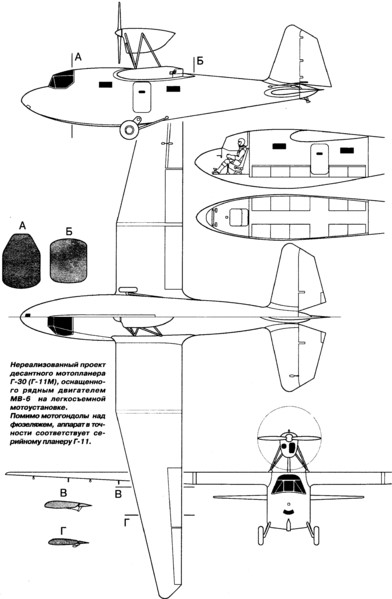
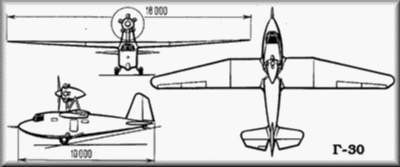
In 1942 Gribovski began development of a motorized version of the G-29 glider with a 100 hp M-11 engine. Two possible variants of the powerplant installation were analyzed: on the nose of the glider or on a pylon on the centroplane. After analyzing the advantages and disadvantages, the second option was finally decided, considering that it could be executed with minimal changes in the production chain.

The moto-glider was named G-11M (G-30 in consecutive Gribovski models) Russian: Грибовский Г-11M (Г-30).

One example was modified in the summer of 1942 at Factory No.471, but it is not clear whether it was ever tested. Maslov states that it was successfully tested in 1942, but other sources such as Shavrov state that it was never tested without explaining reasons. In any case, the need to increase motive power was valued, so the wing installation of two M-11 or MV-6 engines was recommended. In this way the G-30 became a transport airplane.

The decision to produce the model was affected by the cancellation of serial production of the G-11 glider in 1942 itself. On the other hand, the need for a small twin-engine transport aircraft had already been covered by the Scherbakov Sche-2. The VVS did not approve production, so development was abandoned. Other competitors such as the Polikarpov MP or the Moscaliov SAM-22 would have the same fate.

G-30 (G-11M)
Engine: M-11 100 hp
Wingspan: 18.0 m
Wing area: 30.0 m²
Length: 9.71 m
Empty weight: 1500 kg
Loaded weight: 2400 kg
Fuel + oil load: 70 kg
Payload: 830 kg
Wing loading: 80 kg / m²
Power load: 24kg / hp
Surface of the horizontal planes: 5.64 m²
Vertical plane surface: 2.7 m²
Spoiler area: 3.1 m²

Gribovski G-29 / Gr-29

With the beginning of the war the OKB-28 received a new task of creating a landing glider capable of transporting 11 people. The order to begin development of the glider was announced by the NKAP leadership on July 7, 1941. That day, the deputy commissioner for the experimental construction of the NKAP, AS Yakovlev asked Gribovski how long it would take to project the glider. Gribovski, without much thought, replied that two months. Considering the response little serious, Yakovlev asked him to put this commitment in writing and signed.

The first plans for the construction of the G-29 (Russian: Грибовский Г-29) were delivered to the production workshops on July 11 and by August 2 the glider was practically finished. On September 1, with a few days remaining for the two months, the new model, named by the OKB G-29 (Gr-29), was ready for the first flight.

The G-28, also known as the Gr-29, was designed as a landing glider with a monoplane structure with a high cantilever wing and entirely made of wood.

The wing had a box-shaped double spar structure, made of wood. The wing profile used was the R-II. The centroplane had a rectangular shape and the wing consoles were fixed to it with inflection on the leading edge and the straight trailing edge. Wing mechanization included ailerons and flaps, located in the wing soffit and intended to improve landing characteristics. In the upper and lower part of the fuselage there were emergency hatches measuring 0.51×0.46 meters, which could also be used for the defense of the glider.

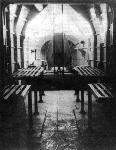
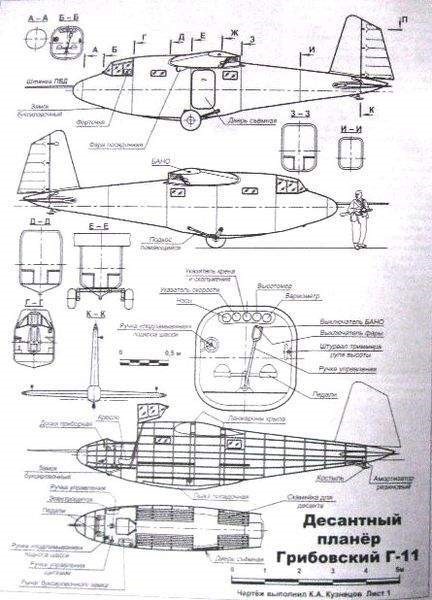
The fuselage was box-shaped with a rectangular cross section. The entire construction had been conceived paying great attention to the simplicity of production and the necessary structural strength. In the central area of the fuselage, there were two master frames to which the centroplane was attached. The cargo cabin, 3.24 meters long and 1.36-1.25 meters wide, featured 1.2 x 0.7 m cargo doors on both sides, as well as two small rectangular windows, which could be opened for operation. shot from them. Wooden benches were placed on both sides of the walls to accommodate the landing troops.

G-11 landing glider transport cabin interior

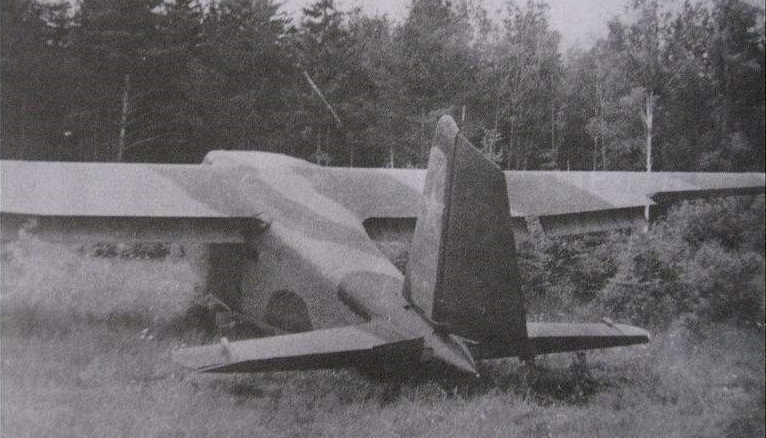
The tail was of the conventional monoplane type with large surface rudders.
The landing gear was a fixed combination type, with 600 x 250mm wheels used during takeoff and a ski on the underside of the fuselage for landings. A crank on the left side of the cockpit allowed the main landers to be retracted for landing. The use of skis significantly decreased the landing roll.

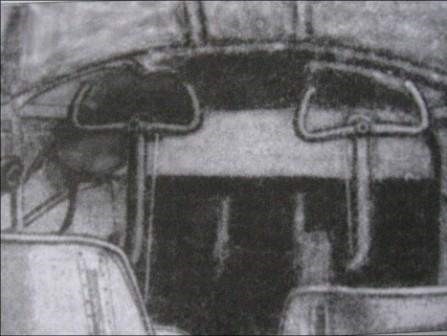
In the nose area there was a single-seater cockpit for the pilot with the steering organs and covered by a transparent lantern that opened up and back, pivoting on a hinge. The cabin equipment was quite austere (a clock, a speedometer, a barometer, an angle indicator and an altimeter).

The first test flight was on 1 of September of 1941 performed by VL Rastorguyev. The good results obtained resulted in the approval of the serial construction of the model in two factories on September 18: number 471 in Shumerlya city and 494 in Kozlovka village.

At the end of September, the military acceptance tests were carried out, which showed totally acceptable results. As a conclusion, a request was made to slightly advance the wings to achieve the necessary centering of the plane once it had been abandoned by the paratroopers.

The tests also showed that with the glider empty and the flaps extended, the tail creaked. This was eliminated by introducing perforations in the flaps.

G-11 glider with flaps extended

The 28 as September as 1941, as soon as they finished the tests, Gribovski traveled to the Factory No.471 and his deputy, Landyshev the Factory No.494. Already on October 18, the first base prototype for production arrived in Shumerlya together with a group of specialists from the OKB-28. By the end of the year, Factory No.471 had finished 10 copies, which soon entered service with the Landing Troops (VDV), receiving the name G-11 (in view of the number of places).

The production of the G-11 was maintained until June 1942, when it was concluded that the military was not prepared for the execution of large landing operations with gliders. The lack of prepared crews in tow and glider pilots was being felt. The absence of conditions for the conservation of these airplanes caused them to be affected by weather conditions, which affected their resistance and reliability.

As a result of this situation the production of the G-11 glider was stopped in 1942 . The OKB-28 collective was reassigned as technical personnel to Factory No.471, which at that time received the mission to start producing the Yakovlev Yak-6. Gribovski was placed at the disposal of the Commissariat for the Aeronautical Industry (NKAP).

In the year of closure of production, Factory No.471 had produced 127 copies (to which must be added the 10 produced in 1941 and the prototype), while Factory 494 delivered 170 copies. Thus, the total number of units produced in this first stage reached 308 copies.

At the end of 1943, the logistical supply needs for guerrilla and combat groups caused the restart of production. This time the Ryazan aviation factory was chosen as the production base. Vladislav Gribovski would be appointed chief builder.

The first G-11 produced in Ryazan was tested in March 1944 by the glider test pilot Lieutenant Chubukov, who even performed spins, inverted flight and barrel roll.

During production various modifications were made. Starting from the standard number 21 on the left side, an increased door 1.4 meters wide with two-leaf opening was introduced. The cargo door located on the right side, present in previous versions, was eliminated. The number of copies produced at this stage, which would last until 1948, is unknown. It is estimated that the total number produced was between 500 and 600 copies.

By the final stage of the war, the VVS leadership had internalized the importance of the gliders in the actions of rapid troop transfer, carrying out surprise attacks on enemy positions, supporting offensive missions and supplying logistics to units. The experiences during the war had not been good, so it was necessary at high speed to start working on the preparation of glider crews and the development of preparation exercises in this type of operations.

Dual control cockpit

As of October 1944, the manufacture of landing gliders equipped with dual flight control, a landing ski suspension system and structural reinforcements would begin in Ryazan. This version would be renamed G-11U.

Production of the G-11U version was closed in mid- 1945, but a little less than a year later it would be resumed, remaining until 1948.

In 1942 Gribovski proposed to develop on the basis of the G-11 a motor glider with an M-11 engine, which would eventually be produced in prototype form under the company name G-30, although it was also known as G-11M.

The landing actions carried out in the USSR during the war were scarce and in some cases catastrophic. The main use of gliders was restricted to specific supply operations, fundamentally to guerrilla groups and the transport of small sabotage units, which operated in the enemy rear.

Perhaps the most brilliant performance of the landing gliders took place in 1943 when they were used in supplying the Belarusian guerrillas in the Minsk region. The gliders were prepared to transport fuel, weapons and ammunition, including those for cannons.

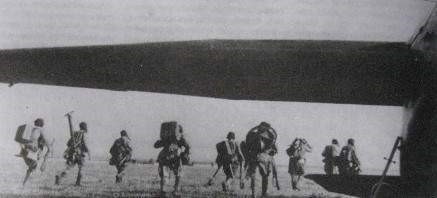
Landing troops board the G-11

The glider launch operation over Belarus was kept a great secret, so for the Germans it was totally unexpected. This operation was directed by the headquarters of the Air Landing Troops (VBV) and its development was personally followed by Stalin.

It was planned to be executed at night. Ilyushin DB-3F and Lisunov Li-2 towed Moscaliov and Gribovski gliders in pairs, releasing about 50 to 60 km from the target. The guerrillas had prepared surfaces for the landing and at the agreed time they lit bonfires as signalling. This operation was successful and allowed the Belarusian partisans to achieve significant successes against the fascist groups.

A G-11 glider prepares to be towed by an Ilyushin Il-4.

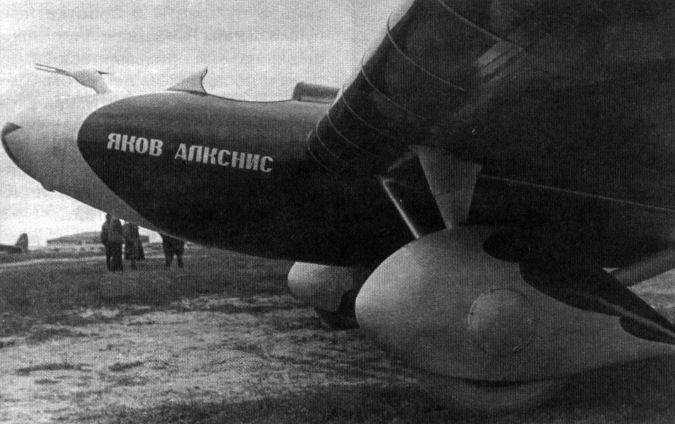
The aeronautical designers OK Antonov, AS Moscaliov and VK Gribovski received the 2nd rank “Guerrilla of the Great Patriotic War” medal for their contributions to the partisans, which was one of the few exceptions for the delivery of this medal to personnel from the deep rear.

The G-11 gliders were also used on a small scale during the crossing of the Dnieper, carrying guns and mortars from one shore to the other. Another notable action was the creation of a supply bridge between Moscow and Stalingrad in November 1942 to carry deicing fluids for Soviet tanks, which were preparing for the offensive.

Versions:

G-29 (G-11)
Original version as a transport glider from 1941 with capacity for 11 people and a rectangular section fuselage. Built 308 copies in factories 471 in Shumerlya city and 494 in Kozlovka village.

G-11U
1944 training version with dual controls, structural reinforcements and changes to the landing gear. The quantity produced is unknown.

G-30 (G-11M)
Motorized version of the G-29 with M-11 powerplant. A prototype was built in 1942. With the closure of production in 1942 the development would be abandoned.

Specifications
G-11
Wingspan: 18.00 m
Wing area: 30.00 m²
Length: 9.71m
Height: 2.7 m
Empty weight: 1250 kg
Maximum takeoff weight: 2400 kg
Wing loading: 83 kg / m²
Payload: 10 equipped soldiers or 1200 kg
Surface of the horizontal planes: 5.64 m²
Vertical plane surface: 2.7 m²
Spoiler area: 3.1 m²
Maximum towed speed: 370 km / h
Maximum planing speed: 146 km / h
Glide ratio: 16
Accommodation: 1

Gribovski, Vladislav Konstantinovich

Glider and airplane builder

1939

Vladislav Konstantinovich Gribovski (Russian: Владислав Константинович Грибовский) was born on September 7, 1899 in Saint Petersburg. Soon his parents died and Gribovski was forced to enter an orphanage in Gatchina where he would receive high school education. In 1909 during an excursion he visited the local airfield and according to his own statement, from that moment he fell in love with aviation. From an early age he began to read all the materials he found on aviation, made a series of model airplanes and helped the mechanics at the airfield. In 1919 he would leave the orphanage, joining the Red Army. He tried to enter the aviation school, but did not succeed, being assigned to the artillery courses in Petrograd. As part of a group of cadets from the school he would participate in combat against Yudenish, being wounded. In the fall of 1920 he was promoted to commander in the Second Moscow Artillery Brigade.

In 1921, he was finally able to enter the Yegorevsk Aviation Theoretical School. He would continue his pilot studies at the Kacha (Sevastopol) and Moscow (VAShL) flight schools in 1923. In 1924 he passed the Higher School of Aerial Shooting and Bombing in Serpukhov. In this way, in just three years, he passed the entire program of preparation courses and became a fighter pilot. Upon graduation in 1924 Gribovski would be assigned to serve in the 3rd Fighter Squadron based in Kiev.

VK Gribovski began flying gliders practically from the moment he joined the unit in Kiev.

In 1924 in Kiev he designed his first glider, the G-1. This aircraft was included in the list of competitors of the III National Sailing Competitions in Koktebel. After some short test flights, the 22 of September of 1925 the G-1 was hit by a gust of wind that destroyed land.

In 1924 he participated in the II National Sailing Competitions in Koktebel and was one of the first pilots who managed to keep his glider in horizontal flight for some time. In these tests, the category of pilot-planerista was established, which was reached after achieving 5 flights with a total duration of 60 seconds of which, at least one, had to exceed 30 seconds. The title of “paritiel” pilot or thermal exploiter was received by those who managed to keep their glider in flight without losing altitude for 3 minutes.

In the II National Competitions of 1924 Artseúlov, Gribovski, Zernov, Kalan, Kravtsov, Rudzig, Seregeyev, Tarasov and Yakovchuk received the title of pilots “paritiel”.

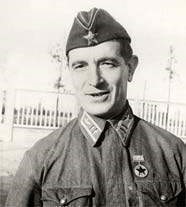
VK Gribovski.

Gribovski became an instructor at the Serpukhov Flight School in 1927. In the workshops of this institution he would build his second glider, which was launched as G-2 in 1927. The G-2 would fly with great success in the IV, V and VI National Sailing Competitions, becoming one of the main Soviet training gliders in those early years.

In parallel with the G-2, Gribovski designed in 1926 a 4-seater transport glider that received the designation G-3 and was not approved. The G-4 was a never-completed project for a low-power Bristol Cherub-powered light aircraft, designed in conjunction with AB Yumashiev. Its construction also began in 1926 in the workshops of the Serpukhov Flight School. Following the transfer of the flight school to Orenburg, Gribovski would successfully build and fly the G-5 light aircraft.

The G-6 (1928) and G-7 (1929) gliders were also built in Orenburg. The G-7 was one of the best gliders among the participants in the VI National Sailing Competitions. In this glider, the renowned pilot VA Stepanchonok set the Soviet record for flight duration by staying in the air for more than 10 hours.

At the beginning of 1930 Gribovski was appointed head of the OSOVIAJIM Flight School in Moscow. Based on his initiative, the famous Túshino aerodrome was built and the OSOVIAJIM Central Aeroclub was created on the basis of the school. Towing tests of Gribovski’s G-2bis glider were carried out in the autumn of 1931 in Túshino and from their results the G-9 towed glider was built, which was manufactured in series and became one of the main training gliders. of the USSR in the pre-war period.

In 1931, in the workshops of the OSOVIA Flight School, Jim Gribovski would build the excellent G-8 light single-seater training aircraft. This small plane with a takeoff weight of only 483 kg and a 60 hp engine reached a speed of 150 km / h and a flight height of 3000 meters. In the autumn of 1932 the G-8 was used by the pilot D. Koshits to carry out a flight that covered a dozen cities in the USSR, covering a total of 4,500 km.

In 1932 Gribovski began working at the Bureau of Construction of Moscow (MKB) of OSOVIAJIM and a year later would steer. The MKB was financed from donation funds and was located in an apartment in the basements of building No19 on Sadovo-Spaskaya Street in Moscow. In addition to the MKB, the founders of the GIRD – creators of the first Soviet rockets – were also located in this basement. Currently at the entrance is a memorial plaque.

Under Gribovski’s direction, the G-512 and G-16 hydro-gliders were built. In the latter, for the first time in the USSR, a takeoff was made from the water in a glider, towed by a Shavrov Sh-2. Another interesting example was the G-14 towed glider, used for different tow tests. The G-14TsL-2A tanker glider was built on the basis of this model in the “Aviajim” factory for the first time in the world, conceived for long-distance flights from the refueling of the tow plane from the glider itself.

Also noteworthy are the G-15 light tourist aircraft and the G-22 and G-23 single – seaters. In the G-22 the pilot Ye. Miednikov set a world speed record in its category in July 1938 by reaching 165 km / h and pilot I. Grodzyanski in the G-23 set a height record of 7266 meters.

Among light Gribovski models include the G-20 in 1935. With a 100 hp M-11 engine this light aircraft reached 210 km / h and a ceiling of 4000 meters. In 1937, after the installation of a more powerful 150 hp engine, the pilots of the aero club began to perform high school acrobatics on this airplane.

In 1938 on the basis of the MKB OSOVIAJIM and the glider factory, the Experimental Department (Opitni Otdiel – OO) was created under the leadership of Gribovski. Its latest models for OSOVIAJIM were built in this department: the G-26 fast plane and the G-27 twin – engine trainer . This latest model was designed as a crew trainer for the newly introduced Túpolev SB and Ilyushin DB-3 bombers. Although the G-27 in weight did not exceed the Polikarpov U-2, it introduced a two-seater cabin for the pilots and a glass nose for the navigator. This aircraft presented excellent performance but was too demanding in piloting, so it was not considered suitable for teaching. The builders proposed to improve it, but this was never realized. At the beginning of 1939 the glider factory was closed.

VK Gribovski with the G-26 light aircraft during testing.

The Glider Factory of the OSOVIAJIM, in which the Gribovski models were built, was closed in March 1939 and its facilities transferred to Professor Lievkov, who would build air-cushioned aircraft there. The experimental department was dissolved and Gribovski went into the reserve of the Aviation Directorate of the Union of Defense and Aviation Assistance Societies-Chemical Construction of the USSR (OSOVIAJIM). Through his own efforts, Gribovski managed to be transferred to the system of the Commissariat of the Aeronautical Industry (NKAP). Initially, in December 1939, a new Construction Bureau was created as a subsidiary of Factory No.301. This new organization was based on a garage under construction belonging to the “Mosvoyentorg” located in the Pavshino village, belonging to the Moscow suburbs.In March 1940 Gribovski was appointed to command the newly created OKB-28 and by May 22 of next year the Gr-28 “Krechet” (TI-28) training fighter had been created under his leadership. The cockpit of this trainer had been configured to allow training in day and night flight. The TI-28 featured a synchronized ShKAS machine gun, a photo-machine gun and a collimator for aiming. Under the wings it could carry training bombs of up to 40 kg. The beginning of the war prevented its production.

With the start of the war the OKB was tasked with building an 11-seater landing glider. To carry out this task, Gribovski asked only 2 months. AS Yakovlev thought the answer was not serious and asked the builder to put this in writing. Work on the new glider, known as Gr-29 (serially as G-11), began on July 7 and its maiden flight was made on September 2. After a week of test flights, its series production was decided. This model was produced until June 1942.

When the production of the G-11 ceased in 1942, the OKB-28 collective was integrated into the technical staff of Factory No. 471, re-destined to produce the Yakovlev Yak-6. Gribovski was placed at the disposal of the Commissariat for the Aviation Industry.

For the invaluable contribution of his planners in the tasks of support to the guerrilla groups of Belarus, Vladislav Cheranovski was one of the few Soviet servicemen in the rear to be awarded the 2nd rank “Guerrilla of the Patriotic War” medal.

In 1943, production of the G-11 was re – established in Ryazan, where Gribovski was appointed chief builder and factory manager. The production of this model was maintained until 1948 in different versions.

In these years Gribovski would work on the development of an improved version of the G-11 glider, which, called G-31, was not approved because priority was given to the Moscaliov SAM-28 (which would not be produced either).

In 1946 he would work on the 3 and 6 ton transport glider projects that would not be built either. A year later Gribovski would be tasked with designing a two-seater training glider with spacious cabins located in tandem. Two specimens were produced that began to fly in the spring of 1948. The dissolution of Gribovski’s KB prevented further work.

In 1948 Gribovski would present a new design for a primary training two-seater aircraft with tandem seats and a 90 hp M-10 engine, conceived to participate in the light aircraft competition promoted by DOSAV. This would be his last “official” job. In 1948 his KB had been disintegrated as part of the process of reorganization and contraction of the aeronautical industry.

After the liquidation of the Construction Bureau (KB) in 1948, Gribovski received proposals to go on to work in the Scientific-Technical Committee of the VVS, to dedicate himself to the development of aeronautical technology. Declining this proposal, he requested his retirement from the ranks of the Red Army, passing to the reserve with the military rank of colonel.

In later years he would participate in various sports glider projection competitions and would work on sports boat design, photography and painting.

Vladislav Konstantinovich Gribovski designed 20 gliders and 14 airplanes between 1925 and 1948, not counting the unrealized or finished projects. Virtually all of his designs were successful and some of his gliders were mass-built. Their small collective included specialists including VV Abramov and BK Landyshev.

It should be noted that despite his activity as an aeronautical constructor, Vladislav Gribovski flew actively. He was generally the first to test his designs in flight. He personally participated in various aviation competitions, public demonstrations and propaganda flights.

Most of his designs, built basically in wood, were characterized by their simplicity. For this same reason, their models did not stand out for their performance, but in all cases they were characterized by their robustness and ease of maintenance.

Gribovski was a great defender of the airplane accessible to anyone and fought for the development of sports and tourist aviation.

The pilot and aeronautical constructor Vladislav Gribovski passed away in 1977.

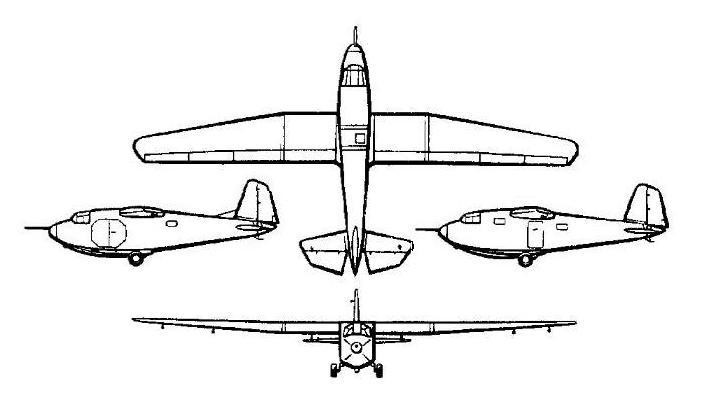
Gribowski G-11

Shortly after the German attack in 1941, the Soviet headquarters realized a need for transport gliders and ordered the development of several designs. Vladimir Gribovski agreed to design a light glider in two months and the tests of a prototype started on 1 September 1941. Given the Gribovsky designation G-29, it was accepted for production under the VVS designation G-11 (for Gribovski, 11-men including pilot).

G-11s were produced from late 1941 until mid-1942 in two factories: 138 were built in Shumerlya (factory no. 471) and 170 in Kozlovka village (factory no. 494), for a total of 308. Production restarted in 1944 at Ryazan remaining in production until 1948. From October 1944 the G-11U training glider with twin controls was also in production. There are no data for a total production number, but it is estimated that 500-600 were eventually completed.
A powered version designated G-11M by the VVS (Gribovsky designation G-30) had a M-11 radial engine mounted above the fuselage. It was tested from the Summer of 1942 but did not enter production.
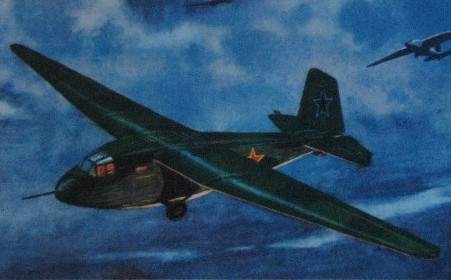
Design

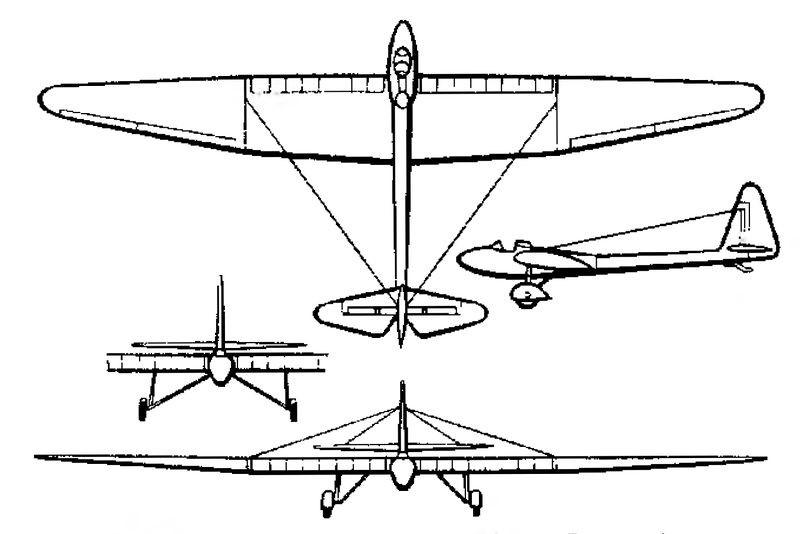
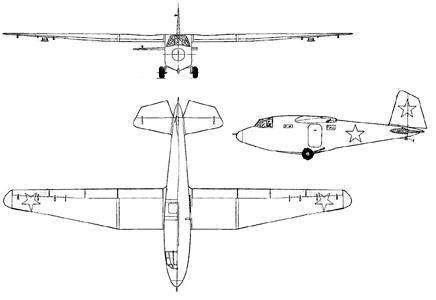
The G-11 was a high-wing, all-wooden construction, plywood-covered transport glider. The fuselage was rectangular in cross-section with a single-seat cockpit in the nose, accessed by an upward opening canopy. Behind the cockpit was the 3.24 m × 1.25 m × 1.36 m (10.6 ft × 4.1 ft × 4.5 ft) cargo hold / passenger cabin. There were two 1.2 m × 0.7 m (3.9 ft × 2.3 ft) doors on opposite fuselage sides. Later series had only one 1.4 m × 0.7 m (4.6 ft × 2.3 ft) hatch on the left side. Troops sat on folding benches along the sides, lit by two small rectangular windows on each side. Wings were three-part, fitted with flaps for landing and the landing gear was fixed, but could be folded by the pilot in order to shorten the landing, using the main fuselage skid for landing.
Operational history

G-11s, along with the Antonov A-7 constituted a majority of Soviet transport gliders. They were mainly used from mid-1942 for supplying Soviet partisans with provisions, weapons, equipment and trained men, towed mainly by SB or DB-3 bombers. Most intensive use was from March to November 1943 in Belarus, in the Polotsk-Begoml-Lepel area, on the Kalinin Front. Several hundred Soviet gliders (of all types) were used in night supply flights there. After landing, the gliders were destroyed and pilots were sometimes returned by aircraft. The only known instance of a glider returning from the field occurred in April 1943, when a famous glider and test pilot Sergei Anokhin evacuated two wounded partisan commanders in a G-11, towed by a Tupolev SB bomber, piloted by Yuriy Zhelutov, on a 10 m (33 ft) short towrope.

Gliders were also used to supply partisans in some areas in 1944 and to transport sabotage groups behind enemy lines. G-11 gliders were also used in at least one small-scale airborne operation, the Dnepr crossing, carrying anti-tank guns and mortars.

A less typical action was an airbridge from Moscow to the Stalingrad area in November 1942, to rapidly deliver anti-freeze coolant for tanks, during the battle of Stalingrad.

The G-11 enjoyed relative success as a light transport glider design, having more capacity than the Antonov A-7, and its transport compartment was a better fit for cargo, although light guns could only be carried in parts due to small hatches.

Wingspan: 18 m (59 ft 1 in)
Length: 9.8 m (32 ft 2 in)
Height: 2.7 m (8 ft 10 in)
Wing area: 30 m2 (320 sq ft)
Empty weight: 1,200 kg (2,646 lb)
Gross weight: 2,400 kg (5,291 lb)
Never exceed speed: 280 km/h (170 mph, 150 kn) (aerotow)
Aerotow speed: 146 km/h (91 mph; 79 kn)
Rate of sink: 2.2 m/s (430 ft/min)
Lift-to-drag: 16:1
Wing loading: 83 kg/m2 (17 lb/sq ft)
Crew: 1
Capacity: 10 troops or cargo / 1,200 kg (2,646 lb)

Greenleaf CT-6A / Plxweve CT-6A / Player CT-6A

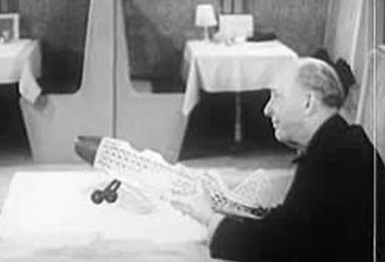
The Greenleaf CT-6A NX19994 was thought of during a meeting at the airport’s restaurant. Designed in 1940 by W E Player.

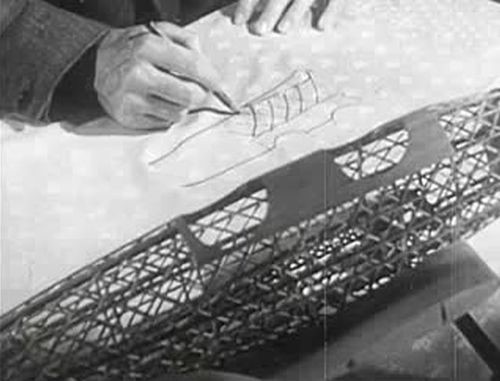
A wooden study.

Professor Blake with the model kit

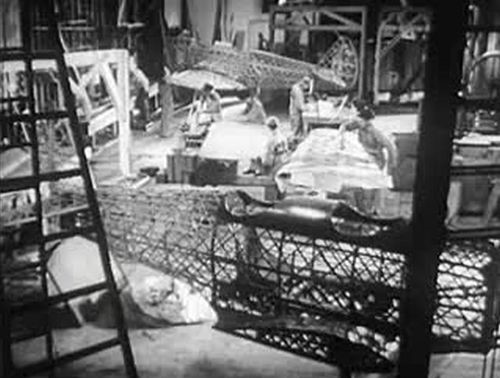
Then the aircraft was built. An all-wood, geodetic construction. All of the wood to make one plane cost $23.00 (in 1940 dollars), the jigs and forms added another $10.20.
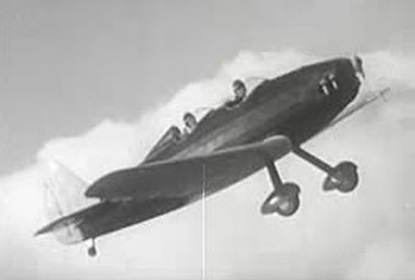
Greenleaf CT-6A (c/n 1), Reg. NX19994.

The original motor was a Dayton (Ford Model A), powering NX19994 c/n 1.

Greenleaf CT-6A (c/n 1), Reg. NX19994.

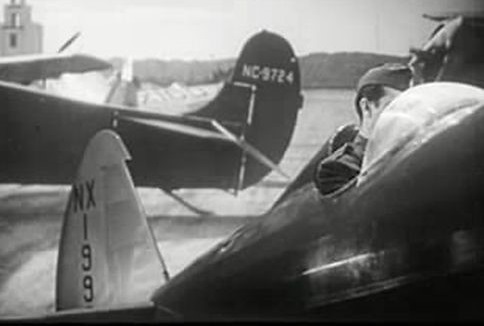
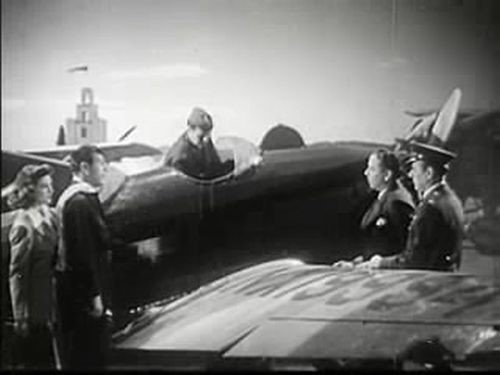
It appeared in several motion pictures.

It was rebuilt in 1960.

Gallery

CT-6A Plxweve
Engine: 75hp Continental A-75
Wingspan: 29’0″
Length: 20’6″
Useful load: 528 lb
Max speed: 130 mph
Cruise: 120 mph
Stall: 47 mph
Range: 350 mi
Ceiling: 17,500′
Seats:2