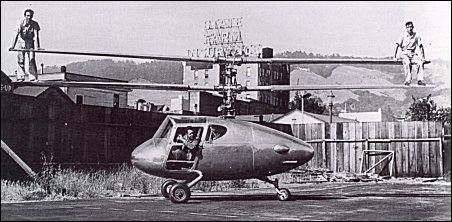
Hiller X-2-235 / UH-1X

Work had begun in October 1944 on three Hiller X-2-235’s, two-place metal-clad successors to the XH-44, each powered by a 235hp Lycoming engine. Whereas the XH-44 was the world’s first successful rigid-rotor helicopter, the X-2-235 featured super-rigid rotors. This unprecedented degree of rigidity was provided to ensure that the opposite-turning rotors would never touch during even the most violent maneuvering. As built, the blades could support a person standing at the tip without noticeable deflection. Ground tests of the first example began in the summer of 1945 at the Old Berkeley Armory.
Although no specific military requirement yet existed for such a machine, the X-2-235 was intended primarily for U.S. Navy use in the light utility, observation, and training roles. The Navy did not actually order the type, but it did procure the third uncompleted X-2-235 under the designation UH-1X, for evaluation in NACA wind tunnels at Langley Field, Virginia. Vibration problems curtailed these tests for fear of damaging the wind tunnel, but not before results vindicated the Hiller group’s belief that super-rigid coaxial rotors were a valid approach to very highspeed helicopter flight.
The UH-1X, Hiller’s first military contract, clearly ran counter to normal aircraft engineering, but then the team building it had experience only in designing ships, bridges, and similar beefy structures. The lack of even a single aeronautical engineer on Hiller’s payroll to introduce that field’s antipathy to heavy structures was, ironically, an advantage in the uncharted terrain being explored.
As a result of the NACA tests, Hiller initiated redesign of the X-2-235 to incorporate three-bladed coaxial rotors augmented by an aft-thrusting rear propeller. The reworked craft was obviously geared to flight at speeds substantially higher than those attained by existing helicopters. Main wheels retracting into sleek wing stubs further confirmed this supposition. The X-2-235s themselves had progressed to tethered flight.
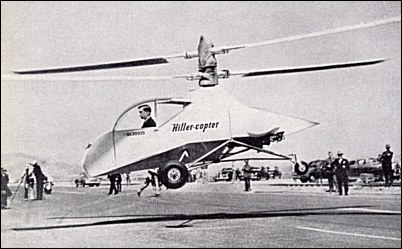
Hiller XH-44

Stanley Hiller flew the first successful American co-axial helicopter, the XH-44, in July 1944, when he was only 19 years old. It also featured the world’s first successful all-metal rigid-rotor blades. Hiller had learned to fly from his father at an early age, and at 16, Hiller had started a business building small gasoline engine model cars; revenue eventually grew to $100,000. Hiller became interested in helicopters in 1937 when he saw pictures of the Focke Wulf Fw 61 and Sikorsky’s VS-300 in 1939. Hiller felt the tail rotors used on the VS-300 and the outriggers on the Fw 61 were wasteful and possibly unnecessary. The XH-44 evaluated three different rotor configurations: rigid, articulated, and semi-rigid, which was selected. The engine was uprated from a 90hp Franklin to a 125hp Lycoming. The XH-44 was the first successful helicopter west of New York, and Hiller made public demonstrations of the XH-44 in nearby San Francisco.

Hiller

Hiller Industries
Hiller Helicopters
Hiller Aviation
Rogerson Hiller Corporation
Hiller Aircraft Corporation

Hiller Helicopters Inc. was formed in 1942 for the development and production of rotary-wing aircraft. Early work on the Hiller Model XH-44, UH-4 Commuter and the UH-5, which introduced a newly-developed ‘Rotor-Matic’ rotor control system, led to the Hiller Model 360 prototype.
Stanley Hiller flew the first successful American co-axial helicopter, the XH-44, in July 1944, when he was only 19 years old. It also featured the world’s first successful all-metal rigid-rotor blades. Hiller had learned to fly from his father at an early age, and at 16, Hiller had started a business building small gasoline engine model cars; revenue eventually grew to $100,000. Hiller became interested in helicopters in 1937 when he saw pictures of the Focke Wulf Fw 61 and Sikorsky’s VS-300 in 1939. Hiller felt the tail rotors used on the VS-300 and the outriggers on the Fw 61 were wasteful and possibly unnecessary.
Formed 1942 as a division of Hiller Industries. Name changed to Hiller Helicopters in 1948.

In 1948 Hiller Helicopters produced the Hiller UH-12, subsequently supplying it to civilian operators and, as the H- 23B and OH-23C/D Raven, to the U.S. Army and to foreign air arms under the MDAP program . Three-seat UH-12E (first flown 1958) and four-seat UH-12E4 variants also developed. The Hiller HOE-1 Hornet ramjet ultralight helicopter and “Flying Platform” were two military experimental types devised by the company.

In 1964 Fairchild-Stratos Corp purchased Hiller Aircraft with cash, not stock transactions. Hiller capabilities fitted into one of Fairchild’s primary goals – vertical takeoff and landing aircraft. The Hiller plant was to remain in Palo Alto.

Fairchild Stratos Corporation acquired Hiller in 1964, hence the FH designations, believing they were about to secure a large military contract as the OH-5A stood out the preferred winner. Leaked production data of the OH-5A resulted in Howard Hughes successfully under bidding with the OH-6A. Fairchild meanwhile announced they would begin civilian helicopter production of a refined OH-5A, designated the FH1100.
Hiller Aviation Inc was formed in 1973 after acquiring the design rights, tooling and spares for Hiller 12E light helicopters from Fairchild Industries. The company provided support for operators of Hiller helicopters and produced three-seat UH- 12E and four-seat UH-12E-4 turbine conversions of the UH-12E, developed in conjunction with Soloy Conversions. Also introduced former Fairchild Hiller FH-1100 in 1984 (later as RH-1100). Became subsidiary of Rogerson Aircraft in 1984, reviving first the name Hiller Helicopters and later becoming Rogerson Hiller Corporation.

Hiller Aircraft Corporation was founded 1994 by Jeffrey Hiller (son of the founder of the original Hiller Aircraft company) and a consortium, to repurchase assets from Rogerson Hiller Corporation. First flight January 1995 of the UH-12E5 five-seat helicopter, and June 1995 for first newly built UH-12E3.

1995: 2140 West 18th St, Port Angeles, Washington 98362, USA.

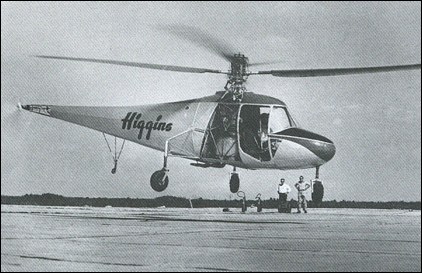
Higgins EB-1

In 1942 an Aircraft Division was formed in Higgins Industries Inc, owned by Andrew Higgins, with the object of manufacturing transport aircraft for the United States Air Force.
There was also a Helicopter Division concerned with building and perfecting a helicopter designed by Enea Bossi.
This small two-seater helicopter had a main four-bladed rotor, consisting of two two-bladed rotors a few inches apart, and a small two-bladed tail rotor. The latter was fixed to the end of the upward-rising tail so that the tail rotor hub was at approximately the same level as the main rotor.
The two-place, side-by-side cabin interior was designed to resemble as closely as possible that of a lightweight aircraft with a wheel control column and a standard panel of flying instruments.
The fuselage is entirely covered, has a forward section with metallic skin, while the tail is covered with fabric.
There is a small, two-bladed, vertical tail rotor and a fixed tricycle landing gear. The pitch-control and clutch-control levers look much like the gearshift on a car. The rudder pedals resemble brake and clutch pedals of an automobile.

EB-1
Engine: 1 x Warner, 190hp
Rotor diameter: 9.75m
Weight fully loaded: 1155kg
Empty weight: 885kg
Cruising speed: 200km/h
Seats: 2

Higgins

In 1942 an Aircraft Division was formed in Higgins Industries Inc, owned by Andrew Higgins, with the object of manufacturing transport aircraft for the United States Air Force.
There was also a Helicopter Division concerned with building and perfecting a helicopter designed by Enea Bossi.

Hidemasa MXY8 Akikusa

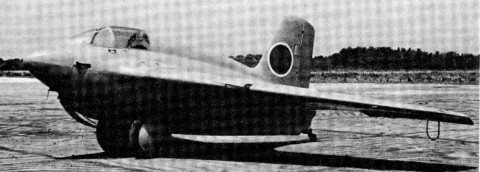
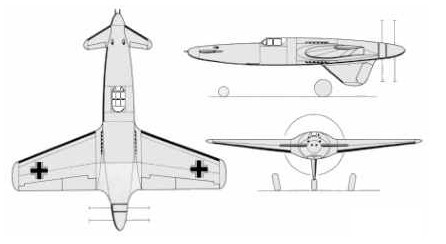
When developing the Mitsubishi J8M1 (Me-163 copy) the Japanese were unfamiliar with the handling characteristics of aircraft lacking a conventional horizontal tail. To provide a means of expediting the training of pilots eventually to be assigned to the rocket-driven fighter, the Scientific Division of the Navy Air Technical Arsenal at Yokosuka had been assigned the task of creating a full-scale wooden glider version of the Shusui. While definitive design work and prototype construction proceeded at Nagoya, Hidemasa Kimura who had been responsible for the Tachikawa-built A-2600 that had created a new international closed-circuit distance record developed the glider which was known as the MXY8 Akikusa (Autumn Grass). This was flown for the first time at the Hyakurigahara airfield, the base of the 312th Naval Air Group which, it had been decided, would be the first recipient of the Shusui. This event took place on 8 December, its pilot being Lt Cdr Toyohiko Inuzuka who had taken the place of Lt Cdr One as the project test pilot after the latter had been taken ill. The Akikusa glider was towed into the air by a Kyushu K10W1 and its handling characteris¬tics received a highly favourable report from Jnuzuka. The second Akikusa was sent to the Army Aerotechnical Research Institute, the Rikugun Kokugijutsu Kenkyujo, at Tachikawa where it was tested by Col Aramaki with similarly successful results.
On 1 December, the completed structural test specimen was inspected and approved by both services, but a week later, on 7 December, the Tokai district, in which Nagoya was situated, was wracked by strong earth tremors and the airframe, which was undergoing loading tests, was overstressed and suffered distortion, On 18 December, the Ohe plant in which the “heavy gliders” were being built suffered a heavy attack from B-29 Superfortresses and it was decided to transfer the salvaged airframes, together with the structural test specimen, to a plant that had been created in a mountain cave at Taura, Yokosuka, although the Ohe plant continued, together with the Nanko plant, to build a number of pre-series Shusui interceptors. Despite these setbacks, the first “heavy glider” Shusui was test flown by Lt Cdr Inuzuka at Hyakürigahara airfield on 8 January 1945, after being towed into the air by a Nakajima B6N1 Tenzan attack bomber.
For the initial flight, the engineless Shusui weighed 2,286 lb (1037 kg) and the Cl was situated at 16.8 per cent of the aerodynamic mean chord, Inuzuka confirming that there was no difference between the handling characteristics of this “heavy glider” and the Akikusa apart from a minor change of trim at take-off. During subsequent flights, some devon vibration was experienced at gliding speeds in excess of 184 mph (296 km/h) but this was eradicated when the gap between the wing and elevon was reduced and the Frise balance near the devon tip shortened. Various problems were encountered in the oil pressure system, but these were quickly resolved and in March all Navy flight testing of the “heavy glider” was to be pronounced satisfactorily completed. The second “heavy glider” was tested by the Navy at the Kashiwa airfield, Chiba, and this was eventually to be tested also by the Army. These tests were not to commence until August, and at an early stage in the trials, the Shusui parted company with its towplane prematurely and crashed in a pine forest, its pilot suffering injuries.

HIBM / Ikmal Hava ve Bakim Merkezi

Turkish aircraft in the true sense began only after the founding of the Republic in 1923. A small delegation was dispatched to Europe to procure aircraft for the new Turkish Air Force. After evaluation it was decided to obtain 16 Bréguet XIV A-2, 39 Caudron C-27 and 32 Caudron C-59 aircraft. These aircraft were dismantled in 1924 and shipped to the Gaziemir / Izmir Air Force Base under French supervision. After the first requirements of the Turkish Air Force, the armed force withdrew from the assembly of planes however, this plan did not last long. When in the course of technical development, the maintenance became more complicated and more complex, the maintenance facilities of these forces were again entrusted with the manufacture of spare parts or installation or modernization of aircraft. So the 1st Air Supply and Maintenance Center emerged (1 Ikmal Hava ve Bakim Merkezi, 1.HIBM) in Eskisehir (1926), the 901 Home Depot and production plant for aircraft (the 901.Hava Araci Ana Depo ve Fabrika Komutanligi, nine hundred and first HAADFK) in Polatlı (1948, 1962 in Ankara) and the 2nd Air Supply and Maintenance Center (2nd Hava Ikmal ve Bakim Merkezi, 2.HIBM) in Kayseri (1950).

Henschel Hs P.75

This 1941 aircraft design was to be a possible successor to the Messerschmitt Bf 110 heavy fighter. Although of a unusual configuration for that time, there were advantages (and disadvantages) to its rear wing/forward canard construction.
The Hs P.75 featured a tapered fuselage, with the slightly swept-back wings being mounted mid-fuselage and set back to the rear of the aircraft. The widened fuselage was designed to house the Daimler Benz DB 610 engine, which were two DB 605 engines joined side-by-side, just aft of the cockpit. These were the same engines that the Heinkel He 177 used, and were found to be prone to overheating and catching fire.Due to this development, they were changed in 1942 to the liquid-cooled, 24 cylinder Daimler Benz DB 613 engines (two coupled DB 603s) that produced 3500 horsepower. Both engine configurations were to drive contrarotating propellers (to offset tourque) of a 3.2m (10′ 6″) diameter via an extension shaft. There were a pair of swept-back canards located on the nose of the aircraft, that were to serve the purpose of elevators. The vertical tail unit was mounted beneath the fuselage, so that it could act as a tail bumper upon takeoff so that the propellers would not strike the ground. Since the propellers were located at the rear in a pusher configuration, a tricycle landing gear arrangement was chosen. Fuel was contained in three tanks, one in each wing and one behind the cockpit. A single pilot sat in the cockpit which was located about midway along the fuselage, and four Mk 108 30mm cannons were mounted in the nose.
The advantages of the pusher propeller/forward canard design was that it opened up the pilot’s view, plus the weapons installation was much simplified and could be concentrated. The disadvantages would be engine cooling plus an ejection system or propeller jettison would have to be designed for the pilot to safely exit the plane in case of an emergency.

Henschel Hs P.75 Data
Span: 11.3 m / 37 ft 1 in
Length: 12.2 m / 40 ft 0 in
Height: 4.3 m / 14 ft 1 in
Wing Area: 28.4 sq.m / 305.7 sq.ft
Max Weight 7500 kg / 16535 lb
Wing Loading: 264 kg/sq.m / 54 lbs/sq.ft
Ceiling: 12000 m / 39370′
Max. Speed: 790 km/h / 491 mph

Henschel Hs 132

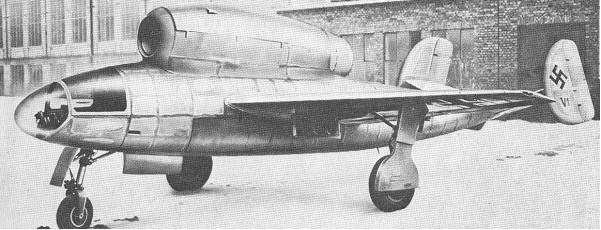
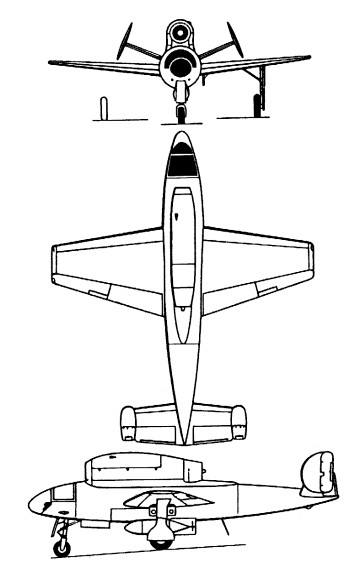
During the last half of 1943 experience showed that losses during convention¬al dive bombing with the Junkers Ju 87 were becoming prohibi¬tive without heavy fighter escort, parti¬cularly in the face of Soviet air presence on the Eastern Front. The Henschel company, with considerable experience in produc¬ing ground support aircraft, put for¬ward late in 1944 proposals for an essentially simple single jet attack bomber with a BMW 109 003E 2 tur¬bojet mounted above the fuselage. In essence the aircraft resembled the Heinkel He 162 with twin fins and rud¬ders, although the sharply tapered wing was mounted at mid fuselage depth; more significant, the pilot occu¬pied a prone position in the extreme nose so as to withstand the likely 12g forces expected to accompany shal¬low dive recovery. Simplified con¬struction with widespread use of wood in the structure was welcomed by the RLM and three prototypes were ordered, and commenced building in March 1945.

Only the Henschel Hs 132 VI powered by a 1,760 lb thrust BMW 003 engine had been completed (but not flown) by the war’s end, and all three aircraft were taken over by the Soviet forces in their advance from the east.

The first aircraft was to have carried a single 500 kg (1,102 1b) bomb recessed into the under-fuselage; the second, with Jumo 004 900 kg (1,984 1b) thrust engine com¬bined this load with two nose mounted 20 mm MG 151 cannon; and the third, with 1300 kg (2,866 1b) thrust Heinkel¬-Hirth 109 011A turbojet would carry a 1000 kg (2,205 1b) bomb, two 30 mm MK 103 and two 20 mm MG 151 guns. It was intended that the PC 1000RS Pol rocket assisted armour piercing bomb would be used for battlefield support attacks.

Hs 132 V1
Engine: one 800 kg (1,764 1b) thrust BMW 109 003E 2 turbojet.
Wingspan 7.20 m (23 ft 7.5 in)
Wing area 14.82 sq.m (159.4 sq.ft)
Length 8.90 m (29 ft 2.5 in)
Height 9ft 10 in
Maximum speed 780 kph (485 mph) at 6000 m (19,685 ft);
Service ceiling 10250 m (33,630 ft)
Range 680 km (423 miles)
Maximum take off weight 3400 kg (7,496 lb)
Armament: one 500 kg (1,102 lb) bomb under the fuselage.

Henschel Hs 130

A high-altitude reconnaissance bomber, developed from the Hs 128, the A-06 and A-07 pre-series aircraft had a wing span of 29m, and turbosupercharged DB 605 engines. They could reach 15500m.

The Hs 130E-0 was powered by two 1750 hp Daimler-Benz DB 603A engines, which were supplied with air by a compressor, driven by a 1475 hp DB 605T. This configuration was known as ‘HZ Anlage’. This aircraft was capable of attaining 16,500 m / 54,000 ft.

Five HS 130 pre-production E-0s and probably three E-1 production aircraft were completed before 1944 when the programme was cancelled.

One E-1, W.Nr.130082 BD+KA, was tested by a crew from the Versuchsverband at the Henschel plant at Berlin-Schonefeld late in 1944, but crashed on 17 December 1944 killing all on board.