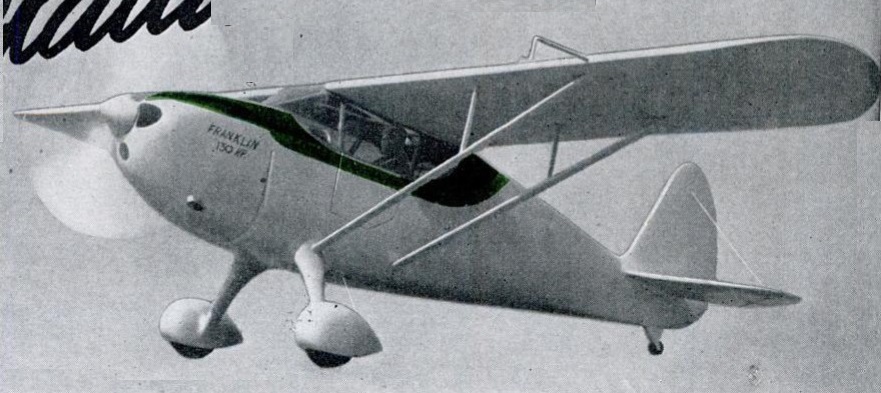
Design work on the CV-139 Comet two-seat high-wing cabin monoplane, but was suspended in 1940 to make way for military contract work for other aircraft companies. The project was resumed in 1944, when the sole prototype was test flown.
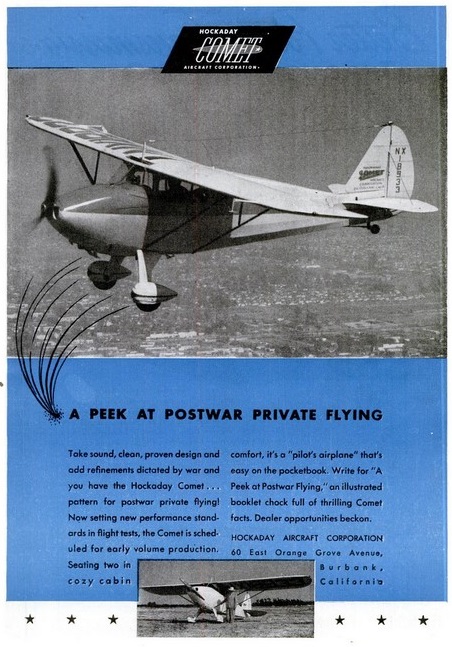
Design work on the CV-139 Comet two-seat high-wing cabin monoplane, but was suspended in 1940 to make way for military contract work for other aircraft companies. The project was resumed in 1944, when the sole prototype was test flown.
A two-seat sesquiplane trainer of wood and metal construction.
Founded in 1939, this company produced the Hitachi T-2 two-seat sesquiplane trainer of wood and metal construction.
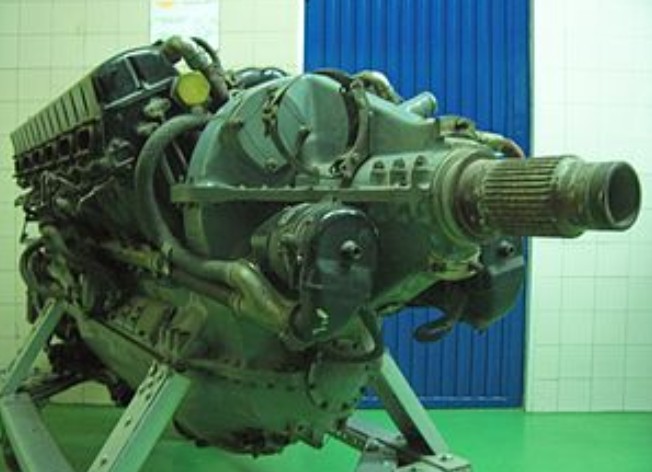
The 12Z was the final evolution of the series of Hispano-Suiza V-12 aircraft engines, which had just entered production when France fell to the Germans during World War II. A small number were produced during the war but the German occupation government would not allow full-scale production to start. After the war small numbers were built to equip new designs, but the rapid introduction of the jet engine ended further development.
The 12Z differed from the earlier 12Y primarily in the use of four valves per cylinder operated by dual overhead cams. This gave the cylinders considerably better volumetric efficiency and faster operation, raising the RPM from 2,400 to 2,700. The engine was also designed to run only on 100 octane fuel (instead of 87, which was common at that point) which allowed the compression ratio to rise from the 12Y’s 5.8:1 to the 12Z’s 6.75:1. These changes raised the power from 1,000 to 1,300 hp (750 to 970 kW) at sea level.
Unfortunately the engine continued to use a single-stage, single-speed supercharger and therefore lacked the all-altitude performance of German and British designs. But tuning the supercharger for a different critical altitude improved high-altitude performance considerably, delivering 1,500 hp (1,120 kW) at 21,000 ft (6,400 m) as opposed to 930 hp (690 kW) at 2,950 ft (900 m) for the 12Y.
Small prototype runs started in 1939, and were fitted to the French Armée de l’Air’s front-line fighter aircraft, the M.S.410 and D.520, creating the M.S.450 and D.524 respectively. Production of the main model, the 12Z-17, was just starting at the time of the armistice. Production was undertaken in Hispano-Suiza’s Spanish factories, but these engines had many problems and were never used in any numbers.
After the war a new version tuned to operate with 92 octane fuel, as opposed to the -17’s 100/130, was built in limited numbers as the 12Z-89. Compression ratio was raised slightly to 7:1, but with the lower grade fuel the power dropped slightly to 1,280 hp (950 kW) at 2,600 rpm (1,479 hp (1,100 kW) maximum take-off). These engines apparently had the same sorts of reliability issues as the earlier -17’s made in Spain, and the type never entered production.
Variants:
Hispano-Suiza 12Z-1
The initial version of the engine used for development
Hispano-Suiza 12Z-17
development peak at time of the Fall of France in May 1940
Hispano-Suiza 12Z-89
post-war development,not successful.
Applications:
Ikarus S-49C
Hispano Aviación HA-1112
Breguet 482
Specifications:
12Z-1
Type: V-12 60° liquid-cooled, geareed drive supercharged four stroke piston engine
Bore: 150mm (5.9in)
Stroke: 170mm (6.69in)
Displacement: 36.05 litres (2,199.9 cu.in)
Length: 2,384mm (93.8in)
Width: 744mm (29.3in)
Height: 1,074mm (42.3in)
Dry weight: 620kg (1,367lb)
Hollow propeller shaft to accommodate a cannon barrel
Valvetrain: Two intake and two sodium-cooled exhaust valves per cylinder actuated by dual overhead camshafts
Supercharger: Gear-driven single-stage two-speed centrifugal type supercharger with automatic boost control – ratios 6.36:1 and 9.38:1
Fuel system: Direct fuel injection @ 40kg/sq.cm (570psi) 2x Lavalette P511-AS2 6-plunger injection pumps with 1x Lavalette KFD injector per cylinder
Fuel type: 100/130-octane rating gasoline
Oil system: Dry sump, pressure feed @ 5kg/sq.cm (70psi), 20.5 centistokes (100S.U. secs) viscosity oil
Cooling system: Ethylene Glycol/water mix
Reduction gear: Spur reduction gear ratio 0.6:1
Air Equipment 1525 compressed gas starting system
Power output:
Take-off – 1,342kW (1,800hp) @ 1,150mm (45.3in)Hg boost @ 2,800rpm
Military, low – 1,193kW (1,600hp) @ 2,500m (8,200ft) @ 2,800rpm
Military, high – 984kW (1,320hp) @ 8,000m (26,200ft) @ 2,800rpm
Cruising, low – 1,193kW (900hp) @ 3,000m (9,800ft) @ 2,100rpm
Cruising, high – 1,193kW (900hp) @ 5,600m (18,400ft) @ 2,100rpm
Specific power: @ take-off power – 37.22kW/l (0.818hp/in³)
Compression ratio: 7.0:1
Specific fuel consumption: 0.29kg/kW/hr (0.48lb/hp/hr)
Oil consumption: 0.006 kg/kW/hr (0.018lb/hp/hr)
Power-to-weight ratio: @take-off power – 2.16kW/kg (1.32hp/lb)
B.M.E.P. (Brake mean effective pressure) 16.3 kg/sq.cm (232psi)
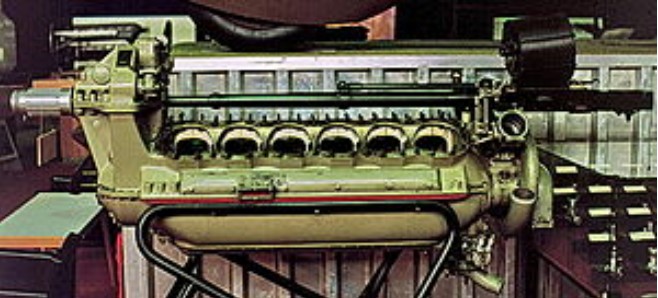
The 12Y was a fairly traditional in construction, a 36-litre water-cooled V-12 with the two cast aluminium cylinder banks set at 60 degrees to each other. The 12Y design was based on the earlier and smaller, 12X. The cylinder heads were not removable, instead the entire block could be quickly removed from the engine. This made it somewhat famous for being leak-proof, a design feature that was considered by other designers and almost became a part of the Rolls-Royce Merlin. The major design change from the earlier 12X was to use a master-articulated connecting rod system, instead of the fork-and-blade type. A single overhead camshaft (SOHC) drove the valves, which were filled with liquid sodium for cooling. Only a single intake and exhaust valve were used, unlike most designs of the era which had moved to three or four valves per cylinder. A single-stage, single-speed supercharger was standard, although the art of designing a useful intake was not as well developed as in other countries, and high altitude performance was always lacking.
The first 12Y test articles were constructed in 1932, and almost immediately the entire French aviation industry started designing around it. At the time the engine developed only 760 hp (570 kW), but it was clear it had potential to the 1,000 hp (750 kW) class. An early modification led to the Hispano-Suiza 12Ycrs which used a hollow propeller shaft to allow a 20 mm cannon to fire through the propeller spinner (a combination known as a moteur-canon). All later designs shared this feature. The 12Ydrs was the next major series, with a basic rating of 836 hp (623 kW) at sea level with a compression ratio of 5.8:1.
The Armée de l’Air changed their nomenclature, so the next version was the Hispano-Suiza 12Y-21, which increased the compression ratio to 7:1, when running on 100 octane gasoline. This boosted power to 867 hp (647 kW). In 1936 the connecting rod design was changed slightly to create the 12Y-31, but the lower 5.8:1 compression ratio was retained and the power was increased only slightly over the drs model to 850 hp (630 kW). Nevertheless this became one of the most used engine designs of the pre-war era, used in almost all French fighter designs and prototypes.
A real effort to improve the performance of the engine in 1938 resulted in the Hispano-Suiza 12Y-45, which used the S-39-H3 supercharger co-designed by André Planiol and Polish engineer Joseph Szydlowski. The Szydlowski-Planiol device was larger, but much more efficient than the indifferent Hispano-Suiza models. When used with 100 octane fuel, the supercharger boosted to the -21’s 7:1, increasing power to 900 hp (670 kW). Combined with the fully adjustable Ratier propeller, this allowed the D.520 to perform as well as contemporary designs from Germany and England.
Another improvement in supercharging led to the Hispano-Suiza 12Y-49, whose performance improved from 850 hp (630 kW) at sea level to 920 hp (690 kW) at just over 10,000 ft (3,000 m). This improvement in power with altitude was a common feature of most engines of the era, the result of the supercharger “robbing” power at low altitudes.
The final major version was the 1,085 hp (809 kW) Hispano-Suiza 12Y-51, which had just started into production at the time of the Armistice with Germany. The -51 was the first version that came close to the performance limits of the engine, although the single-stage supercharging meant that it was unable to compete with designs from England and Germany above 15,000 ft (5,000 m).
Foreign derivatives
In the early 1930s the Czechoslovakian Republic gained rights to build a license version of the HS-12Y. This was initially known locally as the Avia Vr. 36 and was produced by Avia (Škoda) at Prag – Čakovice. The engine was intended to become the standard powerplant of all Czech military aircraft. Both the HS-12Ycrs and HS-12Ydrs were built in quantity and were more commonly known by these names rather than any Czech designation. Aircraft powered by these engines included the Avia B-34, Avia B-534, Avia B-71, Avia B-35 and Avia B-135.
In the mid-1930s, Russian engineer Vladimir Klimov was sent to France to obtain a license for local production of the 12Y. A series of design changes were added to cope with cold weather operation, and the engine entered production in 1935 as the Klimov M-100 with about 750 hp (560 kW). However a series of continual upgrades increased the allowable RPM from the 12Y’s fairly low 2,400 to 2,700, thereby increasing power to 1,100 hp (820 kW). The resulting design, the Klimov M-105 (VK-105) became one of the major Soviet engine designs during the war, powering all Yakovlev fighters.
Variants:
Type 73 Hispano 12Yb
Configuration: V-12
Bore: 150 mm
Stroke: 170 mm
Capacity: 36.0 litres
Year: 1932
Compression: 6.4
Power: 785 hp
Max power rpm: 2,200
TO power: 785 hp
Output reduction: 1.5
Weight: 415 kg)
Rated power (650 hp) less than nominal 785 hp
Left turning
Type 73 Hispano 12Ygrs
Configuration: V-12
Bore: 150 mm
Stroke: 170 mm
Capacity: 36.0 litres
Year: 1932
Compression: 5.8
Power: 850 hp
Max power rpm: 2,400
TO power: 800 hp
Output reduction: 1.5
Supercharger optimum altitude: 4,000 m
Weight: 430
Rated power (650 hp) less than nominal 850 hp
Left turning
Type 73 Hispano 12Y dr
Configuration: V-12
Bore: 150 mm
Stroke: 170 mm
Capacity: 36.0 litres
Compression: 6.4
Year: 1934
Power: 800 hp
Max power rpm: 2,200
TO power: 800 hp
Output reduction: 1.5
Weight: 440
Left turning
Type 73 Hispano 12Y drs
Configuration: V-12
Bore: 150 mm
Stroke: 170 mm
Capacity: 36.0 litres
Year: 1934
Compression: 5.8
Power: 860 hp
Max power rpm: 2,400
TO power: 835 hp
Output reduction: 1.5
Supercharger optimum altitude: 4,000 m
Weight: 470 kg
Left turning
Type 73 Hispano 12Y 12Ydrs1
Configuration: V-12
Bore: 150 mm
Stroke: 170 mm
Capacity: 36.0 litres
Year: 1934
Compression: 5.8
Power: 880 hp
Max power rpm: 2,400
TO power: 890 hp
Output reduction: 1.5
Supercharger optimum altitude: 2,400 m
Weight: 470 kg
Left turning
Type 73 Hispano 12Y drs2
Configuration: V-12
Bore: 150 mm
Stroke: 170 mm
Capacity: 36.0 litres
Year: 1934
Compression: 5.8
Power: 930 hp
Max power rpm: 2,400
TO power: 992 hp
Output reduction: 1.5
Supercharger optimum altitude: 900 m
Weight: 470 kg
Left turning
Type 73 Hispano 12Y frs
Configuration: V-12
Bore: 150 mm
Stroke: 170 mm
Capacity: 36.0 litres
Year: 1934
Compression: 5.8
Power: 860
Max power rpm: 2,400 rpm
TO power: 835 hp
Output reduction: 1.5
Supercharger optimum altitude: 4,000 m
Weight: 470 kg
Right turning
Type 73 Hispano 12Y frs1
Configuration: V-12
Bore: 150 mm
Stroke: 170 mm
Capacity: 36.0 litres
Year: 1934
Compression: 5.8
Power: 880 hp
Max power rpm: 2,400
TO power: 890 hp
Output reduction: 1.5
Supercharger optimum altitude: 2,400 m
Weight: 470 kg
Right turning
Type 73 Hispano 12Y frs2
Configuration: V-12
Bore: 150 mm
Stroke: 170 mm
Capacity: 36.0 litres
Year: 1934
Compression: 5.8
Power: 930 hp
Max power rpm: 2,400
TO power: 992 hp
Output reduction: 1.5
Supercharger optimum altitude: 900m
Weight: 470 kg
Right turning
Type 73 Hispano 12Y 21
Configuration: V-12
Bore: 150 mm
Stroke: 170 mm
Capacity: 36.0 litres
Year: 1935
Compression: 7.0
Power: 910 hp
Max power rpm: 2,400
TO power: 880 hp
Output reduction: 1.5
Supercharger optimum altitude: 3,600m
Weight: 470 kg
Type 73 Hispano 12Y 25
Configuration: 60° V-12
Bore: 150 mm (5.906 in)
Stroke: 170 mm (6.693 in)
Capacity: 36.0 litres (2,199.9 cu,in)
Length: 1,722 mm (67.8 in)
Width: 764 mm (30.08 in)
Height: 935 mm (36.81 in)
Year: 1935
Compression: 5.8
Power: 860 hp
Max power rpm: 2,400
TO power: 943 hp
Specific power: 17.08 kW/lt (0.38 hp/cu.in)
Specific fuel consumption: 328 g/(kW/hr) (0.54 lb/(hp/hr))
Oil consumption: 11 g/(kW/hr) (0.28 oz/(hp/hr))
Power-to-weight ratio: 1.32 kW/kg (0.8 hp/lb)
Output reduction: Spur, 1.5
Fuel system: Six Solex 56 S.V.C carburetors
Fuel type: 85/100 octane gasoline
Supercharger: Gear-driven single-speed centrifugal type, 10.0:1 gear ratio
Supercharger optimum altitude: 3,600m
Dry weight: 475 kg (1,050 lb)
Cooling system: Pressurised, Liquid-cooled: 600 litres/min.
Valvetrain: One intake and one sodium-filled exhaust valve per cylinder actuated via a single overhead camshaft per bank.
Left turning, variable ignition timing
Type 73 Hispano 12Y 27
Configuration: V-12
Bore: 150 mm
Stroke: 170 mm
Capacity: 36.0 litres
Year: 1935
Compression: 5.8
Power: 900 hp
Max power rpm: 2,400
TO power: 950 hp
Output reduction: 1.8
Supercharger optimum altitude: 850m
Weight: 483 kg
Type 73 Hispano 12Y 33
Configuration: V-12
Bore: 150 mm
Stroke: 170 mm
Capacity: 36.0 litres
Year: 1936
Compression: 7.0
Power: 965 hp
Max power rpm: 2,400
TO power: 960 hp
Output reduction: 1.5
Supercharger optimum altitude: 2,250 m
Weight: 490 kg
Type 73 Hispano 12Y 39
Configuration: V-12
Bore: 150 mm
Stroke: 170 mm
Capacity: 36.0 litres
Year: 1936
Compression: 7.0
TO / Max Power: 1000 hp
Max power rpm: 2,400
Output reduction: 1.5
Supercharger optimum altitude: 3,400m
Type 73 Hispano 12Y 5
Configuration: V-12
Bore: 150 mm
Stroke: 170 mm
Capacity: 36.0 litres
Year: 1938
Power: 920 hp
Max power rpm: 2,400
TO power: 950 hp
Output reduction: 1.5
Supercharger optimum altitude: 10,000m
3 speed compressor
Type 77 Hispano 12Y crs
Configuration: 60° V-12
Bore: 150 mm (5.906 in)
Stroke: 170 mm (6.693 in)
Capacity: 36.0 litres (2,199.9 cu,in)
Length: 1,722 mm (67.8 in)
Width: 764 mm (30.08 in)
Height: 935 mm (36.81 in)
Year: 1934
Compression: 5.8
Power: 860 hp
Max power rpm: 2,400
TO power: 835 hp
Specific power: 17.08 kW/lt (0.38 hp/cu.in)
Specific fuel consumption: 328 g/(kW/hr) (0.54 lb/(hp/hr))
Oil consumption: 11 g/(kW/hr) (0.28 oz/(hp/hr))
Power-to-weight ratio: 1.32 kW/kg (0.8 hp/lb)
Output reduction: Spur, 1.5
Supercharger: Gear-driven single-speed centrifugal type, 10.0:1 gear ratio
Supercharger optimum altitude: 4,000m
Weight: 470 kg
20 mm calibre Hispano-Suiza 404 cannon between cylinder banks, firing through propeller shaft.
Fuel system: Six Solex 56 S.V.C carburetors
Cooling system: Pressurised, Liquid-cooled: 600 litres/min.
Valvetrain: One intake and one sodium-filled exhaust valve per cylinder actuated via a single overhead camshaft per bank.
Type 77 Hispano 12Y brs
Configuration: V-12
Bore: 150 mm
Stroke: 170 mm
Capacity: 36.0 litres
Year: 1934
Compression: 5.8
Power: 860hp
Max power rpm: 2,400
TO power: 835hp
Output reduction: 1.0625
Supercharger optimum altitude: 4,000m
Weight: 470kg
20 mm calibre Hispano-Suiza 404 cannon between cylinder banks, firing through propeller shaft.
Type 77 Hispano 12Y 29
Configuration: V-12
Bore: 150 mm
Stroke: 170 mm
Capacity: 36.0 litres
Compression: 7.2
Power: 920hp
Max power rpm: 2,400
TO power: 910hp
Output reduction: 1.5
Supercharger optimum altitude: 3,600m
Weight: 475kg
20 mm calibre Hispano-Suiza 404 cannon between cylinder banks, firing through propeller shaft.
Type 77 Hispano 12Y 31
Configuration: V-12
Bore: 150 mm
Stroke: 170 mm
Capacity: 36.0 litres
Year: 1936
Compression: 5.8
Power: 860hp
Max power rpm: 2,400
TO power: 830hp
Output reduction: 1.5
Supercharger optimum altitude: 3,250m
Weight: 468kg
20 mm calibre Hispano-Suiza 404 cannon between cylinder banks, firing through propeller shaft.
Redesigned connecting rods
Type 77 Hispano 12Y 37
Configuration: V-12
Bore: 150 mm
Stroke: 170 mm
Capacity: 36.0 litres
Year: 1936
Compression: 7.0
Power: 960hp
Max power rpm: 2,400
TO power: 1,050hp
Output reduction: 1.8
Supercharger optimum altitude: 1,250m
Weight: 483kg
20 mm calibre Hispano-Suiza 404 cannon between cylinder banks, firing through propeller shaft.
Type 77 Hispano 12Y 41
Configuration: V-12
Bore: 150 mm
Stroke: 170 mm
Capacity: 36.0 litres
Year: 1936
Compression: 7.0
Power: 920 hp
Max power rpm: 2,400
Output reduction: 1.5
Supercharger optimum altitude: 3,600m
Weight: 483kg
20 mm calibre Hispano-Suiza 404 cannon between cylinder banks, firing through propeller shaft.
Type 77 Hispano 12Y 45
Configuration: 60° V-12
Bore: 150 mm (5.906 in)
Stroke: 170 mm (6.693 in)
Capacity: 36.0 litres (2,199.9 cu,in)
Length: 1,722 mm (67.8 in)
Width: 764 mm (30.08 in)
Height: 935 mm (36.81 in)
Compression: 7.0
Power: 920hp
Max power rpm: 2,400
TO power: 935hp
Output reduction: Spur, 1.5
Fuel system: Six Solex 56 S.V.C carburetors
Fuel type: 92/100 octane gasoline
Specific power: 17.08 kW/lt (0.38 hp/cu.in)
Specific fuel consumption: 328 g/(kW/hr) (0.54 lb/(hp/hr))
Oil consumption: 11 g/(kW/hr) (0.28 oz/(hp/hr))
Power-to-weight ratio: 1.32 kW/kg (0.8 hp/lb)
Supercharger: Gear-driven single-speed centrifugal type, 10.0:1 gear ratio
Supercharger optimum altitude: 4,200m
Dry weight: 515 kg (1,140 lb)
Cooling system: Pressurised, Liquid-cooled: 600 litres/min.
Valvetrain: One intake and one sodium-filled exhaust valve per cylinder actuated via a single overhead camshaft per bank.
20 mm calibre Hispano-Suiza 404 cannon between cylinder banks, firing through propeller shaft.
Szydlowsky-Planiol (SP) supercharger
Type 77 Hispano 12Y 47
Configuration: V-12
Bore: 150 mm
Stroke: 170 mm
Capacity: 36.0 litres
Year: 1936
Compression: 5.8
Power: 860 hp
Max power rpm: 2,400
TO power: 830 hp
Output reduction: 1.5
Supercharger optimum altitude: 3,250m
Weight: 468 kg
20 mm calibre Hispano-Suiza 404 cannon between cylinder banks, firing through propeller shaft.
Type 77 Hispano 12Y 49
Configuration: V-12
Bore: 150 mm
Stroke: 170 mm
Capacity: 36.0 litres
Compression: 7.0
Power: 910hp
Max power rpm: 2,400
TO power: 910hp
Output reduction: 1.5
Supercharger optimum altitude: 5,250m
Weight: kg
20 mm calibre Hispano-Suiza 404 cannon between cylinder banks, firing through propeller shaft.
Szydlowsky-Planiol (SP) supercharger, variable ignition timing
Type 77 Hispano 12Y 51
Configuration: V-12
Bore: 150 mm
Stroke: 170 mm
Capacity: 36.0 litres
Year: 1939
Compression: 7.0
Power: 1,000hp
Max power rpm: 2,500
TO power: 1,100hp
Output reduction: 1.5
Supercharger optimum altitude: 3,260m
Weight: 492kg
20 mm calibre Hispano-Suiza 404 cannon between cylinder banks, firing through propeller shaft.
Szydlowsky-Planiol (SP) supercharger, variable ignition timing
Licence built variants:
Avia Vr. 36
License production in Czechoslovakia.
Klimov M-100
License production in the USSR.
Hispano-Suiza HS-77
Licence-built 12Ycrs produced in Switzerland.
Applications:
Amiot 370
Arsenal VB 10
Arsenal VG-33
Avia 156
Avia B-534
Bloch MB.177
Dewoitine D.510
Dewoitine D.513
Dewoitine D.520
EKW C-35
Fairey Fantôme
Farman NC.223.3
Farman NC.223.4
Ikarus IK-2
Latécoère 298
Latécoère 521
Loire-Nieuport 161
Morane-Saulnier M.S.406
Morane-Saulnier M.S.475
ANF Les Mureaux 110-119 series
Renard R-36
Rogozarski IK-3
Wibault 366
12Y Derivatives Applications:
Arkhangelsky Ar-2
Lavochkin-Gorbunov-Goudkov LaGG-1
Lavochkin-Gorbunov-Goudkov LaGG-3
Mörkö-Morane
Petlyakov Pe-2
Petlyakov Pe-3
Yakovlev Yak-1
Yakovlev Yak-2
Yakovlev Yak-3
Yakovlev Yak-4
Yakovlev Yak-7
Yakovlev Yak-9
Yermolayev Yer-2
In 1968, Snecma took control over Hispano-Suiza, which included the mechanical engineering firm Bugatti, the landing gear manufacturer Messier, and the engine maker Berthiez. All of these were at the edge of ruin.
Spain
La Hispano Aviacion SA manufactured the Fiat CR.32 biplane fighter as the HA-132-1 Chirri between 1938- 1942. In 1943 the company received a contract to build the Messerschmitt Bf 109G under license for the Spanish Air Force. Designated Hispano HA-1109, it was powered initially by a Hispano-Suiza HS-12Z engine and later, in HA-1109/1110 Buchon variants, by the Rolls-Royce Merlin. An indigenous HA-43D-1 advanced two-seat military trainer went into production for the Spanish Air Force in 1947, followed in 1953 by the HA-1 OOEI replacement, with tricycle landing gear, designed by Willy Messerschmitt. Messerschmitt also supervised design of the HA-200 Saeta jet trainer, which first flew in 1955 and which was later developed as the HA-220 Super Saeta single-seat light ground-attack aircraft.
Hispano merged with Construcciones Aeronauticas SA in 1972.
Wolf Hirth GmbH, a prewar manufacturer of sailplanes, made wooden subassemblies for Messerschmitt projects during the Second World War, including a high-speed glider-trainer for Me 163 Komet pilots, and components for the Me 321 and Me 323 Gigants. The re-established company, owned largely by Messerschmitt-Bölkow-Blohm, built Arnold Wagner’s Acrostar competition aerobatic aircraft in small numbers, and supported the Bolkow Bo 107, 207, 208, and 209 lightplanes.
Hellmuth Hirth (1886 – 1938) worked for a short time as a foreman at aviation pioneer August Euler in Darmstadt. However, since Euler had difficulties with his Voisin-type flying machine, Hirth returned to Stuttgart to build himself a Blériot machine. Because of the too weak engine, this did not go beyond small aerial jumps, causing Hirth to go to Vienna to fly the Etrich Taube together with Illner. He then became designer at Rumpler and Gotha, before turning to engine development.
1998:
Göbler-Hirthmotoren
Postfach 62
D 71726 Benningen / Neckar
Germany
UK
F.Hills & Sons Ltd was formed by Francis Hills in 1849 as a one-man joinery company in Yarm on Tees. Cooper and Walter Hills (grandsons of Francis) took over in 1907, and during the First World War, the company made ammunition boxes and joinery for the Forces. In 1921, Hills became a limited company, and in 1923, moved to larger premises in Stocton. The company began making aeroplanes after Managing Director W.R.Chown, who was interested in aircraft development, visited Prague, Czechoslovakia to obtain a license to produce the Praga E.114 Air Baby two-seat lightplane. Thirty were manufactured from 1936, known as Hillson Pragas. Following this, he purchased the old Ford Motor Company premisis in Trafford Park, Manchester, for joinery and aircraft production.
The first aircraft built by Hills was a Pou du Ciel, an HM.14 Flying Flea. The aircraft was registered G-ADOU in October 1935, and test flown at Barton Aerodrome.
The first licence-built Praga E.114 was sold to Australia, and the second registered G-AEEU became the company’s demonstrator in April 1936. Total production by Hills amounted to twenty-eight aircraft, plus seven uncompleted.
There followed two-one-off Hillson light aircraft, both designed by Norman ykes: the Pennine, a two seat, side by side, high wing monoplane, registered G-AFBX but not flown before the outbreak of war; the Helvellyn G-AFKT, an open cockpit, tandem, two seater, low wing monoplane was built and flown in 1939.
During 1938-39, Hills built Anson wings and laminated spars for Airspeed Oxfords. During the war, the company produced no less than 480.000 JABLO propeller blades and 10 million square feet of aeronautical plywood for Mosquito and other aircraft.
In addition the company produced more than 800 Percival Proctors and the slip-wing Hawker Hurricane I, after first buillding and testing a research aircraft called the Hillson Bi-mono. An expendable slip-wing was mounted above the fuselage in order to obtain more lift for operating out of small fields and to enable the aircraft to take off at greater than normal gross weight. Once airborne, the wing could be released by the pilot.
 All Aero