Klimov VK-107

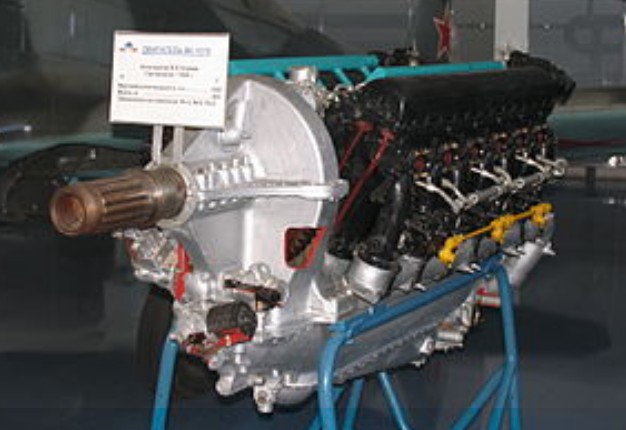
The Klimov VK-107 was a V-12 liquid-cooled piston aircraft engine used by Soviet aircraft during World War II.

The VK-107 was a brand-new design having little in common with its predecessors M-105 and VK-106. To achieve a greater power output, each cylinder now had four valves (two intake and two exhaust), crankshaft and camshafts were completely revised, and a new supercharger design was implemented. Although the engine could have been ready for production as early as 1942, Soviet factories lacked the capacity to produce a brand new design. Thus, less powerful VK-105PF and VK-105PF2 were built instead. However, the appearance of Luftwaffe Messerschmitt Bf 109G with Daimler-Benz DB 605 engine in 1943 created an urgent demand for a more powerful engine. VK-107A was put into production in 1944 and was used on Yak-9U fighters. The engine was not well liked by either pilots or mechanics — it had a life expectancy of only 25 hours and war emergency power was almost never used for fear of decreasing this even more. The engine was also difficult to service, in part because its exhaust headers were on the inside of the cylinder banks, the reverse placement of most V-type liquid-cooled engine designs.

Variants:
VK-107A – production version
VK-107R – version for hybrid piston-motorjet powered Mikoyan-Gurevich I-250 (N) and Sukhoi Su-5 fighters
VK-108 – attempt to further develop VK-107 with 1,380 kW (1,850 hp) on takeoff, used on several Yakovlev Yak-3 prototypes but did not enter production.

Applications:
Mikoyan-Gurevich MiG-7
Petlyakov Pe-2
Yakovlev Yak-3
Yakovlev Yak-9

Specifications:
VK-107A
Type: 12-cylinder supercharged liquid-cooled Vee aircraft piston engine
Bore: 148mm (5.83in)
Stroke: 170mm (6.69in)
Displacement: 35.08 liters (2,140 in³)
Dry weight: 765 kg (1,685 lb)
Valvetrain: Two intake and two exhaust valves per cylinder actuated via an overhead camshaft
Supercharger: Single stage, two-speed, gear-driven centrifugal type supercharger
Cooling system: Liquid-cooled
Power output:
1,230 kW (1,650 hp) at 3,200 rpm for takeoff
1,082 kW (1,450 hp) at 2,800 m (12,500 ft)
Specific power: 35.1 kW/L (0.77 hp/in³)
Compression ratio: 6.75:1
Power-to-weight ratio: 1.61 kW/kg (0.98 hp/lb)
Klimov VK-106

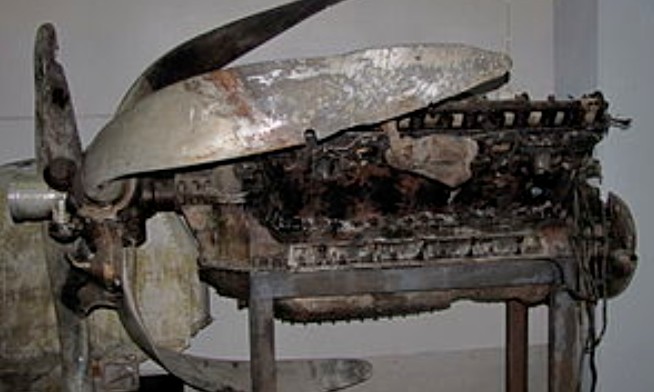
The Klimov M-106 was an experimental liquid-cooled V12 piston aircraft engine intended for Soviet aircraft during World War II.

With the VK-105PF exhausting the potential of the M-105, Klimov prolonged its development into new VK-106 engine from 1941. Since air combat on the Eastern Front took place primarily at low altitudes (under 4,000 m {13,000 ft}), the new engine was built specifically for peak performance at those altitudes with a reduced compression ratio and a single-speed supercharger. Static testing was carried out from 27 October till 9 November 1942. Although reliable and easily installed in M-105-powered aircraft, VK-106 did not enter production because its cooling problems were not solved. Like M-105P, VK-106P could house an autocannon in the “vee” between the cylinder banks. Over 300 engines were built.

Applications:
Yak-1b with M-106

Specifications:
VK-106-1sk
Type: 12-cylinder supercharged liquid-cooled piston aircraft engine
Bore: 148mm (5.83 in)
Stroke: 170mm (6.69 in)
Displacement: 35.08 liters (2,140 in³)
Dry weight: 600 kg (1,320 lb)
Supercharger: Gear-driven single-stage single-speed centrifugal type supercharger
Fuel type: 95-octane rating gasoline
Cooling system: Liquid-cooled
Power output:
1,007 kW (1,350 hp) at 2,600 rpm for takeoff
1,007 kW (1,350 hp) at 2,000 m (6,560 ft)
Specific power: 28.8 kW/L (0.63 hp/in³)
Compression ratio: 6.5:1
Power-to-weight ratio: 1.68 kW/kg (1.02 hp/lb)

Klimov M-103

Klimov M-103 engine recovered from Tupolev SB wreck

The Klimov M-103 is a V12 liquid-cooled piston aircraft engine used by Soviet aircraft during World War II.

The M-103 was a further development of the Klimov M-100 engine that was itself a licensed copy of the French Hispano-Suiza 12Ybrs. It differed from both engines in a number of aspects such as increased compression ratio, increased supercharger ratio, increased rpm’s, strengthened cylinder blocks, a new crankshaft, and flat bottomed cylinders. Developed in 1936 it was ready for testing in October 1936. The first two models failed testing due to cracked cylinder blocks and the engine was resubmitted for testing in 1937. After passing its trials it was cleared for production in 1938 and 11,681 were produced until 1942 at its factory in Rybinsk. The M-103 was followed by the M-105.

Variants:
M-103A – 148mm rather than 150mm bore cylinders.
M-103P – A ShVAK cannon fitted to fire through the engine vee.
M-103SP – A proposed version with two engines married to a common crankshaft.
M-103G – With Glycol rather than water cooling.
M-103A-TK – With an experimental Turbo-Supercharger
M-103U – Improved service life variant.
M-104 – Basically a M-103A with a two speed single stage supercharger for increased performance. 232 built.

Applications:
Bolkhovitinov S
Beriev MBR-7
Polikarpov TsKB-44
Polikarpov VIT-1 & VIT-2
Tupolev SB
Yakovlev Yak-2
Yakovlev Yak-12
Yakovlev Yak-22

Specifications:
M-103A
Type: Twelve-cylinder supercharged liquid-cooled 60° V12 engine
Bore: 148mm (5.826 in)
Stroke: 170mm (6.693 in)
Displacement: 35.101 Liters (2,142.2 cu in)
Length: 1,971 mm (77.6 in)
Width: 764 mm (30.08 in)
Height: 942 mm (37.08 in)
Dry weight: 500 kg (1,101 lb)
Valvetrain: One intake and one sodium-filled exhaust valve per cylinder actuated via a single overhead camshaft per bank.
Supercharger: Gear-driven single-speed centrifugal type compressor. Gear ratio: 11.0:1. Maximum boost for take-off: 1,100 mm Hg (43.30 MP). Maximum boost at altitude: 920 mm Hg (36.22 MP). Critical altitude: 4,000 m (13,123 ft)
Fuel system: Six K-100A Carburettors (License copy of Solex-Hispano 56S2 self-adjusted carburettor)
Fuel type: 90 (minimum grade), 95 or 100 octane.
Cooling system: Liquid-cooled
Reduction gear: 2:3
Power output:
1,000 hp (745 kW) at 2,450 RPM for take-off, boost rated at 1.44 Atm (43.30 MP)
960 hp (715 kW) at 2,400 RPM at 13,123 ft (4,000 m), boost rated at 1.21 Atm (36.22 MP)
500 hp (372 kW) at 2,450 RPM at 30,839 ft (9,400 m)
Specific power: 21.22 kW/L (0.466 hp/in³)
Compression ratio: 6.6:1
Specific fuel consumption: 328 g/(kW•h) (0.54 lb/(hp•h))
Oil consumption: 11 g/(kW•h) (0.28 oz/(hp•h))
Power-to-weight ratio: 1.50 kW/kg (0.916 hp/lb)

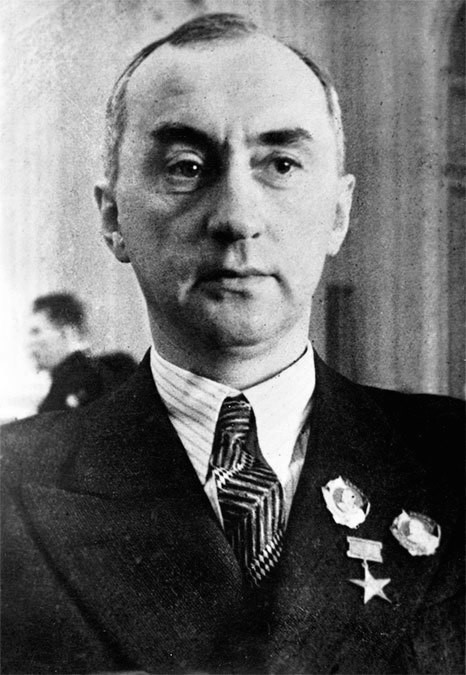
Klimov, Vladimir Yakovlevich

Vladimir Yakovlevich Klimov was born on 23 July 1892 in Moscow and studied at the Technical School Komissarovskom.

In 1918 he graduated from the Faculty of Mechanical Engineering of the Technical State University of Moscow NE Bauman and began his career in October of 1919 in Kolomna factory, an engineering company based in Moscow.

From July 1918 to 1931 he worked interchangeably as chief laboratory engineer, department head, assistant director of the automotive research laboratory of this factory which later became the Soviet Scientific Institute of Engines (NAMI).

After 1931 he became Head of the Department of Technical Control of gasoline engines of the Central Institute of Aviation Engines and at the same time, he worked as a professor at the Moscow Higher Technical School, the Lomonosov Institute and the Military Academy of the Force, Zhukovsky Aerial.

He was also head of the Engine Design Department at the Moscow Aviation Institute.

Vladimir Yakovlevich Klimov participated in the development of the first Soviet air-cooled star-shaped aircraft engines, the M-12, M-23, and others. In 1927 he created the first and most powerful engine of the time (approx. 650 kW (880 horsepower) the M-13 with liquid cooling for cylinders.

In the mid-1930s, it organizes the production of 12-cylinder M-100 engines, whose capacity was 30% more than that of similar foreign engines of the same size, at that time the M-103 series engine for bombers. “SB” designed by AA Tupolev and Arkhangelsk.

In 1935, Vladimir Klimov was appointed Chief Designer of the Rybinsk Engine Plant No. 26.

In August 1941, he worked designing high-power engines for Soviet aircraft destined to defend the USSR during World War II in a factory evacuated to Ufa.

The engines that Klimov had designed in the late 1930s and early 1940s (M-105, VC-105PF, EC-107, EC-108), were installed in Pe-2 dive bombers designed by VM Petlyakov and fighter jets designed by Yakovlev.

In the postwar period Klimov led the design and production of a wide series of jet engines.

During his work and research, Klimov developed and implemented a series of inventions and innovations in aircraft piston engines such as the closed liquid cooling system, the closed system with a special pressure air pump with two speed traction, advanced timing, mixed fuel feed systems in powerful and high-speed engines, and proposed a number of innovative solutions in the construction of the turbojet.

Klimov made a significant contribution to the development of lubrication theory, to the solution of balance piston engine problems, and other aircraft engine problems.

In 1947-1949 he created the first engines with internal centrifugal compressors for jet aircraft.

In 1951, on the basis of the English Nene engine, Klimov created the VK-1F – one of the world’s first turbojet engines equipped with an afterburner.

Vladimir Yakovlevich Klimov was a Deputy of the Supreme Soviet of the USSR from 1946 to 1950.

He reached the degrees of Major General in the USSR Air Engineering Service.

He was also an outstanding academic twice awarded as Hero of Socialist Labor (1940, 1957). Winner of four Stalin Awards (1941, 1943, 1946, 1949).

He died on September 9, 1962. He was buried in the Novodevichy Cemetery in Moscow.

In 2002, the name Klimov was given to a street in the Shevchenko district of Zaporozhye and a park called Academician Klimov already existed there.

Klemm Kl-107 / MBB Bo.207 / Bolkow F.207

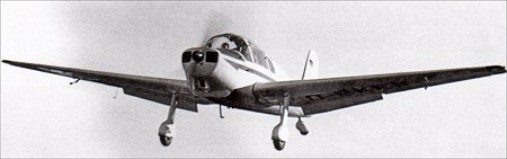
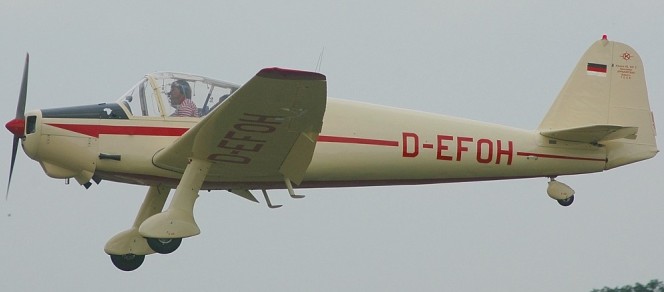
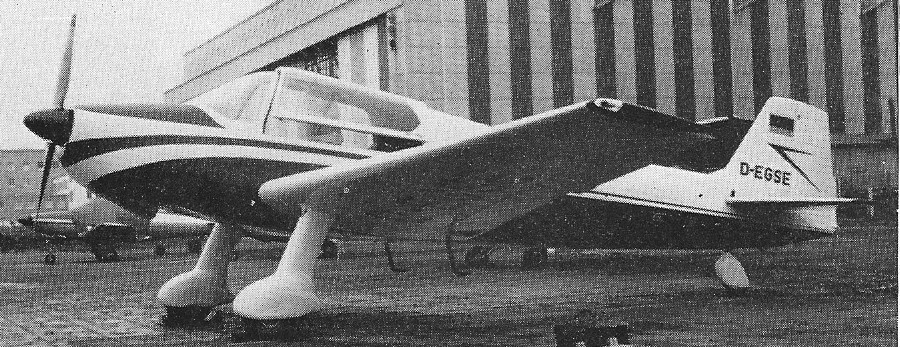
The Kl.107 low-wing, wooden-framed monoplane trainer was designed in Germany during World War II. Early versions were powered by the Hirth HM 500 100hp engine, and only a small number were completed before the factory was erased by Allied bombing. In 1956 it was decided to reintroduce the Kl-107 as a civil training/touring type, initially as the Kl-107B, but then as the three-seat Kl-107C. Rights to the design were acquired by what became the MBB consortium, and the final version became the Bo.207.

Klemm Kl-107C

The Bolkow F.207 second prototype development of the Kl107C, originally called the Klemm Kl 107D, first flew on 21 April 1961, from Stuttgart-Echterdingen airport.

Bolkow F.207

Kl.107C
Engine: 1 x 150hp Continental O-320
Wingspan: 10.80 m / 35 ft 5 in
Length: 8.30 m / 27 ft 3 in
Max. speed: 234 km/h / 145 mph
Range: 820 km / 510 miles

Klemm

Dr Ing Hanns Klemm (1885-1961) was an eminent pioneer in the development of light aircraft. During the First World War he worked with Zeppelin, Dornier and Hansa und Brandenburgische Flugzeugwerke, and later with Daimler, for whom he designed biplanes and monoplanes, including fighters. After the war he concentrated on light and economical aircraft, sometimes called Daimler-Klemm. L15 of 1919 was originally a glider, though later powered, but had high wing. True precursor of the classic Klemm low-powered two-seat line of low-wing monoplanes was L20 of 1924. In December 1926 Leichtflugzeugbau Klemm GmbH was formed (notably associated with Bb’blingen), and L 25 was produced from 1927 with many types of engine, consolidating Klemm’s reputation. K131 and K132 of early 1930s were cabin types. Part of Klemm became Halle in 1934. Company renamed Hans Klemm Flugzeugbau August 1938, and was then making K135 cranked-wing tourer/trainer series for Luftwaffe and export. In new type-number series built Kl 105-107. During Second World War contributed to military-aircraft production, afterwards Klemm revived Kl 107 three-seat cabin model. Klemm joined Siebel in 1940.
Production ended November 1957.

Kellett O-60

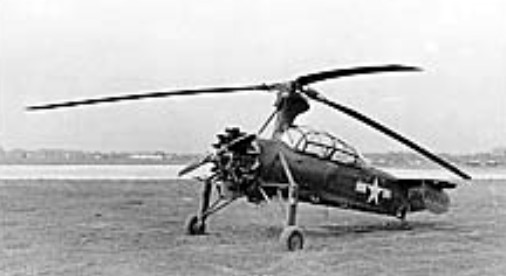
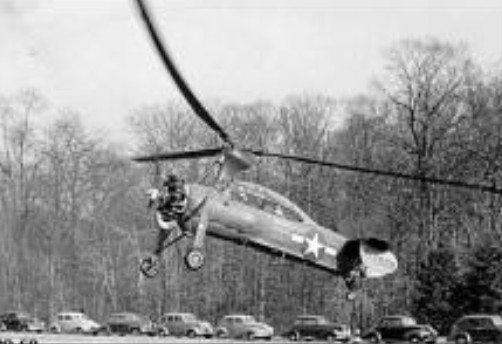
The Kellett O-60 was built and tested as an observation aircraft for the US Army in 1942 while the helicopter was still in development. The aircraft had a free-turning 43 ft 2 in rotor which provided lift in place of a conventional wing. A 285 horsepower radial engine turning a two-blade propeller gave the O-60 its forward thrust.
The two-place YO-60 was designed by Richard O. Prewitt and could do jump take-offs. The rotor was spun up to about 280 rpm (rotations per minute) at a no-lift angle using the power of the radial engine. When ready for take-off, the pilot would release a clutch mechanism which changed the blade angle to 8 degrees. This caused the aircraft to ‘jump’ about 10 feet into the air. The engine and propeller then pulled the YO-60 into forward flight as the rotor angle was decreased to a normal flight pitch of 3 degrees. The engine was only used to spin the rotor up to flight speeds on the ground, while in flight the rotor was free spinning.

The YO-60 never got past the service test phase. Seven aircraft were built as XO-60 (S/N 42-13604 to 42-13610) with 225 hp radial engines and later re-engined with 285 hp. radials and redesignated YO-60.

YO-60
Engine: Jacobs R-915-3 of 285 hp.
Fuselage length: 20 ft. 9 in.
Fuselage width: 9 ft. 6 in. (at landing gear); 10 ft. at horizontal stabilizer
Height: 10 ft. 3 in.
Rotor diameter: 43 ft. 2 in.
No of blades: 3
Weight: 2,640 lbs. (gross)
Crew: 2
Top speed: 122 mph

Kazan Aviation Institute

Russia
Founded 1939, and since 1951 has manufactured Mil helicopters.
The Kazan Aviation Institute at Kazan on the River Volga, nearly 500 miles east of Moscow, has designed and produced some of Russia’s most notable sailplanes, especially the very advanced KAI-19 high performance all-metal single-seater which, in two-seater form, broke the world’s 300km closed circuit speed record on 1 August 1964, and the KAI-17 training glider.
Own designs are Ansat twin-turboshaft light multipurpose helicopter (first flown 1998) for up to 10 persons, and Aktay three-seat piston helicopter (to fly about year 2000).

Kayaba Heliplane

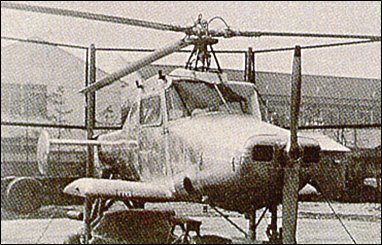
In 1952, Kayaba returned to rotary wing experimentation with the “Heliplane”. This was a compound helicopter fabricated from the fuselage and 180 hp Continental E-180 engine of a Cessna 170 light aircraft, with a rotor mounted above the cabin roof and low-set stub wings to which the undercarriage was attached. The three-blade rotor was fitted with small ramjets which were used for takeoff and landing and the rotor would rotate freely in horizontal flight when the “Heliplane” was being driven by the normal propeller. It first flew in 1954.

Engine: 185 hp Continental E-180
Rotor diameter: 24 ft 3.25 in
Fuselage length: 10 ft 6 in
Height: 9 ft 2.25 in
Seats: 4