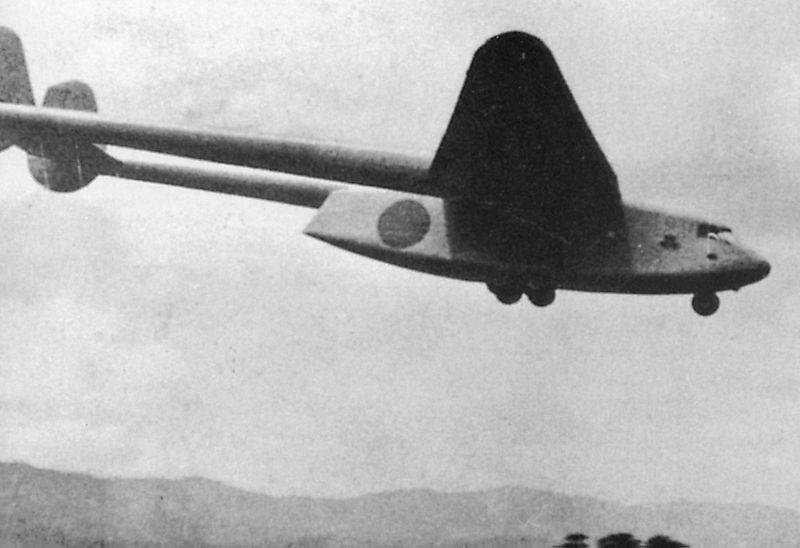
Kyushu Q3W1 Nankai

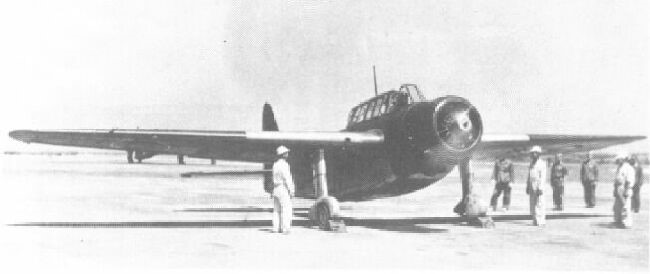
The K11W served as the basis for the Q3W1 Nankai (南海, “South Sea”) anti-submarine patrol aircraft.

The Q3W1 retained the basic layout of the K11W2, with a circular fuselage and large wing with a straight trailing edge and tapered leading edge. It carried a crew of two with the remaining space allocated for anti-submarine warfare equipment. A single prototype was produced, and made its maiden flight in January 1945. This first flight ended with a wheels-up landing, and after that work on the project was suspended and didn’t resume before the end of the war.

Kyushu K11W Shiragiku / White Crysanthemum

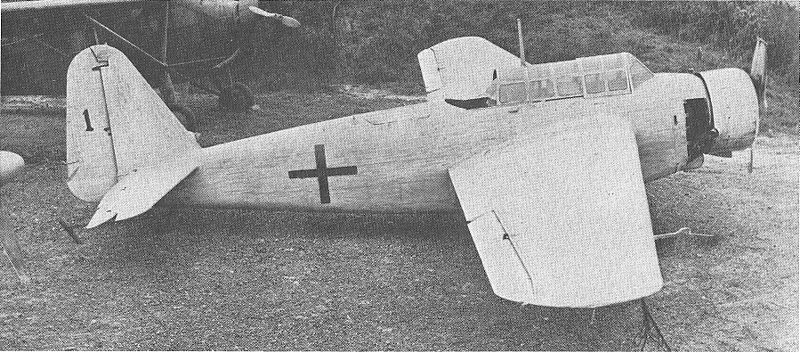
The Kyūshū K11W Shiragiku (白菊, “White Chrysanthemum”) made by the Kyūshū Aircraft Company, was a land-based bombing trainer aircraft which served in the Imperial Japanese Navy Air Service in the latter years of World War II. As indicated by its Japanese designation, “training aircraft for on-board work” (機上作業練習機, kijō sagyō renshū-ki), it was designed to train crews in operating equipment for bombing, navigation, and communication, as well as navigation techniques.

The Kyūshū K11W had a mid-wing layout, the crew consisting of a pilot and gunner/radio operator sitting in line under the canopy and the trainee bombardier, trainee navigator, and instructor in the lower fuselage beneath the wing.

The K11W1 was a basic bomber crew trainer, of all-metal construction with fabric-covered control surfaces.

The K11W2 was a anti-submarine warfare and transport version of all-wood construction.

A total of 798 K11Ws were manufactured, including a small number of K11W2 ASW and transport aircraft alongside the K11W1 trainer variant. These aircraft were also used in kamikaze mission during the last stages of the Pacific War.

The K11W served as the basis for the Q3W1 Nankai (南海, “South Sea”) anti-submarine patrol aircraft.

K11W1
Powerplant: 1 × Hitachi GK2B Amakaze 21, 384 kW (515 hp)
Wingspan: 14.98 m (49 ft 2 in)
Wing area: 30.5 sq m (328 sq ft)
Length: 10.24 m (33 ft 7 in)
Height: 3.93 m (12 ft 11 in)
Empty weight: 1,677 kg (3,697 lb)
Gross weight: 2,640 kg (5,820 lb)
Maximum speed: 230 km/h (140 mph, 120 kn) at 1,700 m (5,577 ft)
Cruise speed: 175 km/h (109 mph, 94 kn) at 1,000 m (3,281 ft)
Range: 1,760 km (1,090 mi, 950 nmi)
Service ceiling: 5,620 m (18,440 ft)
Time to altitude: 3,000 m (9,843 ft) in 19 min 35 sec
Crew: 5
Armament: 1 × 7.7 mm rear-firing machine gun
Bombload 2 × 30 kg (66 lb) bombs, or 1 × 250 kg (550 lb) bomb on kamikaze missions
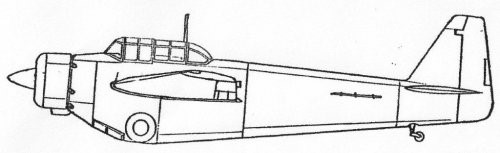
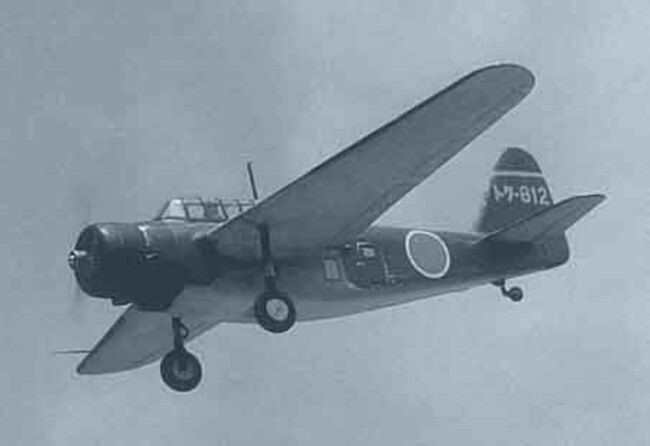
Kyushu Q1W1 Tokai / Eastern Sea

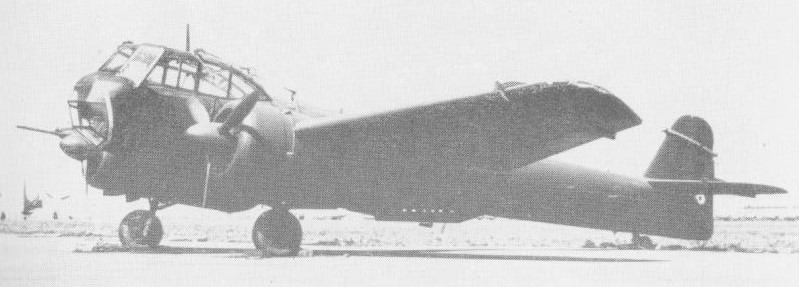
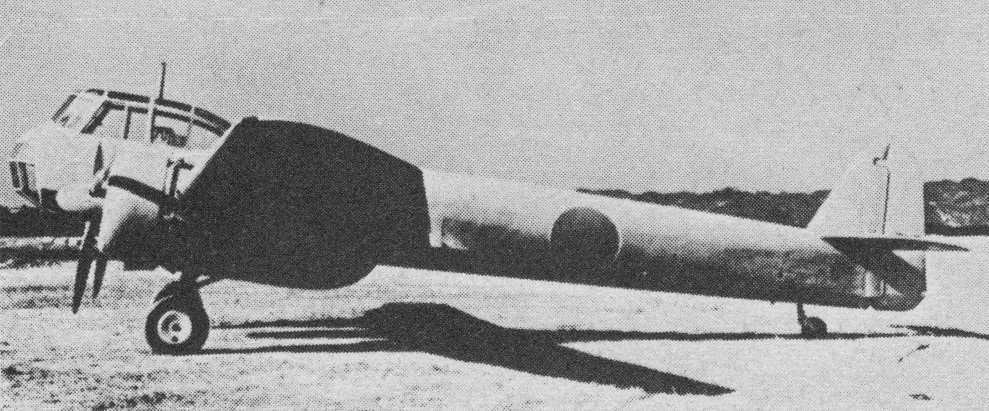
Built as an anti-submarine patrol aircraft for home defense, the Q1W1 was mentioned in a Japanese Navy delivery schedule directed to the manufacturer that was captured in 1944 and received the allied code name ‘Lorna’. It wasn’t spotted in action until 1945.

Kyushi built 153 of the Q1W1 Tokai during the war (allied codename Lorna).

Some Tokais were equipped with crude forms of radar and submarine detection gear.

Engines: 2 x Hitachi Tempu 31, 610 hp
Wingspan: 52 ft 6 in
AUW: 10,582 lb
Max speed: 200 mph at 4396 ft
Ceiling: 14,730 ft
Range: 914 miles
Armament: 1 x 20mm cannon, 1 x 7,7mm mg
Bombload: 1100 lb
Crew: 3

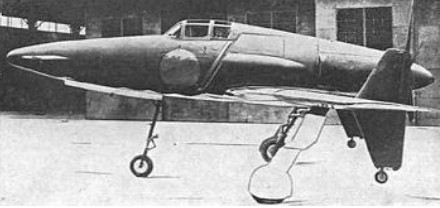
Kyushu J7W Shinden

J7W1

Towards the end of World War II the Japanese developed a canard fighter design which was the only such aircraft ever ordered into mass production. The machine was conceived in 1943 by Captain Masaoki Tsuruno, an Imperial Japanese Navy technical officer, who planned a jet powered high performance interceptor to counter the growing effectiveness of American air power in the Pacific. Three glider prototypes were built by the Dai lchi Kaigun Koku Gijitsusho (First Naval Air Technical Arsenal). They performed well, so in 1944 the Kyushu Hikoki company was commissioned to finalize the interceptor design. The Kyushu J7W Shinden (Magnificent Lightning) was powered by the 2130 hp Mitsubishi MK9D radial engine mounted amidships driving a six bladed pusher propeller through a long transmission shaft. It was armed with four 30 mm cannon and a projected maximum speed 0f 750 kph (466 mph) and a maximum operating altitude 0f 12,000 m (39,370 ft). The Japanese Navy ordered the Shinden into mass production long before the first prototype was ready. Nakajinia and Kyushu tooled up for but the first prototype did not fly until 3 August 1945, 12 days before the Japanese surrender.

Speed: 466 mph
Range: 528 miles
Crew: 1
Armament: 4 x 30mm cannon
Bombload: 4 x 66 lb or 132 lb bombs

Kokusai Ki-76 / Nippon Ki-76

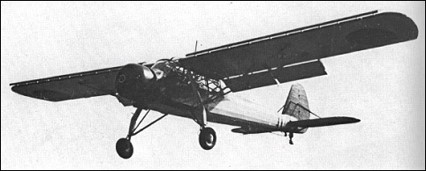
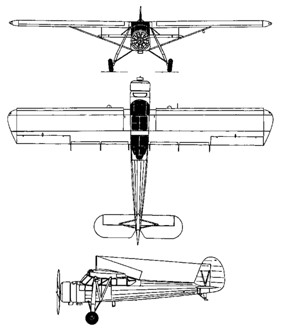
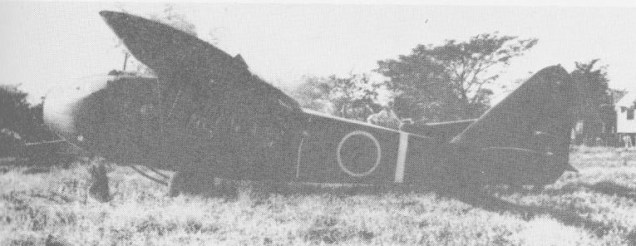
In 1940, the Imperial Japanese Army Air Force ordered the Nippon Kokusai Koku Kogyo to produce an artillery spotting and liaison aircraft. The resulting Ki-76, or Liaison Aircraft Type 3 (in Japanese: 三式指揮連絡機), was inspired by, and similar to, the German Fieseler Fi 156 “Storch”, although not a direct copy. A high-winged monoplane with a fixed tailwheel undercarriage, the Ki-76 used Fowler flaps, and was powered by Hitachi Ha-42 radial engine.

First flying in May 1941, the Ki-76 proved successful when evaluated against an example of the Fi-156, and was ordered into production as the Army Type 3 Command Liaison Plane in November 1942. 937 including a single prototype were built.

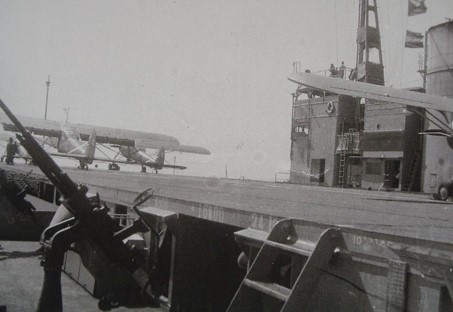
The Ki-76 remained in service as an artillery spotter and liaison aircraft until the end of the war. Ki-76s were also used as anti-submarine aircraft, operating from the Japanese Army’s escort carrier, the Akitsu Maru, being fitted with an arrestor hook and carrying two 60 kg (132 lb) depth charges.

Kokusai Ki-76 spotter planes on deck of Imperial Japanese Army landing vehicle carrier Akitsu Maru

The Allied reporting name was “Stella”.

Some were used by the Royal Thai Air Force.

Ki-76
Engine: 1 × Hitachi Ha42, 231 kW (310 hp)
Propeller: 2-bladed fixed-pitch
Wingspan: 15 m (49 ft 3 in)
Wing area: 29.4 m2 (316 sq ft)
Length: 9.65 m (31 ft 8 in)
Height: 2.9 m (9 ft 6 in)
Empty weight: 1,110 kg (2,447 lb)
Gross weight: 1,530 kg (3,373 lb)
Max takeoff weight: 1,623 kg (3,578 lb)
Maximum speed: 178 km/h (111 mph, 96 kn) at sea level
Range: 750 km (470 mi, 400 nmi)
Service ceiling: 5,630 m (18,470 ft)
Guns: 1× 7.7 mm (0.303 in) machine gun in rear cockpit
Bombs: 2× 60 kg (132 lb) depth charges (some variants)
Crew: 2

Kokusai Ku-8

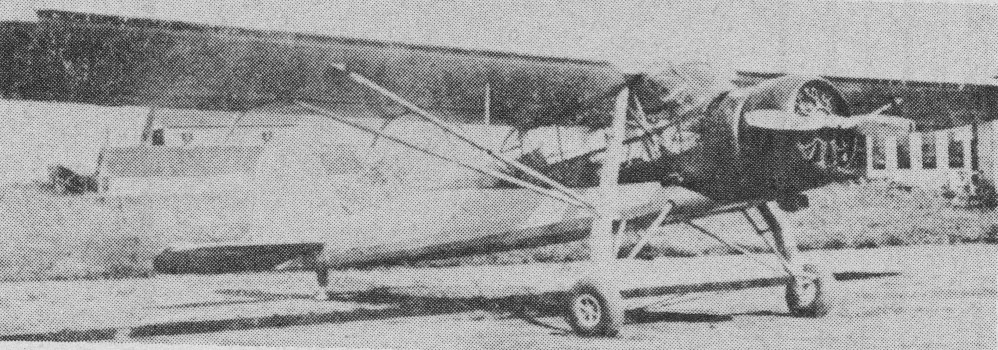
Near the end of 1941 one Ki-59 was modified into a glider with the removal of the engines and the landing gear replaced by under-fuselage skids. It was designated the Ku-8-I or Army Experimental Glider. This was further developed as the Ku-8-II or Army Type 4 Large Transport Glider which became the only operationally-used Japanese assault glider. It was named ‘Goose’ by the Allies but subsequently changed to ‘Gander’.

Carrying a crew of two and 15-20 armed troops, the Ku-8 jettisoned its main undercarriage after take-off, landing on fixed under-fuselage skids. The tail wheel was also fixed. Small vehicles or artillery pieces, when carried, were loaded from the front, the whole nose section hinging to starboard. Troop entry was via the outward opening door in the fuselage side.

Variants:

Ku-8-I (Army Experimental Glider)
Experimental conversion to glider configuration.

Ku-8-II (Army Type 4 Large Transport Glider) (“Gander”)
Assault-glider variant.

Span: 75 ft 0 in
Crew: 2
Payload: 15-20 troops

Kokusai Ki.105

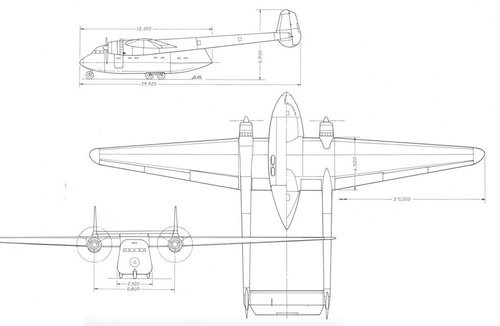
The Ki-105 Ohtori, (‘Phoenix’, allied codename Crane) was a project in the last months of the Pacific War. With Allied attacks on ports and shipping, Japan’s sources of oil to fuel its defensive fighters were drying up. To meet the demand for aviation fuel, the experimental Kokusai Ku-7 transport glider was developed into a powered version for use in transporting fuel from the oilfields still held in Sumatra to Japan.

This required a range of 2500km, and to achieve this the Ki-105’s engines drew on the transported fuel, and used 80% of it to reach Japan (plus what it used to reach Sumatra unloaded). Japan developed a process to make gasoline from pine tree oil, which saw whole forests destroyed to fill the tanks of a few fighter aircraft.

The Ku-7 Manazuru were modified by fitting them with engines, which were designated the Ki-105 Otori (鳳 “Phoenix”). Ku-7-II was the original designation for the Ki-105. Intended for use as fuel transports, only nine, of 300 ordered, were produced before development priorities were shifted elsewhere.

Engines: 2 x Mitsubishi Ha-26-Il, 940 hp (700 kW)
Wingspan: 35.00 m / 115 ft 10 in
Length: 19.92 m / 65 ft 4 in
Height: 5.56 m / 18 ft 3 in
Max take-off weight: 12,500 kg / 27,558 lb
Normal payload: 3,300 kg / 7,300 lb
Cruising speed: 220 km/h / 137 mph / 120 kn
Maximum range: 2,500 km / 1,600 mi / 1,300 nmi
Crew: 3

Kokusai Ku-7

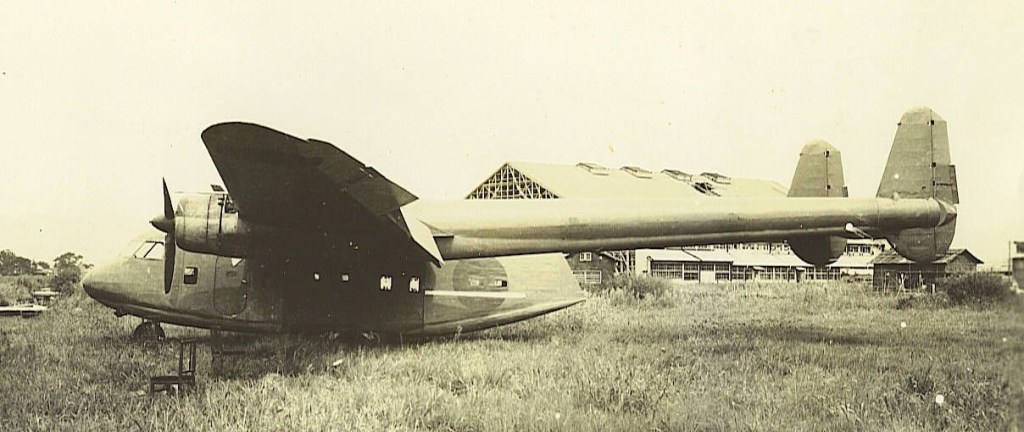
The Kokusai Ku-7 Manazuru (真鶴 “white-naped crane”; Allied code-name Buzzard) was a large experimental twin boom Japanese military glider.

An enlarged version of the earlier Maeda Ku-1 glider, it was developed during 1942. The use of a twin boom design allowed for a large square cargo door, which meant that the aircraft was capable of carrying either 32 soldiers, 7600 kg of cargo or even a light tank.

First flown on 15 August 1944, it required a powerful towing aircraft, either the Nakajima Ki-49 or the Mitsubishi Ki-67, which were in short supply. As a result, the aircraft were modified by fitting them with engines, which were designated the Ki-105 Otori (鳳 “Phoenix”). Ku-7-II was the original designation for the Ki-105.

Only two Ku-7 Manazuru were built.

Ku-7
Wingspan: 34.75 m (114 ft 0 in)
Wing area: 119.7 m2 (1,288 sq ft)
Aspect ratio: 10.8
Length: 19.5 m (64 ft 0 in)
Empty weight: 4,536 kg (10,000 lb)
Gross weight: 12,000 kg (26,455 lb)
Never exceed speed: 354 km/h (220 mph, 191 kn)
Maximum towing speed: 201 km/h (125 mph; 109 kn)
Crew: 2
Capacity: 32 troops, equipped / 8 short tons (7,300 kg) tank / 75 mm (3.0 in) howitzer with 4 short tons (3,600 kg) tractor / 7,464 kg (16,455 lb)

Klimov M-120

The Klimov M-120 was a Soviet prototype 18-cylinder liquid-cooled inline aircraft engine designed during the early years of World War II. Testing did not go well and it was cancelled in 1942.

The M-120 was developed by arranging three Klimov M-103A cylinder blocks in an inverted ‘Y’ configuration, driving a common crankshaft. It began development in 1938 and manufacture of five prototypes began in late 1939. The first prototype was completed on 30 October 1939 and began bench tests the next year. Two M-120TKs were flown in a prototype Ilyushin DB-4 bomber in November 1940. It was submitted for its State acceptance trials in August 1941, but the main connecting rod and the supercharger both broke down and the tests were not completed. The project was cancelled in 1942.

Variants:
M-120
1,600 hp (1,193 kW), weight of 850–895 kg (1,874–1,973 lb).
M-120TK
1600 hp, weight of 950 kg (2,094 lb), fitted with turbo-supercharger.
M-120UV
1,800 hp (1,342 kW). Version with a long shaft to the remote reduction gear.
M-120UV-TK
A 1940 project to combine the two variants.

Specifications:
M-120TK
Type: liquid-cooled, 18-cylinder, three-block inline engine
Bore: 148 mm (5.8 in)
Stroke: 170 mm (6.7 in)
Displacement: 54 l (3,295 cu in)
Dry weight: 950 kg (2,090 lb)
Supercharger: single stage, two-speed geared
Cooling system: liquid
Power output: 1,600 hp (1,193 kW)
Compression ratio: 6.6:1