The McDonnell Aircraft Corporation was formed on 6 July 1939 by James S. McDonnell. Built Fairchild AT-21 gunnery trainers at Memphis, Tennessee, plant and designed XP-67 experimental twin-engined fighter in 1942. Developed first U.S. Navy twin-jet fighter, FH-1 Phantom I, which was first flown January 26,1945. Enlarged version was F2H Banshee, flown January 11,1947. F3H Demon single-engined jet fighter, maiden flight August 7,1951. XF-88 jet fighter for USAF cancelled 1950 but developed later as F-101 Voodoo, flown September 29,1954. F-4 Phantom II twin-engined missile-armed attack fighter flown May 27,1958, subsequently standard USAF, USN and USMC fighter, built also for reconnaissance and antiradar roles and widely exported; 5,057 built in U.S.A. up to June 1979, and production by Mitsubishi in Japan continued until 1981.
Merged with Douglas Aircraft Corporation Inc April 28,1967 to form McDonnell Douglas. Douglas files bankruptcy and was forced to sell at a knocked down price to McDonnell of St. Louis, which had been making handsome profits out of its F-4 Phantom, supplied to the air force in Vietnam.
German leaders were reluctant to supply the Royal Hungarian Air Force (Magyar Királyi Honvéd Légierő), MKHL, which was seen to be focused on home defence and the possibility of conflict with Romania. Adolf Hitler expressed this in early 1942 when Hungary requested German-built fighters. “They would not use the single-seaters against the enemy but just for pleasure flights!… What the Hungarians have achieved in the aviation field to date is more than paltry. If I am going to give some aircraft, then rather to the Croats, who have proved they have an offensive spirit. To date, we have experienced only fiascos with the Hungarians.”
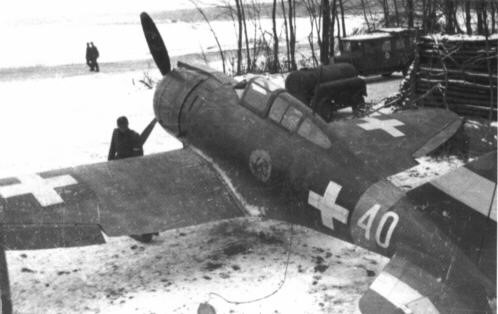
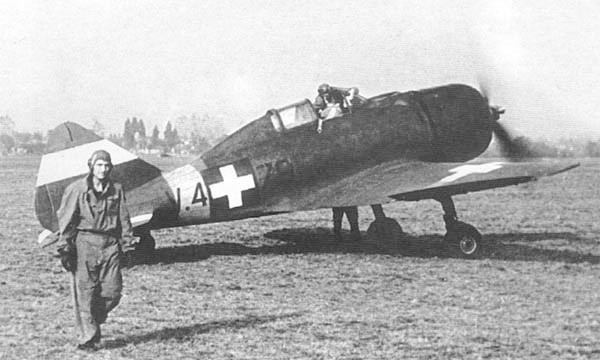
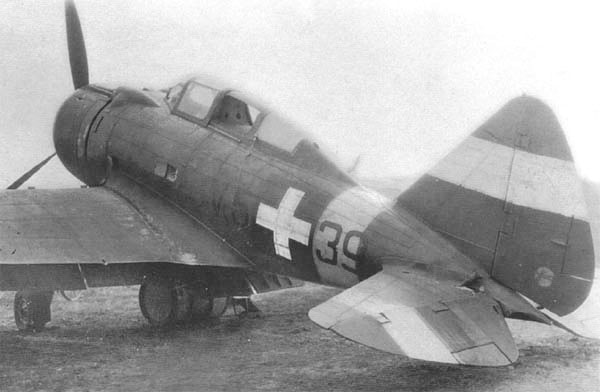
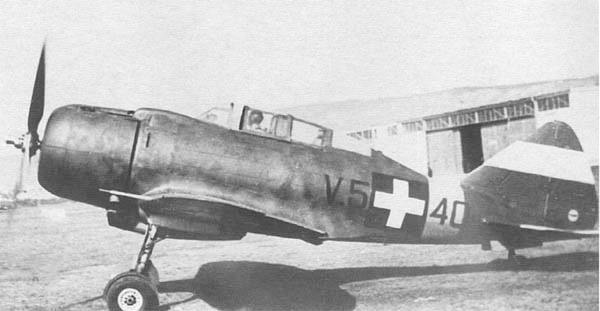
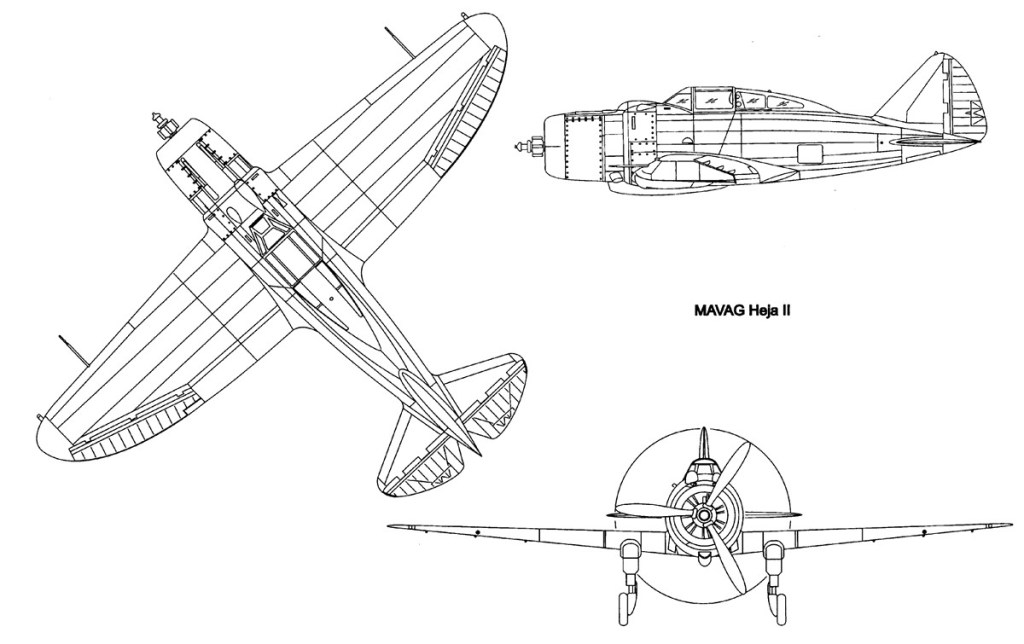
The MKHL consequently became a significant purchaser of Italian aircraft and was the main operator of the Re.2000. December 27, 1939 representatives of the company Reggiane and Head of the Air Force of the Hungarian Ministry of Defence signed a contract for delivery of 70 Re.2000 and agreed preconditions for the licensed production of the aircraft in Hungary producing a total of 200 aircraft, known as MÁVAG Héja (“Hawk”) II built between 1940 and 1942. According to other sources,170–203 aircraft were built.
In December 1939 seventy Reggiane Re.2000 fighters, purchased from Italy, were delivered to the Magyar Királyi Állami Vas-, Acél- és Gépgyárak, (“Royal Hungarian State Iron, Steel and Machine Works”), where they were modified into MÁVAG Héja I (“Goshawk I”) fighters.
The original Piaggio P.XI engines were replaced by the Hungarian-built Manfred Weiss WM K-14 driving Hamilton Standard three-bladed, constant-speed propellers. Using the WMK-14 allowed less dependence on spare parts from Italy. The WM K-14 was a licensed copy of the French Gnome-Rhône 14K engine that necessitated a 1-foot 3-inch (350 mm) lengthening of the fighters’ forward fuselage, to restore the center of gravity to a safe position. The Piaggio engine was itself also a copy of the Gnome-Rhône 14K, but less reliable than the original. On January 5, 1940 the Hungarians sent one WMK-14 to Italy to study, however, Reggiane did not want to make Re.2000 for Hungary with other than the original power plant.
In early 1940 the Hungarian delegation headed by engineer Tibor Takatsi was sent to Italy for the acquisition of the technical documentation for the license production of Re.2000. The Italians have provided all the necessary drawings by 11 October 1940.
The Hungarians at the same time held talks with Germany on the subject of joint construction of the Bf. 109. The interstate agreement to this effect was signed on June 6, 1941 however, the Hungarians could only count on 1943 to receive the Messerschmitt fighter for its air force. The Ministry of Defense was considering a draft MAVAG Hejja II as a transition to the 109.
Breda-Safat 12.7 mm machine guns were replaced by Hungarian Gebauer machine guns of the same calibre, with a rate of 1000 rounds per minute. Ammunition was a 300 round drum cartridge, under the hood. The modified Re.2000s had were named Hejja – Hungarian translation of the word Falco.
A decision was soon made to produce more Héja fighters under license in Hungary as the MÁVAG Héja II (Goshawk II). The new Héja II was entirely Hungarian with locally produced airframes, engines and armament. The new fighter differed from the Reggiane fighter in a number of ways. Armament was changed to twin 0.50 inch (12.7 mm) Gebauer fixed forward-firing guns in the upper nose with 300 rounds each. Length was 27 ft 6.25 inch (8.39 m), and maximum level speed was 301 mph (485 km/h) at 13,780 ft (4,200 m). Endurance was 2 hours and 30 minutes. Manfred Weiss originally planned to build 329 WMK-14B – 247 engines and 82 Hejja replacements. The project was completed by June 1941, and the first fighter Hejja II with the new motor was raised in the air the pilot Tasilo Seshenem (Taszilo Szechenyi). The first Re.2000, received new motor (V401), was successfully tested, and the Ministry of Defence ordered 100 aircraft, denoting them Hejja II. MAVAG planned to build two sets of 25, in the first (V4 + 71 – V4 + 95) and 75 in the second (V4 + 96 – V5 + 70).
The first MÁVAG Héja II took to the air on 30 October 1942, and in total MÁVAG built a further 203 Héjas for the Royal Hungarian Air Force. The last aircraft was completed on 1 August 1944 when production ceased. 98 were completed in 1943 and 72 in 1944 although the variant was regarded as no longer suitable for combat against the latest Soviet fighters. Hungary requested an additional 50–100 Re.2000 airframes made in Italy, as suitable engines and armament could be locally manufactured and other countries expressed interest, including Finland (100 examples), Portugal (50), Spain, Switzerland and Yugoslavia. However, no airframes were available.
After the first combat experience on the eastern front the Re.2000s were modernized. From August 1941 an 8 mm pilot armour was istalled, and an additional 100-liter self-sealing fuel tank istalled in the fuselage. The rear cabin windows were covered by sheet metal. The Ministry of Defence has also expressed the wish “… to MAVAG Hejja II was able to carry 250 or 500 kg bombs under the fuselage.” To do this it was necessary to completely revise the power circuit of the aircraft.
The first aircraft received from Italy were sent to Debrecen to strengthen home defences, as there was danger that the growing crisis over Transylvania could lead to a conflict with Romania. Conflict was avoided and the Hungarian Reggianes were used on the Eastern Front, in the war against the Soviet Union. The first seven Re.2000 were sent to the front on an experimental basis in autumn 1941. Flying alongside the Fiat CR.32s of 1/3 Fighter Company, the Reggiane pilots claimed eight kills, for one loss, during three months of combat, against Soviet Air Force.
Héja-II
The first series of 25 aircraft was started in November 1941. Engine WMK-14B was fitted with a three-blade propeller Hungarian variable pitch. The engine had a slightly larger diameter (3.2 m) than the Italian Piaggio.
MAVAG finished the first series Hejja II at the beginning of July 1942. In the production it was found that the Italian glued fuel tanks had a large percentage of leaks. Chief Engineer Takatsi urgently developed smaller fuel tanks for replacement. Now the plane had 22 tanks in the central part of the wing, each with a capacity of 20 to 25 liters. After minor modifications of aircraft of the first series ended in October 1942, the Hungarian Ministry of Defence had ordered 100 more Hejja II on September 29 before starting the laying of the second series of 75 aircraft. The third series began with the construction in September 1943. Aircraft of the second series was completed March 7, 1944, the latter two have been modified in a dive bomber. They got the brake bars on the wings and the ability to carry up to 500 kg bombs. Later this version was rebuilt on another aircraft (V6 + 60).
By April 1944, the MKHL still deployed four Héja IIs in 1/1 Fighter squadron and four Hejas II in 1/2, all of them based in Szolnok for home defence duties, along with about 40 Bf 109s and Messerschmitt Me 210s. The last sortie for the licence-built Reggiane Re.2000 occurred on 2 April 1944. That day, 180 bombers from the USAAF 15th Air Force, escorted by 170 fighters, bombed the Danube Aircraft Works and other targets in Budapest. The Hungarian fighter control centre in the Géllert hill, near Budapest, scrambled one wing of Hejas from 1/1 Fighter squadron, along with 12 Bf 109G-4/G-6S and a couple of Messerschmitt Me 210Cas-1s from the Experimental Air Force Institute (RK1). The Hungarians reported 11 aerial victories, of which six were confirmed, while USAAF pilots claimed 27 MKHL aircraft shot down. However, later records showed only two Honvéd pilots were killed.
By March 1944, imports of various parts and tools from foreign contractors began to fade. British bombers on the night of 3 to 4 April 1944 destroyed plants for the production of aircraft and engines, burned most of the warehouses and the end of April production stopped. Manfred Weiss were bombed on 27 July completely disabling the motor plant, assembly plant, and warehouses. In a fire 25-30 still unfinished third series of aircraft were destroyed.
The last Hejja II (V6 + 87) flew on 11 October 1944. Four or five aircraft remained on the factory airfield waiting flight in late December 1944 when Soviet troops were in the vicinity. Hungarian engineers blasted them with hand grenades. Total produced 203 fighter Hejja II.
The Royal Hungarian Air Force (RHAP) did not use MAVAG Hejja II on the Eastern Front. Most of these fighters was used as a trainer aircraft, even though quite a few Hejja II took part in the defense of the airspace of Hungary by the Allied bombers.
In late 1942, it was planned to arm the night fighter squadron 5/1 eight Hejja II. These aircraft were to have a German radio equipment; however, it remained in the plans.
On March 19, 1944 German armed forces entered into Hungary to prevent the collapse of the Axis. The Germans forbade test flights of aircraft built. This ban remained in force until April 1, when the 15th US Army Air started regular bombing Hungarian goals. Despite the attacks, and a critical shortage of spare parts, the Hungarians had commissioned 30 MAVAG Hejja II during April. The lack of parts has reached a critical stage, many built aircraft could not get off the ground.
Héja-II
On April 13, 1944 Budapest was attacked by American bombers, accompanied by P-38s from the 1st Fighter Group, led by Lieutenant Alford (Alford). Pilots of the R-38s reported the downing of two Re.2001 to the west of Lake Balaton, which were actually MAVAG Hejja II. The Americans will only hit one of them.
Air Defense Forces raised eight Hejja II 1/2. squadron from Szolnok to cover the south of Budapest. Four Hejja bombers attacked the 454th Group, but was interrupted by the attack, stumbled upon a dense barrage fighters. Two Hejja were damaged, and one was forced to belly land. The remaining four Hungarian fighter bombers were unable to catch up, faced with a P-47 325th Fighter Group. American pilots had reported a downed Re.2001 and one damaged. Again there is an error in the identification. Lieutenant Eugene Emmons won the victory, and the lieutenant. George Novotny content damage the second fighter. These losses are confirmed by the Hungarian side. In September, many of the half-Hejja II were still expecting different units and parts, compasses, variometers, and machine guns. Twenty fighters had no propellers, ten – without engines.
During the last months of 1944, 101/6 Training Squadron “Puma” has had six flying MAVAG Hejja II. The last official report, mentioning Hejja II was dated to February 22, 1945. It stated that Hejja II (V6 + 09) crashed during a training flight.
Royal Hungarian Air Force 2 Vadászszázad based at Szolnok Század Héja 1/2.Század ‘Keresztes pók 2/1.Század ‘Keresztes pók 1/1.Vadászszázad 2/1.Vadászszázad 1/1.Század Dongó,Önálló Vadász Osztály (OVO)
Héja II Engine: 1 × Manfred-Weiss 14kfs Mistral-Major, 694 kW (1030 hp) Wingspan: 11.00 m (36 feet 1 inch) Wing area: 20.40 sq.m Length: 8.39 m (27 feet 6 inches) Height: 3.10 m (10 feet 2 inches) Empty weight: 2,070 kg (4,563 pounds) Loaded weight: 2,520 kg (5,555 pounds) Maximum speed: 485 km/h at 4,200 m (301 mph at 13,780 feet) Range: 900 km (560 miles) Service ceiling: 8,138 m (26,700 feet) Max ceiling: 9400 m Maximum rate of climb: 750 m / min Endurance: 2 hr 30 min Armament: Two fixed forward-firing 12.7 mm (0.50 inch) Gebauer machine guns Crew: 1
Belford D. Maule, or “B.D.”, as everyone knew him, was born November 4, 1911 in Old Fort, Ohio to farming parents. Not caring much for farm life, he left at the age of 15 to live in Salladasburg, PA. with an uncle and aunt who owned a garage and tea room. There he demonstrated his mechanical ability by building a tractor, and by motorizing an ice cream freezer and an ice saw, among other things.
B.D. joined the Army when he was 18 and was assigned to the 19th Airship Company at Langley Field, Virginia. While working on dirigibles, he found time to design and build his first airplane, a single seat midwing monoplane powered by a Henderson 27 HP motorcycle engine, known as the M-1. Starting with the airplane on floats, and later on wheels at the Salladasburg farm, B.D. taught himself to fly. (Regulations weren’t as strict in those days.)
Following his stint in the Army, B.D. moved back to Pennsylvania and became a family man, marrying June Aderhold in 1934. June and B.D. located in Jersey Shore, Pennsylvania and built their own home there in 1936. Note that Jersey Shore is not only June’s birthplace but is also midway between Lock Haven (Piper Aircraft) and Williamsport (Lycoming Aircraft Engines). This was an area in keeping with B.D.’s interest in aviation. B.D. went to work for Lycoming, and in 1939 designed and built “the Hummer”, a low cost mechanical starter for light aircraft. (Many airplanes did not have electrical systems back then.) In 1940, the Maule family moved to Jackson, Michigan. Mechanical Products Company was formed to manufacture the Hummer starter (Piper and the Continental Engine Company had shown an interest). In 1941 the B.D. Maule Company was formed in Napoleon, Michigan to build a light aircraft tailwheel which B.D. had designed. The steerable, full-swiveling tailwheel, is still being manufactured by Maule, in an improved form. With the advent of World War II, the starter business waned, and tailwheels were in demand as well as subcontract work to support the war effort.
As a diversion during the latter part of the war, B.D. designed a man-powered glider with flapping wings, known as an ornithopter. He claims to be the first (and is probably the last) person to have successfully flown such a device.
In 1946, B.D. and June purchased a farm near Napoleon, Michigan. With the help of their two oldest children, they converted it to an airport. In the process, they had the dubious honor of leveling a dog race track which had been operated by Al Capone. The airport flourished, being used for flight training during the initial post-war aviation boom.
Maule Aircraft Corporation formed by B. D. Maule at Jackson, Michigan, to manufacture M-4 four-seat light aircraft; production transferred to Moultrie, Georgia, September 1968. The airplane manufacturing business that received its first FAA type certificate in 1961. Prototype flown September 8, 1961, produced as M-4 with 145 hp Continental engine, as M-4 Rocket with 210 hp Continental. M-4 Strata-Rocket with Franklin engine led to M-5-220C Lunar Rocket, flown 1 November 1971, while M-4 Rocket became M-5-210C; M-5- 235 with 235 hp Lycoming 0-540 engine also built. Current name Maule Air Inc., offering large range of four- and five-seat lightplanes for recreational and business uses in the M-7, MT-7 and MXT-7 series. Over 2,000 Maule aircraft built since 1961.
The Maules are built on the Air Force’s abandoned Spence Air Base, just east of Moultrie, Georgia. They had been building airplanes for years in Jackson, Michigan, when in 1972, a particularly severe winter convinced them to seek a warmer haven. Moultrie was looking for industry. The first production model, known as the Jetasen M-4 was delivered in April 1962. Then, as now, all Maules are constructed in Moutrie, Georgia.
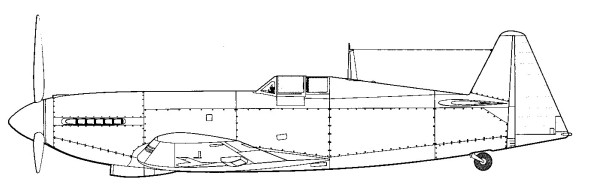
At the outset Martin considered the best decision was to build a machine virtually identical with the M.B.3, but with a Rolls Royce Griffon engine. By the end of 1942 the Griffon engined M.B.4 had been almost finished as far as drawings were con¬cerned, but it contained a number of unsatisfying compromises. Early in 1943 Martin took the decision to start again and, while making the maximum possible use of MB.3 philo¬sophy and hardware, create an optimised fighter that would have no obvious shortcomings.
The wing of the M.B.5 was similar to that of the M.B.3, though Martin reduced the armament to four 20mm Hispanos, with his own patented flat ¬feed mechanism, which met the F.18/39 specification. The wing was simpler than that of the M.B.3, with light alloy sheet structure except for the spar booms which were of laminated high ¬tensile steel. The fuselage philosophy was the same but the shape was considerably different, and the steel ¬tube longerons were joined by flanged sleeves to which the diagonal, vertical and transverse struts were secured by fork ends held by close tolerance tapered bolts. Light alloy secondary structure supported heavy section rubber mouldings against which the large skin panels were pressed by Dzus fasteners. Control surfaces were metal skinned and driven by spring tabs, and the landing gear, brakes and up/down flaps were worked by compressed air (not at 60 lb/sq in but 350, giving a lighter system).
The construction of the instrument panel itself was arranged for ease of maintenance. Mounted on a sub frame, it was designed to hinge open for access to the interior and the instruments themselves. The position of the cockpit afforded an excellent view over the nose and wing leading edges. The cockpit also included a full floor, which in 1944 was rather novel.
The pilot sat on fuel tanks of 70 and 130 Imp gal, and the Griffon 83 engine had its air intake just behind the spinner of the Botol six blade contra rotating propeller, and was cooled by a three unit radiator inter-cooler, main cooler and oil cooler ¬in a neat diffuser duct under the rear fuselage. The propeller shafts were mounted coaxially, the drive for the forward one passing through that for the rear. Contra rotation had been chosen to provide greater performance at altitude, and to permit higher power at take off than would otherwise have been feasible.
A Rolls Royce Bendix Stromberg injection carburettor was adopted, the long carburettor air intake extending up to the spinner and forming an integral part of the engine cowling; vertical ‘splitters’ ensured stiffness and reduced turbulence.
The three cooling radiators needed were placed in a diffuser duct under the rear fuselage. In the forward position was the intercooler, aft of this the main radiator and finally the oil cooler. This arrangement ensured that, when warming up, the heat from the main radiator prevented coring of the oil, and the full oil pressure was obtained within a few minutes of start¬up. Fuel was contained in two tanks of 70 and 130 imp. gallons (318 and 590 litres) situated one ahead of and one behind the pilot.
The MB.5 prototype received the serial R2496, originally allotted for the second MB.3 (which was never completed). On the morning of May 23, 1944, R2496 was ‘knocked down’ at Denharn in about an hour, placed aboard a Queen Mary road transporter and taken to Harwell.
Reassembled in just over an hour, the MB.5 was inspected and flown for the first time in the afternoon by Captain Bryan Greensted, Rotol’s chief test pilot, who had been seconded to the programme by MAP. During the company testing Greensted found the MB.5 well thought out and was impressed by all but the directional handling. Fin and rudder modifications were swiftly made involving an extension to the fin leading edge and a larger and taller rudder. With these modifications, W/C Maurice Smith, who later briefly flew R2496 for Flight magazine found that the handling was “pleasing in every way”.
Towards the end of October 1944, after 40 hours in the air, R2496 was taken to Farnborough for demonstration by Bryan Greensted before visiting VIPs, including Winston Churchill. During this display the Griffon failed when a piston shattered. As his cockpit filled with smoke, Greensted reached up to jettison the canopy, while travelling at a speed of over 400mph (644km/h). As he did so, his arm became caught in the slipstream and was very severely dislocated. Meanwhile the canopy had clipped the tailplane causing slight damage. Greensted elected to remain aboard, however, and managed a deadstick landing. As a result of this experience, the offending hood jettison lever was repositioned.
In early 1946, with 80 hours 45 minutes flown, the MB.5 was handed over to A&AEE at Boscombe Down. The first testing report, on maintenance and accessibility was issued on March 1. Prominently at the beginning it stated, “It is considered that the general design and layout of the Martin Baker 5 is excellent, and is definitely better from the engineering and maintenance aspect than any other similar type of aircraft”. It went on “The layout of the cockpit might very well be made a standard for normal piston engined fighters” and “The time necessary for a quick turn around… would appear to be very low when compared with existing types of aircraft”.
Flight test comments passed by Boscombe praised R2496 as virtually viceless. It was found that the contra prop simplified take off and gave an immediate and powerful response to engine power changes, over a very wide speed range. Minimal engine vibration was experienced, and the cockpit noise level was low. Both the rudder and elevators were light, and control was exceptional especially near the stall, which was very gentle. Use of the trimmer was found necessary only infrequently; even at low speed with flaps down, when the aircraft became mildly tail heavy, it was not sufficient to warant moving the trimmer from its usual neutral position. The only mildly adverse comment was over a slight lateral instability caused by comparatively ineffective ailerons the rate of roll was mediocre but could be improved by use of rudder. Lt Cdr Eric M Brown, doyen of Service test pilots described R2496 as “superb”.
Flaps of the split trailing edge type are either selected up or down, no inter¬mediate position being provided, so a take off is made without flap. The mini¬mum take off for the M B V is 420yd over 50ft in zero wind. Wheels retract quickly, the only indi¬cation that they have moved and locked being that given by the warning lights. The throttle lever, placed above the pitch control, has a long quadrant and moves smoothly and positively. The pitch lever is, by comparison, rather sensitive, and a big change in rpm results from quite a small lever movement. Engine speed is controlled over a range of roughly 1,800 rpm to 3,000 rpm, and the blades cannot be feathered. At about 8,000 ft the M B V cruised along very sweetly at about 315 mph indicated with 4 lb boost and 2,250 rpm. This is somewhat less than the recommended cruising power and the speed is at least 100 m.p.h. less than the maximum for this height.
All of the controls have spring tabs.
With flaps down, engine idling and attitude very slightly nose up, the con¬trols became pretty sloppy at 110 mph indicated at 5,000ft and the aircraft stalled very gently away to the left at just over the 100 mph.
The sole prototype MB.5 passed from hand to hand attracting praise wherever it went. In June 1946, it was demonstrated at Farnborough by S/L Jan Zurakowski. After this, the MB.5 returned to Boscombe, where the Commandant, Air Commodore Sir Henry Paterson Fraser, flew it. He found R2496 free of vice. The MB.5 was popular and unique. Later, R2496 was taken to the newly acquired Martin Baker airfield at Chalgrove. There, it was used to examine oiling problems in the propeller translation bearing between the pair of blade sets.
Martin took out a patent for the automatic oiling unit developed as a result of these trials. It continued in use in the de Havilland contra rotating propellers of the Avro Shackleton. The MB.5 was maintained in an airworthy condition, flight testing continuing into 1947, the sole prototype being scrapped thereafter.
Engine: One Rolls-Royce Griffon Mk 83 piston engine with two stage, two speed supercharger Maximum power, 2,340 h.p. at 750ft (M gear), 2,120 h.p. at 12,250ft (S gear) with 25 lb/sq in boost Max speed: 460mph (740kph) at 20,000 ft (740 km/h at 6,096m) Stalling speed (assumed ISA, SL) 95 mph (153 km/h) Range at 225 mph (362 km/h) 1,240 miles (2,000 km) Service ceiling: 40,000ft (12,192m) Empty weight 9,233 lb (4,188kg) Empty wt, equipped 9,345 lb (4,230kg) All up wt: 11,500 lb (5,216kg) Wingspan: 35ft (10.6m) Length: 37ft 9in (11.5m) with final tail unit Height: 15ft (4.5m), with final tail unit Wing area, 262.64 sq ft (24,40 sq.m) Wing loading: 44 lb/sq ft Armament: Four 20mm Hispano cannon with 200 rpg.
The second of the three MB.3 prototypes ordered by MAP, R2496, was intended to be Griffon powered, and was referred to as the MB.4. At the time of R2492’s crash, the necessary drawing amendments for the MB.4 were complete and manufacture had started. It was intended to enter the competition against Specification F6/42 but the attempt was unsuccessful. However, Martin felt that he could improve on the MB.3/MB.4 concepts. R2496 was left uncompleted and work on the third intended aircraft, R2500, was not begun. Early in 1943, the difficult decision was taken to start afresh, tempered by the knowledge that the firm had received verbal assurances from MAP that if a new fighter design were produced, a contract for one prototype would be awarded, again to Specification F5/39. With the then hand built nature of a prototype, in an experimental shop, with design adjustments made on the spot, and drawings brought into line afterwards, made resources available out of all proportion to the effort. By 1943, when work on the MB.5 had begun.
With the Spitfire and Hurricane in widespread service, the Air Ministry contemplated their eventual replacement. Specification F18/39 issued on May 1, 1939, called for a single seat interceptor armed with two cannon or eight machine guns, capable of 400mph (644km/h) at 12,000ft (3,658m) at an all up weight of 15,000 lb (6,800kg), and with a ceiling of 35,000ft (10,668m).
In the summer Martin Baker received an order for three prototypes of Martin’s new MB.3 at a total contract price of £64,000. With war imminent Martin had been asked to ‘come aboard’ and produce prototypes to contract as had established contractors in the earlier F5/34 submission.
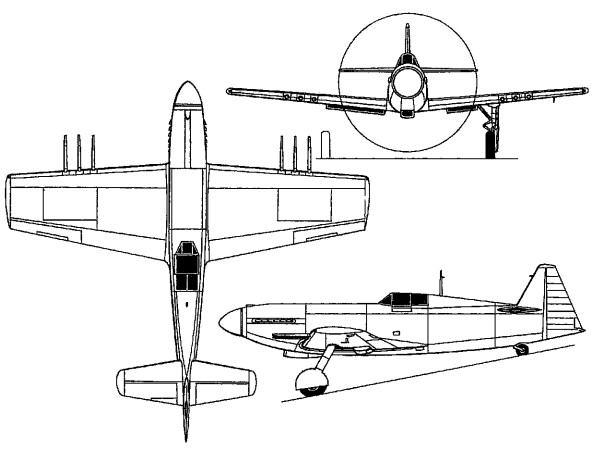
In its fuselage structure the MB.3 was an advance on its predecessors. The skinning was of stressed light alloy and flush ¬riveted except where the numerous inspection panels were situated. The wing was completely new, its basis being a D section torsion box. A substantial light alloy spar web was adopted, with upper and lower spar booms made from laminated high tensile steel strip, the number of laminations decreasing towards the tip. The structure was covered with heavy gauge flush riveted light alloy stressed skin. The fin was reminiscent of that fitted late in the life of the MB.2. All control surfaces were fitted with torsion bar spring tabs to enhance manoeuvrability.
Martin had intended a Rolls Royce Griffon as the powerplant, this being the engine specified in F18/39. As an interim measure, the company was supplied with a Merlin ballasted to simulate the Griffon. With the advent of the Napier Sabre, which promised to give over 2,000hp (1,492kW), a second option became available and in 1941 Martin Baker was awarded a revised contract for a Napier Sabre II version of the MB.3. The Sabre drove a de Havilland three bladed constant speed propeller. Shallow ducted radiators were incorporated under the left wing (oil cooler) with the main radiator under the right wing.
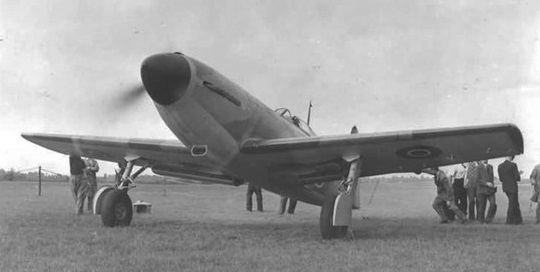
The main inward retracting undercarriage of the MB.3 had an track of 15ft 5ins (4.7m). The wheels were raked so far ahead that the threat of a nose over was minimal. Undercarriage operation was by 60 lb/sq.in (27kg/2.5csq.m) pneumatic system. A second, lower pressure pneumatic system was used to operate the large split flaps which had no intermediate settings.
The intended armament consisted of six 20mm Hispano cannon, to have 200 rounds per gun. The armament was removed prior to flight trials and never tested.
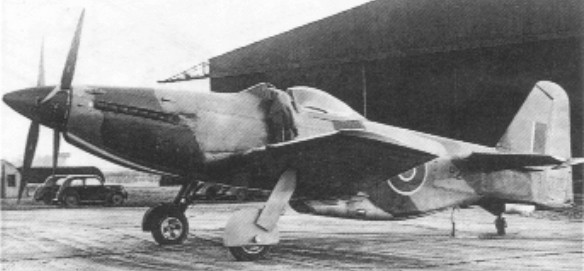
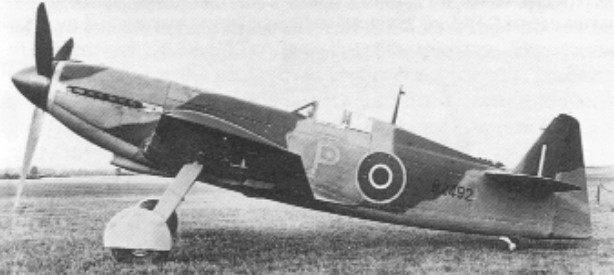
The prototype MB.3, R2492, emerged from Denham in the summer of 1942, the contract completion date having been set for the previous March. Initial taxiing trials were undertaken at Denham and demonstrated a very stable ride.
Martin received orders from the Ministry of Aircraft Production (MAP) to use RAF Wing in Buckinghamshire for flight testing and during August 1942 the MB.3 arrived at Wing in crates, Val Baker flying it for the first time on 31 August 1942. According to an eye witness, the MB.3 with its 24 cylinder sleeve valved Napier Sabre flew well for a short period but then had to make a hurried landing because of the threat of engine overheating due to inadequate radiator cooling.
In subsequent flights in early September, Baker found the MB.3 highly manoeuvrable. On September 12, 1942, Valentine Baker took off satisfactorily, but shortly afterwards the Sabre failed when a sleeve drive crank broke, resulting in immediate and total loss of power. Baker attempted a dead stick landing but after touching down in a small field, the MB.3 hit a tree stump and was destroyed; Baker was fatally injured.
After the loss of R2492, the MB.3 prototype programme came to a halt. Martin decided to start again with a new design. It had been by no means certain that the MB.3 would have secured a production contract.
Engine: One 2,020hp (1,506kW) Napier Sabre II 24 Cylinder H-¬type piston Max speed 430 mph (691km/h) Range 840 miles (1,351 km) Initial climb, 4,350 ft/mm (22,09 m/sec) Operational ceiling 34,500ft (10,515m) Empty weight 8,500 lb (3,855kg) All up weight 11,000 lb (4,989kg) Wnigspan 35ft 2in (10.7m) Wing area, 262.64 sq ft (24,40 sq.m) Length 34ft 1 in (103m) Height: 14ft 3in (4.3m) Armament: Six Hispano cannon intended.
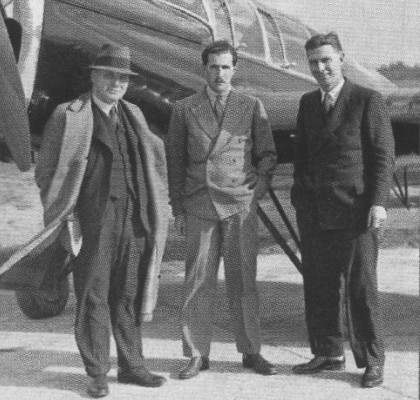
James Martin, Francis Francis, Capt Valentine Baker
Martin-Baker Aircraft was established on August 17,1934, when Mr James Martin joined forces with Capt Valentine Henry Baker (and Mr Francis Francis, who provided the finance) to form the new company at Higher Denharn near Uxbridge in Buckinghamshire. The three men all became directors of the firm, which initially operated under the name “Martin’s Aircraft Works”.
The first objective was to build the experimental M.B.1 two-seat light aircraft. The original offices and works buildings at Denharn were destroyed by fire on April 26, 1940, but by mid-1941, some new modern buildings had been built to replace them. A July 1941 Air Ministry report noted how the conduct of the company’s affairs was characterised by the usual indifference to accounting detail, often found when technical men with outstanding ideas were financed by a wealthy man, all of whom were following an ideal rather than making a profit. The Ministry found no evidence of slackness or extravagance at Martin-Baker, but an air of quiet efficiency about the offices and factory and all connected with them.
Martin was born in September 1893, Martin went on to become an engineer and inventor, designing and building a wide variety of machines when a teenage. In 1929 Martin established his own engineering firm but when he became chief designer and managing director of Martin-Baker in 1934, aviation became his chief interest.
Valentine Henry Baker was born in August 1888 and served with all three Services in the First World War (during which he was awarded the Military Cross and the Air Force Cross). In 1917 he became a flying instructor, and resulted in the establishment of his flying school at Heston, Baker’s students included several members of the royal family and Arny Johnson. In Martin-Baker his main job was company test pilot.
James Martin had evolved a method of steel-tube construction and built experimental MB.1 two-seat light aircraft to demonstrate construction system, flown March 1935. In 1935, with a company employing 35 people, James Martin called for the latest Air Ministry Specification F5/34, to find out what the RAF would require of a new interceptor fighter. Private venture MB.2 eight-gun fighter with Napier Dagger engine flown 3 August 1938. MB.3 experimental fighter with Napier Sabre first flown 31 August 1942, followed by MB.5 with Rolls-Royce Griffon 83 driving contrarotating propellers, which made maiden flight May 23,1944.
Martin-Baker became a leading manufacturer of ejection seats, having made first live firing on May 11,1945.
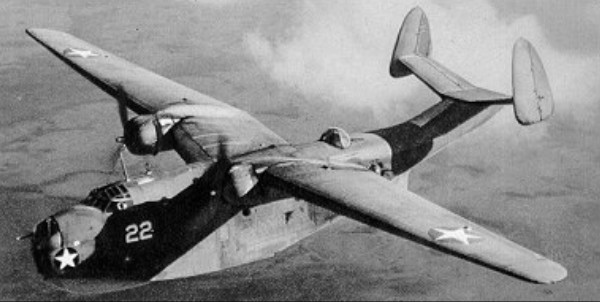
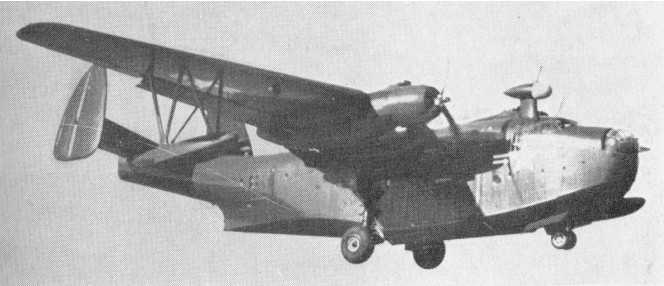
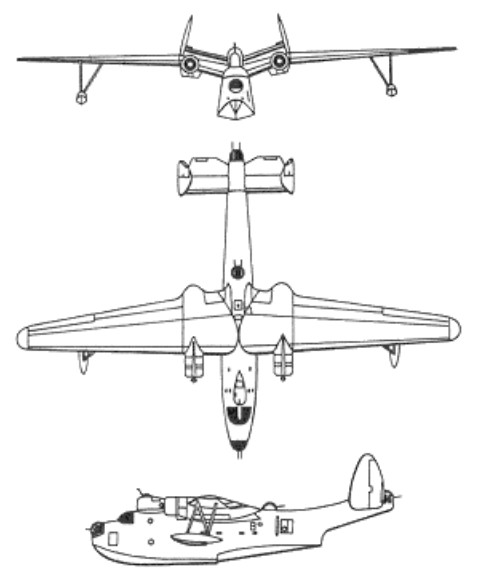
The XPBM-1 prototype flying-boat patrol bomber was originally ordered by the US Navy in 1936. Before it was built, a quarter-size prototype (Model 162A) was constructed and flown. The full-size aircraft was flown for the first time in February 1939.
The production PBM-1 – fitted with two 1,192 kW Wright R-2600-6 radial engines, a dihedral tail and retractable wingtip floats – was ordered in 1938 and 20 of these went into Navy service in 1941. A single XPBM-2 was ordered at the same time as a long-range version specially strengthened for catapult take-off. The PBM-3, with two 1,267kW Wright R-2600-12 engines, was ordered in quantity in 1940 and deliveries began in 1942. In this version the crew was increased from seven to nine, the armament was revised and the fuel capacity increased. The retractable wingtip floats of the PBM-1 were replaced by fixed floats. In 1942 the PBM-3 was adopted also as a naval transport carrying 20 passengers or 3,629-4,082kg of cargo (PBM-3R). Twenty-six PBM-3B patrol bombers were also used by RAF Coastal Command, delivered under Lend-Lease. At the end of the war a specialised anti-submarine version was also developed as the PBM-3S.
PBM-5A
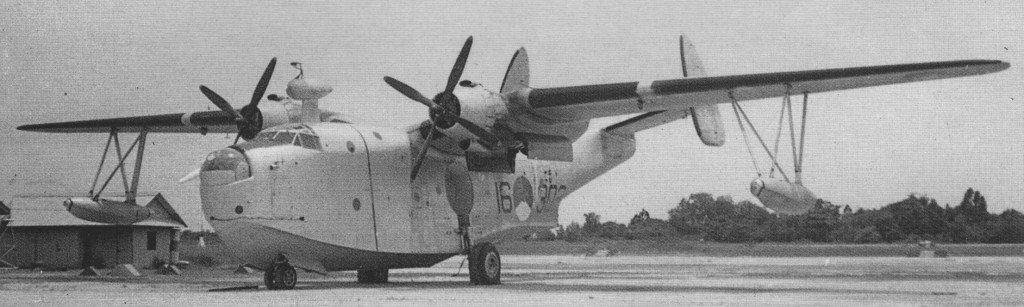
The final two production versions of the Mariner were the PBM-5 and PBM-5A, powered by 1,565kW R-2800-22 and R-2800-34 engines respectively. The last PBM-5A was delivered to the US Navy in April 1949. This version was basically an amphibious version of the PBM-5 and ended its career as a general utility aircraft.
PBM-5A Mariner
630 PBM-5 flying boats were built, followed by 36 PBM-5A amphibians, used for air-sea rescue duties, primarily by the U.S.C.G.
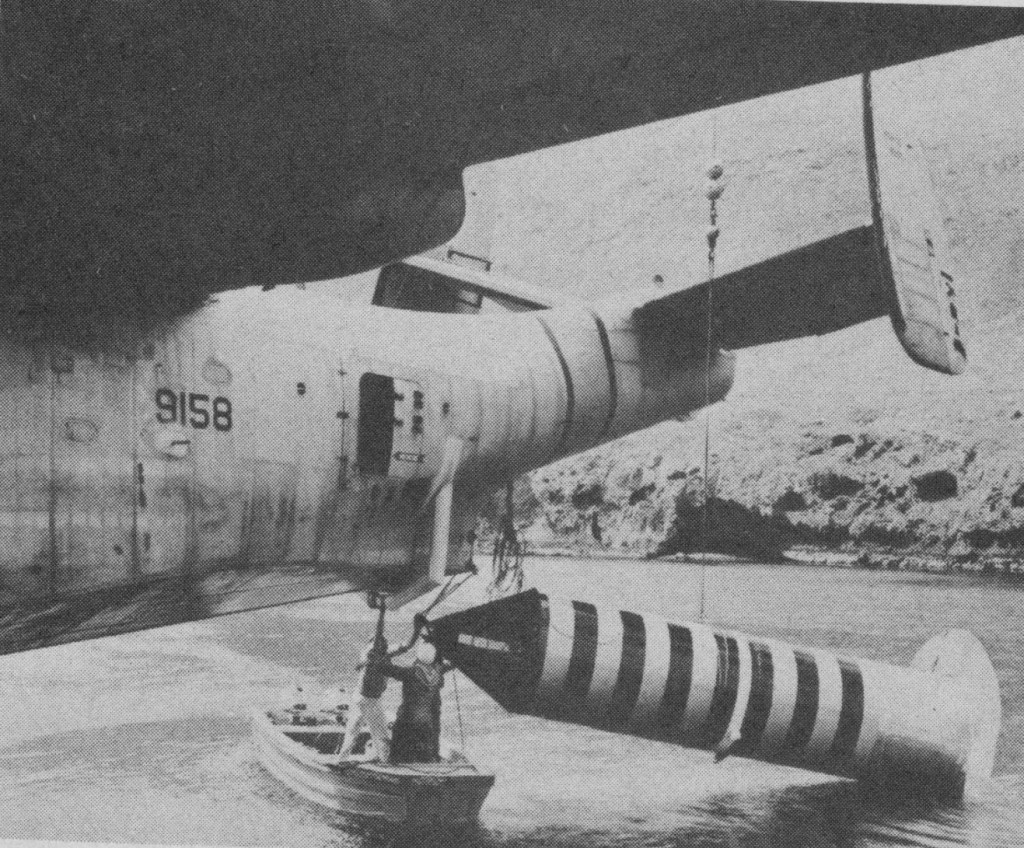
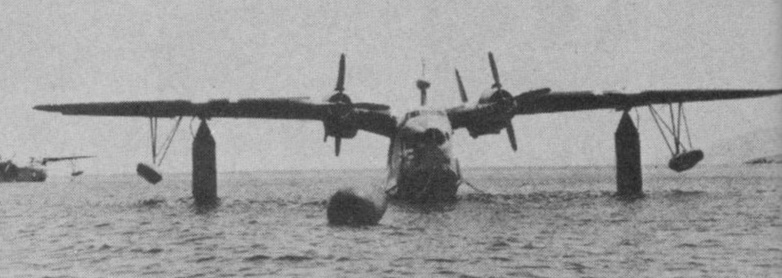
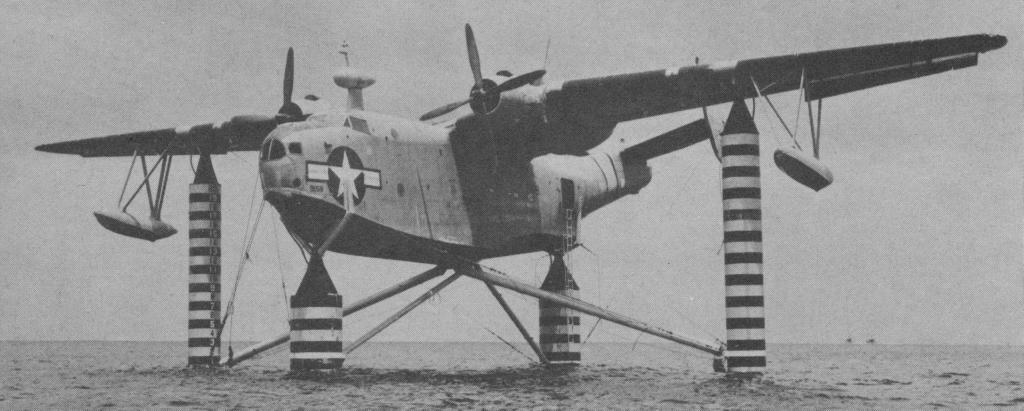
In 1963 the US Navy tested vertical floats designed by General Dynamics/Convair, on a PBM-5.
These made the seaplane a stable working platform for anti-submarine warfare with little motion from 4-5 ft waves.
Engines: 2 x Wright R-2800A-5B, 1250kW Max take-off weight: 25400 kg / 55998 lb Empty weight: 14660 kg / 32320 lb Wingspan: 36.0 m / 118 ft 1 in Length: 34.4 m / 112 ft 10 in Height: 8.4 m / 27 ft 7 in Wing area: 130.0 sq.m / 1399.31 sq ft Max. speed: 325 km/h / 202 mph Cruise speed: 240 km/h / 149 mph Ceiling: 6150 m / 20200 ft Armament: 8 x 12.7mm machine-guns, 2000kg of bombs Crew: 7
PBM-5A Mariner Air-sea rescue amphibian Engines: 2 x Pratt & Whitney R2800-34, 2,100 h.p. Wingspan: 118ft Length: 79ft. 10in Loaded weight: 60,300 lb Max speed: over 200 m.p.h. Ceiling: 20,200 ft. Max range: 2,900 miles at 143 m.p.h. Armament: (when fitted) 8x.50 in machine-guns Bombload: 4,000 lb
Martin PBM 3 D Mariner Engines: 2 x Wright R-2600-22 Cyclone, 1874 hp Length: 79.823 ft / 24.33 m Height: 27.493 ft / 8.38 m Wingspan: 118.012 ft / 35.97 m Wing area: 1407.931 sq.ft / 130.8 sq.m Max take off weight: 58009.1 lb / 26308.0 kg Weight empty: 33180.8 lb / 15048.0 kg Max. speed: 184 kts / 340 km/h Service ceiling: 19800 ft / 6035 m Wing load: 41.21 lb/sq.ft / 201.00 kg/sq.m Range: 1947 nm / 3605 km Crew: 8 Armament: 8x MG cal.50 (12,7mm), 3629kg Bomb./Depth Chrgs.
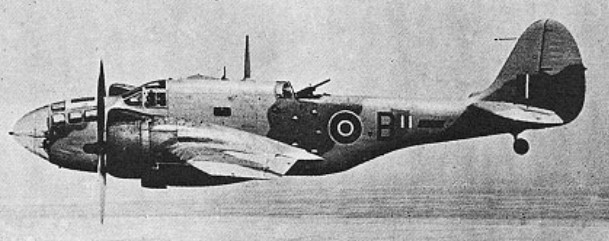
The Martin 187 was developed from the Maryland to specific British requirements. It differed primarily by having more powerful engines and a deeper fuselage to allow direct communication between crew members. Its narrow-section fuselage did make it virtually impossible for injured crew members to change positions in flight.
An order of 400 of these aircraft, named Baltimore by the RAF, was placed in May 1940, and following introduction of the US Lend-Lease Act two batches, of 575 and 600, were ordered in June and July 1941 respectively, and the full total of 1,575 aircraft was duly produced for the RAF.
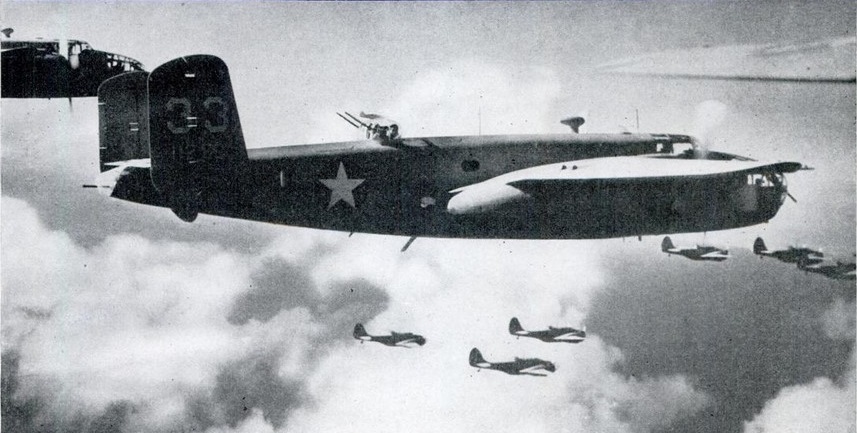
North American Mitchells and Martin Baltimores from Africa
This full total was not received, for some Mk III and Mk IIIA aircraft were lost during transatlantic delivery when two cargo ships carrying them were sunk. Initial deliveries of Baltimore Mk Is were made in late 1941, being issued first to Operational Training Units, and were followed by deliveries of Mk IIs in 1942 to Nos 55 and 223 Squadrons operating in the Middle East. All Baltimores were used operationally entirely in the Mediterranean theatre, proving to be effective day and night bombers. In addition to those used by the RAF, Baltimores were allocated by the RAF for service with the Royal Australian Air Force, Free French Air Force, Greek No. 13 (Hellenic) Squadron, Italian Co-Belligerent Air Force, and the South African, and Turkish air forces.
Martin 187 Baltimore Engines: 2 x Wright GR-2600-A5B Cyclone 14, 1637 hp Length: 48.507 ft / 14.785 m Height: 17.749 ft / 5.41 m Wingspan: 61.319 ft / 18.69 m Wing area: 538.523 sqft / 50.030 sq.m Max take off weight: 23198.8 lb / 10521.0 kg Weight empty: 15463.7 lb / 7013.0 kg Max. speed: 265 kts / 491 km/h Cruising speed: 195 kts / 362 km/h Service ceiling: 23294 ft / 7100 m Wing load: 43.05 lbs/sq.ft / 210.00 kg/sq.m Maximum range: 2433 nm / 4506 km Range: 940 nm / 1741 km Crew: 4 Armament: 8x MG cal.303 (7,7mm), 6x MG cal .30 (7,62mm), 907kg Bomb.
Baltimore Mk IV Engines: 2 x Wright R-2600-10 Cyclone 14 radial, 1238kW Max take-off weight: 10251 kg / 22600 lb Empty weight: 7013 kg / 15461 lb Wingspan: 18.69 m / 61 ft 4 in Length: 14.8 m / 48 ft 7 in Height: 5.41 m / 17 ft 9 in Wing area: 50.03 sq.m / 538.52 sq ft Max. speed: 491 km/h / 305 mph Ceiling: 7100 m / 23300 ft Range: 1741 km / 1082 miles

 All Aero