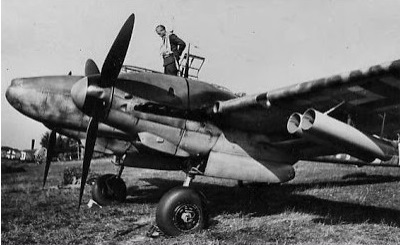
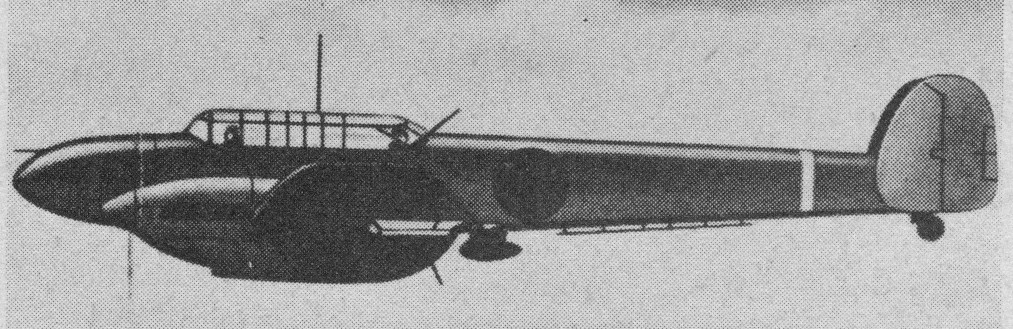
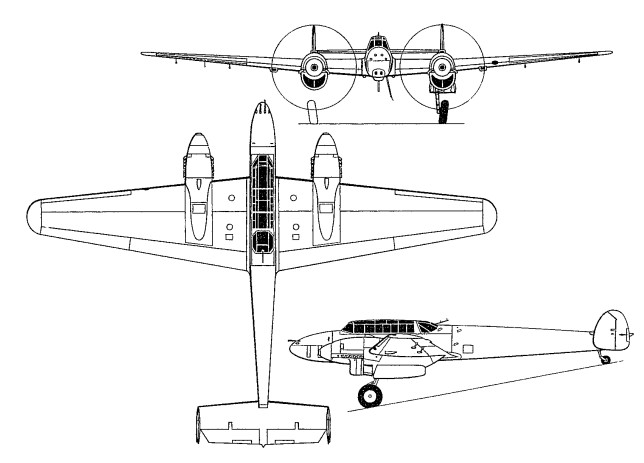
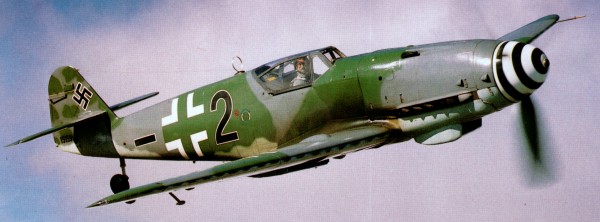
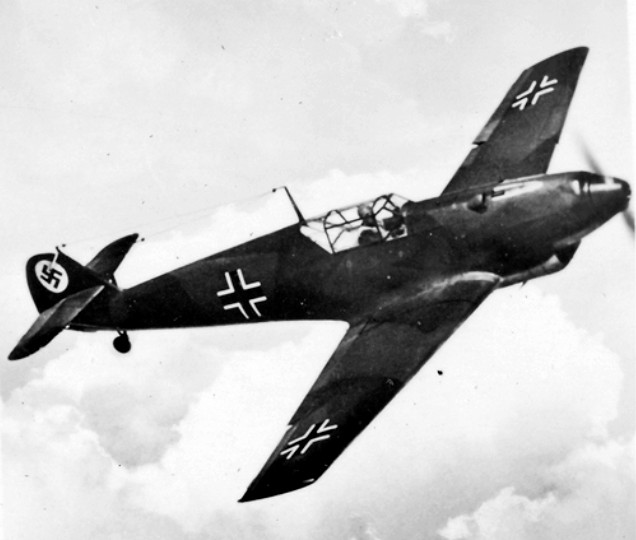
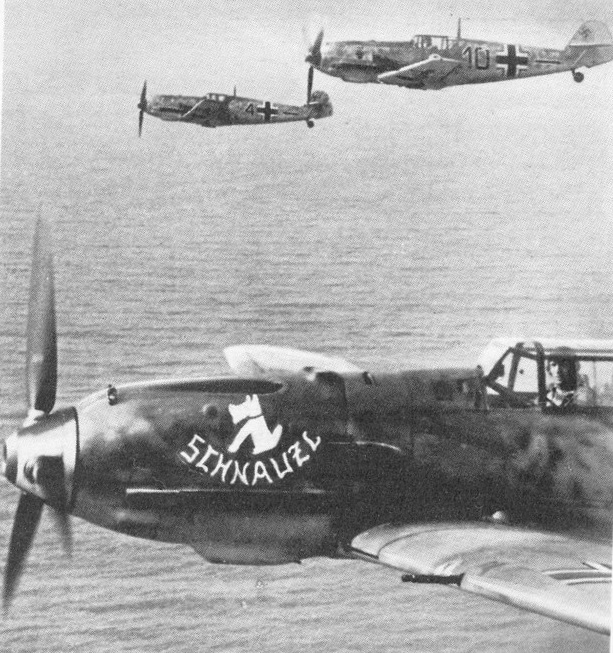
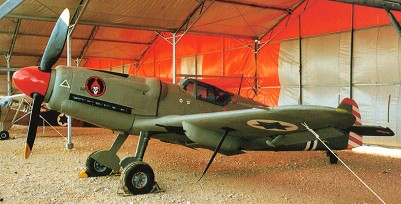
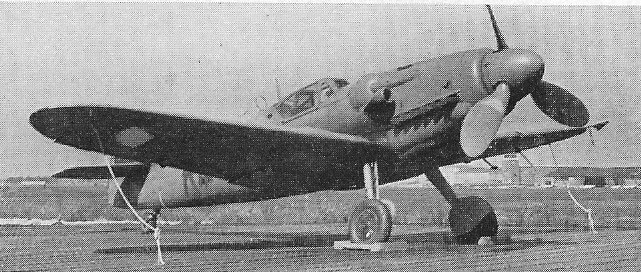
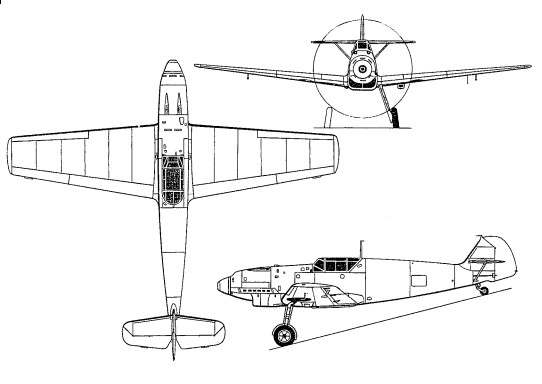
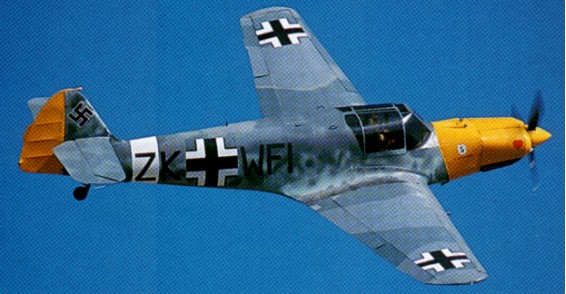
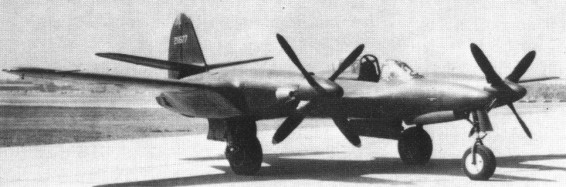
Messerschmitt Me 262 Sturmvogel / Avia S 92 Turbina / Avia CS 92 Turbina

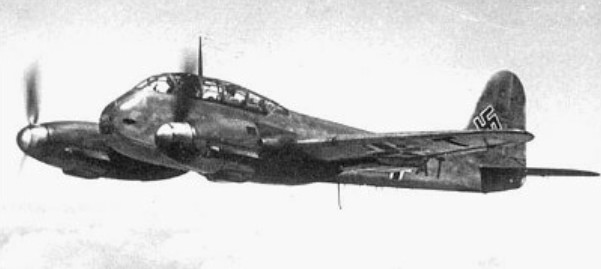
Me 262A-2a

Messerschmitt’s P.1065 design had originated as early as 1938 when the Reichsluftfahrtministerium had requested the company to design a twin-engined fighter able to utilise the new turbojet engines being developed in Germany. After inspection of the mock-up, three prototypes were ordered on 1 June 1940.

Messerschmitt Me 262 Article

It was initially designed around the Axial Flow BMW003 turbojet. In the axial flow turbojet air is compressed after entering the front of the engine by a series of compressor stages or fans, in the middle of the engine fuel is added and the mixture ignites, the rapidly expanding gases then pass through a turbine connected to the forward compressor stages before exiting the jet pipe. The design has the advantage of having a much smaller cross-section although it does suffer much more if debris are ingested into the engine.

There was a great deal of doubt over how much power the BMW engine would produce, estimates of less than 2,000lbs of thrust forced the designers to a twin-engine configuration as the only way to produce an aircraft capable of sufficient performance while carrying a useful warload. The smaller diameter of the engine however made it possible to suspend the engines below the wings without requiring excessively long main undercarriage legs to achieve ground clearance.

The construction of the first prototype ME262 V1 began in January 1941 and it was ready for flight long before its turbojet engines, early bench tests of these were very disappointing at just 570lbs of thrust, far too low for practical use. This led to the first prototype V1 being fitted with a conventional 750hp Jumo 210A in the nose driving a wooden propellor in order to flight test the airframe. It was ready for taxi trials on the 17th April 1941 and flew for the first time on the 18th April fitted with a tail wheel rather than the tricycle undercarriage that would be a feature of the later design.

The aircraft flew a total of 23 times on piston engine power up until 8th May 1941 when it finally received its pre-production BMW003 engines. The engines were rated at 1085lbs but the first flight was a disaster with both units failing, it was only saved from total loss by the by its piston engine and propeller which allowed a safe landing. The ME262 would not fly again with BMW engines until October 1943 when it was fitted with redesigned BMW003a engines. A small reciprocating engine is used for starting.

Of conventional all-metal stressed-skin construction, the wing had moderate sweepback, long-span ailerons, trailing-edge flaps, and full-span automatic leading-edge slots. The engines were mounted beneath the wing to preclude a complex wing-spar structure and the landing gear was of retractable tailwheel type. The fifth prototype introduced a non-retractable nosewheel unit and the sixth was the first to have a fully retractable tricycle-type landing gear necessitating the main undercarriage to be moved back 3ft in the wing.

Standard fuel for the Jumo jet is a brown coal oil known as J-2 and distinguished by a particularly disagreeable odor. Diesel oil and aviation gasoline may also be used but the latter is not considered practicable due to an extremely high rate of consumption.

The second and third prototypes V2 & V3 were modified to take the Jumo 004, this required a nacelle 10% larger in diameter and 16% longer. To counteract this the horizontal stabilizer was enlarged and the wings were swept back. V3 was the first to fly on the 18th July 1942 (piloted by Fritz Wendel) at Leipheim near Günzburg, Germany, with Jumo 004AA0 engines of 1,850 lbs thrust, V2 was completed in July 1941 but did not fly until 1st October 1942. The development program was expanded during this time to include two further prototypes and fifteen pre-production aircraft. The last two prototypes V4 & V5 flew on the 15th May 1943 & 26th June respectively.

In April 1941, Willy Messerschmitt actually proposed to fit a 35° swept wing (Pfeilflügel II) to the Me 262. Though this suggestion wasn’t implemented, he continued this line of thought with the projected HG II and HG III high-speed derivatives of the Me 262 in 1944, which were designed with a 35° and 45° wing sweep respectively.
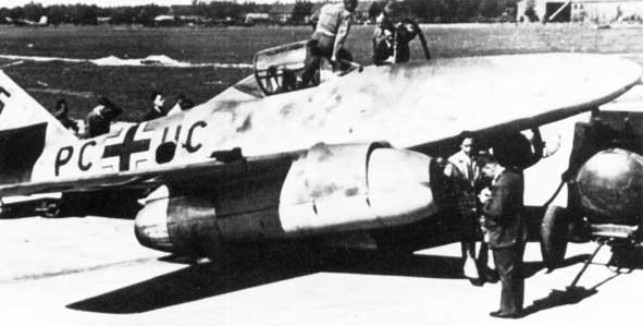
ME262 V1 first flew again on jet power alone on the 20th March 1943 with Jumo 004A-0 engines, the piston engine had been removed and replaced with 3 x 30mm cannon and a partially pressurized cockpit added. It completed 65 flights up until the 7th July 1944 when it suffered a catastrophic engine failure; it was damaged beyond repair in the subsequent forced landing.

Junkers Jumo 109-004 Article

Five of the fifteen pre-production aircraft were allocated versuchs numbers to replace prototypes that had been lost or damaged and to expand the test program. The first of these 130001 V1+AA flew on the 17th October 1943 powered by Jumo 004B-0 engines. These weighed 220lbs less than the 004A while still delivering 1,980 lbs thrust. The aircraft also included fully retractable tricycle undercarriage. The aircraft completed a total of 28 flights until it crashed on the 9th March 1944 in a fatal accident.

The most significant impact on the development of the ME262 was the inability of Junkers (and BMW before them) to produce state of the art engines without the proper materials. This is demonstrated when considering the combustion chambers of the Jumo 004 which were made of ordinary steel sprayed with aluminium for heat resistance which led to frequent engine failures. The compression flow was also unstable at moderate speeds in addition to issues with fuel flow regulation which limited the effectiveness of the aircraft and resulted in an average engine life of around 20 hours.

Me 262A-2a

Armament for the 262 was to have consisted of two 55-mm cannon, but these, though designed, were not yet in production. Hitler then favored the installation of 50-mm tank guns but Goering countered with a reminder that the barrels would extend six feet beyond the nose, thus impairing the plane’s stability and performance. Eventually, four MK 108s (30-mm cannon) were selected as standard armament for the A-1 fighter version and two cannon of like caliber for the A-2 bomber. Synchronized to converge at between 400 and 500 yards, the guns were generally fired at about 800 yards in order to compensate for the plane’s high speed. Reflector gun sights were first installed, later to be replaced by newer gyroscopic sights. Reportedly, a few Me-262s carried six guns and there is evidence of a plan to install two batteries of twelve R4M rockets under each wing. These would have been launched at Allied bomber formations at more than a mile’s distance.

Armor protection consists of 16-mm head and shoulder plates and a forward cockpit bulkhead of the same thickness. Absence of armor and proximity of a fuel tank to the rear of the pilot is apparently discounted due to the plane’s high speed. German pilots interrogated on this point were confident that nothing in the air could match them.

The Me-262’s high performance is due not only to the power generated by its two big Jumo turbines but to an airframe that is fundamentally sound, aerodynamically clean. The horizontal stabilizers are situated well out of the slipstream and so there is no flutter at high speeds. Extremely thin wings minimize the factor of compressibility.

Test flights continued over the next year but the engines continued to be unreliable. Although airframe modifications were completed by 1942, production never began until 1944 when the production engines — which due to the shortage of strategic materials like tungsten had to be completely redesigned to employ alloys of inferior temperature resistance — finally started to work.

Production plans in August 1944 called for 500 in December, 600 in January and February, 800 in March, but by war’s end no more than 1,400 had been produced. Of these, half were destroyed in training accidents and by Allied attacks on German airfields. Most of the remaining 700 were either shot down or crashed due to failure of jet units. Others were destroyed by retreating Germans and only a handful remained to enlighten Allied Technical Air Intelligence squads.

The first delivery (A-0 to Rechlin) was in May 1944.

First major version was the Me 262A-1a Schwalbe (Swallow) interceptor (first flown June 7 1944), armed with four 30mm MK 108 cannon mounted in the nose. It was powered by two 8.825kN Junkers Jumo 109-004B-1 eight-stage axial-flow turbo-jets. A number of variants were built with differing armament. The other major version was the Me 262A-2a Sturmvogel (Stormbird) bomber. This was produced at the insistence of Adolf Hitler – a decision which caused considerable overall production delays. It carried, in addition to the standard MK 108 armament, one 1,000kg, two 500kg or two 250kg bombs. As with the Schwalbe, there were a number of variants, mainly for armed or unarmed reconnaissance.

The first experimental combat unit (EK 262) was formed on June 30, 1944, entered operational service, at Juvincourt, France on 10 July 1944, and the first regular combat (8/ZG26) in September 1944.
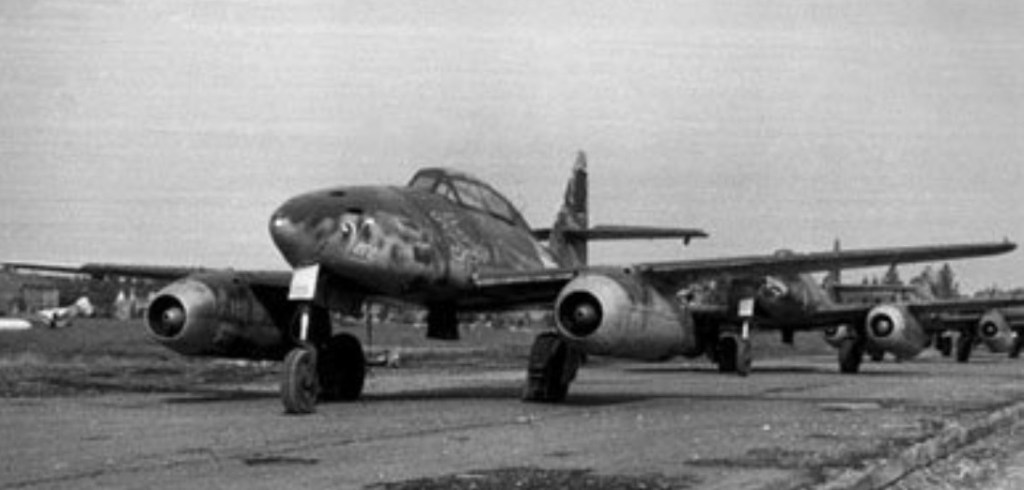
The Me 262A 1a Schwalbe (Swallow) became operational with the Kommando Nowotny on 3 October 1944 and was used, initially, against USAAF Bombers. There were many problems but with a speed advantage of some 70 mph over the fastest Allied escort fighter and its heavy armament of four 30mm cannons, it was a formidable new fighter.

With 522 gallons of fuel, 360 rounds of ammunition, the A-1 takes off at 15,550 pounds. The A-2 with its two guns, 160 rounds of ammunition, and one 500-kg or two 250-kg bombs, weighs 15,400 pounds.

Without bomb load or auxiliary fuel tank the Me-262 requires from 900 to 1,100 yards for take-off on concrete and from 1,100 to 1,400 yards on a grass field. The normal required take-off run of 1,100 yards is reduced to 650 by means of two A.T.O. rockets having a total thrust of 1,000 kg. As few German airfields were equipped with concrete runways, Autobahns were frequently used for operations.

At full throttle, a straight and level speed of 830 kph (515 mph) can be maintained for ten or fifteen minutes. Cruising speed is approximately 465 mph and speeds of 650 mph in dives were not uncommon. Willi Messerschmitt quotes a maximum speed of 560 mph in level flight and at any altitude. That American test pilots were able to get no more than 525 mph out of the plane under favorable conditions he attributes to consid¬erable variance in individual jet units. Messerschmitt also admits to inferior construction due to inadequate materials and lack of skilled labour.

Endurance of the Me-262 ranges from 45 to 90 minutes. Stall characteristics are good, ailerons respond well and it is capable of all combat manoeuvres. Spoilers fitted along the leading edge project automatically at about 300 kph (186 mph) when the plane is in a gliding anile and at about 450 kph (279 mph) when in a climbing position. Turns are not attempted at speeds of less than 350 kph. If throttle is advanced too quickly at less than 7,000 rpm, engines are likely to fail, a characteristic which has resulted in a number of take-off accidents.

The standard approach against bomber formations, which were travelling along at cruise speed, called for the Me 262 to approach the bombers from the rear at a higher altiude, diving in below the bombers to get additional speed before zooming up again to their level and opening fire with its four 30 mm cannon at 600 m range.

Reportedly, Allied bomber gunner were finding that their electric gun turrets had problems tracking the jets. However, due to the jets’ straight line approach, traverse rates were actually not as important as target acquisition itself, which was difficult because the jets closed into firing range very quickly and had to remain in firing position only very briefly using their standard attack profile.

On 3 October 1944, the German Lechfeld Aerial Test Unit was set up under Major Nowotny. The test unit was made up of two squadrons stationed at Achmer and Hesepe airfields near Osnabrück, a total of 40 Me 262s.
On 4 October, four Me 262s took off from Achmer for the first time. Two were shot down over the take off field, and a third was shot down while landing, by Canadian Spitfires of 401 Sqn.
The Lechfield Unit managed to shoot down 25 four-engined bombers in a month, but at a cost of 35 jets.

The Me 262A-2 night fighter is a radar-equipped two-seater, and has external tanks for additional range, a lengthened cockpit, and radar antenna.

In February 1945 the German 7th Fighter Wing under Col. Steinhoff, the only Luftwaffe wing armed with Me 262, reported that it was ready for deployment. Squadrons of the 3rd Fighter Wing assumed the task of protecting the jet fighters during take-off and landing. There was one other umit of Me 262 fighters, the 44h Fighter Group, whose commanders included General Galland – the fighter general removed from office by Goring – and several other fighter officers who had fallen into disfavour.

In March 1945 three Me 262A airframes were taken from the assembly line and converted as two seaters by substituting an 88-gallon fuel tank for the aft 198-gallon tank and using the created space for the observer’s seat. To compensate for the reduction of fuel, two 66-gallon drop tanks were attached under the fuselage and an FuGe 218 radar array was fitted in the nose. The standard four 30 mm MK108 armament was retained and it was proposed to tow a 198-gallon auxiliary tank to increase patrol endurance. This aircraft was designated Me 262B-2a; the first prototype crashed during flight trials, killing the observer.

Me.262B-1A
Me 262B-1a/U1

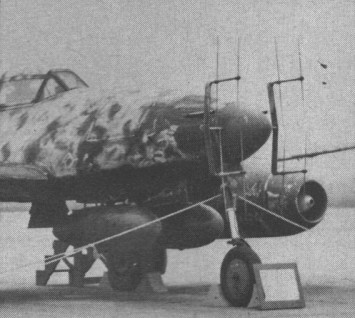
The Me 262B-1a/U1 was used for trials of the Lichtenstein SN-2 (FuG 220) interception radar and Hirschgeweih antennae, equipped with twin under fuselage auxiliary fuel tanks.
Me 262B-1a/U1

Tactics against the Me 262 developed quickly to find ways of defeating it despite its insurmountable speed. Allied bomber escort fighters (specifically P-51s) would fly high above the bombers to gain extra speed in a dive down to protect the bombers, thus reduce the speed advantage of the Me262. The Me262 was less manoeuvrable than the P-51 and trained allied pilots could catch up to a turning Me262; but the only reliable way of dealing with the jets was to attack them in the take-off and landing phase of their flight, and on the ground. Accordingly, Luftwaffe air fields that were recognized as jet bases were frequently bombed by medium bombers, and Allied fighters patrolled over the fields to attack jets that were trying to land on their bases. The Luftwaffe countered these moves by installing Flak alleys along the approach lines in order to protect the Me 262s from the ground, and providing top cover with conventional fighters during the take-off and landing phase.

A Hawker Tempest Mk.V was the first Allied plane to shoot down a Me262, and won number of victories over these jet fighters, while the Lavochkin was the only Soviet fighter to encounter a German jet, with La-7 ace Ivan Nikitovich Kozhedub fighting and downing one Me262 jet on February 15, 1945 over eastern Germany. Kozhedub apparently later said that his success was mainly due to the Me262 pilot attempting to out-turn his more manoeuvrable plane.

In the end, the overwhelming numbers of allied planes meant that the jets had no overall effect on the war. On March 18, 1945, 37 Me 262s intercepted a force of 1,221 bombers and 632 escorting fighters. They managed to shoot down 12 bombers and one fighter for the loss of three Me 262s. Although a four to one ratio was exactly what the Luftwaffe was dreaming about, it represented only one per cent of the attacking force — more were lost to mechanical problems.

Although the Me 262 had a negligible impact on the course of the war—shooting down an estimated 150 Allied aircraft for the loss of 100 Me 262s, the majority of aircraft grounded for lack of fuel.

Only 1,433 Me 262s were built, 500 of those destroyed during Allied bombings, leaving less than 300 jets to enter into the final days of combat.

Willy Messerschmitt regarded the Me 262 as it went into production only as an interim type. His interest in high-speed flight that had led him to initiate work on swept wings starting in 1940 is evident from the advanced developments he had on his drawing board in 1944. While the Me 262 HG I (Hochgeschwindigkeit – high speed) that was actually flight-tested in 1944 had only small changes compared to combat aircraft, most notably a low-profiled canopy to reduce drag, the HG II and HG III designs were far more radical. The projected HG II variant combined the low-drag canopy with a 35 degrees wing sweep and a butterfly tail. The HG III aircraft had a conventional tail, but a 45° wing sweep and the jet turbines embedded in the wing root.

Messerschmitt also conducted a series of carefully controlled flight tests with the series production Me 262. In these dive tests, it was established that the Me 262 was out of control in a dive at Mach 0.86, and that higher Mach numbers would lead to a nose-down trim that could not be countered by the pilot. The resulting steepening of the dive would lead to even higher speeds and disintegration of the airframe due to excessive negative g loads.

The HG series of Me 262 derivatives was estimated to be capable of reaching trans-sonic Mach numbers in level flight, with the top speed of the HG III being projected as Mach 0.96 at 6 km altitude. Despite the necessity to gain experience in high-speed flight for the HG II and III designs, Messerschmitt undertook no attempts to exceed the Mach 0.86 limit for the Me 262.

After the war, the Royal Aircraft Establishment — at that time one of the leading institutions in high-speed research — re-tested the Me 262 to help with the British attempts at breaking the sound barrier. The RAE achieved speeds of up to Mach 0.84 and confirmed the results from the Messerschmitt dive tests as accurate. No attempts were made to exceed the Mach limit established by Messerschmitt.

Me 262 Pilot notes

After Willy Messerschmitt’s death, the former Me 262 pilot Hans Guido Mutke claimed to be the first person to break the sound barrier on April 9, 1945 in a Me 262. This claim is only based on Mutke’s memory of the airspeed indicator reading and is disputed.

During the war the Germans set up a number of assembly plants in Czechoslovakia for the production of the Messerschmitt Me 262. After the war the manufacturing infrastructure remained intact, so production could start up again for the new owners.

Messerschmitt Me 262A-1 White 25 Restoration 2025

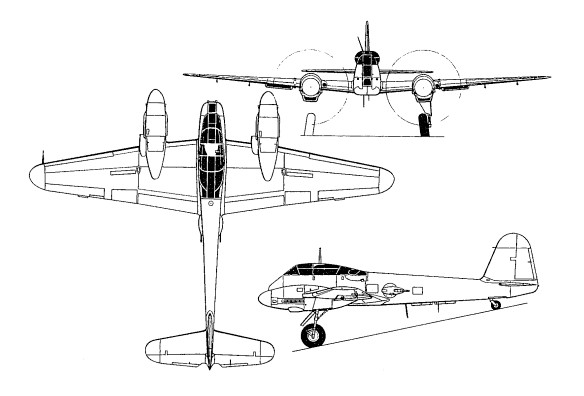
All jigs, tools and components for the Messerschmitt Me 262 jet fighter in Czechoslovakia at the time of the German surrender were seized by the Soviet forces and then handed over to the newly restored Czechoslovak government by Marshal Ivan Konev. Forward fuselages and other components of the Me 262 had been manufactured at Letnany, some components had been produced in converted railway tunnels, and the CKD and Walter works had built the Junkers Jumo 004 turbojet, assembly of the fighters having been undertaken at Cheb, near the German border. Sufficient components were recovered for Avia to build 17 single- and two-seat Me 262s, the first single-seater flying as the S 92.1 on 27 August 1946.

The first Avia S 92.1 was assembled at Letnany Research Institute in 1945 (PL-01), with the airframe coming from Avia and the engines from the repair works in Malesice (the Junkers Jumo 004 now called the M-04). The S 92’s first flight was with Avia’s chief pilot Antonin Kraus in control. Tested pilots included RAF veteran Major Jiri Manak.

On 5 September, this aircraft was lost in an accident, a second, S 92.2, flying on 24 October, and what was referred to as the first series aircraft, a two seater (CS 92.3), following on 10 December. Dubbed the Turbina (Turbine), the S 92 was demonstrated to a Yugoslav delegation which placed an order with Avia for two examples, although, in the event, these were not delivered. The seventh aircraft, CS 92.7, was experimentally fitted with BMW 003 turbojets, the thrust of which had been boosted to 950kg, but flight testing was not entirely successful and the aircraft was re-engined to take the standard Jumo 004 turbojets. The eleventh and twelfth aircraft, S 92.11 and S 92.12 were completed during 1949.

Czech production included Avia S-92 code V-34(cn 51104), the fourth Czech-built. The fourth aircraft was first example armed with a pair of 30mm Rheimettal MK 108 cannon.

Avia S 92 Turbina

Delivery of the first S 92 to the Czech air force was in June 1948. In October 1950, with twelve being made in all (nine S 92 and three CS 92) equipping the 5th Fighter Flight at Mlada-Milovice airport, until they were grounded for use as instructional airframes in 1951. One of them is on display at the Prague Aero museum.

By the time Yugoslavia showed interest in buying the S 92, Avia was looking at closing down the production line to make way for new up to date aircraft and when Avia were given a licensed to make the Mig 15 (they were all ready making the Yak 23 as the S 101) the S 92 facilities were broken up.

Avia CS.92

Gallery

Replicas
Texas Aircraft Factory Me 262

Specifications:

Me 262 A1 Schwal
Engines: 2 x Jumo 004 B-1, 8829 N
Length: 34.777 ft / 10.6 m
Height: 12.598 ft / 3.84 m
Wingspan: 40.945 ft / 12.48 m
Wing area: 233.579 sq.ft / 21.7 sq.m
Max take off weight: 14103.2 lb / 6396.0 kg
Weight empty: 8379.0 lb / 3800.0 kg
Max. speed: 469 kt / 869 km/h
Service ceiling: 37566 ft / 11450 m
Wing loading: 60.48 lb/sq.ft / 295.0 kg/sq.m
Range: 567 nm / 1050 km
Crew: 1
Armament: 4x MK108 30mm

Me 262A-1a
Type: single-seat fighter
Engines: 2 x Junkers Jumo 004B-1/-2/-3 turbojets , 1,980lb (900kg)
Span: 12.5m / 40 ft 11.5 in
Length: 10.6m / 34 ft 9.5 in
Height: 3.83m / 12 ft 6.75 in
Wing area: 21.7 sq.m / 233.58 sq ft
Ceiling: 11450 m / 37550 ft
Empty weight: 4000kg
Loaded weight: 7045kg
Maximum speed: 540mph (870km/h)
Climb rate: 1200m/min
Ceiling: 11,500m
Range on internal fuel: 1050km (650 Miles)
Armament: 4 x 30mm MK 108 cannon / Two with 100 rounds each, two with 80

Me 262A-1a/U1
Engines: 2 x Junkers Jumo 004B turbojets , 1,980lb (900kg)
Span: 12.5m
Length: 10.6m
Height: 3.8m
Wing area: 21.7 sq.m / 233.58 sq ft
Ceiling: 11450 m / 37550 ft
Empty weight: 4000kg
Loaded weight: 7045kg
Climb rate: 1200m/min
Ceiling: 11,500m
Range on internal fuel: 1050km (650 Miles)
Armament: 2 x 30mm MK 103, 2 x 30mm MK 108 cannon, 2 x 20mm MG 151/20

Me 262A-1b
Engines: 2 x Junkers Jumo 004B turbojets ,1,980lb (900kg)
Span: 12.5m
Length: 10.6m
Height: 3.8m
Wing area: 21.7 sq.m / 233.58 sq ft
Ceiling: 11450 m / 37550 ft
Empty weight: 4000kg
Loaded weight: 7045kg
Climb rate: 1200m/min
Ceiling: 11,500m
Range on internal fuel: 1050km (650 Miles)
Armament: 4 x 30mm MK 108 cannon / Two with 100 rounds each, two with 80, 24 spin-stabilised R4/M 55mm rockets

Me 262A-2a
Type: single-seat bomber
Engines: 2 x Junkers Jumo 004B turbojets ,1,980lb (900kg)
Span: 12.5m
Length: 10.6m
Height: 3.8m
Wing area: 21.7 sq.m / 233.58 sq ft
Ceiling: 11450 m / 37550 ft
Empty weight: 4000kg
Loaded weight: 7045kg
Maximum speed: 470 mph (755km/h)
Climb rate: 1200m/min
Ceiling: 11,500m
Range on internal fuel: 1050km (650 Miles)
Armament: 4 x 30mm MK 108 cannon / Two with 100 rounds each, two with 80
Bomb load: 2 x 500kg

Me 262B-1a
Type: two-seat night fighter
Engines: 2 x Junkers Jumo 004B turbojets ,1,980lb (900kg)
Span: 12.5m
Length excluding radar aerials: 11.8m
Height: 3.8m
Wing area: 21.7 sq.m / 233.58 sq ft
Ceiling: 11450 m / 37550 ft
Empty weight: 4000kg (B-1a 4400kg)
Loaded weight: 7045kg (B-1a 6400kg)
Maximum speed: 497 mph (800km/h)
Climb rate: 1200m/min
Ceiling: 11,500m
Range on internal fuel: 1050km (650 Miles)
Armament: 4 x 30mm MK 108 cannon / Two with 100 rounds each, two with 80

Me 262B-2a
Engines: 2 x Junkers Jumo 004B turbojets ,1,980lb (900kg)
Span: 12.5m
Length: 10.6m
Height: 3.8m
Wing area: 21.7 sq.m / 233.58 sq ft
Ceiling: 11450 m / 37550 ft
Empty weight: 4000kg
Loaded weight: 7045kg
Climb rate: 1200m/min
Ceiling: 11,500m
Range on internal fuel: 1050km (650 Miles)
Armament: 4 x 30mm MK 108 cannon / Two with 100 rounds each, two with 80, 2 x inclined MK 108 behind the cockpit in Schrage Musik installation
(D) SG 500 Jagdfaust with 12 rifled mortar barrels inclined in nose
(E) 50mm MK 114 gun or 48 R4/M rockets

Avia S.92 Turbina
Engine: 2x Malesice M-04B (Jumo 004) turbojets
Wing Span: 12.5 m / 41 ft 0 in
Length: 10.58 m / 35 ft 9 in
Height: 3.83 m / 13 ft 7 in
Wing area: 21.80 sq.m / 234.65 sq ft
Weight: Empty 4,000 kg / 8819 lb
MTOW: 7,045 kg / 15532 lb
Maximum Speed: 870 km/h / 541 mph
Rate of climb: 1220 m/min / 4000 ft/min
Ceiling: 11,450 m / 37550 ft
Range: 1,050 km / 652 miles
Crew: 1
Armament: 4x 30 mm cannon

Avia CS.92
Engine: 2 x Malesice M-04B (Jumo 004) turbojets
Wing Span: 12.5 m
Length: 10.58 m
Height: 3.83 m
Weight: Empty 4,000 kg / Loaded 7,045 kg
Maximum Speed: 870 km/h
Ceiling: 11,450 m
Range: 1,050 km
Crew: 1
Armament: 4x 30 mm cannon

Messerschmitt Me 261

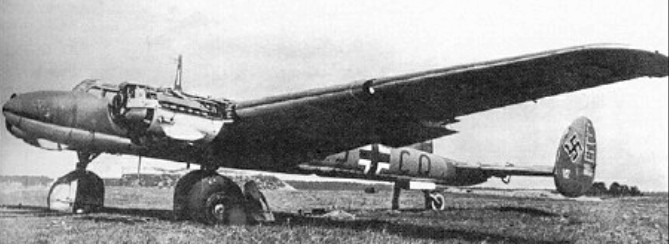
Originally designed as a long-range record-breaking aircraft, the Me 261 had an extremely slender fuselage, but two DB606 engines – each consisting of two coupled DB601 V-12s. Work continued even during the war, because of their advanced design. With their cramped fuselages they had little military value, however. Three were built, one was used for reconnaissance flights in 1943.

Messerschmitt Me 210

Originated in 1937, the Me 210 was designed as a superior twin-engined multi-purpose aircraft to replace the Bf 110. In autumn 1938 RLM awarded a contract to Arado and Messerschmitt simultaneously for the development of a Bf 110 replacement. The resulting Messerschmitt design consisted in a mere improvement of the basic design with more powerful powerplants and heavier armament. Arado’s answer to the requirements was the Ar 240 but confidence in the original Bf 110 long-range fighter and bomber-destroyer concept led at the beginning of 1938 to Messerschmitt being asked to design an eventual successor. The result was the Messerschmitt Me 210 which first flew on 5 September 1939, powered by two 1,050 hp (783 kW) Daimler-Benz DB 601A engines. It proved to be extremely unsatisfactory, being difficult to handle and suffering from extreme instability.

After the first flight test of the Me 210 V1 the plane had to be heavily modified for its flying capabilities were barely poor. It had problems with longitudinal and lateral stability, and these were not suitable for a firing platform such as a combat aircraft. The design was improved by deleting the original twin vertical surfaces, similar to those of Bf 110, and fitting a large traditional vertical stabilizer and rudder with the aircraft flying on 23 September. A slight improvement was apparent, but in spite of a number of modifications carried out on the two prototypes they continued to display poor handling characteristics, being prone to stalling and spinning, but by mid-1940 a first batch of airframes was in final assembly.

Even while test flying was still going on, the RLM placed an order of 1000 Me 210As in mid-1940. The first 15 Me 210s were earmarked as test aircraft and on 5 September 1940 the program suffered the first of a number of crashes when the second prototype broke up during diving trials, fortunately the pilot escaped.

The first flight of a pre-production 210A-0 was in April 1941. The first pre-production planes were under trials in a new established special test unit Erprobungsgruppe 210 at the end of 1940. The ErG 210 was to conduct operational testing of the Me 210 and develop combat tactics for the fighter-bomber. This unit was already well known, during the battle of Britain in Summer 1940, while it mainly flew the Bf 110s and 109s awaiting for Me 210 deliveries. Its first leader was Hauptmann Walter Rubensdörffer, killed in action in a Bf 110 over England before he could ever fly a Me 210. Another important victim was Oberleutnant Heinz Forgatsch of 3./SKG 210. He died in an accident while testing a Me 210 at Rechlin. Production began in Spring 1941 in both the Augsburg and Regensburg factories.

Such were the problems encountered that eight pre-production Me 210A-O and 13 production Me 210A-l aircraft were added to the test program, but in spite of this very little improvement was evident, and it was obvious that only major design changes would have any chance of correcting the faults. At this stage such a move would have caused an unacceptable delay in the production program, so deliveries began and 64 were supplied starting in April 1941 in two variants, the Me 210A-l destroyer-bomber which was armed with two 20 mm MG 151/20 cannon and two 7.92 mm (0.31 in) MG 17 machine guns, and the Me 210A-2 fighter-bomber which had a maximum bomb load of 4,4091b (2000 kg).
By the end of 1941 the test program was over and the final evaluation was that it was still an unsuitable firing platform for its stability problems. Messerschmitt modified a pre-production plane (Me 210 A-0 NE+BH Werk Nr. 101) with lengthened rear fuselage (lengthened by 1½ panels) and redesignating it with the Versuch-number V17 on 14 March 1942. This modification was very successful in increasing the plane’s handling qualities. Another important modification was the fitting, in July 1942, of wing leading edge slots. Soon after flying tests it was ordered to retrofit all Me 210 As with this device.

However, on 14 April 1942, after about 200 Me 210s had been delivered (this number including two Me 210B-0 pre-production and two Me 210B-l production reconnaissance aircraft), construction was halted in favour of a resumption of manufacture of the Bf 110 to give time to try to resolve some of the Me 210’s shortcomings. The stability problem was solved finally by introducing automatic wing leading-edge slots and redesign of the rear fuselage, which was lengthened by 3 ft 1 1/2 in (0.95 m) and made deeper. The improvements were tested and the design was submitted with the proposal that the 1,750 hp (1305 kW) Daimler-Benz DB 6O3A engine should be used to provide better performance, This appealed to the RLM, as a solution of this kind would allow a number of unfinished Me 210 airframes to be used, and Messerschmitt was given the go-ahead and the designation 410 assigned to the revised design. The final Me 210 delivery was in April 1942.

Although introduced into operational service in Me 210A, B and C versions from early 1941, most were being replaced within two years.

The rear gunner controlled rear-facing machine guns in twin barbettes which gave much trouble in early service. Forward-firing armament was two cannon and four machine guns.

The Hungarians built the Me 410C in the Danube Aircraft Factory and used it successfully. Messerschmitt had supplied jigs and tools, and a new factory had been built for production when the German decision to stop its own Me 210 program was made. The Hungarians nevertheless decided to proceed and one of the pre-production Me 210A-0s had been fitted with 1,475 hp (1100 kW) DB 605E engines as a prototype for the Me 210C. The engines were license-built by Manfred Weiss.

Production started in 1943 with the Luftwaffe receiving two-thirds and Royal Hungarian Air Force one-third of the aircraft built.

The Me 210C had the wing slots and new rear fuselage, and production deliveries from the Hungarian factory started at the beginning of 1943. They were split on the basis of one-third to the Royal Hungarian air force and two-thirds to the Luftwaffe. Production was slow to develop, but by early 1944 the first Hungarian units had been formed. Production ended in Hungary in March 1944, by which time 267 Me 210Cs had been built in two variants, the Me 210C-1 reconnaissance/bomber-destroyer aircraft, and the Me 21OCa-1 bomber-destroyer/dive-bomber. In contrast with the Luftwaffe, Hungarian pilots liked the Me 210 and used it as a close-support aircraft and dive-bomber.

A total of 267 Me 410’s had been constructed before production ended in March 1944.

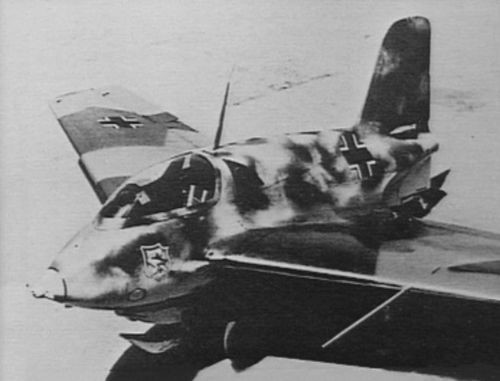
Messerschmitt Me 163 Komet (Interceptor)

The Messerschmitt Me 163 Komet (comet) rocket interceptor stemmed from prolonged research by Dr Alex¬ander Lippisch over 15 years before the war. The heart of Projekt X was a rocket engine developed by Hellmuth Walter. Lippisch’s task was to design a tailless aircraft to go with it. Even he was not allowed to have blueprints of the power¬plant for the airframe he was designing. The result of this clandestine effort was a tailless rocket research craft designated the DFS 194 which began flight trials with a 400 kg (882 lb) thrust liquid fuel Walter rocket motor at the Baltic coast test site of Peenernfinde in August 1940. While test pilot Heini Dittmar flew this test bed, reaching 550 kph (341.8 mph) in level flight, Lippisch and his team pressed on with the next stage of Projekt X at the Messerschmitt Werke in Augsburg. The ultimate aim was to produce a rocket powered interceptor fighter.

In the mid 1930s the German Air Ministry were supporting the work of rocket engine designer Hellmuth Walter, issuing him a contract to develop a 400 kg / 882 lb thrust motor. In the mean time, Alexanderander Lippisch had been working at the German Institute for the Study of Sailplane Flight (DFS) and was given the order to produce a second prototype of his DFS 39 tail-less aircraft to test the potential of a rocket powered airframe. The work would see DFS build the wings and Heinkel build the fuselage.

Lippisch discovered the wing mounted rudders would likely cause unacceptable flutter, so he redesigned the airframe to include a large conventional central fin and rudder. Redesignated DFS 194 it was fitted with a small propeller engine and a landing skid. A takeoff dolly was mounted under the landing skid, it being jettisoned shortly after takeoff.

Dr Lippisch and his staff were transferred to Messerschmitt’s works at Augsburg in January 1939, with the partially completed DFS 194. The decision was also made to by-pass the prop driven version and move directly to rocket power.

The completed airframe was shipped to Peenemünde West in early 1940.

Messerschmitt Me 163 Komet Article

The Comet’s wooden, plywood-covered wings are of special swept-back design with a marked wash-out of incidence towards the tip. The fuselage is of metal construction. “Elevons” which serve both as elevators and ailerons are located outboard in the wings; there are no horizontal tail surfaces.

Three development prototypes of the DFS 194 were ordered by the RLM and the first two were completed by the spring of 1941, when unpowered gliding flights began from the factory airfield. The engineless Messerschmitt Me 163 attained a top speed of 850 kph (528 mph) in a dive test.

In early 1940 the DFS 194 was equipped with a rocket motor at Peenemünde. After test flights by Heini Dittmar had confirmed speeds of up to 550km/h on the power of a single 2.94kN Walter motor, there was sufficient interest to initiate development. In 1941 the first Me 163 prototype was being tested in gliding flight and shortly after was fitted with a 7.35kN Walter RII-203 rocket motor. On 2 October 1941 Heini Dittmar cast off from a Messerschmitt Bf 110 tow-plane at 4000 m (13,125 ft), fired the Me 163V-1’s rocket motor and accelerated rapidly reached 1004.5 kph (623.8mph); two months later the Me163B Komet was ordered into production.

Speeds of up to 915km/h were achieved (limited by the volume of liquid propellants carried) and to gain some idea of the speed potential, this aircraft was towed to a high altitude before being released. Flown under power, a speed of over 1,000km/h was attained before the engine had to be throttled back because the aircraft was becoming uncontrollable.

This success saw the development of the first production prototype, now designated Me 163. Flight testing began in the Spring of 1941. These were a series of unpowered flights before the Me 163 V1 was shipped to Peenemünde for installation of the improved Walter RII-203 engine.

On 2 October 1941, the Me 163 V1 piloted by Heini Dittmar set a new world speed record of 1004.5 kph / 623.8 mph. After this performance, the RLM instructed Lippisch to design an improved version around a more powerful motor under development. The resulted in the Me 163B. The first prototype, the Me 163 V3, was completed in April 1942, but it was not until early autumn that the first Walter 109-509A motors were ready for installation.

Plans proceeded during 1943 to equip the first operational units with the Me 163B-1a. Production Me 163Bs were po¬wered by Walter 109 509A2 rocket motors using T Stoff (hydrogen peroxide) and C Stoff (hydrazine hydrate, methyl alcohol and water) to give a thrust of 1700 kg (3,748 lb).

The new motor employed a ‘hot’ system in which the oxygen was ignited for additional thrust and better fuel efficiency. Flight testing of the first series of Me 163B-0 pre-production aircraft proceeded throughout 1942.

The fuselage of the Komet was made of metal but its wing was of wooden construction. The leading edge of the wing featured long slats in front of the elevons. Early Me 163B 0 aircraft were armed with a pair of 20 mm guns, but Me 163B 1 fighters carried two 30 mm weapons. The aircraft possessed no conventional landing gear, but took off from a trolley, which was jettisoned immediately after take off and at the end of the flight the Komet was landed on the skid. The small propeller on the nose served to drive a generator which supplied electrical power for the radio and instruments. Armour includes a nose cone constructed of 15-mm plate.

Laminated bullet-resisting glass gives the pilot added protection from frontal attack. Two triangular plates comprise the side cockpit armor. No provision is made for defense against attack from the rear except the plane’s high speed.

The production Me 163B’s 1500 kg (3307 1b) thrust Walter HWK 109-509 rocket motor was fuelled with a highly volatile mixture of C stoff (methyl alcohol, hydrazine hydrate and water) and T stoff (hydrogen peroxide with additional hydrocarbon stabilizers) which would explode at the least provocation. The Komet carried more than 2000 kg (4409 lb) of fuel and climbed to 12,000 m (39,370 ft) in 3 minutes 30 seconds. The Walter HWK 109-509A rocket motor made use of a steam generator that used calcium permanganate as a catalyst to produce steam when a small amount of T-Stoff was added via an electric starter motor, the resulting steam starting the turbine to begin pumping the two fuels to the rocket motor. The starter motor was switched off, and the rocket motor was throttled through its five positions until it reached maximum thrust.

Messerschmitt Me 163 B-1 Komet

After rocket¬ing high, the Komet pilots would use their remaining fuel to dive at high speed through the ranks of bombers firing on them with the Me 163B’s two 20mm MG 151/120 or 30 mm MK 108 cannon, or with the SG 500 Yagdfaust (hunter’s fist) 50 mm (1.97 in) weapon system, which fired shells vertically upwards from the top surface of the Komet’s wing when a bomber’s shadow triggered its photo electric cell firing circuit.

Series production began at dispersed facilities by Klemm, but was later transferred to Junkers, as a result of quality control problems. An operational training unit, Erprobungskommando 16 (EK 16) was formed during July 1943 at Peenemünde West, but moved to Bad Zwischenahn before the first group of pilot trainees arrived. The unit received its first group of 36 pilot trainees in the summer of 1943 and by May 1944 the first operational Me 163 wing, Jagdgeschwader 400 (JG 400) was created under the command of Hauptmann Wolfgang Späte. The unit was ordered to defend the synthetic oil refineries at Leuna from its base at Brandis, near Merseburg. The same day several Me 163s over Wesermude attacked a formation of B-17s of the 3rd Air Division and shot down one. P-38 escorts of 479th FG tried in vain to intercept the fighters.

Two additional units fighter groups, II and III/JG 400 were formed before the end of the war, but only saw limited combat against single aircraft.

On 28 July 1944 the Luftwaffe deployed for the first time the Me 163B fighter. Seven Comets were flown by JG400, which had been formed in Wittmundhafen out of the 16th Test Unit.. JG400 was assigned to protect the synthetic fuel plants. That day the US 359th Mustang Fighter Group saw five Me 163s over Merseburg. “They cooly carried out a number of attacks on our unit”.

The same day several Me 163s over Wesermüde attacked a formation of B-17s of the 3rd Air Division and shot down one. P-38 escorts of 479th FG tried in vain to intercept the fighters.

JG 400 made interceptions of Allied bombers on 7th and 28th of July 1944, without success, but on 16 August Fw Siegfried Schubert scored the types first success. He scored three victories before his death in that October. The only other major USAAF interceptions were on 24 August (4 B-17s shot down by 1 Gruppe), 11th September, and 2nd November.

Although the aircraft’s two 30mm MK 108 cannons were capable of downing a four engined bomber with only a few hits, the Komet’s high speed, and the cannons’ slow rate of fire and short range, made effective gunnery nearly impossible. As a result, the Me 163 pilots recorded a total of only nine confirmed kills. (Schubert 3 kills, Kelb, Schiebeler, Ryll, Strasnicky, Glogner, & Bott one each). After completing an attack, the pilot had to glide back to base as the fighter only carried enough fuel for eight minutes of powered flight.

In response to combat reports, alternative weapons were including the SG 500 recoilless ‘Jägerfaust’. Five were mounted in either wing and fired by photocell trigger as the aircraft passed below.

Further combat sorties were curtailed by order by the end of 1944 due to pilot losses as high as 30%. On 14 April 1945, the remaining aircraft at Brandis were destroyed and the remaining personnel ordered to join the army. The official order to disband 1./ and II./JG 400 was issued on 20 April 1945.

An improved variant with greater endurance and a tricycle undercarriage, the Me 163 C was also produced in small numbers, but was not flown operationally. A few examples of a two seat trainer, the Me 163 S were also completed. The slightly larger Me 163C development – with aerodynamic refinements, pressurised cockpit and blister-type canopy, and more powerful Walter 109-509C rocket motor and auxiliary cruising jet – was built only in prototype and pre-production form. It did not enter service, although it was almost ready for delivery to Luftwaffe squadrons at the time of the German surrender. With this version, endurance was increased from eight-ten minutes to twelve minutes of powered flight. It was faster by 40 mph, weighing 11,280 pounds.

The Me 163D was developed in to the Me 263. The aircraft was briefly known as the Junkers Ju 248 V1.

Produced in only small numbers, about 360 examples were completed.

Official top speed of the Comet, contrary to Messerschmitt’s statement, is 550 mph at 20,000 feet and above. Armament consists of two 30-mm cannon, one in each wing root, firing a total of 120 rounds. Normal flying weight of the 163 is 9,500 pounds; wing span is just over 30 feet, length, slightly under 20.

The fuels in the Komet were highly corrosive and would dissolve organic material (such as the pilot). To avoid this, the pilots would wear special asbestos fibre suits. A bumpy landing sometimes caused unburned fuels to mix and ignite.

Replica:
Kurtz Me 163B

Gallery

Me 163B Komet
Wing span: 30 ft 7 in (9.32 m)
Length: 18 ft 8 in (5.69 m)
Engines: 1 x Walter, 3300 lb
Max TO wt: 9042 lb (4110 kg)
Max level speed: 596 mph ( 960 kph)

Me 163B-la
Powerplant; 1 Walter HWK 509A-1 (or A-2), 3,748lb (1700kg) thrust
Fuel; C-stoff: 57% methyl alcohol, 30% hydrazine hydrate, 13% water – T-stoff: 80% hydrogen peroxide, 20% stabilisers
Max. speed: 559mph sea level to 39,400ft (12,000m)
Service Ceiling; 39,400ft (12,000m)
Climb: 1.48 minutes to 6,600ft (2,000m)
Climb: 2.02 minutes to 13,100ft (4,000m)
Climb: 2.27 minutes to 19,700ft (6,000m)
Climb: 3.45 minutes to 39,400ft (1 2,000m)
Endurance; 7min 30sec
Range; Approx 80 miles (130km)
Empty weight: 4,1901b (1900kg)
Max takeoff weight: 9,0521b (4310kg)
Wing span: 30ft 7in (9.40m)
Length: 19ft 2in (5.85m)
Height: 9ft (2.75m) on takeoff dolly
Wing area: 199.1 square feet (18.5sq.m)
Armament Two 30mm Rheinmetall – Borsig MK 108 cannon / 60 rpg

Messerschmitt Bf 161

Bf 161 V2

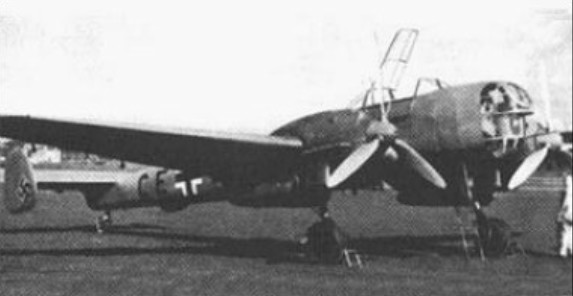
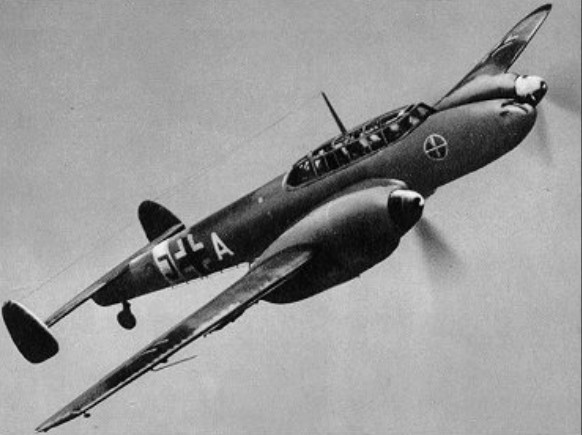
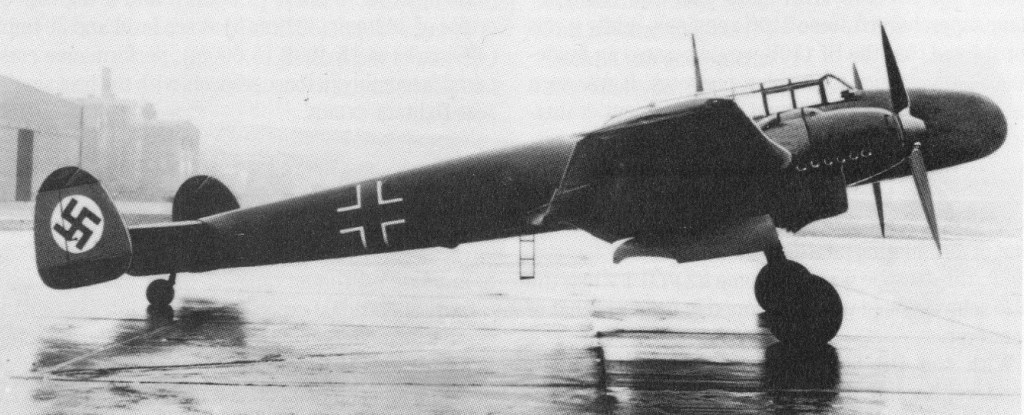
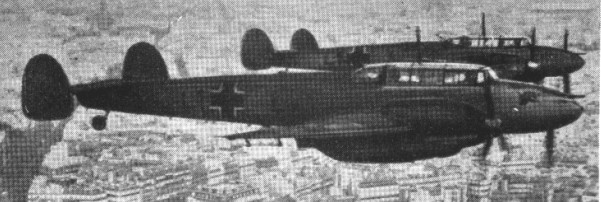
Reconnaissance version of the Bf 110, with a new nose. Development was abandoned when it was understood that much simpler modifications of the Bf 110 would do the job.

Two models built the V1 (D-ABBA) powered by 2 Jukers Jumo 210 engines, and the V2 (D-AOFI), powered by 2 Daimler-Benz 600A engines. The V1 went to Rechlin and the V2 went to Augsburg and later to Peenemunde West and was used for towing the Me163A.

Messerschmitt Bf 110

The Bf 110 originated from a Reichsluftfahrtministerium requirement of 1934 for a long-range escort fighter or heavily armed Zerstorer (destroyer). With a cantilever low-wing monoplane configuration, this two-seat fighter had an oval-section fuselage, long glazed canopy, high-mounted tailplane with endplate fins and rudders, retractable landing gear, and power plant was two Daimler-Benz DB 600 in-line engines.

Messerschmitt Bf 110 Article

The first prototype, the Bf 110 V1 powered by two 910 hp Daimler-Benz DB 600A engines, was flown for the first time on 25 May 1936 at Augsburg-Haunstetten by Dr-Ing Hermann Wurster. During an early test phase a speed of 314mph / 505 kph was clocked in level flight at 10,830 ft / 3300 m at a loaded weight of 11,025 lb / 5000 kg. For a relatively large, twin-engined aircraft it proved very agile and, in mock combat with a pre-series single-seat Bf 109B flown by Ernst Udet, the newly appointed Inspector of Fighter Pilots repeatedly failed to keep his larger opponent in his gun sight for sufficient time to render a hit likely, and experienced some difficulty in staying with the twin-engined fighter in steep turns.

Bf 110 V-1 – the first prototype

In January 1937, as a result of evaluation of a second prototype, the Bf 110 V2, at the Rechlin Erprobungsstelle, instructions were given that Messerschmitt should commence preparations for a pre-production series of aircraft. The proposed series model, the Bf 110A, was to be powered by a pair of DB 600Aa carburettor-equipped engines of 986 hp for take-off. By the time that the pre-series Bf 110A airframes had attained an advanced stage of construction the DB 600 engine was considered basically unsuited for fighter installation and was already being already phased out of production in favour of the direct-fuel-injection DB 601. The Reichsluftahrt-ministerium confidently expected that the DB 601 would be available by the Spring of 1938, when deliveries of the Bf 110 to the schweren (heavy) Jagdgruppen were expected to commence. Accordingly, instructions were issued to curtail the Bf 110A series, adapting the four airframes that had reached an advanced stage in assembly to take Junkers Jumo 210Da engines of 680 hp for take-off.

As it became obvious predictions for DB 601A engine delivery could not be met, the decision was taken to build an interim model, the Bf 110B with direct-injection two-stage supercharged Jumo 210Ga engines. While it was considered that the Bf 110B would possess an inadequate performance for combat purposes, it was seen as an ideal tool for equipment and armament evaluation, and the development of operational techniques.

Me.110C

It was issued during late 1938 to I (Schweren Jagdruppe)/LG 1 of the Lehrdivision, or Instructional division, to formulate tactics and techniques. In January 1939 this Gruppe was to become I(Z)/LG 1 with the Zerstörer.
With the DB 601A engine, the Messerschmitt Zerstörer became the Bf 110C, a pre-series of 10 being delivered to the Luftwaffe early in January 1939, and acceptances of the initial production Bf 110C-1 by I(Z)/LG 1 began before the end of that month. Production of the Bf 110C-1 increased rapidly and by the early summer of 1939 Focke-Wulf and Gothaer Waggonfabrik had tooled up to supplement the output of Messerschmitt’s Ausburg-Haunstetten factory, and the MIAG at Braunschweig was preparing to phase into the programme.

By 31 August 1939 a total of 159 Bf 110C fighters had been accepted, although the Quartermaster-General’s strength returns for that date indicated that only 68 of these, plus 27 Bf 110Bs, had actually been taken into the inventory. Three Zerstörergruppen were to be included in the Order of Battle against Poland.
Output of the Bf 110C had risen to more than 30 per month, and another 156 were delivered during the first four months of hostilities when production rates rose. The average monthly production during 1940 was 102.6 aircraft.

Early operational experience had resulted in the successive introduction of the Bf 110C-2, differing solely in having FuG 10 HF radio in place of the original FuG 3aU R/T and the Bf 110C-3 which differed in having improved MG FF cannon. These now gave place to the Bf 110C-4 in which some attempt was to provide nominal armour protection for pilot and gunner, normal loaded weight rising 490 lb / 333 kg over that of the Bf 110C-1 to 13,779 lb / 6250 kg. Further escalation in weight resulted from a demand for adaptation of the aircraft for to Jagd-bomber (Jabo) mission, two ETC 250 racks being introduced beneath the fuselage centre section for a pair of 551 lb / 250 kg bombs.

The substantially increased overload weight necessitated more power for take-off and emergency use, and the Jabo Bf 110C-4/B was fitted with DB 601N engines which with increased compression and 96 octane fuel, had a maximum take-off output of 1200 hp with full boost for one minute.

Issued to the Erprobungsgruppe 210, the Bf 110C-4/B fighter-bombers of two staffeln of this unit were to operate throughout the ensuing Battle singly and in small groups.

The Bf 110C escorted the bomber units that devastated Poland at the beginning of World War II, and just before Christmas 1939, Bf 109 and 110 destroyed 12 of a force of 22 Wellingtons which were making a reconnaissance of Heligoland Bight.

A parallel development was the Bf 110C-5 which had a single Rb 50/30 reconnaissance camera in the cockpit floor, forward-firing armament being restricted to the quartet of machine guns. This sub-type was to reach the Aufklärungstaffeln, or reconnaissance squadrons, in time to participate in the Battle, initially in mixed units with the Do 17P and Do 17Z.

On 20 July 1940 a total of 278 Bf 110s were available to Luftflotten 2, 4 and 5, and of these 200 were serviceable.

Bf 110C and longer-range Bf 110D were launched against Britain in the summer of 1940, but even before the Battle of Britain had reached a peak, it was clear that the Bf 110 was no match for the RAF’s manoeuvrable single-seat fighters. Indeed it was so vulnerable that this ‘escort’ fighter was unable to operate in British airspace by daylight unless it was itself escorted.

The Bf 110D-0 was the pre-series of the Dackelbauch (Dachsund-belly) equipped version.

Bf 110D-0

The Bf 110D-1 was a so-called langstrecken, or long-distance, Zestörer with a 264 ImpG / 1200 lt auxiliaet fuel tank made of plywood and dubbed a Dackelbauch (Dachsund-belly). It was found to ‘hang up’ under extremely low temperatures after its fuel had been exhausted, the fumes remaining in the tank tending to explode.

The Dackelbauch (Dachsund-belly) suffered disastrously on 15 August when flown by I/ZG 76. One-third of 21 participating aircraft were lost.

Bf 110C

Despite its failure in this role, the Bf 110 was to prove a most valuable and successful night fighter until more advanced aircraft entered the scene in the latter stages of the war. Bf 110E with DB 601N engines and Bf 110F with DB 601E engines formed the nucleus of such operations. Considerable success was gained by these aircraft in conjunction with Wiirzburg radar, the pilots being directed by ground controllers into an interception position.

The three-seat night-fighter Bf 110F was followed into production by a series of Bf 110G with DB 605B engines, the early versions serving as fighter bombers. However the four-seat Bf 110G-4a, -4b, -4c, and -4d variants were provided with differing airborne radar installations for operation as night fighters. Final production version was the Bf 110H, generally similar to the Bf 110G but equipped with heavier armament. It is worth recording a significant factor in favour of the Bf 110, so often dismissed as a complete failure. During early 1944 almost 60% of the entire German night-fighter force was composed of variants of the Bf 110.

Otto Fries’s Me 110 at St Trond, Belgium, 1943
Bf 110G of III/ZG.26 Summer 1943 at Plantlȕnne with twin wing-mounted Doppelrohr BR 21 motar rocket launchers.

The spotting of modern twin-engined monoplanes in combat led to the belief that Japan was using imported German Me.110s. These were allocated the allied code name Doc, remaining in recognition manuals until the spring of 1943, and was then dropped.

A total of 6,050 of these aircraft was built before production ended in March 1945.

Gallery

Bf 110C-1
Engines: 2 x DB 601A-1, 1050 hp
Armament: 2 x 20mm MG FF cannon, 180 rds / 4 x 7.9mm MG 17 mg, 1000 rds / 1 x 7.9mm MG 15, 750 rds
Max speed SL: 295 mph / 475 kph
Max speed 19,685ft / 6000m: 335 mph / 540 kph
High cruise SL: 262 mph / 422 kph
High cruise 16,400ft / 5000m: 304 mph / 490 kph
Economic cruise 13,780ft / 4200m: 217 mph / 350 kph
Range at Econ cruise: 680 mi / 1095 kph
Fuel, drop tanks: 121 Imp.Gal / 550 lt
Max range, max fuel: 876 mi / 1410 km

Bf.110-E2
Engines: 2 x Daimler Benz DB601A

Bf.110-F2
Engines: 2 x Daimler Benz DB601F.

Bf 110F-4a
Engines: 2 x Daimler-Benz DB601F, 1350 hp
Wingspan: 53 ft 4.75 in
Length: 39 ft 8.5 in
Height: 11 ft 6 in
Empty weight: 11,577 lb
Combat weight: 14,884 lb
External fuel: 66 Imp.Gal standard
Max speed: 311 mph at 14,760 ft
Cruise: 278 mph at SL
Service ceiling: 35,760 ft
Range: 745 mi
Armament: 2 x 20mm MG FF cannon / 5 x 7.9mm MG 17 machine guns
Radar: FuG Lichtenstein BC

Me 110 G Zerstörer
Engines: 2 x Daimler Benz DB 605 B-1, 1455 hp
Length: 42.815 ft / 13.05 m
Height: 13.714 ft / 4.18 m
Wingspan: 53.314 ft / 16.25 m
Wing area: 413.338 sq.ft / 38.400 sq.m
Max take off weight: 20705.0 lb / 9390.0 kg
Weight empty: 11232.3 lb / 5094.0 kg
Max. speed: 297 kts / 550 km/h
Landing speed: 81 kts / 150 km/h
Cruising speed: 275 kts / 510 km/h
Service ceiling: 26247 ft / 8000 m
Cruising altitude: 19619 ft / 5980 m
Wing loading: 50.23 lb/sq.ft / 245.0 kg/sq.m
Range: 486 nm / 900 km
Max range: 1305 miles
Crew: 3
Armament: 4x MG 151/20. 1x MG 81 Z

Bf 110G-2
Engines: 2 x DB-605, 1065kW
Max take-off weight: 7100 kg / 15653 lb
Empty weight: 5600 kg / 12346 lb
Wingspan: 16.2 m / 53 ft 2 in
Length: 12.3 m / 40 ft 4 in
Height: 4.1 m / 13 ft 5 in
Wing area: 38.5 sq.m / 414.41 sq ft
Max. speed: 595 km/h / 370 mph
Cruise speed: 450 km/h / 280 mph
Ceiling: 10000 m / 32800 ft
Range: 1200 km / 746 miles
Armament: 4 machine-guns, 5 cannons
Crew: 2

Bf 110G-4d/R3
Engines: 2 x Daimler-Benz DB605B-1, 1475 hp
Wingspan: 53 ft 4.75 in
Length: 41 ft 6/75 in
Height: 13 ft 1.5 in
Empty weight: 11,245 lb
Combat weight: 20,727 lb
Max speed: 342 mph at 22,967 ft
Cruise: 317 mph at 19,685 ft
Service ceiling: 26,248 ft
Range: 1305 mi
Armament: 2 x 30mm MK 108 cannon / 2 x 20mm MG 151 cannon / 2 x 7.9mm machine guns
Radar: FuG 220b Lichtenstein SN-2 and FuG 227/1 Flensburg

Messerschmitt Me 109 / Bf 109 / Avia S-199 Mezek / C.10 / C.110 / C.210 / Hispano HA-1109 Buchon / HA-1110 Buchon / CASA HA1112

Me.109G-10

Design of the Bf 109 was initiated by Bayerische Flugzeugwerke in late 1933, following issue by the Reichsluftfahrtministerium (RLM) of a specification for a monoplane fighter to replace the Arado Ar 68 and Heinkel He 51 in Luftwaffe service. The need was not then urgent, but the RLM believed that by competitive evaluation and with reasonable time available for development, they would have a worthwhile fighter when the moment came for it to enter operational service. Submissions were made by Arado, Bayerische Flugzeugwerke, Focke-Wulf and Heinkel: those of the second and last companies were selected for construction and evaluation, with each initially to build ten examples.

Messerschmitt Me 109 Article

Heinkel’s He 112 was the first to fly (in the summer of 1935) but it was the Bf 109 that was to be built in very large numbers. Both of these prototypes made their first flight under the power of a 695 hp Rolls-Royce Kestrel in-line engine, as the Junkers Jumo 210 in-line engine – around which both had been designed- was not available in time. Using the Me 108 airframe as the basis for the design; the wings, undercarriage, rear fuselage and tail of the new Me 109 fighter were the same as in the Me108. The prototype, powered by a Roll-Royce Kestrel, first flew in May 1935, piloted by Haus Knoetzsch, from the factory airfield between Ausburg and Haunstettem.

The second and third prototypes were completed with the intended Jumo 210A rated at 680 hp for takeoff.

Follow-on prototypes utilized several other engines until settling on the Daimler-Benz inverted-V, liquid-cooled engine that powered subsequent airframes throughout its wartime production.

The new fighter’s first public demonstration took place at the 1936 Olympic Games held in Berlin, but the plane’s first real impact on the aviation world came during the international flying meet held in Zurich in the summer of 1937. Five Bf 109s took part and demonstrated outstanding climbing, diving, and maneuverability, along with astonishing speed.

Bf 109

The initial example of the first production model, the Bf 109B, left the Ausburg-Haunstetten assembly line in February 1937 enabling Geschwader JG 132 Richthofen conversion to begin almost immediately at Juterborg-Damm.

Bf.109B

In March twenty-four Bf 109Bs were shipped direct from the factory to the Tablada airfield, Seville, Spain, for use by the Condor Legion. 2 Staffel of Jagdgruppe 88 achieved operational status by late April 1937. Bf 109B-2 and variants of the Bf 109C were flown by the Condor Legion in the Spanish Civil War.

A single-seat fighter of all-metal construction, the Bf 109 was a cantilever low-wing monoplane, the wing having automatic leading-edge slots, large slotted trailing-edge flaps, and ailerons which drooped when the flaps were right down. The main landing-gear units were retractable but most versions had a non-retractable tailwheel. The tail unit was conventional, but the tailplane was braced by struts until a tailplane of cantilever structure was introduced with the Bf 109F.

First production version to enter service with the Luftwaffe was the Bf 109B-1 powered by a 635 hp / 473.2kW Jumo 210D engine, followed by the 109B-2 with a 477kW Jumo 210E and later with a 499kW Jumo 210G. Armament of the Bf.109B 1was three machine guns.

Series manufacture of the Bf 109B gave way to the successively improved Bf 109C and D, but these retained the Jumo engine. Design emphasis was now being placed on the Bf 109E with the new Daimler-Benz engine.

On 11 November 1937 Bf 109 V13, fitted with a specially-boosted Daimler-Benz DB 601 engine, raised the world airspeed record for landplanes to 379.38 mph / 610.53 kph.

The first series Bf 109E began the leave the assembly lines at the beginning of 1939, all production of the fighter by the parent company having been transferred to Regensburg. The Erla Maschinenwerk at Leipzig and the Gerhard Fieseler Wetke at Kassel had become the principle suppliers of the Bf 109 and the Wiener-Neustädter-Flugzeugwerke in Austria was preparing for large scale manufacture of the fighter. The DB 601A engine of the Bf 109E had received final clearance for service use late in 1938 and, in addition to being built by the Daimler-Benz plants at Genshagen and Marienfelde, this was being produced by the Henschel Flugmotorenbau at Altenbauna and the Niedersachsische subsidiary of the Büssing-Werke of Braunschweig.

The direct injection enabled the Messerschmitt to out-dive its opponents, reduced fuel consumption, and afforded better results from relatively low octane fuel. The DB 601A was rated at 1175 hp for take-off.

The Bf 109E retained the 40-mile (65 km) range FuG 7 R/T equipment of the earlier versions along with the Carl Zeiss C/12C reflector sight, and armament of the initial Bf 109E-1 comprised four 7.9mm Rheinmetall Borsig MG 17 machine guns. It had been decided to standardise on the more lethal if slower firing 20 mm MG FF cannon as a wing-mounted weapon as supply allowed.

The Bf 109E-3 followed the E-1, retaining the twin fuselage-mounted synchronised MG 17 machine guns with 1000 rounds per gun and mating them with two MG FF cannon, each with 60 rounds. No armour for the pilot or fuel tanks was provided, nor bullet-proof windscreen.

Bf 109E-3 – September 1940

Bf 109 production barely exceeded 400 in 1938 whereas 1092 of the E-model were built between 1 January and 1 September 1939. At the invasion of Poland 1056 Bf 109s were on strength, of which 946 were serviceable.

On Sunday 8 October 1939 at around 3.00pm two French fliers named Villey and Casenobe shot down one Messerschmitt 109 each near Landau, during an aerial combat between 5 Curtiss Hawks of the French ‘Red Devil’ Squadron (4 Sqn 2nd Fighter Group), and for Me 109s. These were the first French kills of the war.

Three Bf.109E were sold to Japan in 1942, coded ‘Mike’ by American Intelligence

Incorporated into the 109E were a cockpit of revised design and embodying heavier framing together with 8mm seat armour weighing 53 lb / 24 kg and a curved plate attached to the hinged canopy weighing 28.6 lb / 13 kg. The fire rate of the MG FF was being improved and was to be introduced by the E-4 which rapidly replace the E-3 during the summer and autumn of 1940.

Bf 109E

The 109D was followed into service by the Bf 109E with 820kW DB 601A engine. In addition to production for the Luftwaffe, some 300 examples of this type were exported. The Bf 109E was the principal version used in the Battle of Britain and was followed by the Bf 109F with an 894.2kW DB 601N or 969kW DB 601E engine. The Bf 109F had much cleaner aerodynamic lines, introducing the unbraced tailplane and retractable tailwheel.

Messerschmitt Bf-109E-4

The Spitfire, the Bf 109’s first major opponent, was slightly faster and definitely more maneuverable, but its performance at altitude was inferior. There was also little difference in pilot ski between the Luftwaffe and the Royal Air Force, although pilots in the RAF had the advantage of fighting over their own country, while the critical range of the Bf 1 09s limited German fighting time to about twenty minutes.

Spitfire versus Messerschmitt Bf 109

The Bf 109E 3 which formed the standard equipment of Luftwaffe squadrons in the Battle of Britain in 1940 had an 1100 hp Daimler Benz DB601A engine and was armed with one 20 mm cannon and four machine guns.
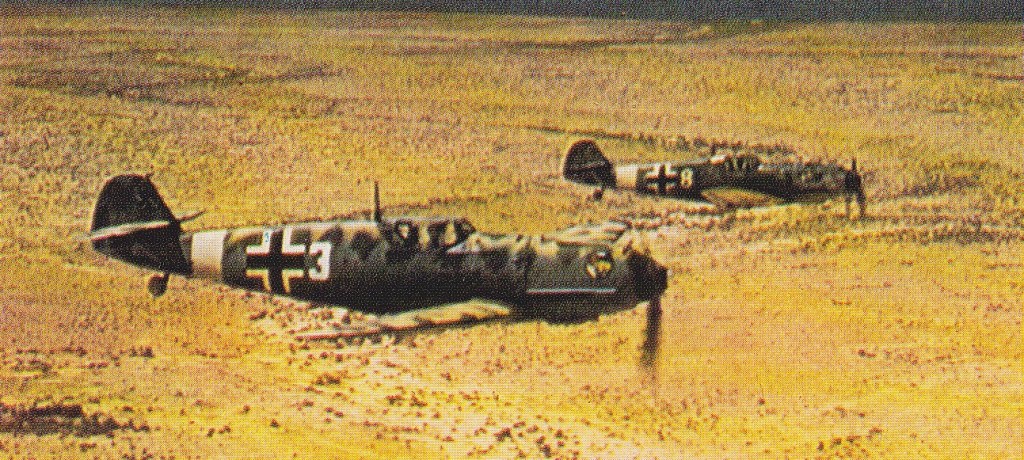
Bf109E4

The Bf.109E controls tended to heavy up as speed increased, demanding more physical effort than its British contemporaries. The absence of a trimmer necessitated continuous application of rudder at high speeds, and it suffered an incipient swing during takeoff and landing. A big advantage was its direct fuel injection.

Also licence built by Fiesler.

The Bf 109G or Gustav was first flown as a type in 1944, with the G-10 having an enlarged supercharger to enable it to be used as a high altitude fighter in defence of the Reich. With a service ceiling of 41,000 feet, the Gustav G-10 was also the fastest of the series with 426 mph at 24,000 feet. Armament was one 30mm cannon and two 13mm machine guns, all in the nose. Modified around the 1475 hp DB605 engine, the Gustav also introduced cockpit pressurisation, crucial from late 1942 onwards as the fighter Gruppen struggled to repel high altitude USAAF daylight bomber raids. The Bf109 was the most abundantly produced fighter manufactured by either side in the 1939-45 war. When German production stopped, the G series of the Bf 109 was produced in far greater numbers than any other model, 21,000 being completed by the end of 1944. This machine had two MG 131 machine guns, a single 30-mm MK 108 cannon firing through the spinner, and sometimes carried two underwing MG 151/20 weapons.

Messerschmitt Me.109G Gustav Article

Messerschmitt BF109 G6

Postwar Spain continued licence manufacture of the Gustav as the Merlin engined Hispano 1112M Buchon.

A significant quantity of Bf 109G 1s and G2s were assembled by IAR at Brasov from main parts supplied by the Germans. These fighters received white serial numbers on their fin in the ‘White’ 200 series. The next sub version assembled at IAR was the Ga 4, a total of 15 being finished up to the factory being dispersed in the summer of 1944 due to Allied bombings. The first one was rolled out in April 1944. The Ga 6 was the next sub version to be manufactured at IAR-¬Brasov. The first one, ‘Black’ 316, was test flown only in early February 1945. Nevertheless, none of the IAR manufactured Bf 109Ga 6s saw action during World War Two.

The mainstay of the Luftwaffe’s fighter arm, over 30,000 were built of the Gustav variant alone between 1941 and 1945. It has been estimated that about 35,000 Bf/Me 109 were built between 1937 and 1945.

Last versions to see limited use were the increased-span Bf 109H and a refined version of the Bf 109G, designated Bf 109K. And right at the end of the war final German deliveries amounted to 19 examples of the Bf 109K-4 with more power and armament as well as a pressurised cockpit.

Production of the Bf 109 continued in Czechoslovakia and Spain during early post-war years, and some Czech-built S-99 were used in a training role until 1957.

Nazi Germany saw the Spanish Civil War as an ideal conflict in which to test its renascent forces and their new weapons, and therefore supported the ideologically allied Nationalists with small but high-quality forces. The air component was the Legion Condor, which began to arrive in November 1936 and included as its fighter element Jagdgruppe 88, initially comprising three Staffeln with He 518 biplanes. In January 1937 three Bf 109B prototypes were trialled in Spain, their success prompting the despatch from March 1937 of the first 24 of an eventual 45 Bf 109B-2s for service with 1. and 2.J/88 as well as the Nationalists’ 5-G-5. This immature fighter proved generally superior to all its opponents, and Bf 109s notched up J/88’s 100th ‘kill’ in January 1938, more than tripling this score by the time the Germans pulled out of the war in March 1939 after gaining invaluable tactical experience.

In the mid-war years, Germany bolstered the Italian air force with numbers of fairly advanced fighters. The initial deliveries comprised sufficient Bf 109F fighter-bombers (in F-4/B and F-4/R1 variants). Further reinforcement was necessary in 1944: the Italians thus received the upengined and upgunned Bf 109G model in the form of 28 G-6, 97 G-10 and four G-12 variants. As a bomber interceptor the Bf 109G 6 was armed with two MG 131 machine guns, a single MK 108 30 mm. cannon firing through the propeller shaft and two MG 151/20 under wing guns.

“Mistletoe” aircraft (officially codename “Beethoven”), also known as father-and-son or piggy-back aircraft, were composite aircraft, made up of two planes, one riding on the other’s back. There were two basic types of Mistletoe. Both used a pilotless Ju.88 bomber as the bottom plane; it carried a 3.5 ton explosive warhead and was guided to the target by a fighter pilot on top. The guide plane was either a Me.109 (as the S-1 Mistletoe), or a Fw-190 (as the S-2 Mistletoe), which would abandon the Ju.88 shortly before it exploded. The Mistletoe composite aircraft were tested at Nordhausen and Peenemünde at the beginning of 1944. On the night of 24-25 June 1944, five S-1 Mistletoes were first used operationally. Approximately 250 Ju.88 were converted to Mistletoes.

HA-1109

In 1943 Hispano received a contract to build the Messerschmitt Bf 109G under license for the Spanish Air Force. Designated Hispano HA-1109, it was powered initially by a Hispano-Suiza HS-12Z engine and later, in HA-1109/1110 Buchon variants, by the Rolls-Royce Merlin.

Although 233 single seat fighters were built, only two dual-control two seat trainers were built. The first was powered by the Hispano-Suiza 12Z and designated HA-1110-K1L.

CASA of Spain built the RR Merlin powered Messerchmitt 109 as the HA1112. The second two-seater was built with a Merlin 500 engine and designated HA-1112-M4L. The HA-1110-K1L was eventually converted to an HA-1112-M4L.

1954 Hispano Aviation HA-1112-M4L G-AWHC

A number of Buchóns were deployed to Spanish Sahara (1957-58) to battle Moroccan insurgents and their allies. The Buchóns were primarily tasked with giving close air support to army units on the ground. During the battle, the HA-1112 earned the distinction of being the last member of the Bf-109 family to participate in actual battle.

Buchóns stared in iconic movies such as:
“Der Stern von Afrika” (The Star of Africa) A German film from 1957 focusing on the Luftwaffe ace, Hans-Joachim Marseille.
“Battle of Britain” The legendary British film from 1968 features many Buchóns filling the Bf-109 role.
“Memphis Belle” The 1990 American film about the Boeing B-17 bomber of the same name.
“The Tuskegee Airmen” A 1995 American film about the famous fighter group of all African American pilots in WWII.
“Dark Blue World” A Czech film from 2001 about Czechoslovakian pilots in the RAF during WWII.

HA1112
Avia S-199

In Czechoslovakia, Avia produced the Messerschmitt 109 as the Avia S-199 Mezek.

Avia S.199 Article

AVIA C.210

The AVIA C.210 single-seat fighter was built during the early post-war year by the former Avia factory for the Czech Air Force. Derived from the Daimler-Benz powered Me 109G-14 and comparable with the Me 109K-18, the C.210 was powered by a 1340 hp Junkers Jumo 211F engine. The Me 109G-14 was built in Czechoslovakia as the C.10 and, in two-seat trainer form, as the C.110. A number of C.210 were exported to Israel.

Messerschmitt Bf 109 / Me 109 Restoration News

Gallery

Replicas
Loehle KW-909
Peak Aerospace Me 109

Specifications:

Bf 109B

Bf.109B 1
Engine: 635 hp Jumo 210D.
Armament: 3 x machine guns.

Bf 109B-2
Span: 9.87m (32tt4.5in)
Length: 8.55m (28ft 0.7 in)
Powerplant: l x Junkers Jumo 2l0Da, 537kW (720 hp)
Armament: 3 x 7.92-mm (0.312-in) mg
Max T/O weight: 2150 kg (4,740 lb)
Max speed: 289 mph at 13,125ft
Operational range: 430 miles.

Bf.109C
Engine: Junkers Jumo 210

Bf.109D
Engine: DB 600

Bf.109E
Engine Daimler Benz DB 601A, 1,100 h.p.
Wing span 32.3 ft. (9.84 m.)
Length 28.5 ft. (8.68 m.)
Normal take-off weight: 5875 lb / 2665 kg
Weight empty 4,420 lb. (2,005 kg.)
Fuel capacity: 88 ImpG / 400 lt
Max speed SL: 290 mph / 466 kph
Max speed 6560ft/2000m: 322 mph / 518 kph
Max speed 14,560ft/4449m: 348 mph / 560 kph
Ceiling 36,000 ft. (11,000 m)
ROC: 3280 fpm / 1000 m at 5400 lb / 2450 kg
Time to 9840 ft / 3000m: 3.6 min
Endurance: 1.1 hr at max continuous pwr, 19685 ft / 6000 m
Range cruise: 410 mi / 660 km at 233 mph / 375 kph at 22,965 ft / 7000 m
Seats: pilot.
Armament: 3 x 20 mm cannon and 2 x 7.9 mm mg
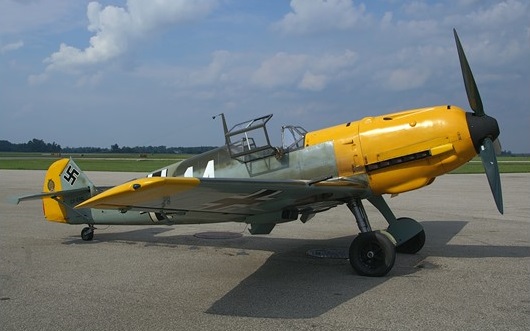
B.109E-0
Pre-production variant
Engine: DB 601A, 1100 hp / 820 kW
Armament: 4 x 7.92mm / 0.312 mg

Me 109 E-1
Production variant
Engine: Daimler-Benz 601Aa, 1085 hp
Length: 28.543 ft / 8.7 m
Height: 11.253 ft / 3.43 m
Wingspan: 32.48 ft / 9.9 m
Wing area: 176.530 sqft / 16.400 sq.m
Max take-off weight: 5699.9 lb / 2585.0 kg
Weight empty: 4090.3 lb / 1855.0 kg
Max weight carried: 1609.7 lb / 730.0 kg
Max speed: 308 kts / 570 km/h
Initial climb rate: 2755.91 ft/min / 14.00 m/s
Service ceiling: 33136 ft / 10100 m
Wing load: 32.39 lb/sq.ft / 158.00 kg/sq.m
Range: 324 nm / 600 km
Endurance: 2 h
Crew: 1
Armament: 2x MG 17 7,9mm; 2x MG FF 20mm;1x MFG FF 20mm

Bf.109E-1B
Fighter/Bomber

Bf 109E-3
Engine: Daimler-Benz DB 601Aa, 1175 hp / 876 kW
Wingspan: 32 ft 4.5 in / 9.87 m
Length: 28 ft 4.5 in / 8.64 m
Height: 8 ft 2.25 in / 2.50 m
Wing area: 174.05 sq.ft / 16.17 sq.m
Empty wt: 4189 lb / 1900 kg
MTOW: 5875 lb / 2665 kg
Max speed: 348 mph / 560 kph at 14,560 ft / 4440 m
Time to 3290 ft / 1000m: 1 min 6 sec
Service ceiling: 34,450 ft / 10,500 m
Range: 410 mi / 660 km
Armament: 2 or 3 x 20mm cannon, 2 x 7.92 mm (.312 in) mg
Seats: 1

Bf.109E-4
Armament: 2 x 7.92mm / 0.312 mg, 2 x 20 mm cannon
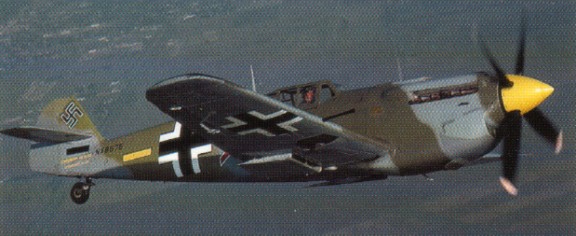
Bf.109E-4/B
Fighter/Bomber

Bf.109E-5
Reconnaissance fighter
Engine: DB 601Aa

Bf.109E-6
Reconnaissance fighter
Engine: DB 601N, 1200 hp / 895 kW

Bf.109E-8
Engine: DB 601E, 1350 hp / 1007 kW

Bf.109E-9
Reconnaissance fighter

Me 109F-3
Engines: 1 x Daimler Benz, 1300 hp
Wing span: 32 ft 6.5 in (9.92 m)
Length: 20 ft 0.75 in (8.86 m)
Height: 11 ft 2 in (3.4 m)
Max TO wt: 6063 lb (2750 kg)
Max level speed: 391 mph / 630 kph

Bf 109F-4/B

Bf 109F-4/R1

Bf 109G
Engine: Daimler Benz DB 605A
Max speed: 387 mph (623 km/h) at 23,000 ft (7,000 m).

BF 109 G-6
Wingspan 9.92 m (32 ft. 6.5 in.)
Length 9.02 m (29 ft. 7 in.)
Height 3.4 m (11 ft. 2 in.)
Empty Weight 2,700 kg (5,953 lb)
Speed: 387 mph at 22,970 ft
Range: 450 miles
Armament: two MG 131 mg, one MK 108 30 mm. cannon firing through the propeller shaft and two MG 151/20 under wing guns.

Bf 109G-6
Engine: 1 x Daimler Benz DB 605AM, 1342kW
Max take-off weight: 3150 kg / 6945 lb
Wingspan: 9.92 m / 32 ft 7 in
Length: 9.02 m / 29 ft 7 in
Height: 3.40 m / 11 ft 2 in
Wing area: 16.05 sq.m / 172.76 sq ft
Max. speed: 621 km/h / 386 mph
Ceiling: 11750 m / 38550 ft
Range: 720 km / 447 miles
Armament: 2 x 13mm machine-guns, 3 x 20mm cannons
Crew: 1

Bf 109G-10
Engine: Daimler-Benz DB605D.

Bf 109G-12

Bf 109K-4
Powerplant: l x Daimler-Benz DB605ASCM, 1491 kW (2,000 hp)
Span: 9.97m (32ft 8.5in)
Length: 8.85m (29ft 0.5 in)
Armament: 1 x 30-mm and 2 x 15-mm cannon
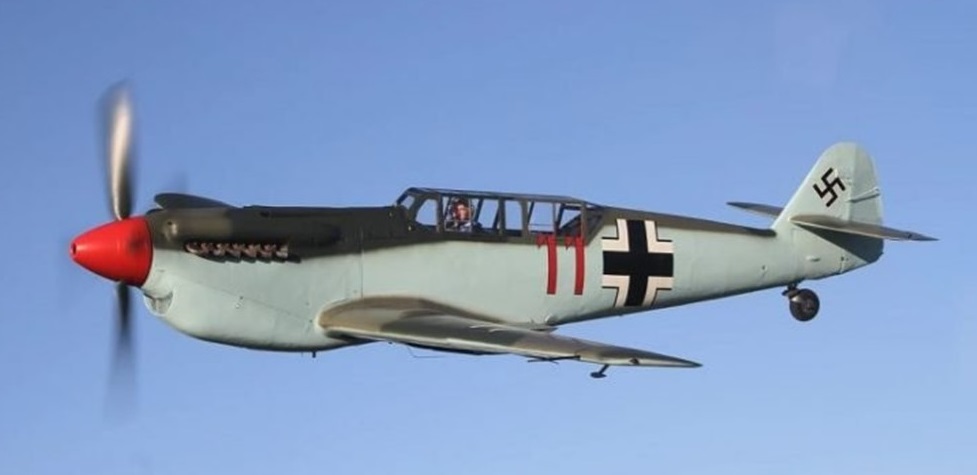
Max TO weight: 3600 kg (7,937 lb)
Max speed: 452 mph at 19,685ft.
Operational range: 366 miles.

Hispano HA-1112-M1L Buchon
Engine: Rolls-Royce Merlin 500-45, 1400 hp
Wingspan: 32 ft 6.5 in
Wing area: 172.2 sq.ft
Length: 29 ft 10.5 in
Height: 8 ft 6 in
Empty weight: 5855 lb
MTOW: 7011 lb
Max speed: 419 mph at 13,000 ft
Max ROC: 5580 ft/min
Range: 475 mi
Armament: 2 x 20 mm cannon
Bombload: 8 x 22 lb rockets

Avia C.210
Engine: 1340 hp Junkers Jumo 211F
Max speed: 432 mph
Range: 350 mi
Normal loaded weight: 7800 lb
Wingspan: 32 ft 6.5 in
Length: 29 ft 6 in
Height: 12 ft

Messerschmitt Bf 109

Messerschmitt M37 / Bf 108 Taifun / Nord 1000 / 1001 / 1002 Pingouin

In 1934 Messerschmitt designed the M37, later to become the Bf 108 Taifun, for the German team taking part in the 1934 Challenge de Tourisme International. The original design was for a light tourist two-seater, and even though the Challenge was not a great success for the Bf 108, as the best German pilot Theo Osterkamp only came in fifth, the RLM still ordered thirty-two Bf 108s.

Messerschmitt Bf 108 Taifun Article

The M 37 prototype flew first in spring 1934 powered by a 250 PS (247 hp, 184 kW) Hirth HM 8U inverted-V engine, which drove a three-blade propeller. It could cruise at 145 knots and was orig¬inally equipped with full span flaps and spoilers for lateral control. It featured automatic Handley Page leading edge slats, a retractable undercarriage, fully stressed skin fuselage construction and flush rivets.
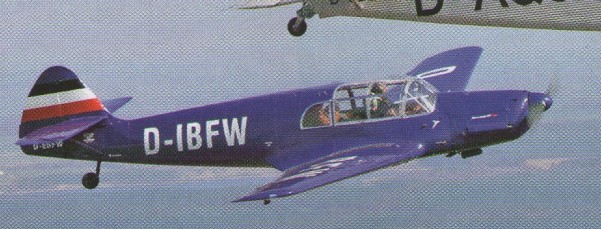
Although it was outperformed by several other aircraft in the competition, the M 37’s overall performance marked it as a popular choice for record flights. Particular among these traits was its extremely low fuel consumption rate, good handling, and superb takeoff and landing characteristics. One of the first major changes made to the production variants was to adapt the fuselage for a four-seat configuration.
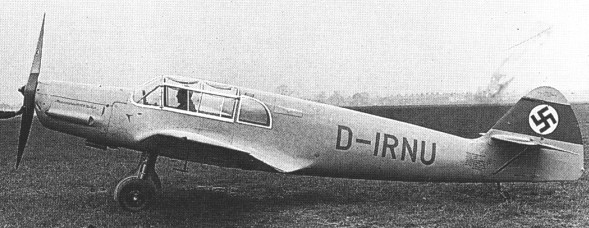
Production as the Bf 108 Taifun began in 1934 and the first foreign pilot who tested the Bf 108 was Charles Lindbergh.

The Bf 108A first flew in 1934, followed by the Bf 108B in 1935. The production of the improved version, the Bf 108B, was set-up in November 1935. The B version was redesigned to be a four-seater with a new 179kW Argus As 10C engine. The Bf 108B was a very modern light aircraft with an all-metal airframe, retractable undercarriage, adjustable propeller, and with excellent flight characteristics.

The military version of the Taifun was the Bf 108B-2 and was acquired by the Luftwaffe in 1939. It was widely employed during the war years by all operational Luftwaffe units as a light liaison aircraft. The nickname Taifun (German for “typhoon”) was given to her own aircraft by Elly Beinhorn, a well known German pilot, and was generally adopted.

In 1941 the Bf 108D replaced the B on the production line. An Argus As 10R engine powered the D version and included the new Argus automatically adjustable propeller and improved fuel assembly.

Production was transferred to the S.N.C.A. du Nord factory at Les Mureaux in France in 1942, where 170 Bf 108D were completed before the liberation of France in 1944. In total 626 military Taifuns, versions B-2 and D-1, were produced. At least 180 civilian or export versions, Bf 108B-0 and B- 1, were produced.

French production continued after the war where another 115 aircraft as the Nord 1000 and Nord 1002 Pengouin were manufactured. 285 were built post-war.

Nord 1002

Production of the Bf 108 amounted to 885 aircraft in total.

The Hungarian Air Force had eight Taifuns, both the Italians and Rumanians had three, the USSR bought two and Switzerland and Yugoslavia had twelve each. One aircraft was used in Chile, one or two in Japan and one was in Australia. The Bulgarian Air Force had six and at least one was in Spain. One Bf 108B-1, coded XC44, was operated by the US Embassy in Berlin. Two Bf 108B-1s were flown by the German Embassy in London but the RAF confiscated these two aircraft in 1939. After the war, one Bf 108B-2 was flown in Czechoslovakia, two in Poland, one in Denmark and one in Sweden. Some 115 Bf 108Ds (Nord 1000) were used by the French Air Force and Navy until the late 1950’s.

The Ilmavoimat / Maavoimat evaluated both the Bf108 but considered the design unsuitable for their overall requirement, correctly assessing the aircraft as a light passenger aircraft unsuitable for combat reconnaisance and without any real STOL capability.

Gallery

Bf 108B Taifun
1 x Argus As 10C, 179kW / 237 hp
Max take-off weight: 1385 kg / 3053 lb
Empty weight: 880 kg / 1940 lb
Wingspan: 10.50 m / 34 ft 5 in
Length: 8.30 m / 27 ft 3 in
Height: 2.30 m / 7 ft 7 in
Wing area: 16.40 sq.m / 176.53 sq ft
Max. speed: 300 km/h / 164 kts / 186 mph
Service ceiling: 5000 m / 16400 ft
Range: 1000 km / 540 nm / 621 miles
Endurance: 4 hr
Initial climb rate: 787.4 ft/min / 4.00 m/s
Seats: 4

Nord 1001
Engine: 240hp Renault 6Q-10, 240 hp
Span: 34ft 6in (10.51m)
Width wings folded: 10 ft 7 in
Length: 27ft 3in (8.3m)
Height: 7 ft 7 in
Max wt: 2990 lbs (1355kg)
Max speed: 186 mph (299 kmh) at 5000 ft
Cruise: 160 mph at 6000 ft
TO speed: 70 mph
Ldg speed: 65 mph
Stall: 53 mph
TO roll at 3000 lb: 950 ft
TO to 50ft: 1120 ft
Ldg rol: 750 ft
Ldg from 50 ft: 1100 ft
ROC: 1200 fpm
Ceiling: 23,500 ft
Range: 620sm (997 km)

Nord 1002
Engine: 240hp Renault 6Q-11, 240 hp

Nord 1002
Engine: 240hp Argus As 10c V8
Span: 34ft 6in (10.51m
Length: 27ft 3in (8.3m)
Max wt: 2990 lbs (1355kg)
Speed: 186mph (299 kmh)
Range: 620sm (997 km)

Messerschmitt Flugzeugbau GmbH / Bayerische Flugzeugwerke (BFW)

Founded by Willi Messerschmitt at Bamberg in 1923 as Messerschmitt Flugzeugbau and became GmbH April 28,1926.

Willie Messerschmitt Article

It was in Augsburg that on 30 July 1926, the Bayerische Flugzeugwerke (BFW) was incorporated and established itself in the former Rumperwerke factory.

S-16 powered glider flown 1924; M-18 three-passenger, single-engined airliners built for Nordbayerische Verkehrsflug AG and others 1925. Developed into M-20 and M-20b built for Lufthansa 1928. Highly successful M-23 two-seat sporting monoplane introduced 1929.

A number of crashes led Lufthansa to refuse to accept any more M20s, which resulted in the Messerschmitt company, Bayerische Flugzeugwerke (BFW) going bankrupt on 1 June 1931. An agreement was reached with all creditors in December 1932 and on 1 May 1933 the BFW AG was able to start a new career. Renamed Messerschmitt AG 11 July 1938.

Messerschmitt airplanes are variously coded with the letters Bf and Me; they refer to Bayerische Flugzeugwerke and Messerschmitt AG, respectively firm names under which he did business. The Bf designation was dropped in 1938, but designs executed before that time properly carry the prefix Bf.

After being renamed in 1938 continued production of BFW’s Bf 108 and of Bf 109 fighter, Bf 110 twin-engined long-range fighter. Rocket-powered Me 163 fighter first flown August 1941, and first of Me 262 twin-jet fighters on 18 July 1942. Bf 110 developed into Me 210 fighter-bomber first flown September 2,1939, built up to 1944, and reengined Me 410, which made maiden flight in late 1942. Me 321 Gigant troop carrier/cargo glider (54.68m wingspan) introduced 1941; 175 built together with 201 of Me 323 powered version with six Gnome- Rhone radial engines.

Reconstituted postwar company formed Flugzeug-Union Sud with Heinkel in August 1956, building Fouga Magister under license and later taking part in programs for Fiat G.91, Lockheed F-104G, Transall C.160 and Bell UH-1D.

Amalgamated with Bolkow as Messerschmitt Bolkow GmbH 1968 and then with Hamburger Flugzeugbau to form Messerschmitt-Bolkow-Blohm 14 May 1969.

McDonnell XP-67 Bat

On 29 July 1941 the McDonnell Aircraft Corporation received a contract for two prototype of a long-range single-seat fighter designated XP-67. The design embodied several innovatory features, not least was an attempt to maintain true aerofoil sections throughout the entire fighter, the centre fuselage and thc rear portions of the engine nacelles merging to give the aircraft a unique appearance. The two 1,350 hp Continental XI-1430 12-cylinder inverted-vee engines were fitted with General Electric D-23 turbo-superchargers and featured exhaust thrust augmentation. The cabin was pressurised and proposed armament comprised six 37-mm M-4 cannon. The first XP-67 was flown on 6 January 1944, and flight trials continued until 6 September 1944, when the prototype suffered irreparable fire damage. This accident and the unsatisfactory nature of certain aspects of the fighter’s performance led to the decision to abandon the second prototype and terminate the development contract.

McDonnell XP-67 Bat Article

Engines: 2 x Continental XI-1430 12-cylinder inverted-vee engines with General Electric D-23 turbo-superchargers and exhaust thrust augmenta¬tion, 1,350 hp.
Max speed, 405 mph (652 km/h) at 25,000 ft (7 620 m)
Max climb, 2,600 ft/min (13,20 m/sec)
Max range, 2,385 sm (3 838 km)
Service ceiling: 11400 m / 37400 ft
Empty weight. 17,745 lb (8 049 kg)
Normal loaded weight, 22,11l4 lb (10 031 kg)
Span, 55 ft 0in (16,76m)
Length, 44 ft 9.25 in (13,65)
Height, 15 ft 9 in (4,80 m)
Wing area, 414 sq ft (38,46 sq.m)

McDonnell XP-67