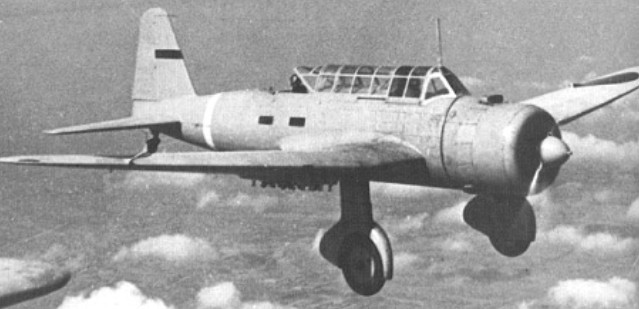
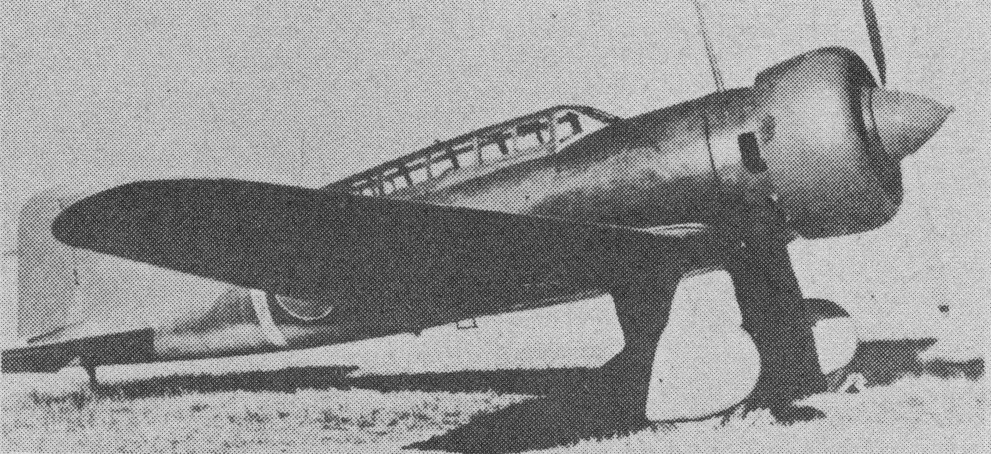
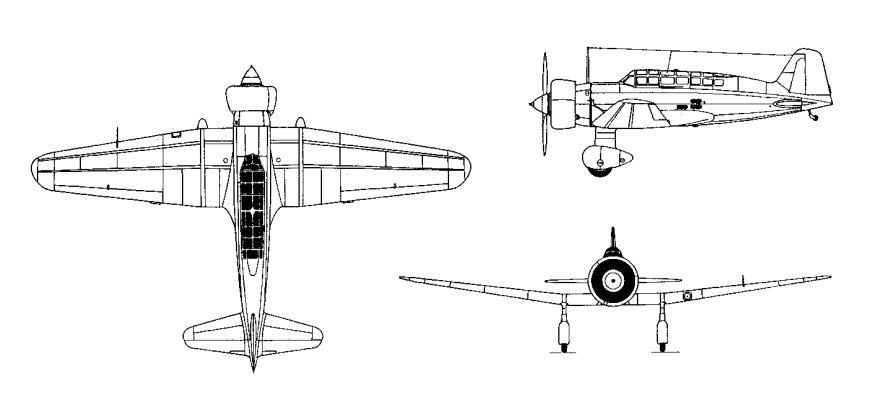
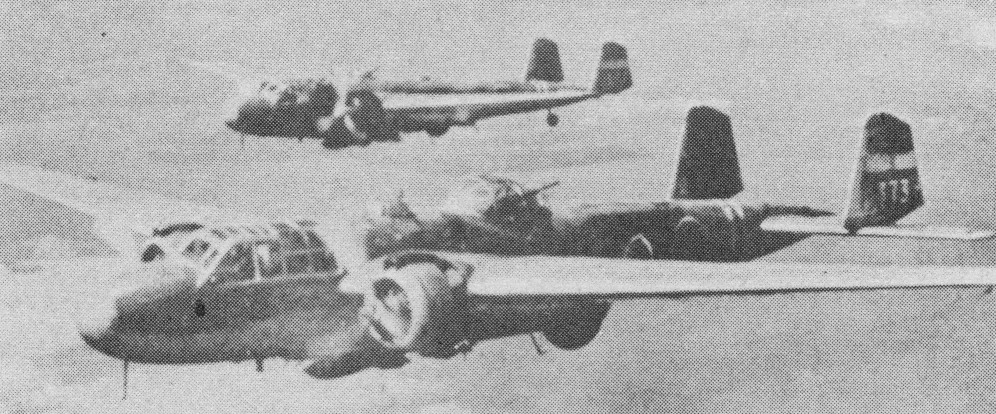
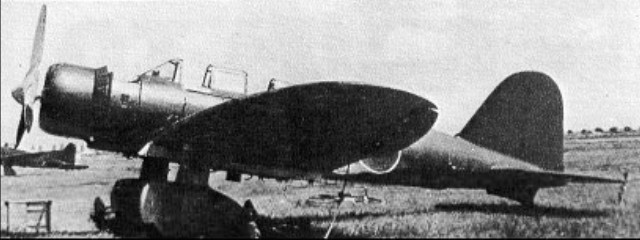
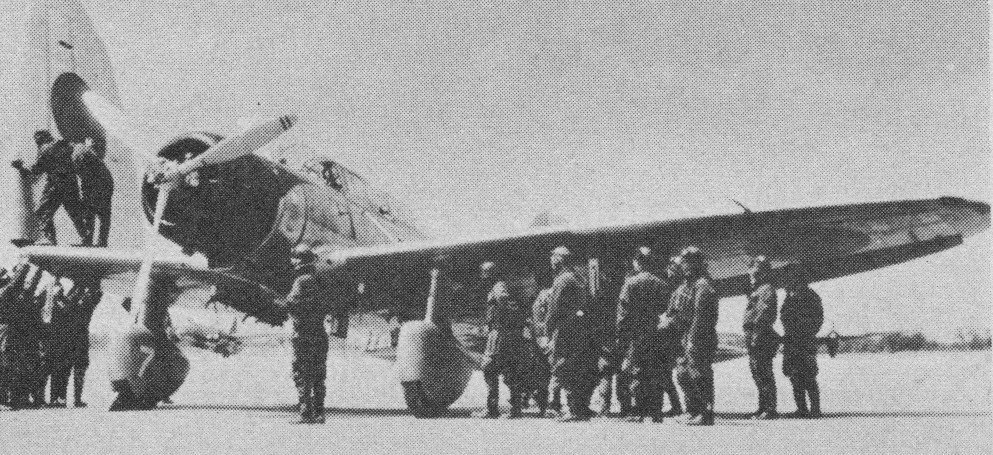
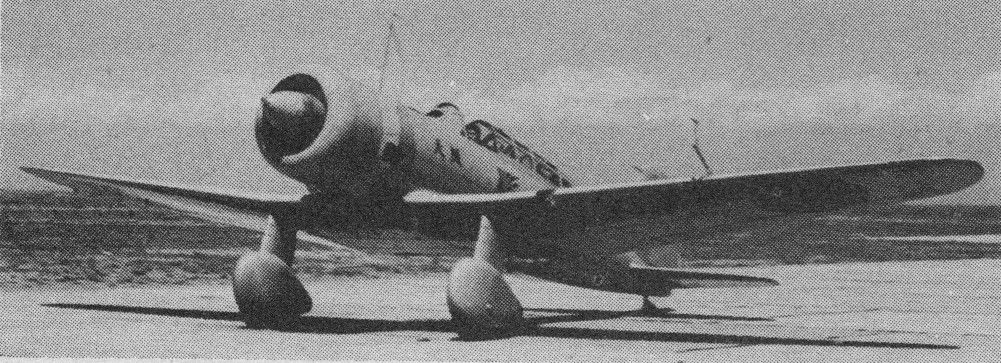
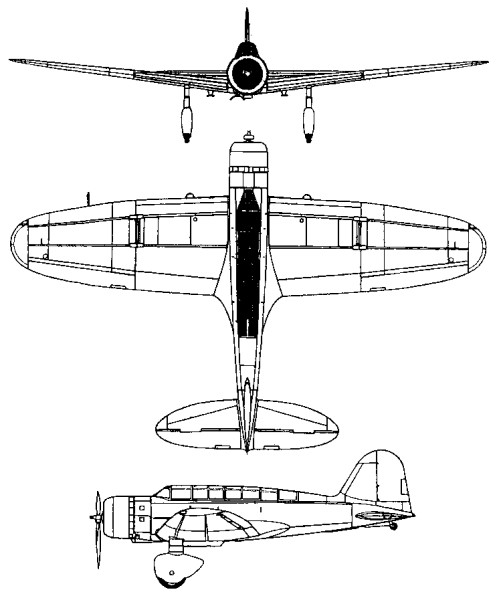
In May 1936 the Imperial Japanese Army issued its specification for a light bomber required to supersede the Mitsubishi Ki-2 and Kawasaki Ki-3 then in service. The Mitsubishi Ki-30 prototype that resulted was of cantilever mid-wing monoplane configuration with fixed tailwheel landing gear, the main units faired and spatted, and powered by a 850 hp / 615kW Mitsubishi Ha-6 radial engine. The engine drove a three bladed variable pitch metal propeller. The Ki 30’s two man crew were housed beneath a long raised glazed canopy. Armament comprised a wing mounted forward-firing 7.7 mm (0.303 in) Type 89 machine gun with a similar weapon on a flexible mounting in the rear cockpit operated by the observer. The normal bombload of 300 kg (660 lb) was carried internally in the bomb bay. The Ki 30 was characterized by its fixed undercarriage with single cantilever strut main units fitted with open sided wheel spats.
The first prototype made its initial flight at the army’s Kagamigahara experimental airfield on February 28, 1937. The army specification had called for a maximum speed of 400 km/h (248 mph) and this was easily exceeded. All other requirements were met except that the weight was slightly more than the specified maximum of 3300 kg (7275 lb). The second prototype had a more powerful Nakajima Ha-5 KAI radial engine. This aircraft showed some slight improvement in performance but, in any case, exceeded the army’s original specification, so there was no hesitation in ordering 16 service trials aircraft. These were delivered in January 1938 and, two months later, the Ki-30 was ordered into production.
Production at Mitsubishi’s Nagoya plant started at the beginning of 1938, utilizing an alternative engine, the 960hp Nakajima Ha 5 Kai. Mitsubishi built 636 aircraft up to April 1940, supplemented by 68 completed at the Tachikawa army arsenal workshops between 1939 1941.
In service with six Sentais (groups) and several independent Chutais (squadrons) as the Army Type 97 Light Bomber, first used operationally in China during 1938.
A number were.supplied to Thailand who used them against the French in Indo China during early 1941. When war was declared on Britain and the United States, Ki 30 units operated in the Philippines, but were from then on gradually transferred to training schools from where a number flew kamikaze missions in the summer of 1945. The Allied codename ‘Ann’ was allocated to the Ki-30, but few were seen operationally after the opening phases of the war.
A total of 704 had been built when production ended in 1941, 68 manufactured by the First Army Air Arsenal at Tachikawa.
Ki-30 Engine: 1 x Mitsubisi Ha-6, 710kW Max take-off weight: 3322 kg / 7324 lb Empty weight: 2230 kg / 4916 lb Wingspan: 14.55 m / 47 ft 9 in Length: 10.34 m / 33 ft 11 in Height: 3.65 m / 11 ft 12 in Wing area: 30.58 sq.m / 329.16 sq ft Max. speed: 432 km/h / 268 mph Cruise speed: 380 km/h / 236 mph Ceiling: 8570 m / 28100 ft Range: 1700 km / 1056 miles Crew: 2 Armament: 2 x 7.7mm machine-guns, 300-450kg of bombs
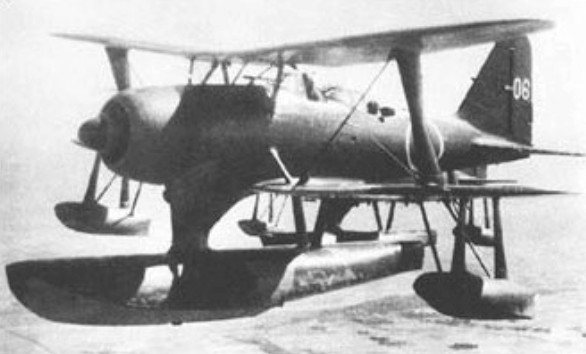
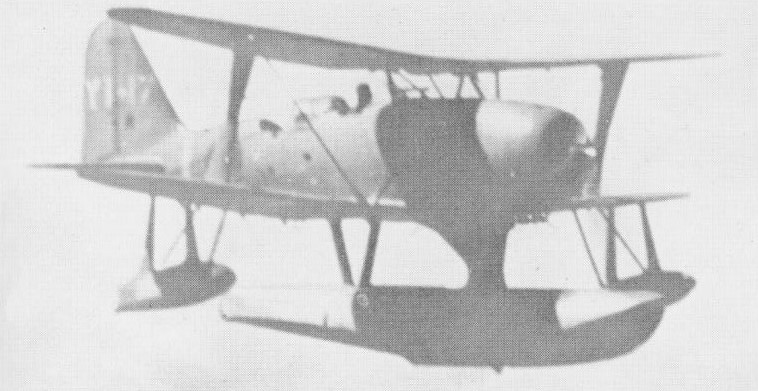
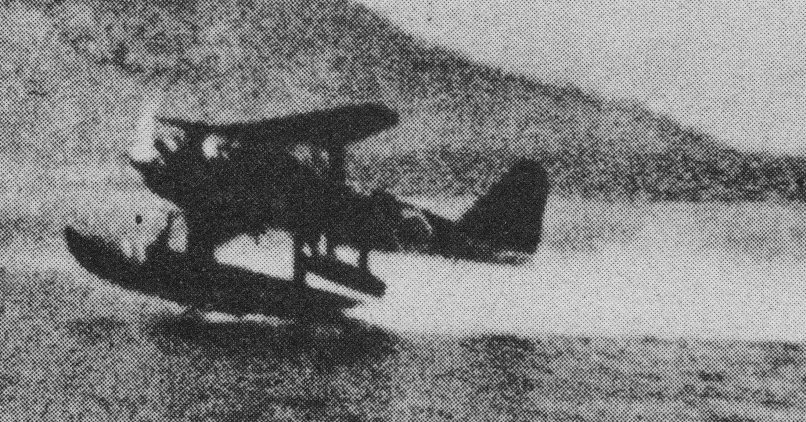
The Mitsubishi F1M development started in 1934, and first flown in June 1936. The F1M1 embodied all the efforts of its designers to achieve an exceptionally clean aerodynamic shape, including low-drag float mountings, single interplane struts and all-metal construction, only the control surfaces being fabric-covered. The early aircraft displayed poor water handling and a lack of in-flight directional stability but after fairly extensive alterations the production F1M2 emerged as a thoroughly efficient aircraft, acceptable in all respects. Initial production by Mitsubishi, begun in 1938, amounted to 524 aircraft before it was transferred to the 21st Naval Air Arsenal (Dai-Nijuichi Kaigun Kokusho) at Sasebo, where a further 590 were built.
The F1M2 equipped all but one of the K-Maru (6,900-ton) and S-Maru (7,200/8,300-ton) classes of converted merchant seaplane tenders, as well as numerous battleships and cruisers of the Imperial Japanese Navy.
Codenamed ‘Pete’ by the Allies, F1M2s were present at the Battle of Midway, two aircraft being launched from the battleship Kirishima (but being lost when the Japanese scuttled the crippled ship at the end of the Battle of the Solomons). The battleships Musashi and Yamato each carried several ‘Petes’ to spot for their 460mm main gun armament at the time of the Marianas battles, but none was used in earnest. The Musashi succumbed to American bombs and torpedoes in the Sibuyan Sea; the Yamato followed her to the bottom on 7 April 1945. ‘Pete’ seaplanes were widely used throughout the Pacific war, accompanying every seaborne landing by Japanese forces, providing gunnery spotting during preliminary bombardment by supporting warships and subsequently serving as covering fighters (and even dive-bombers) once the assault forces were ashore. It was also flown on convoy escort duties with the many supply convoys sailed by the Japanese during the mid-war period.
In the last stages of the war, the type was committed to the unequal task of defending the Japanese homeland from the devastating American raids, serving alongside ‘Rex’ and ‘Rufe’ seaplane fighters with the Otsu Kokutai in 1945.
F1M2 Crew: 2 Engine: 1 x Mitsubishi Tsuisei-13, 655kW Max take-off weight: 2550 kg / 5622 lb Empty weight: 1928 kg / 4251 lb Wingspan: 11 m / 36 ft 1 in Length: 9.5 m / 31 ft 2 in Height: 4 m / 13 ft 1 in Wing area: 29.54 sq.m / 317.97 sq ft Max. speed: 365 km/h / 227 mph Ceiling: 9440 m / 30950 ft Range: 730 km / 454 miles Armament: 3 x 7.7mm machine-guns, 120kg of bombs
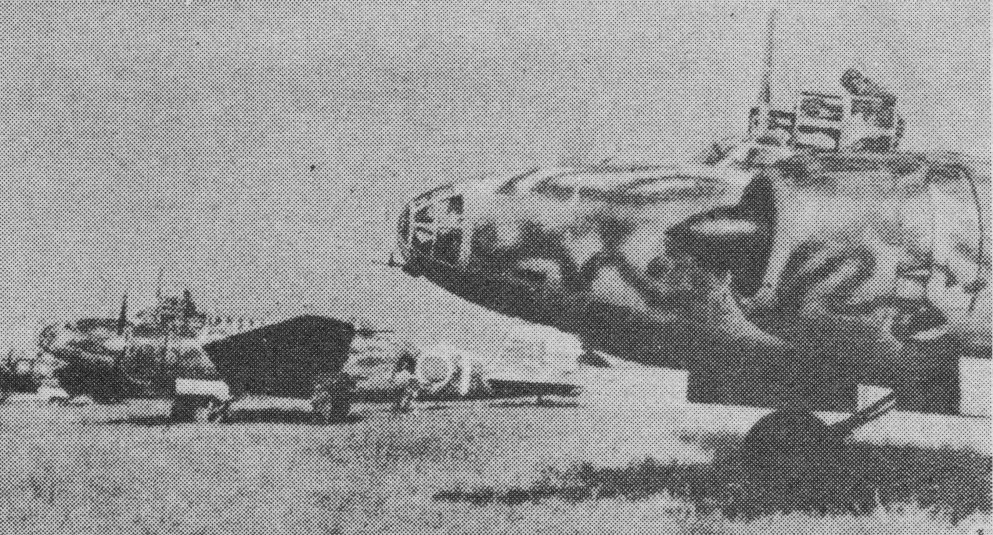
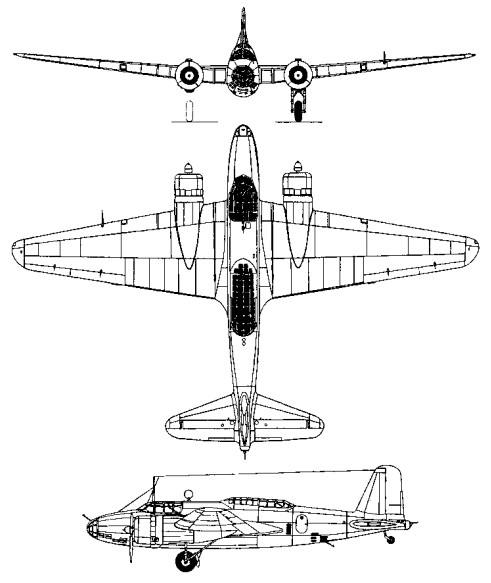
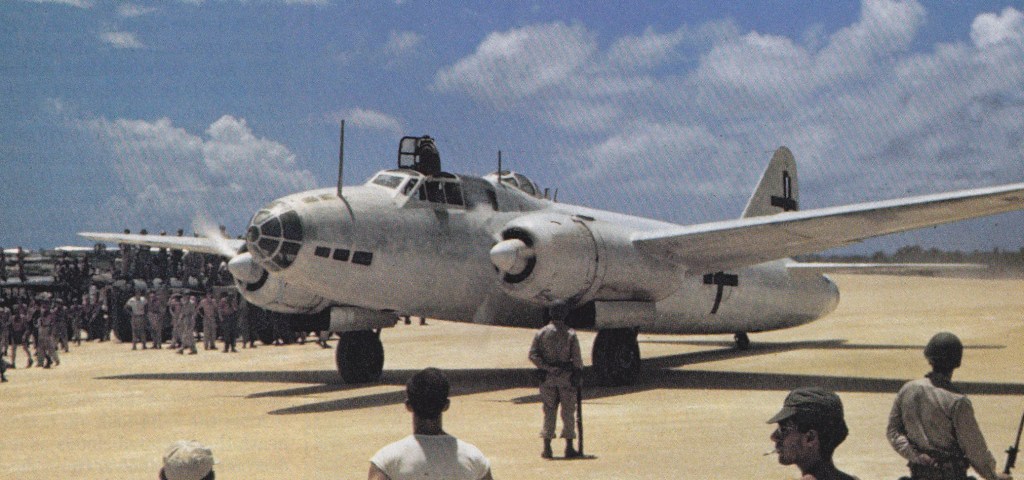
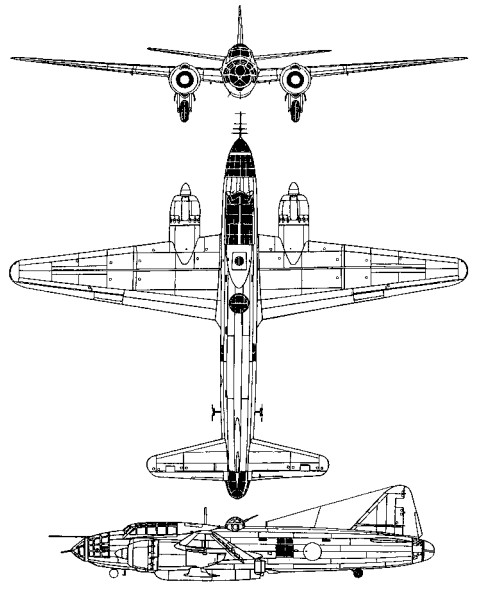
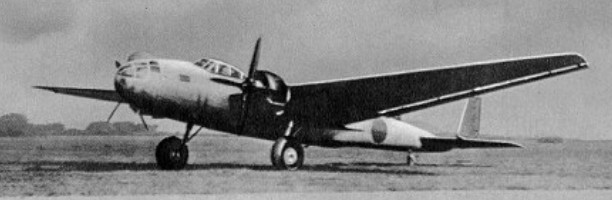
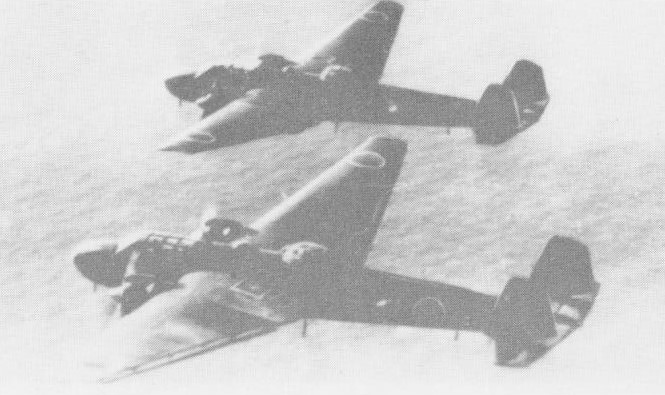
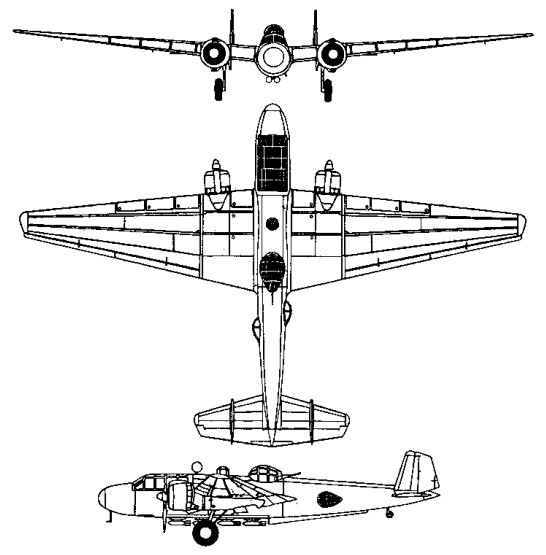
The Mitsubishi Ki-21 (Army Type 97 Heavy Bomber) was produced by engineers Nakata and Ozawa in response to an operational specification issued by the Air Headquarters (Daihonei) of the JAAF on 15 February 1936. The original specification, issued in February 1936, had required an aircraft with an endurance of over five hours at an average cruising speed of 300 km/h (186 mph), able to climb to 3000 m (9840 ft) in eight minutes and reach a maximum 400 km/h (248 mph) at that height. Normal crew was to be four, with provision for two more gunners on missions where extensive air opposition was anticipated. Maximum bombload for short range missions was to be 1000 kg (2200 lb). Early production aircraft in fact met or exceeded all these criteria.
In its definitive form the Ki 21 was a midwing monoplane of all metal semi-monocoque construction, and the smoothly contoured fuselage was oval in section. It had a single fin and rudder, and the main under-carriage legs retracted forward into the two engine nacelles.
The first of eight prototypes and service trial aircraft flew on December 18, 1936. It had a square glassed in nose, dorsal gun turret and a ventral step for a lower defensive gun. Later prototypes adopted a long dorsal greenhouse accommodating the gunner’s position, a well contoured hemispherical glassed in nose and a smooth lower fuselage line which eliminated the ventral step. To improve directional stability the fin and rud¬der were redesigned and increased in area. The first prototype had two Mitsubishi Ha 6 825 hp radial engines, while the remaining prototypes and early production machines had 850 hp Nakajima Ha 5 Kais.
Before going into production the Ki 21 had survived a competition with its rival the Nakajima Ki 19. As a consolation a contract was awarded by the Koku Hombu (the army air headquarters) not only to Mitsubishi (432 Model Is built) but also to Nakajima (351 Model Is).
A year late in entering service, some of its technology, compared with that of contemporary foreign aircraft, was not as advanced as the designers Nakata and Ozawa had hoped. The gap left by the delay in delivery of Ki 21s had to be filled by importing Fiat B.R.20 bombers. The first production model being the Mitsubishi Ki-21-Ia (Army Type 97 Model 1A). Because of production bottlenecks it was not until the end of 1939 that Ki-21-la bombers equipped the first JAAF unit, the 60th Hikosentai (air regiment) based in China, the next unit to be equipped was the 61st Sentai.
Early lessons learned over China demonstrated lack of firepower and protection, and the Ki-21-Ib and Ki-21-Ic subvariants had extra armour, additional 7.7mm Type 89 machine-guns, more fuel and larger bomb-bays. The engines were 634kW Nakajima Ha-5 KAI radials.
By the time of the outbreak of war in December 1941, the majority of the Mitsubishi Ki-21-Ia, Ki-21-Ib and Ki-21-Ic bombers had been relegated to second-line duties, or to service as operational bomber trainers. Most army front line bomber units were equipped with the Model 2 version of Ki 21, powered by two 1450 hp / 1119kW Mitsubishi Ha 101 14 cylinder radials driving constant speed three bladed metal propellers, unlike the Ha 5 Kai radials of the earlier version which had variable pitch propellers. The larger and more powerful Ha 101s required larger nacelles, and these completely enclosed the retracted landing wheels in the earlier machines, the wheels were left partly exposed.
Production models in service in 1941 were the Ki-21-IIa (Army Type 97 Heavy Bomber Model 2A), and the Ki-21-IIb which had a pedal-operated dorsal turret with one 12.7mm Type 1 heavy machine gun. Three sentais remained in Japan, Korea and in Manchuria when the Japanese high command went to war in South East Asia. For operations over the Philippines the JAAF’s 5th Air Group, based in Formosa, mustered the 14th and 62nd Hikosentais; these went into action early on the morning of 8 December 1941 striking at Aparri, Tuguegarao, Vigan and other targets in Luzon. Mitsubishi Ki-21s of the 3rd Air Group, based in French Indo-China, were earmarked for bombing strikes against Siam (Thailand) and Malaya: units were the 12th, 60th and 98th Hikosentais. These smashed RAF and RAAF facilities at Alor Star, Sungei Patani and Butterworth, being escorted by Nakajima Ki-27 and Ki-43 fighters. Only over Rangoon over December 1941 and January 1942 did the Ki-21s, codenamed ‘Sally’, suffer heavy casualties.
At its peak the Ki 21 was supplied to 11 first line Sentais and played a considerable part in the Pacific air war. Towards the end of its career lack of Ki 49 and Ki 67 replacements forced the retention of the Ki¬-21 in the first line when it was obsolete and suffering heavy losses. It took part in a number of outstanding actions, perhaps the most notable of which was the suicide mission by nine Model 2s of the 3rd Dokuritsu Hikotai (independent air wing). These were to land on the US occupied airfield at Yontan on Okinawa in the summer of 1945 to launch commando style attacks on airfield installations and aircraft. Only one aircraft survived to deliver its troops, but considerable damage was inflicted before they were wiped out.
The original Ki 21 defensive armament of single flexibly mounted 7.7 mm (0.303 in) Type 89 machine guns mounted in nose, dorsal and ventral positions proved barely adequate even for operations against the poorly equipped Chinese air force, and the Ki 21 Ib had an additional gun in a remotely operated tail stinger position plus another which could be fired from lateral positions on either side of the fuselage. The Ki 21 Ic and IIa had two beam guns while the Ki 21 IIb (688 of which were built between 1942 1944) had a remotely controlled tail stinger position for a 7.7 mm (0.303 in) machine gun, and the dorsal greenhouse replaced by a large conical turret mounting a single 12.7 mm (0.54in) Type 1 machine gun. This latter change greatly altered the appearance of the Ki 21 IIb and for a period it was thought by the Allies to be a new bomber type and given a different codename, Gwen, which was soon dropped when the new version was properly identified.
The bombload of all Ki 21 versions remained the same: a normal load of 750 kg (1653 lb) and a maximum of 1000 kg (2205 lb). The maximum range was 2700 km (1680 miles).
Some Ki 21 Ia bombers were modified during 1940 and put into service as MC 21 freight transports. Formally they passed into civil use as they were operated by the Dai Nihon Koku KK (Greater Japan Airlines) on routes between Japan, China and Manchuria, but all these flights were in fact military contract work, carrying army supplies (or personnel). Although all armament and other equipment appropriate to the bombing role had been removed, the aircraft were externally identical to the bombers, until a number were modified by the fitting of a ‘solid’ nose.
The Ki.21 was coded ‘Jane’ after Gen. MacArthur’s wife but when this came to his attention at the General’s request the code was changed to ‘Sally’,
Code named Sally, a modified model with a smooth dorsal line and a gun turret in place of the ‘greenhouse’ led spotters to believe a new type was entering service. The name ‘Gwen’ was assigned, but soon dropped in favour of ‘Sally 3’ when it was identified as a model variation.
Production of the Ki 21 ceased in September 1944, with the 2064th aircraft.
Ki-21 (Army Type 97 Heavy Bomber) prototype Engines: 2 x Mitsubishi Ha 6 825 hp radial or 850 hp Nakajima Ha 5 Kais. Propellers: variable ¬pitch Span: 22.5m (73ft l0in) Length: 16m (52ft 6in) Height: 4.35 m / 14 ft 3 in Wing area: 69.6 sq.m / 749.17 sq ft
Ki-21-Ia (Army Type 97 Model 1A) Engines: 2 x 850 hp Nakajima Ha 5 Kais. Propellers: variable ¬pitch Span: 22.5m (73ft l0in) Length: 16m (52ft 6in) Height: 4.35 m / 14 ft 3 in Wing area: 69.6 sq.m / 749.17 sq ft Gross weight: 7916 kg (17452 lb) Empty weight: 4691 kg / 10342 lb Maximum speed: 432 km/h (268 mph) at 4000 m (13,125 ft) Ceiling: 8600 m / 28200 ft Range w/max.fuel: 2700 km / 1678 miles Range w/max.payload: 1500 km / 932 miles Crew: 5 Armament: 3 x 7.7mm (0.303 in) Type 89 machine-guns Bombload: 750 kg (1653 lb) – 1000 kg (2205 lb)
Ki-21-Ib Engines: 2 x 634kW Nakajima Ha-5 KAI radials. Propellers: variable ¬pitch Span: 22.5m (73ft l0in) Length: 16m (52ft 6in) Height: 4.35 m / 14 ft 3 in Wing area: 69.6 sq.m / 749.17 sq ft Maximum range: 2700 km (1680 miles) Armament: 4 x 7.7mm (0.303 in) Type 89 machine-guns Bombload: 750 kg (1653 lb) – 1000 kg (2205 lb)
Ki-21-Ic Engines: 2 x 634kW Nakajima Ha-5 KAI radials. Propellers: variable ¬pitch Span: 22.5m (73ft l0in) Length: 16m (52ft 6in) Height: 4.35 m / 14 ft 3 in Wing area: 69.6 sq.m / 749.17 sq ft Maximum range: 2700 km (1680 miles) Armament: 4 x 7.7mm (0.303 in) Type 89 machine-guns Bombload: 750 kg (1653 lb) – 1000 kg (2205 lb)
Ki 21-II Engines: 2 x 1450 hp / 1119kW Mitsubishi Ha 101 14 cylinder radials Props: constant speed three bladed metal Span: 22.5m (73ft l0in) Length: 16m (52ft 6in) Height: 4.35 m / 14 ft 3 in Wing area: 69.6 sq.m / 749.17 sq ft Maximum range: 2700 km (1680 miles) Armament: 4 x 7.7mm (0.303 in) Type 89 machine-guns Bombload: 750 kg (1653 lb) – 1000 kg (2205 lb)
Ki-21-IIa (Army Type 97 Heavy Bomber Model 2A), Engines: 2 x 1450 hp / 1119kW Mitsubishi Ha 101 14 cylinder radials Props: constant speed three bladed metal Span: 22.5m (73ft l0in) Length: 16m (52ft 6in) Height: 4.35 m / 14 ft 3 in Wing area: 69.6 sq.m / 749.17 sq ft Maximum range: 2700 km (1680 miles) Armament: 4 x 7.7mm (0.303 in) Type 89 machine-guns Bombload: 750 kg (1653 lb) – 1000 kg (2205 lb)
Ki-21-IIb Engines: 2 x 1450 hp / 1119kW Mitsubishi Ha 101 14 cylinder radials Props: constant speed three bladed metal Span: 22.5m (73ft l0in) Length: 16m (52ft 6in) Height: 4.35 m / 14 ft 3 in Wing area: 69.6 sq.m / 749.17 sq ft Empty weight: 13,382 lb Gross weight: 9710 kg (21407 lb) Maximum speed: 486 km/h (302 mph) at 4720 m (15,485 ft). Maximum range: 2700 km (1680 miles) Armament: 4 x 7.7mm (0.303 in) Type 89 machine-guns, 1 x 12.7mm Type 1 heavy machine gun. Bombload: 750 kg (1653 lb) – 1000 kg (2205 lb) Crew: 7
In July 1935 the Imperial Japanese Army drew up its specification for a new two-seat reconnaissance aircraft, and Mitsubishi responded with a can¬tilever low-wing monoplane, the Mit¬subishi Ki-15.
The Ki 15, or Army Type 97 Command Reconnaissance Aircraft, owed its inception to Lieutenant¬ Colonel Yuzo Fujita of the army air force, who collaborated closely in its design with the Mitsubishi engineers Kono, Kubo and Mizumo. It was among the first strategic reconnaissance aircraft to be adopted by any air force. Two prototypes, one military and one civil, were completed, the former making the type’s first flight in May 1936.
Shortly afterwards, the Asahi Shimbun newspaper group purchased the second prototype, which as the Karigane I (wild goose) made a historic flight from Tachikawa to Croydon, a distance of 15 356 km. (9542 miles) in April 1937 in a flying time of approximately 51¼ hours.
Service testing was completed without difficulty and the type was ordered into production under the official designation Army Type 97 Command Reconnaissance Plane Model 1. In May 1937, a year after the first flight, delivery of production aircraft to the army began.
The military Ki 15 was a clean, low wing monoplane, with a 640 hp Nakajima Ha 8 nine cylinder radial engine and a ‘trousered’ and spatted main undercarriage. The pilot and radio operator/observer (who also doubled up as the gunner) sat in tandem cockpits under a long greenhouse canopy. A single 7.7 mm (0.303 in) Type 89 machine gun formed the only defensive armament.
C5M
The army’s Ki-15-I had been received in time to make a significant impact at the beginning of the war with China. The Ki 15 I became operational during the second Sino Japanese war, and was joined in service in late 1939 and early 1940 by the Ki 15 II.
Plans had already been made to upgrade performance of the KI-15-I, this being achieved by installing the 671-kW (900-hp), smaller-diameter Mitsubishi Ha-26-I engine, its in¬corporation providing an opportunity to overcome what had been the major shortcoming of the type, a poor forward field of view past the large-diameter Nakajima engine. The improved version entered production for the army in September 1939 as the Ki¬-15-II, but before that the Japanese navy, impressed by the performance of this aircraft, ordered 20 examples of the Ki-15-II under the official designation Navy Type 98 Reconnaissance Plane Model 1, Mitsubishi designation C5M1 in 1938 (with 780 hp Mitsubishi Suisei 12 radials). The navy acquired two years later 30 C5M2 aircraft that were generally similar except for installation of the more powerful 708-kW (950-hp) Nakajima Sakae (Prosperity) 12 engine. These aircraft serving with two Sentais (air corps) of the naval air force.
The Ki 15 III, with the 1050 hp Ha 102 version, although capable of 530 km/h (329 mph), was itself surpassed by the more modern Mitsubishi Ki 46.
When production ended almost 500 of all versions had been built, the majority being in first-line service when the Pacific war started. Given the Allied codename ‘Babs’, the type was relegated to second-line roles in early 1943, but many survived to be used in kamikaze attacks at the war’s end.
Mitsubishi built 439 in successive models between 1936 40.
Ki-15 Engine: Naka¬jima Ha 8, 640 hp. Armament: one 7.7-mm (0.303-in) machine-gun Crew: 2
Ki-l5-I Powerplant: one 477-kW (640-hp) Nakajima Ha-S radial piston engine Maximum speed 480 km/h (298 mph) at 4000 m (13,125 ft) Cruising speed 320 km/h (199 mph) at 5000 m(16,405 ft) Service ceiling 11400 m (37,400 ft) Range 2400 km (1,491 miles) Empty weight 1400 kg (3,086 lb) Maximum take-off 2300 kg (5,071 lb) Wingspan 12.00 m (39 ft 4.4 in) Length 8.70 m (28 ft 6.5 in) Height 3.35 m (11 ft 0in) Wing area 20.36sq.m (219.16 sq ft) Armament: one 7.7-mm (0.303-in) machine-gun Crew: 2
Ki 15 II Engine: Mitsubishi Ha 102, 850 hp. Armament: one 7.7-mm (0.303-in) machine-gun Crew: 2
Ki 15 III Engine: Mitsubishi Ha 102, 1050 hp Max speed: 530 km/h (329 mph) Armament: one 7.7-mm (0.303-in) machine-gun Crew: 2
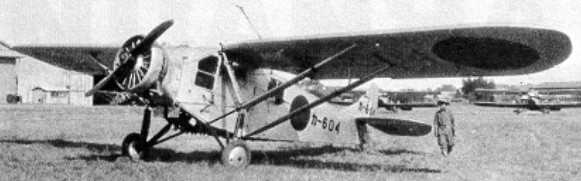
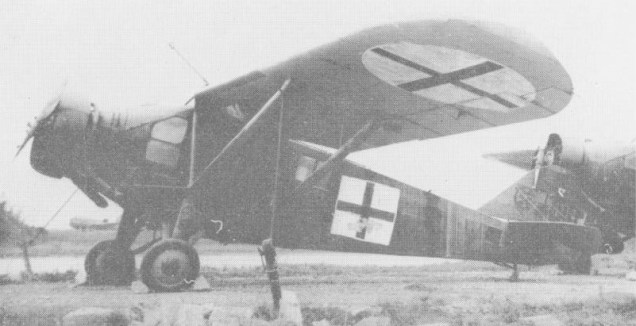
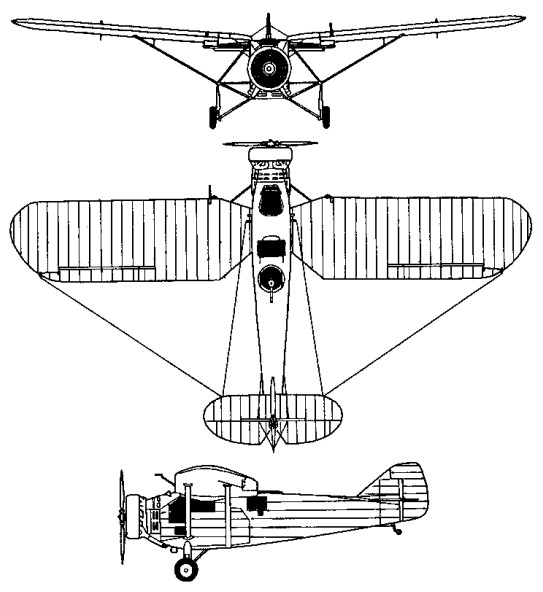
Designed by Herbert Smith, the Sopwith designer working in Japan, the Mitsubishi 4MS1 prototype crew trainer made its maiden flight in 1930. A strut-braced high-wing cabin monoplane with fixed wide-track landing gear, the 4MS1 was powered by a single engine. The Ki-7 was the Japanese army prototype of the Mitsubishi K3M naval trainer aircraft. First appearing as the K3M1 in 1931/32 with a 300 hp Hispano-Suiza engine, and was an adaptation of the Fokker Universal for training purposes. The first K3M2 production version entered naval service in 1932 as the Type 90 Crew Trainer, with the pilot and gunner in separate open cockpits, and instructor and two pupils in the enclosed cabin. Later liaison/passenger variants accommodated five passengers in the cabin.
The principal JNAF service version was the K3M2 with a 300 hp Amakaze 11 radial, of which 317 were built by Mitsubishi. Production continued until 1941, and examples pressed into service as liaison aircraft in the postwar period were to be found in a variety of national markings.
Watanabe built 301 K3M3, entering production in 1939. Several, as K3M3-L, were employed on transport duties.
The K3M3 was known as “Pine” during the war.
K3M3 Engine: Nakajima Kotobuki II-Kai-I, 580 hp / 435kW Wingspan: 15.78 m / 51 ft 9.25 in Wing area: 34.5 sq.m / 371.35 sq ft Length: 9.54 m / 31 ft 4 in Height: 3.82 m / 12 ft 6 in Max take-off weight: 2200 kg / 4850 lb Empty weight: 1360 kg / 2998 lb Max. speed: 230 km/h / 143 mph Ceiling: 6390 m / 20950 ft Range: 790 km / 491 miles Bombload: 2 x 132 lb / 4 x 30-kg bombs Armament: 1 x 7.7 mm mg Crew: 3-5
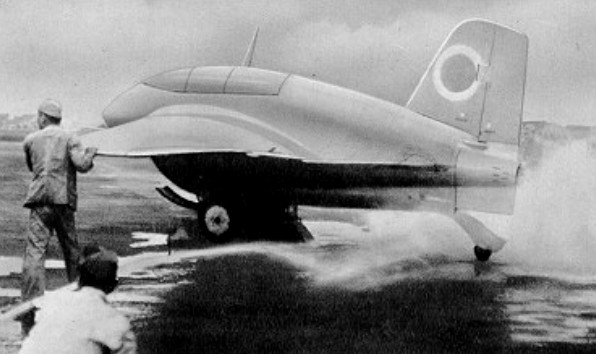
In July 1944, the Imperial Navy issued a l9-Shi specification for a rocket-propelled target defence interceptor to be based on the Messcrschmitt Me 163B. The task of developing this aircraft was assigned to Mitsubishi under the Navy designation J8M1, but as it was a joint Navy-Army venture it received the designation Ki-200 from the latter service and the name Shusui (Sword Stroke) was also adopted. Development of the Messerschmitt Me 163B rocket-powered fighter in Germany prompted Japan to acquire rights to build this aircraft and its Walter rocket engine.
A complete Me 163B plus an example of the Walter HWK 109 509A engine and detailed blueprints were shipped to Japan in mid-1944 but the submarine carrying this precious cargo was sunk en route. A second submarine managed to get through but this only brought a rocket engine and an Me 163 instruction manual, no detailed plans or blueprints.
While work on the Walter HWK 109-509 rocket motor (as the Toku Ro.2) was largely confined to its adaptation for Japanese manufacturing techniques. Yokosuzka Naval Aeronautical Engineering Arsenal was given the task of constructing the eng¬ine. Mitsubishi Jukogyo KK was instructed to build the fighter though inadequate German data on the airframe dictated considerable original structural design work.
With J8M1 prototype design finalised, the 1st Naval Air Arsenal began construction of a full-scale training glider version at Yokosuka under the designation MXY8 Akigusa (Autumn Grass), and this was towed into the air and flown for the first time in December 1944.
A heavier glider, with ballast tanks to approximate the weight of the operational aircraft, was also built under the designation Ku-13 Shusui (sword stroke). Design of the rocket engine resulted in the 1500kg thrust Toko Ro.2, and this powerplant was installed in the first of the J8M1 Navy Experimental Rocket-Powered Interceptor Fighter Shusui prototypes completed by Mitsubishi.
The first Shusui made an unpowered test flight on 8 January 1945. The first powered flight test took place six months later, on 7 July, but the aircraft was destroyed and no further flight testing was undertaken before the termination of hostilities. Four more Shusui interceptors had been completed by this time, and six more were virtually complete.
J8M Power Plant: One Toku Ro.2 (KR-20) bi-fuel rocket motor with a maximum thrust of 3,307 lb (1 500 kg) Endurance: 50-55 min. Fuel capacity totalled 255 Imp gal (1159 lt) of Ko-liquid and 118 Imp gal (536 lt) of Otsu-liquid Max speed, 559 mph (900 km/h) at 32,810 ft (10000 m) Time to 19,685 ft (6000 m), 2.26 min Time to 32,810 ft (10000 m), 3.5 min Time to 39,370 ft (12 000 m), 3.83 min Service ceiling, 39,370 ft (12000 m) Empty weight equipped, 3,318 lb (1 505 kg) Max loaded weight, 8,565 lb (3885 kg) Span, 31 ft 2 in (9,50m) Length, 19 ft 10 ¼ in (6,05 m) Height (on dolly), 8 ft l0 ¼ in (2,70 m) Wing area, 190.84 sq ft (17,73 sq.m) Armament: Two 30-mm Type 5 cannon with 50 rpg Crew: 1
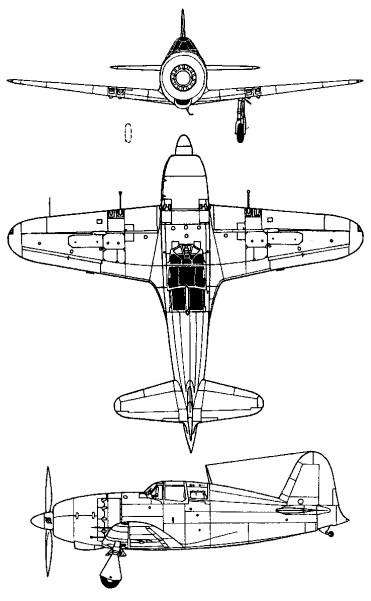
The J2M1 Raiden (Thunderbolt) was conceived to meet an Imperial Navy requirement for a shore-based Kyokuchi Sentoki, or Local [defence] Interceptor, usually abbreviated to Kyokusen. Although a 14-Shi (1939) requirement, the definitive specification for the Kyokusen was not formulated until April 1940, design being undertaken by Jiro Horikoshi assisted by Yoshitoshi Sone and Kiro Takahashi.
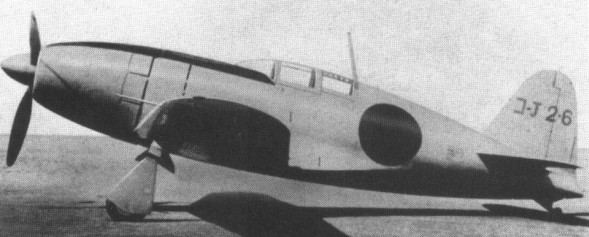
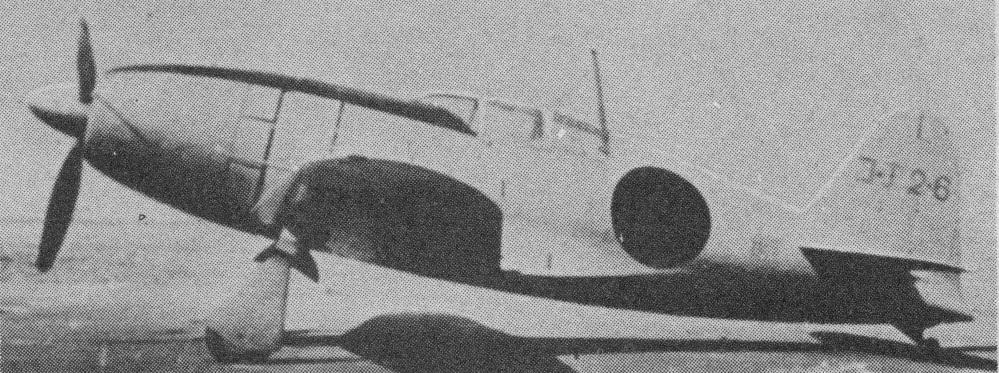
The Japanese navy’s emphasis upon speed and climb rate prompted the designer Jiro Hinkoshi to adopt a squat single-engine design with long-chord radial engine cowling, and high-raked, curved windscreen. Of all metal construc¬tion with a low aspect ratio laminar flow wing, the J2M1 was powered by a 14-cylinder Mitsubishi MK4C Kasei 13 radial rated at 1,430 hp for take-off and which, in order to reduce aerodynamic drag, drove the propeller via an extension shaft, a fan drawing cooling air through a narrow annular intake. Armament comprised two 7,7-mm and two 20-mm guns. The first of three J2M1 prototypes flew on 20 March 1942, but the test programme was plagued with technical difficulties and service test pilots were critical of some of its characteristics. Consequently, Mitsubishi was instructed to introduce numerous changes as the Kyokusen-Kai, or J2M2, these being introduced on the fourth of 14 experimental airframes that had been laid down.
On 13 October 1942, the fourth Kyokusen prototype was flown as the J2M2, this embodying numerous changes. The most noticeable external change was the replacement of the extremely shallow, curved windscreen by one of deeper, more conventional form, with a suitably enlarged canopy and raised aft fuselage decking. The MK4R-A Kasei 23Ko drove a four-rather than three-bladed propeller via a shorter extension shaft, this engine benefiting from water-methanol injection and affording 1,800 hp for take-off. Individual exhaust stacks were introduced, fuel tankage was rearranged, and the pilot’s seat was moved both forward (2.75 in/70 mm) and upward (3.15 in/80 mm). In this form, the Kyokusen, or J2M2, was adopted as the Navy Interceptor Fighter Raiden (Thunderbolt) Model 11, armament remaining as for the J2M1.
Production J2M2 fighters left the factory slowly and entered service with the 381st Kokutai late in 1943.
J2M2
In the event, only eight J2M2 (Model 11) Raidens were built as this version was overtaken by the J2M3 (Model 21) characterised with a stronger wing stressed to mount an armament of four wing-mounted 20-mm cannon, this thus becoming the first service Raiden, the J2M3-Ko (Model 2lKo) differing in the type of cannon installed. The heavier armament now restricted the performance of the Raiden to the extent that it no longer met the original demands, and the J2M4 was an attempt to restore the performance by including a turbocharger.
The J2M4 had a Kasei 23Hei engine with a turbosuper¬charger and two of the wing cannon transferred to the fuselage to fire at an oblique angle. The first of three prototypes of the J2M4 flew on 24 September 1944, but persistent difficulties with its turbosupercharger led to its discontinuation.
The J2M5 (Model 33) and J2M6 (Model 31) were developed in parallel, entering flight test in May and June 1944 respectively and both being committed to production. Whereas the J2M6 differed from the J2M3 essentially in having a wider and taller windscreen, the basic model reverting to J2M2 armament and the J2M6-Ko (Model 3lKo) having four wing cannon, the J2M5 had a 1357kW Kasei 26Ko engine equipped with a mechanically-driven three-stage supercharger. This latter was ordered into production with the Takaza Arsenal and Nihon Kentetsu, as well as Mitsubishi. The J2M5 (34 built) achieved 382 mph (615 km/h) at 22,310 ft (6 800 m.
In all, 476 J2Ms were built.
The Allies selected the reporting name ‘Jack’ for the J2M on the basis of intelligence reports and captured data.
J2M1 Engine: Mitsubishi MK4C Kasei 13 radial, 1,430 hp Max speed, 359 mph (577 km/h) at 19,685 ft (6 000 m) Empty weight, 4,830 lb (2 191 kg) Normal loaded weight, 6,307 lb (2 861 kg) Span, 35 ft 5¼ in (10,80 m) Length, 32 ft 5¾ in (9,90 m) Height, 12 ft 6 3/8 in (3,82 m) Wing area, 215.82 sq ft (20,05 sq.m) Armament: two 7,7-mm and two 20-mm guns
J2M2-6 Raiden Engine: MK4R-A Kasei 23Ko, 1,800 hp
J2M3 Engine: 1 x Mitsubishi “Kasei-23a”, 1350kW Max take-off weight: 3435 kg / 7573 lb Empty weight: 2460 kg / 5423 lb Wingspan: 10.8 m / 35 ft 5 in Length: 9.95 m / 32 ft 8 in Height: 3.95 m / 12 ft 12 in Wing area: 20.05 sq.m / 215.82 sq ft Max. speed: 580 km/h / 360 mph Ceiling: 11700 m / 38400 ft Range: 1900 km / 1181 miles Armament: 4 x 20mm cannons, 120kg of bombs Crew: 1
J2M3 (Model 21) Max speed, 363 mph (584 km/h) at 17,880 ft (5 450 m) Initial climb, 3,838 ft/min (19,50 m/sec) Normal range, 655 mls (1055 km) Empty weight, 5,489 lb (2490 kg) Loaded weight, 7,584 lb (3440 kg) Span, 35 ft 5¼ in (10,80 m) Length, 32 ft 7½ in (9,94 m) Height, 12 ft 11¼ in (3,94 m) Wing area, 215.82 sq ft (20,05 sq.m)\Armament: four wing-mounted 20-mm cannon
J2M4 Engine: Kasei 23Hei.
J2M5 Engine: Kasei 26Ko Max speed: 382 mph (615 km/h) at 22,310 ft (6 800 m)
Kiro Honjo led the design team to a 12-Shi requirement of the Imperial Navy specifying the range, and twin engines. The result was very light and devoid of any protection for crew, engines, fuel tanks or systems.
The first flight by the first of two prototypes was made on October 23, 1939, to a 1937 requirement for a long-range bomber. During trials recorded an extraordinary performance of a 444km/h top speed and 5,555km range, albeit without bombload.
Almost immediately afterwards its development was channelled in an entirely different direction. The company was instructed by the navy to adapt it instead for bomber escort duties. This meant sacrificing some 25% of the fuel load to offset the added weight of extra guns and ammunition, and increasing the crew to a total of ten men, compared with seven in the bomber version. No fewer than 30 examples of the G6M1, as this version was known, had been completed and put through service acceptance trials in 1940 before the JNAF was forced to admit that performance was just not good enough for the escort job. The aircraft themselves were later adapted to serve as G6M1 K trainers and, later still, as G6M1 1 2 paratroop transports.
G4M
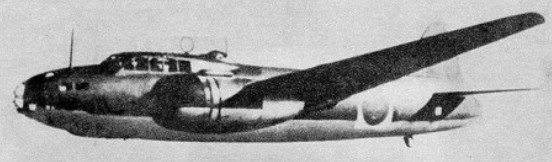
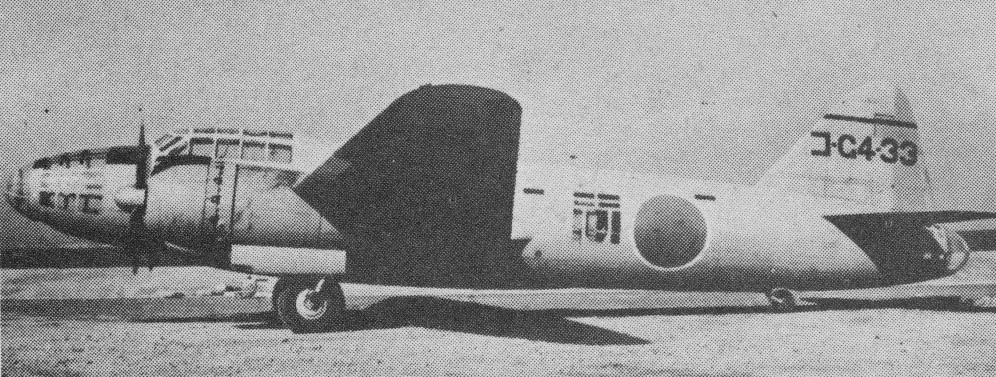
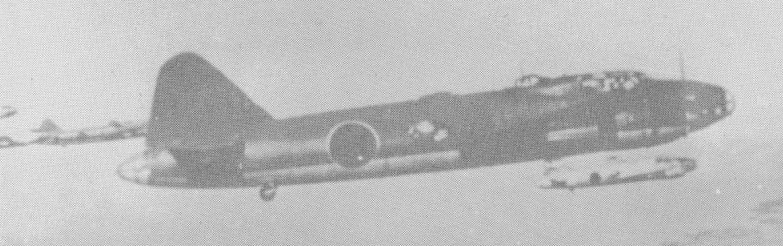
Continuing G4M development, however, Mitsubishi managed to get another 14 of these bombers completed by the end of March 1941, and in April this version was accepted for service as the G4M1 Model 11. They were soon in successful operation against targets in China, and by the time of the Pearl Harbor attack at the end of that year, 120 or so were in service. The Model 11 was armed with four single 7.7 mm (0.303 in) Type 92 machine guns in nose, waist and dorsal positions, and a 20 mm (0.79 in) Type 99 cannon in the tail, and could carry the specified 800 kg (1764 1b) weapon load. Powerplant was a pair of 1530 hp Mitsubishi Kasei 11 14 cylinder two row radial engines. The Model 11 scored a number of early successes, but when losses began to mount, Mitsubishi produced the improved G4M1 Model 12, with Kasei 15 engines.
The first production G4M1s (Navy Type 1 Attack Bomber Model 11) were initially deployed against China in mid-1941 but on the eve of the attack on Malaya the bombers moved to Indo-China and within a week had successfully attacked the Prince of Wales and Repulse. When Allied fighter opposition eventually increased to effective proportions, the G4M1 was seen to be very vulnerable, possessing little armour protection for crew and fuel tanks, and it was in a pair of G4M1s that Admiral Yamamoto and his staff were travelling when shot down by P-38s over Bougainville on 18 April 1943. Little improvement had been secured in the Navy Type 1 Attack Bomber Model 22 with revised powerplant.
Its inherent weakness, which earned it the totally unwelcome sobriquet of ‘the one shot lighter’, was not altogether surprising when it is considered that the September 1937 JNAF requirement to which it was designed demanded a twin engined aircraft with a range of nearly 4830 km (3000 miles) and, over 3706 km (2300 miles), an 800 kg (1764 1b) weapon load. This ‘range at all costs’ philosophy could only be met by cramming every available bit of wing space with 4900 litres (1078 Imp gal) of fuel, and only then by omitting any kind of armour protection for either the crew or the fuel tanks. Everything else had to go into the fuselage and, by the standards of the day, was necessarily large and bulky.
After the Solomon Islands campaign in August 1942, when losses were particularly heavy because of the bomber’s extreme inflammability, there quickly followed the prototype G4M2.
G4M2
This had more powerful engines, 1343kW / 1800 hp Kasei 21s with water¬methanol injection and several aerodynamic improvements. Armament was increased by adding two more 7.7 mm (0.303¬in) guns in the nose and replacing the dorsal 7.7 mm by a turret mounted 20 mm (0.79 in) cannon; internal bombload went up to 1000 kg (2204 lb). Fuel capacity was increased, to 6490 litres (1427 Imp gal), but still the tanks remained virtually unprotected. This version (Navy Type 1 Attack Bomber Model 22A and Model 22B) remained in production until the end of the war in steadily improved Navy Type 1 Attack Bomber Model 24 variants. The G4M2 was built in such numbers as to become the second most important production model, a total of 1154 being completed compared with 1200 G4M1s. These included the G4M2 Model 22A (Type 99 cannon in the waist positions) and 22B (all four Type 99 cannon of a later type); the G4M2a Model 24 (with 1850 hp Kasei 25 engines and bulged bomb bay doors); the G4M2b Model 25 testbed (1795 hp Kasei 27s); two G4M2c Model 26s (testbeds for turbocharged Kasei 25s); the G4M2d Model 27 testbed (1825 hp Kasei 25b engines); and the G4M2e Model 24.1 a version with one 7.7 mm (0.303 in) and four 20 mm (0.79 in) guns.
G4M
In the face of continuing heavy losses, in 1944 Mitsubishi built 60 examples of the G4M3, with armour protection for the crew and a much ¬redesigned wing containing a reduced fuel load of 4490 litres (988 Imp gal), stored in fully protected tanks, produced in small numbers as the Navy Type 1 Attack Bomber Model 34. Final versions were two G4M3 Model 36 prototypes, which made test flights with exhaust driven engine turbo¬chargers.
The ‘Betty’ did per¬form as the carrier aircraft for the air launched Yokosuka MXY¬7 Ohka piloted flying bomb, developed in the latter half of 1944. The Ohka should have entered service at the end of that year, but the first consignment of 50 was lost in November, when the carrier Shinano was sunk on its way to the Philippines. The first combat encounter was thus deferred until March 21, 1945, when a force of 16 Ohka¬-carrying G4M2e Model 24J bombers (the version chosen for this role), with an escort of 30 Zero fighters, was despatched against a US task force some 480 km (298 miles) off Kyushu. On the way, however, the force was met by more than 50 US Hellcat fighters, and lost every Ohka carrying bomber and half of the escorting Zeros. In order to attach the Ohka beneath the belly of the G4M2e the latter’s bomb bay doors were removed. Launch was usually made from an altitude of around 8200 m (26900 ft), at an airspeed of about 319 km/h (198 mph), the Ohka then gliding towards its target, cutting in the rocket motor only for the last few miles of flight and the terminal dive.
Many G4M1s were converted into trainers, maritime reconnaissance aircraft or 20 passenger troop transports towards the end of the Second World War. The G4M can also claim to have served from beginning to end of the Pacific war, for a pair of white painted G4M1s were used to trans¬port the Japanese delegation to Ie Shima on August 19, 1945, to sign the instrument of surrender.
Of the total production of 2446 G4M series aircraft, production amounted to 1,200 G4M1s, 1,154 G4M2s and 60 G4M3s.
G4M1 Engine: 2 x Mitsubishi Kasei (Mars) II 14 cyl, 1530 hp Crew: 7 Armament: 4 x 7.7mm mg, 1 x 20 mm cannon Max speed: 266 mph at 13,870 ft Cruise speed: 196 mph at 9840 ft Service ceiling: 30,000 ft Range: 1900 mile Bomb load: 2200 lb or 1 x 1760 lb torpedo
G4M2 Crew: 7-10 Engines: 2 x Mitsubishi MK4P “Kasei-21”, 1350kW Max take-off weight: 12500 kg / 27558 lb Empty weight: 8160 kg / 17990 lb Wingspan: 24.9 m / 81 ft 8 in Length: 19.62 m / 64 ft 4 in Height: 6 m / 19 ft 8 in Wing area: 78.13 sq.m / 840.98 sq ft Max. speed: 430 km/h / 267 mph Cruise speed: 310 km/h / 193 mph Ceiling: 8950 m / 29350 ft Range w/max.fuel: 6000 km / 3728 miles Armament: 2 x 20mm cannons, 4 x 7.7mm machine-guns, 2200kg of bombs
G4M2a Model 24 Engine: 2 x Mitsubishi Kasei 25, 1850 hp Span: 24.89 m (81 ft 8 in) Length: 19.63 m (64 ft 5 in) Height: 13 ft 5.75 in Empty weight: 18,449 lb Gross weight: 15,000 kg (33 069 lb) Maximum speed: 436 km/h (271 mph) at 15,090 ft Service ceiling: 29,350 ft Normal range: 2262 mi Armament: 4 x 20mm Type 99 cannon, 1 x 7.7mm Type 97 mg Bombload: 2200 lb or 1 x 1764 lb torpedo Crew: 7
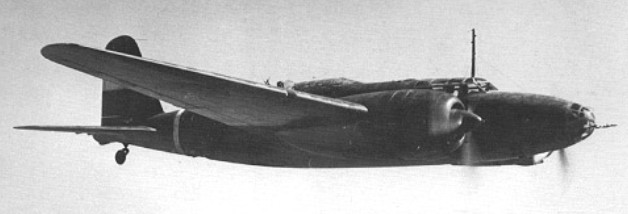
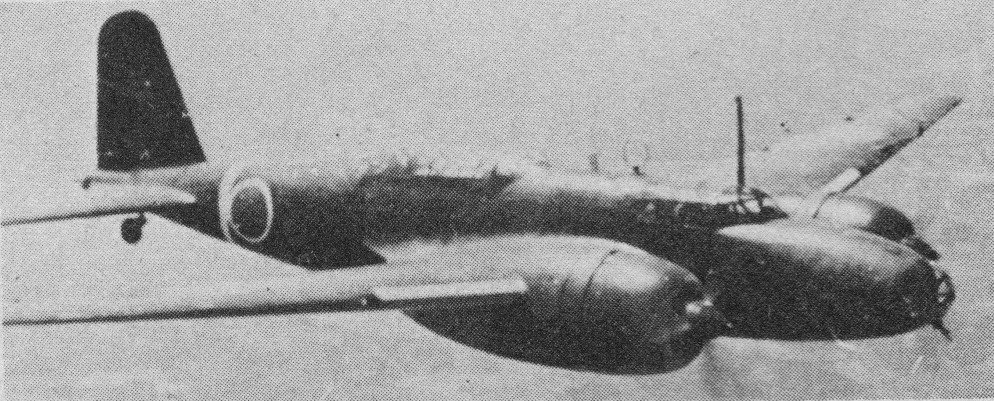
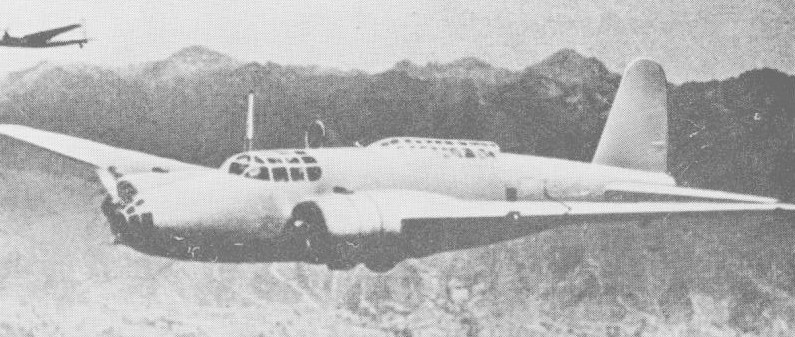
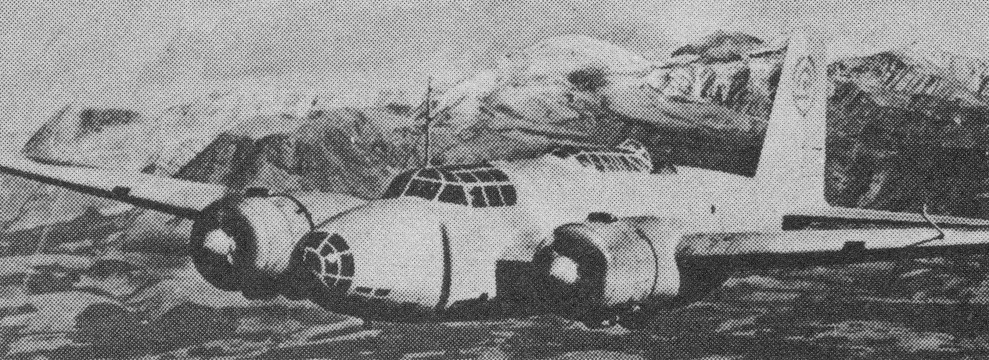
In response to a 1935 Japanese naval requirement for a landbased twin-engine reconnaissance aircraft, Mitsubishi flew the first Ka-15 prototype, an aircraft which possessed a design potential that allowed development as a long-range medium bomber. Following successful flight trials, the aircraft entered production in June 1936 as the Navy Type 96 Attack Bomber Model 11 (Mitsubishi G3M1).
In its original prototype form the Ka 15, designed by Kiro Honjo, made its first flight in July 1935. Two 750 hp Hiro Type 91 12-cylinder V type engines were mounted on the mid set wings, which were essentially the same as those of the Ka 9.
Twenty more prototype/preproduction Ka 15s were completed, of which three had Hiro engines; the remaining 17 were powered by 830 hp or 910-hp Mitsubishi Kinsei 2 or 3 14 cylinder two-row radial engines, giving enhanced performance. These aircraft had the designation G3M1, and unofficially they were subdivided into G3M1a (the four with Hiro engines and solid noses), G3M1b (two with Kinseis and solid noses), and G3M1c (the other 15 Kinsei powered aircraft, which had a transparent bombing station in the nose). Twelve were used for service trials, but before these had been completed a production batch of 34 Kinsei 3 powered G3M1s, with modified cockpit windows, was authorized by the IJN. These had a crew of five, and could carry an 800 kg (1763 1b) torpedo beneath the fuselage; defensive armament consisted of two retractable dorsal turrets each containing one 7.7 mm (0.303 in) Type 92 machine gun, with another of these guns in a retractable ventral turret.
As the improved Kinsei 41 and 42 engine became available in 1937 a new version, the G3M2, started production and, with a total of 581 built by mid-1941, was the principal variant. With a top speed now increased to 374km/h, a bombload of up to 800kg carried externally and a defensive armament of three 7.7mm machine-guns, the G3M2 possessed a maximum range of 4380km.
It was built in two basic variants, the Model 21 and Model 22. The 21 had uprated Kinsei 41 or 42 engines of 1075 hp, increased fuel tankage and modified dorsal turrets; the 22 had 1075 hp Kinsei 45s (also fitted to some late¬production Model 21s), and a completely revised armament system that eliminated the retractable ventral and rear dorsal turrets, replacing the latter by a large turtleback enclosure housing a 20 mm (0.79 in) Type 99 cannon, and the former by a pair of blisters, one each side of the rear fuselage, each with single Type 92 gun. Between 1937 39, Mitsubishi built 343 Model 21s, following these in 1939 41 with 238 Model 22s.
G3M2
Mitsubishi G3M2s were first flown in action by the Japanese navy’s Kanoya Kokutai in August 1937 in raids on Hangchow and Kwangteh in China. By 1940 four kokutais in China were equipped with a total of about 130 G3M2s, a number that grew to 204 by the date of Pearl Harbor with the deployment of forces against Wake Island, the Philippines and the Marianas. And it was a force of 60 G3M2s of the Genzan and Minoro Kokutais (with 26 Mitsubishi G4Mls of the Kanoya Kokutai) which, flying from bases in Indo-China, found and sank the British warships HMS Prince of Wales and HMS Repulse as they steamed without fighter protection off the Malayan coast on 10 December 1941. The type was known to the Allies as the ‘Nell’.
G3M2
When Mitsubishi production was then phased out in favour of the later G4M bomber, production of the G3M was carried on by the Koizumi factory of the Nakajima company, which built 412 G3M type bom-bers, of which a proportion were of a fourth model, the G3M3. These had Kinsei 51 radials of 1300 hp each, and a further increase in fuel tankage, extending the max¬imum range to 6230 km (3870 miles) com-pared with the 4380 km, (2720 miles) of the G3M2 Model 22.
At the time of Pearl Harbor, the backbone of Japan’s long range strike force consisted of just over 200 G3Ms (mostly G3M2s and G3M3s) and about 120 of the later G4M1s. The G3M (‘Nell’ under the Pacific system of codenarnes introduced by the Allies during the Second World War) had made its service debut in August 1937, with raids on Chinese mainland targets from bases on Kyushu (Omura) and Formosa (Taipei).
The G3M was used throughout the war, in most of the Pacific theatres, as was the G3M1 L, a prewar transport conversion with Kinsei 45 engines which took part in the invasion of Celebes. Wartime transport con¬versions were the L3Y1 Model 11 and L3Y2 Model 12 (both codenarned ‘Tina’), con¬verted from G3M1s and G3M2s respectively by the First Naval Air Arsenal at Kasurnigaura. These carried up to ten pas¬sengers, and had a single 7.7 mm (0.303 in) machine gun for defence.
Total production of the G3M series reached 1100, including the Kinsei 42 powered G3M2b, the transport G3M2d (L3Y2) and the G3M3 final bomber.
G3M 1 Engines: 2 x 678kW Kinsei 3 Maximum speed: 360km/h at 1975m
G3M2 Engines: 2 x Mitsubihi Kinsei 45, 1000 hp Wingspan: 82 ft 0.25 in Length: 53 ft 11.75 in Height: 11 ft 11.75 in Empty weight: 11,442 lb Loaded weight: 17,637 lb Max speed: 238 mph at 9,840 ft Service ceiling: 29,890 ft Amament: 1 x 20mm cannon, 2 x 7.7mm mg Bombload: 2200 lb or 1 x 1760 lb torpedo Crew: 7
G3M2 Model 22 Span: 25m (82ft 0.25in) Length. 16.45 m (53 ft 11.75 in) Gross weight: 8000 kg (176371b) Maximum speed: 373 km/h (232 mph)
G3M3 Engines: 2 x Mitsubishi MK8 Kinsei-51, 975kW Max take-off weight: 8000 kg / 17637 lb Empty weight: 5250 kg / 11574 lb Wingspan: 25.0 m / 82 ft 0 in Length: 16.5 m / 54 ft 2 in Height: 3.7 m / 12 ft 2 in Wing area: 75.1 sq.m / 808.37 sq ft Max. speed: 415 km/h / 258 mph at 6000m Cruise speed: 295 km/h / 183 mph Ceiling: 10300 m / 33800 ft Range w/max.fuel: 6200 km / 3853 miles Armament: 1 x 20mm cannon, 4 x 7.7mm machine-guns, 800kg of bombs Crew: 5
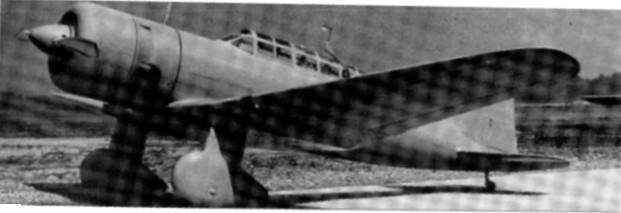
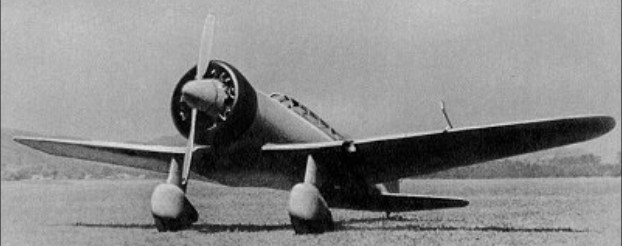
With the company designation Mitsubishi Ka-16, this cantilever low-wing monoplane, carrier-based torpedo-bomber flew in prototype form as the Navy 10-Shi Experimental Attacker in 1936.
A three-seater, it had a long glazed crew canopy and was distinguished easily from its Nakajima B5N rival by having fixed cantilever landing gear with spat-type wheel fairings. The wings outboard of the landing gear could be folded upwards for carrier stowage.
Mitsubishi B5M1
As a precaution against problems with the B5N, this Mitsubishi B5M1 design was placed in production and went into service as the Navy Type 97 Carrier Attack Bomber Model 2, gaining initially the Allied codename ‘Mabel’, later changed to ‘Kate 61’.
At least 125 had been delivered when the obvious success of the B5N brought production to a halt. The B5M1 saw some action from land bases in the South Pacific before being relegated to training and liaison duties.
B5M1 Engine: 746kW Mitsubishi Kinsei 43 Wingspan: 15.3 m / 50 ft 2 in Length: 10.23 m / 33 ft 7 in Height: 3.12 m / 10 ft 3 in Wing area: 37.95 sq.m / 408.49 sq ft Max take-off weight: 4000 kg / 8819 lb Max. speed: 379 km/h / 236 mph Range: 2187 km / 1359 miles Armament: one 7.7mm machine-gun, 800kg torpedo or 800 kg bombs Crew: 3





 All Aero