Work began in 1940 on the DVB-102 long-range, high-altitude bomber. Only two prototypes were built, because it was decided to copy the B-29 as the Tu-4.
Engines: 2 x Ash-71, 1620kW Max take-off weight: 15500-17750 kg / 34172 – 39132 lb Wingspan: 25.3 m / 83 ft 0 in Length: 19.5 m / 63 ft 12 in Wing area: 78.8 sq.m / 848.20 sq ft Max. speed: 565 km/h / 351 mph Cruise speed: 445 km/h / 277 mph Ceiling: 11500 m / 37750 ft Range w/max.fuel: 2230 km / 1386 miles Crew: 5 Armament: 3 x 20mm machine-guns, 4 x 12.7mm machine-guns, 1 x 7.62mm machine-guns, 2000-3000 lb bombs
Vladimir Myasishchev’s design career included association with the ANT-16 and ANT-29 before work began, in 1940, on prototype DVB-102 twin-engined bomber.
New bureau established 1951 to develop four-jet long-range heavy bomber, which became Mya-4 Molot (NATO codename: Bison), first flown January 1953; also served as maritime research aircraft and finally as tanker and heavylift transport.
Designed M-52 Bounderiour-\e\ delta-winged strategic bomber seen at 1961 Soviet Aviation Day display, but not put into production. Produced II-22 airborne command post, as converted llyushin 11-18 airliner. Important M-17 first flew in May 1982, having been designed originally in early 1970s as high-altitude reconnaissance balloon interceptor but developed into M-17/M-55 high altitude reconnaissance and ecological monitoring aircraft. Small civil aircraft include pressurized and single turboprop eight-seat M-101 Gzhel (first flown 1995) and M- 201 Sokol twin-engined version, with projects covering M-202PW Olen enlarged development of the Indian Saras, M-203PW Barsuk radial-engined general-purpose transport, and M-500 piston-engined agricultural monoplane suited also to other roles.
In parallel with the development of the RM-1 interceptor, Moscaliev ‘s OKB was engaged in the design of a new version of the SAM-5-2bis transport, which was designed as a staff liaison and light transport aircraft.
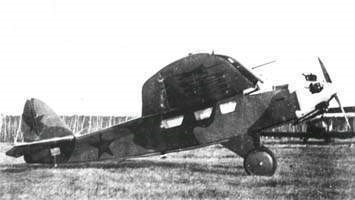
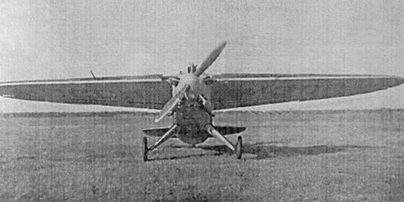
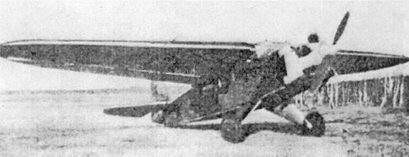
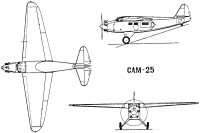
The Moscaliev SAM-25 (Russian: Москалёв САМ-25) six-seat aircraft was modified with a new, more mechanized wing with TsAGI R-2s profile, featuring leading and trailing edge flaps. The leading edge flaps were automatically engaged when the aircraft reached certain angles of attack. The ailerons could be used together with the flaps during takeoff and landing, which gave it excellent characteristics in these operations. Despite the low power of the 140-hp M-11E engine, the aircraft guaranteed an excellent speed of 230 km/h and a load capacity of 505 kg. The rest of its characteristics fully matched those of the SAM-5-2bis and SAM-14 aircraft.
In the spring of 1943 the prototype was ready for state tests, which were carried out at the range of the Air Landing Troops.
At this time there was a difficult situation with the guerrilla groups from Belarus. The fascists had created non-regular groups in that region, formed in many cases by Soviet traitors who looted and plundered villages and towns, terrorizing and massacring the civilian population. The civilian settlers ran to the forests in search of support from the guerrillas. This resulted in the guerrilla camps being filled with civilians, mainly women, children and the elderly, which worsened the situation of these forces, as they lost their mobility and found it difficult to feed and maintain all those people. To assess the situation created from Moscow, the official Schervakov flew there, who, after analyzing the situation, informed Stalin that it was necessary to proceed without delay.
This was the cause of the urgent request to Moscaliev to proceed with the construction of 50 AM-14 gliders with great urgency.
Stalin ordered Schervakov to return to Moscow, but the task was beyond the reach of any of the VVS planes.
Only the SAM-25, which was being tested, had excellent takeoff characteristics, with a run of only about 40 meters, which suggested a chance of success. The SAM-25 also had excellent range. On this plane the pilot A. Dabajov managed to pick up Schervakov and transport him to Moscow.
The SAM-25 aircraft was evaluated positively and the Landing Air Forces (VDV) raised their need for an aircraft like this, with takeoff and landing characteristics close to that of the German Fieseler Fi-156 Storch. The VDV command requested an urgent delivery of a series of aircraft to be built at Factory No.499 in 1944, which at that time had the productive capacity for its production. The request was not approved and the head of the NKAP 11 directorate, IV Kulikov, who called Moscaliev to Moscow and forbade him to take the request from the military. This decision marked the fate of the new model.
Developments of the basic model as a night bomber, attack plane and ambulance did not go beyond the drawing board, mainly due to the end of the war.
SAM-25 Engine: 140 hp M-11E Wingspan: 11.49 m Wing area: 21.86 m² Length: 8.02m Height: 3.86m Empty weight: 846 kg Maximum weight: 1280 kg Power load: 5.5 kg/hp Fuel load: 95 kg Oil load: 10 kg Maximum speed SL: 228 km/h Maximum speed at altitude: 170 km/h Cruising speed: 168 km/h Practical range: 1760 km Service ceiling: 4850 m Payload: 6-7 passengers Crew: 1
The SAM-11 training amphibian was developed in parallel with the Moscaliov SAM-10 and was designed with the same powerplant, the Bessonov MM-1 inverted linear engine. Its origins are based on a Naval Fleet Aviation (AVMF) request made to Moscaliev, which was originally scrapped due to the absence in Voronezh of a surface on which to test.
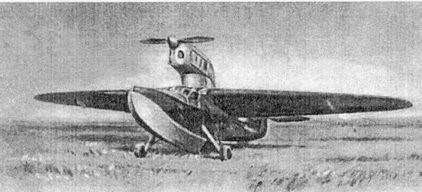
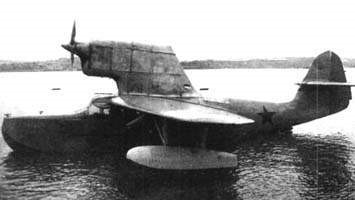
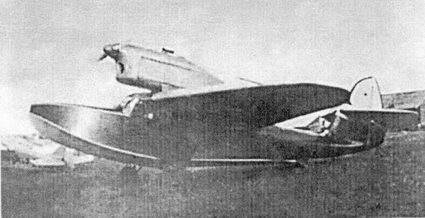
The Moscaliev SAM-11 Bekas (Russian: Москалёв САМ-11 «Бекас») amphibian was designed for training and liaison.
The designation SAM-11 in the OKB-31 and the name “Bekas” (Woodcock or Chocha), follows a custom of those years of assigning names of seabirds to flying boats.
Specialists from the naval department of TsAGI participated in the general configuration and a scale model was tested.
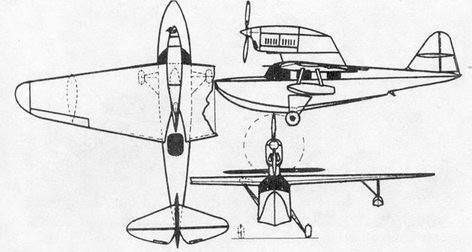
The SAM-11 amphibian was designed as a two-seat monoplane with a high cantilever wing with fixed stabilization floats on the wing consoles. All construction was made of wood. To speed up work, the wing and tail unit were taken from the Moscaliev SAM-10 with minor modifications such as openings to collect the wheels.
The double hull was built in wood with a waterproof resin coating and fabric. The use of wood and the need for reinforcement made the SAM-11 about 200 kg heavier than the SAM-10.
The powerplant consisted of the Bessonov designed 220 hp MM-1 inverted 6-cylinder inline engine, driving a tractor propeller and was located on a faired strut located directly above the fuselage.
The main landers of the landing gear were in the form of consoles that pivoted on the sides of the fuselage to be collected inside the wing by means of a pneumatic system. With the wheels retracted into the wing, the landing gear was exposed as studs, so they were carefully faired. The wheels and structure of the landers were generally similar to those used on the Moscaliov SAM-5-2bis. The tail unit was fixed and was located at the rear of the second rediente.
The monoplane-type tail had stabilizers located high on the empennage.
The cockpit housed two pilots with dual control and featured access through the deck and a drop-down door located on the port side. The passenger cabin had a capacity for 2-3 passengers and access to it was through an opening located in the upper part of the hull, behind the wing.
In general, the SAM-11 had a small load capacity, only 306 kg, with a weight delivery of only 22%, but this was not a limitation considering its conception as a training and liaison aircraft for the VMF.
The prototype was completed by Voronezh Institute of Technology by the end of July 1938 and flight tests began in mid-August.
The first flights in a wheeled configuration were successfully carried out by the factory test pilot AN Gusarov. Takeoff and landing tests were performed directly on the runway of the OKB-31 at the factory. During these flights the aircraft demonstrated excellent air handling and good control. The only negative point was the behavior during the approach glide to the runway, when tbufting appeared, which was soon solved by slightly modifying the engine mount. Despite its amphibious configuration, the aircraft demonstrated good speed.
Since the beginning of the flights, a search had been made for a surface of water with the necessary conditions, which was found in the vicinity of Voronezh. They wanted to avoid having to take the plane to the Black Sea (where the naval LII was located) without having carried out at least some initial tests of the model’s behavior in water beforehand.
Finally the necessary site was found, a small lagoon not far from the city and large enough to carry out the operations. Tests on water, on the recommendation of the contractor, would be carried out by test pilot P. Ya. Yakovlev, belonging to the Naval Fleet Aviation Flight Research Center (LII VVS VMF). First, the lagoon was explored from the ground and from the air in a Polikarpov Po-2. Later, a group of OKB-31 workers went to the lake to guarantee the necessary conditions: clearing the road to the water, setting up tents for specialists, signage, among others. Lastly, the SAM-11 plane was transferred.
The tests were carried out successfully despite the poor conditions. The SAM-11 took off and landed easily in the water. It was impossible to test the behavior with waves.
Upon returning to Voronezh, the model began to be prepared for the state tests, which were to take place in Sevastopol, at the LII VVS VMF. Finally the plane was sent there together with a group of OKB-31 collaborators, under the direction of LV Polukarov.
The state tests were carried out in the period September-October 1940. As test pilot was selected P. Ya. Yakovlev. The tests on the sea differed considerably from the tests carried out in the calm lagoon and from the first flights with maximum load a tendency to raise splashes was observed, which had to be solved by adding horizontal surfaces to the sides of the bow that deflected the water flow out.
SAM-11 with the wavebreaker mustaches on the sides of the bow.
The tests went smoothly. In the conclusions it was highlighted that the SAM-11 responded to the requirements of a training amphibian and its serial production was requested, also pointing out some difficulties, which had to be corrected in the modified model with a new MV-6 power plant, which would serve basis for series production.
The second prototype, known as the SAM-11bis, rectified the findings made during state testing and introduced a new MV-6 inverted-in-line-6 powerplant, which was the engine selected for series production.
SAM-11bis
Unfortunately, the change of engine, like the Moscaliov SAM-10 bis, did not improve performance, mainly due to the absence of a suitable propeller. The tests were carried out with a fixed-pitch wooden propeller, which due to the higher revolutions of the MV-6 engine, decreased its effectiveness. It was proposed to install a French Ratier metal propeller on the model, but this change was never made.
The SAM-11bis model was not produced for the same reasons as all other models designed to use Renault engines produced in the USSR under license by MV. These engines proved not to be prepared to operate in the harsh winter conditions of the USSR and in 1939 they were taken out of production.
The OKB-31 collective had also worked on a military version in which the second cabin was fitted out to house an artilleryman who operated a pair of ShKAS machine guns. This version had no development.
SAM-11bis with MV-6 engine.
SAM-11 Power plant: 1 x 220 hp MM-1 Wingspan: 11.49 m Wing area: 20.20 m² Length: 8.74m Empty weight: 1094 kg Normal takeoff weight: 1400 kg Wing loading: 64.5 kg/m² Power load: 6.4 kg/hp Load capacity: 2 passengers or 306 kg Maximum speed at sea level: 225 km/h Maximum speed at 2400 m: 240 km/h Takeoff speed: 100 km/h Landing speed: 85km/h Service ceiling: 5600 m Accommodation: 2
SAM-11bis Powerplant: 1 × 220 hp MV-6 Wingspan: 11.49 m Wing area: 20.20 m² Length: 8.74m Empty weight: 1030 kg Normal takeoff weight: 1350 kg Wing loading: 62.0 kg/m² Power load: 6.2 kg/hp Load capacity: 2 passengers or 320 kg Maximum speed at sea level: 217 km/h Maximum speed at 2400 m: 240 km/h Landing speed: 85km/h Service ceiling: 5600 m Time to 3000m: 17.2min Time to 5600m: 1h 03min Range: 900km Landing run: 110m Take-off run: 200m Accommodation: 2
In September 1941 the Germans were approaching Voronezh, but even under these circumstances the aviation factory continued to deliver Il-2 assault aircraft to the front. At the beginning of September 1941, the decision was made to evacuate Factory No. 18 and OKB-31 led by Moscalev.
The new production base was established in the Siberian village of Zavodoukovsk, located in the Tyumen Oblast, where a new factory was organized that was numbered 499. AS Moscalevwas selected as director and main constructor.
Some time later the factory began to deliver the Antonov A-7 7-seater landing glider productions and a little later the A-2 training gliders, from the same manufacturer.
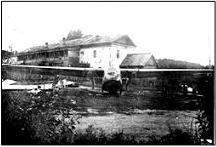
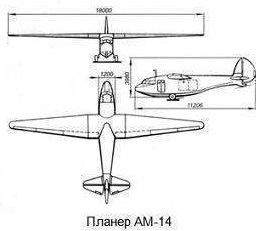
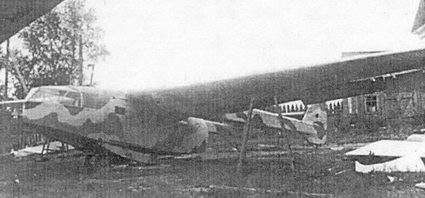
At the end of 1942 A. S. Moscalevwas given the task of modernizing the A-7 glider. The task envisaged the development of an enlarged version with capacity increased to 14 people, which was renamed AM-14 (Antonov – Moscalev14 seats, in Russian Антонов / Москалёв АМ-14). The prototype was built in Factory No. 499 in 1943.
Modifications to the base model included lengthening the central region of the fuselage by 670 mm, increasing the wing area and tailplane span, and increasing the diameter of the wheels.
After the tests, which were carried out successfully, Factory No. 499 began serial production of the model.
At the end of May 1943, A. S. Moscalev was tasked with urgently producing 50 AM-14 landing gliders at Factory No. 499, to be used in a supply mission to Belarusian guerrillas in the Minsk region. The gliders had to be prepared to carry fuel, weapons and ammunition, including cannon. The request established a delivery time of only 25 days for the 50 gliders and its fulfilment was personally followed by Stalin.
The glider launch operation over Belarus was kept a great secret, so for the Germans it was totally unexpected. This operation was led by the Air Landing Troop Headquarters and was planned to be carried out at night. Ilyushin DB-3F and Lisunov Li-2 towed gliders Moscalev and Gribovski pairs, releasing about 50 to 60 km from the target. The guerrillas had prepared surfaces for landing and at the agreed time they lit bonfires as signalling. This operation was successful and allowed the Belarusian partisans to achieve significant successes against the fascist groups.
For their contributions to support the partisans, the designers OK Antonov, AS Moscalev and VK Gribovski received the 1st level “Guerrilla of the Great Patriotic War” medal, which was one of the few exceptions for the delivery of this medal to personnel from the deep rear.
AM-14 Wingspan: 18.0 m Wing area: 29.10 m² Aspect ratio: 11.2 Length: 11.20 m Empty weight: 1080 kg Wing loading: 84 kg / m² Surface of the horizontal plane: 3.97 m² Vertical plane surface: 3.24 m² Spoiler area: 2.7 m² Glide ratio: 18 Crew: 1 Carrying capacity: 14 soldiers equipped
The Moscalev SAM-23 Москалёв САМ-23 (second use of the name) glider designed as transport landing capable of carrying 22 soldiers or light military vehicle and was designed in OKB of Moscaliov, taking into account the experience in the operation of the AM-14.
The SAM-23 featured a monoplane structure with a high cantilever wing with a double tail cone, ending in a double empennage and a short central nacelle.
The cockpit and the cargo cabin were located in the fuselage. The rear cover of the fuselage could be removed to allow loading. The SAM-23 allowed the transport of 22 equipped soldiers, a tank, a light vehicle or a cannon with its crew.
The glider’s landing gear consisted of two skis with shock absorbers and two landing pads on the tail. Take-off was carried out by means of a wheelbarrow that was released when the glider separated from the ground.
Construction of the prototype at Factory No.499 was completed in 1944 and it successfully passed state tests. The serial production of the model was not authorized since the glider with similar tasks Tsybin / Koliesnikov TsK-20 was already being produced in series at that time.
SAM-23 Wingspan: 16.5 m Wing area: 38.00 m² Aspect ratio: 7.2 Length: 12.5 m Carrying capacity: 20 equipped soldiers or a light car Crew: 1
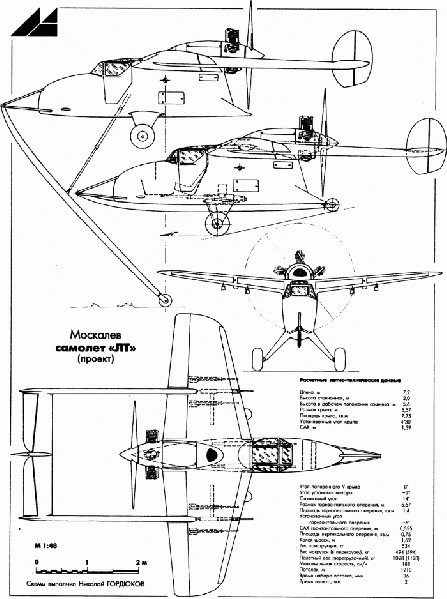
During the Great Patriotic War A. Moscaliov developed more than landing gliders. In the archives of the TsAGI branch of Novosibirsk, a project of an attack aircraft known as the flying tank or LT (according to the initials of Letayushaya Tanquietka, in Russian: ЛТ) with an M-11 engine. Sometimes called “Bloja” (Fly). In the records of the Moscaliov OKB this aircraft was known as SAM-23 (in Russian: САМ-23), a name that would later be used for a landing troop transport glider.
The development of this aircraft was carried out at Factory No.499 by the constructor Nekrasov.
The project was ready by the end of May 1942 and on September 14 it was handed over to the TsAGI for evaluation. In the project’s descriptive memory, “the behavior of the plane on the ground… ” was written, which has allowed speculation that a prototype had been built.
This airplane was designed with the objective of destroying armor and forces, as well as the destruction of ground defences.
The LT was designed as a 6.8 meter long, twin-fuselage, high-wing monoplane single-seat airplane. The fuselage was built on a structure of welded tubes with a duralumin coating.
The wing featured an RP profile with a single spar and was made of wood, covered with plywood and fabric. The wing featured flaps on the leading edge and the full span of the trailing edge to facilitate take-off on short runways.
The LT was powered by an M-11 radial engine located in the upper rear of the fuselage, driving a driving propeller.
The pilot was located in a cockpit at the front of the nacelle, which allowed excellent visibility. The entire cabin was armored with 3mm plates on the sides and 4.5mm on the front. The pilot’s seat featured armor similar to that of the Ilyushin Il-2. The cockpit windshield also featured transparent shielding. Access to the cabin was through a car-type door located on the left side.
At the end of each tail cone, it was joined by the horizontal stabilizer in the center of which the oval-shaped empennage was located with the rudder.
The landing gear was fixed and of the conventional type, with a tail skid. The wheels of the main landers were inflatable with dimensions 470 x 210 mm.
The armament consisted of two ShVAK 20 mm cannons, located in the fuselage on both sides of the cockpit and 200 shots per muzzle (500 in the overloaded version). Two ShKAS machine guns with 1500 (2000) rounds and 4-6 RS-82 reactive rockets located on external supports under the wings or 400 kg of bombs. With full load the takeoff weight reached 1128 kg. By calculations, with a more powerful engine like the M-34. The armor, the offensive load, could be increased, raising the takeoff weight to 1500 kg.
The tactics for using the LT included flight following the terrain at a height of 4-5 meters. This was accomplished through the use of a pole attached to the nose. The end of this structure traveled brushing against the irregularities of the terrain.
It was considered that flying at that height, at a speed of 150 – 180 km / h it would be quite difficult for the enemy to shoot down. The ground troops could do little due to the high speed and for the fighters it would be at a height where they were ineffective. On the other hand, the small dimensions of the LT allowed it to operate from highways or roads, even moving along them until approaching the target.
The SAM-23 could be used to carry out attacks on defensive ground positions following normal dive methods from heights of 1000 – 1200 meters.
Designed to work in large formations the LT had to be characterized by its low price, the use of a cheap engine and large productions and the simplicity of the piloting, to be able to prepare large numbers of pilots.
The project did not receive the approval of the TsAGI, fundamentally considering that the pilot was poorly defended by the thin armor. It was also alleged that flying at such a low altitude required too much stress on the pilot to avoid the unevenness of the terrain and keep the plane from crashing.
SAM-23 or LK Engine: M-11, 100 hp Wingspan: 5.57 m Wing area: 7.75 m² Length: 6.8 m Height: 2.00 m Empty weight: 534 kg Maximum takeoff weight: 1128 kg Top speed: 188 km / h Endurance: 2 hours ROC: 34 m / sec Ceiling: 1210 m Accommodation: 1 Armament: two ShVAK cannons and two ShKAS machine guns Bombload: 400 kg
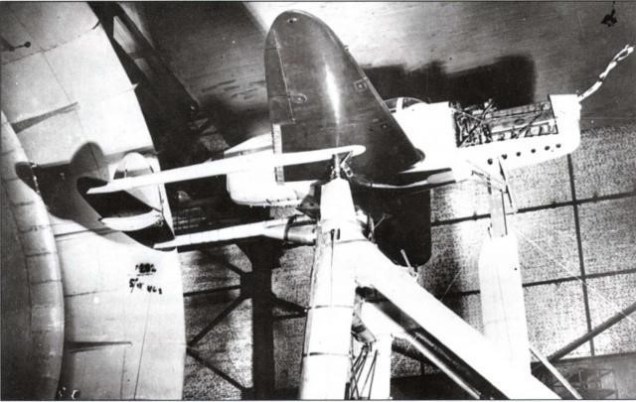
Moscaliev SAM-13 in the tunnel room T-101 at the TsAGI
This design was conceived with the OKB from the beginning as a military aircraft and, despite the low engine power, the project augured a good future due to the good performance obtained from the calculations and the low production cost.
The Moscaliev SAM-13 (Russian: Москалёв САМ-13) was designed around two 220 hp Renault MV-6 engines fore and aft and armed with four Ultra-ShKAS machine guns.
After submitting the conceptual designs, the NKAP department 7 decided to approve its inclusion in the group of experimental developments, since the MV-6 engine was not intended for military use. The evaluating commission decided that the design was novel and presented interesting solutions that could later be used in real fighters with high-powered engines.
The configuration selected for the SAM-13 comprised a low wing-set fuselage entirely in wood with a plywood covering.
The wing had a trapezoidal shape in plan, with rounded ends. The wing mechanization included offset ailerons. From the forward wing spar two bars extended backwards which joined behind the propeller cone in an oval stabilizer in which the elevators were located and from whose center the empennage rose.
The SAM-l3 was fitted with a retractable tricycle undercarriage, the forward unit was stowed aft, while the main units, attached to the forward spar of the wing at the tail cone area, were retracted into the fuselage.
The cockpit was located between both engines. Behind the engine were also located the fuel tank and the flight equipment. The rear propeller featured a mechanism that allowed it to be stopped in a horizontal position in emergencies, to allow the pilot to leave the plane.
In general, the Moscaliov SAM-13 was characterized by its small size and its clean lines.
By the end of 1939, the evaluation commission led by Colonel Kvitko met and the main topic of discussion revolved around the high value of the speed obtained as a result of the calculations. This speed of 700 km/h was considered not very objective for an airplane powered by 220 hp engines. Actually the calculations were made based not on the MV-6 engines, but on the French Renault Bengali 6 with Ratier metallic variable pitch propellers. Finally, after not a few discussions, the model of the SAM-13 was approved and the construction of the prototype began at Factory No.18.
Different tail configurations of the SAM-13 during the development of the project.
The armament comprised two synchronised 7,62-mm guns in the forward fuselage and a similar weapon in the forward end of each tailboom.
By the end of 1939 the prototype was finished, which was delivered in the spring of 1940 to carry out factory flight tests. ND Fikson was selected as test pilot, V. Galitski was singled out for the TsAGI, and engineer Pushkin for the leadership of the NKAP.
Factory tests went smoothly. After the period of runs and jumps the flights began. The pilot Fikson was satisfied with the results, assessing the stability and control very positively. The speed at sea level was established with the gear extended and reached 560 km/h. Problems with the retraction of the forward landing gear prevented it from obtaining the expected speed, reaching only 607 km/h. These results made it possible to think that with the gear collected and at the optimal working height of the engine, the goal of the calculated 700 km/h could be achieved.
These flights also evidenced the need for long takeoff and landing runs due to the small wing area and low payload capacity.
The tests were not completed. After the seventh flight, the instruction was received from Moscow to suspend them until the wings and tail were tested in the TsAGI , with the aim of verifying the possible appearance of Flutter. It was also decided that the rest of the plane’s tests would be carried out at the TsAGI, so the plane had to be sent to that institution, together with a group of OKB-31 specialists.
In the TsAGI a new commission for the evaluation of flights was created. As test pilot ML Galai was selected. The OKB-31 group of workers was led by LB Polukarov and included NA Morietski, SA Zabyalov and Dovgi.
The results of the tests of the Flutter in the TsAGI T-101 tunnel showed that the design was capable of withstanding speeds of up to 800 km/h and were followed by a new period of taxiing and runway tests, carried out by Galai.
Moscaliev SAM-13 tested in TsAGI tunnel T-104.
By that time, the TsAGI had finished installing a new high-speed wind tunnel model T-104. It was proposed to test there in a plane with a pilot and the engines working, with the aim of establishing the effectiveness of the model. These tests were completed in the spring of 1941 and the results were considered so secret that they were not even communicated to their designers.
A short time later Moscaliov was called to the office of AS Yakovlev, where he was informed that by government decision the tests of the model would be cancelled. The weak armament and the little capacity of the plane to increase it were argued. Then the war started.
All materials and documentation linked to this model were destroyed.
SAM-13 Powerplant: 2 × 220 hp Renault Bengali 6 Span. 23 ft 11 1/3 in (7,30 m) Wing area, 96.88 sq ft (9.00m sq.m) Length, 25 ft 4 in (7,68 m) Empty weight: 745 kg Maximum takeoff weight: 1183 kg Wing loading: 131 kg/m² Power load: 7 kg/hp Max speed reported: 323 mph (520 km/h) at 11,485 ft (3 500 m) Maximum speed at 5000 m est: 680 km/h Maximum speed at sea level est: 463 km/h Landing speed: 125 km/h Practical range: 850 km Service ceiling: 10000 m Accommodation: 1 Armament: Four 7.62 mm Ultra-ShKAS machine guns.
Alexandr Moscaliov was born on 16 of November of 1904 in the city Valuiki, the governor of Voronezh, Russia. In 1913 his family moved to Voronezh where at the age of 10 he started school. Previously his education had been at home.
In 1922 entered the physical-mathematical faculty of the Voronezh University, but it was closed two years later, so Moscaliov was forced to move, first to the Kazan branch and later to Leningrad. In 1928 he finished his studies at the physical-mathematical faculty of the Leningrad State University.
After graduating, he enrolled in a job board from which he was sent to work at Factory No. 23 (formerly “Krasni Liotchik”). His first important work was the development of tests of 12 types of radiators to be located in the I-2bis fighter developed by Grigorovich. Applying his university knowledge Moscaliov managed to make a good selection and propose methods to improve radiators. In this period, externally, he took examinations at the Leningrad Technical Institute, which was soon reflected in his work.
In 1930 Moscaliov entered the competition to develop a fighter-interceptor with the new M-34 engine. His project was selected, but delays in tuning the engine prevented its construction. In 1931 at the “Krasni Liotchik” his first aeronautical design would see the light: the MU-3 training hydrofoil, a development of DP Grigorovich’s MU-2.
Due to health problems, Moscaliov left Leningrad and returned to his native Voronezh where a large aviation factory had begun to be built. From 1932 he began to work as a substitute for the head of the serial construction department (SKO) of the Voronezh Aviation Factory No. 18. From 1933 he began his teaching activity at the Voronezh State University and from 1936 he became a substitute for the director of the Voronezh Aviation Technology.
In 1932 – 1933 Moscaliov led a group of enthusiasts who designed and built one of the first all-metal light aircraft, the SAM-5, in response to a request from the Osoaviajim. This aircraft was the first of the family of aircraft with the acronym SAM designed as high-wing cantilever monoplanes for 5 passengers.
With the help of the facilities of the Voronezh State University, Moscaliov began to develop a research project to achieve a supersonic configuration. As a result of his research, in 1933 he developed a project, not so ambitious, of an interceptor fighter capable of approaching 1000 km / h using two paired tandem engines moving counter-rotating propellers that was called SAM-4 and known as “Sigma”.
The project turned out to be too innovative and received a rather cold reception until a few years later it became known that in the United States experiments were being carried out on a similar configuration and it was urgently requested to create a scale demonstrator, which was launched as SAM-9 “Stelá” in 1937.
By 1936 Moscaliov’s work volume had grown, for which the Main Directorate of the Aviation Industry (GUAP) decided to allow him a bureau of his own design, which became known as OKB-31, in Factory No.18. In 1939 the construction workshop was built and in 1940 the independent building on the airfield was completed. This OKB would be responsible for the creation of a score of new projects.
Moscaliov belongs to that group of enthusiastic designers who stood out for their aeronautical productions despite the absence of regular financial support and their own production base. His aeronautical design and production work included more than 35 models of which 23 were built between 1930 and 1945. Moscaliov’s planes set several records for range and flight duration.
With the start of the war, OKB-31 was evacuated to Siberia, near the city of Yalutorovska, Tyumen Oblast. The decision was made to unify with OKB of P. Grojovski and a small factory Muscovite creating the new factory No.499. Moscaliov was selected as principal director and constructor.
Moscaliov in the 1940s
This factory prepared the serial production of the first Soviet reactive fighter, the Bereznyak / Isayev BI, produced the landing cabins for the Ilyushin DB-3 bombers and built different types of gliders. For his contribution in the construction of the AM-14 aircraft for the support of the guerrilla groups in Belarus, Moscaliov received the 1st level “Guerrilla of the Great Patriotic War” medal.
On his return to Leningrad in 1945 the OKB of Moscaliov designed the project supersonic fighter PM-1 with reactive engines Dushkin. This aircraft was also known as SAM-29 RD-2P-3V and maintained the same general scheme of the Sigma project of 1933.
This time the project was studied in depth at the TsAGI and its construction was proposed, but changes in the direction of the MAP led to the closure of the project, the replacement of Moscaliov and the liquidation of the OKB.
From 1948 Moscaliov began working as a professor at the Leningrad Military Aeronautical-Engineering Academy named after AF Mozhaiski (LKVVIA), sharing his experience with new generations of aeronautical designers and engineers. From 1954 he directed the scientific-research laboratory for the development of perspective military technique.
He died on 3 as January as 1982 and his remains lie the North Cemetery in Leningrad (St Petersburg).
Orders and medals: Order of the Red Star Medals In 1979 he was awarded the Koroliov Academic gold medal for contributions to aviation and on the occasion of his 75th birthday.
Aeronautical production:
First designs SAM-1 – 1930 fighter project with an M-34 engine. It was not built. MU-3 – 1931 training floatplane. A single copy built.
OKB-31 works in Voronezh: RDD – Modernization of Túpolev RD with diesel power plant. A single prototype was produced in 1936. SAM-4 ‘Sigma’ – High speed aircraft project developed between 1933 and 1934 SAM-5 – 1933 light aircraft built in metal. SAM-5bis – Development of the SAM-5 but with wood construction. SAM-5-2bis – Improved development of the SAM-5 from 1937. SAM-6 – Experimental aircraft to test single-wheel landing gear. SAM-7 “Sigma” – Tailless escort fighter project. A copy was built in 1936. SAM-9 “Strela” – Development of the SAM-4 concept in an experimental light aircraft prototype. SAM-10 – Light passenger aircraft from 1938, development of the SAM-5. SAM-10bis – Improved version of SAM-10 with new powerplant. SAM-11 – Amphibious training aircraft from 1939. SAM-11bis – Improved development of SAM-11 with new powerplant. SAM-12 – 1939 Training Plane Project. SAM-13 – Experimental twin-fuselage aircraft similar in conception to the Fokker D-XXIII. A copy produced in 1939. SAM-14 – Light transport aircraft, development of the SAM-5-2bis for Aeroflot. 1939. SAM-16 – reconnaissance floatplane from 1940. The prototype was never finished.
Works at Factory No. 499 during evacuation AM-14 – Landing glider. Enlarged version of the Antonov A-7 built in series since 1942. * SAM-18 – Passenger amphibian project for 12 – 14 people. SAM-19 – Hydrofoil project with tandem paired engines moving counter-rotating propellers SAM-22 – Motor glider project developed during the war at Factory No.499 SAM-23 (LT) – Cheap “disposable” ground attack aircraft project, developed in 1942 with a similar objective to that of the Tomashevich Pegas. SAM-23 – Landing glider from 1945. Not built by the end of the war. SAM-24 – Project for a passenger plane with two M-11E engines. SAM-25 – Staff liaison aircraft over SAM-5-2bis with M-11E engine. 1943. SAM-27 – Project for a passenger plane with capacity for 22 people from 1943. SAM-28 – Motor glider project developed during the war at Factory No. 499 with M-11E engine and capacity for 21 soldiers. SAM-29 or RM-1 – Project obtained as supersonic fighter development of the concept of the Sigma in 1933 with reactive power plant.
Morrow Aircraft developed the Model 1-L tandem two-seat trainer for Civil Pilot Training Program. Employed plastic-bonded plywood construction and was powered by a Lycoming O-435A engine.










 All Aero